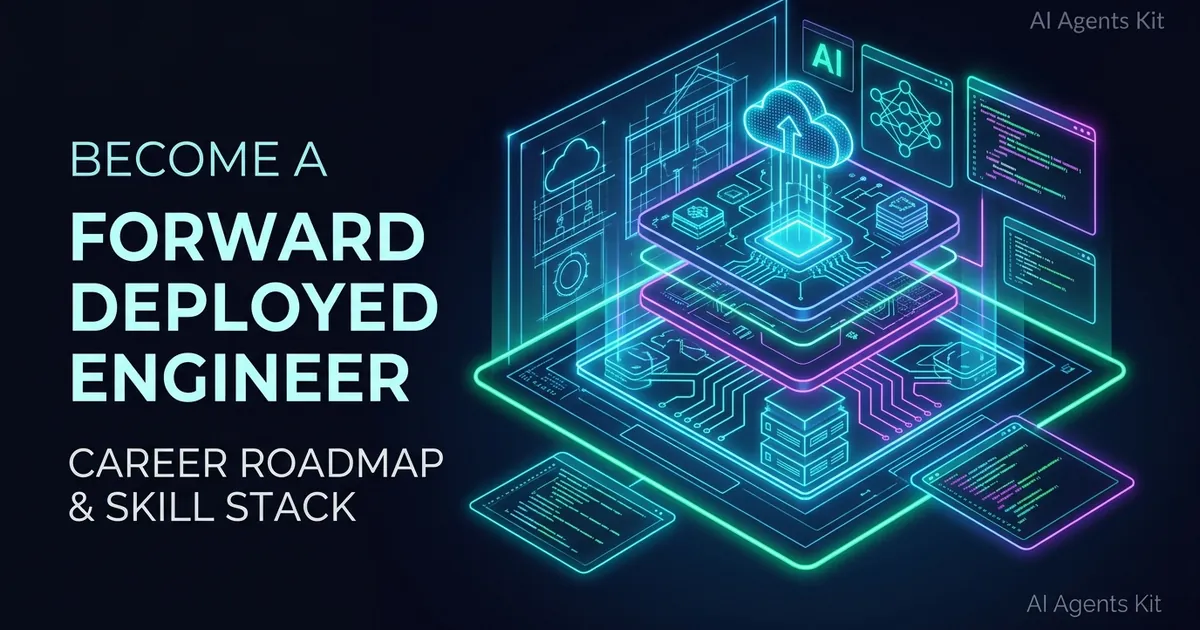
How to Become a Forward Deployed Engineer: Complete 2026 Roadmap, Skills, and Portfolio
Master the roadmap to become a Forward Deployed Engineer. Discover core skills, infrastructure requirements, portfolio projects, and interview preparation.
The enterprise adoption of artificial intelligence models has created intense market demand for software builders who can operate between frontier research and legacy corporate infrastructure. Forward Deployed Engineers have emerged as one of the most lucrative and high-impact engineering specializations across modern technology firms.
Total compensation benchmarks for forward deployed engineers range from $220,000 to $480,000 across major technology firms. In these roles, typical enterprise deployments demand service latency under 500 ms and 99.9% operational uptime.
Transitioning into this discipline presents unique hurdles because standard software engineering bootcamps and algorithmic interview prep fail to address real-world field dynamics. Prospective candidates must master not only production backend engineering, but also enterprise network security and executive stakeholder diplomacy.
This practical career guide explains how to become a forward deployed engineer by deconstructing the required four-layer skill architecture, portfolio strategies, and interview loops. Following this structured pathway will prepare you to deploy mission-critical systems at frontier artificial intelligence laboratories. For a foundational exploration of field engineering responsibilities, read our comprehensive Forward Deployed Engineer guide.
Key Takeaways
- The Four-Tier Skill Stack: Becoming an FDE requires mastering four distinct layers: core distributed systems (Python, Go, SQL), enterprise cloud infrastructure (Kubernetes, VPCs, SOC2), applied AI (RAG, agent orchestration, eval frameworks), and field diplomacy.
- Portfolio Over LeetCode: Leading AI labs evaluate practical systems integration over abstract algorithm puzzles. High-signal portfolios must demonstrate resilient data pipelines, schema validation, and automated evaluation frameworks.
- The Decomposition Interview: FDE hiring loops emphasize the signature “Decomposition Round,” where candidates must transform vague business pain into structured, ship-able software architectures.
- Experience Prerequisites: Forward deployed engineering is rarely an entry-level position; candidates typically need 2 to 4 years of hands-on software development, backend engineering, or DevOps experience.
What Does It Take to Become a Forward Deployed Engineer?
Becoming a Forward Deployed Engineer requires mastering full-stack systems engineering, containerized cloud infrastructure, applied artificial intelligence workflows, and consultative problem decomposition. Successful candidates demonstrate the ability to clone customer codebases, resolve messy integration friction, and deploy production software inside isolated enterprise environments.
Unlike traditional core software engineers who build features behind corporate firewalls for millions of anonymous users, the Forward Deployed Engineer operates directly on the frontlines. You step into complex client environments where databases lack documentation, network policies block standard package managers, and business executives demand immediate return on investment.
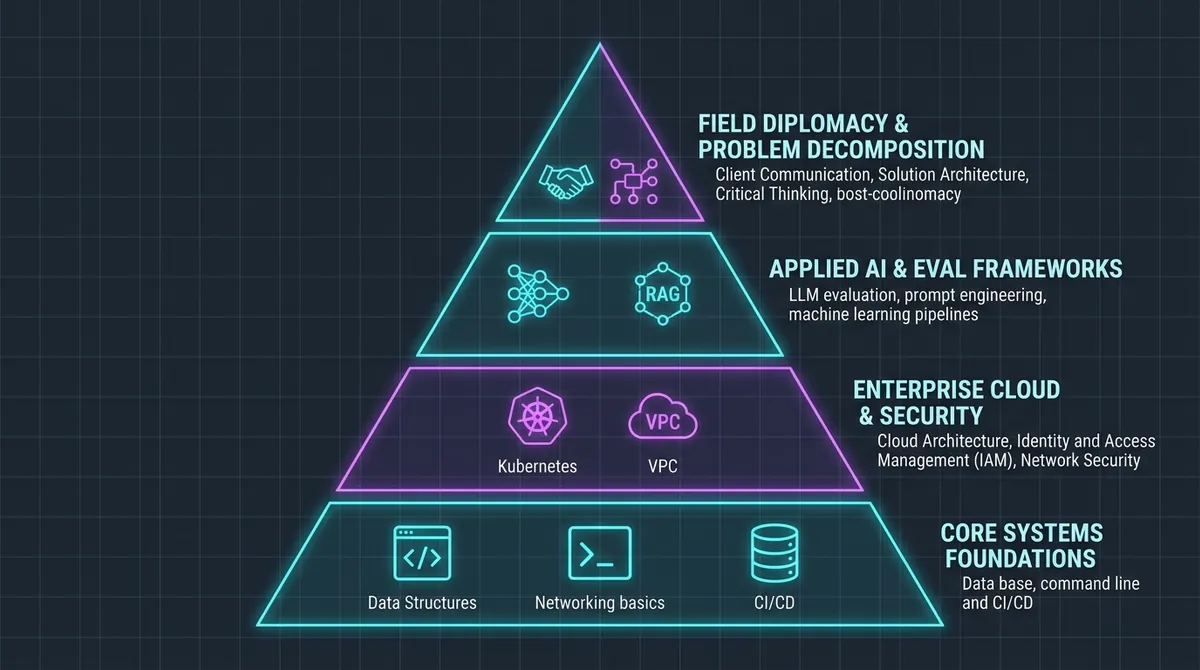 Figure 1: The four-layer technical skill pyramid required for enterprise forward deployed engineering roles.
Understanding the complete forward deployed engineer skills architecture requires looking past surface-level job descriptions. Cultivating these foundational fde skills enables engineers to adapt to diverse enterprise architectures under intense delivery timelines. The most effective practitioners structure their technical development across four distinct layers:
- Layer 1: Core Software Systems Foundations: Production Python, TypeScript, and Go; schema validation; distributed SQL; and API contract design.
- Layer 2: Enterprise Cloud Infrastructure and Security: Multi-cloud Kubernetes deployment, Helm packaging, VPC peering, TLS termination, and SOC2 compliance.
- Layer 3: Applied AI and Production Evaluation: Retrieval-augmented generation, agent state machines, tool protocols, and automated evaluation frameworks.
- Layer 4: Field Communication and Problem Decomposition: Managing client expectations, translating ambiguous requirements into engineering milestones, and upstreaming product fixes.
Engineering organizations rarely recruit recent college graduates for forward deployed roles. Hiring managers prioritize candidates who have already spent two to four years managing backend microservices, maintaining cloud infrastructure, or leading technical client engagements.
Layer 1: Core Software Engineering and Distributed Systems Foundations
The bedrock of any field deployment role is world-class software engineering. When embedded inside a customer environment, you cannot open internal support tickets or escalate bugs to another team. You must diagnose memory leaks, parse unfamiliar codebases, and write clean, maintainable pull requests autonomously.
Python serves as the primary language for enterprise AI integration. You must write modern, asynchronous, typed Python using Python 3.11 or newer. This includes deep familiarity with async event loops, Pydantic data modeling, and performance profiling.
In addition to Python, production environments demand proficiency in secondary backend languages:
- TypeScript and Node.js: Crucial for building enterprise web interfaces, customer portal integrations, and full-stack administrative consoles.
- Go or Rust: Increasingly adopted for high-throughput data processing sidecars, custom reverse proxies, and low-latency API gateways.
- Advanced SQL and Data Normalization: Writing complex analytical window queries, designing transactional schemas, and optimizing database indices across PostgreSQL, Snowflake, and BigQuery.
Data contracts represent the primary failure point in enterprise deployments. Customer databases frequently output malformed JSON, missing timestamps, and unescaped strings. FDEs protect core platforms by implementing strict serialization boundaries using Protocol Buffers, gRPC, and the open Model Context Protocol server architecture.
Layer 2: Enterprise Cloud Infrastructure, Security, and Compliance
Even the most sophisticated artificial intelligence model provides zero enterprise utility if security architects refuse to deploy it. Enterprise customers operating in banking, healthcare, and defense require software to run inside private Virtual Private Clouds (VPCs) or entirely air-gapped data centers.
A forward deployed engineer must be an experienced systems operator capable of packaging and orchestrating distributed applications across diverse cloud providers:
- Containerization and Orchestration: Building minimal, multi-stage Docker images, configuring Kubernetes deployment manifests, and creating reusable Helm charts for client DevOps teams.
- Private Networking and VPC Topology: Configuring subnets, route tables, NAT gateways, VPC peering connections, and private endpoints across AWS, Azure, and Google Cloud Platform.
- Authentication and Identity Federation: Integrating single sign-on (SSO) systems using SAML 2.0, OpenID Connect (OIDC), and enterprise identity providers such as Okta and Microsoft Entra ID.
- Zero-Trust Security and Compliance: Implementing mutual TLS (mTLS), secret rotation via HashiCorp Vault, and data encryption at rest and in transit.
Operating in air-gapped environments presents unique constraints. Public package registries, base container repositories, and internet endpoints are completely unavailable. You must configure local container mirrors, bundle Python wheels into offline tarballs, and manage air-gapped artifact registries.
FDEs work closely with enterprise compliance teams to ensure software adheres to SOC2 Type II, HIPAA, and ISO 27001 audit standards. Familiarity with the Kubernetes Architecture Documentation provides the necessary groundwork for configuring high-availability clusters under strict enterprise firewalls.
Securing customer data pipelines is equally critical when deploying autonomous models. For an extensive technical breakdown of hardening enterprise agent deployments, review our guide on enterprise AI agent security best practices.
Layer 3: Applied Artificial Intelligence and Production Evaluation
While core engineering and infrastructure provide the delivery mechanism, modern FDE positions demand deep expertise in applied artificial intelligence. You do not need a doctoral degree in machine learning theory or experience training foundation models from scratch. Instead, you must master the operational patterns required to make pre-trained models function reliably on messy enterprise data.
Production Retrieval-Augmented Generation (RAG) forms the core of many enterprise AI deployments. In modern corporate environments, processing pipelines often ingest context windows exceeding 128k tokens, requiring semantic caching to shave 400 ms off response times and achieve a 45% reduction in token costs. Moving beyond naive tutorial scripts requires implementing sophisticated retrieval architectures:
- Hybrid Search Pipelines: Combining dense semantic vector search with sparse keyword search (BM25) and cross-encoder re-ranking algorithms.
- Advanced Document Chunking: Developing semantic chunking strategies that respect document tables, visual hierarchy, and structural metadata.
- Embedding and Context Caching: Utilizing Redis or specialized vector databases (Pinecone, Qdrant, Milvus) to minimize token consumption and reduce inference latency.
To validate model reliability inside customer pipelines, Forward Deployed Engineers construct automated evaluation frameworks. These suites execute regression tests against curated client test sets, measuring semantic precision, context recall, and latency bounds.
The following Python implementation illustrates a production-grade evaluation suite designed to benchmark model outputs against latency constraints and strict schema validation:
# ==============================================================================
# FORWARD DEPLOYED ENGINEER: Enterprise Model Evaluation Suite
# Purpose: Automated regression test verifying JSON schema adherence & latency SLA.
# Dependencies: pydantic, time, typing
# ==============================================================================
import time
import logging
from typing import Dict, Any, List, Optional
from pydantic import BaseModel, Field, ValidationError

logging.basicConfig(level=logging.INFO, format="%(asctime)s [%(levelname)s] %(message)s")
logger = logging.getLogger("FDE.EvalSuite")

class ExtractionResult(BaseModel):
    """Schema contract for enterprise document extraction pipeline."""
    document_id: str = Field(..., pattern=r"^DOC-[0-9]{6}$")
    risk_score: float = Field(..., ge=0.0, le=1.0)
    entities: List[str] = Field(..., min_items=1)
    confidence_level: str = Field(..., pattern=r"^(LOW|MEDIUM|HIGH)$")

class ModelEvaluationRunner:
    """Evaluates customer-facing model endpoints against operational SLAs."""

    def __init__(self, latency_threshold_ms: float = 800.0, min_confidence: str = "MEDIUM"):
        self.latency_threshold_ms = latency_threshold_ms
        self.min_confidence = min_confidence

    def evaluate_test_case(self, raw_model_response: Dict[str, Any], elapsed_ms: float) -> Dict[str, Any]:
        eval_metrics = {
            "latency_pass": elapsed_ms <= self.latency_threshold_ms,
            "schema_pass": False,
            "business_rule_pass": False,
            "latency_ms": elapsed_ms,
            "error_detail": None
        }

        # 1. Enforce strict schema validation
        try:
            validated = ExtractionResult(**raw_model_response)
            eval_metrics["schema_pass"] = True
        except ValidationError as err:
            eval_metrics["error_detail"] = f"Schema validation error: {err.errors()}"
            logger.error("Test case failed schema validation: %s", err.json())
            return eval_metrics

        # 2. Enforce enterprise business logic assertions
        if validated.confidence_level in ["MEDIUM", "HIGH"] and validated.risk_score < 0.85:
            eval_metrics["business_rule_pass"] = True
        else:
            eval_metrics["error_detail"] = "Confidence score below enterprise threshold or risk score elevated."

        logger.info("Test case evaluated: Latency: %.2fms, Schema: %s, Rule: %s",
                    elapsed_ms, eval_metrics["schema_pass"], eval_metrics["business_rule_pass"])
        return eval_metrics

# Simulation of a production test execution
if __name__ == "__main__":
    runner = ModelEvaluationRunner(latency_threshold_ms=500.0)

    # Mocking real-time model extraction output
    sample_payload = {
        "document_id": "DOC-883921",
        "risk_score": 0.24,
        "entities": ["Acme Corp", "General Fund", "Subsea Holdings"],
        "confidence_level": "HIGH"
    }

    start_time = time.perf_counter()
    time.sleep(0.08)  # Simulated inference overhead
    duration_ms = (time.perf_counter() - start_time) * 1000

    result = runner.evaluate_test_case(sample_payload, duration_ms)
    print("Evaluation Summary:", result)
Engineers deepening their applied AI skills should explore the Pydantic Official Documentation to master data validation contracts. To examine complete end-to-end retrieval architectures, consult our practical guide on building production-grade RAG pipelines.
Layer 4: Field Communication, Problem Decomposition, and Client Diplomacy
The quality that distinguishes senior Forward Deployed Engineers from isolated backend developers is consultative problem decomposition. In traditional engineering roles, product managers translate business requirements into detailed Jira tickets complete with acceptance criteria. In field engineering, you receive vague, emotional problem statements directly from client executives.
A Chief Operating Officer might declare that their compliance audits take three weeks and their analysts are overwhelmed. The FDE cannot ask the client for an architectural specification. Instead, the FDE must decompose this operational frustration into concrete technical requirements:
- What structured data points are required to satisfy the audit checklist?
- What legacy databases store historical audit decisions?
- What throughput and latency benchmarks must the extraction pipeline achieve?
- What human-in-the-loop review workflow is required for low-confidence classifications?
Client diplomacy requires navigating the social dynamics of enterprise software. Customer developers often view vendor engineers with skepticism, fearing that external software will replace their jobs or create maintenance nightmares. Successful FDEs build trust by writing clean code, documenting every integration point, and pairing with internal engineers.
Furthermore, Forward Deployed Engineers drive the parent platform roadmap through the “absorb friction, upstream product” loop. When an FDE builds a custom connector for a specific customer, they write the adapter cleanly. They then abstract that connector into a reusable platform module for their headquarters product team.
Understanding how this consultative ownership compares with sales roles is essential when planning your career. For a detailed analysis of organizational incentives and compensation splits, review our Forward Deployed Engineer vs Solutions Architect vs Sales Engineer comparison.
3 High-Signal Portfolio Projects That Win FDE Interviews
Engineering hiring managers review hundreds of resumes containing trivial AI wrapper apps. Building a basic chatbot with a generic OpenAI API key signals zero enterprise readiness. When selecting your fde portfolio projects, prioritize real-world failure modes, data contracts, and production deployment architectures.
In production deployments, enterprise adapters regularly process over 10 million records with sub-100 ms lookup requirements. Focus on constructing these three high-signal portfolio projects:
Project 1: Enterprise Legacy Data Integration Adapter
Construct a production-grade data pipeline that ingests dirty, unstructured CSV or JSON data from legacy endpoints, validates records against strict schemas, and dispatches them to a simulated data warehouse.
Key technical requirements for your GitHub repository:
- Enforce schema contracts using Pydantic, handling type casting, date normalization, and missing fields.
- Implement exponential backoff and jitter algorithms to handle rate limits and intermittent network dropouts.
- Route corrupted or unparseable records to a dead-letter queue (DLQ) with structured error logs for auditability.
- Include a comprehensive Dockerfile and a local container setup spinning up PostgreSQL, Redis, and worker containers.
Project 2: Production Multi-Modal RAG with Automated Evaluation Framework
Build an end-to-end document processing pipeline that parses complex multi-column PDFs containing tables and diagrams, performs hybrid semantic search, and evaluates answer accuracy.
Key technical requirements for your GitHub repository:
- Ingest documents using hybrid chunking strategies that preserve table formatting and section hierarchy.
- Store document embeddings in a self-hosted vector database (such as Qdrant or Milvus) alongside a lexical BM25 index.
- Build an automated evaluation suite measuring answer relevancy, context precision, and latency percentiles (P95 and P99).
- Document a cost-latency analysis in your project README comparing different chunk sizes and embedding models.
Project 3: Secure Model Context Protocol (MCP) Tool Server
Implement an enterprise-ready tool server based on the open Anthropic Model Context Protocol Documentation that allows autonomous AI agents to query corporate data safely.
Key technical requirements for your GitHub repository:
- Expose secure database search and analytics tools via standardized MCP server interfaces.
- Enforce role-based access control (RBAC) preventing unauthorized tool execution on sensitive tables.
- Add structured Prometheus metrics tracking tool invocation rates, failure counts, and execution latency.
- Provide a clear architecture diagram detailing network boundaries and credential handling.
Structuring these repositories with clear architecture diagrams, reproducible setup scripts, and automated test suites proves that you think like a production engineer. For more inspiration on designing hiring-ready systems, explore our guide on hiring-ready AI engineering portfolio projects.
The 5-Phase Career Transition Roadmap
Transitioning into forward deployed engineering requires disciplined execution over four to six months. This structured 20-week forward deployed engineer roadmap breaks the journey into manageable milestones:
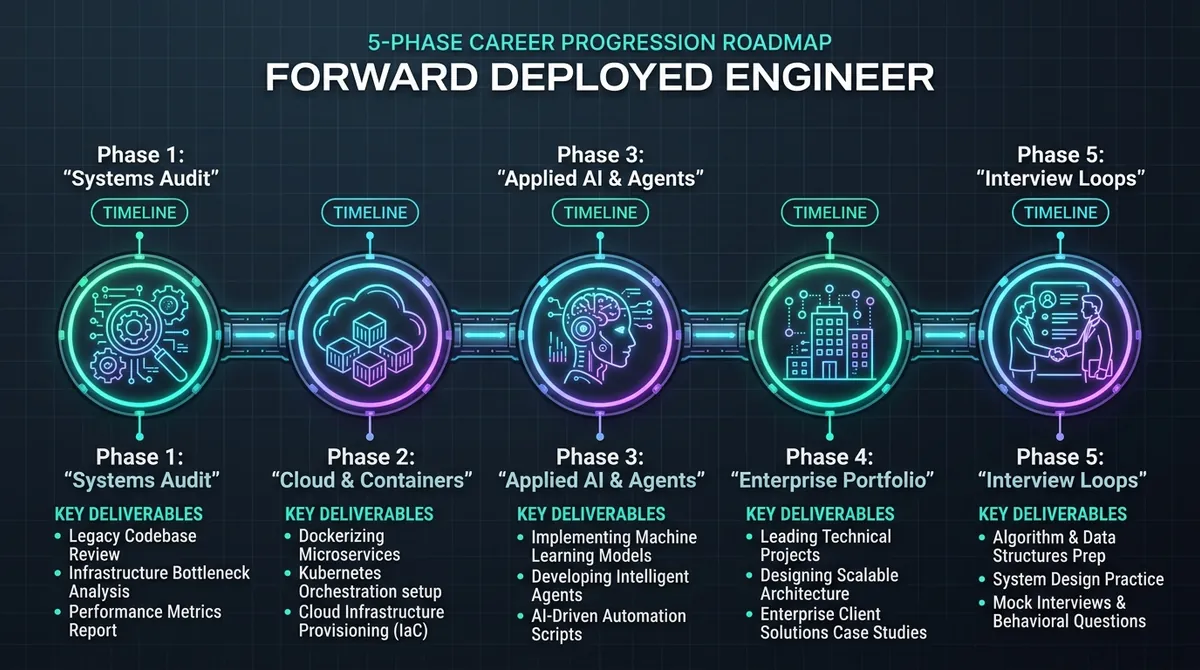 Figure 2: The five-stage career progression roadmap for transitioning into forward deployed engineering.
Phase 1: Systems Engineering Audit (Weeks 1 to 4)
Conduct an honest assessment of your backend programming depth. If your background is primarily frontend development, dedicate this phase to mastering backend systems:
- Deepen your fluency in modern asynchronous Python, data structures, and type annotations.
- Practice building clean RESTful APIs and gRPC microservices with automated unit and integration tests.
- Master relational database design, indexing strategies, and complex SQL joins.
Phase 2: Cloud Infrastructure and Container Mastery (Weeks 5 to 8)
Advance your infrastructure skills from basic cloud hosting to enterprise container orchestration:
- Containerize your existing backend services using multi-stage Docker builds.
- Set up a local multi-node Kubernetes cluster using Minikube or k3s.
- Author Helm charts that parameterize environment configurations, secret references, and resource quotas.
- Learn the fundamentals of enterprise VPC routing, subnet isolation, and TLS certificate management.
Phase 3: Applied AI and Agent Orchestration (Weeks 9 to 12)
Integrate applied artificial intelligence into your systems engineering toolkit:
- Master hybrid retrieval pipelines, embedding caching, and semantic document processing.
- Build multi-step state machines using frameworks like LangGraph or PydanticAI.
- Develop custom evaluation suites that quantify model accuracy, latency, and token expenditures.
Phase 4: Production Portfolio Construction (Weeks 13 to 16)
Build, document, and publish your two flagship portfolio systems:
- Write clean, well-tested code in public GitHub repositories with open-source licenses.
- Author comprehensive README files detailing system architecture, operational trade-offs, and deployment instructions.
- Record three-minute video walkthroughs demonstrating live deployments, error handling, and test suite execution.
Phase 5: Targeted Application and Interview Execution (Weeks 17 to 20)
Target companies hiring Forward Deployed Engineers and prepare for their unique interview loops:
- Target enterprise AI companies, foundation model laboratories (OpenAI, Anthropic, Scale AI), and data platforms (Palantir, Databricks).
- Tailor your resume to emphasize system integration, production deployments, and direct client impact.
- Practice live problem decomposition and stakeholder role-playing scenarios with engineering peers.
- Review the commercial incentives driving enterprise recruitment by examining why AI startups need forward deployed engineers to convert complex pilots.
Cracking the Forward Deployed Engineer Interview Loop
Interviews for Forward Deployed Engineer roles diverge substantially from standard big tech software engineering loops. While traditional software engineering interviews focus heavily on abstract LeetCode algorithms, FDE loops evaluate practical systems construction and client communication.
Enterprise technology companies generally structure their hiring process across five distinct rounds:
Round 1: Recruiter and Engineering Screening (45 Minutes)
The initial conversation evaluates your technical background and motivation for customer-facing engineering. Interviewers seek candidates who are genuinely energized by solving messy real-world problems rather than engineers who view client work as a distraction from pure algorithmic research.
Round 2: The Signature Decomposition Round (60 Minutes)
Originating at Palantir Technologies, the decomposition round represents the defining evaluation of an FDE candidate. The interviewer presents a high-level, ambiguous operational scenario without clear technical specifications.
For example, an interviewer might ask how you would design and deploy an automated customs documentation pipeline for a global logistics carrier operating across 40 marine ports.
To excel in this round:
- Clarify Constraints: Ask probing questions regarding data formats, network reliability, volume throughput, and regulatory restrictions.
- Define System Milestones: Break the massive project into an initial proof-of-concept, a pilot deployment, and a production rollout.
- Architect the Data Pipeline: Map out data ingestion, validation boundaries, storage tiers, and model inference services.
- Address Edge Cases: Explain how your system handles network disconnections, malformed customs manifests, and human exception review.
Round 3: Practical Systems Integration Coding (60 Minutes)
This live coding session tests your ability to write practical, production-ready software under time constraints. Rather than implementing binary tree traversals, you are asked to parse messy JSON payloads, implement API clients with retry logic, or build an asynchronous queue worker in Python.
Interviewers evaluate code cleanliness, error handling, type hinting, and unit test coverage.
Round 4: Customer Simulation and Stakeholder Presentation (45 Minutes)
This behavioral round evaluates your emotional composure and consultative communication. The interviewer role-plays a frustrated enterprise stakeholder whose migration is delayed or whose security team flagged a deployment issue.
You are assessed on your ability to listen actively, de-escalate tension, explain technical trade-offs without defensive jargon, and propose constructive next steps.
Round 5: Systems Architecture and Scalability (60 Minutes)
The final technical round evaluates your understanding of distributed cloud infrastructure. You will design resilient, secure architectures capable of handling multi-region failovers, enterprise VPC peering, and high-concurrency model inference.
Industry compensation benchmarks documented on Levels.fyi engineering compensation datasets demonstrate that candidates who master these holistic interview rounds command top-tier engineering salaries. To refine your responses across foundational technical questions, study our dedicated breakdown of forward deployed engineer interview questions.
Frequently Asked Questions About Becoming an FDE
How long does it take to transition into a forward deployed engineer role?
Transitioning into a Forward Deployed Engineer role typically requires four to six months of focused preparation for mid-level software developers. Candidates who already possess solid backend programming and containerization skills can accelerate this timeline by building applied AI portfolio projects and practicing consultative problem decomposition interviews.
Can a new graduate become a forward deployed engineer?
While a select number of large technology companies hire entry-level FDEs into structured rotational programs, the vast majority of firms require two to four years of professional software engineering experience. The autonomy demanded when operating inside client infrastructure makes prior production experience indispensable.
What programming language is most important for forward deployed engineers?
Python is the indispensable language for forward deployed engineers in the artificial intelligence sector. It serves as the primary ecosystem for foundation model APIs, data processing pipelines, and agent frameworks. Complementing Python with TypeScript for full-stack integration and Go for high-performance microservices provides the ideal competitive advantage.
How does the FDE interview differ from a standard software engineering interview?
Standard software engineering interviews emphasize abstract algorithmic puzzles, dynamic programming, and isolated data structures. FDE interview loops prioritize practical systems integration, live debugging, end-to-end data pipeline construction, and the signature problem decomposition round where candidates solve ambiguous business challenges.
What is the signature decomposition round in FDE interviews?
The decomposition round evaluates a candidate’s ability to take a chaotic, underspecified enterprise business problem and systematically break it into structured engineering milestones, data contracts, and architectural components. It tests consultative judgment, risk assessment, and pragmatic systems design.
Do forward deployed engineers need deep machine learning theory?
No, Forward Deployed Engineers do not need extensive machine learning theory, mathematical optimization proofs, or deep neural network training expertise. FDEs focus on applied AI, meaning they must master model orchestration, retrieval-augmented generation, tool calling protocols, evaluation frameworks, and secure infrastructure deployment.
How do I demonstrate consultative skills on an engineering resume?
Highlight concrete instances where you collaborated with external customers, led technical discovery sessions, translated ambiguous product requests into technical roadmaps, or trained client developers. Emphasize business impact, such as contract retention or operational time saved, alongside technical achievements.
What are the best portfolio projects for an aspiring forward deployed engineer?
The most effective portfolio projects demonstrate end-to-end production engineering: an enterprise data integration adapter with schema validation and dead-letter queues, a production multi-modal RAG system with automated evaluation metrics, and a secure Model Context Protocol tool server with role-based access control.
Summary and Next Steps
The Forward Deployed Engineer sits at the vital intersection of high-level business strategy and hands-on software construction. As enterprise artificial intelligence matures, organizations no longer need generic advice; they require elite technical builders who can step into their codebases and make complex systems function reliably.
By systematically mastering systems engineering, containerized cloud infrastructure, applied AI pipelines, and field communication, you position yourself at the forefront of modern technical careers.
If you are ready to put this roadmap into practice and explore flexible opportunities across global teams, examine our tactical guide on finding high-paying remote AI engineering jobs.