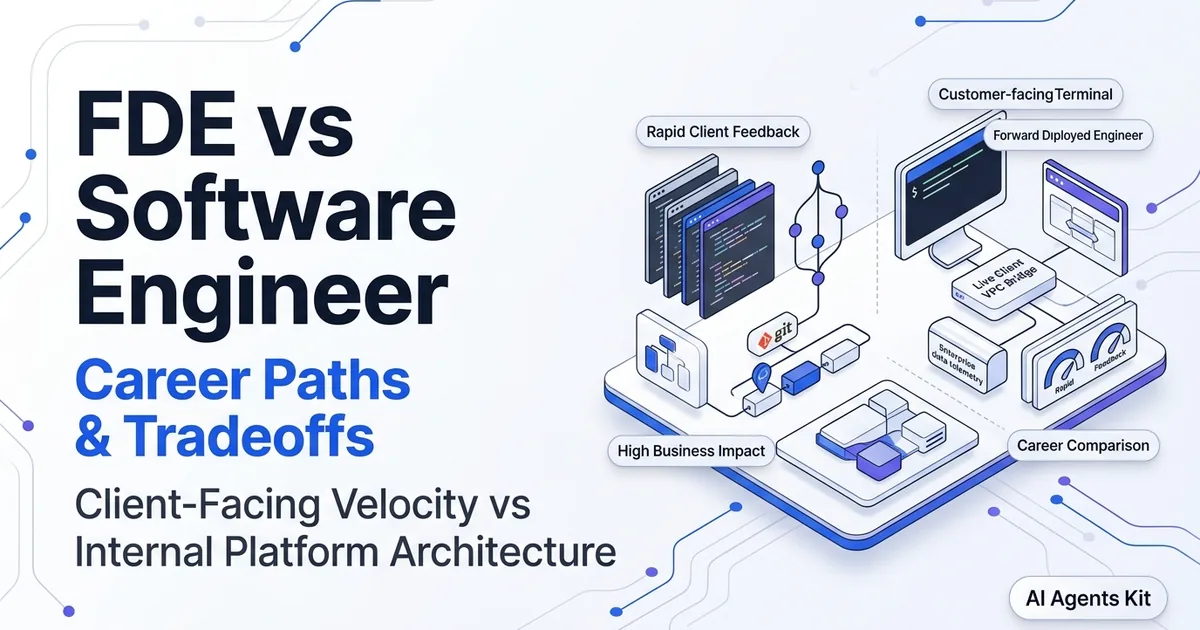
Forward Deployed Engineer vs Software Engineer: Career Comparison & Tradeoffs
Compare Forward Deployed Engineer vs Software Engineer. Discover key differences in coding intensity, day-in-the-life, compensation, and career trajectories.
Choosing a technical career path requires deciding between two distinct engineering philosophies. One path focuses on building centralized, scalable product platforms for millions of generic users, while the other embeds directly inside enterprise client environments to build custom production systems.
Understanding the difference between a forward deployed engineer vs software engineer is essential for developers planning their professional growth. Both roles demand rigorous software craftsmanship, yet they differ dramatically in daily routines, stakeholder exposure, and long-term exit velocity.
This comprehensive guide analyzes the operational tradeoffs, compensation economics, and career trajectories of both disciplines. For a foundational exploration of field engineering responsibilities, read our comprehensive Forward Deployed Engineer guide.
Key Takeaways
- Core software engineers build inward for centralized product platforms, prioritizing Big-O algorithmic efficiency, generic abstractions, and long-horizon roadmaps.
- Forward deployed engineers build outward for enterprise clients, prioritizing messy data integration, defensive schema normalization, and rapid client unblocking.
- Field engineers frequently command a 15% to 35% compensation premium because executive leadership treats them as direct revenue enablers rather than engineering cost centers.
- The forward deployed career path offers an accelerated trajectory to enterprise startup founder, Chief Technology Officer, and VP of Field Engineering roles.
1. The Fundamental Divide: Inward vs. Outward Engineering
The primary distinction between standard software engineering and forward deployed engineering centers on where and for whom code is written. In the technology industry, this distinction is defined as inward-facing versus outward-facing engineering.
A core software engineer (SWE) or systems development engineer (SDE) builds inward. Their primary customer is the product platform itself, internal developer platforms, or a broad, anonymous consumer base. They work from refined product requirement documents, participate in sprint grooming, and ship features designed to scale uniformly across the entire customer cohort.
In contrast, a forward deployed software engineer vs software engineer builds outward. An FDE embeds directly inside high-value customer environments, such as commercial banks, defense agencies, healthcare providers, or global logistics carriers.
When evaluating an fde vs swe or analyzing fde vs sde responsibilities across large organizations, systems development engineers focus on infrastructure availability, whereas forward deployed engineers address immediate customer deployment roadblocks.
Their mission is to ensure that complex software functions reliably within messy, legacy enterprise ecosystems. To see how this consultative builder mindset compares with traditional pre-sales engineering, explore our Forward Deployed Engineer vs Solutions Architect vs Sales Engineer comparison.
Taxonomy Comparison Matrix
| Operational Dimension | Core Software Engineer (SWE / SDE) | Forward Deployed Engineer (FDE / FDSE) | DevOps / Platform Engineer |
|---|---|---|---|
| Primary Code Target | Centralized product repository and APIs | Client infrastructure, data pipelines, adapters | Internal CI/CD, Kubernetes clusters, tooling |
| Stakeholder Exposure | Internal product managers and engineering peers | Client executive sponsors, CIOs, and client engineers | Internal engineering squads and security teams |
| Ambiguity Level | Low to moderate (scoped engineering tickets) | Radical ambiguity (ill-defined business pain points) | Moderate (infrastructure availability and SLOs) |
| Requirement Source | Product roadmaps and feature backlogs | Live customer operational failures and contracts | Engineering architectural needs and scaling targets |
| Delivery Horizon | Multi-month sprints and quarterly releases | Rapid multi-day and multi-week operational sprints | Continuous deployment and infrastructure resilience |
| Primary Failure Metric | Regressions, pipeline latency, uptime drop | Customer pilot cancellations and deployment stalls | Cluster downtime, deployment pipeline failures |
2. Day in the Life: Work Distribution, Coding Intensity, and Autonomy
A common misconception among early-career developers is that forward deployed engineering involves minimal programming. In reality, both roles write substantial volumes of production code, but their daily time allocation reflects very different operational priorities.
Understanding the daily cadence of both tracks helps engineers evaluate which work environment aligns with their cognitive strengths.
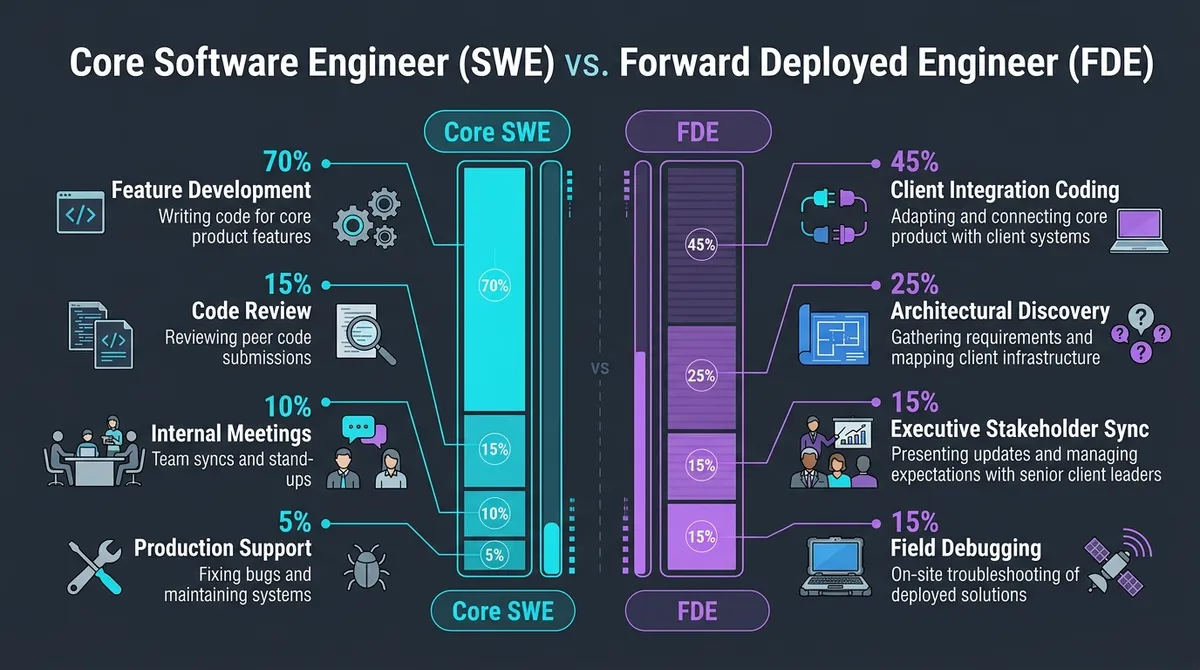 Figure 1: Daily workflow distribution comparing core platform software engineers with embedded field engineers.
The Core Software Engineer Daily Workflow
A typical day for a backend software engineer revolves around deep, uninterrupted focus blocks:
- Morning Standup and Code Reviews (9:00 AM - 10:30 AM): The engineer participates in a fifteen-minute team standup, updates ticket progress in Jira, and reviews pull requests submitted by teammates.
- Deep-Focus Feature Development (10:30 AM - 1:00 PM): The engineer spends uninterrupted time writing business logic, designing relational database migrations, and implementing unit test suites.
- Cross-Functional Architecture Alignment (2:00 PM - 3:00 PM): The engineer meets with an internal product manager and UX designer to review edge-case requirements for the upcoming quarterly release.
- Asynchronous Optimization and CI/CD Triage (3:00 PM - 5:30 PM): The engineer reviews automated performance benchmarks, resolves merge conflicts, and optimizes database query execution plans.
The SWE environment prioritizes predictable schedules, structured code reviews, and sustained deep work. Context switching is intentionally minimized to protect developer flow.
The Forward Deployed Engineer Daily Workflow
The FDE workflow is significantly more varied, characterized by high autonomy, rapid triage, and frequent customer collaboration. If you are preparing to navigate this fast-paced field environment, study our detailed forward deployed engineer roadmap and skill stack.
- Client Infrastructure Standup (9:00 AM - 10:00 AM): The FDE meets with the client technical lead and database administrator to review progress on on-premises VPC network routing and API token provisioning.
- Bespoke Integration Coding (10:00 AM - 1:00 PM): The FDE writes custom Python adapters to ingest unindexed legacy XML streams, normalize data schemas, and handle intermittent connection timeouts.
- Executive Discovery Workshop (2:00 PM - 3:30 PM): The FDE co-leads an architectural workshop with client directors, decomposing ambiguous supply chain delays into concrete data entities and API endpoints.
- Live Production Debugging (3:30 PM - 5:00 PM): The FDE investigates a production data ingestion failure, patches a missing null-check in an unversioned client endpoint, and deploys the hotfix directly to the staging cluster.
- Upstream Product Feedback (5:00 PM - 5:30 PM): The FDE files an RFC with the core product engineering team, documenting a recurring client pain point that should be integrated into the central software platform.
The FDE environment demands mental versatility. Engineers must shift effortlessly from writing low-level network code to presenting system trade-offs in boardroom meetings.
3. Code Craftsmanship: Abstract Architecture vs. Pragmatic Field Resilience
Both software engineers and forward deployed engineers write production software, but their definitions of code quality differ fundamentally based on operational context.
The core software engineer values algorithmic purity, generalized abstractions, and DRY (Don’t Repeat Yourself) principles. Their code must be maintainable by dozens of internal developers over a multi-year horizon.
In contrast, the forward deployed engineer values pragmatic resilience, backward compatibility, and defensive execution. They operate in hostile technical environments where third-party APIs violate specifications, historical records contain corrupt data, and network connections drop without warning.
To see how field teams build these resilient systems in modern artificial intelligence deployments, explore our guide on forward deployed AI engineering enterprise deployment architectures. For schema validation standards, developers refer to the Pydantic official documentation to construct strict data contracts.
Side-by-Side Code Implementation
The following executable Python script illustrates the stark difference in coding style between a Core SWE building an internal library component and an FDE building an enterprise-grade client integration adapter.
"""
Code Craftsmanship Comparison: Core SWE vs. Forward Deployed Engineer (FDE).
Demonstrates architectural differences between internal library design and defensive field integration.
"""

from typing import Dict, Any, List, Optional
import time
import random
import logging
from pydantic import BaseModel, Field, ValidationError

logging.basicConfig(level=logging.INFO, format="%(asctime)s [%(levelname)s] %(message)s")
logger = logging.getLogger("CodeComparison")


# ==============================================================================
# 1. CORE SOFTWARE ENGINEER (SWE) IMPLEMENTATION: ELEGANT & GENERALIZED
# Focus: Type safety, Big-O efficiency, clean abstractions, standardized contracts.
# Assumes: Well-behaved upstream microservices and valid internal payloads.
# ==============================================================================

class CoreTelemetryService:
    """Internal platform service designed for predictable, standardized microservice inputs."""

    def __init__(self, multiplier: float = 1.25):
        self.multiplier = multiplier

    def process_standard_metric(self, device_id: str, raw_reading: float) -> Dict[str, Any]:
        """Calculates normalized efficiency score using clean arithmetic abstractions."""
        if raw_reading < 0:
            raise ValueError("Raw reading cannot be negative.")

        normalized_score = round(raw_reading * self.multiplier, 4)
        return {
            "device_id": device_id,
            "calculated_score": normalized_score,
            "processed_at": time.time()
        }


# ==============================================================================
# 2. FORWARD DEPLOYED ENGINEER (FDE) IMPLEMENTATION: DEFENSIVE & FIELD-HARDENED
# Focus: Schema drift isolation, messy legacy formats, network jitter, dead-letter queues.
# Assumes: Client systems are untrusted, inconsistent, and prone to unannounced schema updates.
# ==============================================================================

class LegacyClientRecord(BaseModel):
    """Strict schema contract isolating client formatting errors."""
    device_id: str = Field(..., min_length=3, description="Alphanumeric hardware identifier")
    reading_val: float = Field(..., ge=0.0, le=50000.0)
    client_status: str = Field(default="UNKNOWN")


class ResilientFieldAdapter:
    """Enterprise client adapter designed to survive dirty data and transient network timeouts."""

    def __init__(self, max_retries: int = 3, backoff_sec: float = 0.2):
        self.max_retries = max_retries
        self.backoff_sec = backoff_sec
        self.dead_letter_queue: List[Dict[str, Any]] = []

    def normalize_messy_input(self, raw_client_payload: Dict[str, Any]) -> Optional[LegacyClientRecord]:
        """Defensively coerces irregular client data formats (strings, unexpected keys) into typed schemas."""
        try:
            # Handle client legacy quirk: numbers occasionally sent as string currencies (e.g. "$120.50")
            raw_val = raw_client_payload.get("reading_val") or raw_client_payload.get("SENSOR_VAL")
            if isinstance(raw_val, str):
                raw_val = float(raw_val.replace("$", "").replace(",", "").strip())

            payload = {
                "device_id": str(raw_client_payload.get("device_id") or raw_client_payload.get("DEV_ID", "UNKNOWN")),
                "reading_val": raw_val,
                "client_status": str(raw_client_payload.get("status", "ACTIVE")).upper()
            }
            return LegacyClientRecord(**payload)

        except (ValidationError, ValueError, TypeError) as err:
            logger.warning("Client record normalization failed: %s. Routing to DLQ.", err)
            self._route_to_dlq(raw_client_payload, reason=str(err))
            return None

    def _route_to_dlq(self, payload: Dict[str, Any], reason: str) -> None:
        """Stores corrupt client data with diagnostic telemetry for client IT review."""
        self.dead_letter_queue.append({
            "corrupted_payload": payload,
            "captured_at": time.time(),
            "rejection_reason": reason
        })

    def dispatch_with_jitter_retry(self, record: LegacyClientRecord) -> bool:
        """Dispatches data to client on-premises endpoint with exponential backoff and jitter."""
        for attempt in range(1, self.max_retries + 1):
            try:
                # Simulate 30% transient network socket drop in client data center
                if random.random() < 0.30:
                    raise ConnectionResetError("Connection reset by peer: client gateway timed out")

                logger.info("Successfully dispatched record %s to client endpoint", record.device_id)
                return True

            except ConnectionResetError as exc:
                if attempt == self.max_retries:
                    logger.error("Exhausted all %d retries for record %s", self.max_retries, record.device_id)
                    self._route_to_dlq(record.model_dump(), reason=str(exc))
                    return False

                sleep_time = self.backoff_sec * (2 ** (attempt - 1)) + random.uniform(0, 0.05)
                logger.warning("Attempt %d socket drop. Retrying in %.2fs...", attempt, sleep_time)
                time.sleep(sleep_time)

        return False


# Verification demonstration
if __name__ == "__main__":
    print("--- 1. Core SWE Standard Processing ---")
    core_svc = CoreTelemetryService(multiplier=1.15)
    clean_result = core_svc.process_standard_metric("DEV-901", 100.0)
    print("Core SWE Clean Result:", clean_result)

    print("\n--- 2. FDE Defensive Adapter Processing ---")
    field_adapter = ResilientFieldAdapter()
    messy_records = [
        {"DEV_ID": "PUMP-404", "SENSOR_VAL": "$145.20", "status": "active"},     # Legacy formatted string
        {"DEV_ID": "VALVE-12", "SENSOR_VAL": -99.0},                             # Schema violation (negative value)
        {"device_id": "TURBINE-01", "reading_val": 420.0, "status": "active"}    # Standard format
    ]

    for item in messy_records:
        normalized = field_adapter.normalize_messy_input(item)
        if normalized:
            field_adapter.dispatch_with_jitter_retry(normalized)

    print(f"\nDead-Letter Queue Total: {len(field_adapter.dead_letter_queue)} unprocessable items isolated.")
The Testing Dilemma: Unit Tests vs. Field Sandbox Mocks
Testing strategies differ between the two roles. Core software engineers prioritize comprehensive unit tests and deterministic mock fixtures, striving for 90%+ code coverage across pure business logic.
Forward deployed engineers recognize that client environments cannot be modeled with pure unit tests alone. When deploying inside on-premises Kubernetes clusters, field engineers build synthetic staging sandboxes.
Engineers refer to the Kubernetes Architecture concepts guide to deploy isolated worker nodes that simulate client data diodes, rate limits, and network latency. Furthermore, teams deploying local model inference nodes consult the vLLM open-source inference engine repository to benchmark throughput in disconnected clusters.
4. Compensation Economics: Cost Center vs. Revenue Enabler
Compensation structures in technology enterprises reflect the economic classification of engineering roles. While both disciplines offer lucrative earnings, market dynamics consistently award forward deployed engineers a notable total compensation premium.
Corporate finance teams frequently categorize core software engineering as a research and development operating expense. While core software is essential for long-term product viability, an individual SWE’s daily contributions rarely correlate directly with immediate contract signings.
In contrast, forward deployed engineers are categorized as direct revenue enablers. When an enterprise software company bids on a $15 million multi-year contract with a global bank, closing the deal requires deploying an elite technical team to execute the pilot.
The FDE unblocks the commercial bottleneck. If the FDE solves the customer’s data integration hurdles within four weeks, the contract closes; if the pilot fails, the client walks away.
Building high-signal demonstrations during your career transition proves your ability to drive tangible commercial value. Explore these hiring-ready AI engineering portfolio projects to construct impressive field assets.
2026 Compensation Benchmarks Comparison
According to verified engineering compensation datasets on Levels.fyi engineering compensation datasets, forward deployed engineers at top-tier enterprise firms command higher equity grants and milestone bonuses.
| Career Level | Core Software Engineer (SWE) Total Comp | Forward Deployed Engineer (FDE) Total Comp | Compensation Premium Drivers |
|---|---|---|---|
| Junior / Associate (0-2 Yrs) | $130,000 – $185,000 | $155,000 – $215,000 | Premium for client presence and autonomy |
| Mid-Level (3-5 Yrs) | $180,000 – $260,000 | $220,000 – $340,000 | Direct ownership of client integration milestones |
| Senior Engineer (6-8 Yrs) | $270,000 – $420,000 | $350,000 – $550,000 | Leading complex multi-million dollar deployments |
| Staff / Principal (9+ Yrs) | $450,000 – $800,000+ | $550,000 – $1,100,000+ | Executive stakeholder influence & deal renewals |
At frontier artificial intelligence laboratories such as OpenAI, Anthropic, Scale AI, and Palantir, senior and staff FDE compensation packages regularly exceed $600,000, heavily weighted with high-growth equity grants. This financial upside reflects the direct impact field teams have on customer contract expansion.
5. Career Trajectory and Exit Velocity: The FDE-to-Founder Pipeline
When evaluating career paths, engineers must look beyond current compensation to assess multi-year career trajectory and exit opportunities. Both tracks offer prestigious advancement, but they lead in distinctly different professional directions.
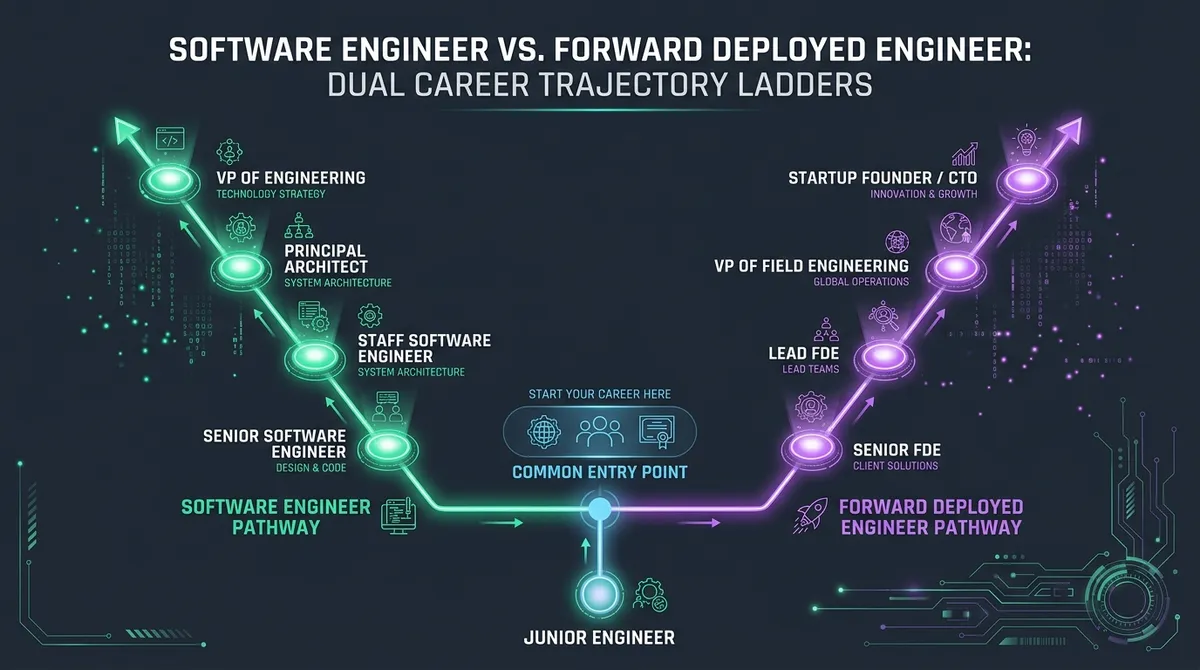 Figure 2: The branching career progression paths and exit velocity differences between core SWE and FDE tracks.
To prepare for the unique evaluation loops that gate these senior field roles, review our comprehensive breakdown of forward deployed engineer interview questions and decomposition rubrics.
The Core Software Engineer Ladder
The traditional SWE track follows a well-defined individual contributor ladder:
- Senior Software Engineer: Owns major feature sets and mentors junior engineers.
- Staff Software Engineer: Defines multi-quarter architectural roadmaps across several engineering squads.
- Principal Engineer / Fellow: Solves company-wide distributed systems challenges, setting technical strategy for hundreds of developers.
This path is ideal for developers who love deep computer science specialization, distributed systems theory, compiler design, or database engine internals.
The FDE Career Path and the Founder Pipeline
The fde career path progresses along an accelerated commercial-technical vector. Engineers advance from Senior FDE to Lead Deployment Architect, eventually overseeing global operations as a VP of Field Engineering.
Crucially, industry data reveals a remarkable phenomenon: the FDE-to-Founder pipeline. Former forward deployed engineers from firms like Palantir, Databricks, and Scale AI establish venture-backed startups at rates significantly higher than traditional software engineers.
Notable enterprise leaders, including defense unicorn Anduril, were founded by former Palantir forward deployed engineers. This high founder conversion rate stems from the unique commercial competencies cultivated directly in the field.
FDEs gain firsthand knowledge of where legacy software breaks and where enterprises waste millions of dollars, identifying genuine commercial software opportunities. Having spent years defending technical architectures to skeptical CIOs, former FDEs excel at pitching venture capitalists and enterprise buyers.
Beyond startup founding, former field engineers transition into elite technical product management roles. Because they have spent hundreds of hours observing where customers experience product friction, they excel at scoping intuitive, market-ready enterprise features.
6. The Lifestyle Tradeoffs: Travel, Pressure, and Visibility
While the forward deployed engineering role offers accelerated compensation and founder-level skill development, it entails specific lifestyle tradeoffs that every candidate must consider honestly.
On-Site Travel Requirements
- Core Software Engineer: Travel is rare, typically limited to annual company offsites or an occasional technical conference. Engineers work from corporate headquarters or remote home offices with stable routines.
- Forward Deployed Engineer: Travel is a core component of the role, averaging 20% to 40% of the engineer’s schedule. Engagements in defense, aerospace, healthcare, and quantitative finance frequently require engineers to work inside secure client facilities, air-gapped data centers, or trading floors where remote access is legally prohibited.
Operational Pressure and Blame Proximity
- Core Software Engineer: When an internal service experiences a bug, the issue is triaged through standard Jira queues or internal Slack channels. The engineer is insulated from direct customer fury by product managers and customer support teams.
- Forward Deployed Engineer: When a field deployment fails, the FDE experiences immediate operational pressure. You are often physically present in the client’s office when systems fail. Surviving this environment requires exceptional emotional composure, active listening, and the ability to de-escalate executive anxiety while debugging complex code.
Despite intense customer pressure, field engineering grants substantial day-to-day autonomy. Field engineers make critical architectural decisions on-site without navigating multi-layered corporate bureaucracy, accelerating rapid problem-solving maturity.
Organizational Visibility
- Core Software Engineer: Visibility is primarily internal. You are evaluated by your engineering manager, peers, and department director based on code quality, design documents, and sprint velocity.
- Forward Deployed Engineer: Visibility is bilateral. In addition to internal executive leadership, you gain direct visibility with external Chief Information Officers, Chief Technology Officers, and VP-level decision-makers. These executive relationships frequently become catalysts for future executive hires, board advisory roles, or venture capital introductions. To understand how founders leverage this dynamic to win enterprise contracts, explore why AI startups need forward deployed engineers.
7. Decision Matrix: Which Engineering Path Fits Your Ambition?
Choosing between a forward deployed engineering track and a traditional core software engineering track comes down to your personal strengths, preferred work environment, and long-term career aspirations.
To see how these options intersect with broader market specializations, review our comparative taxonomy on AI and machine learning engineering specializations.
Neither discipline is permanently binding. Many accomplished engineering leaders spend their early years as core software engineers mastering system architecture before stepping into forward deployed roles to gain commercial exposure.
Similarly, field engineers often transition into core infrastructure squads when they wish to reduce travel and focus on foundational platform scaling.
Use the following self-diagnostic scorecard to evaluate which track aligns with your goals:
| Professional Preference Question | If You Answer “Strongly Agree” | If You Answer “Strongly Disagree” |
|---|---|---|
| “I prefer solving messy human-system problems over abstract algorithmic puzzles.” | Pursue Forward Deployed Engineer | Pursue Core Software Engineer |
| “I enjoy explaining complex technical architectures to non-technical business leaders.” | Pursue Forward Deployed Engineer | Pursue Core Software Engineer |
| “I need long, uninterrupted blocks of deep-focus coding time to feel productive.” | Pursue Core Software Engineer | Pursue Forward Deployed Engineer |
| “I am energized by travel and working in evolving, on-site client environments.” | Pursue Forward Deployed Engineer | Pursue Core Software Engineer |
| “My ultimate career goal is to become an enterprise startup founder or CTO.” | Pursue Forward Deployed Engineer | Pursue Core Software Engineer |
| “My ultimate career goal is to become a Staff/Principal Systems Architect.” | Pursue Core Software Engineer | Pursue Forward Deployed Engineer |
8. Frequently Asked Questions (PAA & Search Intent)
Is a forward deployed engineer a real software engineer?
Yes, a forward deployed engineer is a genuine software engineer who writes, debugs, and ships production code. Rather than writing abstract platform code in an internal office, FDEs write production software directly inside enterprise customer environments. They build high-throughput data pipelines, construct resilient API adapters, configure air-gapped infrastructure, and refactor legacy client codebases to ensure platform adoption.
Does an FDE make more money than a standard software engineer?
Forward deployed engineers typically earn a 15% to 35% total compensation premium compared to traditional software engineers at equivalent seniority levels. Because FDEs are directly embedded in multi-million dollar client deployments, executive leadership views them as revenue enablers rather than engineering cost centers. At leading artificial intelligence firms, senior FDE total compensation regularly ranges between $350,000 and $550,000.
What is the difference between an FDE vs SWE at Palantir?
At Palantir Technologies, a Software Engineer (often referred to as an internal Dev) builds and maintains the core platform capabilities of Gotham and Foundry. A Forward Deployed Software Engineer (FDSE or Delta) embeds directly with enterprise and government clients. FDSEs configure data ontologies, build bespoke integration adapters, write custom frontend analytics, and solve urgent operational problems on-site.
Is forward deployed engineering bad for long-term coding skills?
Forward deployed engineering does not degrade coding skills; rather, it broadens them significantly. While core software engineers develop deep specialization in specific backend frameworks, FDEs become versatile full-stack systems builders. They master distributed systems, API integration, data engineering, network security, and defensive programming under high-pressure production conditions.
Can a core software engineer transition to an FDE role?
Yes, core software engineers transition smoothly into forward deployed roles because they already possess foundational programming and system design capabilities. To succeed in the transition, engineers must develop consultative communication, emotional composure under pressure, comfort with radical ambiguity, and the ability to explain complex technical trade-offs to non-technical executive stakeholders.
How much travel is typically required for an FDE?
Travel requirements for forward deployed engineers generally range between 20% and 40% of their annual schedule. Travel intensity depends on the industry vertical: engineers working with commercial SaaS clients travel occasionally, while those deployed in defense, intelligence, healthcare, or financial trading environments spend substantial time on-site due to strict security and air-gapped network policies.
What are the best exit opportunities for a forward deployed engineer?
Forward deployed engineers possess exceptionally versatile exit opportunities. Because they master both production software engineering and commercial negotiation, former FDEs frequently become venture-backed enterprise startup founders, Chief Technology Officers, Heads of Product, or VPs of Field Engineering. Their deep understanding of real-world enterprise software friction makes them ideal startup builders.
Why are AI companies hiring more FDEs than traditional SWEs in 2026?
Artificial intelligence companies are aggressively hiring forward deployed engineers because frontier foundation models face an implementation crisis in enterprise environments. Demos function well in laboratory settings, but enterprise deployments stall due to messy legacy databases, firewall restrictions, and compliance rules. Companies hire FDEs to build the custom evaluation harnesses and data connectors required to convert models into production solutions.
9. Conclusion: Choosing Your Technical Destiny
The choice between becoming a core software engineer or a forward deployed engineer is not a question of prestige or intellectual capability. It is a fundamental choice about how you prefer to engage with technology and human organizations.
If you thrive in structured environments, enjoy deep-focus programming, and dream of designing planetary-scale distributed algorithms that serve millions of anonymous users, the core software engineering path provides an intellectually satisfying and lucrative journey.
However, if you are energized by real-world complexity, thrive under high autonomy, and want to bridge the chasm between raw software capabilities and executive business strategy, forward deployed engineering is one of the most compelling career tracks in modern technology. By mastering both production-grade code craftsmanship and commercial leadership, you position yourself to become an indispensable technical leader.