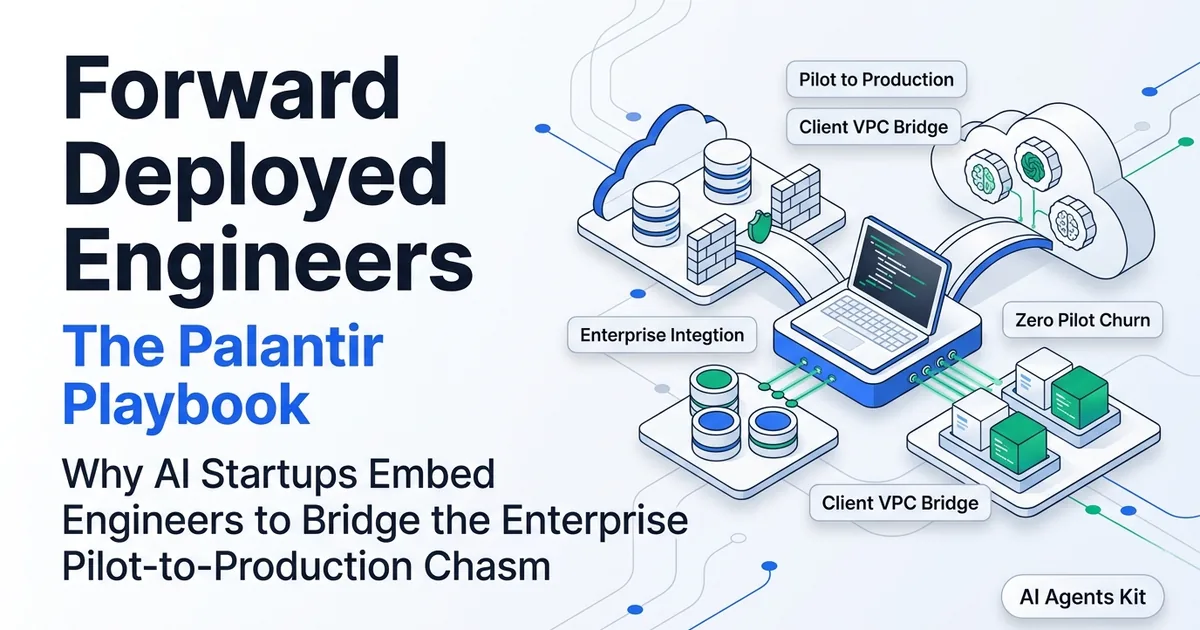
Why AI Startups Need Forward Deployed Engineers: The Palantir Playbook
Discover why AI startups must hire forward deployed engineers to bridge the pilot-to-production gap, master enterprise integrations, and protect gross margins.
Key Takeaways
- Enterprise AI cannot close or retain six-figure contracts through self-serve product-led growth because enterprise data lives behind firewalls, custom security perimeters, and dirty legacy schemas.
- Enterprise founders evaluating why hire forward deployed engineers discover that embedded technical talent prevents pilot failure and turns customer friction into reusable platform code.
- The primary reason to adopt a forward deployed engineering strategy is trading short-term gross margin for a long-term enterprise moat that prevents pilot churn.
- Successful startups enforce the “Rule of Three” to avoid the agency trap, ensuring customer-specific code is systematically abstracted into reusable platform modules.
The enterprise software sector has experienced a profound structural dislocation. In traditional SaaS, startups scaled to tens of millions in revenue through product-led growth (PLG). End users swiped corporate credit cards, integrated webhooks via browser dashboards, and adopted applications without speaking to a human.
That playbook is dead for enterprise generative and agentic systems. When founders pitch Fortune 500 enterprises on autonomous agents, enterprise LLM orchestration, or automated decision pipelines, they encounter an immediate operational wall. The enterprise buyer does not lack budget; they lack the engineering capacity to integrate experimental AI systems into thirty-year-old internal systems.
This friction creates the notorious “Pilot-to-Production Chasm.” Over 80% of enterprise AI proofs of concept stall out before reaching production rollout. Prospective clients sign nominal evaluation contracts, but the software fails to connect with air-gapped data centers, legacy ERP databases, or custom identity boundaries.
Understanding why hire forward deployed engineers is now the central strategic question for artificial intelligence founders navigating Fortune 500 sales cycles. To bridge this chasm, elite artificial intelligence startups are reviving and modernizing an organizational model popularized by Palantir Technologies: the Forward Deployed Engineer (FDE). As detailed in our comprehensive Forward Deployed Engineer guide, these customer-embedded software developers write production-grade code directly inside client environments.
This guide provides founders, chief technology officers, and engineering leaders with the definitive playbook for adopting the FDE model for startups. We analyze the unit economics of the forward deployed engineering strategy, establish strict architectural guardrails to prevent your startup from devolving into an IT consultancy, and demonstrate how to structure your founding field engineering team.
1. The Death of Pure Self-Serve PLG in Enterprise AI
Product-led growth succeeded because Web2 software operated on standardized web protocols. A SaaS product like Figma, Slack, or Notion required only a browser runtime and standard REST APIs. The end customer shouldered the operational burden of adopting the product within their personal workflow.
Enterprise artificial intelligence systems operate under completely different physical and organizational constraints. AI systems do not merely display data; they process, transform, and generate actions across mission-critical corporate records.
+-----------------------------------------------------------------------------------+
|                        THE PILOT-TO-PRODUCTION CHASM                              |
|                                                                                   |
|  [ Enterprise AI Demo ]  --->  [ POC Contract Signed ]  --->  [ THE CHASM ]      |
|    - Slick UI                    - $50k Evaluation Fee         - Air-gapped VPCs  |
|    - Synthetic Data              - 90-Day Clock                - Dirty Schemas    |
|    - Standalone Sandbox                                        - RBAC Failures    |
|                                                                - PII Scrubbing    |
|                                                                                   |
|                                                                       |           |
|                                         WITHOUT FDEs                  | WITH FDEs |
|                                         (Pilot Death)                 v           |
|                                  [ Contract Cancelled ]     [ $1M+ Production ARR]|
+-----------------------------------------------------------------------------------+
The Three Structural Roadblocks of Enterprise AI
Organizations attempting to deploy enterprise AI encounter three structural barriers that self-serve onboarding cannot resolve:
- Unstructured and Dirty Data Infrastructure: Enterprise data does not reside in clean JSON tables. It sits in on-premise Oracle instances, unindexed SAP relational tables, network file shares containing scanned PDFs, and fragmented Salesforce custom objects. Frontier models cannot execute reliable agentic reasoning across dirty source schemas without custom ETL pipelines.
- Strict Air-Gapped Security Boundaries: Regulated institutions in banking, healthcare, aerospace, and defense prohibit public SaaS API routing. They require deployments within private virtual clouds (AWS GovCloud, Azure Confidential Computing) or behind corporate VPC firewalls with zero egress access.
- The Hallucination and Risk Perimeter: Standard software bugs produce predictable error codes. In contrast, non-deterministic model failures produce plausible hallucinations, compliance violations, or unauthorized data leakage. Enterprises demand strict deterministic evaluation rails and continuous latency monitoring before granting production database access.
Why Traditional Sales Engineers Fall Short
When evaluating why hire forward deployed engineers instead of traditional pre-sales personnel, founders must examine the structural friction of legacy data. Traditional Solutions Architects (SAs) or Sales Engineers (SEs) consistently struggle to rescue stalled accounts because of fundamental role misalignments.
As explained in our Forward Deployed Engineer vs Solutions Architect vs Sales Engineer comparison, sales engineers are commercial presenters. They build slide decks, demonstrate architectural blueprints, and configure pre-packaged product connectors. They are neither trained nor authorized to refactor client-side codebases, write custom asynchronous token streaming services, or debug low-level Kubernetes ingress configurations.
When an enterprise customer says, “Our data warehouse uses a proprietary binary protocol with custom Kerberos tokens,” a sales engineer submits a feature request to internal product management. A forward deployed engineer opens their terminal, inspects the customer’s network traffic, and writes a production-grade adapter within forty-eight hours.
| Dimension | Pure Self-Serve PLG | Enterprise Field Deployment (FDE) |
|---|---|---|
| Target Customer | Individual contributors & SMBs | Fortune 500, Global 2000, Defense |
| Average Contract Value (ACV) | $1,200 to $15,000 | $150,000 to $2,500,000+ |
| Sales Cycle Duration | Days to weeks (Instant swipe) | 3 to 9 months (Pilot to multi-year) |
| Primary Deployment Blocker | Product awareness & onboarding | Legacy infrastructure & data hygiene |
| Customer Retention Vector | Feature utility & UI simplicity | Deep operational integration (High moat) |
| Gross Margins (Year 1) | 80% to 85% | 55% to 65% |
| Gross Margins (Year 3+) | 80% to 85% | 82% to 88% (Post-productization) |
This comparison highlights why enterprise founders must shift their perspective. Executing a palantir playbook enterprise ai deployment is not an auxiliary customer support cost. It represents the primary customer acquisition and retention engine for high-value enterprise contracts.
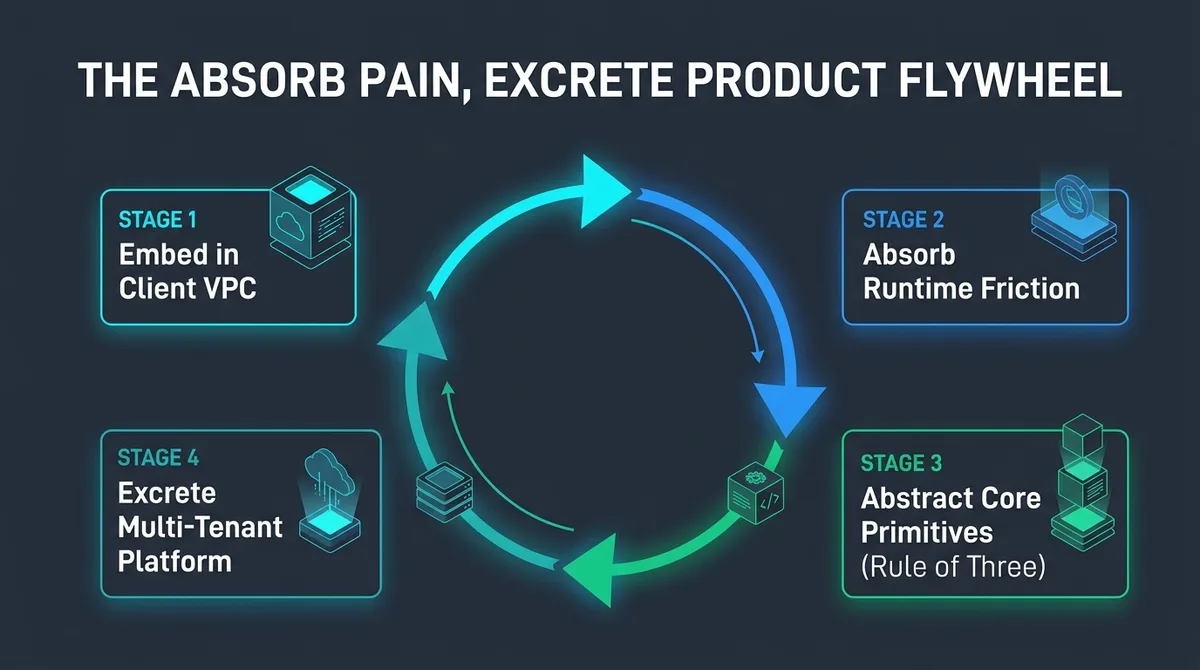
2. The “Absorb Pain, Excrete Product” Flywheel
The defining philosophy of Palantir’s engineering organization is captured in an iconic operating aphorism: “Absorb pain, excrete product.” For an artificial intelligence startup, this principle constitutes the single fastest mechanism for achieving true product-market fit (PMF).
In an early-stage company, founders and product managers operate at an intellectual distance from customer reality. Customer advisory boards and product surveys are notoriously unreliable. Enterprise executives tell vendors what they think they want; their actual software systems reveal what they desperately need.
The flywheel answers why hire forward deployed engineers during the zero-to-one product validation phase: they convert real customer pain into scalable software modules.
How the Flywheel Operates in Practice
Forward deployed engineers function as high-bandwidth product discovery probes embedded directly inside customer infrastructure. The flywheel progresses through four distinct stages:
- Direct Exposure to Production Pain: The FDE sits in the customer’s development environment, observing firsthand why the startup’s platform fails. They discover that the customer’s Postgres database times out under concurrent vector search, or that their corporate proxy strips essential bearer tokens.
- Immediate Bespoke Remediation: Rather than waiting for a six-week roadmap cycle, the FDE writes an immediate, decoupled software adapter on-site. The pilot stays alive, executive stakeholders remain confident, and the enterprise sees immediate business value.
- Pattern Recognition Across Deployments: When two or three different enterprise customers experience identical failure points, the FDE flags this friction as a systemic enterprise pattern rather than an isolated anomaly.
- Platform Productization: Core software engineering takes the battle-tested adapter logic developed by field engineers and refactors it into a native, scalable platform capability. The next ten enterprise customers receive this feature out of the box.
Deploying this architecture requires rigorous synchronization with forward deployed AI engineering enterprise deployment architectures. When engineering teams view field friction as raw fuel for core product development, product iteration cycles accelerate by an order of magnitude.
Palantir Foundry: Born in the Mud of Customer Deployments
Palantir’s flagship enterprise platform, Foundry, was not conceptualized by product managers sitting in Palo Alto offices. Foundry emerged directly from the operational challenges encountered by forward deployed engineers embedding with multinational aerospace manufacturers, global financial institutions, and government defense departments.
Early Palantir engineers spent thousands of hours manually writing data integration scripts, building custom entity ontologies, and resolving branch merge conflicts across client datasets. Because field engineers were senior developers with full authority to modify product code, they built standardized tools to automate their own operational pain.
Those internal automation tools were refined, unified, and packaged into what became Palantir Foundry. Executing this fde model for startups transformed what critics labeled a “glorified consultancy” into a platform enterprise software company commanding multi-billion dollar revenues.
3. The Financial Calculus: Gross Margins vs. Enterprise Moats
The most frequent objection to the forward deployed engineering model originates from venture capitalists and financial purists: “Doesn’t field engineering destroy software gross margins?”
Traditional SaaS businesses target gross margins between 75% and 85%. Because cost of goods sold (COGS) in standard SaaS consists primarily of cloud hosting fees and third-party API costs, adding new users requires minimal incremental labor expenditure.
When a startup introduces forward deployed engineers, deployment labor is accounted for in cost of goods sold. In the initial months of an enterprise contract, gross margins can compress to 55% or 60%.
Analyzing gross margin trajectories demonstrates why hire forward deployed engineers early in an enterprise startup’s commercial lifecycle: short-term deployment costs protect multi-year contract expansion.
The a16z Thesis: “Trading Margin for a Moat”
Venture capital firm Andreessen Horowitz directly addressed this mathematical tension in their Andreessen Horowitz enterprise research on trading margin for a moat.
The strategic insight is straightforward: Startups that refuse to sacrifice short-term gross margin protect their financial metrics at the expense of their customer contracts. A startup boasting immaculate 85% gross margins on paper that loses 70% of its enterprise pilots during onboarding has built an unsustainable business.
+-----------------------------------------------------------------------------------+
|                     THE GROSS MARGIN EXPANSION TRAJECTORY                         |
|                                                                                   |
|  Gross Margin %                                                                   |
|   90% |                                               =========================   |
|   80% |                                      ========= (High-Margin Platform)     |
|   70% |                             =========                                     |
|   60% |                    =========                                              |
|   50% |  ================== (Initial Field Embedding)                             |
|       +------------------------------------------------------------------------>  |
|          Year 1 (Pilots)        Year 2 (Expansion)        Year 3+ (Mature SaaS)   |
+-----------------------------------------------------------------------------------+
By embedding forward deployed engineers, an artificial intelligence startup accepts lower gross margins during Year 1 to achieve two decisive commercial outcomes:
- Near-Zero Pilot Churn: By assigning top-tier engineering talent to overcome internal enterprise blockers, pilot conversion rates routinely exceed 90%.
- Massive Net Revenue Retention (NRR): Once an FDE integrates an AI system into core enterprise data flows, switching costs become insurmountable. The startup is embedded in the company’s operational fabric.
The Palantir Gross Margin Precedent
Historical financial disclosures confirm the viability of this economic curve. In Palantir’s public Securities and Exchange Commission filings, the company revealed that in its early operating phases, high-touch deployment operations resulted in compressed gross margins.
However, as Palantir’s core platforms matured and automated integration capabilities expanded, gross margins experienced steady, compounding expansion. In recent operating years, Palantir has consistently reported gross margins exceeding 80% to 82%, rivaling pure-play cloud SaaS providers while maintaining significantly higher contract values.
Understanding the career tradeoffs of the role is equally critical for talent retention, as examined in our Forward Deployed Engineer vs Software Engineer tradeoffs analysis. When startups compensate field engineers appropriately and align their incentives with enterprise expansion, the financial return on deployment headcount is substantial.
4. Avoiding the “Agency Trap”: Consultative Death Spirals
While the commercial advantages of forward deployed engineering are compelling, the model carries a severe, potentially fatal risk: The Agency Trap.
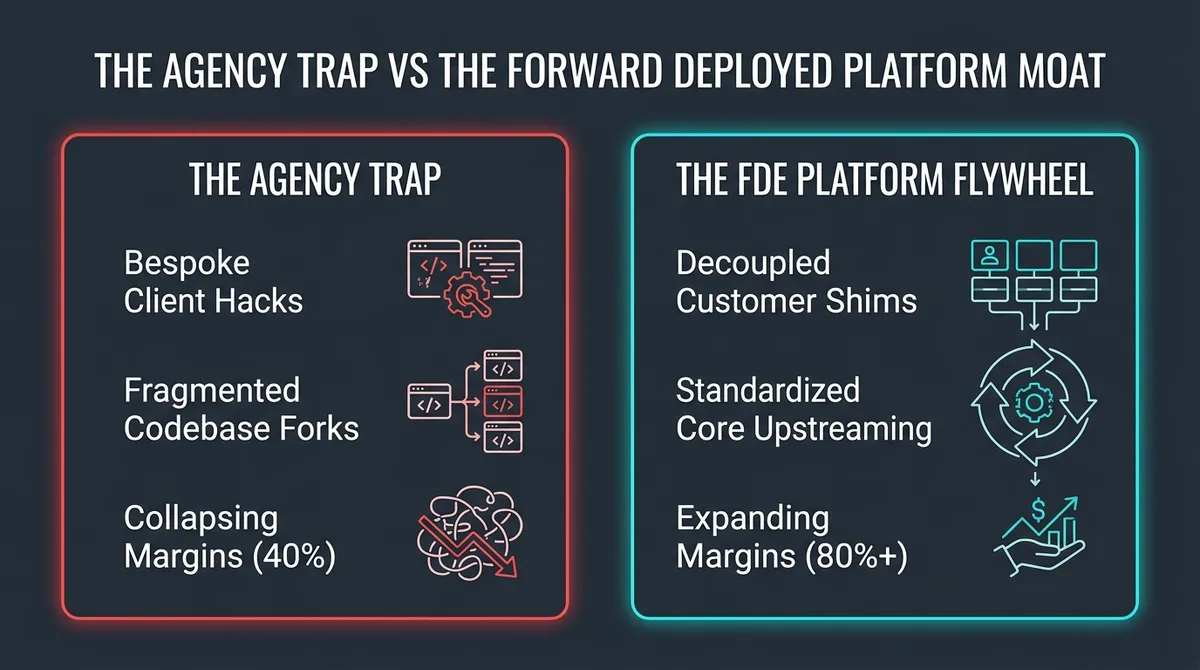
The agency trap occurs when an early-stage startup becomes addicted to custom enterprise revenue. Rather than treating customer engagements as temporary probes to build standardized platform features, the company says “yes” to every bespoke feature request.
Founders asking why hire forward deployed engineers rather than external implementation agencies discover that field engineers possess the architectural discipline to protect platform modularity.
Within twelve months, undisciplined startups cease being venture-scale software platforms. They mutate into outsourced professional services agencies. Headcount must scale linearly with revenue, product roadmaps fracture into customer-specific forks, and valuation multiples collapse from 20x ARR to 2x EBITDA.
The “Rule of Three” Governance Model
To protect product architecture and enterprise valuations, executive teams must institute strict operational governance. The most effective framework is the Rule of Three:
- One Customer Request: If a single enterprise client demands a bespoke schema parser or legacy connector, the FDE writes this logic as an external, decoupled integration shim. The code lives strictly outside the core monorepo.
- Two Customer Requests: If a second independent enterprise asks for similar functionality, the FDE team creates an experimental, modular plugin. The core product engineering team is notified, and a shared interface is drafted.
- Three Customer Requests: When three separate enterprise clients require identical underlying capabilities, the requirement is classified as a foundational platform feature. Core platform engineering assumes ownership, abstracts the logic, and releases it into the core product SDK.
By enforcing this cadence, forward deployed engineers never pollute core codebases with one-off client hacks. Instead, they operate inside standardized extension points, such as the Model Context Protocol specification and enterprise agentic AI frameworks that isolate custom business logic from the central inference engine.
5. Production Code: The Decoupled Enterprise Ingestion Shim
To prevent customer-specific data formats from corrupting the core software platform, forward deployed engineers build decoupled integration shims. These shims execute inside the customer’s perimeter, translating proprietary data schemas into clean, standardized internal models before dispatching telemetry to the central platform.
Below is an enterprise-grade production implementation built with Python and the FastAPI Framework. It illustrates how an FDE decouples a client’s legacy database records, scrubs sensitive personally identifiable information (PII), and routes standardized payloads back to the core AI platform.
"""
Decoupled Enterprise Data Ingestion Shim
Author: Forward Deployed Engineering Team
Purpose: Normalize client-specific data schemas and stream telemetry to core platform.
"""

from typing import Dict, Any, Optional
from datetime import datetime, timezone
import hashlib
import httpx
from fastapi import FastAPI, HTTPException, Header, status
from pydantic import BaseModel, Field, EmailStr

app = FastAPI(
    title="FDE Enterprise Ingestion Bridge",
    description="Customer-edge adapter isolating legacy schemas from core AI platform.",
    version="1.2.0"
)

# -----------------------------------------------------------------------------
# Standardized Core Platform Schema (Immutable Across All Customers)
# -----------------------------------------------------------------------------
class CoreIngestionPayload(BaseModel):
    account_id: str = Field(..., description="Unique enterprise customer identifier")
    session_id: str = Field(..., description="Traceable user execution context")
    anonymized_actor_hash: str = Field(..., description="SHA-256 hashed identity token")
    normalized_content: str = Field(..., description="Sanitized text ready for vector embeddings")
    metadata: Dict[str, Any] = Field(default_factory=dict)
    ingested_at: datetime = Field(default_factory=lambda: datetime.now(timezone.utc))

# -----------------------------------------------------------------------------
# Customer-Specific Legacy Schema (Varies By Client Deployment)
# -----------------------------------------------------------------------------
class AcmeCorpLegacyRecord(BaseModel):
    EmployeeID: str
    InternalEmail: EmailStr
    DepartmentCode: str
    RawInternalTicketText: str
    ClientSecurityClearance: Optional[str] = "Standard"

class TelemetryResponse(BaseModel):
    status: str
    core_dispatch_id: str
    latency_ms: float

# -----------------------------------------------------------------------------
# Transformation & Redaction Logic (Maintained by FDE in Client VPC)
# -----------------------------------------------------------------------------
def sanitize_and_normalize(record: AcmeCorpLegacyRecord, account_id: str) -> CoreIngestionPayload:
    # Deterministic PII hashing to preserve auditability without exposing identities
    salt = "enterprise-vllm-perimeter-salt"
    actor_string = f"{record.EmployeeID}:{record.InternalEmail}:{salt}"
    actor_hash = hashlib.sha256(actor_string.encode('utf-8')).hexdigest()

    # Normalize unstructured legacy field into standardized platform prompt input
    clean_text = record.RawInternalTicketText.strip()

    return CoreIngestionPayload(
        account_id=account_id,
        session_id=f"sess_{hashlib.md5(clean_text[:50].encode('utf-8')).hexdigest()[:12]}",
        anonymized_actor_hash=actor_hash,
        normalized_content=clean_text,
        metadata={
            "department": record.DepartmentCode,
            "security_tier": record.ClientSecurityClearance,
            "bridge_version": "1.2.0"
        }
    )

# -----------------------------------------------------------------------------
# Edge Ingestion Endpoint
# -----------------------------------------------------------------------------
@app.post(
    "/v1/ingest/acme",
    response_model=TelemetryResponse,
    status_code=status.HTTP_200_OK
)
async def ingest_acme_record(
    record: AcmeCorpLegacyRecord,
    x_customer_token: str = Header(..., alias="X-Customer-Token")
):
    start_time = datetime.now(timezone.utc)

    # Validate client token against local secure vault
    if not x_customer_token.startswith("acme_prod_"):
        raise HTTPException(
            status_code=status.HTTP_401_UNAUTHORIZED,
            detail="Invalid customer deployment credentials."
        )

    # Transform bespoke enterprise format into core platform schema
    core_payload = sanitize_and_normalize(record, account_id="cust_acme_corp_global")

    # Forward to centralized core platform API via secure mutual TLS tunnel
    core_platform_url = "https://core-platform.internal.aiagentskit.com/v1/telemetry/events"

    async with httpx.AsyncClient(timeout=5.0) as client:
        try:
            response = await client.post(
                core_platform_url,
                json=core_payload.model_dump(mode="json"),
                headers={"Authorization": "Bearer fde_internal_edge_gateway_token"}
            )
            response.raise_for_status()
            dispatch_id = response.json().get("event_id", "evt_simulated_dispatch")
        except httpx.HTTPError:
            # Fallback: Cache locally in client VPC SQLite database during network blips
            dispatch_id = "evt_cached_locally_due_to_vpc_egress_drop"

    duration = (datetime.now(timezone.utc) - start_time).total_seconds() * 1000.0

    return TelemetryResponse(
        status="processed_and_dispatched",
        core_dispatch_id=dispatch_id,
        latency_ms=round(duration, 2)
    )
This decoupled enterprise ai deployment strategy delivers two critical business advantages. First, the customer’s idiosyncratic schemas and PII constraints are resolved locally without leaking internal records. Second, the core software platform remains clean and multi-tenant, protecting the company’s valuation metrics and SaaS gross margins.
6. When and How to Hire Your First Forward Deployed Engineer
Adopting the forward deployed engineering model prematurely can be as damaging as adopting it too late. Hiring high-touch field engineers when a company has only built an early minimum viable product leads to aimless consulting work.
Conversely, waiting until major enterprise pilots are failing results in customer cancellations and brand damage. Founders must time their hiring decisions based on specific commercial trigger points.
The trigger points for why hire forward deployed engineers center on deal size and deployment complexity, particularly when annual contract values surpass six figures.
+-----------------------------------------------------------------------------------+
|                     THE FDE HIRING TRIGGER CHECKLIST                              |
|                                                                                   |
|  [ ] Average Contract Value (ACV) exceeds $100,000 annually                       |
|  [ ] At least 3 enterprise pilots are actively negotiating deployment dates       |
|  [ ] Core engineering is spending >30% of sprint capacity fixing client integrations|
|  [ ] Customers require on-premise VPC or air-gapped installation                  |
|  [ ] Contract renewals hinge on passing enterprise infosec compliance audits      |
+-----------------------------------------------------------------------------------+
The “Founding Field Engineer” Persona
The profile of your first forward deployed engineer is distinct from that of a standard software engineering hire. In a traditional engineering role, technical excellence and algorithmic proficiency dominate the evaluation scorecard.
For a Founding Field Engineer, technical prowess is merely table stakes. The candidate must possess executive presence, emotional resilience, and deep commercial intuition.
For software developers evaluating this transition, our guide on how to become a forward deployed engineer outlines the exact portfolio and technical milestones necessary to succeed in this discipline.
| Evaluation Dimension | Traditional Software Engineer | Founding Field Engineer (FDE) |
|---|---|---|
| Primary Code Focus | Internal services, algorithms, tests | Client VPC adapters, SDKs, ETL pipelines |
| Ambiguity Tolerance | Moderate (Requires clear sprint specs) | Extreme (Debugs undocumented legacy systems) |
| Customer Exposure | Zero to minimal (Insulated by PMs) | Daily direct interaction with CIOs and IT teams |
| Emotional Composure | Standard peer collaboration | High resilience during high-stakes outages |
| Commercial Acumen | Feature delivery velocity | Understanding contract expansion & NRR |
| Ideal Background | FAANG/Scale-up backend developer | Former technical founder, elite consultancy lead |
Structuring Compensation and Reporting Lines
Founders frequently struggle with how to compensate forward deployed engineers. A common mistake is assigning FDEs sales commissions or variable quota bonuses, treating them like sales engineers.
This incentive structure is catastrophic. If an FDE’s compensation depends on closing a quarterly deal, they will agree to every custom feature the customer requests, directly triggering the agency trap.
Forward deployed engineers require alignment with core software engineering compensation principles.
Field engineering compensation packages should prioritize three foundational elements:
- Competitive Base Salary: Aligned with senior engineering market tiers ($175,000 to $240,000 base).
- Substantial Equity: Ownership stakes matching foundational platform architects to reward enterprise valuation growth.
- Engineering Reporting: Direct reporting lines to the CTO or VP of Engineering to prevent sales-driven code debt.
7. Organizational Architecture: Interfacing FDEs with Core Engineering & Sales
Once a startup hires multiple forward deployed engineers, organizational friction inevitably arises between the field team, core product engineering, and enterprise sales.
Account executives want FDEs to write custom code to close deals quickly. Core platform engineers want FDEs to stop requesting architectural modifications for individual accounts. Managing this tripartite tension requires structured operating rituals.
Organizational leaders understanding why hire forward deployed engineers establish direct feedback rituals between field developers and core engineering directors.
                    ┌─────────────────────────┐
                    │    ENTERPRISE SALES     │
                    │  (Account Executives)   │
                    └────────────┬────────────┘
                                 │ Closes Deal
                                 ▼
                    ┌─────────────────────────┐
                    │    FORWARD DEPLOYED     │
                    │       ENGINEERING       │
                    └────────────┬────────────┘
                                 │ Upstreams Telemetry
                                 ▼ & Rule of Three
                    ┌─────────────────────────┐
                    │     CORE PLATFORM       │
                    │       ENGINEERING       │
                    └─────────────────────────┘
The Weekly “Pain Review” Ritual
To maintain tight alignment between customer deployments and core platform roadmaps, engineering leadership must institute a mandatory weekly Pain Review Meeting.
In this sixty-minute session, forward deployed engineers present concrete operational telemetry extracted from active client environments:
- Which internal SDK methods produced unhandled exceptions during client runs?
- Where did customer network firewalls block agentic tool calls?
- What proprietary enterprise data connectors required custom shims this week?
If a specific integration blocker appears across multiple customer deployments, the core engineering lead creates a dedicated sprint epic to resolve the issue at the platform level. This practice transforms customer friction into platform defensibility.
When evaluating candidates for these demanding operational roles, engineering leadership should consult our forward deployed engineer interview rubrics to ensure candidates are rigorously vetted against real-world customer crisis scenarios.
8. Frequently Asked Questions About the FDE Model for Startups
Why hire forward deployed engineers instead of traditional software engineers?
Startups hire forward deployed engineers because enterprise AI systems fail at the physical integration layer, not the algorithmic layer. Traditional software engineers build internal platform features based on structured product requirements. Forward deployed engineers embed directly within enterprise client environments to debug dirty data schemas, resolve air-gapped security blockers, and ensure mission-critical systems transition smoothly from pilot evaluations to multi-million-dollar production contracts.
Does executing a forward deployed engineering strategy hurt startup gross margins?
While forward deployed engineering introduces deployment labor costs that can compress Year 1 gross margins to between 55% and 65%, it protects enterprise contract values and eliminates pilot churn. As bespoke integration logic is abstracted into core software capabilities, gross margins expand above 80% in subsequent contract years, creating a defensible platform moat that rivals traditional SaaS unit economics.
How do startups prevent forward deployed engineers from turning into a consulting agency?
Startups enforce the Rule of Three governance framework. If one customer requests a bespoke feature, the FDE writes a decoupled integration shim outside the core codebase. If two customers request it, an experimental plugin is developed. If three customers require the same capability, ownership transfers to core platform engineering to build a standardized, reusable product feature.
How many forward deployed engineers does an early-stage startup need?
Most early-stage enterprise AI startups require only one or two “Founding Field Engineers” to support their initial three to five enterprise pilots. As the company scales, organizations typically maintain a ratio of one forward deployed engineer for every two to three active enterprise customer deployments, gradually decreasing as the platform achieves higher automated self-serve integration maturity.
Should forward deployed engineers report to Sales or Engineering?
Forward deployed engineers must always report into the Engineering organization, typically to the VP of Engineering or Chief Technology Officer. Aligning FDEs under Sales creates misaligned commercial incentives, encouraging engineers to write unsustainable custom code to close individual quarterly quotas rather than abstracting scalable platform capabilities.
What is the ideal background for a founding forward deployed engineer?
The ideal founding field engineer is a former technical founder, an experienced full-stack systems engineer, or a senior technical lead from an elite technology consultancy. Candidates must combine deep systems programming proficiency (Python, Kubernetes, distributed databases) with executive communication skills and emotional resilience in high-stakes customer-facing environments.