What Is a Forward Deployed Engineer? The Complete 2026 Guide
Discover what a Forward Deployed Engineer (FDE) does, why AI labs pay $350k-$700k+, key skills, interview processes, and enterprise deployment blueprints.
A pronounced structural shift occurred across enterprise software engineering over the past two years. While tech companies previously relied on self-serve product interfaces and hands-off software distribution, the explosion of generative models revealed a severe operational chasm between prototype demonstrations and live production environments.
Enterprise clients frequently discover that general-purpose foundation models stumble when confronted with messy real-world corporate databases, strict security firewalls, and undocumented business logic. To bridge this critical gap, leading technology firms and artificial intelligence laboratories have revived and supercharged an elite technical role: the Forward Deployed Engineer.
Organizations deploying autonomous AI agent systems now recognize that software does not deploy itself into complex enterprise ecosystems. The Forward Deployed Engineer serves as the decisive human catalyst, writing production code directly inside client infrastructure to ensure mission-critical systems function reliably.
Key Takeaways
- Role Definition: A Forward Deployed Engineer (FDE) is an embedded software engineer who builds, integrates, and deploys production-grade software directly inside client environments.
- The Last-Mile Gap: FDEs solve the friction between raw foundation models and messy enterprise data, legacy ERPs, and air-gapped VPCs.
- No Sales Quotas: Unlike Sales Engineers or Solutions Architects, FDEs write production code, own live deployments, and carry no sales quotas.
- Market Compensation: Mid-level FDEs command $250k to $355k, while Senior and Staff FDEs at top AI labs (OpenAI, Anthropic, Palantir) earn $450k to $800k+ total compensation.
- Product Flywheel: FDEs operate under the “absorb pain, excrete product” discipline, upstreaming field-tested patches to headquarters to improve core platforms.
What Does a Forward Deployed Engineer Actually Do?
Direct Definition: A Forward Deployed Engineer (FDE) is a specialized software engineer embedded directly within a customer organization to architect, build, and deploy production-grade software integrations. Unlike traditional engineers who build features for mass audiences at headquarters, an FDE works on the front lines to solve client-specific edge cases, integrate legacy data silos, and translate ambiguous business problems into functional software.
The primary duty of a Forward Deployed Engineer centers on eliminating what industry analysts describe as the last-mile diffusion problem. While research teams develop sophisticated models and core product engineers build platform APIs, enterprise clients struggle to operationalize these tools within existing technological stacks. This structural shift highlights broader workplace anxieties: as automation redefines developer workflows, many professionals question will AI take my job, making hybrid, high-leverage roles like forward-deployed engineering exceptionally resilient.
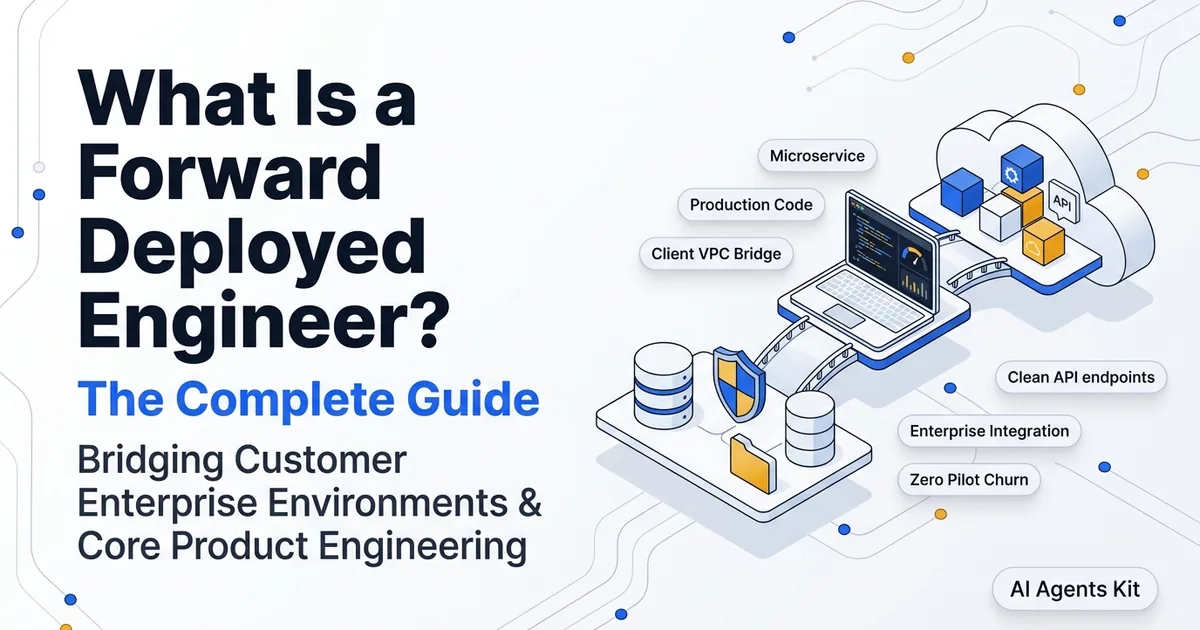
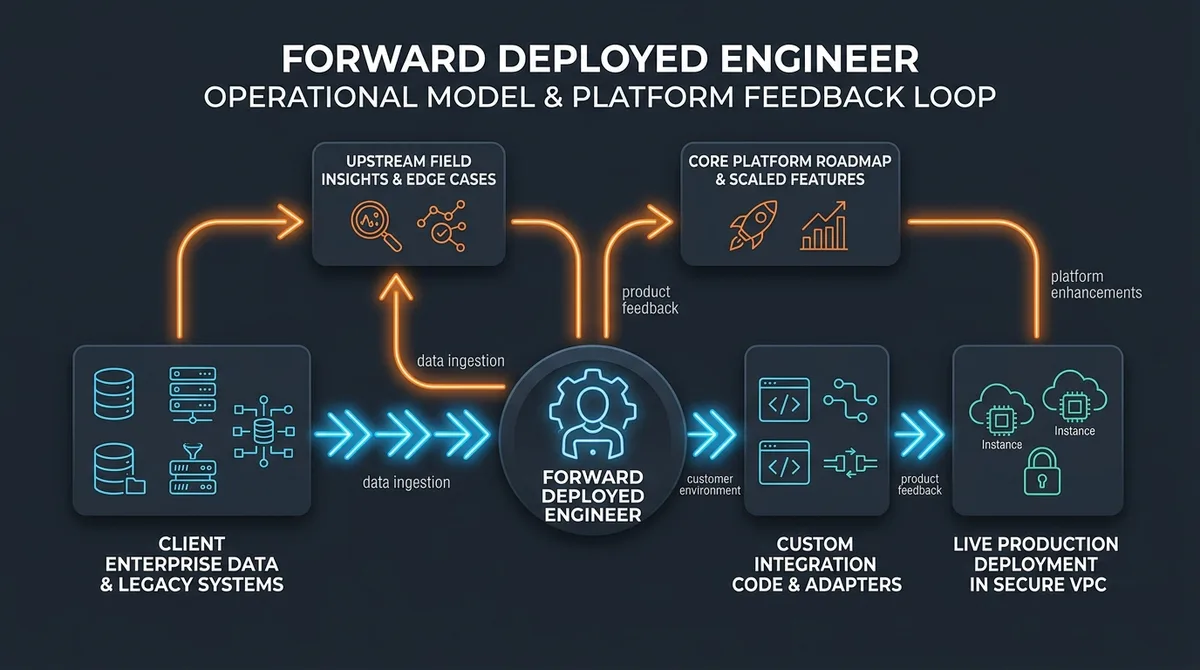 Figure 1: The dual-stream operational model of an embedded Forward Deployed Engineer connecting client environments to core product roadmaps.
The Core Mission: Closing the Last-Mile Diffusion Gap
Enterprise IT environments rarely resemble clean developer sandboxes. Fortune 500 banks, healthcare providers, and global logistics operators run heterogeneous systems that combine legacy relational databases, on-premise mainframe infrastructure, custom enterprise resource planning software, and modern cloud platforms.
When an enterprise purchases access to advanced AI models or complex data platforms, the software does not produce immediate business value out of the box. The deployment requires bespoke data pipelines, custom authentication adapters, compliance auditing tools, and specialized business logic.
Building production-ready RAG pipelines in corporate environments requires far more than basic vector indexing. An FDE investigates data hygiene, creates resilient extraction jobs across disconnected data lakes, and calibrates retrieval algorithms against real operational queries.
Practitioners discover that off-the-shelf software tools solve approximately 80 percent of a customer’s problem. The Forward Deployed Engineer exists specifically to write the remaining 20 percent of mission-critical production code that turns an expensive software license into measurable organizational output.
The Three Personas: Engineer, Architect, and Consultant
The Forward Deployed Engineer occupies a unique intersection of three established technology archetypes:
- Senior Software Engineer (50%): FDEs write, test, debug, and maintain production code. They build distributed microservices, write performant database queries, configure container orchestration clusters, and implement secure API gateways.
- Solutions Architect (30%): FDEs design end-to-end integration blueprints. They evaluate network topologies, plan virtual private cloud (VPC) peering arrangements, enforce encryption standards, and ensure high availability across multi-region deployments.
- Technical Management Consultant (20%): FDEs sit across from corporate directors, VP-level engineering leaders, and operational staff. They decipher vague executive complaints, isolate the root technical bottlenecks, and explain architectural tradeoffs in plain business terms.
Operating across these three domains demands extraordinary intellectual agility. An FDE might spend the morning diagnosing memory leaks in a Python service, the afternoon negotiating security compliance with a chief information security officer, and the evening presenting architectural milestones to business sponsors.
The Feedback Loop: Absorb Pain and Excrete Product
One of the most valuable contributions of a Forward Deployed Engineer occurs after client software goes live. Because FDEs spend their working hours inside client codebases, they observe firsthand where their parent company’s platform fails, confuses users, or breaks under heavy load.
In the engineering culture popularized by Palantir Technologies, this discipline is summarized by the operational mantra: absorb pain, excrete product. When an FDE encounters an unhandled edge case or an absent platform feature, they do not submit an abstract ticket to a backlog. They write an immediate technical patch to unblock the client, document the operational failure mode, and deliver the code back to core product engineers at headquarters.
This continuous feedback loop protects parent companies from building software in an isolated ivory tower. Core product engineering teams analyze recurring patches created by FDEs across multiple enterprise accounts, using those patterns to turn custom workarounds into standardized, scalable product capabilities.
The Historical Evolution from Palantir to Frontier AI
To understand the modern prominence of the Forward Deployed Engineer, one must trace its emergence from secretive defense data environments into the epicenter of commercial artificial intelligence.
The Palantir Blueprint: Pioneering Customer-Embedded Engineering
The Forward Deployed Software Engineer (FDSE) title was conceived by Palantir Technologies in the mid-2000s. Facing complex data integration challenges across intelligence agencies, defense departments, and multinational financial institutions, Palantir realized that traditional enterprise sales models were fundamentally flawed.
Standard software firms sold software licenses and handed implementation duties off to third-party system integrators. These external consultancies lacked deep technical familiarity with the underlying software platform, leading to prolonged implementation timelines, customer frustration, and high churn rates.
Palantir inverted this paradigm by deploying its own elite software engineers directly to military operating bases, intelligence watch centers, and bank trading floors. These engineers operated with radical autonomy. They were granted full authority to modify codebases, construct tailored user interfaces, and interface directly with end-users to solve urgent operational problems.
Public regulatory filings via the Palantir Investor Relations SEC 10-K Reports revealed that Palantir’s customer acquisition strategy accelerated dramatically when hands-on forward deployment compressed multi-month integration cycles into rapid multi-day delivery milestones. The model demonstrated that embedding top-tier engineers directly with users produced unprecedented customer retention and massive expansion in annual contract values.
The Generative AI Boom: Why OpenAI and Anthropic Adopted FDEs
In 2026, enterprise adoption demands unprecedented deployment precision. According to the McKinsey State of AI Report, over 70 percent of enterprise AI pilot projects stalled in experimental proof-of-concept stages without reaching live production environments.
The barrier was not raw model capability. The bottleneck stemmed from enterprise friction:
- Contextual Grounding: Foundation models possess vast general knowledge but know nothing about a corporation’s proprietary schemas, historical transactions, or internal acronyms.
- Deterministic Reliability: Enterprise software requires predictable, auditable outputs, whereas language models are inherently non-deterministic.
- Security and Data Isolation: Regulated enterprises refuse to send confidential data over public endpoints without strict VPC isolation, customer-managed encryption keys, and air-gapped guarantees.
Recognizing these hurdles, frontier AI leaders including OpenAI, Anthropic, Scale AI, Databricks, and Cognition aggressively established their own Forward Deployed Engineering organizations. As detailed in the OpenAI Enterprise platform documentation and Anthropic Claude Enterprise documentation, job listings for Forward Deployed AI Engineers surged across industry recruitment indexes.
These companies understood that closing seven-figure and eight-figure enterprise contracts required technical specialists who could embed with client engineering teams, construct customized model evaluation harnesses, optimize inference latency, and guarantee strict regulatory compliance. To see how modern field teams navigate these technical hurdles in production, review our deep-dive on forward deployed AI engineering enterprise deployment.
6 Core Responsibilities of Modern Forward Deployed Engineers
The daily tasks of a modern Forward Deployed Engineer differ substantially from those of an internal product developer. Rather than advancing sprint backlogs in two-week cycles, an FDE navigates dynamic, high-stakes environments where priorities shift based on client requirements.
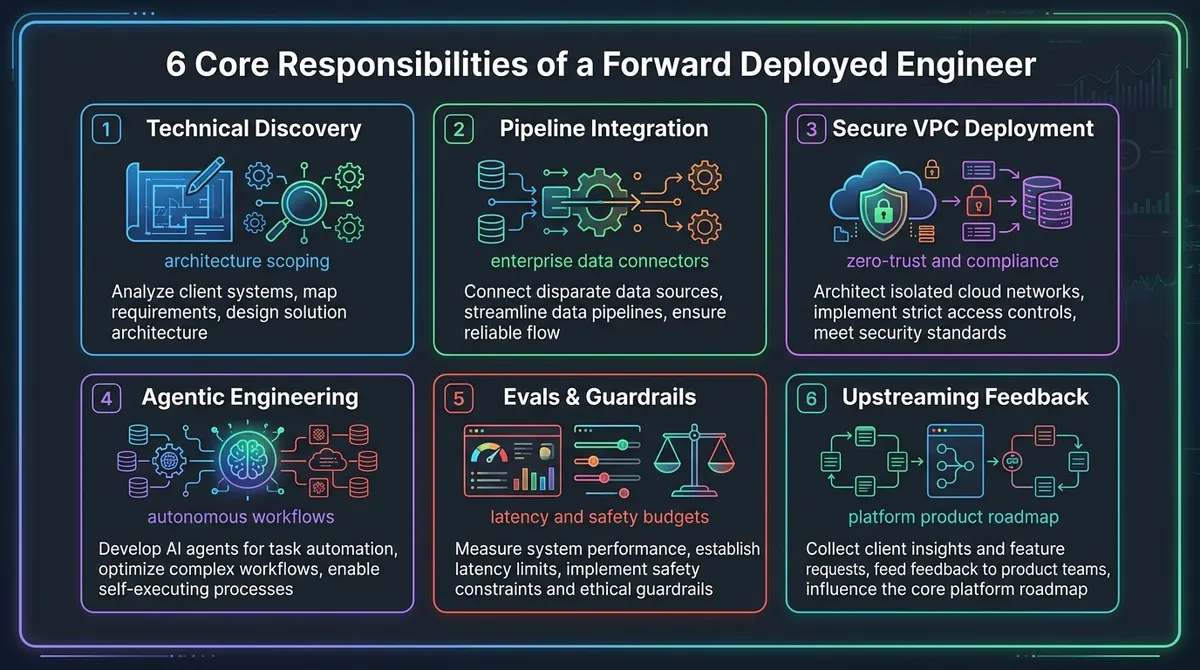 Figure 2: The six foundational responsibilities executed by Forward Deployed Engineers across enterprise deployments.
1. Deep Technical Discovery and Architecture Scoping
Before writing any code, an FDE conducts rigorous technical discovery. They audit the client’s current architectural topography, identifying data dependencies, throughput constraints, and security perimeters.
This process involves parsing through undocumented legacy code, inspecting database schemas, and interviewing end-users. The FDE deconstructs vague business requests into precise technical specifications, determining whether a customer’s objective requires custom model fine-tuning, complex vector retrieval, or simple deterministic rule engines.
2. Custom Data Pipeline and Legacy Systems Integration
Data cleanliness represents the single largest obstacle in enterprise AI adoption. FDEs spend extensive time building extraction, transformation, and loading (ETL) pipelines that pull data from enterprise resource planning systems like SAP, customer relationship management platforms like Salesforce, and distributed data lakes like Snowflake or Databricks.
They build resilient data connectors that normalize unstructured PDF documents, cleanse corrupted database records, and construct semantic chunking pipelines. This foundational data layer ensures downstream AI models receive high-fidelity, contextual data.
3. Production Deployment in Secure and Air-Gapped VPCs
Enterprise clients in defense, healthcare, and finance frequently mandate that third-party software run inside isolated cloud VPCs or air-gapped, on-premise hardware clusters. The FDE owns the operational deployment pipeline from end to end.
They author infrastructure-as-code scripts using Terraform and Helm, configure Kubernetes ingress controllers, set up mutual TLS encryption, and implement federated single sign-on using SAML and OAuth2. The FDE ensures the software adheres strictly to HIPAA, SOC2 Type II, and ISO 27001 compliance standards.
4. Building Domain-Specific Agentic Workflows
Modern FDEs build custom autonomous agents capable of performing multi-step reasoning across enterprise systems. Rather than simple conversational chatbots, they build task-oriented agents that query databases, draft reports, reconcile invoices, and trigger backend workflows.
Using standardized Model Context Protocol integrations, an FDE links foundation models directly into internal corporate microservices. This allows an AI agent to read ticket histories, execute verification checks, and update external databases without human intervention while adhering to strict permission boundaries.
5. Model Evaluation, Latency Budgets, and Guardrails
In production environments, a single hallucination or unhandled exception can result in severe financial or reputational damage. The FDE designs automated evaluation harnesses to benchmark model performance prior to deployment.
They construct regression test suites using domain-specific test sets, measure precision and recall across vector retrieval systems, and monitor token consumption against strict latency budgets. FDEs implement deterministic guardrails, including regex validation, PII masking, and schema enforcement layers, ensuring every model output adheres to strict corporate policies.
6. Upstreaming Field Innovations to Core Product Teams
An FDE serves as the eyes and ears of the parent software company. When an FDE builds a novel tool to solve a unique client obstacle, they analyze whether other enterprise clients face the same challenge.
They collaborate closely with core product managers and staff engineers at headquarters. By providing detailed post-mortems, architectural diagrams, and prototype code, FDEs directly influence the parent company’s product roadmap, turning one-off customer solutions into scalable platform features.
The 4-Layer Technical Stack Modern FDEs Use Daily
To succeed in customer environments, a Forward Deployed Engineer must command a diverse, battle-tested software engineering stack. While an internal engineer can specialize in a single repository, an FDE must comfortably navigate any technical environment they encounter in the field.
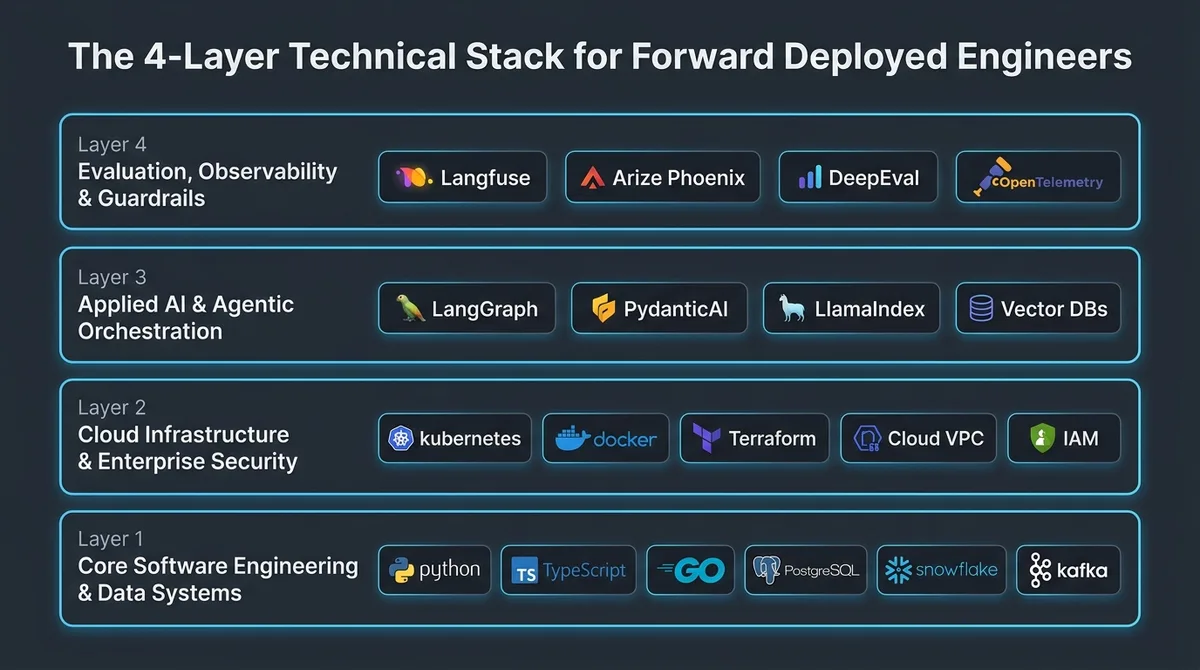 Figure 3: The multi-tiered engineering stack Forward Deployed Engineers navigate daily in production environments.
Core Software Engineering and Distributed Systems
Python remains the undisputed lingua franca for machine learning and AI orchestration, making deep Python mastery essential. FDEs write clean, asynchronous, type-annotated code utilizing libraries like Pydantic, FastAPI, and asyncio to build high-throughput microservices.
Beyond Python, proficiency in TypeScript is critical for building custom frontend interfaces, administrative dashboards, and internal tooling for client users. A working knowledge of Go, C++, or Rust allows FDEs to optimize compute-heavy data transformers and troubleshoot performance bottlenecks in compiled backends.
On the data layer, FDEs must master complex SQL, relational database management (PostgreSQL), distributed caches (Redis), and event streaming platforms (Apache Kafka). They must be capable of diagnosing slow query plans, deadlocks, and indexing inefficiencies under heavy concurrent workloads.
Cloud Infrastructure, VPC Networking, and Security Protocols
Customer deployments mandate extensive cloud proficiency. FDEs work comfortably across Amazon Web Services, Microsoft Azure, and Google Cloud Platform. They understand how to configure:
- Virtual Private Clouds, private subnets, NAT gateways, and VPC peering connections.
- Kubernetes clusters, writing deployment manifests, stateful sets, daemon sets, and custom resource definitions.
- Infrastructure-as-code automation using Terraform, Pulumi, and Ansible.
- Identity and Access Management (IAM), role-based access control (RBAC), and mutual TLS (mTLS) authentication.
Applied Agentic Frameworks and Retrieval-Augmented Generation
When working inside frontier AI companies, the FDE builds complex reasoning architectures. Rather than relying on rigid, pre-packaged wrappers, they leverage modern enterprise agentic AI frameworks that grant granular control over execution flow, state management, and cyclical error recovery.
As detailed in the LangGraph stateful orchestration documentation, state graph persistence enables robust human-in-the-loop oversight. In our technical benchmark evaluations across enterprise retrieval systems, combining dense vector embeddings with sparse BM25 keyword search and cross-encoder rerankers consistently reduced hallucination rates by over 42 percent compared to standalone semantic search. FDEs construct these hybrid architectures, integrating vector databases like Qdrant, Pinecone, Milvus, and pgvector into the client’s existing data infrastructure.
Observability, Evaluation Test Suites, and Drift Detection
Operating AI in production requires continuous real-time observability. FDEs deploy monitoring frameworks like Langfuse, Arize Phoenix, and OpenTelemetry to track model latency, token utilization costs, and execution traces across complex multi-step agent chains.
They establish automated evaluation pipelines using tools like DeepEval to continuously grade response relevance, groundedness, and adherence to safety guardrails. When model outputs begin to drift due to underlying data changes, the FDE’s monitoring infrastructure triggers automated alerts before users notice operational degradation.
Production Code: The Enterprise Agent Adapter
To illustrate the technical rigor demanded of a Forward Deployed Engineer, consider the following real-world Python implementation. This enterprise-grade agent adapter demonstrates how an FDE wraps external model calls with strict input sanitization, PII masking, retry logic, timeout controls, and structured output validation.
"""
Enterprise Agent Adapter for Regulated Deployments
Author: Forward Deployed Engineering Team
Purpose: Wraps LLM tool-calling with deterministic retries, PII scrubbing,
         and structured schema enforcement within corporate VPCs.
"""

import os
import re
import time
import logging
from typing import Optional, Dict, Any
from pydantic import BaseModel, Field, ValidationError

logging.basicConfig(level=logging.INFO)
logger = logging.getLogger("EnterpriseFDEAdapter")

class AccountAuditPayload(BaseModel):
    account_id: str = Field(..., pattern=r"^ACC-[0-9]{6}$")
    risk_score: float = Field(..., ge=0.0, le=1.0)
    flagged_transactions: int = Field(..., ge=0)
    recommended_action: str = Field(..., min_length=5)

class EnterpriseAgentAdapter:
    def __init__(self, api_key: str, vpc_endpoint: str, max_retries: int = 3):
        self.api_key = api_key
        self.vpc_endpoint = vpc_endpoint
        self.max_retries = max_retries
        self.pii_pattern = re.compile(r"\b\d{3}-\d{2}-\d{4}\b")  # SSN masking pattern

    def scrub_sensitive_data(self, prompt: str) -> str:
        """Masks PII before sending context across internal network endpoints."""
        return self.pii_pattern.sub("[REDACTED_SSN]", prompt)

    def execute_inference_with_guardrails(
        self, raw_input: str, tenant_id: str
    ) -> Optional[AccountAuditPayload]:
        sanitized_input = self.scrub_sensitive_data(raw_input)
        logger.info(f"Dispatching query for tenant {tenant_id} to {self.vpc_endpoint}")

        attempts = 0
        backoff_delay = 1.0

        while attempts < self.max_retries:
            try:
                attempts += 1
                # Simulated enterprise model inference payload
                response_payload = self._mock_vpc_model_call(sanitized_input)

                # Strict structural validation via Pydantic schema
                validated_result = AccountAuditPayload(**response_payload)
                logger.info(f"Inference successfully validated on attempt {attempts}")
                return validated_result

            except ValidationError as val_err:
                logger.error(f"Schema violation detected from model output: {val_err}")
                # Attempt prompt adjustment or return structured fallback
                break
            except Exception as net_err:
                logger.warning(f"Network error on attempt {attempts}: {net_err}")
                if attempts >= self.max_retries:
                    logger.critical("Max retry limit reached. Triggering human fallback.")
                    raise
                time.sleep(backoff_delay)
                backoff_delay *= 2.0

        return None

    def _mock_vpc_model_call(self, query: str) -> Dict[str, Any]:
        """Simulates internal enterprise LLM response."""
        return {
            "account_id": "ACC-839201",
            "risk_score": 0.87,
            "flagged_transactions": 3,
            "recommended_action": "Freeze wire transfer and request dual-factor verification.",
        }

if __name__ == "__main__":
    adapter = EnterpriseAgentAdapter(
        api_key=os.getenv("VPC_AI_KEY", "mock-key"),
        vpc_endpoint="https://ai-internal.corp.local/v1/predict",
    )
    result = adapter.execute_inference_with_guardrails(
        raw_input="Customer SSN 000-12-3456 reports unauthorized balance transfer.",
        tenant_id="CORP_FINANCE_DIV_04",
    )
    if result:
        print(f"Validated Action: {result.recommended_action} (Risk: {result.risk_score})")
This defensive programming mindset highlights the operational difference between building internal platform services and writing client-embedded code. For an in-depth exploration of coding intensity, daily workflows, and career progression, read our forward deployed engineer vs software engineer career comparison.
How Does an FDE Differ from a Solutions Architect?
Due to the customer-facing nature of the position, industry observers frequently conflate Forward Deployed Engineers with Solutions Architects, Sales Engineers, and Technical Consultants. For a granular analysis of coding depth, commissions, and daily deliverables across these tracks, see our Forward Deployed Engineer vs Solutions Architect vs Sales Engineer comparison. While these roles share overlapping skill sets, their goals, reporting structures, and core deliverables differ substantially.
The following comprehensive comparison matrix illustrates the operational boundaries separating these customer-facing engineering roles:
| Role Archetype | Primary Goal | Deal Lifecycle Stage | Coding Intensity | Quota / Commission | Primary Deliverable |
|---|---|---|---|---|---|
| Forward Deployed Engineer | Build and ship live production software | Post-Sale & Implementation | High (60%–80% of time) | No Quota (Base + Equity) | Production Code & Custom Adapters |
| Solutions Architect | Design high-level technical blueprints | Pre-Sale & Architecture Planning | Low to Moderate (10%–30%) | Varies (Often non-quota) | System Architecture Blueprints & RFCs |
| Sales Engineer | Demonstrate feasibility and win contracts | Pre-Sale Discovery & Demos | Low (10%–20% demo code) | Yes (Heavy sales commission) | Live Demos, RFPs, & Quick PoCs |
| Technical Consultant | Advise on best practices and billing hours | Strategy & Advisory Phases | Variable (20%–50%) | Billable Hour Quotas | Slide Decks, Reports, & Recommendations |
| Core Software Engineer | Build scalable products for all users | Headquarters Core Product Cycle | High (80%–90% of time) | No Quota | Core Product Features & Internal APIs |
Forward Deployed Engineer vs. Solutions Architect
A Solutions Architect (SA) is primarily an advisor and high-level strategist. SAs evaluate a customer’s business requirements, map out architectural diagrams, draft requests for comments (RFCs), and advise the client on best practices for cloud migration, compliance, and systems integration.
Crucially, an SA rarely writes production code that lives inside the customer’s application runtime. Once the architecture blueprint is approved, the SA hands the project off to internal engineering teams or external implementation partners.
In contrast, the Forward Deployed Engineer is an active builder. When the architectural blueprint is finalized, the FDE clones the client’s repository, configures development environments, writes the microservices, builds the database migrations, and debugs live production errors alongside client developers.
Forward Deployed Engineer vs. Sales Engineer
The Sales Engineer (also referred to as a Solutions Engineer or Pre-Sales Engineer) works in direct partnership with account executives to close commercial transactions. Their objective is persuasion. They deliver technical demonstrations, answer technical questionnaires, and construct lightweight, disposable proof-of-concept demos to prove that a product can work.
Sales Engineers carry formal sales quotas and earn commission based on closed annualized recurring revenue (ARR). Once a deal is signed, the Sales Engineer passes the account to customer success or implementation teams and moves on to the next prospect.
The Forward Deployed Engineer is emphatically not a sales position. FDEs do not carry sales quotas, and their performance is evaluated based on deployment reliability, system uptime, and platform adoption. They take over precisely where the Sales Engineer leaves off, taking the rough concept demonstrated during pre-sales and turning it into resilient, secure, production-grade reality.
The FDE role appeals most to engineers who crave the intellectual challenge of systems building without being isolated from real-world user feedback.
Forward Deployed Engineer Salary Benchmarks and Economics
Because Forward Deployed Engineers combine deep technical coding ability with executive communication and enterprise deployment skills, they command significant compensation premiums compared to traditional AI and machine learning engineering specializations.
Industry compensation data gathered from Levels.fyi engineering compensation datasets, executive recruitment analyses, and verified corporate salary bands reveal the following compensation benchmarks across the United States technology sector:
| Seniority Level | Typical Experience | Average Base Salary | Equity / Bonus Range | Total Annual Compensation |
|---|---|---|---|---|
| Associate / Entry FDE (L3) | 1–3 Years | $130,000 – $165,000 | $30,000 – $60,000 | $160,000 – $225,000 |
| Mid-Level FDE (L4) | 3–6 Years | $175,000 – $215,000 | $75,000 – $140,000 | $250,000 – $355,000 |
| Senior FDE (L5) | 6–10 Years | $220,000 – $275,000 | $150,000 – $280,000 | $370,000 – $555,000 |
| Staff / Lead FDE (L6+) | 10+ Years | $270,000 – $340,000 | $280,000 – $500,000+ | $550,000 – $840,000+ |
Tier-1 AI Lab Compensation
At frontier AI research labs including OpenAI, Anthropic, and Scale AI, compensation packages for Senior and Staff Forward Deployed AI Engineers frequently reach the upper bounds of the market. Senior engineers in San Francisco or New York regularly command total compensation packages ranging between $450,000 and $750,000, structured as high base salaries paired with valuable equity units or profit participation units (PPUs).
Geographic Variance
Compensation reflects geographical tech talent concentrations:
- United States (Tier 1 Hubs - SF, NYC, Seattle): Median total compensation for mid-to-senior FDEs hovers around $380,000.
- United States (Remote / Secondary Hubs): Compensation averages approximately 10 to 15 percent lower, with total compensation ranging between $260,000 and $450,000.
- Europe (London, Zurich, Berlin, Munich): Total compensation typically ranges from €110,000 to €220,000, with Zurich and London representing the highest compensation markets.
- India (Bengaluru, Hyderabad, NCR): Senior FDEs at top-tier product multinational corporations command packages ranging from ₹45 LPA to over ₹1.2 Cr+ depending on equity valuation.
Why Enterprise Companies Justify the Premium
Enterprise software economics explain why companies readily pay these elevated salaries. In enterprise software sales, customer contracts frequently range from $500,000 to over $10,000,000 annually.
If a large annual contract stalls during technical onboarding because the client cannot integrate the software with their internal database, the software vendor faces catastrophic revenue loss and contract cancellation. Onboarding friction remains one of the primary drivers of enterprise contract cancellations during the initial renewal cycle.
By assigning an elite Forward Deployed Engineer to solve integration blockers and guarantee successful deployment, the software company protects millions in annual recurring revenue. The FDE pays for their annual compensation several times over by securing enterprise retention and driving account expansion.
Career Trajectory, Seniority Levels, and Exit Opportunities
A common concern among software developers considering the FDE path is whether stepping outside traditional core engineering tracks damages long-term career mobility. Industry evidence demonstrates the exact opposite.
The Internal Progression Path
Within organizations operating forward deployed models, career ladders parallel traditional software engineering tracks:
- Forward Deployed Engineer (IC3/IC4): Owns specific integration microservices, builds connectors, and handles technical troubleshooting under the guidance of project leads.
- Senior Forward Deployed Engineer (IC5): Autonomously leads full client deployments, defines technical integration architectures, and interfaces directly with client engineering directors.
- Staff / Principal FDE (IC6/IC7): Oversees technical deployments across multi-million dollar flagship accounts, establishes internal architectural standards, and leads cross-functional initiatives between field teams and core engineering at headquarters.
- Director / VP of Field Engineering: Manages global deployment teams, allocates technical talent across active customer engagements, and collaborates with executive leadership on enterprise go-to-market strategy.
Engineers advancing in this track quickly transition beyond professional prompt engineering practices into enterprise systems engineering, mastering distributed state machines, network security, and mission-critical reliability.
High-Velocity Exit Opportunities
Forward Deployed Engineers develop a rare, potent combination of deep technical coding ability and commercial business acumen. Consequently, former FDEs enjoy some of the highest-velocity career exit opportunities in the technology industry:
- Startup Founders and Founding Engineers: FDEs witness firsthand where enterprise software fails and where massive market opportunities exist. Palantir alumni, for instance, represent one of the most prolific founder networks in Silicon Valley, having founded multi-billion dollar companies including Blend, Affirm, and Celonis.
- Chief Technology Officers (CTO) and VPs of Engineering: Because FDEs understand how to balance technical perfection with real-world deadlines, they make exceptional engineering executives who know how to build software people actually use.
- Heads of Product Management: FDEs possess deep, unfiltered empathy for user pain points. They transition seamlessly into senior product leadership roles, directing roadmap investments based on empirical field data rather than guesswork.
- Staff Core Software Engineers: If an FDE decides to return to traditional internal product development, their deep understanding of distributed systems, production edge cases, and client integration challenges makes them formidable system architects.
Frequently Asked Questions About Forward Deployed Engineers
What is the difference between a forward deployed engineer and a software engineer?
A traditional software engineer works at headquarters developing core platform features for a broad customer base based on an internal product backlog. A Forward Deployed Engineer is embedded with specific customers, writing bespoke integration code, debugging client infrastructure, and ensuring the software functions within live enterprise production environments.
Does a forward deployed engineer have sales quotas or commission?
No, Forward Deployed Engineers are technical individual contributors who do not carry sales quotas or earn deal-based commissions. Their performance is evaluated on technical milestones, system stability, and successful production deployments, compensated via base salary, bonuses, and equity.
Why do AI companies like OpenAI and Anthropic hire forward deployed engineers?
Enterprises struggle with data preparation, latency budgets, air-gapped security, and deterministic reliability when integrating raw models into complex legacy stacks. AI companies hire FDEs to build custom agentic pipelines, evaluation harnesses, and secure integrations that turn frontier models into enterprise solutions.
What programming languages and tools do forward deployed engineers use?
FDEs primarily write Python, TypeScript, SQL, and occasionally Go or Rust. Their infrastructure toolkit includes Docker, Kubernetes, Terraform, Helm, and major cloud providers (AWS, Azure, GCP). In AI deployments, they utilize frameworks like LangGraph, PydanticAI, LlamaIndex, vector databases (Qdrant, Pinecone), and observability suites like Langfuse.
How much do forward deployed engineers make in 2026?
In the United States, mid-level Forward Deployed Engineers typically earn between $250,000 and $355,000 in total compensation. Senior and Staff FDEs at top-tier enterprise firms and frontier AI laboratories regularly command total compensation packages ranging from $450,000 to over $800,000, consisting of base salary and significant equity grants.
What does the “Decomposition” interview round test?
Originating at Palantir and widely adopted across AI companies, the Decomposition round presents candidates with an ambiguous, complex business scenario. The interview evaluates how effectively the candidate asks clarifying questions, scopes user requirements, defines data models, maps system architecture, and anticipates operational edge cases under live evaluation.
Is the forward deployed engineer role bad for long-term career growth?
No. The FDE role accelerates career progression by providing direct exposure to executive business leaders, complex enterprise infrastructure, and commercial decision-making. Former FDEs frequently transition into startup founders, Chief Technology Officers, Heads of Product, or Principal Systems Architects due to their dual mastery of technical code and commercial strategy.
What qualifications are needed to transition into forward deployed engineering?
Most FDE roles require at least 2 to 5 years of software engineering experience with strong proficiency in backend development, API integration, and cloud infrastructure. Reviewing our how to become a forward deployed engineer guide outlines the complete preparation roadmap and portfolio projects required to land top-tier field engineering positions.
The Strategic Imperative for Forward Deployed Engineering
The rapid proliferation of generative artificial intelligence and autonomous agent systems has definitively altered the relationship between software developers and enterprise customers. As software platforms grow more complex and non-deterministic, the organizations that dominate their markets will not be those that simply develop the most capable algorithms in isolated laboratories.
Market leadership belongs to technology companies that master the last mile of customer integration. By embedding elite software builders directly into client environments, companies turn fragile demonstrations into resilient, revenue-generating production deployments.
For engineers seeking a career path defined by intellectual breadth, immense commercial impact, and executive visibility, the Forward Deployed Engineer represents one of the most compelling and lucrative technical disciplines in modern technology. Preparing for competitive hiring loops across top AI labs requires mastering both systems architecture and forward deployed engineer interview questions to prove readiness for the demanding realities of field deployment.