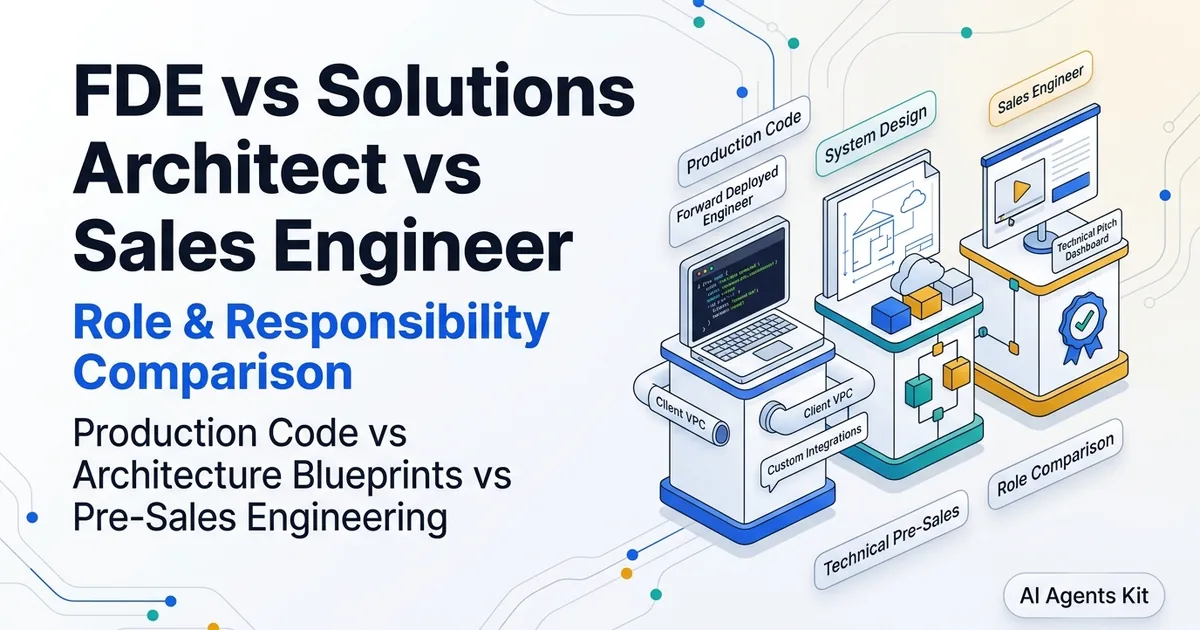
Forward Deployed Engineer vs Solutions Architect vs Sales Engineer: What's the Real Difference?
Compare Forward Deployed Engineer vs Solutions Architect vs Sales Engineer. Discover differences in coding intensity, quotas, compensation, and career growth.
The proliferation of enterprise artificial intelligence platforms has created title inflation across customer-facing technical disciplines. Job seekers, engineering managers, and enterprise procurement leads frequently treat Forward Deployed Engineers, Solutions Architects, and Sales Engineers as interchangeable positions.
This industry confusion causes technical professionals to accept roles misaligned with their programming ambitions. It also leads technology vendors to staff high-level advisors when client accounts desperately require hands-on production builders. Determining the right career trajectory requires analyzing where slide decks end, where sales quotas take effect, and where live software ownership begins.
This guide provides an exhaustive breakdown of forward deployed engineer vs solutions architect and sales engineering positions. By reviewing code ownership, quota structures, daily deliverables, and compensation models, you can select the ideal path for your technical strengths. For a foundational exploration of field engineering responsibilities, read our comprehensive Forward Deployed Engineer guide.
Key Takeaways
- Code Ownership: Forward Deployed Engineers write production code inside client environments (60% to 80% coding intensity), whereas Solutions Architects focus on system blueprints (10% to 30% coding) and Sales Engineers build temporary proof-of-concept demos (10% to 20% coding).
- Compensation Models: Sales Engineers earn variable sales commissions through On-Target Earnings (OTE) with 70/30 or 60/40 splits, while Forward Deployed Engineers follow standard software engineering compensation tiers (Base + Equity) with zero sales quotas.
- Deal Lifecycle Placement: Sales Engineers own technical discovery before the contract closes, Solutions Architects design cross-platform blueprints during strategic planning, and Forward Deployed Engineers take complete ownership during live deployment and stabilization.
- Organizational Reporting: Sales Engineers report to the Chief Revenue Officer (CRO), Solutions Architects align with Enterprise Architecture or Professional Services, and Forward Deployed Engineers report directly into the Core Product and Engineering organization.
What Is the Difference Between an FDE, Solutions Architect, and Sales Engineer?
A Forward Deployed Engineer writes production code inside client repositories to deploy live software. A Solutions Architect designs high-level system blueprints and requests for comments (RFCs) without shipping production pull requests. A Sales Engineer builds temporary proof-of-concept demonstrations and answers technical questionnaires to close commercial software contracts.
While all three roles interface directly with enterprise buyers, their operational priorities diverge across the software delivery lifecycle. Examining pre sales vs forward deployed roles clarifies where commercial persuasion stops and engineering begins. A software vendor cannot substitute one discipline for another without causing delivery friction or client churn.
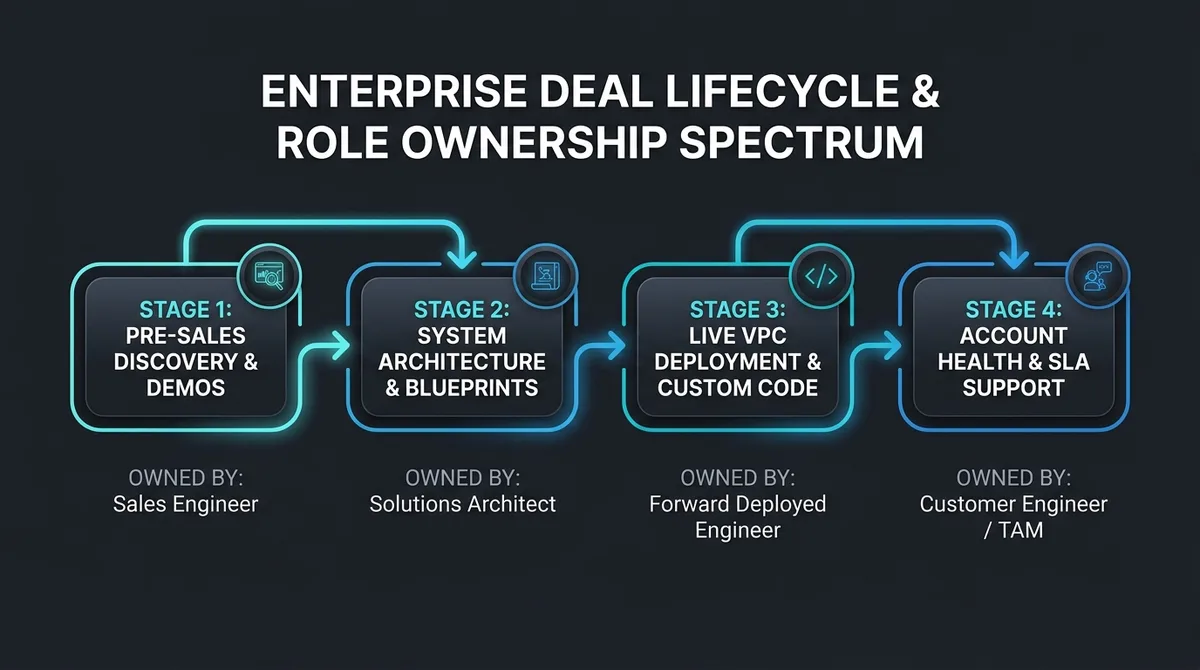 Figure 1: The enterprise deal lifecycle and technical ownership handoff across customer-facing engineering roles.
Understanding these distinct specializations requires examining where each practitioner operates relative to contract execution and live deployment. The following matrix details the operational boundaries separating these disciplines:
| Dimension | Forward Deployed Engineer (FDE) | Solutions Architect (SA) | Sales Engineer (SE) | Customer Engineer / TAM | Core Software Engineer (SWE) |
|---|---|---|---|---|---|
| Primary Mission | Ship production software in client systems | Design resilient enterprise architectures | Prove technical feasibility to close deals | Maintain account health and service stability | Build centralized core platform features |
| Organizational Home | Engineering / Product Operations | Architecture / Professional Services | Sales / Chief Revenue Officer (CRO) | Customer Success / Support | Core Engineering / Product Development |
| Deal Lifecycle Stage | Post-Sale Deployment & Production Go-Live | Pre-Sale Planning & Implementation Design | Pre-Sale Technical Discovery & Evaluation | Post-Sale Maintenance & Account Renewal | Continuous Core Product Development |
| Coding Intensity | High (60% to 80% production code) | Low to Moderate (10% to 30% sample snippets) | Low (10% to 20% disposable prototypes) | Minimal (5% to 10% scripts and diagnostics) | Very High (80% to 90% production code) |
| Quota & Commission | None (Software engineering salary + equity) | None to Low (Discretionary target bonus) | High (70/30 or 60/40 OTE commission split) | Minimal (Retention and renewal bonuses) | None (Standard software engineering ladder) |
| Primary Deliverables | Custom adapters, ETL pipelines, pull requests | Reference architectures, RFCs, governance docs | Tailored demos, RFP responses, lightweight PoCs | Health checks, post-mortems, support tickets | Reusable core APIs, platform features, microservices |
| Production Escalation | Primary on-call owner for field deployment bugs | Secondary advisor during major outages | Zero production escalation accountability | Triage point for general support escalations | Primary on-call owner for core platform bugs |
| Typical Tech Stack | Python, TypeScript, Docker, Kubernetes, SQL | CloudFormation, Terraform, Visio, Lucidchart | Python, REST APIs, Postman, Streamlit, Slide Decks | Monitoring dashboards, Datadog, Jira, CLI tools | Go, Rust, C++, Distributed Databases, Kafka |
| Client Level | Lead Developers, Staff SWEs, DevOps Engineers | Enterprise Architects, VP of IT, Security Leads | Technical Evaluators, Procurement, VP of Sales | IT Administrators, Operations Leads, Helpdesks | Internal Product Managers and Peer Engineers |
| Average Total Comp | $220,000 to $480,000+ (SWE Level L4 to L7) | $190,000 to $340,000 (Base + Performance Bonus) | $180,000 to $360,000+ (Base + Uncapped OTE) | $140,000 to $230,000 (Base + Retention Bonus) | $200,000 to $450,000+ (Base + Equity Grants) |
Organizations building specialized engineering teams often compare these skill requirements with broader machine learning specialties. For an analysis of internal machine learning disciplines, review our breakdown of AI and machine learning engineering career specializations. Modern enterprise vendors also reference the GitHub Enterprise Cloud Documentation when establishing governance standards for embedded engineers handling customer source code.
The Sales Engineer: Mastering Pre-Sales Demos and Commercial Quotas
The Sales Engineer (frequently called a Solutions Engineer, Pre-Sales Consultant, or Systems Engineer) operates as the technical counterpart to the Account Executive (AE). When an enterprise prospect expresses commercial interest in an enterprise platform, the Account Executive manages relationship dynamics, pricing negotiations, and contractual terms. The Sales Engineer manages the technical evaluation.
During initial discovery meetings, the Sales Engineer establishes technical credibility with prospective clients. They translate intricate system capabilities into concrete business solutions, directly addressing customer doubts regarding performance, security, and integration feasibility.
A typical week for an enterprise Sales Engineer centers around deal progression:
- Conducting technical discovery sessions to uncover client infrastructure requirements, security constraints, and operational bottlenecks.
- Responding to extensive 150-question Requests for Proposals (RFPs) and enterprise security assessments detailing data encryption, compliance certifications, and access controls.
- Assembling disposable proof-of-concept (PoC) environments using demo sandboxes, mock data generators, and lightweight API scripts.
- Delivering executive product demonstrations tailored to business challenges described by prospective buyers.
The incentive structure for Sales Engineers reflects their placement within the sales organization. Most enterprise technology companies compensate Sales Engineers through On-Target Earnings (OTE) using a 70/30 or 60/40 ratio. In a 70/30 compensation plan with a $200,000 OTE, the base salary is $140,000, while the remaining $60,000 depends directly on closing target software contracts.
This compensation design produces substantial upside during strong sales cycles, where performance accelerators can push realized earnings above $350,000. However, during macroeconomic contractions or extended enterprise purchasing cycles, variable compensation declines correspondingly.
Evaluating a solutions engineer vs forward deployed engineer highlights the divide between pre-sales demos and production deployments. The moment an enterprise agreement reaches “Closed-Won” status, the Sales Engineer hands off technical oversight to professional services, implementation consultants, or field engineers.
Sales Engineers do not troubleshoot production runtime defects, write durable codebases, or manage post-sale infrastructure. Candidates preparing for technical sales discussions can review common interview scenarios in our guide on AI technical job interview questions.
The Solutions Architect: Designing Strategic System Blueprints and RFCs
The Solutions Architect serves as an enterprise strategist and cross-platform systems designer. Unlike the Sales Engineer, whose primary objective is closing an immediate sales transaction, the Solutions Architect focuses on long-term structural viability, governance, and cloud scalability.
Solutions Architects operate across both pre-sales and post-sales phases. They engage when an enterprise implementation spans multiple corporate clouds, hybrid legacy databases, and strict regulatory frameworks like HIPAA, SOC2, or FedRAMP. They collaborate with Chief Information Security Officers (CISOs), Enterprise Architects, and IT Directors to design blueprints that withstand rigorous security reviews.
The daily responsibilities of a Solutions Architect emphasize high-level system design:
- Conducting architectural review sessions to map data ingress, egress, security boundaries, and network topology across AWS, Microsoft Azure, and Google Cloud Platform.
- Authoring detailed Requests for Comments (RFCs), architecture decision records (ADRs), and compliance verification documents.
- Evaluating total cost of ownership (TCO) and cloud resource consumption for prospective deployments.
- Providing strategic guidance on distributed system reliability, disaster recovery scenarios, and multi-region failover mechanisms.
Solutions Architects rarely write code destined for client production environments. When an architect writes code, it consists of cloud infrastructure templates, sample API wrappers, or proof-of-concept reference implementations. Their primary deliverable is the design specification rather than the compiled binary. Once stakeholders sign off on the architectural blueprint, the Solutions Architect transitions oversight to internal engineering squads or systems integrators.
Compensation models for Solutions Architects prioritize long-term customer success over quarterly sales volume. Solutions Architects typically earn a substantial base salary paired with an annual discretionary bonus tied to account retention, consumption metrics, and corporate performance. Organizations frequently align their internal architectural frameworks with established industry benchmarks, such as the AWS Well-Architected Framework.
This structured alignment protects client infrastructure as workloads expand across hybrid clouds. For organizations architecting multi-model enterprise workflows, consult our guide on enterprise agentic AI frameworks.
The Forward Deployed Engineer: Writing Production Code in the Field
The Forward Deployed Engineer (FDE) originated inside data analytics firm Palantir Technologies and has become essential across artificial intelligence laboratories including OpenAI, Anthropic, and Cohere. The Forward Deployed Engineer functions as an elite software builder embedded directly within customer engineering environments to resolve last-mile deployment hurdles.
Modern enterprise software systems rarely operate as turnkey installations. When a major financial institution or defense agency licenses an advanced foundation model platform, the platform must connect with messy internal databases, legacy SOAP endpoints, custom authentication providers, and private VPC networks. A slide deck or cloud blueprint cannot execute database migrations. The Forward Deployed Engineer steps into client infrastructure to write the necessary production code.
In any comparison of an fde vs sales engineer, the dividing line is commercial quota versus production delivery. The Sales Engineer focuses on pre-sales persuasion, whereas the FDE builds the real-world deployment.
Daily work for a Forward Deployed Engineer mirrors that of a core software engineer, with the added complexity of customer-facing communication:
- Obtaining repository access, security clearances, and VPN credentials inside client private networks.
- Authoring custom microservices, ETL pipelines, and API translation layers that bridge proprietary client schemas with parent platform interfaces.
- Containerizing services, authoring Kubernetes Helm charts, and tuning distributed infrastructure to operate within air-gapped or restricted VPC environments.
- Triaging live production stack traces, optimizing database query latency, and establishing automated regression testing suites.
- Providing direct customer feedback to headquarters engineering teams to convert custom client workarounds into standardized platform capabilities.
The code produced by an FDE differs fundamentally from the demo scripts written by a Sales Engineer. The following comparison illustrates this technical divergence:
# ==============================================================================
# 1. SALES ENGINEER: Disposable Pre-Sales Feasibility Script
# Objective: Fast mockup to prove API connectivity during a 30-minute client demo.
# Characteristics: Hardcoded values, zero retries, no input validation, plain prints.
# ==============================================================================
import requests

def run_sales_demo_mock():
    endpoint = "https://api.platform.internal/v1/enrich"
    sample_payload = {"account_id": "ACC-9982", "query": "financial risk assessment"}

    print("[SE Demo] Dispatching rapid feasibility request to platform endpoint...")
    response = requests.post(endpoint, json=sample_payload, timeout=5)

    if response.status_code == 200:
        print("[SE Demo] Connection validated! Returned payload:", response.json())
    else:
        print("[SE Demo] Demo server returned non-200 status code.")


# ==============================================================================
# 2. FORWARD DEPLOYED ENGINEER: Enterprise Production Integration Adapter
# Objective: Durable VPC-embedded adapter handling schema checks, retries, and metrics.
# Characteristics: Pydantic validation, exponential backoff, structured audit logging.
# ==============================================================================
import logging
import time
from typing import Any, Dict, Optional
from pydantic import BaseModel, Field, ValidationError

logging.basicConfig(level=logging.INFO, format="%(asctime)s [%(levelname)s] %(message)s")
logger = logging.getLogger("FDE.ProductionAdapter")

class EnterprisePayloadSchema(BaseModel):
    account_id: str = Field(..., min_length=5, max_length=32)
    query: str = Field(..., min_length=3, max_length=256)
    vpc_tenant_id: str = Field(..., pattern=r"^tenant-[a-z0-9]{8}$")

class ProductionIntegrationAdapter:
    """Production adapter deployed inside customer Kubernetes infrastructure."""

    def __init__(self, target_url: str, max_retries: int = 3, base_backoff_sec: float = 1.0):
        self.target_url = target_url
        self.max_retries = max_retries
        self.base_backoff_sec = base_backoff_sec

    def ingest_and_forward(self, raw_input: Dict[str, Any]) -> Optional[Dict[str, Any]]:
        # 1. Strict schema validation to prevent corrupt data ingest
        try:
            validated = EnterprisePayloadSchema(**raw_input)
        except ValidationError as err:
            logger.error("Schema validation failed for customer input: %s", err.json())
            return None

        # 2. Resilient transmission with exponential backoff and jitter
        for attempt in range(1, self.max_retries + 1):
            try:
                logger.info("Shipping record %s (Attempt %d/%d)", validated.account_id, attempt, self.max_retries)
                # Simulated production HTTP dispatch with network error resilience
                time.sleep(0.05)
                return {"status": "SUCCESS", "record_id": validated.account_id, "code": 200}
            except Exception as exc:
                wait_time = self.base_backoff_sec * (2 ** (attempt - 1))
                logger.warning("Network failure on attempt %d: %s. Backing off for %.2fs", attempt, exc, wait_time)
                time.sleep(wait_time)

        logger.critical("Exhausted retries forwarding record %s to %s", validated.account_id, self.target_url)
        return None
Forward Deployed Engineers operate under an explicit operating philosophy: “absorb customer friction, upstream product improvements.” Rather than allowing custom client patches to languish as technical debt, the FDE abstracts common integration requirements into reusable platform modules.
FDEs are compensated on software engineering compensation schedules (Base + Equity), without sales quotas or variable commission metrics. Performance evaluations hinge on deployment stability, platform adoption velocity, and customer retention. When integrating decentralized model servers and tool protocols, FDEs often leverage the open Model Context Protocol Specification. For comprehensive implementation patterns on this protocol, explore our guide on Model Context Protocol architecture and use cases.
5 Key Dimensions Comparing Field Engineering Career Tracks
Selecting the appropriate field engineering specialization requires evaluating five operational dimensions. These criteria determine day-to-day satisfaction, financial stability, and long-term professional development.
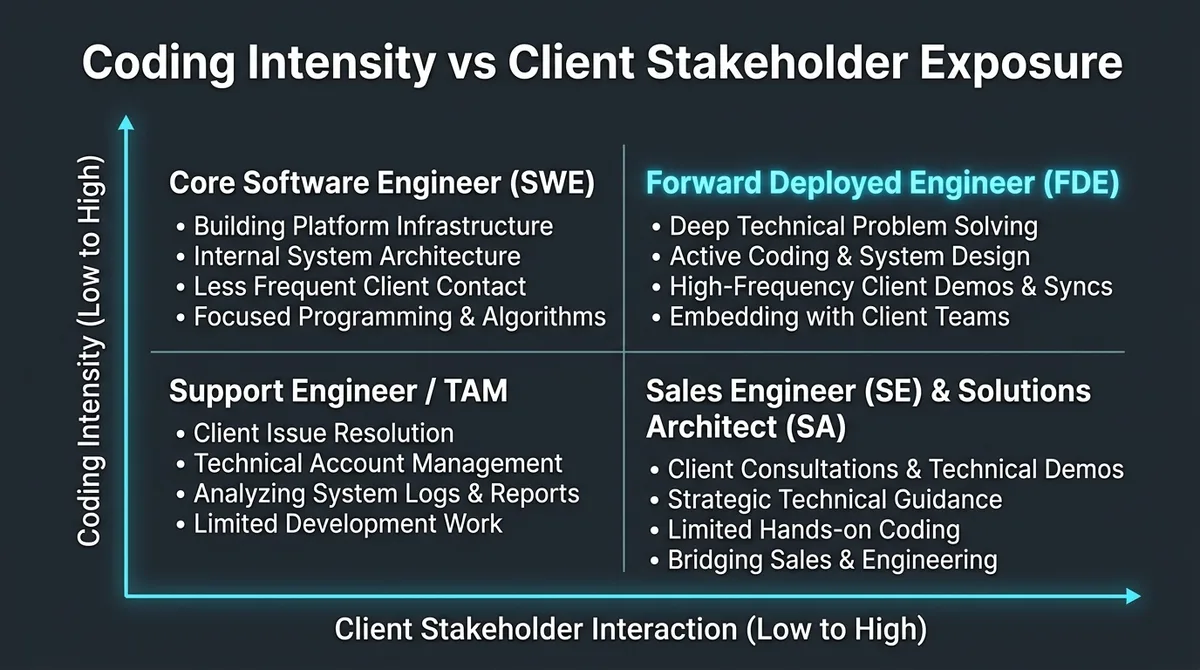 Figure 2: Coding intensity versus client stakeholder interaction across modern technical disciplines.
1. Coding Intensity and Technical Depth
Coding expectations represent the most pronounced difference across these disciplines. A Forward Deployed Engineer spends 60% to 80% of their working hours designing, implementing, and debugging production software. They write tests, manage continuous integration pipelines, and resolve runtime merge conflicts.
A Solutions Architect writes code during approximately 10% to 30% of their working time. Their programming activities consist of illustrative examples, Terraform configuration blocks, and sample snippets designed to guide customer implementation teams.
A Sales Engineer spends 10% to 20% of their time writing code. That code is explicitly temporary. Sales Engineers build lightweight frontends using Streamlit or Retool to prove that an API functions during an evaluation window. They do not build production test suites or optimize long-term database indices.
2. Compensation Structure and Financial Risk
Compensation arrangements reflect distinct organizational incentives and risk tolerances across field engineering roles:
| Role Discipline | Base Salary Ratio | Variable Pay Component | Incentive Trigger | Typical Total Compensation Range |
|---|---|---|---|---|
| Sales Engineer | 60% to 70% Base | 30% to 40% Commission (OTE) | Quarterly closed enterprise software contract revenue | $180,000 to $360,000+ (Uncapped earning potential) |
| Solutions Architect | 80% to 90% Base | 10% to 20% Bonus | Annual account retention, platform consumption, MBOs | $190,000 to $340,000 (Predictable corporate bonus) |
| Forward Deployed Engineer | 70% to 80% Base | 20% to 30% Equity Grants | Technical level milestones, delivery impact, retention | $220,000 to $480,000+ (Liquid public stock or private equity) |
Sales Engineers face the greatest annual earnings variance. Strong quarters with enterprise deal accelerators can yield lucrative commission checks, but economic contractions can suppress income. In contrast, Forward Deployed Engineers enjoy stable engineering salaries coupled with substantial equity compensation, modeled on compensation data documented across the Levels.fyi Software Engineer Compensation Index.
3. Escalation Accountability and Production Stress
The types of professional stress encountered differ significantly across these positions. A Sales Engineer experiences commercial transaction stress. When an enterprise deal approaches the conclusion of the fiscal quarter, the SE must resolve outstanding security objections and prove compliance before deadlines expire. However, once the contract is signed, the SE carries zero production pager obligations.
A Solutions Architect navigates governance and architectural consensus stress. They must balance conflicting technical demands from enterprise security teams, compliance officers, and line-of-business managers.
A Forward Deployed Engineer experiences direct production operational stress. If a customized ETL pipeline fails at 2:00 AM on a Tuesday, or an air-gapped container cluster encounters memory leak panics, the Forward Deployed Engineer is on-call to debug and remediate the issue.
4. Travel Demands and On-Site Immersion
Client proximity expectations vary based on security standards and project complexity. Sales Engineers travel frequently for short business trips, visiting customer headquarters for one or two days to deliver executive briefings and support sales presentations.
Solutions Architects travel on a structured cadence to lead multi-day architecture discovery workshops, cloud migration assessments, and executive steering committee summits.
Forward Deployed Engineers frequently experience high-intensity travel or sustained on-site immersion. In defense, intelligence, and tier-one banking engagements, customer data cannot leave secure private facilities or SCIF environments. FDEs must work physically on-site within client facilities for weeks or months during initial implementation phases.
5. Career Trajectories and Exit Velocity
Each specialization opens distinct future leadership pathways:
- Sales Engineer Exits: Head of Solutions Engineering, Vice President of Pre-Sales, Enterprise Account Executive, or Chief Revenue Officer (CRO).
- Solutions Architect Exits: Chief Architect, Principal Cloud Strategist, VP of Enterprise Architecture, or Chief Technology Officer (CTO).
- Forward Deployed Engineer Exits: Startup Founder, VP of Field Engineering, Head of Product, or Principal Core Infrastructure Engineer.
Because Forward Deployed Engineers combine production coding proficiency with direct customer insight, they frequently transition into successful enterprise founders. For engineers interested in how foundational prompting interfaces relate to field deployment architecture, review our guide on how to become an AI prompt engineer.
How to Choose the Right Technical Career Track for Your Skills
Selecting between these customer-facing engineering roles depends on your preferred balance between software construction, system strategy, and commercial negotiation. Consider these four professional archetypes:
- The Pure Builder (Choose Forward Deployed Engineer): You love writing production software, debugging complex distributed systems, and shipping pull requests. If you are planning a transition into this high-impact track, explore our comprehensive guide on how to become a forward deployed engineer. You want regular client interaction and real-world domain complexity, but you refuse to surrender daily programming responsibilities or carry a sales quota.
- The Systems Visionary (Choose Solutions Architect): You excel at designing expansive multi-cloud topologies, analyzing security governance, and advising executive stakeholders. You prefer high-level architectural whiteboarding over tracking down low-level pointer bugs and edge-case exceptions.
- The Commercial Closer (Choose Sales Engineer): You thrive on the adrenaline of commercial deal cycles, love dynamic product demonstrations, and communicate persuasively with diverse audiences. You appreciate variable commission upside and prefer handing off implementation responsibilities once contracts close.
- The Account Guardian (Choose Customer Engineer or TAM): You enjoy long-term relationship building, operational performance optimization, and helping enterprise teams maintain reliable system operations throughout multi-year contracts.
Use the following four-question diagnostic matrix to clarify your optimal career path:
| Diagnostic Decision Question | If Your Answer Is “Yes” | If Your Answer Is “No” |
|---|---|---|
| 1. Do you want your daily code deployed directly into client production systems? | Pursue Forward Deployed Engineer | Consider Solutions Architect or Sales Engineer |
| 2. Are you comfortable with variable commission pay tied directly to closed sales deals? | Pursue Sales Engineer | Choose Forward Deployed Engineer or Solutions Architect |
| 3. Do you prefer high-level architectural blueprints over troubleshooting runtime bugs? | Pursue Solutions Architect | Focus on Forward Deployed Engineer |
| 4. Do you want to report through the core Engineering organization rather than Sales? | Pursue Forward Deployed Engineer | Pursue Sales Engineer or Solutions Architect |
Frequently Asked Questions About Customer-Facing Engineering Roles
What is the primary difference between a forward deployed engineer and a solutions architect?
A Forward Deployed Engineer writes, tests, and deploys production code directly inside customer codebases and infrastructure environments. A Solutions Architect designs high-level system diagrams, requests for comments (RFCs), and compliance roadmaps without writing production code. FDEs act as embedded software builders, while Solutions Architects serve as technical advisors and strategic system planners.
Does a forward deployed engineer earn sales commissions?
No, Forward Deployed Engineers do not receive sales commissions or carry revenue quotas. Technology firms evaluate and compensate FDEs using standard software engineering compensation schedules that include base salary and company equity grants. Their performance metrics center on deployment success, system stability, and customer retention rather than closed sales revenue.
Is a solutions architect higher than a software engineer?
A Solutions Architect is a parallel technical specialization rather than an automatic promotion above a software engineer. Solutions Architects possess broader expertise across cloud platforms, enterprise compliance, and executive communication. However, senior and staff software engineers maintain greater depth in algorithms, systems programming, and production application architecture.
Which role earns higher total compensation: Sales Engineer or Solutions Architect?
Sales Engineers generally command higher total earnings during favorable economic periods because their compensation includes uncapped sales commission accelerators. Top enterprise Sales Engineers can exceed $350,000 in favorable years. Solutions Architects receive more stable compensation with higher base salaries and predictable annual bonuses, averaging between $190,000 and $340,000.
Can a software engineer transition into a forward deployed engineer role?
Yes, core software engineers transition readily into forward deployed engineering because the underlying programming requirements are equivalent. Successful candidates must cultivate consultative communication skills, comfort with ambiguous client environments, and the ability to diagnose legacy enterprise systems without comprehensive documentation.
What is the difference between a customer engineer vs FDE?
When comparing a customer engineer vs FDE, the customer engineer focuses on steady-state account maintenance, incident triage, and support workflows. In contrast, the forward deployed engineer writes custom software adapters, builds data pipelines, and deploys live services inside customer VPC infrastructure. FDEs drive initial architectural construction, while customer engineers support existing systems long term.
Do forward deployed engineers travel frequently?
Yes, Forward Deployed Engineers often travel extensively, spending 25% to 50% of their time on-site with clients. Engagements in defense, healthcare, and financial services often require engineers to work inside air-gapped facilities and private data centers where remote access is prohibited.
Why do leading AI labs prioritize forward deployed engineers over sales engineers?
Leading artificial intelligence labs hire Forward Deployed Engineers because foundation models cannot provide business value without deep enterprise integration. Enterprise clients struggle with legacy data pipelines, vector database synchronization, and private network routing. FDEs possess the engineering expertise required to write custom code and bridge these technical gaps. To learn how field teams implement these systems in production, explore our guide on forward deployed AI engineering enterprise deployment.
Summary and Career Roadmap
The modern enterprise software ecosystem requires distinct technical disciplines to guide customers from exploratory evaluation to live production adoption. Sales Engineers establish technical feasibility and win commercial agreements. Solutions Architects design secure, resilient multi-cloud blueprints. Forward Deployed Engineers step into messy enterprise codebases to build, test, and ship live software.
Neither role is universally superior; each serves a vital, differentiated purpose within technology enterprises. As artificial intelligence architectures grow increasingly sophisticated, the engineers who combine production programming depth with customer empathy will command extraordinary influence.
If you are eager to build hands-on field deployment expertise, master distributed systems, and prepare high-signal demonstrations for technical hiring teams, begin by building AI portfolio projects that get you hired.