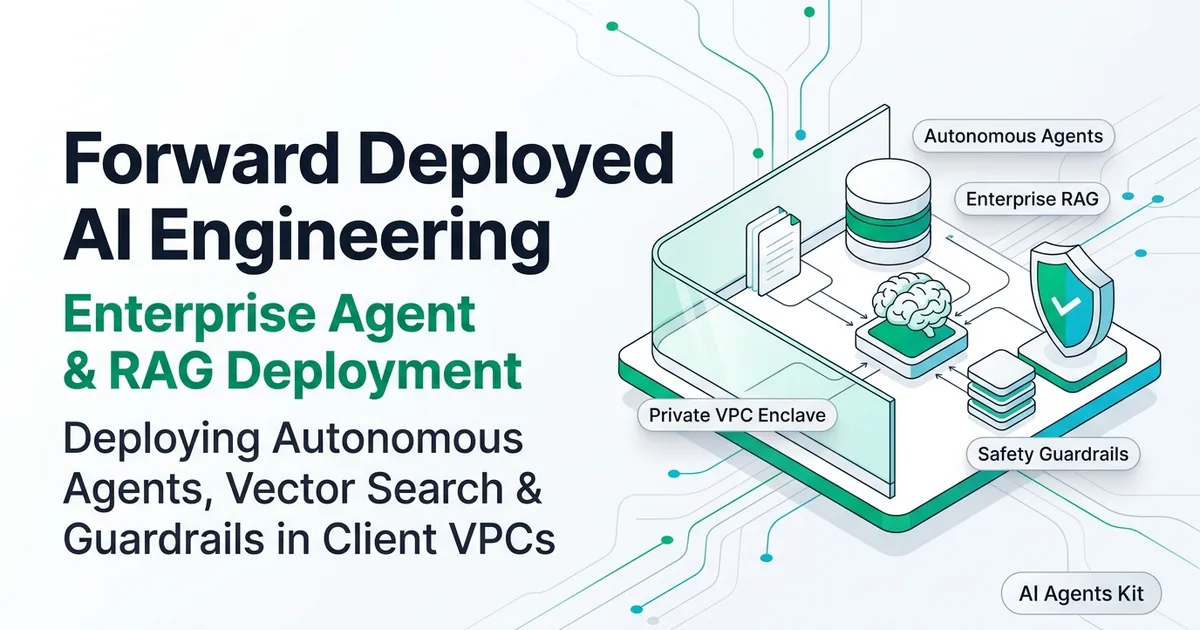
Forward Deployed AI Engineering: Deploying Agents and RAG in Enterprise Environments
Master forward deployed AI engineering. Learn how to deploy autonomous AI agents and air-gapped RAG pipelines inside complex enterprise infrastructures.
Deploying generative models in enterprise environments presents challenges that standard tutorials and software development kits rarely address. While prototype demonstrations function reliably in clean cloud sandboxes, enterprise deployments must operate inside locked-down subnets, adhere to strict regulatory compliance, and query decades of fragmented corporate records.
Industry research reveals that between 80% and 95% of enterprise generative artificial intelligence pilots stall before reaching scaled production. The primary bottleneck is not model capability, but the structural difficulty of integrating non-deterministic intelligence into legacy transaction systems.
Bridging this gap requires specialized engineering practices centered on security, resilience, and operational empathy. For an end-to-end overview of field engineering career tracks and core competencies, read our comprehensive Forward Deployed Engineer guide.
Key Takeaways
- The forward deployed AI engineer solves the implementation crisis by turning fragile prototype models into resilient enterprise systems.
- Enterprise deployments fail primarily from dirty siloed data, air-gapped network perimeters, runaway latency budgets, model drift, and regulatory exposure.
- Production-grade retrieval-augmented generation relies on Pre-Retrieval Identity Injection and hybrid search fusing dense vectors with sparse lexical rankings.
- Autonomous agent wrappers require defense-in-depth architectures featuring automated PII redaction, token budgets, exponential retries, and strict schema validation.
1. The Enterprise AI Reality Check: The Implementation Crisis
The rapid evolution of frontier foundation models has created a false expectation among executive leaders that generative software deploys effortlessly. Corporate leadership frequently expects that buying API subscriptions or provisioning managed cloud instances is sufficient to automate complex business workflows.
In practice, organizations encounter the harsh realities of enterprise software architecture. Proprietary databases do not possess clean vector indices, network firewalls reject outbound internet traffic, and data privacy officers prohibit sending client records to public endpoints.
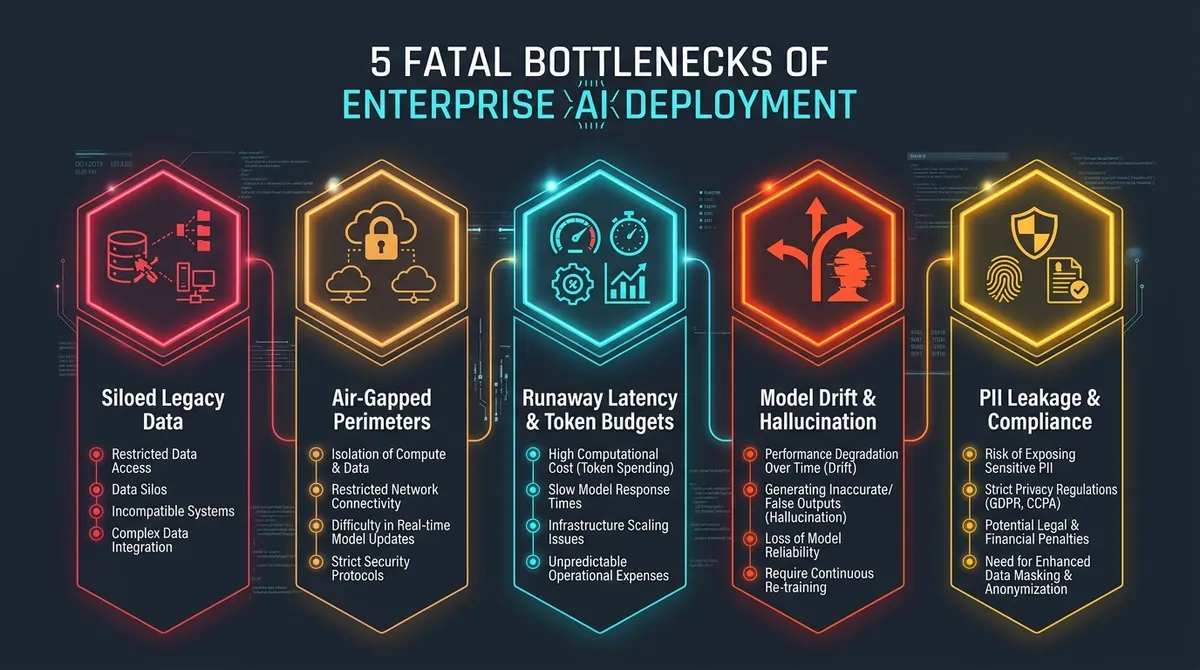 Figure 2: The five primary operational roadblocks encountered when transitioning from prototype to production.
This operational friction has elevated the strategic importance of the forward deployed AI engineer. Unlike traditional machine learning engineers who work in centralized research laboratories focusing on loss functions and training runs, field engineers embed directly inside customer environments.
They practice last mile ai engineering, transforming unformatted documents and fragile business logic into dependable automated services. To understand the architectural anatomy of these intelligent systems, explore our guide on autonomous AI agents architecture and capabilities.
The Prototype vs. Production Chasm
The difference between a functional proof-of-concept and an enterprise-grade agent deployment spans several critical dimensions. Teams that fail to recognize these differences find their deployments canceled during initial security audits.
| Architectural Dimension | Notebook Proof-of-Concept | Enterprise Production System |
|---|---|---|
| Data Ingestion | Clean static PDFs and formatted CSV files | Unstructured SharePoint lakes, SAP exports, and legacy SQL |
| Network Egress | Direct HTTPS calls to public commercial APIs | Air-gapped VPCs, mutual TLS, and zero internet connectivity |
| Access Governance | Single administrative API token | Pre-retrieval identity injection with SAML and Active Directory |
| Error Handling | Unhandled exceptions and manual terminal restarts | Circuit breakers, exponential retries, and dead-letter queues |
| Latency Profiles | Unconstrained 15-to-45 second reasoning loops | Strict sub-second service level agreements for customer interfaces |
| Audit Verification | Ephemeral console print statements | Cryptographic append-only ledgers and verifiable citations |
2. The 5 Fatal Roadblocks of Enterprise AI Deployments
Navigating enterprise client deployments requires anticipating where software breaks. Forward deployed engineers design architectures specifically to withstand the five fatal roadblocks that derail enterprise initiatives.
Securing customer environments against vulnerabilities requires disciplined system controls. For a detailed breakdown of defense mechanisms, review our comprehensive resource on enterprise AI agent security best practices.
1. Siloed, Unstructured, and Dirty Legacy Data
Enterprise knowledge is rarely organized neatly. Useful operational context lives buried inside decades-old enterprise resource planning systems, internal wiki pages, and email archives.
Furthermore, duplicate files, contradictory policy memos, and obsolete spreadsheets pollute corporate repositories. Naive ingestion pipelines convert this conflicting data directly into vector embeddings, leading to confident hallucinations and erroneous business decisions.
2. Air-Gapped Perimeters and Sovereign Zero-Egress Networks
Organizations in national defense, investment banking, and healthcare operate under strict information security mandates. These companies prohibit corporate intellectual property, employee communications, or customer records from leaving their private subnets.
Public inference endpoints from commercial model providers are completely off-limits. Field engineers must build air gapped ai architecture where ingestion, embeddings, vector indexing, and model inference run on self-hosted infrastructure.
3. Runaway Latency Budgets and Unbounded Token Consumption
Autonomous agents utilize multi-step planning loops, generating intermediate thoughts and tool calls to solve user requests. In uncontrolled environments, these loops frequently trigger cascading API queries.
A complex user query can trigger fifteen recursive tool invocations, consuming over 80,000 tokens and taking two minutes to return a response. In production, this behavior burns infrastructure budgets and frustrates enterprise operators expecting rapid software responses.
4. Non-Deterministic Output Drift and Edge-Case Degradation
Traditional software engineering relies on deterministic execution paths where identical inputs yield identical outputs. In contrast, large language models exhibit subtle behavioral variance across temperature settings, system prompt modifications, and library version changes.
A prompt template that processes financial balance sheets successfully in January can fail silently in March when quarterly reporting formats change slightly. Without continuous offline evaluation suites, field deployments degrade unnoticed.
5. Sensitive Data Exposure and Regulatory Governance
Regulatory frameworks such as the European Union AI Act, the NIST AI Risk Management Framework, HIPAA, and SOC 2 Type II enforce strict data protection guidelines. Deploying ai agents enterprise environments requires guaranteeing that Personally Identifiable Information (PII) is never logged in plaintext or retained in model weights.
Field systems must guarantee that users can only query information they have explicit clearance to view. A customer service representative must never receive an AI completion containing executive executive compensation data, even if the model ingested company-wide payroll databases.
3. Architectural Blueprint: The 4-Tier Forward Deployed Agent Stack
To overcome these operational challenges, forward deployed teams build modular systems that enforce security and reliability at every execution stage. Rather than coupling model logic directly with user interfaces, enterprise architectures separate responsibilities across four distinct tiers.
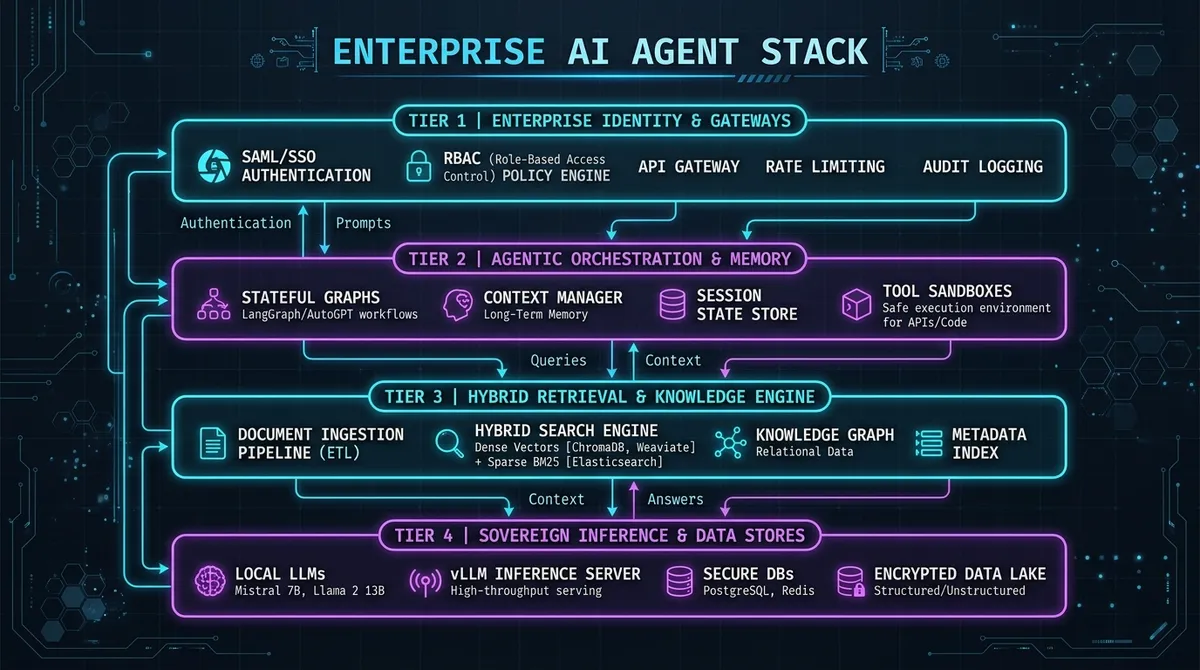 Figure 1: The four-tier architectural framework for deploying resilient AI agents inside enterprise perimeters.
Standardizing the interfaces between agents and enterprise data sources prevents custom development bottlenecks. If you are designing scalable tool adapters, review the open Model Context Protocol server specifications to build interoperable connectors. Specifications detailed in the Anthropic Model Context Protocol specification offer a standardized client-server model for enterprise tools.
[ Tier 1: Identity & Policy Enforcement ]
  - SAML 2.0 / OIDC Session Validation
  - Pre-Retrieval Identity Injection (ABAC / RBAC)
  - Ingress Rate Limiting & Prompt Sanitization
                   │
                   ▼
[ Tier 2: Agentic Orchestration & Memory ]
  - Stateful Graph Execution Engine
  - Episodic & Working Session Memory
  - Human-in-the-Loop Approval Gates
                   │
         ┌─────────┴─────────┐
         ▼                   ▼
[ Tier 3: Knowledge Engine ] [ Tier 4: Sovereign Inference ]
  - Hybrid Search (Dense+BM25) - Air-Gapped Model Serving
  - Reciprocal Rank Fusion      - PagedAttention (vLLM)
  - Document Lineage Ledger     - Quantized Model Weights
Tier 1: Enterprise Identity, Gateways, and Policy Enforcement
The outer perimeter authenticates incoming requests using enterprise Single Sign-On protocols such as SAML 2.0 or OpenID Connect. The gateway extracts verified user identity tokens, department memberships, and security clearance levels.
Instead of passing user queries directly to the model, Tier 1 sanitizes input strings, filtering malicious prompt injection patterns and toxic characters. It tracks rate limits and API quotas per organization before routing requests downstream.
Tier 2: Agentic Orchestration and Stateful Execution
Tier 2 manages the cognitive execution flow. Using stateful graph frameworks, the orchestration engine breaks high-level goals into discrete reasoning steps, maintaining conversation checkpoints and working memory.
Crucially, this tier manages tool execution boundaries. When an agent decides to call an enterprise API, such as processing an invoice refund or modifying an insurance policy, Tier 2 verifies authorization boundaries and enforces human approval checks for destructive mutations.
Tier 3: Hybrid Retrieval and Vector Knowledge Storage
Tier 3 serves as the institutional memory of the enterprise. It ingests corporate documentation through automated extract, transform, and load (ETL) pipelines, converting raw files into structured embeddings.
To prevent unauthorized data access, Tier 3 uses Pre-Retrieval Identity Injection. The user security attributes verified at Tier 1 are passed directly into the vector database search query, mathematically excluding unauthorized records before vector calculations begin.
Tier 4: Sovereign Inference and Persistent Storage
The foundation tier hosts model inference and storage systems. In air-gapped environments, Tier 4 runs open-weights models inside isolated virtual private clouds using optimized inference engines like vLLM. Engineers can consult the vLLM open-source inference engine repository for high-concurrency production deployments.
All interactions, model completions, system prompts, and tool outputs write to an append-only, tamper-evident audit ledger. This guarantees complete forensic traceability for compliance audits and internal performance reviews.
4. Air-Gapped RAG Architecture: From Notebook to Sovereign Subnets
Building an enterprise rag deployment inside an air-gapped network requires reconsidering every standard retrieval assumption. In consumer applications, developers rely on cloud embeddings and approximate nearest-neighbor vector search.
In enterprise corporate environments, pure vector similarity fails. Enterprise users frequently search for specific invoice serial numbers, legal statute sections, or engineering part codes. Vector embeddings map these exact alphanumeric tokens to broad semantic clusters, resulting in low precision.
Preparing for the technical complexities of enterprise deployment requires solid foundational knowledge. Review our practical forward deployed engineer roadmap and skill stack to master the underlying systems engineering skills. Furthermore, consult the Kubernetes Architecture concepts guide for deploying stateful clusters within air-gapped corporate perimeters.
Why Pure Dense Retrieval Fails in Enterprise Environments
Dense vector models excel at semantic conceptual matching, such as connecting “automobile repairs” to “car engine maintenance.” However, enterprise documents contain dense technical jargon and exact alphanumeric identifiers.
For instance, an aerospace engineer searching for “Part A-492-X Bolt Failure” receives poor results from pure semantic search. The embedding model evaluates the generic concepts of “bolt” and “failure” rather than matching the exact alphanumeric serial number “A-492-X.”
The Solution: Hybrid Search with Reciprocal Rank Fusion
Production air-gapped retrieval systems combine dense semantic embeddings with sparse lexical keyword matching using the BM25 algorithm. Both retrieval passes run in parallel across the on-premises document repository, and their results fuse using Reciprocal Rank Fusion (RRF).
The Reciprocal Rank Fusion score for a document $d$ across a set of retrieval systems $R$ is calculated as:
$$RRF_Score(d) = \sum_{r \in R} \frac{1}{k + rank_r(d)}$$
Where $k$ is a smoothing constant, typically set to 60. By summing reciprocal ranks, documents that score exceptionally well in keyword matching or semantic similarity rise to the top of the context window.
Incoming User Query: "Replace sensor module SN-8812 on pump 4"
                       │
       ┌───────────────┴───────────────┐
       ▼                               ▼
[ Dense Vector Search ]      [ Sparse BM25 Search ]
  (Semantic Concepts)          (Exact Alphanumeric Match)
  Top 20 Semantic Hits         Top 20 Lexical Hits
       │                               │
       └───────────────┬───────────────┘
                       ▼
         [ Reciprocal Rank Fusion ]
           (Unified Rank Scoring)
                       │
                       ▼
         [ Cross-Encoder Reranker ]
           (Top 5 Context Chunks)
                       │
                       ▼
       [ Local Air-Gapped LLM Inference ]
Pre-Retrieval Identity Injection Mechanics
In naive RAG tutorials, systems search the entire document database, retrieve the top ten chunks, and then filter out files the user lacks permission to view. This approach is unacceptable in enterprise environments for two reasons:
- Information Starvation: If nine of the top ten retrieved chunks belong to confidential files, post-filtering leaves the model with only one chunk to formulate an answer, causing low-quality responses.
- Context Window Leakage: Post-filtering logic can accidentally expose document titles, metadata headers, or file paths in error messages, leaking internal organizational intelligence.
Forward deployed engineers implement Pre-Retrieval Identity Injection. The user identity claims (such as Active Directory security groups: ["Finance-L2", "Risk-Analyst", "Region-EMEA"]) are injected directly into the database query filter:
{
  "query_vector": [0.024, -0.081, 0.142, "..."],
  "filter": {
    "and": [
      { "security_classification": { "lte": 3 } },
      { "authorized_groups": { "in": ["Finance-L2", "Risk-Analyst"] } },
      { "geographic_region": { "in": ["EMEA", "GLOBAL"] } }
    ]
  },
  "top_k": 5
}
The database applies the boolean security filter before performing nearest-neighbor calculations. The vector search runs exclusively against documents the user is legally permitted to inspect.
5. Production Code Implementation: The Resilient Enterprise Agent Adapter
Forward deployed AI engineers build resilient integration adapters that sit between raw models and client applications. These adapters protect enterprise backends from malformed outputs, redact sensitive information, track token consumption, and manage intermittent network faults.
Evaluating framework choices is an essential step when building custom agent wrappers. Explore our comparative analysis of PydanticAI vs LangChain vs LangGraph framework comparison to choose the right foundation for your stack. For schema validation standards, refer to the Pydantic official documentation to design resilient data models.
The following executable Python implementation demonstrates production-grade enterprise resilience patterns. It features regex-based PII redaction, Pydantic schema validation, token budgeting, and exponential backoff retry mechanics with full jitter.
"""
Resilient Enterprise Agent Adapter.
Demonstrates PII redaction, schema validation, token governance, and retries.
"""

from typing import Dict, Any, List, Optional
import re
import time
import random
import logging
from pydantic import BaseModel, Field, ValidationError

logging.basicConfig(level=logging.INFO, format="%(asctime)s [%(levelname)s] %(message)s")
logger = logging.getLogger("EnterpriseAgentAdapter")


class EnterpriseAnalysisOutput(BaseModel):
    """Defines strict schema structure for agentic business recommendations."""
    incident_id: str = Field(..., min_length=4, description="Unique operational incident identifier")
    severity_level: str = Field(..., pattern=r"^(CRITICAL|HIGH|MEDIUM|LOW)$")
    root_cause_summary: str = Field(..., min_length=20, max_length=500)
    recommended_actions: List[str] = Field(..., min_items=1, max_items=5)
    confidence_score: float = Field(..., ge=0.0, le=1.0)
    estimated_remediation_hours: float = Field(..., ge=0.5, le=120.0)


class SecurityRedactor:
    """Sanitizes text inputs and outputs to prevent PII leakage."""

    EMAIL_PATTERN = re.compile(r"\b[A-Za-z0-9._%+-]+@[A-Za-z0-9.-]+\.[A-Z|a-z]{2,7}\b")
    SSN_PATTERN = re.compile(r"\b\d{3}-\d{2}-\d{4}\b")
    CREDIT_CARD_PATTERN = re.compile(r"\b(?:\d{4}[-\s]?){3}\d{4}\b")

    @classmethod
    def redact_pii(cls, text: str) -> str:
        """Replaces sensitive patterns with generic privacy redaction tokens."""
        text = cls.EMAIL_PATTERN.sub("[REDACTED_EMAIL]", text)
        text = cls.SSN_PATTERN.sub("[REDACTED_SSN]", text)
        text = cls.CREDIT_CARD_PATTERN.sub("[REDACTED_CARD]", text)
        return text


class TransientModelSocketError(Exception):
    """Raised when on-premises model server experiences an intermittent network timeout."""
    pass


class EnterpriseAgentAdapter:
    """Manages input redaction, model interaction, retries, and schema validation."""

    def __init__(self, token_budget: int = 10000, max_retries: int = 3, base_backoff_sec: float = 0.5):
        self.token_budget = token_budget
        self.tokens_consumed = 0
        self.max_retries = max_retries
        self.base_backoff_sec = base_backoff_sec
        self.dead_letter_records: List[Dict[str, Any]] = []

    def _mock_model_inference_call(self, prompt: str, fail_rate: float = 0.25) -> Dict[str, Any]:
        """Simulates local model inference call with token consumption and occasional network drops."""
        # Check token budget governor
        estimated_tokens = len(prompt.split()) * 2 + 150
        if self.tokens_consumed + estimated_tokens > self.token_budget:
            raise RuntimeError(f"Token budget exceeded. Consumed: {self.tokens_consumed}, Requested: {estimated_tokens}")

        self.tokens_consumed += estimated_tokens

        # Simulate network socket flakiness
        if random.random() < fail_rate:
            raise TransientModelSocketError("504 Gateway Timeout: Local vLLM worker disconnected")

        # Return simulated JSON payload
        return {
            "incident_id": "INC-8892",
            "severity_level": "HIGH",
            "root_cause_summary": "Upstream database connection pool exhausted due to unindexed join queries.",
            "recommended_actions": [
                "Deploy temporary read replica to relieve transactional load",
                "Apply missing composite index on telemetry table",
                "Restart application connection pool with strict keep-alive limits"
            ],
            "confidence_score": 0.94,
            "estimated_remediation_hours": 3.5
        }

    def execute_resilient_analysis(self, raw_incident_text: str) -> Optional[EnterpriseAnalysisOutput]:
        """Runs end-to-end sanitized inference workflow with retries and output validation."""
        # Step 1: Pre-inference PII redaction
        clean_input = SecurityRedactor.redact_pii(raw_incident_text)
        logger.info("Executing analysis on sanitized input (Length: %d chars)", len(clean_input))

        # Step 2: Resilient inference call loop
        raw_output = None
        for attempt in range(1, self.max_retries + 1):
            try:
                raw_output = self._mock_model_inference_call(clean_input)
                logger.info("Inference succeeded on attempt %d", attempt)
                break
            except TransientModelSocketError as err:
                if attempt == self.max_retries:
                    logger.error("All %d inference retries exhausted: %s", self.max_retries, err)
                    self._route_to_dead_letter(clean_input, reason=str(err))
                    return None

                sleep_duration = self.base_backoff_sec * (2 ** (attempt - 1)) + random.uniform(0, 0.1)
                logger.warning("Attempt %d failed. Retrying in %.2f seconds...", attempt, sleep_duration)
                time.sleep(sleep_duration)

        if not raw_output:
            return None

        # Step 3: Strict Schema Validation
        try:
            validated_result = EnterpriseAnalysisOutput(**raw_output)
            logger.info("Output successfully validated against schema. Confidence: %.2f", validated_result.confidence_score)
            return validated_result
        except ValidationError as err:
            logger.error("Output schema validation failure: %s", err.errors())
            self._route_to_dead_letter(raw_output, reason=f"ValidationError: {str(err)}")
            return None

    def _route_to_dead_letter(self, data: Any, reason: str) -> None:
        """Stores unprocessable items in an internal dead-letter queue for forensic review."""
        entry = {
            "payload": data,
            "timestamp": time.time(),
            "reason": reason
        }
        self.dead_letter_records.append(entry)
        logger.error("Transaction routed to Dead-Letter Queue. Total DLQ items: %d", len(self.dead_letter_records))


# Verification run
if __name__ == "__main__":
    sample_text = (
        "Server outage reported by user john.doe@enterprise-corp.com (SSN: 000-12-3456). "
        "Postgres cluster experiencing memory pressure and locking transactions."
    )

    adapter = EnterpriseAgentAdapter(token_budget=5000, max_retries=3, base_backoff_sec=0.1)
    outcome = adapter.execute_resilient_analysis(sample_text)

    if outcome:
        print("\nValidated Incident Recommendation:")
        print(f"Severity: {outcome.severity_level}")
        print(f"Summary: {outcome.root_cause_summary}")
        print(f"Remediation Time: {outcome.estimated_remediation_hours} hours")
        print(f"Total Tokens Used: {adapter.tokens_consumed}")
Architectural Insights from the Implementation
- Defensive Redaction at Ingress: Notice that PII redaction executes prior to passing prompts into the model. This guarantees that customer private data never enters prompt memory buffers or log aggregators.
- Token Budget Governor: The adapter validates remaining token capacity before initiating network calls. If a malfunctioning agent enters an infinite loop, the governor terminates execution before triggering budget overruns.
- Structured Pydantic Contract: The model completion is coerced into an explicit
EnterpriseAnalysisOutputmodel. If the language model outputs hallucinated fields or invalid status strings, the validation layer intercepts the error and routes the payload to the dead-letter queue.
6. Tool-Calling Security and Defense-in-Depth for Enterprise Agents
Giving an autonomous language model the capability to call external application programming interfaces introduces substantial security risks. In laboratory settings, agents freely query databases, execute terminal scripts, and send emails.
In enterprise production environments, an unconstrained agent poses an existential threat to data integrity. A model that misunderstands a prompt could drop active database tables, approve fraudulent transactions, or broadcast confidential documents to public mailing lists.
Forward deployed engineers implement strict defense-in-depth principles when connecting agents to corporate backends.
Incoming Model Tool Invocation Request
                   │
                   ▼
[ Static Security Policy Inspection ]
  - Is the requested action Read-Only or Mutating?
                   │
         ┌─────────┴─────────┐
         ▼                   ▼
  [ Read-Only Action ]   [ Mutating Action ]
  - SELECT queries       - UPDATE, DELETE, POST
  - Document lookups     - Financial transfers
         │                   │
         │                   ▼
         │         [ Human-in-the-Loop Gateway ]
         │         - Requires verified operator sign-off
         │         - Two-Phase Transaction Lock
         │                   │
         └─────────┬─────────┘
                   ▼
    [ Ephemeral Sandbox Container ]
    - Network isolated, zero internet access
    - Least-privilege database credentials
                   │
                   ▼
    [ Cryptographic Execution Log ]
1. Separation of Read-Only vs. Mutating Operations
Enterprise tools must be split into two distinct security categories:
- Read-Only Tools: Operations that inspect state without modifying underlying records, such as retrieving product documentation, querying ticket status, or viewing account balances. These tools execute autonomously under standard rate limits.
- Mutating Tools: Operations that alter records, delete data, or initiate financial transactions. Examples include updating customer billing addresses, transferring funds, or provisioning cloud servers.
2. Human-in-the-Loop Approval and Two-Phase Commits
Mutating actions must never execute autonomously based solely on model reasoning. When an agent determines that an account record requires modification, it generates a staged transaction proposal.
The system issues an approval ticket to a human operator through an enterprise portal. The human reviewer inspects the proposed parameters, validates the business justification, and signs off cryptographically. Only upon receiving verified operator approval does the agent execute the mutation.
3. Ephemeral Sandboxes and Least-Privilege Execution
Code execution tools, such as Python interpreters used for data analysis, must run inside locked-down, ephemeral microVMs or container sandboxes.
The execution container must lack outbound internet access, mount only temporary in-memory file systems, and execute under restricted user privileges. If a user attempts prompt injection to read host system files, the sandbox boundaries contain the exploit completely.
7. Evaluation, Regression Guardrails, and Model Drift Monitoring
Once an enterprise agent system is active in production, the engineering mission shifts from initial integration to continuous reliability monitoring. Software that operates in evolving enterprise environments faces continuous data schema updates, changing user behaviors, and subtle model drift.
Preparing for senior field engineering roles requires mastering evaluation methodologies alongside systems design. To review common technical prompts and calibration standards, explore our guide on forward deployed engineer interview questions and decomposition rubrics.
The RAG Triad for Automated Performance Evaluation
Forward deployed teams deploy automated evaluation pipelines that grade production completions without relying on expensive manual labeling. The foundation of this evaluation methodology is the RAG Triad:
                  [ User Query ]
                    ▲        ▲
                   /          \
  Context Relevance            Answer Relevance
                 /              \
                ▼                ▼
     [ Retrieved Context ] ────▶ [ Generated Answer ]
                ▲
                 \
             Faithfulness
                   \
(Grounding)- Context Relevance: Measures whether the document chunks retrieved by the search engine actually contain the facts needed to answer the user query. Low relevance scores indicate poor chunking boundaries or suboptimal vector embeddings.
- Faithfulness (Grounding): Measures whether every statement in the generated answer can be mathematically traced back to the retrieved context. If an answer makes claims not present in the context, it receives a low faithfulness score, signaling a hallucination.
- Answer Relevance: Measures whether the model completion directly answers the original user prompt rather than wandering off-topic or returning generic boilerplate text.
Continuous Telemetry and Operational Quality Metrics
In addition to algorithmic evaluations, field teams monitor real-world user interaction telemetry to detect subtle workflow friction:
- Implicit Feedback Signals: Track how often corporate users copy generated outputs to their clipboard, how many characters they edit before submitting drafts, and how frequently they abandon automated workflows to complete tasks manually.
- Latency Distribution Percentiles: Measure end-to-end response times across 50th, 95th, and 99th percentiles. A spike in p99 latency typically signals vector database memory fragmentation or queuing delays in local inference servers.
- Fallback Trigger Rates: Track the percentage of user requests that trigger fallback logic, dead-letter routing, or human intervention. An unexpected increase in fallback rates indicates upstream corporate database schema drift.
8. Frequently Asked Questions (PAA & Search Intent)
What does a Forward Deployed AI Engineer do?
A Forward Deployed AI Engineer is an embedded software engineer who builds, integrates, and customizes artificial intelligence systems inside customer environments. Rather than training models in research laboratories, they connect algorithms to enterprise databases, secure air-gapped infrastructure, and build resilient agentic workflows.
Why do most enterprise AI agent pilots fail?
Enterprise AI agent pilots fail primarily because of the learning gap between clean notebook prototypes and chaotic corporate production environments. Siloed legacy data, firewall restrictions, excessive latency, and compliance hurdles prevent unvetted prototypes from surviving enterprise security audits.
How do you deploy AI agents in air-gapped environments?
Deploying AI agents in air-gapped environments requires hosting the entire software stack within an isolated private network with zero outbound internet connectivity. Field engineers package container images and open-weights models into signed offline bundles, serving them using high-throughput local inference engines like vLLM on internal GPU clusters.
What is Pre-Retrieval Identity Injection in enterprise RAG?
Pre-Retrieval Identity Injection is a security pattern where verified user authorization claims are injected directly into vector database query filters before search execution. This guarantees that the retrieval engine only searches documents the user is legally permitted to access, eliminating context starvation and data leakage.
Why is hybrid search mandatory for enterprise retrieval?
Hybrid search is mandatory because dense semantic vectors fail to match exact alphanumeric tokens such as invoice numbers, error codes, and technical acronyms. Fusing dense semantic embeddings with sparse lexical BM25 rankings via Reciprocal Rank Fusion provides a 15% to 25% lift in retrieval accuracy.
How do Forward Deployed AI Engineers prevent prompt injection?
Field engineers prevent prompt injection by implementing defense-in-depth security layers rather than relying on system prompt instructions. They sanitize inputs through deterministic token filters, segregate untrusted external data from instructions, enforce strict Pydantic output schemas, and execute tools inside isolated sandboxes.
What frameworks are best for enterprise agentic orchestration?
Stateful graph frameworks like LangGraph and PydanticAI are standard for enterprise agentic orchestration due to explicit state persistence and cyclic routing. These frameworks allow engineers to define deterministic execution boundaries, transaction rollbacks, and human-in-the-loop approval checkpoints.
How do enterprises monitor agent performance and model drift?
Enterprises monitor agent performance through automated offline test suites using the RAG Triad alongside real-time production telemetry. Field teams track token consumption, p99 latency percentiles, user edit distances, and fallback trigger rates to detect operational degradation early.
9. Conclusion: The Future of Field AI Engineering
Deploying generative intelligence into complex enterprise landscapes represents one of the most demanding engineering frontiers of the modern technology era. Success is not achieved by chasing larger foundation models or adding elaborate prompt instructions to fragile web wrappers.
Real-world enterprise impact requires rigorous software craftsmanship. It demands building defensive data validation layers, mastering sovereign air-gapped architectures, enforcing strict tool security boundaries, and designing systems that treat non-deterministic intelligence with disciplined engineering skepticism.
As organizations transition from experimental technology evaluations to permanent operational adoption, the forward deployed AI engineer remains the indispensable human bridge. By mastering these architectural blueprints and deployment patterns, you position yourself at the absolute forefront of applied enterprise artificial intelligence.