PDF Parsing & Document OCR for LLMs: Complete Production RAG Ingestion Guide (2026)
Complete architectural guide to PDF parsing and document OCR for RAG. Compare Docling, Marker, MinerU, LlamaParse, table chunking, and ColPali vision.
When enterprise data engineering teams deploy Retrieval-Augmented Generation systems, they spend months optimizing vector embeddings, fine-tuning rerankers, and writing complex agent prompts. Yet despite these sophisticated components, systems frequently deliver wrong answers, hallucinate financial metrics, and miss critical paragraphs.
The root cause almost never lies in the language model. It occurs at the document ingestion boundary when choosing the best pdf parser for rag pipelines. When raw PDF byte streams are flattened into disorganized text strings, reading orders scramble across multi-column layouts and tabular rows lose their column coordinates.
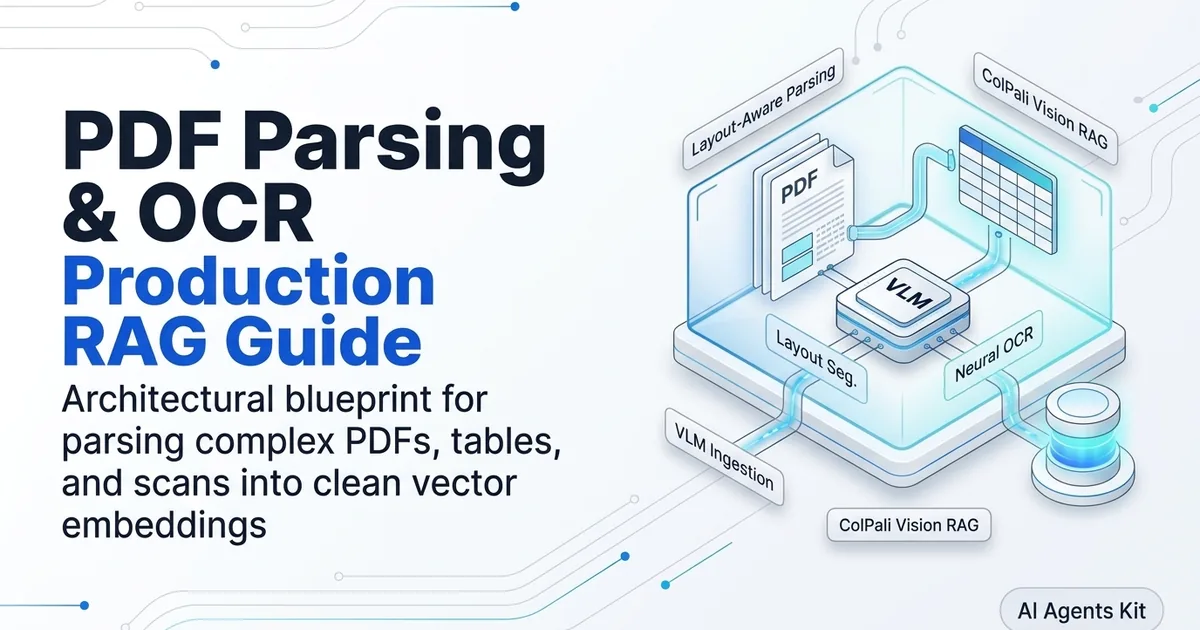
This definitive architectural guide provides a blueprint for engineering high-reliability document ingestion systems. We examine the four core parsing paradigms, evaluate the dominant open-source and cloud frameworks, design structure-aware table chunking pipelines, and explore the vision-RAG shift powered by ColPali.
Key Takeaways
- The Ingestion Bottleneck: Document extraction errors account for up to 41% of downstream RAG retrieval failures, making layout-aware parsing far more impactful than embedding model upgrades.
- Four Architectural Paradigms: Enterprise systems span Rule-Based Extractors, Deep Learning Layout Parsers, Multimodal VLM Parsers, and End-to-End Vision Retrieval.
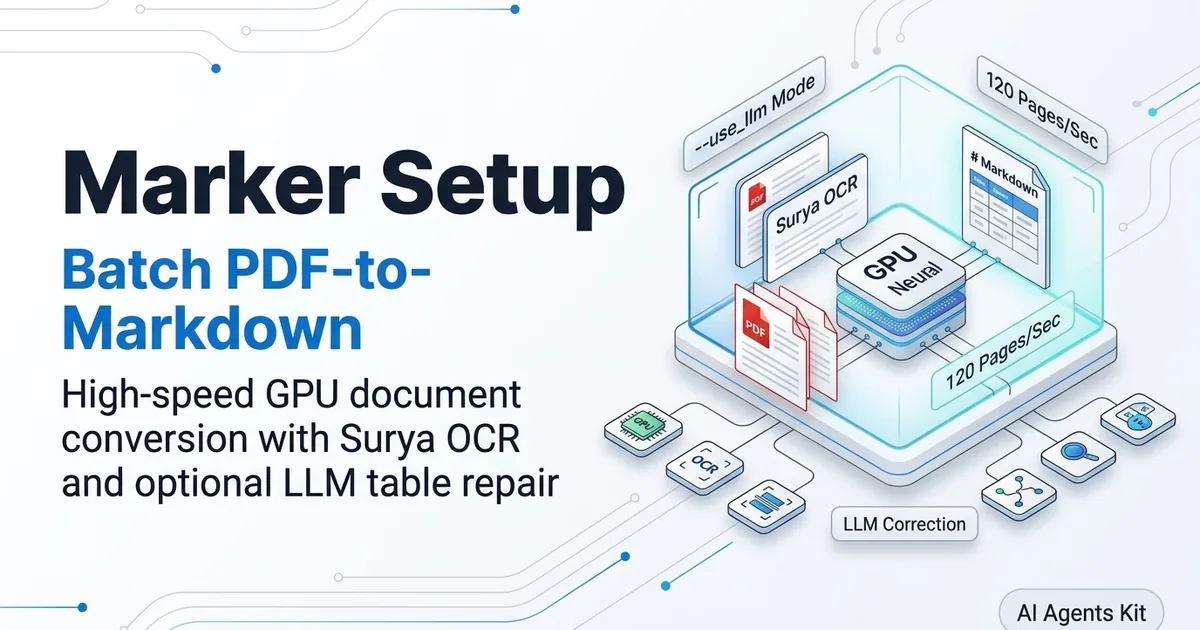
- The Open-Source Triad: IBM Docling provides the permissive MIT enterprise baseline, Marker delivers 120 pages/sec GPU throughput, and OpenDataLab MinerU leads academic benchmarks on LaTeX formulas.
- Context-Enriched Chunking: Deploying header injection and Parent Document retrievers preserves tabular context, increasing retrieval cosine similarity from 0.62 to 0.91.
- ColPali Paradigm Shift: Bypasses text parsing completely by indexing raw document page images with late-interaction vision embeddings, scoring 92.8% on the ViDoRe benchmark.
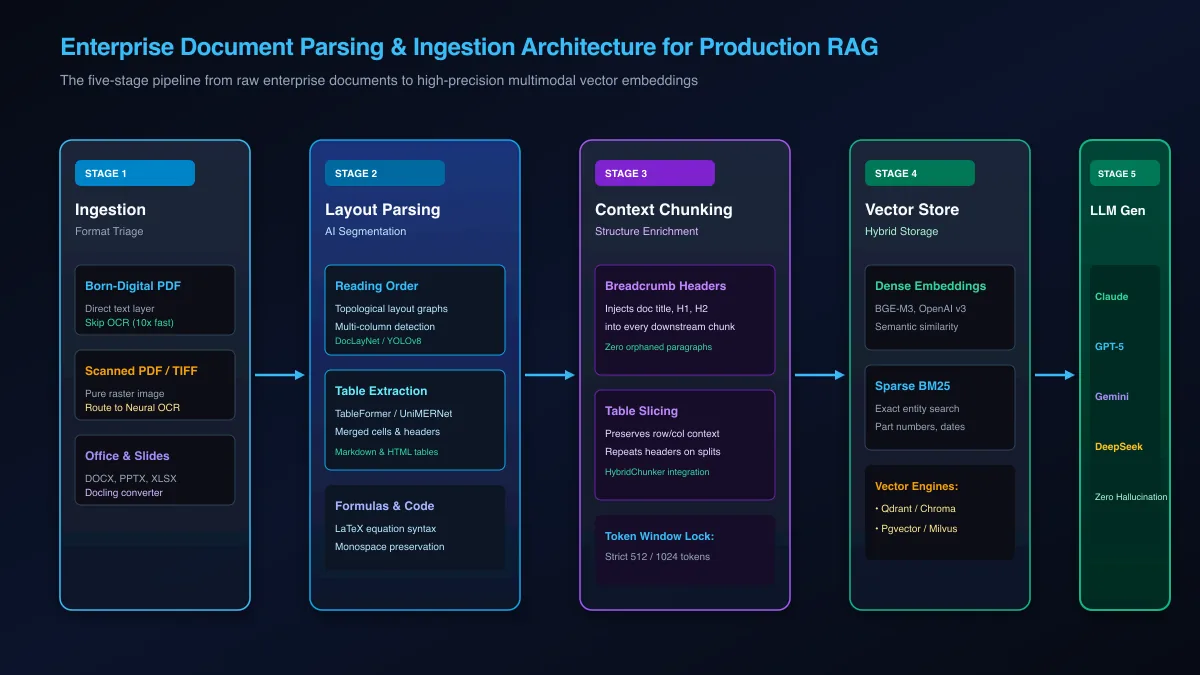 Figure 1: End-to-end enterprise document ingestion pipeline illustrating format triage, layout segmentation, structure-aware chunking, and vector indexing.
The Ingestion Crisis: Why Document Parsing Is the Silent Bottleneck in Enterprise RAG
Document parsing is the single most critical failure point in enterprise RAG systems because downstream vector databases and frontier language models can only reason over the tokens they receive. When raw document extractors scrape text out of reading order or flatten tables into plain strings, retrieval accuracy drops by up to 41% regardless of model capability.
Most enterprise documents are not clean, plain text files. They arrive as complex Portable Document Format (PDF) files containing corporate earnings reports, scanned legal contracts, clinical trial filings, and engineering schematics.
When evaluating your retrieval pipeline, pairing document ingestion with a robust vector database architecture ensures that metadata and spatial coordinates persist cleanly across indexing passes.
The Anatomy of Upstream Ingestion Failure
To understand why document parsing breaks downstream reasoning, consider the transformation pipeline:
- Source Document: A human-designed PDF featuring two narrative columns, an embedded financial balance sheet, and a footnote.
- Naive Extraction: The parser reads text glyphs in stream write order, merging text from Column A with Column B and converting table rows into raw, unpunctuated numbers.
- Chunking Pass: A character splitter slices the distorted text at an arbitrary 512-token boundary, separating table data from column headers.
- Vector Embedding: The embedding model encodes the fragmented chunk into vector space, creating a representation devoid of semantic context.
- Generation Failure: The LLM receives irrelevant or corrupt context chunks and hallucinates an answer.
Upstream extraction failures are permanent. No prompt engineering, reranker model, or frontier LLM can recover information that was scrambled during ingestion.
Why Naive Character Extractors Fail on Real-World Documents
Legacy Python packages like pypdf, pdfminer, and basic PyMuPDF text readers are character scrapers. They parse documents by reading the underlying PostScript content stream.
In modern desktop publishing software like Adobe InDesign or Microsoft Word, content elements are frequently written into the PDF stream out of visual order. Sidebars may be written before body text, and table cells are often rendered as independent text blocks without semantic association.
Character extractors have no concept of visual geometry. They cannot distinguish between a chapter title, a floating figure caption, or a table row, leading to corrupted text streams that degrade RAG accuracy.
The Four Document Ingestion Paradigms: An Architectural Taxonomy
Modern document processing spans four distinct technical paradigms: Rule-Based Programmatic Extractors, Deep Learning Layout & Table Parsers, Multimodal Vision-Language Model Parsers, and End-to-End Late-Interaction Vision RAG. Selecting the right paradigm depends on balancing processing latency, infrastructure cost, document visual complexity, and data privacy mandates.
Understanding these four paradigms allows systems architects to select the appropriate tool for specific document types and budget constraints.
| Ingestion Paradigm | Representative Engines | Primary Mechanism | Pages / Sec (GPU) | Best Suited For |
|---|---|---|---|---|
| 1. Rule-Based Extractors | PyMuPDF, pdfplumber | Programmatic text stream scraping & geometric heuristics | 50 - 200 pgs/s (CPU) | Born-digital, single-column plain text documents |
| 2. Deep Learning Layout Parsers | IBM Docling, Marker | Neural layout segmentation + table reconstruction | 10 - 120 pgs/s | Multi-format office docs, multi-column reports, books |
| 3. Multimodal VLM Parsers | MinerU, LlamaParse | Autoregressive / Vision-Language Models (VLM) | 0.3 - 2 pgs/s | Complex academic math, messy forms, financial 10-Ks |
| 4. Late-Interaction Vision RAG | ColPali, Byaldi | Multi-vector patch embeddings of raw page images | 2 - 5 pgs/s | Slide decks, infographics, visually dense documents |
Paradigm 1: Rule-Based Programmatic Extractors (PyMuPDF, pdfplumber)
Rule-based extractors read digital text streams directly from the PDF container. They use geometric bounding box heuristics and whitespace gap calculations to estimate word and line boundaries.
Advantages: These extractors are fast, lightweight, and execute on minimal CPU resources with zero GPU dependencies.
Limitations: They fail completely on scanned images, mangle multi-column text flows, and cannot reconstruct complex tables containing merged cells or spanning headers.
Paradigm 2: Deep Learning Layout & Table Parsers (IBM Docling, Marker)
Deep learning layout parsers replace hardcoded geometric heuristics with trained computer vision models. They use convolutional networks and vision transformers (such as DocLayNet and Surya) to identify functional page regions.
Once layout regions are categorized, dedicated structural neural networks (like TableFormer) predict row and column adjacency matrices. For a comprehensive walkthrough of setting up DocLayNet and TableFormer in Python, consult our IBM Docling Python tutorial.
Paradigm 3: Multimodal Vision-Language Model Parsers (MinerU, LlamaParse)
Multimodal VLM parsers treat document extraction as an image-to-text translation task. They pass page image rasters into vision-language backends trained specifically on document corpora.
These models excel at interpreting handwritten forms, unbordered financial matrices, and complex mathematical formulas. For developers needing to deploy local VLM extraction for scientific literature, vision-language pipelines provide deep layout understanding.
Paradigm 4: End-to-End Late-Interaction Vision RAG (ColPali, Byaldi)
End-to-End Vision RAG bypasses text parsing and chunking entirely. Rather than converting PDFs into text strings, these systems render each page as an image and generate visual patch embeddings using late-interaction models like ColPali.
During retrieval, user text queries match directly against visual patches on the page image. This completely eliminates extraction error, preserving charts, tables, and typography.
The Open-Source Parser Triad: Docling, Marker, and MinerU Evaluated
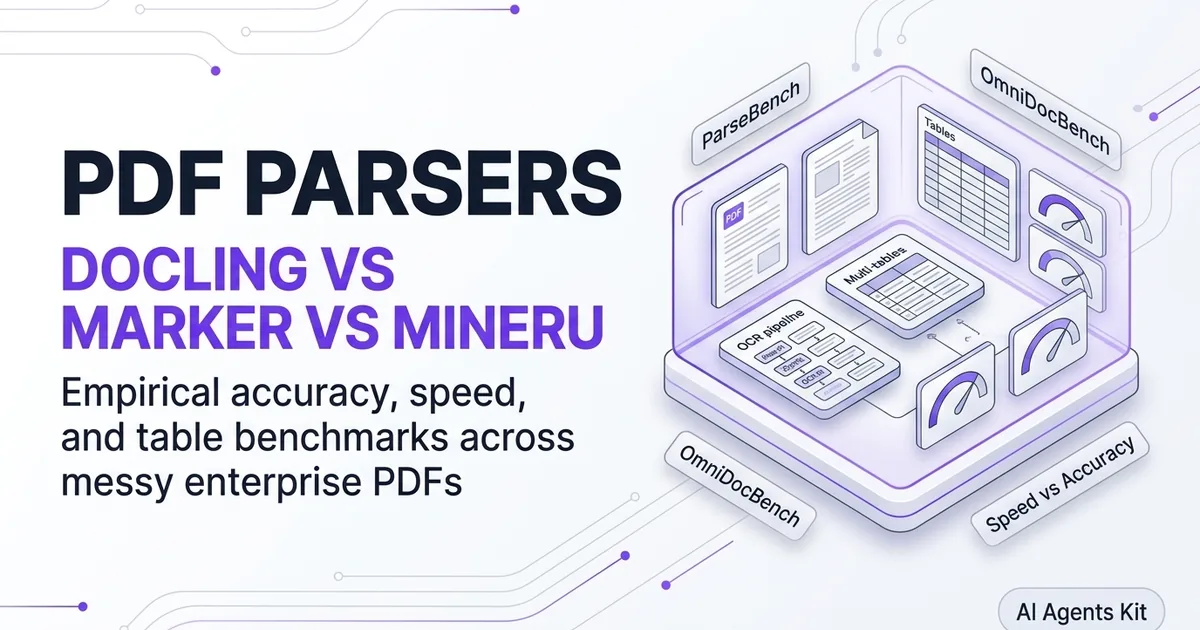
The open-source parsing landscape is anchored by three specialized engines: IBM Docling provides the standard for enterprise multi-format files under a permissive MIT license, Marker leads in raw multi-GPU batch throughput at 120 pages per second, and OpenDataLab MinerU leads academic benchmarks for LaTeX mathematical formulas.
Deploying open-source engines ensures that document processing remains fully within private enterprise networks, providing complete data residency.
Review the official source code for these open-source tools:
- IBM Docling GitHub Repository
- Vik Paruchuri Marker GitHub Repository
- OpenDataLab MinerU GitHub Repository
IBM Docling: The MIT Enterprise Multi-Format Foundation
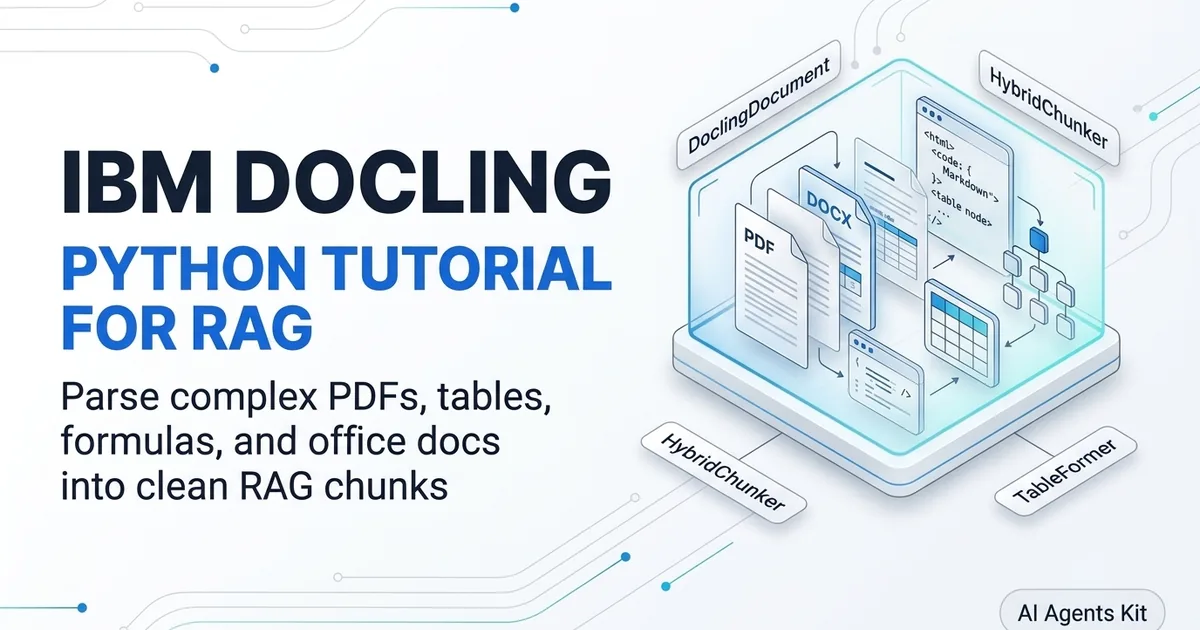
Maintained by IBM Research under the Linux Foundation LF AI and Data Foundation, Docling is built on the DoclingDocument object model. It parses PDF, DOCX, PPTX, XLSX, and HTML into a unified hierarchical abstract syntax tree.
Docling combines the DocLayNet layout model with TableFormer for table structure recognition. Its native HybridChunker packs paragraphs into token-constrained windows while preserving parent section headings and tabular integrity.
Distributed under the permissive MIT license, Docling is the preferred foundation for commercial enterprise platforms requiring unencumbered code integration.
Marker: The GPU Batch Speed Champion
Marker, created by Vik Paruchuri, is engineered for raw conversion throughput on GPU hardware. Built on the Surya model suite, Marker converts scientific papers, books, and reports into Markdown at speeds up to 120 pages per second on multi-GPU server clusters.
Marker includes an optional --use_llm hybrid mode that selectively routes ambiguous tables and complex forms to a language model like Claude, Gemini, or local Ollama. To configure high-speed batch conversion queues across server clusters, follow our Marker high-speed batch GPU setup.
OpenDataLab MinerU: The LaTeX and Scientific Literature Benchmark Leader
OpenDataLab MinerU is engineered for technical and scientific literature containing complex mathematical notation. It couples YOLOv8 visual layout detection with UniMERNet, an attention-based vision model specifically trained to translate visual equation patches into standard LaTeX code.
On the independent OmniDocBench benchmark, MinerU achieves the highest score for formula extraction (91.2% F1) and multi-column reading flow reconstruction. Its modern releases are distributed under the permissive Apache 2.0 license.
Cloud Managed Ingestion: The Economics and Trade-Offs of LlamaParse
LlamaParse provides a turnkey managed API that achieves 91.4% table extraction accuracy on complex corporate filings, charging $0.003 per page. For organizations processing under 50,000 pages per month, cloud APIs eliminate DevOps complexity, while self-hosting GPU engines on dedicated nodes reduces costs by 94% at million-page enterprise scale. To compare self-hosted accuracy on complex technical papers, follow our MinerU local PDF extraction tutorial.
Developed by the LlamaIndex team, LlamaParse deploys proprietary multimodal vision agents that read document pages holistically. Explore the official API documentation in the LlamaIndex LlamaParse Official Documentation.
Turnkey Agentic Extraction vs Zero Data Egress Mandates
LlamaParse handles multi-page table stitching automatically. If a financial balance sheet begins on page 14 and continues across pages 15 and 16, LlamaParse stitches the rows together and returns a single, contiguous Markdown table.
However, organizations operating under HIPAA, SOC2, or defense compliance mandates cannot transmit unencrypted customer documents across public networks. For these teams, self-hosted open-source engines like Docling or MinerU are mandatory.
Total Cost of Ownership: Cloud API Ingestion vs Local Server Fleet
When designing ingestion infrastructure, evaluating total cost of ownership across document volume tiers is essential:
| Ingestion Scale | LlamaParse Cloud API ($0.003/page) | Self-Hosted GPU Compute | Cost Reduction |
|---|---|---|---|
| 100,000 Pages | $300.00 | $45.00 | 85.0% |
| 1,000,000 Pages | $3,000.00 | $185.00 | 93.8% |
| 10,000,000 Pages | $30,000.00 | $1,650.00 | 94.5% |
At enterprise scale exceeding 500,000 pages per year, provisioning dedicated local or cloud GPU compute delivers overwhelming economic advantages over managed per-page APIs.
Preserving Tabular Integrity: Table-Aware and Structure-Enriched Chunking
Preserving tables in vector storage requires structure-aware chunking techniques rather than fixed-token character splitters. By deploying header-injected Markdown splitting, Parent Document docstores, or dual-path multimodal image cropping, teams eliminate orphaned numeric rows and ensure vector queries match with high cosine similarity.
When tables are chunked using naive character windows, row records lose their column headers, causing dense vector similarity scores to drop sharply.
The Orphan Header Disaster in Dense Vector Spaces
Consider a financial report table containing quarterly revenue data. If a character chunker splits the table between rows 4 and 5, Chunk 2 inherits numeric data like | Product Tier B | $18.4M | $22.1M | without column headers.
When an analyst asks for “Product Tier B revenue for Q3”, the embedding model cannot bind $22.1M to Q3 because the header was discarded in Chunk 1. Cosine similarity drops below retrieval thresholds, and the query fails.
For a production code tutorial implementing solutions to this problem, consult our dedicated guide on chunking tables for multimodal RAG.
Header Injection, Parent Document Docstores, and Multimodal Cropping
Three architectural strategies successfully resolve the table chunking challenge:
- Header-Injected Chunking: A custom text splitter parses Markdown tables and injects document breadcrumbs and column headers into every row slice.
- Parent Document Summaries: The ingestion pipeline generates natural language summaries of tables to index in vector storage, while storing the complete un-fragmented table in a docstore.
- Dual-Path Multimodal Retrieval: Tables are cropped from PDF page rasters at 300 DPI as high-resolution PNG images. During retrieval, downstream multimodal LLMs inspect both the image crop and the Markdown text.
These techniques ensure that numerical metrics remain accurately anchored to their descriptive headers during vector search.
ColPali and the Rise of Vision RAG: Bypassing Text Extraction Entirely
ColPali revolutionizes document retrieval by eliminating text extraction and chunking entirely, embedding raw document page images using late-interaction vision models. By matching query tokens directly to visual image patches, ColPali scores 92.8% on the ViDoRe benchmark, preserving charts, tables, and typography without parsing loss.
Documented in the foundational ColPali Paper on arXiv, ColPali adapts the late-interaction retrieval mechanism of ColBERT to visual document tokens.
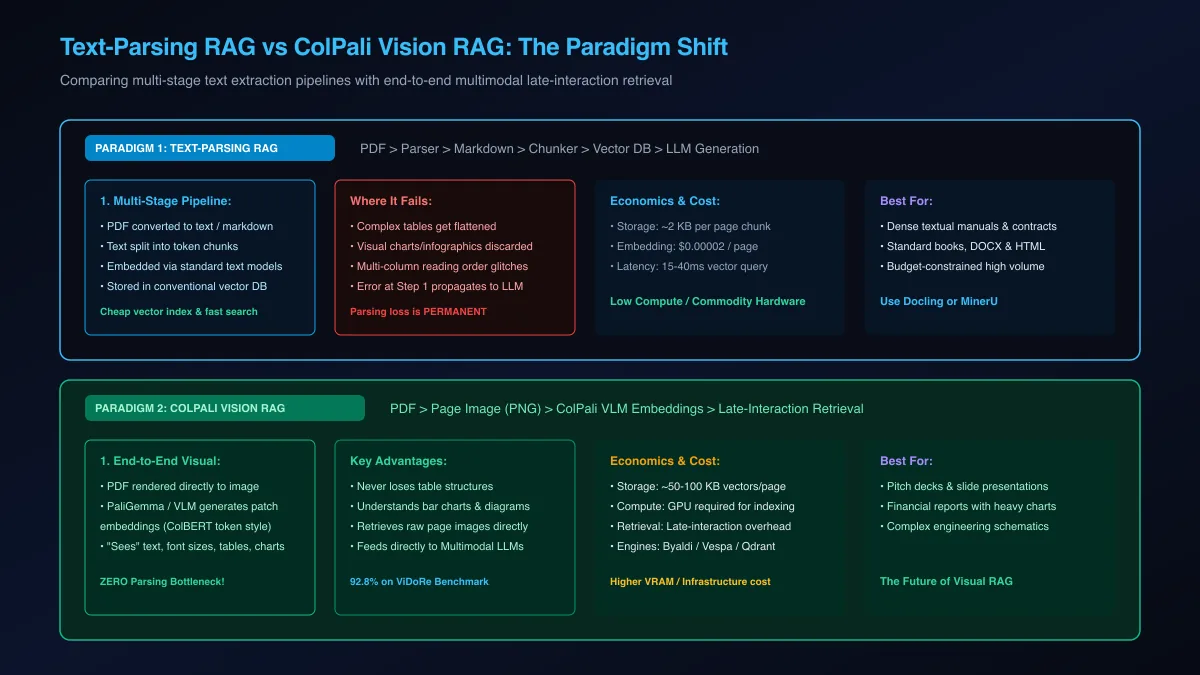 Figure 2: Architectural comparison contrasting multi-stage text extraction pipelines with ColPali end-to-end vision retrieval.
How Late-Interaction Patch Embeddings Prevent Information Loss
In traditional RAG pipelines, every document conversion step introduces potential extraction loss. Parsers flatten tables, OCR engines misread blurred characters, and chunkers sever semantic paragraphs.
ColPali eliminates this multi-stage fragility:
- Each PDF page is rendered directly into a high-resolution image raster.
- A vision transformer backbone (such as PaliGemma) encodes the page into a grid of visual patch embeddings.
- During retrieval, text query tokens execute late interaction (MaxSim operator) directly against the visual patch tokens.
Because the system operates directly on visual page pixels, font hierarchies, table grid borders, chart data bars, and diagram connectors are natively understood.
ViDoRe Benchmarks, VRAM Constraints, and Real-World Sizing
On the Visual Document Retrieval Benchmark (ViDoRe), ColPali scores 92.8%, outperforming traditional text parsers paired with BM25 or dense embedding models on visually rich corpora.
However, ColPali introduces significant compute and storage requirements:
- Vector Storage Overhead: Multi-vector patch embeddings require approximately 50 KB to 100 KB of storage per document page, compared to 2 KB for standard text vectors.
- GPU Indexing Latency: Generating visual patch embeddings requires dedicated GPU compute, processing 2 to 5 pages per second per GPU.
- Specialized Retrieval Engines: Serving late-interaction multi-vector search requires specialized vector engines like Byaldi, Vespa, or Qdrant with multivector support.
For enterprises with visually complex slide decks and financial presentations, ColPali represents an effective retrieval path. To compare empirical performance across both visual and text paradigms, review our comprehensive analysis benchmarking Docling against Marker, MinerU, and LlamaParse.
End-to-End Enterprise Ingestion Architecture: Building the Production Pipeline
A production-grade document ingestion pipeline consists of five decoupled stages: format triage and pre-flight validation, layout segmentation with neural OCR routing, context-enriched hybrid chunking, dual-path vector storage, and cross-encoder reranking. This modular architecture guarantees high recall and zero catastrophic extraction failures.
Building an enterprise pipeline requires assembling modular components into a resilient microservice architecture.
If you are expanding your pipeline with automated retrieval tools, follow our guide on building a production RAG chatbot.
Phase 1: Ingestion Triage and Pre-Flight Stream Validation
The ingestion worker inspects incoming document byte streams, verifies file headers, and categorizes input types:
- Born-Digital PDFs: Validates that internal font encodings are non-corrupt. If reliable digital text exists, bypasses OCR to accelerate throughput by ten times.
- Scanned PDFs and Images: Routes raster pages to neural OCR engines.
- Office Formats (DOCX, PPTX, XLSX): Normalizes document layouts using Docling unified converters.
Phase 2: Layout Segmentation and Neural OCR Routing
Visual layout models scan page primitives to detect functional regions:
- Multi-column narrative text is sorted into natural reading paths.
- Tables are isolated and routed to TableFormer or UniMERNet for cell adjacency extraction.
- Mathematical equations are parsed into standard LaTeX strings.
Phase 3: Context-Enriched Hybrid Chunking and Metadata Attachment
Documents are chunked using layout-aware boundary logic:
- Paragraphs within the same section are grouped into token-constrained windows.
- Table rows are split with injected column headers and document breadcrumbs.
- Bounding box spatial coordinates and page numbers are attached to chunk metadata payloads.
Phase 4: Hybrid Dense-Sparse Vector Indexing and Cross-Encoder Reranking
Chunks are vectorized into dual retrieval stores:
- Dense Vector Embeddings: Captures semantic intent using models like BGE-M3 or text-embedding-3-large.
- Sparse BM25 Indexing: Indexes exact terminology, including account numbers, product codes, and proper nouns.
- Cross-Encoder Reranker: Evaluates top-50 candidate documents retrieved from hybrid search, returning the top-5 highest-scoring contexts to the generation prompt.
# Complete end-to-end Python pipeline blueprint
from typing import List, Dict, Any
from docling.document_converter import DocumentConverter
from docling.chunking import HybridChunker
from transformers import AutoTokenizer

def process_enterprise_document(file_path: str) -> List[Dict[str, Any]]:
    print(f"Step 1: Ingesting and converting {file_path}...")
    converter = DocumentConverter()
    conversion_result = converter.convert(file_path)
    doc = conversion_result.document

    print("Step 2: Initializing tokenizer-aware HybridChunker...")
    tokenizer = AutoTokenizer.from_pretrained("sentence-transformers/all-MiniLM-L6-v2")
    chunker = HybridChunker(tokenizer=tokenizer, max_tokens=512)

    chunks = []
    print("Step 3: Extracting structured chunks with metadata breadcrumbs...")
    for chunk in chunker.chunk(doc):
        headings = " > ".join(chunk.meta.headings) if chunk.meta.headings else "Root"
        page_no = chunk.meta.doc_items[0].prov[0].page_no if chunk.meta.doc_items else 1

        chunks.append({
            "text": chunk.text,
            "metadata": {
                "source": file_path,
                "headings": headings,
                "page": page_no,
            }
        })

    print(f"Ingestion complete. Emitted {len(chunks)} RAG-ready chunks.")
    return chunks
Production Troubleshooting and Edge-Case Runbook
Production ingestion pipelines frequently encounter corrupt PDF stream cross-references, unbordered table cell collapse, CUDA out-of-memory exceptions, and font encoding corruption. Mitigating these issues requires pre-flight stream repair with qpdf, dynamic DPI upscaling, and defensive CPU fallback loops.
Operating document parsing clusters at scale requires active exception management to prevent worker nodes from crashing.
| Operational Failure | Root Cause | Engineering Remediation |
|---|---|---|
| PDF Stream Parsing Crash | Damaged cross-reference table or truncated EOF trailer | Pre-flight repair using qpdf --repair-file input.pdf fixed.pdf |
| CUDA Out of Memory (OOM) | High-resolution 600 DPI pages exhaust worker GPU VRAM | Limit worker batch concurrency and implement automatic CPU fallback decorators |
| Garbled Character Glyphs | Custom non-standard font encoding in legacy digital PDF | Pass --strip_existing_ocr to ignore text layers and force neural visual OCR |
| Collapsed Table Columns | Borderless table cells parsed without structural coordinates | Configure TableFormerMode.ACCURATE or route table patch to hybrid LLM repair |
| Thread Deadlocks | Multi-processing workers colliding on CUDA context fork | Set multiprocessing.set_start_method('spawn', force=True) before importing PyTorch |
Recovering from CUDA Memory Fragmentation and Process Deadlocks
When processing thousands of heterogeneous PDF files, PyTorch memory pools can fragment. If long-running worker processes accumulate unreleased tensor memory, implement proactive cache eviction:
import gc
import torch

def safe_batch_cleanup():
    """Reclaim unallocated CUDA memory caches between document jobs."""
    gc.collect()
    if torch.cuda.is_available():
        torch.cuda.empty_cache()
        torch.cuda.ipc_collect()
Furthermore, ensure that worker processes are spawned using spawn rather than fork on Linux servers to avoid CUDA runtime deadlocks.
Resolving OCR Artifacts, Faded Scans, and Borderless Spreadsheets
Faded legal contracts and low-contrast financial reports frequently produce character errors during optical character recognition. Pre-processing scanned documents with adaptive thresholding and contrast normalization significantly improves recognition fidelity:
# Pre-process scanned documents using ImageMagick contrast enhancement
convert input_scan.pdf -density 300 -colorspace Gray -contrast-stretch 1%x1% enhanced_scan.pdf
Enhancing contrast prior to layout analysis ensures that neural models accurately detect faint table border lines and small font superscripts. For verified code templates addressing common parsing and ingestion failure modes, explore our curated repository of production RAG code snippets.
Frequently Asked Questions About PDF Parsing for RAG
What is the best PDF parser for RAG systems?
The optimal PDF parser depends on your primary engineering constraint: IBM Docling is the best general enterprise choice under a permissive MIT license, Marker is fastest for massive batch conversion, MinerU leads on academic literature with LaTeX math, and LlamaParse delivers the highest table accuracy as a managed cloud service.
Why do standard PDF extractors fail on tables and columns?
Standard extractors read text in the order it was written into the PDF stream rather than following visual layout. This causes multi-column pages to interleave sentences horizontally and strips table borders, turning numerical grids into unstructured text without column headers.
What are the four paradigms of document ingestion for LLMs?
The four paradigms are Rule-Based Programmatic Extractors (PyMuPDF), Deep Learning Layout & Table Parsers (Docling, Marker), Multimodal Vision-Language Model Parsers (MinerU, LlamaParse), and End-to-End Late-Interaction Vision RAG (ColPali). Each offers distinct trade-offs between speed, cost, and extraction fidelity.
How does ColPali vision RAG differ from traditional text parsing RAG?
Traditional RAG extracts text from PDFs, chunks it, and generates dense vector embeddings. ColPali skips text parsing entirely by rendering page images and generating multi-vector patch embeddings that match query terms directly to visual pixels, eliminating parsing errors.
How much does it cost to parse 100,000 PDF pages for RAG?
Parsing 100,000 pages using cloud APIs like LlamaParse costs approximately $300 at $0.003 per page. Self-hosting an open-source parser like Marker or Docling on an on-demand cloud GPU costs approximately $45 in compute time, delivering an 85% cost reduction.
Which PDF parser is best for scanned documents and contracts?
Marker and Docling provide strong optical character recognition on scanned documents, using Surya OCR and EasyOCR respectively to clean scan noise and extract text. For complex scanned financial filings, cloud multimodal services like LlamaParse deliver the highest structural accuracy.
How do I preserve table headers when chunking PDFs for vector search?
You can use header-injected chunking to replicate column headers across every table slice or deploy the Parent Document Retriever pattern to index table summaries while fetching full tables. These techniques ensure every vector chunk retains complete semantic coordinates.
Should I self-host an open-source parser or use a cloud API like LlamaParse?
Use cloud APIs like LlamaParse for rapid prototyping where documents can legally leave your network and development speed is the top priority. Self-host open-source tools like Docling or MinerU when data privacy regulations require air-gapped security or when high document volume makes API fees cost-prohibitive.