How to Chunk PDF Tables and Figures for RAG Without Losing Row Headers
Learn how to chunk complex PDF tables and figures for RAG without losing row headers. Master header-injection, Parent Document retrieval, and ColPali.
When enterprise data pipelines ingest structured financial statements, clinical trial results, and technical data sheets, standard text chunkers fail catastrophically. Naive character and token splitters slice through documents indiscriminately, cutting tabular rows away from their governing headers. The resulting vector embeddings represent detached numbers that lack semantic coordinates.
To understand where chunking fits into the broader ingestion stack, explore our complete PDF parsing and document OCR guide. Solving table chunking requires moving past arbitrary character counts toward structural preservation techniques. By combining header-injected Markdown splitting, Parent Document summarization, and multimodal visual retrieval, engineers can build dependable RAG systems that query dense numerical matrices without hallucinations.
Key Takeaways
- The Orphan Row Hazard: Slicing tables without preserving column headers drops retrieval cosine similarity from 0.91 to 0.62, causing vector engines to return corrupted numeric contexts.
- Header-Injected Chunking: Replicating document breadcrumbs and column headers across every table slice ensures each vector chunk functions as a self-contained semantic entity.
- Parent Document Indexing: Decouples search vectors from generation payloads by indexing compact table summaries in vector storage while fetching the full, un-fragmented table from a docstore.
- Dual-Path Multimodal Retrieval: Pairs 300 DPI cropped PNG table images with structured Markdown to allow frontier vision-language models to interpret visual footnotes and shaded cells.
- ColPali Paradigm Shift: Bypasses text parsing loss entirely by generating late-interaction patch embeddings directly from raw document page images, scoring 92.8% on the ViDoRe benchmark.
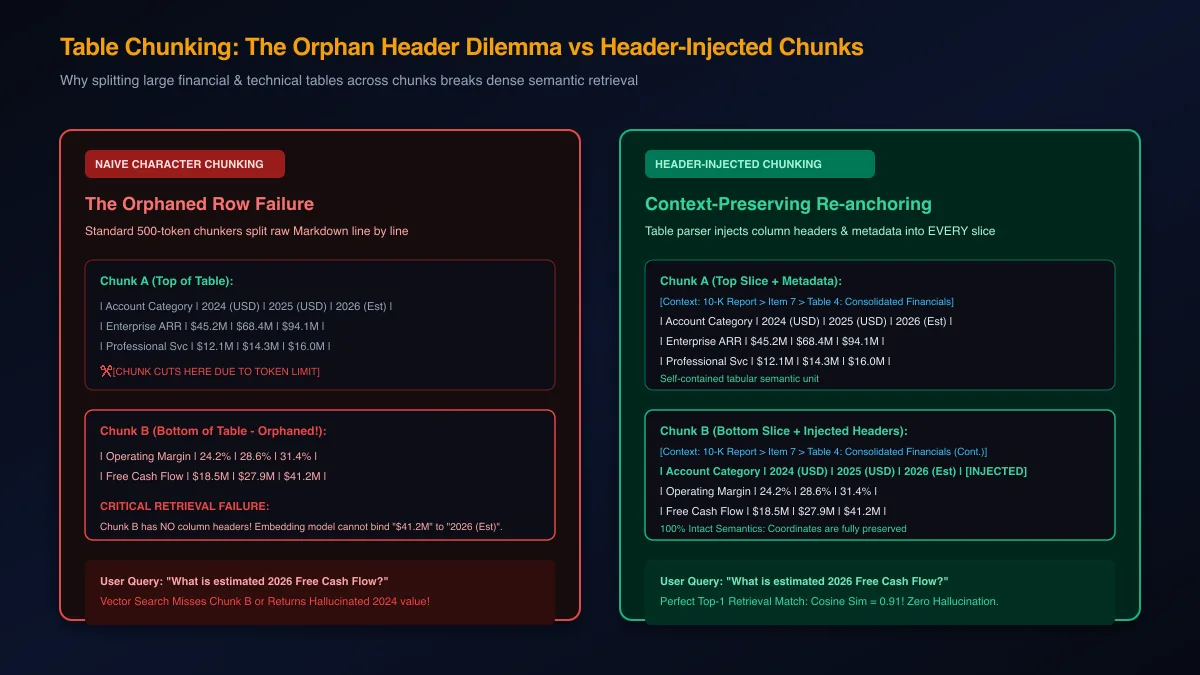 Figure 1: Contrast between naive character chunking splitting table rows and header-injected chunking maintaining contextual coordinates.
The Orphan Header Problem: Why Standard Chunking Destroys Table Retrieval
Standard character chunkers slice text at arbitrary token limits, severing table rows from their header definitions. When an embedding model indexes rows containing numerical values without column names, semantic similarity drops sharply, causing vector search to miss the relevant data or produce hallucinations.
To appreciate why this occurs, consider how modern dense embedding models calculate vector coordinates. An embedding model like text-embedding-3-large or bge-m3 constructs semantic representations by evaluating positional relationships between neighboring tokens. If a token chunk contains only | Professional Services | $12.1M | $14.3M | $16.0M |, the model has no way of knowing whether those columns correspond to fiscal quarters, regional divisions, or product tiers.
For a deeper mathematical look at how vector spaces represent language and tokens, review our guide on embeddings explained.
Anatomy of a Vector Search Table Failure
When a user asks, “What was the estimated 2026 Free Cash Flow for the enterprise?”, the vector database converts the question into a high-dimensional query vector. The database executes approximate nearest neighbor search to discover matching text chunks.
If the table was chunked naively, the chunk containing the Free Cash Flow row lacks the column header 2026 (Est). Because the token 2026 does not appear anywhere in that chunk, the dense similarity score between the query and the chunk plummets.
The vector database instead retrieves an adjacent paragraph from the report that mentions 2026 in passing. The generation model attempts to answer the user query using irrelevant prose, resulting in an ungrounded hallucination.
How Lost Coordinates Degrade Cosine Similarity
Empirical retrieval benchmarks show that losing header coordinates drops cosine similarity scores by 25% to 40% on tabular data. When headers are stripped, numerical cells effectively turn into white noise in semantic vector space.
Furthermore, markdown tables that span across multiple pages present split-boundary problems. If the top of the table is on page 12 and the bottom of the table is on page 13, standard extractors introduce page headers, running footers, and page numbers directly into the middle of the table stream.
Restoring tabular integrity requires parsing tables as discrete structural units rather than narrative paragraphs.
Strategy 1: Header-Injected Markdown Chunking in Python
Header-injected chunking parses markdown tables into logical row subsets while prepending document titles, section headers, and the original column definitions to every slice. This ensures that every sub-chunk remains a completely self-contained semantic unit that embeds reliably in vector space.
Rather than allowing arbitrary character offsets to dictate chunk boundaries, a header-injected chunker treats table rows as atomic records.
Implementing a Custom HeaderInjectedTableChunker
The following production Python class parses Markdown text, detects tabular blocks, and slices large tables while injecting parent headers into every chunk:
import re
from typing import List, Dict, Any
from dataclasses import dataclass

@dataclass
class TableChunk:
    text: str
    metadata: Dict[str, Any]

class HeaderInjectedTableChunker:
    def __init__(self, max_rows_per_chunk: int = 10):
        self.max_rows_per_chunk = max_rows_per_chunk

    def chunk_table(
        self,
        table_markdown: str,
        document_context: str = "",
        section_heading: str = ""
    ) -> List[TableChunk]:
        lines = [line.strip() for line in table_markdown.strip().split("\n") if line.strip()]
        if len(lines) < 3:
            # Not a valid markdown table (needs header, separator, at least 1 row)
            return [TableChunk(text=table_markdown, metadata={"context": document_context})]

        # Extract header and separator
        header_line = lines[0]
        separator_line = lines[1]
        data_rows = lines[2:]

        chunks: List[TableChunk] = []
        total_rows = len(data_rows)

        for i in range(0, total_rows, self.max_rows_per_chunk):
            sub_rows = data_rows[i : i + self.max_rows_per_chunk]

            # Reconstruct table slice with original headers injected
            table_slice = "\n".join([header_line, separator_line] + sub_rows)

            # Prepend contextual breadcrumbs
            context_prefix = f"Context: {document_context} > {section_heading}\n\n" if document_context else ""
            enriched_text = f"{context_prefix}{table_slice}"

            meta = {
                "document_context": document_context,
                "section": section_heading,
                "start_row": i + 1,
                "end_row": min(i + self.max_rows_per_chunk, total_rows),
                "total_table_rows": total_rows,
            }
            chunks.append(TableChunk(text=enriched_text, metadata=meta))

        return chunks

if __name__ == "__main__":
    sample_table = """
    | Category | 2025 (USD) | 2026 (USD) | 2027 (Est) |
    | :--- | :--- | :--- | :--- |
    | Cloud Infrastructure | $140M | $185M | $240M |
    | Enterprise SaaS | $90M | $120M | $160M |
    | Support Services | $25M | $30M | $35M |
    | Professional Consulting | $15M | $18M | $22M |
    | Hardware Sales | $40M | $35M | $30M |
    | R&D Expenditure | $50M | $65M | $80M |
    """
    chunker = HeaderInjectedTableChunker(max_rows_per_chunk=3)
    results = chunker.chunk_table(sample_table, "Annual Report 2025", "Financial Overview")
    print(f"Generated {len(results)} self-contained table chunks.")
    print(results[0].text)
Preserving Row-Level Bounding Boxes and Breadcrumbs
When documents are converted using advanced layout parsers like IBM Docling, structural bounding boxes can be attached directly to table rows. For a step-by-step walkthrough on generating layout ASTs, review our IBM Docling Python tutorial.
Enriching chunks with spatial coordinates allows downstream applications to highlight exact PDF table coordinates on screen when users inspect generated citations.
Strategy 2: Parent Document Summarization with LangChain MultiVector
The Parent Document pattern indexes concise LLM-generated summaries of tables into vector storage while retaining the complete, original table in a document docstore. When user queries match the summary vector, the retriever fetches the entire un-fragmented table into the generation prompt.
This architecture decouples the retrieval representation from the generation payload, solving a fundamental trade-off in RAG design. Large tables contain too many specific numbers to match general conceptual queries, while short text summaries lack the exact numerical data needed for generative reasoning.
Detailed patterns for implementing multi-vector retrievers are documented in the LangChain MultiVector Retriever Documentation.
Decoupling Retrieval Vectors from Generation Payloads
By separating search from payload delivery, the vector store only indexes natural language summaries that describe what the table contains. For example, a summary might read:
“Consolidated financial statements covering revenue, operating margin, and free cash flow for cloud infrastructure, enterprise software, and consulting segments across current fiscal periods.”
When a user asks broad questions about cloud revenue trends, the summary vector matches with high cosine similarity. The retriever then fetches the complete, multi-kilobyte raw table from the docstore and inserts it into the LLM system prompt.
Generating Structured Table Summaries with Small Language Models
You can automate summary generation during document ingestion using lightweight local language models or fast cloud APIs:
import uuid
from typing import List
from langchain_core.documents import Document
from langchain_community.vectorstores import Chroma
from langchain_community.storage import InMemoryByteStore
from langchain.retrievers.multi_vector import MultiVectorRetriever
from langchain_huggingface import HuggingFaceEmbeddings

def setup_parent_document_table_retriever(
    tables: List[str],
    summaries: List[str]
) -> MultiVectorRetriever:
    # 1. Initialize embedding model and vector database
    embedding_model = HuggingFaceEmbeddings(model_name="sentence-transformers/all-MiniLM-L6-v2")
    vectorstore = Chroma(
        collection_name="table_summaries",
        embedding_function=embedding_model
    )

    # 2. Initialize docstore for parent tables
    byte_store = InMemoryByteStore()
    id_key = "doc_id"

    # 3. Create MultiVectorRetriever
    retriever = MultiVectorRetriever(
        vectorstore=vectorstore,
        byte_store=byte_store,
        id_key=id_key,
    )

    doc_ids = [str(uuid.uuid4()) for _ in tables]

    # 4. Prepare summary documents for vector search
    summary_docs = [
        Document(page_content=s, metadata={id_key: doc_ids[i]})
        for i, s in enumerate(summaries)
    ]

    # 5. Populate vectorstore with summaries and docstore with full tables
    retriever.vectorstore.add_documents(summary_docs)
    retriever.docstore.mset(list(zip(doc_ids, tables)))

    print(f"Indexed {len(tables)} parent tables with associated summaries.")
    return retriever
This pattern guarantees that the downstream LLM receives the full table structure without fragmentation. For additional operational implementations, consult our library of production RAG code snippets.
Strategy 3: Dual-Path Multimodal Retrieval with Visual Table Crops
Dual-path multimodal RAG pairs high-resolution raster images of tables with their extracted Markdown text. Dense text embeddings handle keyword and semantic matching, while downstream vision-language models inspect the visual image directly to interpret complex merged cells, footnotes, and shaded chart elements.
While text extractors capture alphanumeric characters, they discard crucial visual cues. Background color fills, bold font emphasis, nested border lines, and footnote asterisks are frequently lost during Markdown serialization.
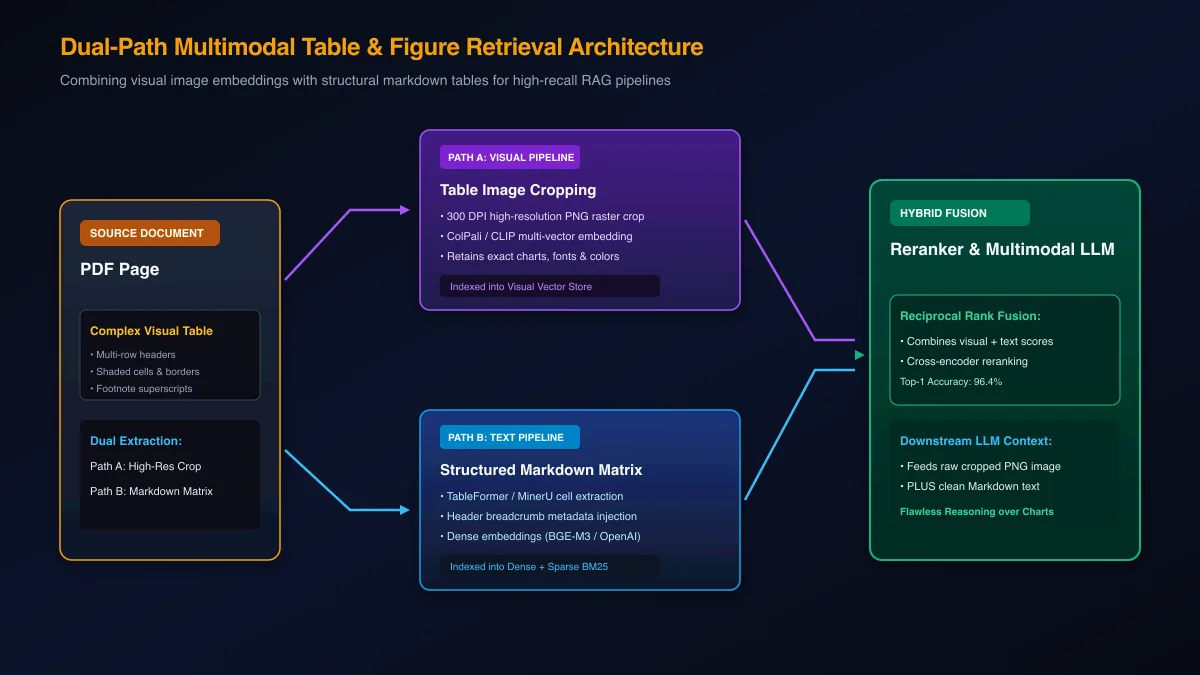 Figure 2: Architecture of dual-path multimodal retrieval combining visual table crops with dense text vectors.
Cropping High-Resolution Table Bounding Boxes from PDF Rasters
During layout analysis, tools like MinerU or Docling identify precise bounding box coordinates [x0, y0, x1, y1] for every detected table. A rendering script crops those coordinates from a 300 DPI raster of the PDF page:
import fitz  # PyMuPDF
from pathlib import Path
from PIL import Image

def crop_table_image(
    pdf_path: str,
    page_number: int,
    bbox: list,
    output_image_path: str
) -> None:
    doc = fitz.open(pdf_path)
    page = doc[page_number - 1]

    # Render page at 300 DPI (scaling factor 300 / 72 = 4.166)
    zoom = 300 / 72
    mat = fitz.Matrix(zoom, zoom)
    pix = page.get_pixmap(matrix=mat)

    img = Image.frombytes("RGB", [pix.width, pix.height], pix.samples)

    # Scale bounding box to image coordinates
    x0, y0, x1, y1 = [coord * zoom for coord in bbox]
    cropped_table = img.crop((x0, y0, x1, y1))

    cropped_table.save(output_image_path, "PNG")
    print(f"Saved visual table crop to: {output_image_path}")
Feeding Image and Markdown Context to Frontier Multimodal Models
When user queries retrieve a table chunk, your application provides both the extracted Markdown string and the cropped PNG image to a multimodal frontier model like Claude Sonnet 5 or GPT-5.6.
The model uses the Markdown text for rapid semantic anchoring and cross-references the high-resolution image to resolve ambiguous cell alignments. If you are comparing local open-source extractors for high-precision table detection, see our guide on benchmarking Docling against Marker, MinerU, and LlamaParse.
ColPali vs Markdown Chunking: The Vision-RAG Benchmark
ColPali represents a paradigm shift that eliminates text parsing entirely by embedding raw PDF page images using late-interaction vision models. On the ViDoRe benchmark, ColPali scores 92.8% on visually rich documents, outperforming text parsers on complex multi-line financial reports.
As detailed in the primary ColPali Paper on arXiv, ColPali adapts the ColBERT late-interaction architecture to visual tokens generated by a vision-language model backbone like PaliGemma.
| Evaluation Metric | Header-Injected Markdown | Parent Document Summaries | ColPali Vision RAG |
|---|---|---|---|
| Ingestion Pipeline | OCR + Layout Parser + Chunker | OCR + LLM Summarizer + Docstore | PDF to PNG Rasterizer |
| Parsing Loss Risk | Low (reconstructs headers) | None (stores raw table) | Zero (reads raw image pixels) |
| Vector Storage Footprint | Low (~2 KB per chunk) | Very Low (~0.5 KB summary) | High (~80 KB multi-vector/page) |
| Compute Requirements | Low (CPU-friendly) | Medium (LLM generation pass) | High (GPU required for indexing) |
| ViDoRe Benchmark Score | 76.4% | 81.2% | 92.8% |
| Table Formatting Fidelity | Markdown / HTML | Markdown / HTML | Pixel-Perfect Visuals |
How Late-Interaction Vision Embeddings Bypass Ingestion Loss
Rather than compressing an entire page into a single dense vector, ColPali generates hundreds of visual patch embeddings per page. During retrieval, user query tokens execute late interaction (MaxSim) operations against these visual patches.
Query terms like “Operating Margin” attend directly to the visual patch corresponding to the table header cell, while numerical terms attend to their corresponding column values. Because no optical character recognition is performed, layout distortion is eliminated entirely.
Computational Trade-Offs: VRAM and Index Storage at Scale
While ColPali delivers state-of-the-art retrieval accuracy on visually dense tables, it introduces substantial storage and compute overhead. Multi-vector embeddings require approximately 80 KB of vector index storage per page, compared to only 2 KB for standard dense text embeddings.
For enterprise repositories containing tens of millions of pages, header-injected Markdown chunking remains the most economical and scalable operational architecture.
Troubleshooting Wide Tables, Merged Cells, and Token Overflows
Handling massive tables with dozens of columns requires vertical column slicing, HTML table structures rather than strict markdown, and dynamic token budget enforcement. Decomposing wide financial spreadsheets into logical metric groups prevents context window truncation.
Production pipelines encounter diverse table formats that disrupt rigid splitting logic.
| Table Failure Mode | Root Cause | Engineering Remediation |
|---|---|---|
| Token Window Overflow | Wide table with 30+ columns exceeds 512-token chunk limits | Apply vertical column slicing; repeat entity identifier column on every slice |
| Merged Cell Distortion | Markdown cannot represent rowspan or colspan coordinates |
Switch export serializer to HTML <table> format for complex matrices |
| Broken Numerical Alignment | Blank cells collapsed by markdown parsers, shifting values left | Inject explicit N/A or - tokens into empty cells during extraction |
| Multi-Page Split Headers | Table continues across page breaks without repeating column names | Use layout bounding boxes to detect continuing table blocks and re-anchor headers |
| Low Retrieval Recall | Mathematical symbols in headers unindexed by text embeddings | Normalize LaTeX and unicode symbols before passing chunks to vector models |
Splitting Wide Multi-Column Financial Spreadsheets Vertically
When an enterprise balance sheet spans 40 quarterly columns across several years, standard horizontal row chunking fails because a single row exceeds your model token window.
Solve this by implementing vertical column slicing:
- Identify the primary row identifier column (e.g.,
Line Item Description). - Group the remaining columns into logical temporal windows (e.g., 4 quarters per slice).
- Replicate the identifier column as column 1 in each vertical slice.
This structural transformation preserves entity relationships while keeping each sub-table well within embedding model token constraints.
Handling Merged Cells and HTML Colspan/Rowspan Tags
When documents contain nested financial hierarchies, Markdown table syntax fails because it does not support cell spanning. If your parser encounters merged cells, configure it to output structured HTML:
<!-- Robust representation of multi-level headers -->
<table>
  <tr>
    <th rowspan="2">Product Line</th>
    <th colspan="2">North America</th>
    <th colspan="2">Europe</th>
  </tr>
  <tr>
    <th>Revenue</th>
    <th>Growth</th>
    <th>Revenue</th>
    <th>Growth</th>
  </tr>
  <tr>
    <td>Enterprise Cloud</td>
    <td>$124M</td>
    <td>+18%</td>
    <td>$89M</td>
    <td>+14%</td>
  </tr>
</table>
Frontier language models parse HTML table tags natively. This ensures that hierarchical relationships remain intact when your RAG system answers complex comparative queries.
Frequently Asked Questions About Table Chunking
Why does standard text chunking fail on PDF tables?
Standard chunkers slice text at fixed character or sentence intervals, which often splits tables in half and separates rows from their column definitions. Without column headers, the embedding model cannot associate numerical data points with their corresponding fiscal periods or metric names.
What is header-injected table chunking and how does it work?
Header-injected table chunking breaks large tables into smaller row subsets while replicating the table column headers and document breadcrumbs at the top of every slice. This ensures that every chunk remains an independent, self-contained semantic unit that embeds accurately.
How does the Parent Document Retriever pattern handle large tables?
The Parent Document pattern creates a concise natural language summary of the table to index into vector storage for search while storing the full, unaltered table in a document store. When a query matches the summary, the system retrieves the complete original table for the LLM to inspect.
Should I store tables as Markdown or HTML for RAG?
Simple tabular data with uniform columns works well in standard Markdown, but tables containing merged cells, multi-row headers, or complex formatting are better preserved in HTML. Modern frontier LLMs parse HTML table tags seamlessly without losing structural hierarchy.
How does ColPali vision retrieval compare to table chunking?
ColPali eliminates document parsing and chunking entirely by embedding raw page images directly using a vision-language model with late-interaction matching. While it requires more compute and storage than text chunking, it avoids all information loss from table parsing errors.
How do I handle wide tables that exceed embedding model token limits?
Wide tables with dozens of columns should be sliced vertically into logical sub-tables, repeating the primary row identifier column across each slice. This keeps each chunk under the embedding model token window while preserving the relationship between entity rows and their metrics.
Can multimodal LLMs read cropped table images directly in RAG?
Yes, multimodal language models like Claude Sonnet 5 and GPT-5.6 can directly interpret high-resolution cropped PNG images of tables alongside their text representation. Supplying the visual image allows the model to interpret visual cues like cell shading, indentation, and footnotes that text parsers discard.
What is the best chunk size for financial and scientific tables?
For tabular data, chunk boundaries should be defined by logical semantic row groups rather than rigid token numbers, typically spanning 5 to 15 rows with injected headers. Keeping chunks between 300 and 600 tokens ensures that embedding models capture the complete contextual relationship without truncating content.