A2A vs MCP vs AG-UI vs WebMCP: How the 4 AI Agent Protocols Fit Together
Understand how Google A2A, Anthropic MCP, AG-UI, and WebMCP form a complete 4-layer protocol stack for tools, peer agents, frontends, and browsers.
The rapid transition from single LLM chatbots to distributed autonomous multi-agent networks has produced a proliferation of competing communication protocols. Developers frequently ask whether Google’s A2A replaces Anthropic’s MCP, or where emerging browser proposals like WebMCP and frontend standards like AG-UI fit into the architectural landscape.
Treating these standards as direct competitors is a fundamental architectural misunderstanding. Just as the modern internet relies on DNS, TCP, HTTP, and WebSockets operating at distinct network boundaries, the emerging agentic computing ecosystem divides responsibilities across four specialized protocol layers.
While our foundational analysis of AI agent memory systems explores how agents maintain local cognitive state, this guide dissects how agents communicate across systems. We explore how A2A, MCP, AG-UI, and WebMCP fit together into a cohesive, enterprise-ready protocol stack.
Key Takeaways
- The modern AI agent stack consists of four specialized layers: AG-UI (Agent-to-Frontend), Google A2A (Agent-to-Agent), Anthropic MCP (Agent-to-Tool/Data), and WebMCP (Browser-to-DOM).
- Google A2A and Anthropic MCP are complementary standards: MCP gives an individual agent hands to operate databases and files, while A2A gives an agent a telephone to discover and delegate work to peer agents.
- AG-UI solves the frontend synchronization gap, streaming typed lifecycle events (
RUN_STARTED,STATE_SYNC,TOOL_CALL_START) between backend agent graphs and client interfaces.- WebMCP standardizes in-browser tool registration via
navigator.modelContext, eliminating 90% of visual computer-use token bloat by letting live websites expose explicit actions directly to agents.- Adopting the four-layer architecture decouples agent reasoning from proprietary vendor runtimes, ensuring enterprise systems remain modular, secure, and future-proof.
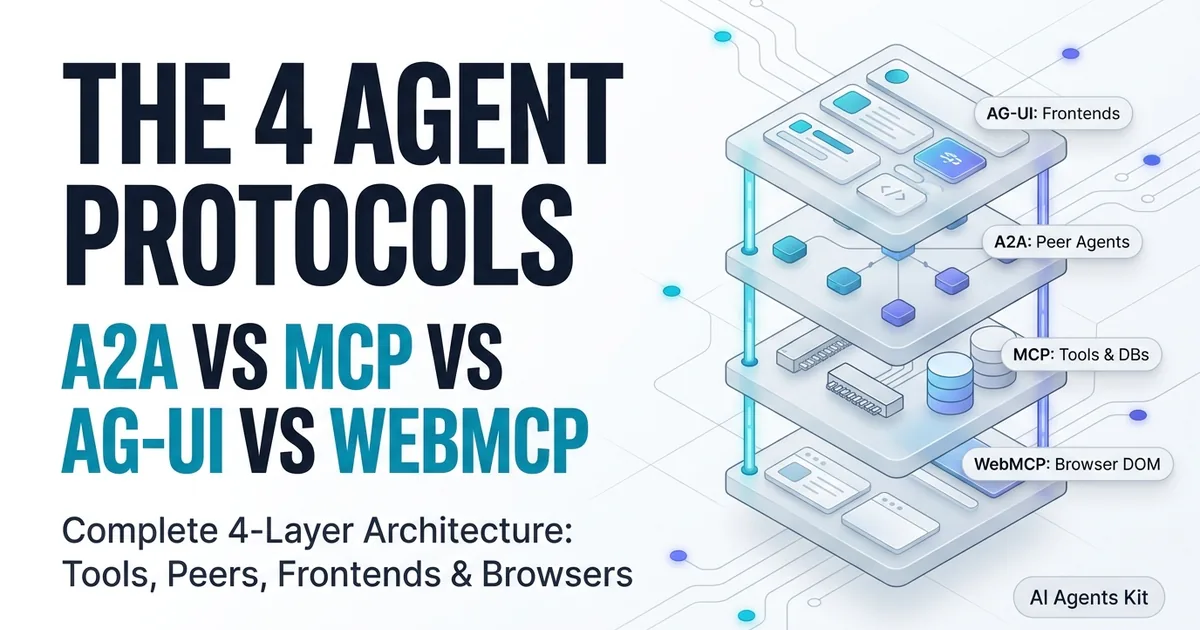
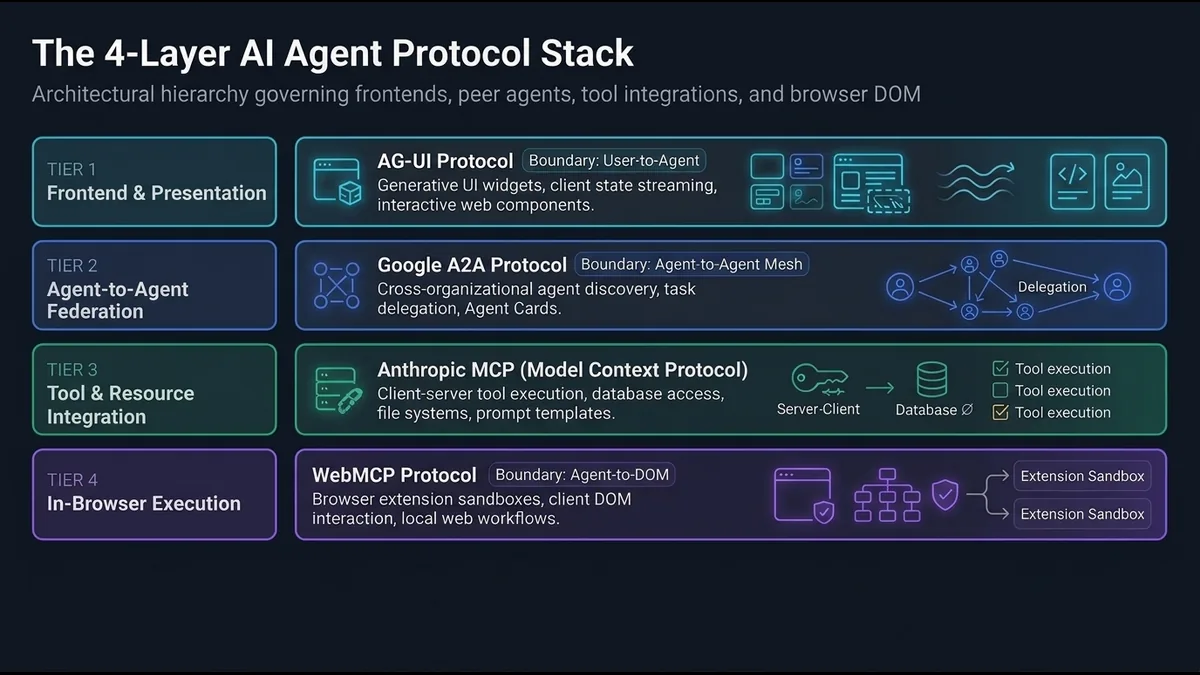 Figure 1: The complete 4-layer agent protocol architecture: each protocol governs a distinct boundary across frontends, peer agents, backend tools, and in-browser DOM elements.
The Evolution of Agent Interoperability: Moving Beyond Monolithic Loops
Early autonomous agents operated as monolithic software loops. An engineer wrote a Python script embedding a language model, hardcoded several API tools directly into the prompt context, and polled a CLI loop for user input. This pattern worked adequately for single-turn scripting and isolated demonstrations.
However, as production requirements expanded toward long-running autonomy, monolithic scripts introduced severe scaling bottlenecks. Hardcoding system prompts alongside database connectors created fragile failure domains where a single schema change broke the entire agent execution chain.
Enterprise workflows now demand specialized intelligence distributed across heterogeneous runtimes. Autonomous systems require clear communication boundaries that isolate prompt management, database access, and user interaction into decoupled, independently testable layers.
Treating all external interactions as generic function calls obscures the operational differences between querying a static database and negotiating with a sovereign peer agent. Decoupling these interaction patterns is the foundational step toward robust autonomous systems.
Why Single-Vendor Agent Stacks Are Breaking Down
As enterprise deployments scale, monolithic designs fail completely. A modern enterprise deployment cannot afford to build every capability inside a single runtime process.
One team builds an analytical agent using Google ADK and Gemini, a second manages customer workflows with LangGraph and Claude, while a third operates specialized database microservices. Forcing these disparate components into a single proprietary framework creates unmanageable deployment dependencies, security vulnerabilities, and vendor lock-in.
The 4 Boundary Layers of Modern Autonomous Systems
To achieve true scalability, the industry has decoupled agent communication into four distinct architectural boundaries:
- Agent-to-User / Frontend Boundary: Streaming thoughts, token deltas, and UI action triggers to human users.
- Agent-to-Agent / Peer Boundary: Decentralized discovery, capability negotiation, and delegation between independent agent processes.
- Agent-to-Tool / Infrastructure Boundary: Invoking external databases, APIs, code runners, and enterprise file systems.
- Browser-to-DOM / Client Web Boundary: Allowing agents to interact deterministically with web applications running inside user browsers without fragile screen recording.
Each boundary addresses unique latency requirements, security models, and data serialization formats.
The 4-Layer Agent Protocol Stack: Demarcating Boundaries
Understanding how emerging agent protocols divide responsibilities prevents severe architectural anti-patterns. In experienced engineering organizations, protocols are selected based on precise network boundaries rather than marketing hype.
Figure 1 illustrates how these standards stack together into an end-to-end operational pipeline. Each tier addresses a distinct set of operational guarantees, ranging from low-latency client rendering to hardened inter-organizational authorization.
By demarcating responsibilities across four distinct layers, engineering teams can swap underlying models or database providers without refactoring their client applications. This modularity ensures that agent ecosystems remain extensible and maintainable over multi-year enterprise lifecycles.
When boundaries blur, systems quickly become brittle. Forcing peer agent negotiations through tool-calling protocols creates security holes, while routing low-level database queries through agent negotiation frameworks adds hundreds of milliseconds of unnecessary overhead.
Architectural Layer Topology: User, Peer, Tool, and Browser
The hierarchy progresses from human interaction down to infrastructure execution:
- Layer 1: AG-UI (Agent-User Interaction) sits at the client presentation tier. It standardizes how agent execution state maps to user interfaces, managing token streaming, interactive widgets, and human-in-the-loop approval workflows.
- Layer 2: Google A2A (Agent2Agent Protocol) governs peer-to-peer collaboration. When an orchestrator agent determines that a sub-task requires specialized domain expertise, it uses A2A to discover and invoke an external specialist across organizational firewalls.
- Layer 3: Anthropic MCP (Model Context Protocol) serves as the backend hardware bus. It standardizes how an individual agent accesses databases (Postgres, MongoDB), developer tools (GitHub, Gitlab), and local files.
- Layer 4: WebMCP (In-Browser
navigator.modelContext) lives in the client browser runtime. It enables client-side web applications to register their UI buttons, inputs, and forms directly into browser memory as callable agent tools.
Orthogonal Standards: Why A2A and MCP Are Not Competitors
The most persistent confusion in the agent ecosystem is the debate of “A2A versus MCP”. In reality, comparing A2A to MCP is like comparing HTTP to SQL.
Anthropic’s MCP provides stateless tool execution. When an agent calls an MCP server, it invokes a low-level capability: “Execute this SQL query” or “Read lines 1 to 50 of this file”. The MCP server does not possess autonomous reasoning, its own LLM, or an independent persona; it is a passive resource provider.
Google’s A2A provides autonomous peer delegation. When an agent calls an A2A agent, it delegates a high-level goal: “Perform a foreign exchange risk analysis on this portfolio”. The recipient A2A agent runs its own reasoning loop, queries its own private tools, manages its own memory, and returns a verified final artifact.
An advanced production agent utilizes both simultaneously: it communicates with peer agents via A2A while using local MCP servers to inspect local files and query PostgreSQL databases.
Layer 1: AG-UI (Agent-User Interaction and Frontend Streaming)
While backend agent runtimes have advanced rapidly, connecting them to modern web applications has traditionally relied on ad-hoc WebSocket endpoints or basic text streaming libraries. These primitive streaming approaches treat model outputs as undifferentiated tokens, ignoring the structured nature of modern agent execution.
When an autonomous system operates in production, users require real-time visibility into internal reasoning steps, pending tool calls, and state mutations. Standard text streams fail to convey when an agent transitions from planning to querying a database or pausing for human approval.
The AG-UI protocol establishes an open, event-driven standard specifically designed for agentic frontends. It bridges the gap between complex multi-actor execution graphs and modern reactive user interfaces. By standardizing lifecycle event streaming across client boundaries, AG-UI eliminates fragile custom socket code in production web applications.
Bridging Agent Reasoning with Reactive Client UIs
Instead of treating agent outputs as simple chunks of chat text, AG-UI models the entire lifecycle of an autonomous reasoning loop.
When an agent plans a task, queries a database, or requests human confirmation, AG-UI emits typed event envelopes. Frontend frameworks consume these events to render interactive progress indicators, dynamic generative UI components, and real-time state synchronizations without bespoke polling code.
Event Types: RUN_STARTED, STATE_SYNC, and Human-in-the-Loop Actions
The AG-UI specification defines standardized event types transmitted over Server-Sent Events (SSE) or WebSockets:
{
  "event": "TOOL_CALL_START",
  "data": {
    "run_id": "run_9421",
    "tool_name": "query_postgres_financials",
    "parameters": {"account_id": "acc_8819", "fiscal_quarter": "Q3"}
  }
}
{
"event": "STATE_SYNC",
"data": {
"run_id": "run_9421",
"agent_state": {
"active_step": "Awaiting Human Approval",
"risk_score": 0.82,
"pending_transfer_usd": 150000.00
}
}
}When the agent requires human intervention, it emits an approval intent. The frontend intercepts STATE_SYNC, renders a modal dialog for the user, and dispatches a signed confirmation event back to the agent runtime.
Layer 2: Google A2A (Agent-to-Agent Delegation and Federation)
Google’s Agent2Agent (A2A) protocol addresses the challenge of distributed multi-agent collaboration across heterogeneous environments. Maintained as an open standard in the A2A Project repository, A2A establishes how autonomous systems discover and delegate work to one another across network boundaries.
Rather than forcing every agent into a single orchestration framework like LangGraph or AutoGen, A2A defines a vendor-neutral wire protocol. Independent systems communicate over standard HTTP interfaces using declarative capability declarations and structured message formats.
This architectural abstraction enables cross-organizational workflows where enterprise systems invoke external specialist agents without sharing proprietary internal code. Each agent maintains complete autonomy over its underlying models, prompt structures, and local memory stores. This isolation guarantees that enterprise intellectual property remains protected even when agents collaborate across untrusted third-party networks.
Decentralized Discovery via .well-known/agent.json
A2A eliminates manual endpoint configuration through standardized Agent Cards. An agent exposes its public identity and competencies by hosting an agent.json manifest at /.well-known/agent.json. For an end-to-end Python implementation, follow our Google A2A protocol Python tutorial.
Callers inspect the card over HTTPS to discover supported skills, communication formats (text, voice, structured payloads), and required authentication schemes (Bearer tokens, mTLS) before initiating work.
Opaque Task Execution over JSON-RPC 2.0
A2A enforces strict architectural opacity. Unlike tightly coupled frameworks where worker agents share in-memory state or prompt variables, A2A communication occurs entirely over JSON-RPC 2.0 specifications:
{
  "jsonrpc": "2.0",
  "method": "tasks/create",
  "params": {
    "skill_id": "analyze_market_liquidity",
    "message": {
      "role": "user",
      "content": {"text": "Analyze EUR/USD order book depth for Q3."}
    }
  },
  "id": "a2a_task_551"
}
The worker agent executes the task within its private sandbox. The caller cannot inspect the worker’s proprietary system prompts, underlying model weights, or internal database connections. This opaque boundary is essential for cross-company agent collaboration.
Layer 3: Anthropic MCP (Agent-to-Tool and Database Connectivity)
Anthropic’s Model Context Protocol (MCP) has established itself as the universal interface connecting language models to external data and execution tools. Governed under the Linux Foundation and detailed within the Model Context Protocol GitHub organization, MCP standardizes how reasoning engines interact with the physical and digital world.
Before the introduction of MCP, connecting an agent to external systems required bespoke integration adapters for every unique database and API endpoint. This exponential connector complexity severely hindered production agent velocity.
By standardizing runtime discovery and tool execution contracts, MCP decouples the agent reasoning loop from external infrastructure. An agent can connect to any compliant tool server without requiring custom interface glue code. This clean separation of concerns allows data engineering teams to manage database tools independently from the prompt engineering teams building user-facing agents.
Standardizing Tools, Resources, and Prompts
MCP solves integration fragmentation by introducing a standardized client-server protocol. An MCP server exposes three core capabilities to any compliant LLM host:
- Tools: Executable functions that the model can invoke to perform side effects (e.g., executing SQL queries, issuing git commits).
- Resources: Structured read-only data streams that provide dynamic context (e.g., file system contents, database table schemas).
- Prompts: Parameterized prompt templates managed directly by the server.
For a comprehensive exploration of client-server transports and production tool configurations, read our detailed architectural guide on what is MCP explained.
Transport Mechanisms: Local stdio Pipes vs Remote HTTP SSE
MCP operates over two primary transport layers:
- Standard Input/Output (
stdio): Used for local developer tooling. The host IDE or desktop application spawns the MCP server as a sub-process and exchanges JSON-RPC messages across raw stdin/stdout pipes, delivering zero-latency execution. - Server-Sent Events over HTTP (
SSE): Used for enterprise cloud microservices. The host establishes an HTTP connection to a remote MCP server, receiving streaming tool updates and posting arguments over standard REST endpoints.
Layer 4: WebMCP (In-Browser Tools via navigator.modelContext)
While MCP standardizes backend tool invocation, web automation has historically relied on fragile visual computer-use models that capture desktop screenshots and simulate mouse clicks. These visual agents incur massive latency penalties and consume thousands of prompt tokens for simple browser tasks.
Furthermore, screenshot parsing frequently fails when user interfaces experience minor layout shifts, responsive element reorganizations, or transient visual popups. Web automation requires a deterministic bridge embedded directly within the browser execution runtime.
The emerging WebMCP proposal brings structured tool execution into native browser DOM memory. Championed within the W3C Web Machine Learning Community Group, this standard allows live web applications to declare structured actions directly to browser agents. By granting web applications a standardized mechanism to declare their own interactive interfaces, WebMCP turns every modern website into an agent-ready service without requiring separate API servers.
The W3C Web Machine Learning ModelContext Proposal
Instead of forcing an AI agent to take expensive visual screenshots, parse messy HTML trees, or guess which CSS selector corresponds to a checkout button, WebMCP enables live web pages to expose structured tools via the native navigator.modelContext JavaScript API:
// A live e-commerce page registers explicit checkout tools directly in browser memory
if ('modelContext' in navigator) {
  navigator.modelContext.registerTool({
    name: 'purchase_inventory_item',
    description: 'Submits an order for an inventory item with verified SKU and quantity.',
    parameters: {
      type: 'object',
      properties: {
        sku: { type: 'string' },
        quantity: { type: 'number', minimum: 1 }
      },
      required: ['sku', 'quantity']
    },
    execute: async ({ sku, quantity }) => {
      const order = await submitDirectOrder(sku, quantity);
      return { order_id: order.id, status: 'CONFIRMED' };
    }
  });
}
Eliminating 90% of Visual DOM Scraping Tokens
WebMCP represents a massive efficiency breakthrough for browser-based agents. Visual computer-use models consume 1,500 to 3,000 prompt tokens per screenshot, frequently failing due to responsive layout shifts, CAPTCHAs, or unexpected popups.
With WebMCP, the browser agent simply inspects navigator.modelContext.getRegisteredTools(). The agent calls the registered function directly through the browser JavaScript engine. This approach eliminates over 90% of token consumption, avoids visual hallucinations, and executes in milliseconds with guaranteed type safety.
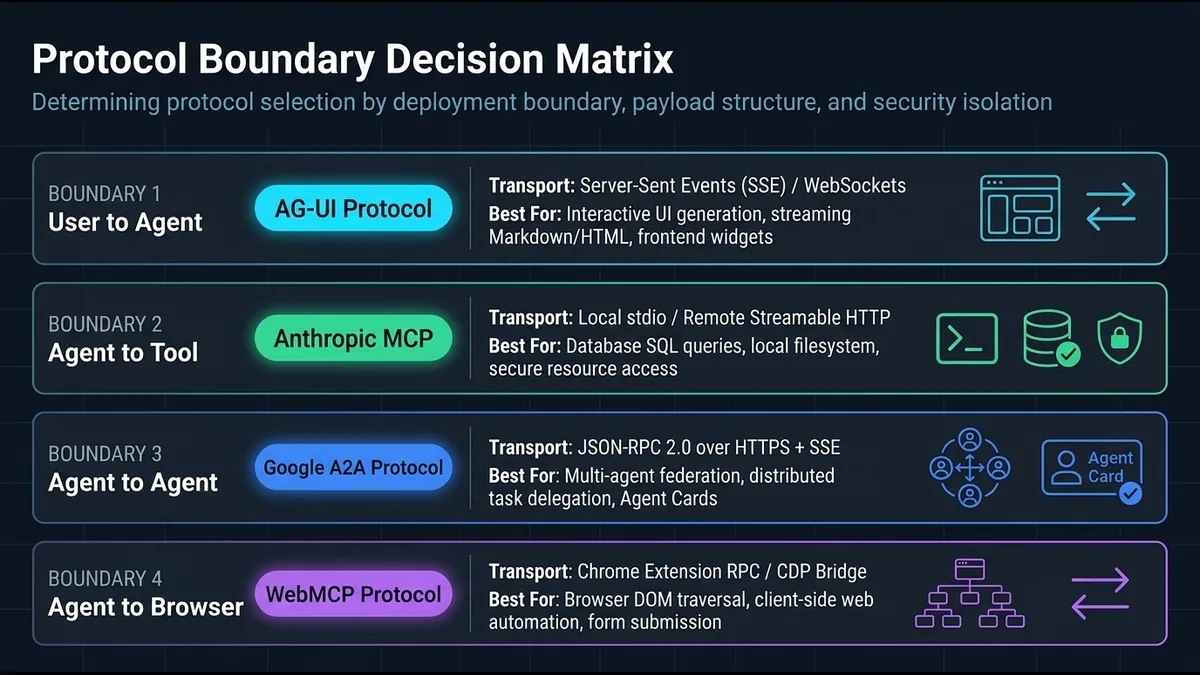 Figure 2: Protocol boundary decision matrix: identifying the correct protocol based on network boundaries, payload types, and infrastructure isolation.
Wire Protocol Bake-Off: Transports, Payloads, and Security Boundaries
Selecting the proper protocol requires rigorous evaluation of low-level network transports, serialization formats, and security postures. No single protocol satisfies every operational requirement across the distributed agent architecture.
Figure 2 maps these variables across all four protocol layers. While client-facing layers prioritize reactive latency and user event handling, inter-agent layers must provide robust cryptographic authentication and structured error delegation.
Similarly, tool-level protocols focus on minimal serialization overhead and zero-copy process communication. The following comparative matrix contrasts these architectural properties to guide your infrastructure selection.
Architects must balance the trade-offs between serialization efficiency, cross-language ecosystem adoption, and wire-level debuggability. Understanding these low-level network mechanics ensures that systems remain performant under heavy enterprise production loads. Evaluating these criteria systematically prevents performance degradation when scaling multi-agent clusters across global corporate networks.
Comparative Technical Specification Matrix
The table below contrasts the architectural specifications of all four standards:
| Protocol | Primary Boundary | Transport Layer | Wire Serialization | Security / Auth Model | Primary Custodian |
|---|---|---|---|---|---|
| AG-UI | Agent ↔ Frontend UI | SSE / WebSockets | Event Stream JSON | Session Cookies, JWT | Open Source Community |
| Google A2A | Agent ↔ Peer Agent | HTTP/2 | JSON-RPC 2.0 | Bearer Tokens, mTLS | Google / A2A Project |
| Anthropic MCP | Agent ↔ Tools & DBs | stdio / HTTP SSE | JSON-RPC 2.0 | Local IPC, API Keys | Anthropic / Open Standard |
| WebMCP | Agent ↔ Browser DOM | In-Memory JS Engine | JavaScript Objects | Web Origin Security (SOP) | W3C WebML Group |
Latency Overhead and Serialization Profiles
Network latency varies dramatically across the protocol layers:
- WebMCP: Sub-millisecond execution. Because tool calls execute directly inside the browser JavaScript runtime without network hops, latency is virtually instantaneous.
- MCP (stdio): ~2ms to 5ms. Local process pipes avoid network serialization, making local file and command execution exceptionally fast.
- AG-UI: 20ms to 45ms. Reactive SSE event streaming delivers immediate UI token rendering without buffering delays.
- Google A2A: 45ms to 120ms. Inter-agent communication spans HTTP boundaries, incorporating TLS handshakes, JSON-RPC parsing, and remote agent scheduling.
Authentication and Trust Models: Bearer, mTLS, and Local IPC
Security models must align with execution exposure. MCP via stdio assumes a local trust boundary where the user controls spawned processes. When running MCP over remote SSE, standard API keys or OAuth2 tokens govern access.
Google A2A incorporates enterprise-grade authentication into the Agent Card definition. Because A2A agents frequently interact across distinct corporate domains, servers declare required authorization schemes (such as signed JWTs or mutual TLS), allowing enterprise gateways to inspect and audit inter-agent delegations.
WebMCP relies on the browser’s native Same-Origin Policy (SOP). A web application can only register tools within its own origin context, preventing malicious cross-origin script injection from spoofing agent capabilities.
Production Decision Guide: Which Protocol When?
When designing a production agent architecture, determining which protocol to deploy at each boundary is critical for long-term scalability. System architects often struggle to identify whether a given capability represents a tool invocation or an autonomous peer delegation.
Selecting the wrong protocol introduces unnecessary complexity and latency. For example, wrapping a passive SQL query in an inter-agent delegation protocol adds excessive HTTP and token overhead, while calling an autonomous specialist via a stateless tool protocol destroys task isolation.
Use the following real-world implementation scenarios to map your technical requirements to the appropriate protocol layers. Each scenario illustrates how the four standards operate in production architectures. By aligning protocol selection with concrete communication requirements, teams can minimize operational latencies while maximizing system auditability.
Scenario 1: Full-Stack Web App with Copilot Interfaces
If you are developing a SaaS platform with an embedded AI assistant that helps users modify dashboard charts and initiate database exports:
- Use AG-UI to connect your frontend React or Vue interface to your backend agent runtime, streaming token progress and component states.
- Use MCP on your backend server to give the agent structured access to PostgreSQL, ClickHouse, and Stripe APIs.
Scenario 2: Enterprise Multi-Agent Supply Chain Federation
If you are coordinating autonomous agents across independent corporate entities (for example, a manufacturer agent ordering components from a supplier agent):
- Use Google A2A across corporate perimeters. Each company publishes its
.well-known/agent.jsoncard, allowing agents to negotiate procurement orders over secure JSON-RPC without exposing internal inventory databases or internal system prompts. - To understand how multi-agent teams maintain coordination topology, explore our architectural guide to multi-agent systems.
Scenario 3: Browser Automation Without Screen Recording
If you are building an autonomous desktop coworker that automates complex multi-step workflows across web applications (such as filing expense reports in Workday):
- Implement WebMCP. Have your web applications expose
navigator.modelContextactions, allowing the coworker agent to invoke structured form tools directly instead of burning tokens on brittle visual computer-use models.
Scenario 4: Connecting Claude to Enterprise SQL Databases
If your objective is equipping an LLM with read-only query capabilities over internal company databases:
- Deploy an MCP Server. Write an MCP service wrapping your database connection pool and expose typed tools (
execute_sql_query,describe_table_schema). Any MCP-compliant client (Claude Desktop, Cursor, LangGraph) can immediately query the data securely.
Frequently Asked Questions About the 4 Agent Protocols
What is the difference between A2A and MCP protocols?
Anthropic’s MCP standardizes how an agent connects to passive tools, files, and databases via client-server JSON-RPC. Google’s A2A standardizes how an autonomous agent discovers, negotiates, and delegates multi-turn tasks to independent peer agents across networks.
What are the 4 layers of the modern AI agent protocol stack?
The four layers are Layer 1: AG-UI (Agent-to-Frontend state streaming), Layer 2: Google A2A (Agent-to-Agent peer delegation), Layer 3: Anthropic MCP (Agent-to-Tool and database execution), and Layer 4: WebMCP (In-Browser DOM tool registration via navigator.modelContext).
What is WebMCP and how does navigator.modelContext work?
WebMCP is an emerging W3C web standard that allows web applications to register structured tools directly into browser memory using navigator.modelContext. Browser-based AI agents inspect these registered tools and invoke actions directly, avoiding fragile visual screenshot parsing and DOM scraping.
What problem does the AG-UI protocol solve for agent frontends?
AG-UI solves frontend synchronization by standardizing typed event streaming (RUN_STARTED, STATE_SYNC, TOOL_CALL_START) between backend agent graphs and client interfaces. It enables dynamic generative UI rendering and human-in-the-loop approvals without custom WebSocket protocols.
Can an agent use both MCP and A2A simultaneously?
Yes, modern autonomous architectures frequently combine both protocols in production workflows. An agent uses A2A to coordinate with external peer agents across network perimeters while simultaneously using local MCP servers to query internal databases and execute local code.
How does WebMCP eliminate visual DOM scraping for browser agents?
WebMCP replaces screenshot capturing and DOM guessing with declarative, type-annotated JavaScript tool interfaces. Agents receive clean JSON parameter specifications directly from the webpage, slashing token consumption by 90% and eliminating visual layout errors.
Which protocol should you use for database and API tool calling?
You should use Anthropic’s Model Context Protocol (MCP) for database and API tool calling. MCP provides mature community servers, structured JSON-RPC error handling, and broad client support across major developer IDEs and agent orchestration frameworks.
How do authentication and authorization differ between A2A and MCP?
MCP assumes a local trust perimeter over stdio pipes, relying on API keys or OAuth2 headers for remote SSE servers. A2A incorporates cryptographic identity and Bearer tokens directly into its .well-known/agent.json discovery manifest, enabling secure cross-organizational delegation over open HTTP networks.
Architectural Takeaways and Next Steps
The modern AI agent ecosystem has matured beyond monolithic loops into a layered, protocol-driven architecture. Standardizing on AG-UI for frontend streaming, Google A2A for inter-agent federation, Anthropic MCP for tool execution, and WebMCP for browser interaction creates modular, resilient systems capable of cross-vendor collaboration.
Decoupling these boundaries protects your architecture against vendor lock-in while drastically improving operational security and execution efficiency. Teams that establish clear interface contracts today will scale their autonomous infrastructure seamlessly as multi-agent networks expand. By adopting composable protocols across every architectural tier, engineering leaders create flexible foundations capable of absorbing rapid advancements in artificial intelligence.
To implement these protocols across different execution frameworks, compare their strengths in our benchmark guide on agentic AI frameworks. Adopting open standards today ensures your autonomous agent infrastructure scales smoothly into the future.