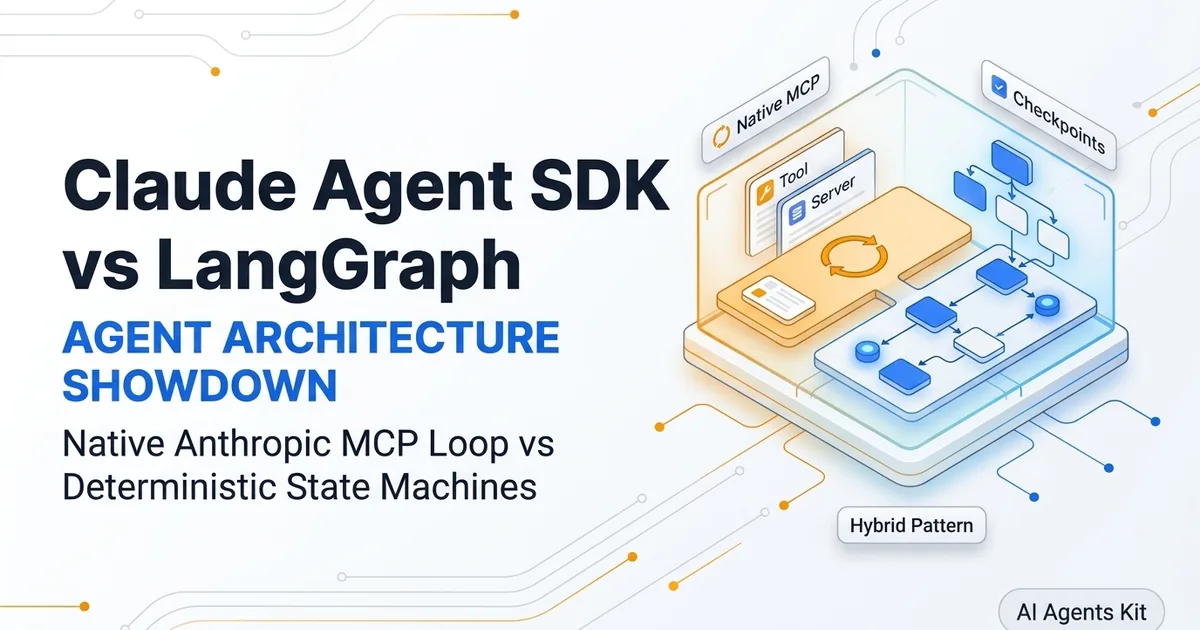
Claude Agent SDK vs LangGraph: Production Comparison (2026)
Compare Claude Agent SDK vs LangGraph for production AI agents: MCP loops, StateGraph checkpoints, prompt caching math, hybrid pattern, and code.
Evaluating Claude Agent SDK vs LangGraph comes down to a single architectural choice: letting a Claude-native runtime drive an autonomous tool loop with minimal code, or enforcing a model-agnostic state machine with deterministic routing and database checkpoints. Choose Claude Agent SDK for rapid, MCP-first coding and research loops; choose LangGraph when compliance edges, multi-model cost tiers, or multi-day human approvals are mandatory.
Production teams building autonomous systems in 2026 rarely face a simple feature checklist. Latency budgets, prompt caching economics, state serialization limits, and failure recovery determine whether an agent survives real traffic.
Key Takeaways
- Claude Agent SDK packages Anthropic’s Claude Code runtime loop, isolated subagent delegation, lifecycle hooks (
PreToolUse,Stop), and native Model Context Protocol (MCP) discovery into a low-boilerplate Python and TypeScript library, but executes exclusively on Claude models.- LangGraph enforces deterministic control flow through typed
StateGraphnodes, conditional edges, PostgreSQL checkpointing (PostgresSaver), and dynamicinterrupt()pauses across any LLM provider.- Anthropic Prompt Caching bills
cache_read_input_tokensat0.1xbase input cost (a 90% discount) after a1.25x5-minute TTL write, reaching its break-even point on the second turn of multi-step agent loops.- The 2026 Hybrid Pattern combines both frameworks: LangGraph governs outer business workflows, multi-model routing, and durable checkpoints while invoking Claude Agent SDK inside specialist reasoning or coding nodes.
Core Architecture: Native Agent Loop vs Deterministic State Machine
The architectural divide between Claude Agent SDK and LangGraph is agent loop vs state machine ownership. Claude Agent SDK gives Claude direct control over a pre-tuned planning, tool-execution, and evaluation loop, whereas LangGraph forces every transition through an explicit directed cyclic graph defined in your application code.
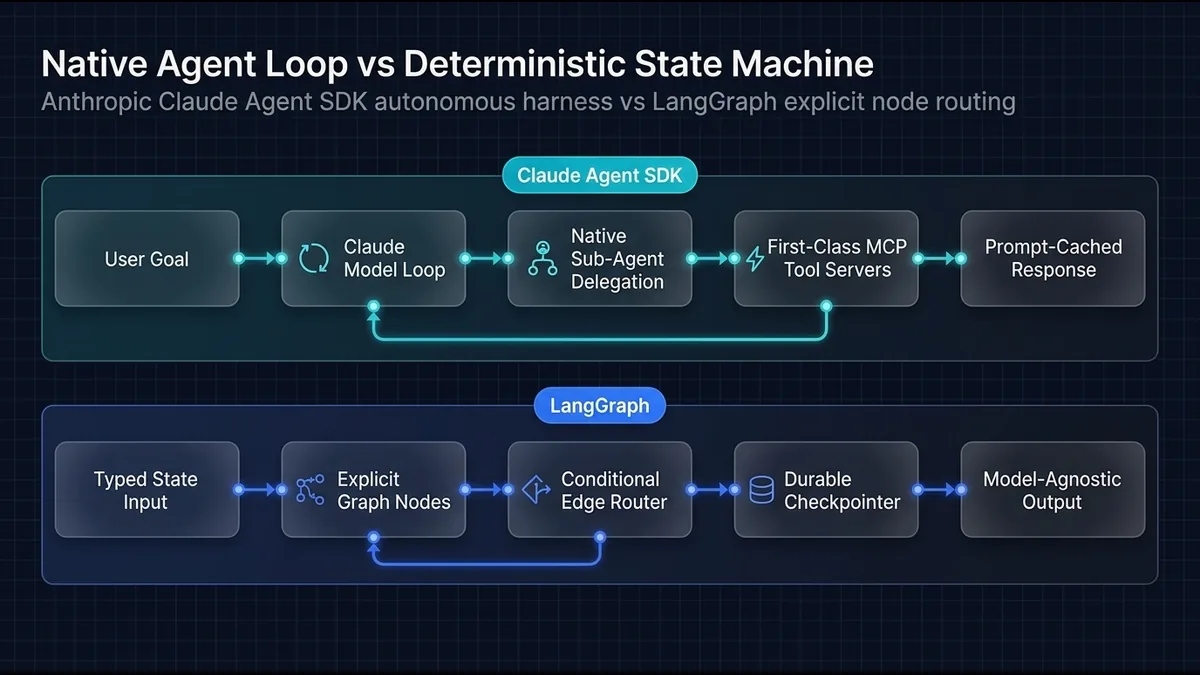 Figure 1: Control-flow comparison between the Claude Agent SDK native reasoning loop and LangGraph deterministic state transitions.
Both runtimes solve multi-turn tool orchestration, yet they optimize for opposite operational constraints. Understanding how each runtime manages context windows, tool discovery, and execution boundaries prevents costly rewrites once traffic scales.
How Claude Agent SDK Orchestrates Loops, Subagents, and MCP
The Claude Agent SDK architecture is derived directly from the core runtime powering Claude Code and is published in the Anthropic Claude Agent SDK Python Repository and TypeScript packages. Instead of writing manual while loops around raw API calls, developers pass a prompt and ClaudeAgentOptions to a query() stream that handles recursive planning, tool invocation, and context compression.
For complex tasks that would pollute a single context window, Claude Agent SDK subagent delegation spawns child agents with isolated context histories. Each subagent executes its own scoped toolset in parallel and returns only a compressed synthesis back to the parent orchestrator.
Tool integration is built around native MCP integration rather than custom function-calling wrappers. The SDK connects directly to local or remote servers implementing the Model Context Protocol Specification, dynamically discovering schemas without manual glue code. For a wire-level breakdown of how client-server transports work, review our guide on what MCP is and how it works.
How LangGraph Enforces StateGraph Edges, Checkpoints, and Interrupts
LangGraph StateGraph treats every agent workflow as a strongly typed finite state machine with cycles. Developers define a TypedDict or Pydantic state schema, attach Python or TypeScript functions as nodes, and declare conditional edges that decide which node runs next based on explicit state fields.
Every superstep transition in a compiled graph can be persisted to an external database through a checkpointer such as PostgresSaver or AsyncPostgresSaver. This design means execution state survives container restarts, worker crashes, and multi-day pauses without keeping a live process open in memory.
Unlike hook-based interception, LangGraph pauses execution via dynamic interrupt() calls tied to a persistent thread_id. As documented in the LangGraph Official Documentation, external clients resume paused workflows by passing human decisions back through Command(resume=...).
Control Flow Determinism and Observability Boundaries
In Claude Agent SDK, control flow is probabilistic: Claude decides which tool to call next, when to spawn a subagent, and when the task is complete. Guardrails are applied at lifecycle boundaries using hooks like PreToolUse and Stop, plus hard caps like max_turns.
In LangGraph, control flow is deterministic wherever you declare hard edges. If a compliance rule states that any financial payout above a threshold must route to a human auditor node, the graph guarantees that transition executes regardless of model output variance.
Side-by-Side Comparison: Claude Agent SDK vs LangGraph
A practical Claude Agent SDK vs LangGraph comparison must separate runtime ergonomics from infrastructure guarantees. The matrix below summarizes how Anthropic Claude Agent SDK vs LangGraph behave across eight production engineering dimensions.
Feature and Runtime Capability Matrix
| Dimension | Claude Agent SDK | LangGraph |
|---|---|---|
| Execution Model | Pre-built autonomous agent loop (model-driven) | Explicit directed cyclic graph (StateGraph, code-driven) |
| Model Support | Claude-only (Sonnet 5.5, Opus 5.5, Haiku 5.5 via Anthropic API, AWS, Vertex AI, Azure) | Model-agnostic (Claude 5.5, GPT-6.2, Gemini 4, DeepSeek-V4.1, local weights) |
| MCP Integration | Native MCP client discovery out of the box | Adapter-based via langchain-mcp-adapters |
| Subagent Isolation | Built-in parallel subagents with isolated context windows | Implemented via subgraphs or custom supervisor nodes |
| State & Durable Checkpointing | Session-managed in-loop state and context compaction | First-class durable checkpointing (PostgresSaver, SQLite, Redis) |
| Human-in-the-Loop | Synchronous lifecycle hooks (PreToolUse, Stop) |
Asynchronous interrupt() + Command(resume=...) across days |
| Boilerplate Overhead | Low (~40-80 lines for a production MCP agent) | Moderate to high (~200-400 lines for typed state, edges, and checkpointer) |
| Primary Observability | Anthropic API usage telemetry, custom hooks, OpenTelemetry | Native LangSmith node-level traces plus OpenTelemetry |
In any production AI agent framework comparison, teams also evaluate lighter typed-agent libraries alongside LangGraph. If you are weighing LangGraph against PydanticAI or classic LangChain chains, see our breakdown of PydanticAI vs LangChain vs LangGraph.
Claude Agent SDK: Production Profile
Verdict: Claude Agent SDK is the fastest path to shipping autonomous coding, repository analysis, and MCP-heavy investigative agents when your organization is standardized on Claude models.
Best for: Developer productivity tools, automated code review, incident triage bots, and open-ended research workflows that benefit from Claude’s native tool loop and subagent context isolation.
Strengths:
- Eliminates 200+ lines of manual tool-loop, message-compaction, and subagent orchestration boilerplate.
- First-class Model Context Protocol discovery connects to filesystem, GitHub, and database MCP servers with minimal config.
- Native alignment with Claude Sonnet 5.5, Claude Opus 5.5, and Extended Thinking reduces prompt-engineering fragility.
Trade-offs:
- Strict vendor lock in vs model agnostic constraint: you cannot route nodes to GPT-6.2 Sol, Gemini 4 Hydrogen, or self-hosted Llama 4 Maverick inside the SDK loop.
- Lacks built-in multi-day database checkpointing for long-running enterprise approval queues without external orchestration wrappers.
Pricing: Open-source SDK (Apache/MIT client libraries); you pay standard Anthropic API, AWS, Google Cloud Vertex AI, or Azure token rates for Claude models.
LangGraph: Production Profile
Verdict: LangGraph is the standard runtime for mission-critical, multi-step business workflows requiring strict compliance edges, multi-model cost routing, and crash-resilient persistence.
Best for: Regulated enterprise pipelines (finance, healthcare, legal review), multi-day human-in-the-loop approvals, and high-volume workloads mixing cheap router models with frontier reasoning models.
Strengths:
- Deterministic state transitions guarantee mandatory audit, validation, and escalation nodes cannot be skipped by LLM hallucinations.
- Durable PostgreSQL checkpointing enables exact time-travel debugging, state branching, and crash recovery per
thread_id. - Full model portability lets teams hot-swap providers or hedge rate limits across Anthropic, OpenAI, Google, and open-weight clusters.
Trade-offs:
- Higher upfront engineering investment to design typed state schemas, reducers, conditional routers, and database connection pools.
- Requires adapter packages (
langchain-mcp-adapters) to match Claude Agent SDK’s turnkey MCP ergonomics.
Pricing: Core langgraph library is MIT open-source and free to self-host; optional managed hosting (LangSmith Deployment) and LangSmith tracing tiers are billed per seat and trace volume.
Evaluating Claude Agent SDK vs LangGraph tradeoffs directly through these isolated profiles makes it clear that neither runtime is strictly superior. Each tool dominates a distinct operational boundary.
Where Each Wins: Production Decision Framework
Deciding between Claude Agent SDK or LangGraph becomes straightforward when you map your workload against four axes: determinism, duration, model diversity, and team velocity. As noted in Anthropic Engineering: Building Effective Agents, teams should always choose the simplest composable abstraction that satisfies reliability requirements.
Where Claude Agent SDK Wins
Claude Agent SDK wins decisively on zero boilerplate vs explicit control flow when the task path cannot be known ahead of time:
- Autonomous coding and repository workflows: When an agent must grep files, inspect stack traces, run shell tests, and iterate on patches, hardcoding graph edges slows development without improving accuracy.
- MCP-first internal developer tools: Teams exposing internal Postgres, Jira, and GitHub capabilities through MCP servers can wire up a working agent in under 60 lines of Python or TypeScript.
- Short-horizon parallel investigation (under 5 minutes): Built-in subagent delegation lets a coordinator fan out three isolated context windows to analyze logs, docs, and code diffs concurrently.
- Small teams optimizing time-to-production: Organizations already committed to Claude Sonnet 5.5 or Claude Opus 5.5 via AWS or Google Cloud Vertex AI avoid maintaining custom checkpointer databases and graph reducers.
Where LangGraph Wins
LangGraph wins whenever business risk, auditability, or multi-provider economics outweigh initial development speed:
- Multi-day human in the loop interrupts: Insurance claims, procurement approvals, and legal sign-offs require suspending execution for 48+ hours and resuming cleanly via
Command(resume=...)after a human clicks approve. - Strict compliance and deterministic guardrails: Financial or healthcare workflows where deterministic code must validate schemas, enforce policy checks, and block unauthorized tool paths regardless of prompt injection attempts.
- Multi-provider model routing and failover: Pipelines that classify 80% of requests on Gemini 4 Hydrogen or DeepSeek-V4.1-Flash and escalate only complex edge cases to Claude Opus 5.5 or GPT-6.2 Astra.
- Crash-resilient batch processing with state replay: Long-running ETL or multi-agent pipelines where a mid-run OOM kill must resume from node 7 of 10 rather than restarting from scratch and re-paying token costs.
Migration Triggers Between Frameworks
Understanding when to choose Claude Agent SDK vs LangGraph also means knowing when to migrate. Start with Claude Agent SDK for greenfield prototypes and internal developer automation, then introduce LangGraph when any of three triggers fire:
- Approval latency exceeds a single HTTP/WebSocket timeout: Synchronous hooks cannot hold open sockets while waiting hours for human input.
- Model spend requires cross-vendor tiering: You need non-Claude worker models for high-volume extraction or local open-weight models for sensitive PII redaction.
- Compliance demands provable state transitions: Auditors require an immutable database ledger of every state transition and branching decision.
Production Code Walkthrough: Python, TypeScript, and StateGraph
Abstract architecture diagrams hide the real day-two maintenance cost of Claude Agent SDK TypeScript Python codebases versus LangGraph state machines. The three runnable implementations below show production-grade error handling, type annotations, and security boundaries for each runtime.
Claude Agent SDK in Python with PreToolUse Hooks and MCP
This Python implementation configures ClaudeAgentOptions with a read-only MCP server, caps execution at 12 turns, and attaches a Claude Agent SDK PreToolUse hook to block destructive shell commands before execution. Note that the SDK loads project-level procedures cleanly; if you also package reusable team checklists, follow our Claude Agent Skills deployment guide.
import asyncio
from typing import Any
from claude_agent_sdk import ClaudeAgentOptions, ResultMessage, query

BLOCKED_SHELL_TOKENS = ("rm -rf", "DROP TABLE", "chmod 777", "curl | sh")


async def enforce_tool_policy(
    tool_name: str, tool_input: dict[str, Any]
) -> dict[str, Any]:
    """PreToolUse hook blocking destructive shell commands deterministically."""
    if tool_name == "Bash":
        command = str(tool_input.get("command", ""))
        if any(token in command for token in BLOCKED_SHELL_TOKENS):
            return {
                "decision": "block",
                "reason": f"Blocked unsafe command pattern in: {command}",
            }
    return {"decision": "allow"}


async def run_triage_agent(incident_prompt: str) -> str:
    options = ClaudeAgentOptions(
        model="claude-5-5-sonnet-20260928",
        max_turns=12,
        allowed_tools=["Read", "Grep", "Bash", "mcp__postgres__query"],
        mcp_servers={
            "postgres": {
                "command": "npx",
                "args": ["-y", "@modelcontextprotocol/server-postgres"],
                "env": {"POSTGRES_RO_URI": "postgresql://readonly@db.internal:5432/prod"},
            }
        },
        hooks={"PreToolUse": [enforce_tool_policy]},
    )

    final_output = ""
    async for message in query(prompt=incident_prompt, options=options):
        if isinstance(message, ResultMessage) and message.subtype == "success":
            final_output = message.result
    return final_output


if __name__ == "__main__":
    report = asyncio.run(
        run_triage_agent("Investigate elevated 502 error rates in the checkout service.")
    )
    print(report)
Setting max_turns=12 prevents runaway token loops if an external MCP server returns ambiguous errors. The PreToolUse hook enforces deterministic security policy right before tool execution without requiring an external graph engine.
Claude Agent SDK in TypeScript for Autonomous Subagent Tasks
For Node.js backends and CI/CD pipelines, the Anthropic Claude Agent SDK TypeScript Repository mirrors the Python API with strict TypeScript interfaces. The example below streams typed messages and bounds execution scope to a target repository directory.
import { query, type Options, type SDKResultMessage } from "@anthropic-ai/claude-agent-sdk";

interface ReviewSummary {
  status: "success" | "error";
  output: string;
  costUsd: number;
}

export async function runAutomatedDiffAudit(repoPath: string): Promise<ReviewSummary> {
  const options: Options = {
    model: "claude-5-5-sonnet-20260928",
    cwd: repoPath,
    maxTurns: 10,
    allowedTools: ["Read", "Grep", "Glob"],
    permissionMode: "default",
  };

  for await (const message of query({
    prompt: "Audit the current git diff for SQL injection and missing auth checks.",
    options,
  })) {
    if (message.type === "result") {
      const result = message as SDKResultMessage;
      return {
        status: result.subtype === "success" ? "success" : "error",
        output: result.subtype === "success" ? result.result : "Audit failed",
        costUsd: result.total_cost_usd ?? 0,
      };
    }
  }

  return { status: "error", output: "Stream closed without result", costUsd: 0 };
}
Restricting allowedTools to ["Read", "Grep", "Glob"] removes write and shell privileges at the SDK runtime layer. Capturing total_cost_usd on the terminal SDKResultMessage feeds directly into per-repository CI cost telemetry.
LangGraph StateGraph with PostgresSaver and Dynamic Interrupts
This LangGraph Postgres checkpointer setup demonstrates deterministic routing, connection pooling, and LangGraph interrupt command resume for an enterprise refund approval flow. Notice how side effects sit strictly in the post-approval node so resuming never double-charges or double-refunds a customer.
import os
from typing import Literal, TypedDict
from psycopg.rows import dict_row
from psycopg_pool import ConnectionPool
from langgraph.checkpoint.postgres import PostgresSaver
from langgraph.graph import StateGraph, START, END
from langgraph.types import Command, interrupt


class RefundState(TypedDict):
    order_id: str
    amount_usd: float
    risk_flag: bool
    approved: bool
    status: str


def evaluate_risk(state: RefundState) -> dict:
    # Deterministic business rule: never delegate threshold math to an LLM
    return {"risk_flag": state["amount_usd"] > 500.0}


def route_after_risk(state: RefundState) -> Literal["human_approval", "execute_refund"]:
    return "human_approval" if state["risk_flag"] else "execute_refund"


def human_approval(state: RefundState) -> dict:
    # Dynamic interrupt suspends graph cleanly; zero side effects before this line
    decision = interrupt({
        "action": "approve_high_value_refund",
        "order_id": state["order_id"],
        "amount_usd": state["amount_usd"],
    })
    return {"approved": bool(decision.get("approved", False))}


def execute_refund(state: RefundState) -> dict:
    if state["risk_flag"] and not state["approved"]:
        return {"status": "rejected_by_reviewer"}
    # Safe to execute idempotent payment gateway API call here
    return {"status": f"refunded_{state['order_id']}"}


def build_refund_graph(pool: ConnectionPool):
    checkpointer = PostgresSaver(pool)
    checkpointer.setup()

    builder = StateGraph(RefundState)
    builder.add_node("evaluate_risk", evaluate_risk)
    builder.add_node("human_approval", human_approval)
    builder.add_node("execute_refund", execute_refund)

    builder.add_edge(START, "evaluate_risk")
    builder.add_conditional_edges("evaluate_risk", route_after_risk)
    builder.add_edge("human_approval", "execute_refund")
    builder.add_edge("execute_refund", END)
    return builder.compile(checkpointer=checkpointer)


if __name__ == "__main__":
    pool = ConnectionPool(
        os.environ["DATABASE_URL"],
        max_size=20,
        kwargs={"autocommit": True, "row_factory": dict_row},
    )
    graph = build_refund_graph(pool)
    config = {"configurable": {"thread_id": "refund-order-98421"}}

    # 1. Initial run pauses at human_approval and persists state to PostgreSQL
    paused = graph.invoke(
        {"order_id": "ORD-98421", "amount_usd": 1250.0, "risk_flag": False, "approved": False, "status": "pending"},
        config=config,
    )
    # 2. Hours later, resume using the exact same thread_id
    completed = graph.invoke(Command(resume={"approved": True}), config=config)
    print(completed["status"])
Using ConnectionPool with max_size=20 and autocommit=True prevents PostgreSQL deadlocks under concurrent worker load. Passing thread_id in config guarantees every pause and resume maps to a single durable execution cursor.
The 2026 Hybrid Pattern: LangGraph Outer Graph + Claude Agent SDK Nodes
Senior engineering teams in 2026 increasingly reject a binary choice and adopt a hybrid agent architecture: LangGraph outer graph Claude Agent SDK inner node. In this layered topology, LangGraph owns durable macro-state, compliance routing, and human approvals, while Claude Agent SDK runs inside bounded specialist nodes for open-ended coding or MCP research.
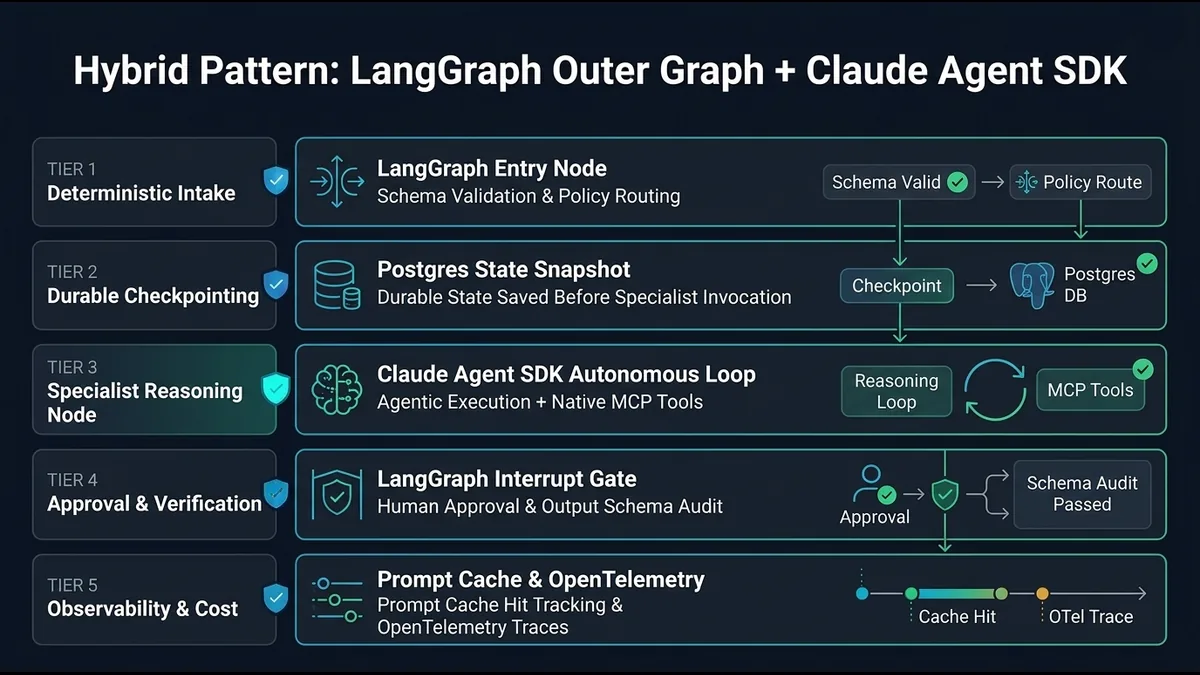 Figure 2: Production hybrid pattern combining LangGraph outer state checkpoints with Claude Agent SDK specialist tool nodes.
Why Layered Orchestration Beats Pure Single-Framework Designs
Pure LangGraph implementations often become brittle when engineers try to model open-ended coding or multi-hop debugging as static graph edges. Conversely, pure Claude Agent SDK deployments struggle when an organization needs multi-day approval persistence, cross-vendor model routing, or hard compliance gates.
Splitting responsibilities across two layers solves both problems cleanly. To evaluate how this layered design compares with peer-to-peer swarms and router meshes, see our architectural guide on supervisor vs swarm vs router multi-agent topologies.
Implementing a Claude Agent SDK Specialist Node Inside LangGraph
The async Python example below embeds a scoped Claude Agent SDK worker inside a LangGraph node backed by AsyncPostgresSaver. The outer graph runs deterministic triage, delegates root-cause investigation to Claude Agent SDK, pauses for engineer sign-off, and records the final remediation.
import asyncio
from typing import TypedDict
from claude_agent_sdk import ClaudeAgentOptions, ResultMessage, query
from langgraph.checkpoint.postgres.aio import AsyncPostgresSaver
from langgraph.graph import StateGraph, START, END
from langgraph.types import interrupt


class IncidentWorkflowState(TypedDict):
    alert_id: str
    service_name: str
    diagnosis_summary: str
    remediation_approved: bool


async def claude_specialist_node(state: IncidentWorkflowState) -> dict:
    """Inner autonomous worker: bounded turns, read-only tools, compressed output."""
    options = ClaudeAgentOptions(
        model="claude-5-5-sonnet-20260928",
        max_turns=8,
        allowed_tools=["Read", "Grep", "mcp__observability__query_logs"],
    )
    prompt = (
        f"Diagnose alert {state['alert_id']} for service {state['service_name']}. "
        "Return a concise 5-bullet root cause summary and proposed patch."
    )

    diagnosis = "No diagnosis produced."
    async for msg in query(prompt=prompt, options=options):
        if isinstance(msg, ResultMessage) and msg.subtype == "success":
            diagnosis = msg.result

    # Return ONLY the synthesized summary to keep outer LangGraph checkpoints small
    return {"diagnosis_summary": diagnosis}


async def oncall_approval_node(state: IncidentWorkflowState) -> dict:
    response = interrupt({
        "alert_id": state["alert_id"],
        "diagnosis": state["diagnosis_summary"],
        "prompt": "Approve automated rollback?",
    })
    return {"remediation_approved": bool(response.get("approved", False))}


async def compile_hybrid_graph(db_uri: str):
    async with AsyncPostgresSaver.from_conn_string(db_uri) as checkpointer:
        await checkpointer.setup()
        builder = StateGraph(IncidentWorkflowState)
        builder.add_node("diagnose", claude_specialist_node)
        builder.add_node("approve", oncall_approval_node)
        builder.add_edge(START, "diagnose")
        builder.add_edge("diagnose", "approve")
        builder.add_edge("approve", END)
        return builder.compile(checkpointer=checkpointer)
Notice the critical state boundary: the inner Claude Agent SDK worker executes up to 8 autonomous tool turns inside its own ephemeral context, then writes only a short diagnosis_summary string into IncidentWorkflowState. That single discipline prevents raw tool transcripts from bloating PostgreSQL checkpoints.
State Boundary Contracts and Timeout Budgets
Always wrap inner Claude Agent SDK nodes in asyncio.wait_for(..., timeout=180) and enforce a strict max_turns cap. Without a hard node timeout, a hung external MCP server can stall a LangGraph worker thread indefinitely and exhaust database pool slots.
Export traces from both layers under a shared correlation ID (alert_id or thread_id) so LangSmith and OpenTelemetry dashboards link outer graph supersteps to inner SDK tool calls.
Cost and Prompt Caching Economics in Multi-Turn Loops
Understanding prompt caching economics is the difference between a profitable AI feature and an unsustainable token bill. Autonomous agents resend large static prefixes (system instructions, CLAUDE.md rules, and 15 to 40 MCP tool JSON schemas) on every single reasoning turn.
Anthropic Prompt Caching Math and Break-Even Turns
According to the Anthropic Prompt Caching Documentation, cached input pricing uses three explicit token counters in every API response:
- Uncached input (
input_tokens): Billed at1.0xthe model’s base input price. - Cache creation (
cache_creation_input_tokens): Billed at 1.25x cache write for the default 5-minute TTL (or2.0xfor a 1-hour TTL). - Cache reads (
cache_read_input_tokens): Billed at 0.1x cache read, delivering a 90% discount on repeated static prefixes.
The break-even point arrives on turn 2. Two uncached turns cost 2.0x base input tokens, whereas one cached write plus one cached read costs 1.25x + 0.1x = 1.35x, saving 32.5% by the second turn and over 80% across a 10-turn loop.
To capture Anthropic prompt caching cache_read_input_tokens, mark static system prompts and tool arrays with cache_control: {"type": "ephemeral"} at the very start of the prompt. Dynamic timestamps, user IDs, or fresh tool results must always appear after the last cache breakpoint.
Multi-Model Tier Routing in LangGraph
Because Claude Agent SDK runs exclusively on Claude models, its primary cost lever is maximizing prompt cache hit rates and delegating lightweight subagent tasks to Claude Haiku 5.5 while reserving Claude Sonnet 5.5 or Opus 5.5 for complex synthesis.
LangGraph unlocks multi model routing cost optimization across vendors. A single StateGraph can run intent classification and JSON extraction on Gemini 4 Hydrogen or DeepSeek-V4.1-Flash, run structured verification on GPT-6.2 Sol, and invoke Claude Opus 5.5 only on the 15% of requests requiring deep architectural reasoning.
Comparing Total Cost per 10,000 Agent Runs
The table below models 10,000 10-turn agent runs with a 12,000-token static prefix (system prompt + MCP schemas) and 1,500 fresh input tokens per turn (assuming Claude Sonnet 5.5 at $3.00 / 1M base input tokens and a lightweight router tier at $0.40 / 1M input tokens):
| Architecture Strategy | Prefix Input Cost (10K Runs) | Dynamic Input Cost (10K Runs) | Effective Input Cost (10K Runs) | Impact on p95 Latency |
|---|---|---|---|---|
| Uncached Single-Model Loop (Sonnet 5.5) | $3,600 | $450 | $4,050 | Baseline (highest TTFT) |
| Prompt-Cached Claude Agent SDK (Sonnet 5.5, 5-min TTL) | $774 (1.25x + 9 x 0.1x) |
$450 | $1,224 (70% lower) | Lower TTFT on turns 2-10 |
| LangGraph Tiered Routing (80% Haiku/Flash + 20% Cached Sonnet) | $285 | $138 | $423 (89% lower) | Lowest p95 latency on fast-path nodes |
[!TIP] Measure cache hit ratios continuously in production using
cache_read_input_tokens / (input_tokens + cache_creation_input_tokens + cache_read_input_tokens). Any single-provider agent loop running below a 75% cache hit ratio almost always has a dynamic variable leaking into its static prefix.
Production Troubleshooting: Context Bloat, Cache Misses, and Replay Bugs
Most production troubleshooting incidents across Claude Agent SDK and LangGraph stem from six predictable runtime failure modes. Diagnosing these early saves hours of silent degradation under peak load.
Fixing Context Bloat and Prompt-Too-Long Errors
In long-running graphs, LangGraph add_messages context bloat occurs when default reducers append full raw ToolMessage payloads (such as 80KB SQL dumps or full repository files) on every turn. Between turns 15 and 30, the API rejects requests with an HTTP 400 prompt is too long error.
Fix: Never store raw bulk tool outputs in the global message list. Insert a dedicated summarization or truncation node that caps every ToolMessage at 2,000 tokens and stores full artifacts in object storage (S3 or R2) referenced by URI.
In Claude Agent SDK, rely on isolated subagents for heavy file or log scanning so raw search output stays trapped inside the child context window and never inflates the parent session.
Debugging Zero Cache Hits and Checkpoint Serialization Inflation
Seeing cache_read_input_tokens zero across multi-turn Claude runs indicates a broken prefix match. Common culprits include injecting datetime.utcnow() into the system prompt, dynamically reordering MCP tool schemas between turns, or exceeding the 5-minute TTL during slow human waits.
Fix: Pin static system prompts and sorted tool definitions at index 0 with cache_control: {"type": "ephemeral"}, move all timestamps into the latest user message, and switch to the 1-hour TTL if human turnaround routinely exceeds five minutes.
In LangGraph, checkpoint serialization bloat happens when PostgresSaver serializes deeply nested Pydantic models via dumpd() on every superstep, causing database rows to grow 5x to 10x larger than the semantic token footprint. Keep StateGraph schemas flat with primitive strings, booleans, and IDs, and never attach independent checkpointers to child subgraphs when the parent graph already persists state.
Preventing Interrupt Side-Effect Replays and Pool Exhaustion
Three database and resumption bugs account for the majority of LangGraph production pages:
| Failure Mode | Observable Symptom | Root Cause | Production Remediation |
|---|---|---|---|
| Interrupt side effect replay | Duplicate emails, double database inserts, or duplicate API charges on resume | LangGraph re-executes a paused node from line 1 up to interrupt() upon Command(resume=...) |
Move all external writes and API mutations to a downstream node after the interrupt() node |
| Postgres connection pool exhaustion | Worker timeouts, OperationalError, and deadlocks during traffic spikes |
Opening raw psycopg connections per request instead of bounded pooling | Initialize a shared ConnectionPool(max_size=20, kwargs={"autocommit": True}) passed into PostgresSaver |
| State schema drift | KeyError or deserialization crashes when resuming active threads post-deploy |
Renaming or removing required keys in TypedDict while older thread_id rows remain paused |
Make new state fields optional (NotRequired), version thread_id prefixes, or write backward-compatible reducers |
[!WARNING] Treat LangGraph’s
update_state()as creating an immutable branch (fork) rather than mutating history in place. If you pair manual context compaction withupdate_state(), verify your resume pointer targets the latest checkpoint ID so discarded pre-compaction messages are not re-injected.
For end-to-end span correlation across both frameworks, implement OpenTelemetry trace propagation following our AI agent observability and distributed tracing guide.
Frequently Asked Questions
What is the main difference between Claude Agent SDK and LangGraph?
Claude Agent SDK gives you a pre-built, Claude-native autonomous loop with built-in subagent isolation and Model Context Protocol (MCP) support in minimal code. LangGraph gives you an explicit, model-agnostic state machine (StateGraph) with deterministic edge routing, database checkpointing, and resumable human-in-the-loop interrupts.
Can you use Claude Agent SDK inside a LangGraph node?
Yes, embedding Claude Agent SDK inside a LangGraph node is the dominant hybrid enterprise pattern in 2026. LangGraph controls macro workflow transitions, Postgres persistence, and compliance gates while delegating open-ended coding or MCP investigation steps to an isolated Claude Agent SDK worker.
Does Claude Agent SDK lock you into Anthropic models?
Claude Agent SDK executes exclusively against Claude models such as Claude Sonnet 5.5, Claude Opus 5.5, and Claude Haiku 5.5, though you can run them via the Anthropic API, AWS, Google Cloud Vertex AI, or Azure. If your architecture requires mixing OpenAI GPT-6.2, Gemini 4, DeepSeek-V4.1, or local weights inside one workflow, LangGraph is the required choice.
How does human-in-the-loop approval differ in Claude Agent SDK vs LangGraph?
Claude Agent SDK handles approvals synchronously through lifecycle hooks like PreToolUse that intercept tool calls before execution inside an active session. LangGraph uses dynamic interrupt() calls backed by durable checkpointers like PostgresSaver, allowing workflows to suspend for hours or days and resume safely via Command(resume=...).
Which is cheaper in production: Claude Agent SDK or LangGraph?
Claude Agent SDK minimizes token spend on single-provider multi-turn loops when static prompts and tool schemas hit Anthropic’s 90% prompt caching read discount (0.1x base rate). LangGraph wins on cost for high-volume mixed pipelines where you route 80% of classification or extraction nodes to ultra-low-cost models like Claude Haiku 5.5, Gemini 4 Hydrogen, or DeepSeek-V4.1-Flash.
How does MCP integration work in LangGraph compared to Claude Agent SDK?
Claude Agent SDK treats MCP as a first-class native layer, dynamically discovering server schemas and routing tool calls without adapter boilerplate. LangGraph relies on standard tool bindings and requires langchain-mcp-adapters to bridge external MCP servers into graph tool nodes.
When should you migrate from Claude Agent SDK to LangGraph?
Migrate to LangGraph when your agent requires strict compliance state transitions that the model must never bypass, multi-day paused human approvals, or multi-provider model failover. If your workload remains an open-ended coding, research, or local MCP execution loop under five minutes, staying on Claude Agent SDK avoids unnecessary graph boilerplate.
Final Architectural Recommendation
Default to Claude Agent SDK when shipping autonomous coding assistants, internal developer tools, and MCP-first investigation workflows where fast iteration and Claude Sonnet 5.5 reasoning quality matter most. Pair it with PreToolUse security hooks, strict max_turns caps, and static prompt prefixes to capture the 90% cached input discount from day one.
Default to LangGraph when your system demands deterministic compliance routing, PostgreSQL-backed multi-day human approvals, or multi-vendor cost tiering across Claude, GPT-6.2, Gemini 4, and open-weight workers. Configure ConnectionPool for PostgresSaver, keep TypedDict state flat, and isolate all external writes in nodes positioned after interrupt().
When an enterprise workflow needs both deterministic governance and deep autonomous problem-solving, deploy the hybrid pattern: let LangGraph orchestrate the durable outer state machine and invoke Claude Agent SDK inside bounded, timeout-protected specialist nodes that return only compressed summaries into persistent graph state.