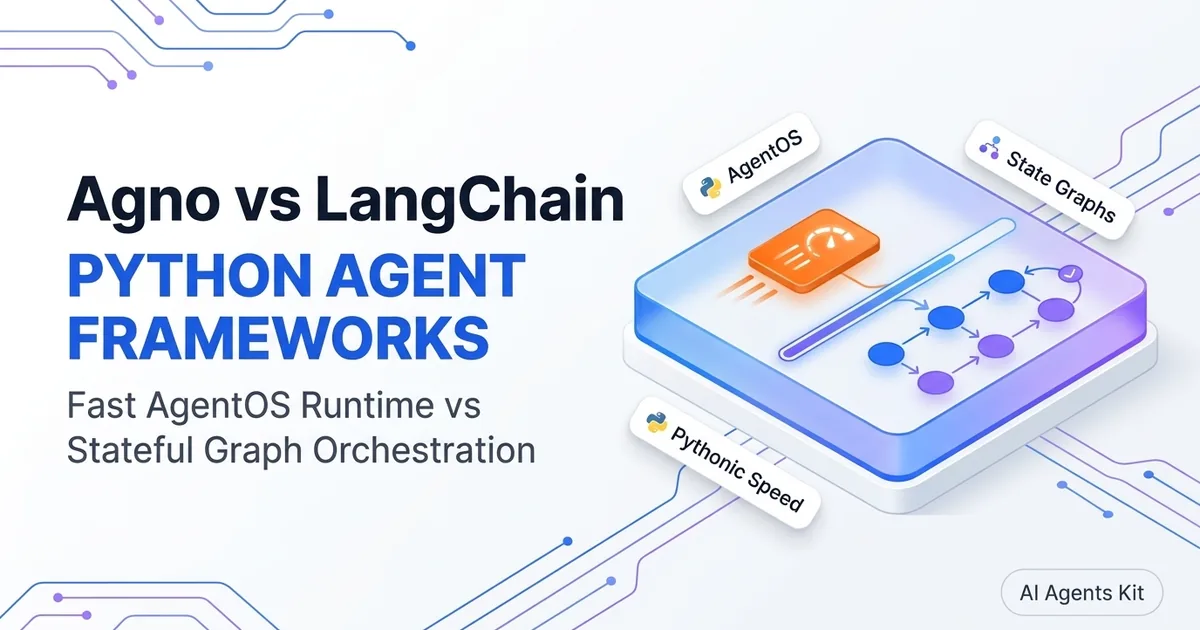
Agno vs LangChain & LangGraph: Agent Comparison (2026)
Compare Agno vs LangChain and LangGraph for Python AI agents. Review AgentOS vs StateGraph architecture, microsecond benchmarks, code, and pricing.
Choosing between Agno vs LangChain and LangGraph comes down to one architectural trade-off: Agno prioritizes pure-Python execution speed and turnkey FastAPI deployment through AgentOS, whereas LangChain v1 and LangGraph prioritize explicit state-machine control, durable checkpointing, and enterprise tracing via LangSmith.
In local tracemalloc micro-benchmarks, Agno instantiates an agent in roughly 3.2 microseconds using 5.2 KiB of memory, compared to 1,100 to 2,000 microseconds and 130 to 145 KiB for a compiled LangGraph graph. Understanding when that 300x startup advantage changes production architecture, and when a 500 ms to 3,000 ms LLM call makes graph durability far more valuable, determines which Python stack fits your team.
Key Takeaways
- Agno (formerly Phidata) treats AI agents as lightweight pure-Python objects paired with AgentOS, a FastAPI production runtime that auto-generates REST endpoints, SSE streams, and Model Context Protocol servers out of the box.
- LangChain v1 and LangGraph split responsibilities cleanly:
langchain.agents.create_agenthandles standard tool loops with composable middleware, while LangGraphStateGraphmanages cyclic routing, durablePostgresSavercheckpointing, and human-in-the-loop interrupts.- Micro-benchmark reality: Agno’s 3.2 microsecond instantiation and 5.2 KiB memory footprint save substantial RAM in high-concurrency ephemeral agent pools, yet account for less than 0.2% of total latency on single requests bound by 500 ms to 3,000 ms LLM inference calls.
- Pricing and observability: Agno and AgentOS run entirely inside your own infrastructure at zero per-seat licensing cost, while LangSmith adds hosted evaluations and prompt versioning starting at $0 per month for one developer seat and $39 per seat on the Plus tier.
Agno vs LangChain and LangGraph: Core Architectural Split
The core difference in Agno vs LangChain and LangGraph is how each framework models control flow and runtime hosting. Agno wraps model calls, tools, memory, and vector knowledge inside plain Python classes served by AgentOS, while LangChain v1 and LangGraph compile agent execution into explicit directed cyclic graphs.
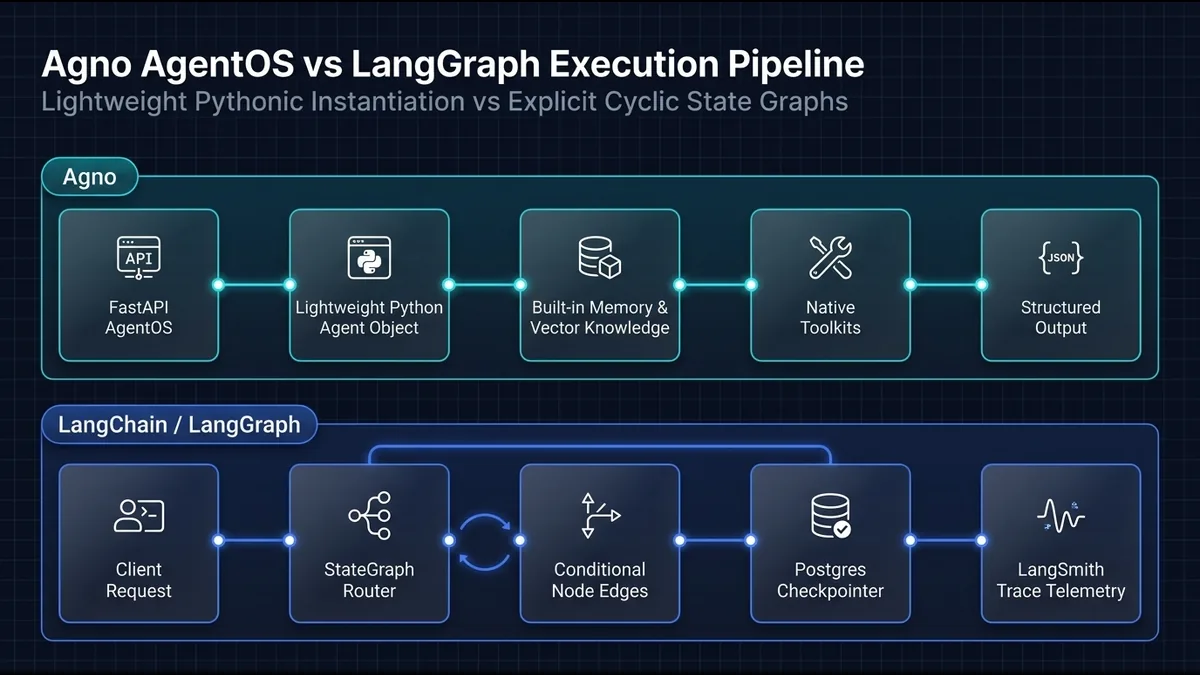 Figure 1: Execution architecture comparing Agno stateless Pythonic AgentOS instances with LangGraph cyclic state-machine orchestration.
Engineers evaluating langchain vs agno often compare Agno against legacy LangChain chains from two years ago. That comparison misses major architectural shifts on both sides, because Phidata rebranded and rebuilt into Agno while LangChain v1 retired AgentExecutor in favor of a unified LangGraph runtime.
From Phidata to Agno: The Pure-Python Agent Runtime
Agno began life as Phidata and kept a strict “pure Python above, runtime below” engineering philosophy documented in the Agno Official GitHub Repository. Instead of forcing developers to declare graph nodes, reducer functions, and edge dictionaries, Agno exposes three primary classes: Agent, Team, and Workflow.
An Agent object accepts a model string such as openai:gpt-6.2-sol, a list of Python callables or toolkits, a database driver like SqliteDb or PostgresDb, and optional vector knowledge bases. Because Agno avoids compiling a domain-specific state graph on startup, every agent runs as standard Python control flow that any backend engineer can step through with a normal debugger.
Above the SDK sits AgentOS, an opinionated production layer built directly on FastAPI. Wrapping an Agent or Team in AgentOS automatically generates documented HTTP routes, Server-Sent Events (SSE) token streams, JWT authorization guards, background queues, and a native /mcp endpoint aligned with the Model Context Protocol Specification.
How LangChain v1 and LangGraph Divide Responsibilities
LangChain and LangGraph are frequently grouped together, yet they solve distinct layers of the Python AI agent stack. LangChain v1 provides standardized model wrappers (langchain-openai, langchain-anthropic), document loaders, retriever interfaces, and the high-level create_agent builder with composable middleware for PII redaction and history summarization.
LangGraph sits underneath LangChain v1 as the low-level orchestration engine, detailed in the LangGraph Overview Documentation. Developers define a typed State schema, register discrete Python functions as graph nodes, and connect them with deterministic or conditional edges that support cycles.
Every step through a LangGraph graph executes as a discrete superstep that writes a serialized snapshot to a checkpointer backend. Teams looking for a deeper walkthrough of create_agent middleware and StateGraph internals can follow our LangChain agents tutorial alongside this comparison.
Side-by-Side Architecture Comparison Matrix
The table below maps how Agno, LangChain v1, and LangGraph differ across core runtime abstractions, state mechanics, and deployment models.
| Dimension | Agno | LangChain v1 | LangGraph |
|---|---|---|---|
| Core Abstraction | Agent, Team, and Workflow Python objects |
create_agent, middleware, and provider wrappers |
StateGraph, typed State, nodes, and edges |
| Control Flow Model | Implicit agent loop and declarative Python workflows | Managed ReAct tool loop backed by LangGraph | Explicit deterministic cyclic state machine |
| State Persistence | Built-in SqliteDb and PostgresDb session drivers |
Inherits LangGraph checkpointers via create_agent |
Native durable checkpointing (PostgresSaver, Redis) |
| Human-in-the-Loop | Confirmation hooks and session-level pauses | Middleware approval hooks | First-class typed interrupt() and state replay |
| Production Serving | Bundled AgentOS FastAPI runtime and /mcp server |
Bring-your-own FastAPI or LangGraph Platform | Self-hosted FastAPI or managed LangGraph Platform |
| Observability | Built-in tracing=True DB logging and AgentOS UI |
Native LangSmith tracing and OpenTelemetry | Native LangSmith tracing, time-travel, and evals |
| Learning Curve | Low for Python and FastAPI developers | Moderate due to modular package layout | Moderate to steep (graph state and reducers) |
Framework Profiles: Agno, LangChain v1, and LangGraph
Evaluating Agno vs LangChain and LangGraph requires separating each framework’s strengths, operational trade-offs, and total cost into standalone profiles. Treating LangChain v1 and LangGraph as separate architectural choices prevents teams from adopting graph boilerplate when a single-loop runtime is sufficient.
Agno Profile: Verdict, Strengths, Trade-offs, and Pricing
- Verdict: Agno is the fastest path from a Python script to a multi-user FastAPI agent service when you want minimal boilerplate, native memory/RAG drivers, and microsecond object instantiation.
- Best for: SaaS engineering teams, startup backends, and high-concurrency API services that spawn ephemeral agents per request or expose agents over REST, SSE, and MCP without assembling a separate serving layer.
- Strengths: Pure-Python API with near-zero learning curve, ~3.2 microsecond instantiation latency, ~5.2 KiB object memory footprint, bundled AgentOS FastAPI runtime (
tracing=True,mcp=True, JWT RBAC), and v3 isolatedagno_runsdatabase tables. - Trade-offs: Smaller third-party integration catalog than LangChain, less formal state-machine determinism for deeply branching cyclic approvals, and occasional synchronization edge cases when mutating
session_stateinsidetool_hooks. - Pricing: The Agno SDK and AgentOS runtime are open source and self-hosted on your own cloud or VPC infrastructure at $0 per seat. You pay only for LLM API tokens, your database (PostgreSQL/SQLite), and compute hosting.
LangChain v1 Profile: Verdict, Strengths, Trade-offs, and Pricing
- Verdict: LangChain v1 is a stable, standardized integration layer and high-level
create_agentruntime that eliminates legacyAgentExecutorfragility while retaining Python’s largest connector catalog. - Best for: Teams integrating dozens of heterogeneous vector stores, enterprise document loaders, and model providers (such as
gpt-6.2-sol,claude-5-5-sonnet-20260928, andgemini-4-neon) through one consistent interface. - Strengths: Stable v1 backward-compatibility guarantee, hundreds of maintained provider packages, composable middleware for PII redaction and context summarization, and direct upgrade path down to raw LangGraph graphs.
- Trade-offs: Modular split across multiple pip packages (
langchain,langchain-core,langchain-openai,langgraph) adds dependency management overhead, and high-levelcreate_agentabstractions hide lower-level node routing until you drop intoStateGraph. - Pricing: Core LangChain v1 packages are MIT-licensed and free to self-host. Optional LangSmith observability starts at $0 per month on the Developer tier (1 seat, 5,000 base traces) and $39 per seat per month on the Plus tier.
LangGraph Profile: Verdict, Strengths, Trade-offs, and Pricing
- Verdict: LangGraph is the gold standard for deterministic, long-running, multi-step AI workflows that demand crash-resilient state checkpointing, human approvals, and auditable execution replay.
- Best for: Regulated enterprise automation, multi-agent research pipelines, financial approval loops, and complex coding agents that must pause, resume after container restarts, or branch conditionally across 10+ execution nodes.
- Strengths: Explicit
StateGraphtopology with typed reducers, durablePostgresSaverandAsyncPostgresSaverpersistence, first-classinterrupt()human-in-the-loop pauses, node-levelRetryPolicy, and deep LangSmith trace inspection. - Trade-offs: Higher upfront engineering boilerplate, ~1.1 to 2.0 ms graph instantiation overhead with ~130 to 145 KiB memory per instance, and strict state-serialization discipline required to prevent checkpoint database bloat.
- Pricing: The
langgraphlibrary andlanggraph-checkpoint-postgrespackage are open source and free to run on your own servers. Managed LangGraph Platform deployments and team LangSmith seats follow the Plus ($39 per seat/month plus trace overages) and custom Enterprise tiers listed on the LangSmith Pricing Page.
Where Agno Wins vs Where LangChain and LangGraph Win
No single framework wins every Python AI agent workload. Agno dominates when engineering speed, low per-agent memory overhead, and turnkey FastAPI serving matter most, whereas LangChain and LangGraph win when deterministic state graphs, audit replay, and ecosystem breadth are mandatory.
Where Agno Wins
Agno holds a clear operational advantage in four concrete production scenarios where explicit state graphs add friction without proportional reliability gains.
- Turnkey FastAPI and MCP deployment: Wrapping an Agno
AgentinsideAgentOSdelivers production REST routes, SSE token streaming, JWT RBAC, cron scheduling, and an auto-generated/mcpserver in under 25 lines of Python. Reaching the same HTTP surface with LangGraph requires writing custom FastAPI endpoints, SSE generators, and MCP adapters yourself or paying for managed platform hosting. - High-concurrency ephemeral agent spawning: Multi-tenant APIs that instantiate a fresh isolated agent per incoming user request benefit directly from Agno’s 5.2 KiB object footprint and 3.2 microsecond startup time. Spawning 10,000 concurrent agent objects consumes roughly 52 MiB of object RAM in Agno versus 1.3 to 1.45 GiB in LangGraph.
- Batteries-included memory and agentic RAG: Agno treats session history, user memories, and vector knowledge search as first-class constructor arguments on
Agent. Teams building customer-facing assistants or internal knowledge bots avoid gluing together separate retriever chains, chat history wrappers, and storage tables. - Fast team onboarding and debugging: Backend engineers who already know Python and FastAPI can read, step-debug, and ship Agno agents on day one without learning graph compilation semantics,
Annotatedreducer annotations, or superstep execution budgets.
Where LangChain and LangGraph Win
LangChain v1 and LangGraph outperform Agno whenever control-flow determinism, cross-restart durability, and formal evaluation tooling outweigh raw setup speed.
- Complex cyclic routing and deterministic guardrails: Workflows with strict conditional loops, such as “run SQL validator, if syntax fails retry up to three times with error context, if row count exceeds 10,000 route to human approval, else format report,” map directly to LangGraph
StateGraphedges. Explicit graph transitions make impossible states unrepresentable rather than trusting an LLM prompt to obey delegation rules. - Long-horizon human-in-the-loop approvals: LangGraph’s
interrupt()primitive halts a graph mid-execution, serializes the full state to PostgreSQL, and waits hours or days for a manager’s API callback before resuming at the exact next node. That crash-resilient pause-and-resume cycle is far harder to replicate reliably with standard request-scoped Python loops. - Time-travel debugging and state forking: Because LangGraph writes a checkpoint after every superstep, engineers can inspect historical state snapshots, rewind a failed production thread to step four, patch a bad tool payload, and fork execution forward without re-running earlier LLM calls.
- Enterprise evaluations and massive connector coverage: Organizations that need prompt registries, golden dataset regression tests, online LLM-as-a-judge evaluators, and prebuilt connectors for niche enterprise databases gain immediate value from LangSmith and the broader LangChain package catalog. Teams comparing LangGraph against type-first minimalist frameworks can also review our PydanticAI vs LangChain vs LangGraph comparison for additional architectural trade-offs.
Workload Decision Matrix
Use this matrix to match concrete engineering requirements to the right framework without over-engineering simple loops or under-engineering regulated pipelines.
| Production Workload | Recommended Framework | Primary Engineering Reason |
|---|---|---|
| Multi-tenant SaaS chat API on FastAPI | Agno + AgentOS | Built-in SSE streaming, JWT scopes, and 5.2 KiB per-request agent footprint |
| Financial or compliance approval workflow | LangGraph (StateGraph) |
Durable PostgresSaver checkpoints and crash-safe interrupt() gates |
| Rapid RAG assistant with SQLite/Postgres | Agno | Native db and knowledge constructor integration with minimal boilerplate |
| Multi-provider enterprise document pipeline | LangChain v1 (create_agent) |
Broadest connector ecosystem plus composable PII and summarization middleware |
| Autonomous multi-step coding or SRE loop | LangGraph (StateGraph) |
Deterministic retry edges, node RetryPolicy, and time-travel state replay |
| Exposing Python agents as an MCP server | Agno + AgentOS | Single-flag mcp=True exposure on /mcp without custom transport plumbing |
Latency, Memory Overhead, and Token Economics Benchmarks
Agno beats LangGraph by 300x to 500x on raw Python agent instantiation speed and by 25x to 28x on per-object memory footprint. However, those micro-benchmark numbers must be evaluated against real LLM network latency and token volume so teams optimize the actual bottleneck.
Instantiation Speed and Object Memory Footprint
Framework benchmark harnesses measuring median execution across 1,000 iterations with Python’s tracemalloc reveal a dramatic structural gap between pure-Python object initialization and compiled state-graph construction.
| Benchmark Metric | Agno (Agent) |
LangGraph (StateGraph compiled) |
Measured Delta |
|---|---|---|---|
| Median Instantiation Latency | ~3.2 microseconds | ~1,100 to 2,000 microseconds (1.1 to 2.0 ms) | Agno is 300x to 500x faster |
| Per-Agent Memory Footprint | ~5.2 KiB | ~130 to 145 KiB | LangGraph uses 25x to 28x more RAM |
| RAM for 1,000 Concurrent Agents | ~5.2 MiB | ~130 to 145 MiB | Saves ~125 to 140 MiB per worker |
| RAM for 10,000 Concurrent Agents | ~52 MiB | ~1.30 to 1.45 GiB | Prevents OOM kills in 1 GiB containers |
| Typical LLM API Call Latency | 500 to 3,000 ms | 500 to 3,000 ms | Identical (model-bound) |
Agno stays in single-digit microseconds because instantiating an Agent allocates a lightweight Python dataclass-like wrapper without compiling routing tables, channel registries, or serializer pipelines. LangGraph pays a 1 to 2 ms upfront compilation tax to validate its typed state schema, wire conditional edges, and attach checkpoint channels.
When Microsecond Overhead Matters in Production (And When It Does Not)
Micro-benchmarks mislead teams when they ignore Amdahl’s law. A single frontier reasoning call to gpt-6.2-sol or claude-5-5-sonnet-20260928 takes between 500 ms and 3,000 ms end to end, meaning a 2 ms LangGraph compilation delay accounts for less than 0.2% of total request latency.
In practice, you should compile a LangGraph StateGraph once at application boot and reuse the compiled graph across incoming requests by passing a unique thread_id in the invocation config. When reused properly, LangGraph’s per-request instantiation cost drops close to zero, leaving only a few milliseconds of checkpoint serialization per superstep.
Agno’s low overhead does become decisive in three architectures:
- Per-request dynamic agent synthesis: Platforms that assemble custom tools, system prompts, and permissions dynamically for every HTTP request cannot always cache a single static compiled graph.
- Memory-constrained serverless runtimes: AWS Lambda functions or 512 MiB container replicas handling bursts of concurrent WebSocket or SSE sessions hit memory ceilings much later at 5.2 KiB per agent.
- High-fan-out agent swarms: Spawning hundreds of short-lived worker agents inside a single Python process consumes negligible heap space in Agno compared to compiling distinct subgraphs.
Token Overhead and Cost Economics at Scale
Framework choice also affects monthly LLM spend through system prompt injection, tool schema formatting, and conversation history retention. Neither Agno nor LangGraph charges a markup on model tokens, yet default memory configurations can double input token counts if left unchecked.
In Agno, keeping num_history_runs bounded (for example, 3 to 5 recent runs) and enabling session compaction prevents unbounded prompt growth across long chat threads. In LangGraph, attaching a summarization node or trimming the messages reducer before the LLM node achieves the same token ceiling while keeping full historical state archived in PostgreSQL.
Side-by-Side Python Code: Building the Same Tool-Calling Agent
Comparing syntax on identical production requirements exposes the real ergonomic difference between Agno and LangChain/LangGraph. Both implementations below build the same typed financial quote and margin-calculation agent using gpt-6.2-sol, strict input validation, and persistent session storage.
If you want to understand the raw Python ReAct loop before adopting either framework, check our tutorial on building your first AI agent in Python.
Implementation 1: Typed Tool-Calling Agent in Agno with AgentOS
Install the Agno SDK, OpenAI client, and FastAPI server runtime in a Python 3.11+ virtual environment.
pip install -U agno openai fastapi uvicorn sqlalchemyThe following module defines two typed Python tools, wires them into an Agno Agent with SqliteDb session persistence, and mounts the agent directly into an AgentOS FastAPI service with tracing and MCP enabled.
import json
from typing import Literal
from agno.agent import Agent
from agno.db.sqlite import SqliteDb
from agno.os import AgentOS


def get_equity_quote(ticker: str, currency: Literal["USD", "EUR"] = "USD") -> str:
    """Return the latest price and daily change for a stock ticker."""
    quotes = {
        "NVDA": {"price_usd": 142.50, "change_pct": "+1.8%"},
        "MSFT": {"price_usd": 456.10, "change_pct": "+0.6%"},
        "GOOGL": {"price_usd": 188.40, "change_pct": "-0.3%"},
    }
    record = quotes.get(ticker.upper().strip())
    if not record:
        return json.dumps({"error": f"Ticker '{ticker}' not found."})

    price = record["price_usd"] * 0.92 if currency == "EUR" else record["price_usd"]
    return json.dumps(
        {
            "ticker": ticker.upper().strip(),
            "price": round(price, 2),
            "currency": currency,
            "change_pct": record["change_pct"],
        }
    )


def calculate_position_value(shares: int, unit_price: float) -> str:
    """Compute total equity position value with input bounds validation."""
    if shares <= 0 or unit_price <= 0:
        return json.dumps({"error": "Shares and unit_price must be positive numbers."})
    return json.dumps({"shares": shares, "unit_price": unit_price, "total_value": round(shares * unit_price, 2)})


session_db = SqliteDb(db_file="agno_finance.db")

finance_agent = Agent(
    name="FinanceAssistant",
    model="openai:gpt-6.2-sol",
    tools=[get_equity_quote, calculate_position_value],
    db=session_db,
    instructions=[
        "Use get_equity_quote before calculating any stock valuation.",
        "Always return structured numbers with currency labels.",
    ],
    add_history_to_context=True,
    num_history_runs=5,
    markdown=True,
)

agent_os = AgentOS(
    agents=[finance_agent],
    db=session_db,
    tracing=True,
    mcp=True,
)

app = agent_os.get_app()

if __name__ == "__main__":
    response = finance_agent.run(
        "What is the USD value of 25 shares of NVDA?",
        session_id="portfolio-session-01",
    )
    print(response.content)
Notice how Agno infers JSON schemas directly from Python type hints and docstrings, persists session history via SqliteDb, and exposes a production FastAPI app plus /mcp server with six lines of AgentOS configuration. Running uvicorn main:app --reload immediately serves streaming endpoints for FinanceAssistant.
Implementation 2: Equivalent Agent in LangChain v1 and LangGraph StateGraph
Install the modular LangChain v1 packages, LangGraph runtime, and Pydantic V2 in your Python 3.11+ environment.
pip install -U langchain langchain-openai langgraph pydanticIn LangChain v1, standard single-loop agents use create_agent, while workflows needing explicit routing control compile a StateGraph. The script below implements the identical tools with explicit Pydantic V2 schemas and wires them into a compiled LangGraph StateGraph with InMemorySaver checkpointing (swap InMemorySaver for PostgresSaver in production).
import json
from typing import Annotated, Literal, TypedDict
from langchain_core.messages import BaseMessage, SystemMessage
from langchain_core.tools import tool
from langchain_openai import ChatOpenAI
from langgraph.checkpoint.memory import InMemorySaver
from langgraph.graph import END, START, StateGraph
from langgraph.graph.message import add_messages
from langgraph.prebuilt import ToolNode, tools_condition
from pydantic import BaseModel, Field


class QuoteInput(BaseModel):
    ticker: str = Field(description="Equity stock ticker symbol such as NVDA or MSFT.")
    currency: Literal["USD", "EUR"] = Field(default="USD", description="Output currency.")


@tool(args_schema=QuoteInput)
def get_equity_quote(ticker: str, currency: Literal["USD", "EUR"] = "USD") -> str:
    """Return the latest price and daily change for a stock ticker."""
    quotes = {
        "NVDA": {"price_usd": 142.50, "change_pct": "+1.8%"},
        "MSFT": {"price_usd": 456.10, "change_pct": "+0.6%"},
        "GOOGL": {"price_usd": 188.40, "change_pct": "-0.3%"},
    }
    record = quotes.get(ticker.upper().strip())
    if not record:
        return json.dumps({"error": f"Ticker '{ticker}' not found."})

    price = record["price_usd"] * 0.92 if currency == "EUR" else record["price_usd"]
    return json.dumps(
        {
            "ticker": ticker.upper().strip(),
            "price": round(price, 2),
            "currency": currency,
            "change_pct": record["change_pct"],
        }
    )


class PositionInput(BaseModel):
    shares: int = Field(gt=0, description="Positive integer share count.")
    unit_price: float = Field(gt=0, description="Positive unit price per share.")


@tool(args_schema=PositionInput)
def calculate_position_value(shares: int, unit_price: float) -> str:
    """Compute total equity position value."""
    return json.dumps({"shares": shares, "unit_price": unit_price, "total_value": round(shares * unit_price, 2)})


class AgentState(TypedDict):
    messages: Annotated[list[BaseMessage], add_messages]


tools = [get_equity_quote, calculate_position_value]
llm = ChatOpenAI(model="gpt-6.2-sol", temperature=0).bind_tools(tools)

SYSTEM_MSG = SystemMessage(
    content="Use get_equity_quote before calculating any stock valuation. Return structured numbers with currency labels."
)


def reason_node(state: AgentState) -> dict[str, list[BaseMessage]]:
    """Invoke the reasoning model with current conversation state."""
    reply = llm.invoke([SYSTEM_MSG, *state["messages"]])
    return {"messages": [reply]}


builder = StateGraph(AgentState)
builder.add_node("reason", reason_node)
builder.add_node("tools", ToolNode(tools))
builder.add_edge(START, "reason")
builder.add_conditional_edges("reason", tools_condition)
builder.add_edge("tools", "reason")

graph = builder.compile(checkpointer=InMemorySaver())

if __name__ == "__main__":
    config = {"configurable": {"thread_id": "portfolio-session-01"}, "recursion_limit": 25}
    result = graph.invoke(
        {"messages": [{"role": "user", "content": "What is the USD value of 25 shares of NVDA?"}]},
        config=config,
    )
    print(result["messages"][-1].content)
For simpler single-loop tasks where custom edges are unnecessary, LangChain v1 collapses the entire graph builder above into a 10-line create_agent(model="openai:gpt-6.2-sol", tools=tools, checkpointer=InMemorySaver()) call while still executing on the LangGraph engine under the hood.
Code Ergonomics and Boilerplate Comparison
Comparing both scripts highlights the exact engineering trade-off. Agno achieves the complete agent, persistent SQLite session storage, FastAPI application, and MCP server in ~55 lines with zero schema boilerplate or graph wiring.
LangGraph requires ~85 lines for the explicit StateGraph without an HTTP server, yet every state transition (reason to tools to reason to END), schema constraint (gt=0 via Pydantic V2), and recursion cap (recursion_limit=25) is visible in code. When you later need to insert a human approval gate before executing a trade over $10,000, LangGraph lets you add one conditional edge and an interrupt() call without rewriting the loop.
State Persistence, Memory, and Observability: AgentOS vs LangSmith
Moving an agent from a local script to production exposes two hard infrastructure requirements: durable multi-user state storage and step-level observability. Agno solves both inside your own database through AgentOS, while LangGraph pairs pluggable checkpointers with LangSmith.
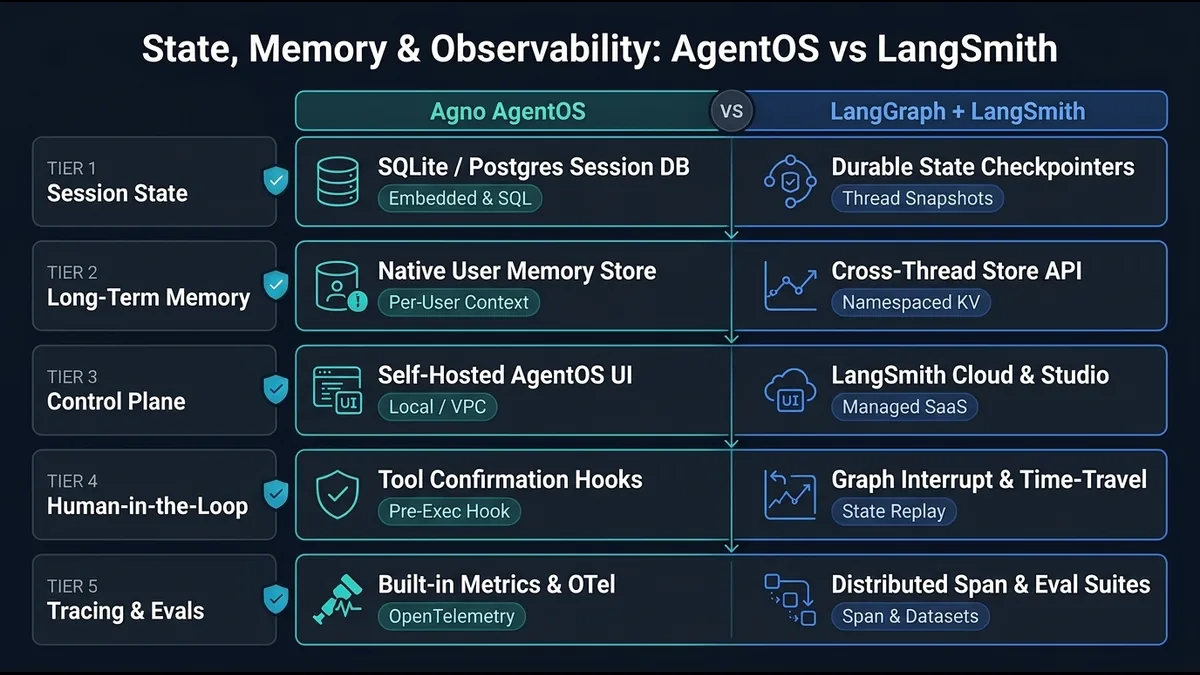 Figure 2: Production state, memory, and observability layers across Agno AgentOS and the LangGraph plus LangSmith ecosystem.
Session Storage vs Durable State Checkpointing
Agno’s database drivers (SqliteDb, PostgresDb) store session histories, user memories, and run records cleanly inside your application database. In Agno v3+, individual agent runs write to a dedicated agno_runs table rather than rewriting one giant JSON session blob on every turn, keeping write latency constant as sessions grow.
LangGraph’s checkpointer architecture, specified in the LangGraph Persistence Documentation, records full graph state snapshots after every superstep inside checkpoints, checkpoint_writes, and checkpoint_blobs tables. Production deployments use PostgresSaver or AsyncPostgresSaver over psycopg v3 connection pools.
import os
from psycopg_pool import ConnectionPool
from psycopg.rows import dict_row
from langgraph.checkpoint.postgres import PostgresSaver

DATABASE_URL = os.environ["DATABASE_URL"]

pool = ConnectionPool(
    conninfo=DATABASE_URL,
    max_size=20,
    kwargs={"autocommit": True, "row_factory": dict_row},
)

checkpointer = PostgresSaver(pool)
checkpointer.setup()  # Creates checkpoint tables on initial deployment
Always set autocommit=True and row_factory=dict_row when passing a psycopg v3 pool to PostgresSaver, and export LANGGRAPH_STRICT_MSGPACK=true in production environments to restrict deserialization to safe primitive types.
AgentOS Built-In Tracing and MCP vs LangSmith Evaluations
Observability is where the two ecosystems diverge sharpest in workflow and cost. As outlined in the Agno AgentOS Runtime Documentation, setting tracing=True writes structured execution traces directly into your own AgentOS database, where the bundled Studio UI inspects prompts, tool latencies, and token counts with zero third-party data egress.
LangSmith operates as a dedicated observability and evaluation platform tightly integrated with LangChain and LangGraph. Beyond visualizing nested node latencies and token spend, LangSmith adds golden dataset curation, automated prompt regression suites, pairwise experiment comparisons, and online evaluation rules.
| Capability | Agno AgentOS | LangSmith (with LangGraph) |
|---|---|---|
| Data Residency | 100% inside your own VPC and database | Hosted SaaS by default; self-hosting on Enterprise |
| HTTP / SSE Serving | Built-in FastAPI app (agent_os.get_app()) |
Separate (custom FastAPI or LangGraph Platform) |
| MCP Exposure | Native /mcp endpoint via mcp=True |
Requires separate MCP server wrapper |
| Offline Dataset Evals | Basic built-in evals; pair with external tools | Deep dataset versioning, regression suites, and judges |
| Time-Travel Replay | Session history inspection | Full checkpoint rewind and state-fork replay |
| Seat Pricing | $0 per seat (open source self-hosted) | $0 (1 seat, 5K traces) / $39 per seat Plus / Custom Enterprise |
Teams running LangGraph who want 100% self-hosted open-source tracing without LangSmith seat fees can evaluate alternatives in our Langfuse vs Arize Phoenix vs LangSmith comparison.
Multi-Tenant Security and Self-Hosting Boundaries
Regulated engineering teams in healthcare, finance, and legal tech often prohibit sending prompt payloads to external SaaS tracing endpoints. Agno’s architecture fits strict data-residency mandates naturally because AgentOS, your database, and the Studio control plane run inside your private network with JWT scope enforcement (authorization=True).
LangGraph achieves the same data boundary when self-hosted with PostgresSaver and OpenTelemetry exporters routed to an internal collector or self-hosted Langfuse cluster. The difference is assembly effort: Agno ships the FastAPI gateway, auth hooks, and local tracing out of the box, whereas LangGraph leaves API security and self-hosted telemetry wiring to your platform team.
Production Troubleshooting: Failure Modes and Deterministic Fixes
Both Agno and LangGraph expose distinct production failure modes once real users send malformed inputs, trigger parallel tool calls, or run long multi-turn sessions. Anticipating these six failure patterns prevents silent freezes, database bloat, and runaway token bills.
Agno Failure Modes: State Bloat, tool_hooks Sync, and JSON Mode Clashes
Agno’s lightweight runtime keeps stack traces readable, yet three recurring issues appear in GitHub bug reports and production rollouts:
- Legacy session JSON bloat: Pre-v3 storage schemas appended entire chat histories and inline base64 media payloads into a single session row, triggering item-size crashes on DynamoDB or slow PostgreSQL updates. Upgrade to Agno v3+ to isolate runs into
agno_runs, run database migrations before cutover, and offload binary media or large tool outputs to S3 or GCS using URL references. tool_hooksandsession_statesnapshot drift: Modifyingsession_stateinside a tool whiletool_hooksare active can cause stale prompt snapshots orpydantic.ValidationErrorexceptions if hooks strip injected agent references. Return state deltas explicitly in tool return payloads and reconcile state at the orchestrator boundary instead of mutating shared state mid-loop.- JSON mode vs tool calling 400 errors: Certain hosted inference providers (such as Groq or local Ollama endpoints) reject requests with
400 Bad Requestwhenresponse_format={"type": "json_object"}is combined with active tool calling. Disable strict global JSON mode on tool-using agents and parse structured outputs in a dedicated final synthesis step. - Multi-tenant namespace leaks and
CodeModesandboxing: Always bind storage and filesystem namespaces dynamically to a JWT-verifieduser_id, and run any code-execution tools inside isolated ephemeral Docker or microVM sandboxes with strict egress rules.
LangGraph Failure Modes: GraphRecursionError, PostgresSaver Config, and State Serialization
LangGraph deployments fail most often at the boundary between cyclic graph execution and database checkpointing, as tracked in the LangGraph Official GitHub Repository:
GraphRecursionErrorfrom superstep miscalculation: LangGraph halts at 25 supersteps by default, and every reasoning-plus-tool round-trip consumes two supersteps (more under parallel fan-out). Never mask an infinite retry loop by settingrecursion_limit=500; instead, inspect failing tool observations, cap loop counters insideAgentState, and attach node-levelRetryPolicy.PostgresSaverstartup and row lookup crashes: Omittingautocommit=Truecauses.setup()table migrations to hang or roll back, while omittingrow_factory=dict_rowcrashes checkpoint reads expecting dictionary keys instead of tuples. Always validate pool kwargs and callcheckpointer.setup()during container initialization.- State serialization bloat and concurrent
thread_idraces: Because LangGraph serializes the entireStateobject on every node step, storing raw DataFrames, binary blobs, or unpruned message histories saturates database I/O. Store lightweight object IDs in state, prune old checkpoint rows via scheduled cleanup jobs, and serialize concurrent requests sharing the samethread_idbehind a Redis lock.
For deeper patterns on keeping episodic and semantic memory bounded across both frameworks, see our AI agent memory systems guide.
from langgraph.types import RetryPolicy

# Apply bounded node-level retries for flaky external APIs without looping the LLM
builder.add_node(
    "tools",
    ToolNode(tools),
    retry_policy=RetryPolicy(max_attempts=3, initial_interval=0.5, backoff_factor=2.0),
)
Attaching RetryPolicy directly to tool nodes absorbs transient HTTP 503 or rate-limit errors in Python before burning extra LLM reasoning tokens or consuming graph supersteps.
Production Hardening Checklist
Use this diagnostic reference to catch the highest-impact failure modes before promoting an Agno or LangGraph service to production.
| Framework | Failure Symptom | Root Cause | Deterministic Fix |
|---|---|---|---|
| Agno | Slow session queries or DB item-size errors | Monolithic pre-v3 session JSON blobs or inline base64 media | Migrate to Agno v3 agno_runs table and offload media to S3/GCS |
| Agno | 400 Bad Request on tool-calling runs |
Combining json_object response format with function calling |
Remove global JSON mode on tool agents; use a final formatter step |
| Agno | Multi-agent team stalls mid-stream | Unbounded delegation loops without run deadlines | Enforce explicit run timeouts and maximum tool-call iteration caps |
| LangGraph | GraphRecursionError at 25 steps |
Infinite tool error retries or missing END edge |
Add loop-counter guards in state and node-level RetryPolicy |
| LangGraph | PostgresSaver fails on first checkpoint write |
Missing .setup(), autocommit=True, or row_factory=dict_row |
Configure psycopg_pool kwargs and run .setup() on boot |
| LangGraph | Rapid PostgreSQL disk growth and slow steps | Unpruned message lists and raw payloads serialized every step | Trim messages in reducers, store object pointers, and schedule pruning |
[!WARNING] Never deploy LangGraph with
InMemorySaverorMemorySaverin production containers. Process restarts, autoscaling events, and rolling deployments wipe in-memory checkpoints instantly and break active human-in-the-loop threads.
Frequently Asked Questions About Agno vs LangChain
Is Agno better than LangChain for building AI agents?
Agno is faster to ship for pure-Python tool agents, RAG assistants, and turnkey FastAPI APIs because it bundles memory, knowledge, and AgentOS into one lightweight abstraction. LangChain v1 and LangGraph remain better suited for complex cyclic workflows that require explicit state machines, human-in-the-loop interrupts, and LangSmith evaluation pipelines.
What is the difference between Agno and LangGraph?
Agno executes standard Python agent loops and declarative team delegation with roughly 3.2 microseconds of instantiation overhead. LangGraph compiles workflows into explicit directed cyclic StateGraph machines that persist full state snapshots after every superstep for crash recovery and time-travel debugging.
Is Agno the same framework as Phidata?
Yes, Agno is the renamed and re-architected successor to Phidata, replacing legacy phi.* packages with the modern agno.* SDK and the AgentOS runtime. Teams migrating from Phidata or older Agno builds to v3+ should run database migrations to move session histories into the dedicated agno_runs table.
Does Agno’s microsecond instantiation speed matter in production?
In single-request workloads, a 500 ms to 3,000 ms LLM inference call makes a 2 ms framework startup difference account for less than 0.2% of total latency. That speed and 5.2 KiB memory footprint become decisive when spawning thousands of ephemeral per-request agents concurrently or operating inside tight serverless RAM limits.
Can Agno handle human-in-the-loop workflows like LangGraph?
Agno supports human confirmation hooks and session persistence, which cover straightforward approval prompts inside API endpoints. LangGraph provides deeper native durability via typed interrupt() primitives and checkpoint replay, letting long-running workflows pause for hours or days across container restarts.
How does AgentOS compare to LangSmith for observability and deployment?
AgentOS runs inside your own FastAPI infrastructure, writing execution traces directly to your database while auto-generating REST, SSE, and Model Context Protocol endpoints at zero per-seat cost. LangSmith is a managed observability and evaluation suite starting at $0 per month for one developer seat and $39 per seat on the Plus tier, adding prompt versioning, dataset benchmarks, and regression testing.
What does LangGraph PostgresSaver require in production?
Production PostgresSaver deployments require psycopg v3 configured with autocommit=True and row_factory=dict_row, a connection pool, and an explicit checkpointer.setup() call during startup. Security teams should also enable LANGGRAPH_STRICT_MSGPACK=true to restrict checkpoint deserialization and schedule periodic pruning so snapshot tables do not grow unbounded.
Conclusion
Both Agno and the LangChain v1 plus LangGraph stack are production-ready Python frameworks built around fundamentally different engineering priorities. Agno wins when your team wants clean pure-Python ergonomics, ultra-low memory overhead for high-concurrency ephemeral agents, and an instant FastAPI plus MCP runtime through AgentOS without paying per-seat SaaS fees.
LangChain v1 and LangGraph win when your agents execute high-stakes, multi-step cyclic workflows that require formal StateGraph transitions, crash-resilient PostgresSaver checkpointing, long-running human approvals, and deep evaluation pipelines in LangSmith. Start with Agno when shipping fast API-backed assistants, and choose LangGraph the moment deterministic state control and auditable execution replay become non-negotiable requirements.