Multi-Agent Topologies: Supervisor, Swarm, Router, Parallel
Compare multi-agent topologies including centralized supervisor, decentralized swarm handoffs, deterministic routers, and parallel map-reduce architectures.
When software engineers transition from building single-agent prototypes to production agentic systems, context window saturation quickly becomes their primary bottleneck. As documented in our architectural breakdown of what AI agents are, giving one LLM instance dozens of tools and thousands of conversation tokens degrades reasoning reliability rapidly.
To overcome this fundamental limit, distributed multi-agent systems divide complex tasks across specialized autonomous nodes. The structural arrangement governing how these agents communicate, delegate subtasks, and persist state is known as an orchestration topology.
Choosing the wrong topology introduces severe performance regressions into production applications. A poorly scoped supervisor can easily multiply token consumption by a factor of ten, while an unconstrained peer-to-peer swarm can trap your workflow in an infinite handoff loop. Understanding the trade-offs between centralized supervisors, decentralized swarms, deterministic routers, and parallel map-reduce pipelines is essential for every AI platform architect.
Key Takeaways
- Multi-agent topologies determine how control flow, task context, and state transitions route between specialized LLM nodes.
- Centralized supervisors maximize execution auditability and state control, but introduce single-point bottlenecks and quadratic token amplification.
- Decentralized swarm handoffs reduce orchestration latency and prompt overhead, but risk unbounded delegation cycles without strict recursion budgets.
- Deterministic routers offer zero-cost LLM dispatch for known task domains, while parallel map-reduce minimizes wall-clock latency for independent batch operations.
What Are Multi-Agent Topologies and Why Does Flow Control Matter?
Multi-agent topologies are formal coordination patterns that define how autonomous LLM agents delegate tasks, manage control flow, and pass state across system boundaries. Rather than relying on a single monolithic prompt, topologies establish bounded communication graphs where specialized agents handle isolated subproblems.
In early agent designs, developers often combined retrieval, code execution, web scraping, and final report generation into a single continuous prompt loop. This monolithic approach inevitably breaks down as application complexity grows.
| Dimension | Monolithic Single-Agent Execution | Topological Multi-Agent Decomposition |
|---|---|---|
| Context Load | Single prompt holds 25+ tool schemas and full history | Each node loads only 2 to 4 domain-specific tools |
| Token Consumption | Context window balloons to 80,000+ tokens rapidly | Scoped state graphs keep active context under 8,000 tokens |
| Reasoning Reliability | High tool selection confusion and hallucination | Isolated specialist nodes achieve deterministic tool execution |
| Error Recovery | Uncaught exceptions abort the entire conversation | Orchestrator routes around node errors or retries selectively |
The Scaling Limit of Monolithic Single-Agent Systems
When an agent attempts to hold more than twenty tool definitions in its context window, tool-selection accuracy drops significantly. Models suffer from distraction, selecting sub-optimal functions or misinterpreting complex argument schemas.
Furthermore, context contamination creates subtle reasoning bugs. When intermediate scraping errors, failed SQL queries, and raw HTML payloads accumulate in a shared conversation history, downstream generation suffers from hallucinations. Specialized sub-agents isolate this execution noise from the primary workflow.
How Orchestration Topology Dictates System Reliability
The topology you select dictates how errors are trapped and recovered. In centralized graphs, an orchestrator inspects worker outputs before deciding whether to proceed, re-prompt, or terminate the pipeline.
Conversely, decentralized systems let worker agents hand control directly to one another through function returns. While this reduces token overhead and orchestrator latency, it makes deterministic failure recovery significantly harder to enforce.
The 4 Primary Multi-Agent Topologies: Supervisor, Swarm, Router, and Parallel
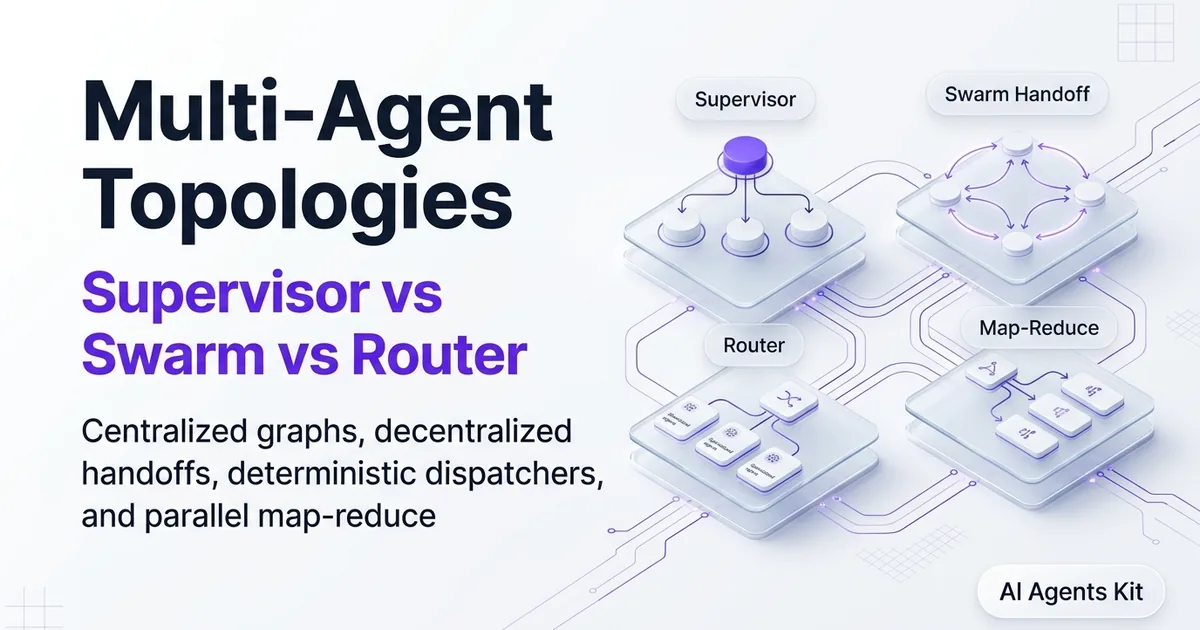
Enterprise applications deploy four primary architectural patterns for agent coordination: hierarchical supervisors, decentralized swarm handoffs, deterministic routers, and concurrent parallel map-reduce graphs. Each pattern offers distinct trade-offs between centralized control, execution latency, and token consumption.
To visualize how control flow and message passing differ across these configurations, examine the architectural comparison below. Understanding foundational multi-agent systems architecture clarifies how these topologies partition state.
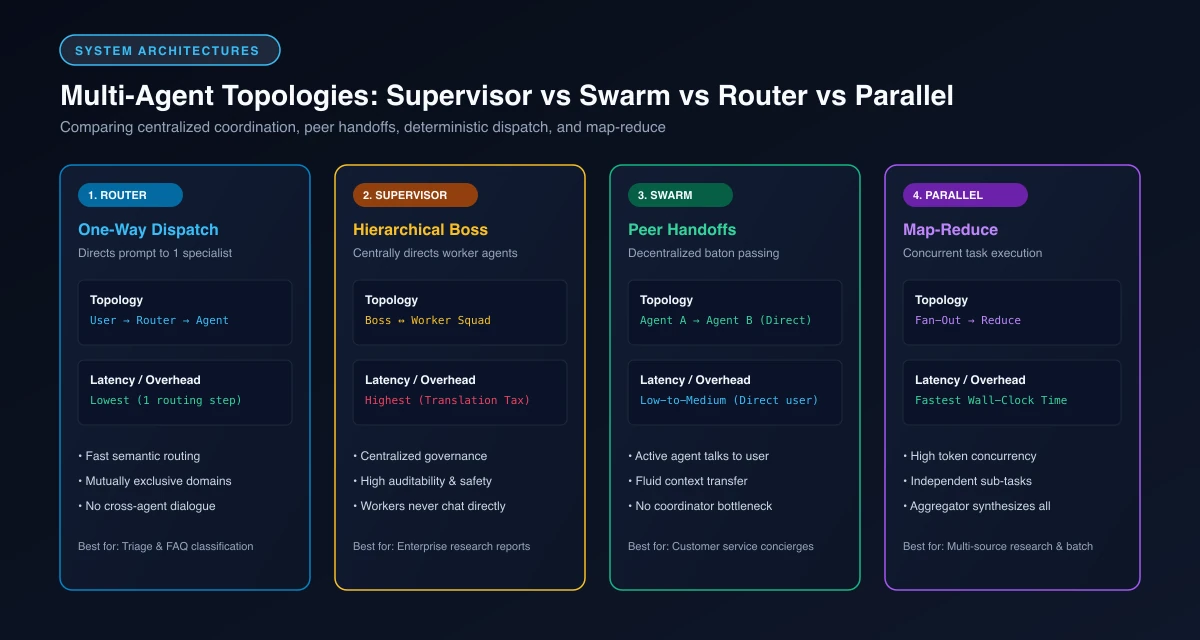 Figure 1: Architectural comparison of supervisor, swarm handoff, router, and parallel multi-agent topologies.
Hierarchical Supervisor Pattern
In a supervisor topology, a centralized coordinator agent acts as the project manager for a group of specialized worker agents. When a user request arrives, the supervisor evaluates the objective, constructs an execution plan, and routes the initial subtask to an appropriate specialist.
Once the specialist completes its work, control returns unconditionally to the supervisor. The supervisor inspects the returned payload, updates the global state graph, and decides whether another agent is required or if the final response can be generated.
The primary benefit of the supervisor pattern is total auditability. Because all transitions pass through a central node, your application can enforce strict quality gates, schema assertions, and security checks at every milestone.
Decentralized Swarm Handoff Pattern
The swarm handoff pattern, popularized by the OpenAI Swarm Framework Repository, removes the centralized coordinator entirely. Instead, each individual agent possesses the ability to hand off execution directly to another agent via tool calls.
In a customer support system, for example, a triage agent might inspect incoming tickets and invoke a transfer_to_billing() function. This function returns a new agent instance along with context variables, immediately transferring the execution loop to the billing specialist.
Swarm topologies eliminate the latency and token overhead of bouncing back to an orchestrator after every turn. However, without centralized governance, swarms require rigorous loop detection to prevent agents from bouncing tasks back and forth indefinitely.
Deterministic Router Pattern
The router topology is an optimized variant designed for workflows where a user request requires exactly one specialized agent. Rather than spinning up a multi-step orchestration loop, a lightweight router classifies the request and dispatches it directly to the designated worker.
In production environments, this initial routing step often bypasses LLMs entirely. Developers frequently use deterministic regex matchers, embedding-based semantic classifiers, or small fine-tuned models to route tasks with sub-10ms latency.
Once the designated worker completes its execution, it returns the final answer directly to the user. The router topology delivers the lowest cost and latency of any multi-agent design, making it the ideal choice for multi-modal help desks and domain-specific query dispatchers.
Concurrent Parallel Map-Reduce Pattern
The parallel pattern, also known as fan-out/fan-in or map-reduce, coordinates multiple agents executing simultaneously on independent subproblems. A primary node divides a large objective into independent tasks, dispatches them concurrently across worker agents, and aggregates the results into a unified output.
This topology is common in competitive intelligence, deep document auditing, and code review pipelines. For example, when evaluating a large pull request, a coordinator can spawn three parallel agents: one checking security vulnerabilities, one auditing test coverage, and one verifying style guidelines.
By running these specialist evaluations concurrently via asynchronous APIs, total wall-clock execution time drops from sequential minutes to seconds. The aggregator node then synthesizes the three independent reports into a structured pull request comment.
Architectural Trade-Offs, Token Amplification, and Latency Multipliers
Selecting an orchestration pattern requires balancing developer visibility against cloud inference costs and response latency. Each structural transition between agents introduces computational overhead that compounds with workflow length.
Architectural guidelines published in the Anthropic Research on Building Effective Agents emphasize that adding agent layers should always be justified by measurable performance improvements. Understanding core AI agent design patterns helps engineers recognize when simpler reflection loops suffice before adopting complex swarms.
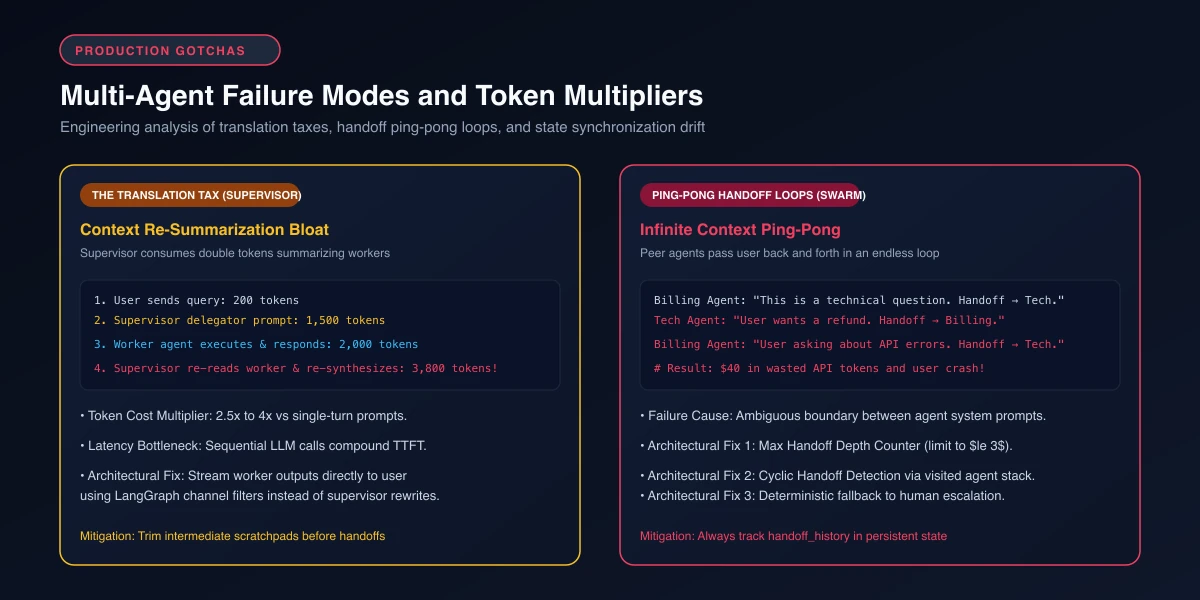 Figure 2: Failure modes, recursion depth limits, and token multiplier comparison across multi-agent topologies.
Token Multipliers and Context Saturation Risks
The most significant operational risk in multi-agent architectures is token amplification. In a naive supervisor design, every message passed back and forth between the coordinator and workers carries the full accumulated conversation history.
If an orchestrator requires five turns with worker agents, and the context window grows by 2,000 tokens per turn, the total tokens billed across the session scales quadratically. Without explicit state filtering, a single complex user query can consume hundreds of thousands of tokens.
Swarm handoffs mitigate this risk by transferring only relevant context variables between nodes. However, if two agents disagree on task completion criteria, they can generate high-velocity ping-pong loops that exhaust API rate limits in seconds.
Quantitative Topology Benchmark Matrix
The following benchmark matrix compares the four topologies across operational criteria derived from production LLM deployments:
| Architecture Topology | State Governance | Relative Latency | Token Multiplier | Loop Vulnerability | Ideal Enterprise Workload |
|---|---|---|---|---|---|
| Hierarchical Supervisor | Centralized | High (2.5x – 4.0x) | High (3.0x – 6.0x) | Low (Supervisor controls cycle) | Sprawling multi-department research |
| Swarm Handoff | Decentralized | Medium (1.5x – 2.0x) | Low (1.2x – 2.0x) | High (Requires hop budget) | Interactive customer support & sales |
| Deterministic Router | Single Dispatch | Minimal (1.0x – 1.1x) | Minimal (1.0x) | None (Acyclic tree) | Intent classification & triage |
| Parallel Map-Reduce | Concurrent Fan-In | Low (Bounded by slowest node) | Medium (1.5x – 3.0x) | None (Directed acyclic graph) | Document auditing & multi-source analysis |
Research on multi-agent communication frameworks in Wu et al. AutoGen Framework Research on arXiv confirms that unstructured agent conversations suffer from high message overhead. Constraining topology edges directly cuts unnecessary communication rounds.
Implementing Production Multi-Agent Topologies in Python
To understand how these concepts manifest in code, let us implement a production-grade orchestration system using typed state graphs. The following example demonstrates both a centralized supervisor dispatcher and a decentralized swarm handoff pattern.
In production architectures, each worker agent internally executes a ReAct execution loop to plan and invoke tools before returning results to the graph.
Defining Shared Agent State with Typed Dicts
Robust multi-agent systems rely on strictly typed state schemas. By separating shared graph state from private worker scratchpads, applications prevent context pollution across node transitions.
from typing import Annotated, Dict, List, Literal, Optional, TypedDict
import operator
from pydantic import BaseModel, Field

# Define immutable state schema passed across graph edges
class MultiAgentState(TypedDict):
    messages: Annotated[List[Dict[str, str]], operator.add]
    current_agent: str
    task_completed: bool
    iteration_count: int
    data_payload: Dict[str, str]

# Structured output contract for supervisor routing decisions
class SupervisorDecision(BaseModel):
    next_step: Literal["researcher", "coder", "validator", "FINISH"]
    instructions: str = Field(
        description="Explicit subtask instructions for the selected specialist"
    )
    reasoning: str = Field(
        description="Justification for the routing decision and current milestone status"
    )

# Structured output contract for peer-to-peer swarm handoffs
class AgentHandoff(BaseModel):
    target_agent: Literal["support_tier_2", "billing_specialist", "escalation_lead", "RESOLVED"]
    handoff_context: str = Field(
        description="Concise summary of user problem and verified credentials"
    )
Supervisor Routing Logic and Node Dispatch
The supervisor inspects the current state, checks safety budgets, and returns an edge transition. Notice how the supervisor logic halts execution immediately if iteration thresholds are exceeded.
def supervisor_node(state: MultiAgentState) -> Dict:
    """
    Evaluates current conversation progress and routes to the next specialist.
    Enforces a strict hop budget to prevent infinite loops.
    """
    iteration = state.get("iteration_count", 0)

    # Enforce hard recursion budget
    if iteration >= 5:
        return {
            "messages": [{"role": "system", "content": "Circuit breaker: max iterations exceeded."}],
            "current_agent": "FINISH",
            "task_completed": True
        }

    # In production, pass state['messages'] to model with structured outputs
    # Mocking deterministic routing logic based on latest message
    latest_msg = state["messages"][-1]["content"] if state["messages"] else ""

    if "data" in latest_msg.lower():
        next_agent = "researcher"
    elif "test" in latest_msg.lower():
        next_agent = "validator"
    else:
        next_agent = "FINISH"

    return {
        "current_agent": next_agent,
        "iteration_count": iteration + 1,
        "task_completed": (next_agent == "FINISH")
    }
Peer-to-Peer Handoff Functions
In contrast to supervisor orchestration, swarm workers transfer control directly using callable handoff tools. The receiving agent inherits the thread with a refreshed, scoped prompt.
def execute_swarm_handoff(
    current_agent_name: str,
    handoff: AgentHandoff,
    session_state: Dict
) -> Dict:
    """
    Transfers execution context from one agent directly to another without
    returning to a central orchestrator.
    """
    # Verify handoff destination is valid
    if handoff.target_agent == "RESOLVED":
        session_state["active_agent"] = None
        session_state["status"] = "closed"
        return session_state

    # Append structured transfer audit log
    transfer_event = {
        "from": current_agent_name,
        "to": handoff.target_agent,
        "context": handoff.handoff_context
    }
    session_state.setdefault("audit_trail", []).append(transfer_event)

    # Switch execution pointer to new agent
    session_state["active_agent"] = handoff.target_agent
    session_state["transferred_context"] = handoff.handoff_context
    return session_state
The difference between these two paradigms lies in state ownership. In the supervisor implementation, the graph retains ownership and decides who executes next. In the swarm implementation, the active agent retains autonomy and selects its own successor.
Production Failure Modes: Infinite Delegation Loops and Context Bloat
Deploying distributed agents into customer-facing environments reveals failure modes that rarely occur in deterministic software. When multiple LLMs interact, edge-case misunderstandings can trigger catastrophic failure cascades.
Architects must guard against three primary failure categories: cyclic handoffs, context saturation, and silent error propagation. Implementing structured outputs and JSON schemas provides an essential line of defense by guaranteeing that inter-agent payloads never suffer from parsing errors.
Loop Detection and Recursion Depth Budgets
The most common failure mode in peer-to-peer swarms is the infinite handoff loop. Agent A determines that an issue requires Agent B’s domain, but Agent B decides that missing prerequisites require Agent A’s tools.
Without explicit safeguards, the agents will pass the conversation back and forth until the user cancels or the API budget is exhausted. Production orchestrators must enforce a strict recursion_limit (typically 5 to 8 hops) on every invocation.
In addition to static count limits, modern runtimes maintain a sliding window of visited node hashes. If the graph detects the sequence [NodeA -> NodeB -> NodeA -> NodeB], a circuit breaker trips automatically, redirecting the thread to a fallback coordinator.
Context Window Scoping and State Distillation
In naive multi-agent architectures, each node appends its raw tool outputs and thought chains to the global message list. Within three to four turns, the shared conversation history exceeds 50,000 tokens.
This context bloating slows down response latency and increases token costs dramatically. More critically, it degrades the reasoning accuracy of subsequent agents by burying key instructions beneath thousands of lines of intermediate scraping data.
Production topologies resolve this by practicing state distillation. When a worker completes its task, it returns a compact typed summary rather than its entire execution trace. Only verified domain entities are written into the shared persistent state.
| Pipeline Stage | Input Artifact | Output Transformation | Token Footprint |
|---|---|---|---|
| Worker Execution | Scoped agent task | Raw tool execution logs, API JSON payloads, and HTTP traces | 5,000 – 12,000 tokens |
| Pydantic Deserialization | Raw text stream | Validated typed class instance with strict field constraints | Filtered boundary |
| Shared State Update | Validated instance | Compact summary payload appended to persistent graph state | 100 – 250 tokens |
Deterministic Fallbacks and Human-in-the-Loop Circuits
No multi-agent architecture should operate without deterministic escape hatches. When confidence metrics fall below thresholds or when automated validation fails repeatedly, the system must degrade gracefully.
Standard fallback patterns include terminating autonomous loops, preserving the complete execution state to durable storage, and escalating the ticket to a human operator. In frameworks like LangGraph, human-in-the-loop nodes pause graph execution until an operator reviews the proposed state change and issues an approval token.
Enterprise Decision Matrix: Selecting the Optimal Multi-Agent Architecture
Selecting an appropriate multi-agent topology is an architectural decision that dictates infrastructure costs, operational complexity, and debugging overhead. Engineering teams should avoid adopting complex multi-agent frameworks when simpler architectures accomplish business objectives.
Reviewing our best AI agent frameworks comparison provides concrete benchmarks across LangGraph, CrewAI, and AutoGen. The decision guide below helps match specific production requirements to the ideal coordination topology.
| Workflow Characteristic | Primary Constraint | Recommended Topology | Alternative Fallback |
|---|---|---|---|
| Single Tool Domain | Low complexity | Single Agent (ReAct) | Deterministic Router |
| Multiple Isolated Domains | Single specialist per request | Deterministic Router | Hierarchical Supervisor |
| Concurrent Independent Subtasks | Minimal wall-clock latency | Parallel Map-Reduce | Hierarchical Supervisor |
| Strict Auditability & Compliance | Deterministic state validation | Hierarchical Supervisor | Parallel Map-Reduce |
| Dynamic Fluid Conversation | Low latency, human dialogue | Decentralized Swarm Handoff | Hierarchical Supervisor |
When to Choose Each Architecture
Use the following guidelines to evaluate which pattern fits your specific production workload:
- Choose Deterministic Router When: Your application features distinct user intents (e.g., billing, technical support, account management) where any single query can be resolved completely by one specialist. This delivers the lowest cost and fastest response time.
- Choose Hierarchical Supervisor When: Your workflow requires sequential task decomposition, strict intermediate verification, and enterprise compliance auditability. Legal analysis, financial reporting, and complex database migrations demand a central controller.
- Choose Decentralized Swarm Handoff When: You are building dynamic, conversational experiences where customer context transfers naturally across roles. Customer service desks and sales qualification pipelines benefit from fluid agent handoffs.
- Choose Parallel Map-Reduce When: Your primary objective is reducing wall-clock latency across high-volume, independent evaluations. Vulnerability scanners, competitive pricing analysis, and multi-source document summarization are ideal fits.
Hybrid Enterprise Topologies
In real-world enterprise architectures, production systems rarely employ a single topology in isolation. Instead, high-throughput systems combine these patterns into nested composite architectures.
An enterprise customer platform might deploy a deterministic router at the API gateway to classify incoming requests. If the request involves account setup, the router invokes a lightweight single agent.
If the request involves complex forensic fraud investigation, the router dispatches the case to a hierarchical supervisor graph. That supervisor, in turn, can spawn parallel worker agents to query multiple distributed databases simultaneously.
By layering topologies hierarchically, engineering teams maximize performance and cost efficiency while preserving absolute state governance where it matters most.
Frequently Asked Questions About Multi-Agent Topologies
What is the difference between a supervisor agent and a router agent?
A router agent performs a single classification step at the beginning of a workflow to dispatch a request to one specialist, after which the router exits the execution loop. In contrast, a supervisor agent actively orchestrates the entire lifecycle, decomposing tasks, delegating sequentially to multiple workers, evaluating returned artifacts, and determining when the objective is met.
Why do multi-agent systems use more tokens than single agents?
Multi-agent systems consume more tokens because each agent requires its own system prompt, tool definitions, and domain instructions. In topologies that do not implement strict context filtering, conversation histories and intermediate tool logs are repeatedly passed across agent boundaries, multiplying inference token consumption with each turn.
Can agents hand off execution directly to one another without a coordinator?
Yes, this is known as the swarm handoff pattern. In this architecture, agents invoke handoff functions that return another agent instance along with context variables. This pattern reduces latency by bypassing coordinator hops, but requires hard recursion limits to prevent infinite delegation loops.
How do I prevent infinite loops in multi-agent workflows?
Production orchestrators enforce loop prevention through three controls: hard recursion depth limits (e.g., maximum 6 to 8 node transitions), visited-node cycle detection using sliding window hashes, and deterministic fallback nodes that escalate stalled workflows to human operators.
What framework is best for building hierarchical supervisor systems?
LangGraph is currently the industry standard for hierarchical supervisor graphs because it models workflows as state machines with cyclical directed graphs. It provides native support for conditional edge routing, durable SQLite/PostgreSQL checkpointing, and granular human-in-the-loop pause nodes.