Google ADK vs LangGraph vs CrewAI: Agent Showdown (2026)
Compare Google ADK, LangGraph, and CrewAI in 2026: architecture, 2-agent Python handoff code, Postgres checkpointing, pricing, and production trade-offs.
Choosing between Google ADK vs LangGraph vs CrewAI comes down to three engineering axes: language stack, state durability, and routing control. Google ADK leads polyglot Google Cloud deployments across Python, TypeScript, Go, Java, and Kotlin. LangGraph leads deterministic cyclic workflows with PostgreSQL checkpointing, and CrewAI accelerates standalone Python multi-agent delivery with role-based Crews and event-driven Flows.
Every enterprise multi-agent framework comparison must look past quickstart demos to examine how each runtime behaves under concurrent load, container restarts, and strict token budgets. This agentic framework showdown evaluates architecture, pricing, protocol support, identical 2-agent Python handoff implementations, deployment pipelines, and production failure modes across all three runtimes.
Key Takeaways
- Google ADK ships native SDKs in Python, TypeScript, Go, Java, and Kotlin, combining hierarchical agent trees, workflow graphs, native Gemini 4 integration, built-in
adk webdebugging, and first-class A2A and MCP support.- LangGraph models multi-agent workflows as typed cyclic
StateGraphmachines with durablePostgresSavercheckpointing, consuming 30% to 40% fewer tokens on multi-step routing than unconstrained conversational delegation.- CrewAI runs as a fully standalone MIT-licensed Python framework after decoupling from LangChain in v1.14, pairing role-based Crews for dynamic collaboration with typed, event-driven Flows for deterministic state control.
- Deployment and Billing Differ Sharply: Google ADK targets Vertex AI Agent Engine and Cloud Run, LangGraph pairs with LangSmith Units ($39 per seat Plus tier, 1 LSU = $1.00) or self-hosted Postgres, and CrewAI caps its free cloud tier at 50 workflow executions per month while keeping its open-source runtime uncapped.
Google ADK vs LangGraph vs CrewAI: Architectural Overview and Quick Verdict
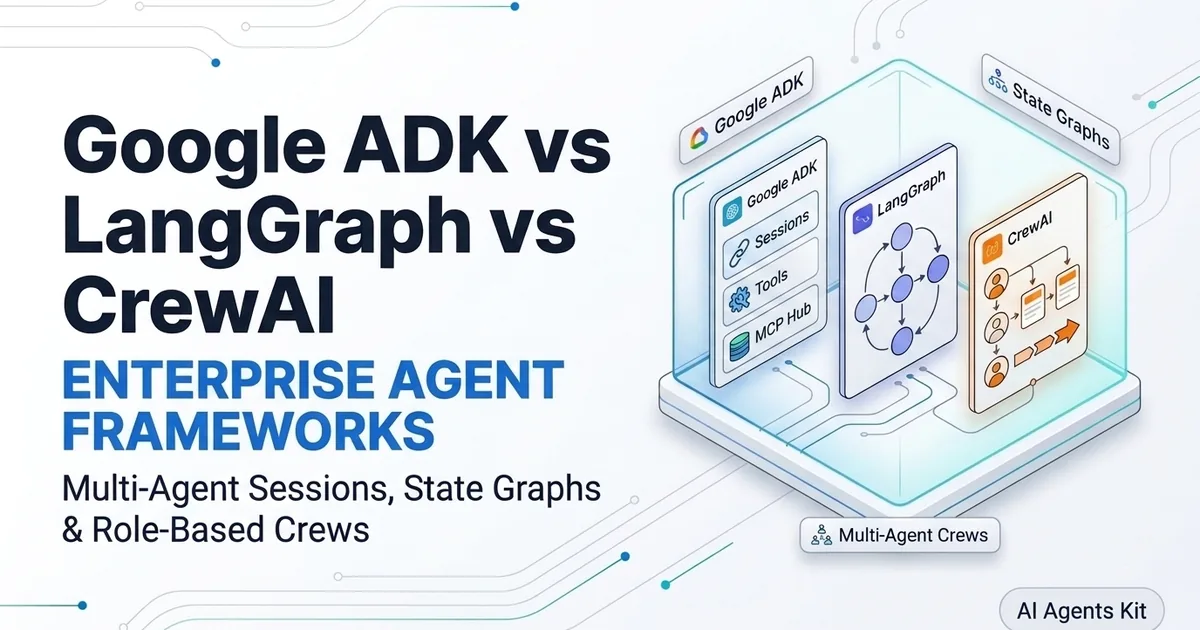
Google ADK vs LangGraph vs CrewAI represents three competing architectural models for multi-agent orchestration: Google ADK treats agents as polyglot cloud software services with managed sessions, LangGraph models execution as deterministic cyclic state machines, and CrewAI organizes autonomous roleplay teams inside event-driven Python Flows.
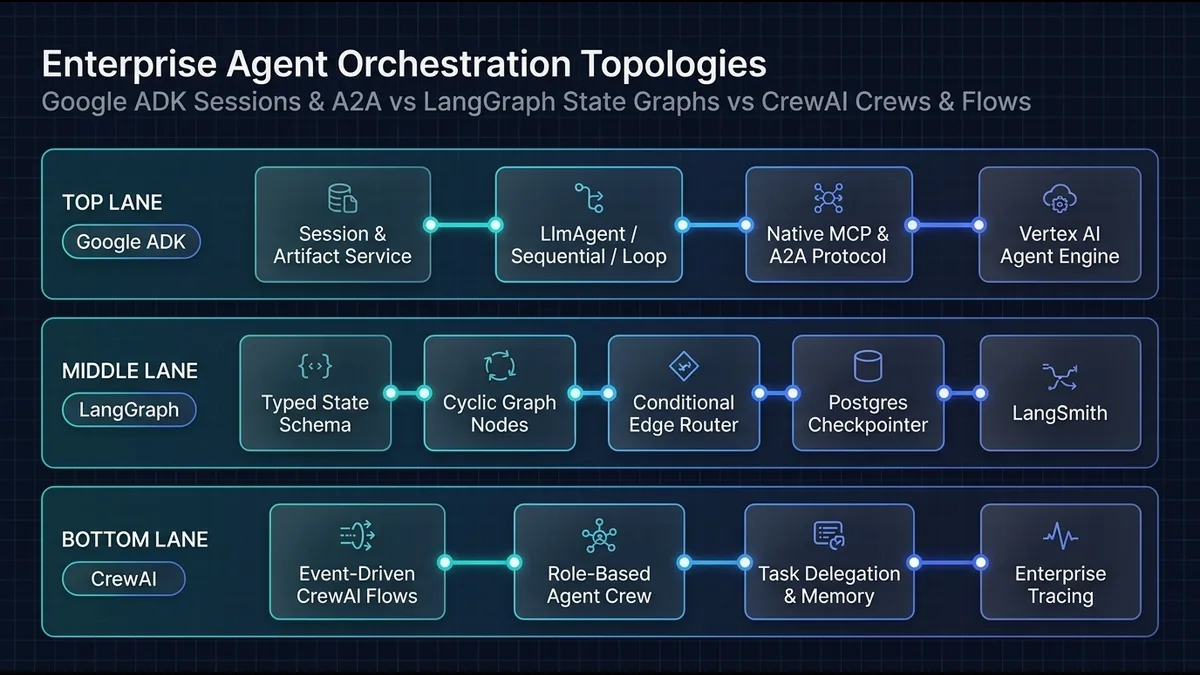 Figure 1: Orchestration topologies across Google ADK session hierarchies, LangGraph cyclic state graphs, and CrewAI crews plus Flows.
Selecting the best multi-agent orchestration framework requires matching your production topology to the runtime abstraction rather than forcing every workflow into one pattern. Engineering teams evaluating a wider field of 11 libraries alongside PydanticAI and LlamaIndex can review our broader AI agent frameworks comparison guide.
Master Enterprise Architecture Matrix
The matrix below compares Google ADK, LangGraph, and CrewAI across primary orchestration primitives, language parity, persistence engines, protocol interoperability, and operational trade-offs.
| Dimension | Google ADK | LangGraph | CrewAI |
|---|---|---|---|
| Core Abstraction | Hierarchical LlmAgent trees + graph workflows (SequentialAgent, LoopAgent, ParallelAgent) |
Directed cyclic StateGraph with typed state channels and conditional edges |
Role-based Crew (Agent, Task) wrapped inside event-driven Flow classes |
| Language SDKs | Python, TypeScript, Go, Java, Kotlin | Python, TypeScript | Python |
| State Persistence | SessionService (SQLite local, Vertex AI Agent Engine managed cloud) and ArtifactService |
PostgresSaver, AsyncPostgresSaver, Redis, and SQLite checkpointers |
Flow Pydantic self.state persistence (@persist) and short/long-term vector memory |
| Model Support | Gemini 4 native; 100+ external models via LiteLlm wrapper |
Model-agnostic via standard chat clients (Claude 5.5, GPT-6.2, Gemini 4, local vLLM) | Model-agnostic via native LiteLLM and direct provider SDKs |
| Protocol Support | Native MCP client/server tools and first-class Agent-to-Agent (A2A) protocol | MCP via langchain-mcp-adapters; custom A2A bridges |
Native MCP server integration; custom A2A wrappers |
| Local Debugging UX | Built-in adk web visual trace debugger, adk run CLI, and adk eval suite |
LangGraph Studio or external tracers (LangSmith, Langfuse, Arize Phoenix) | Verbose CLI logs, CrewAI Studio visual builder, and OpenTelemetry hooks |
| Primary Hosting Target | Vertex AI Agent Engine, Cloud Run, GKE, or any Docker runtime | LangSmith Deployment (Serverless / Dedicated) or self-hosted FastAPI/Kubernetes | CrewAI Enterprise Cloud/VPC or self-hosted Python containers |
| Open-Source License | Apache 2.0 | MIT | MIT |
Core Execution Philosophies Compared
Google ADK treats multi-agent systems as composable software modules built around explicit sessions, events, and artifacts. According to the Google Agent Development Kit (ADK) Official Documentation, developers combine deterministic workflow agents with LLM-driven LlmAgent nodes so predictable pipeline stages never waste inference tokens on routine transitions.
LangGraph adopts a strict finite-state-machine philosophy inspired by Pregel and Apache Beam. Every node receives a typed state snapshot, executes Python or TypeScript logic, and returns state deltas that reducer functions merge atomically before conditional edges choose the next node.
CrewAI approaches orchestration from an organizational design perspective. Teams define specialist agents with explicit roles, goals, and backstories inside a Crew, then wrap those crews inside deterministic Flow methods (@start, @router, @listen) to enforce branching rules and persistent state boundaries.
Fast-Track Decision Matrix by Engineering Stack
Use the table below to narrow your candidate shortlist based on language constraints, cloud infrastructure, and workflow determinism.
| Production Requirement | Recommended Runtime | Architectural Rationale |
|---|---|---|
| Polyglot Services (Go, Java, Kotlin, TS, Python) | Google ADK | Native multi-language SDKs and A2A messaging avoid forcing backend teams into Python rewrites. |
| Auditable Financial or Approval Loops | LangGraph | Durable PostgresSaver checkpoints, interrupt() pauses, and time-travel state replay protect long-running transactions. |
| Rapid Python Business Process Automation | CrewAI | Roleplay task definitions and declarative YAML configs ship working multi-agent pipelines in hours. |
| Native Gemini 4 Multimodal & Vertex AI Stack | Google ADK | Zero-friction Vertex AI Agent Engine deployment, artifact versioning, and native Gemini 4 Carbon/Neon streaming. |
| Multi-Cloud Self-Hosted Kubernetes | LangGraph | MIT runtime with direct psycopg_pool PostgreSQL persistence and zero cloud-vendor lock-in. |
Deep-Dive Framework Profiles: Verdicts, Strengths, and Pricing
Evaluating enterprise agent SDKs requires isolated, self-contained profiles so each framework’s strengths, operational limits, and billing meters remain unambiguous. Below are structured architectural assessments for Google ADK, LangGraph, and CrewAI as of late 2026.
Google ADK: Polyglot Session-First Agent SDK
Google ADK (Agent Development Kit) evolved through ADK 2.0 into a code-first, graph-capable workflow runtime engineered for enterprise cloud teams. As detailed in the Google ADK Python GitHub Repository, the framework pairs hierarchical sub-agent delegation with strict SessionService state scoping, binary artifact storage, and built-in evaluation runners (adk eval).
Because Google ADK supports native SDKs across Python, TypeScript, Go, Java, and Kotlin, platform teams can embed agents directly inside JVM microservices or Go API gateways without maintaining a separate Python inference tier. Developers test trajectories locally using adk run and adk web before containerizing for Cloud Run or deploying directly to Vertex AI Agent Engine.
- Verdict: Best overall framework for polyglot enterprise organizations and Google Cloud teams building production multimodal or cross-service agent networks.
- Best for: Multi-language engineering teams (Python, TypeScript, Go, Java, Kotlin), Gemini 4 workloads, and enterprises standardizing on MCP and A2A interoperability.
- Strengths: True multi-language SDK parity, zero-config local web trace inspector (
adk web), built-inadk evaltrajectory testing, nativeSessionServiceandArtifactServiceprimitives, and direct deployment to Vertex AI Agent Engine. - Trade-offs: Deepest managed observability and session scaling features favor Google Cloud; built-in Gemini tools like
google_searchdo not run on non-Gemini models via LiteLLM, and non-GCP teams must wire their own relational session backends. - Pricing: The Google ADK SDK is free and open-source under Apache 2.0. Production hosting incurs standard Google Cloud compute rates on Cloud Run, GKE, or Vertex AI Agent Engine (billed by vCPU-hours, memory GiB-hours, and underlying Gemini 4 or third-party model API tokens).
LangGraph: Deterministic Cyclic State Machines
LangGraph is a low-level orchestration engine designed for stateful, cyclical, and human-in-the-loop agent pipelines. The LangGraph Official Python Documentation defines every workflow as a StateGraph composed of typed state channels, pure Python or TypeScript nodes, and deterministic conditional edges.
Unlike frameworks that hide control flow inside prompt templates, LangGraph puts routing, retries, and approval pauses directly in application code. Production deployments attach PostgresSaver or AsyncPostgresSaver via langgraph-checkpoint-postgres so every super-step commits a durable snapshot keyed by thread_id, enabling instant crash recovery and historical state branching.
- Verdict: Best production runtime for mission-critical, long-running, and heavily branched agent workflows requiring deterministic control and crash recovery.
- Best for: Financial compliance pipelines, automated coding loops, multi-day human-in-the-loop approval workflows, and multi-cloud Kubernetes deployments.
- Strengths: Industry-leading durable checkpointing (
PostgresSaver, Redis), native time-travel state replay, 30% to 40% lower token overhead on multi-step routing, model-agnostic execution across Claude 5.5, GPT-6.2, and Gemini 4, and MIT open-source freedom. - Trade-offs: Steepest initial learning curve among the three frameworks, verbose
TypedDictstate reducer boilerplate for simple tasks, and no built-in zero-config web debugger without pairing LangGraph Studio, LangSmith, or an external OpenTelemetry UI. - Pricing: The open-source LangGraph runtime is MIT-licensed and free to self-host. Optional managed LangSmith plans bill via seats plus LangSmith Units (1 LSU = $1.00): Developer is $0/month (1 seat, 5,000 base traces), Plus is $39 per seat/month (10,000 base traces plus 1 free Small Serverless agent server, ~$5.00 per 1,000 extra base traces), and Enterprise offers custom self-hosted or hybrid licensing.
CrewAI: Standalone Role-Based Crews and Deterministic Flows
CrewAI operates as a standalone MIT-licensed Python framework after decoupling completely from LangChain in v1.14. As documented in the CrewAI Official Documentation, CrewAI separates high-autonomy collaboration (Crews) from deterministic pipeline orchestration (Flows), allowing teams to mix LLM-driven roleplay teams with typed Python control logic.
In a CrewAI system, developers define specialist agents with explicit personas, goals, tools, and Pydantic output contracts, then coordinate them sequentially or hierarchically. Wrapping those crews inside a Flow with @start, @router, and @listen decorators gives engineering teams typed self.state persistence, conditional branching, and clean REST or webhook triggers without abandoning CrewAI’s fast authoring model.
- Verdict: Fastest Python framework for shipping collaborative multi-agent teams and business process pipelines when developer velocity outweighs low-level graph control.
- Best for: Research synthesis teams, content and competitive intelligence pipelines, internal operations automation, and small Python teams building rapid production MVPs.
- Strengths: Completely standalone with zero LangChain dependency bloat, gentle learning curve with YAML or Python role configs, native LiteLLM and MCP support, and CrewAI Flows for adding deterministic routing around autonomous Crews.
- Trade-offs: Python-only SDK, higher baseline token usage when autonomous Crews delegate conversationally, and coarser mid-step crash recovery compared to LangGraph’s super-step database checkpointing.
- Pricing: The open-source CrewAI framework is MIT-licensed and uncapped when self-hosted. CrewAI’s hosted platform offers a Free Basic tier capped at 50 workflow executions per month (including CrewAI Studio and GitHub integration) and custom-quoted Enterprise tiers adding SSO, RBAC, PII redaction, and dedicated VPC deployment.
Where Each Framework Wins in Production
No single multi-agent SDK dominates every workload because Google ADK vs LangGraph vs CrewAI optimizes for different operational bottlenecks. Mapping specific production scenarios to each winner prevents mid-project migrations.
Where Google ADK Wins
- Polyglot Enterprise Microservices: Organizations with core backend teams writing Go, Java, Kotlin, or TypeScript avoid creating a brittle Python-only island by adopting Google ADK’s native language SDKs.
- Native Gemini 4 Multimodal and Artifact Workflows: Workloads processing live audio streams, video frames, or large binary documents benefit directly from Google ADK’s
ArtifactServiceand native Gemini 4 Carbon and Gemini 4 Neon optimizations. - Cross-Team Agent Discovery over A2A: Large enterprises running isolated agent services across separate business units use Google ADK’s built-in Agent-to-Agent (A2A) protocol support to publish Agent Cards and delegate tasks securely across network boundaries.
- Zero-Friction Local Trajectory Testing: Teams that require CI-integrated evaluation suites and visual step debugging without paying for a third-party SaaS tracer gain immediate value from
adk webandadk eval.
Where LangGraph Wins
- Long-Running Human-in-the-Loop Approvals: Workflows that pause for hours or days awaiting manager sign-off on wire transfers, SQL migrations, or customer refunds rely on LangGraph’s
interrupt()primitive andPostgresSaversnapshots to resume without repeating prior LLM calls. - Strict Token Budgets on Branching Pipelines: High-volume multi-step pipelines with 5 to 20 conditional transitions save 30% to 40% in token costs because LangGraph evaluates routing rules in plain Python functions instead of spending extra inference calls on supervisor chatter.
- Time-Travel Debugging and Compliance Audits: Regulated finance, healthcare, and legal teams use LangGraph’s immutable checkpoint history to fork execution from any historical node, inspect exact state mutations, and prove why an agent triggered a downstream API.
- Multi-Cloud Self-Hosted Infrastructure: Enterprises running on AWS EKS, Azure AKS, or air-gapped on-premises Kubernetes clusters deploy LangGraph directly over existing PostgreSQL databases with zero vendor lock-in.
Where CrewAI Wins
- Rapid Multi-Agent Prototyping to Production: Small Python teams tasked with delivering a working competitive research, lead enrichment, or RFP drafting pipeline within a single sprint reach production fastest with CrewAI’s role-and-task abstractions.
- Hybrid Autonomous + Deterministic Workflows: Business processes that combine predictable API validation (handled by CrewAI
Flowrouters) with open-ended creative or analytical synthesis (delegated to a 3-agentCrew) map naturally onto CrewAI’s dual architecture. - Zero-Dependency Python Microservices: Teams scarred by legacy transitive dependency conflicts appreciate CrewAI’s post-v1.14 standalone architecture, which pairs directly with LiteLLM, Pydantic v2, and MCP servers without pulling in the broader LangChain package tree.
Choosing the right coordination topology (supervisor, swarm, or deterministic router) matters just as much as the SDK itself. For a deeper look at how coordination shapes failure modes, see our guide on supervisor vs swarm vs router multi-agent topologies.
Side-by-Side Python Code: Building a 2-Agent Handoff
Comparing syntax on identical business logic exposes real ergonomic and architectural differences faster than feature checklists. All three Python implementations below build the exact same 2-agent customer billing handoff: a Triage Agent inspects an incoming support ticket, verifies invoice eligibility, and hands approved claims to a Refund Specialist Agent to issue a bounded refund.
Google ADK: Hierarchical Sub-Agents and Session State
Google ADK implements a 2-agent handoff by attaching specialist LlmAgent instances to a parent coordinator’s sub_agents list. Tool functions receive a ToolContext object to read and write typed keys directly into the managed SessionService state.
import asyncio
from google.adk.agents import LlmAgent
from google.adk.runners import Runner
from google.adk.sessions import InMemorySessionService
from google.adk.tools import ToolContext
from google.genai import types


def check_invoice_eligibility(invoice_id: str, tool_context: ToolContext) -> dict:
    """Verify invoice refund eligibility and store status in ADK session state."""
    eligible = invoice_id.startswith("INV-")
    tool_context.state["invoice_id"] = invoice_id
    tool_context.state["refund_eligible"] = eligible
    return {"invoice_id": invoice_id, "eligible": eligible, "max_refund_usd": 250.0}


def issue_refund(amount_usd: float, tool_context: ToolContext) -> dict:
    """Execute a bounded refund only when session state confirms eligibility."""
    if not tool_context.state.get("refund_eligible", False):
        return {"status": "rejected", "reason": "Invoice failed eligibility check."}
    if amount_usd <= 0 or amount_usd > 250.0:
        return {"status": "escalated", "reason": "Amount exceeds automated refund cap."}
    invoice_id = tool_context.state.get("invoice_id", "unknown")
    return {"status": "refunded", "invoice_id": invoice_id, "amount_usd": amount_usd}


refund_specialist = LlmAgent(
    name="refund_specialist",
    model="gemini-4-neon",
    description="Executes verified billing refunds under $250.",
    instruction="Use issue_refund to process the approved invoice refund and confirm the receipt.",
    tools=[issue_refund],
)

triage_coordinator = LlmAgent(
    name="billing_triage_coordinator",
    model="gemini-4-hydrogen",
    description="Validates invoices and delegates eligible refunds to refund_specialist.",
    instruction=(
        "Call check_invoice_eligibility first. If eligible, transfer to refund_specialist. "
        "If ineligible, explain why and stop."
    ),
    tools=[check_invoice_eligibility],
    sub_agents=[refund_specialist],
)


async def run_adk_handoff() -> None:
    session_service = InMemorySessionService()
    await session_service.create_session(app_name="billing_app", user_id="u_42", session_id="s_101")
    runner = Runner(agent=triage_coordinator, app_name="billing_app", session_service=session_service)
    message = types.Content(role="user", parts=[types.Part(text="Refund $120 for invoice INV-8842.")])

    async for event in runner.run_async(user_id="u_42", session_id="s_101", new_message=message):
        if event.is_final_response() and event.content:
            print(event.content.parts[0].text)


if __name__ == "__main__":
    asyncio.run(run_adk_handoff())
In this Google ADK pattern, triage_coordinator runs on high-speed gemini-4-hydrogen while refund_specialist executes on gemini-4-neon, sharing state safely through tool_context.state. For production deployment, swap InMemorySessionService() for VertexAiSessionService or a database-backed session store without changing agent definitions.
LangGraph: Typed StateGraph with Conditional Routing and PostgresSaver
LangGraph implements the same 2-agent handoff as an explicit StateGraph backed by a TypedDict state schema and a deterministic Python router. Attaching PostgresSaver with psycopg_pool guarantees every transition survives worker restarts.
import os
from typing import Literal, NotRequired, TypedDict
from langchain_anthropic import ChatAnthropic
from langgraph.checkpoint.postgres import PostgresSaver
from langgraph.graph import END, START, StateGraph
from psycopg.rows import dict_row
from psycopg_pool import ConnectionPool


class BillingState(TypedDict):
    invoice_id: str
    amount_usd: float
    eligible: NotRequired[bool]
    status: NotRequired[str]
    summary: NotRequired[str]


triage_llm = ChatAnthropic(model="claude-5-5-haiku-20261007", temperature=0)
refund_llm = ChatAnthropic(model="claude-5-5-sonnet-20260928", temperature=0)


def triage_node(state: BillingState) -> dict:
    """Deterministically check invoice format and record eligibility."""
    eligible = state["invoice_id"].startswith("INV-") and 0 < state["amount_usd"] <= 250.0
    verdict = triage_llm.invoke(
        f"Summarize eligibility ({eligible}) for {state['invoice_id']} (${state['amount_usd']})."
    )
    return {"eligible": eligible, "summary": str(verdict.content)}


def refund_node(state: BillingState) -> dict:
    """Issue refund and return final confirmation."""
    receipt = refund_llm.invoke(
        f"Confirm refund of ${state['amount_usd']} for {state['invoice_id']} in one sentence."
    )
    return {"status": "refunded", "summary": str(receipt.content)}


def route_after_triage(state: BillingState) -> Literal["refund_specialist", "__end__"]:
    """Route deterministically in Python without spending extra routing tokens."""
    return "refund_specialist" if state.get("eligible") else END


builder = StateGraph(BillingState)
builder.add_node("triage_agent", triage_node)
builder.add_node("refund_specialist", refund_node)
builder.add_edge(START, "triage_agent")
builder.add_conditional_edges("triage_agent", route_after_triage)
builder.add_edge("refund_specialist", END)


def run_langgraph_handoff() -> None:
    db_uri = os.environ["POSTGRES_URI"]
    conn_kwargs = {"autocommit": True, "row_factory": dict_row}
    with ConnectionPool(conninfo=db_uri, max_size=10, kwargs=conn_kwargs) as pool:
        checkpointer = PostgresSaver(pool)
        checkpointer.setup()
        graph = builder.compile(checkpointer=checkpointer)

        config = {"configurable": {"thread_id": "billing-ticket-8842"}}
        result = graph.invoke({"invoice_id": "INV-8842", "amount_usd": 120.0}, config=config)
        print(result["status"], result["summary"])


if __name__ == "__main__":
    run_langgraph_handoff()
Notice two production details in the LangGraph snippet: conn_kwargs explicitly enforces autocommit=True and row_factory=dict_row as required by langgraph-checkpoint-postgres, and route_after_triage makes the handoff decision in pure Python with zero extra LLM calls. Defining optional fields with NotRequired prevents KeyError crashes when older checkpointed threads resume after schema updates.
CrewAI: Event-Driven Flow Orchestrating a Role-Based Crew
CrewAI implements the same handoff cleanly by using a Pydantic-backed Flow for deterministic validation and routing, then kicking off a focused Crew only when the ticket passes refund eligibility checks.
from pydantic import BaseModel
from crewai import Agent, Crew, LLM, Process, Task
from crewai.flow.flow import Flow, listen, router, start


class BillingFlowState(BaseModel):
    invoice_id: str = "INV-8842"
    amount_usd: float = 120.0
    eligible: bool = False
    final_receipt: str = ""


class BillingHandoffFlow(Flow[BillingFlowState]):
    @start()
    def triage_invoice(self) -> None:
        """Validate invoice eligibility inside deterministic Flow state."""
        self.state.eligible = (
            self.state.invoice_id.startswith("INV-") and 0 < self.state.amount_usd <= 250.0
        )

    @router(triage_invoice)
    def route_claim(self) -> str:
        """Route eligible claims to the refund Crew and reject invalid claims."""
        return "approved" if self.state.eligible else "rejected"

    @listen("approved")
    def execute_refund_crew(self) -> str:
        """Hand off approved ticket to a bounded 2-agent CrewAI pipeline."""
        specialist_llm = LLM(model="openai/gpt-6.2-sol", temperature=0.0)

        auditor = Agent(
            role="Billing Compliance Auditor",
            goal="Verify refund amount and invoice ID against policy limits.",
            backstory="Senior billing systems analyst enforcing strict refund caps.",
            llm=specialist_llm,
            max_iter=3,
        )
        processor = Agent(
            role="Refund Execution Specialist",
            goal="Generate the final customer refund confirmation.",
            backstory="Automated payments operator producing concise audit receipts.",
            llm=specialist_llm,
            max_iter=2,
        )

        audit_task = Task(
            description=f"Confirm invoice {self.state.invoice_id} for ${self.state.amount_usd} is under $250.",
            expected_output="One-line compliance approval.",
            agent=auditor,
        )
        receipt_task = Task(
            description="Produce a one-sentence refund receipt referencing the approved invoice.",
            expected_output="Single-sentence refund receipt.",
            agent=processor,
            context=[audit_task],
        )

        crew = Crew(
            agents=[auditor, processor],
            tasks=[audit_task, receipt_task],
            process=Process.sequential,
        )
        output = crew.kickoff()
        self.state.final_receipt = str(output.raw)
        return self.state.final_receipt

    @listen("rejected")
    def reject_claim(self) -> str:
        self.state.final_receipt = f"Rejected invoice {self.state.invoice_id}: outside automated policy."
        return self.state.final_receipt


if __name__ == "__main__":
    flow = BillingHandoffFlow()
    print(flow.kickoff())
Combining Flow decorators (@start, @router, @listen) with a bounded Crew (max_iter=3) eliminates CrewAI’s historical vulnerability to runaway conversational loops while keeping role definitions readable. Using LLM(model="openai/gpt-6.2-sol") demonstrates CrewAI’s standalone native LiteLLM routing with zero LangChain imports.
State Persistence, Protocol Support, and Token Economics
Production multi-agent architectures succeed or fail on three underlying runtime layers: how state persists across crashes, how agents connect to external tools and peer agents, and how routing logic affects monthly token spend.
SessionService vs Checkpointers vs Flow State
Google ADK manages runtime context through SessionService (keyed by app_name, user_id, and session_id) paired with an ArtifactService for versioned files and binary payloads. This separation keeps large PDFs, audio clips, and SQL exports out of the LLM prompt window while allowing every sub-agent in a session to reference artifact IDs on demand.
LangGraph persists complete graph snapshots via PostgresSaver or AsyncPostgresSaver after every super-step. Because checkpoints store serialized channel states per thread_id, operators can pause execution indefinitely with interrupt(), inspect pending tool calls, edit state fields manually, and resume from the exact node without re-running prior model calls.
CrewAI stores deterministic workflow variables inside Pydantic Flow state (self.state) alongside optional @persist SQLite or database hooks, while individual Crews maintain short-term, long-term, and entity memory backed by vector stores. Isolating short-term scratchpads from long-term vector memory keeps prompt windows lean across multi-day runs.
MCP and A2A Interoperability Across Runtimes
Open interoperability protocols now decouple tool integrations and cross-team agent delegation from framework lock-in. All three frameworks support the Model Context Protocol (MCP) Specification, allowing engineers to write a single typed PostgreSQL, GitHub, or Jira MCP server and attach it to Google ADK, LangGraph, or CrewAI agents simultaneously.
Where Google ADK pulls ahead in late 2026 is native integration with the Agent-to-Agent (A2A) Protocol Specification. Google ADK agents expose standardized Agent Cards and negotiate asynchronous task lifecycles with remote agents written in Java, Go, or Python over HTTP/JSON-RPC.
LangGraph and CrewAI currently rely on custom API wrappers or community bridges for cross-framework A2A orchestration. For a wire-level breakdown of how these standards fit together, see our A2A vs MCP vs AG-UI vs WebMCP protocols guide.
Token Overhead and Latency Economics
Orchestration overhead directly impacts unit economics at scale because every extra LLM routing call multiplies input context tokens across multi-turn trajectories. The comparison table below summarizes how routing design and protocol features affect production token burn.
| Economic / Protocol Factor | Google ADK | LangGraph | CrewAI |
|---|---|---|---|
| Routing Token Overhead | Low in SequentialAgent/LoopAgent; moderate in LLM-driven sub_agents delegation |
Lowest: conditional Python edges consume zero routing tokens (30% to 40% fewer tokens on multi-step workloads) | Moderate in Flows; highest (+40% to 50% baseline) in unconstrained hierarchical Crews |
| Prompt Caching Synergy | Native Gemini 4 context caching on Vertex AI | Full control over Anthropic/OpenAI/Gemini prompt prefix headers per node | Supported via underlying LiteLLM provider settings |
| External Model Overhead | Zero for Gemini 4; minor wrapper translation via LiteLlm for Claude 5.5 or GPT-6.2 |
Direct native SDK calls (langchain-anthropic, langchain-openai, langchain-google-genai) |
Direct LiteLLM and native provider SDKs |
| Artifact Isolation | Built-in ArtifactService keeps large blobs out of token context |
Requires custom external blob references in TypedDict state |
Requires manual truncation or external object URLs in task context |
Consider a 10-step enterprise support workflow processing 100,000 tickets per month at 4,000 average prompt tokens per step. Cutting routing and delegation overhead by 35% through deterministic LangGraph edges or Google ADK workflow agents removes roughly 1.4 billion input tokens per month, which translates directly into thousands of dollars saved on frontier models like Claude Sonnet 5.5, GPT-6.2 Sol, or Gemini 4 Neon.
Deployment, Observability, and Enterprise Governance
Shipping multi-agent code locally is straightforward; keeping it observable, auditable, and cost-controlled across staging and production clusters separates mature enterprise platforms from brittle prototypes.
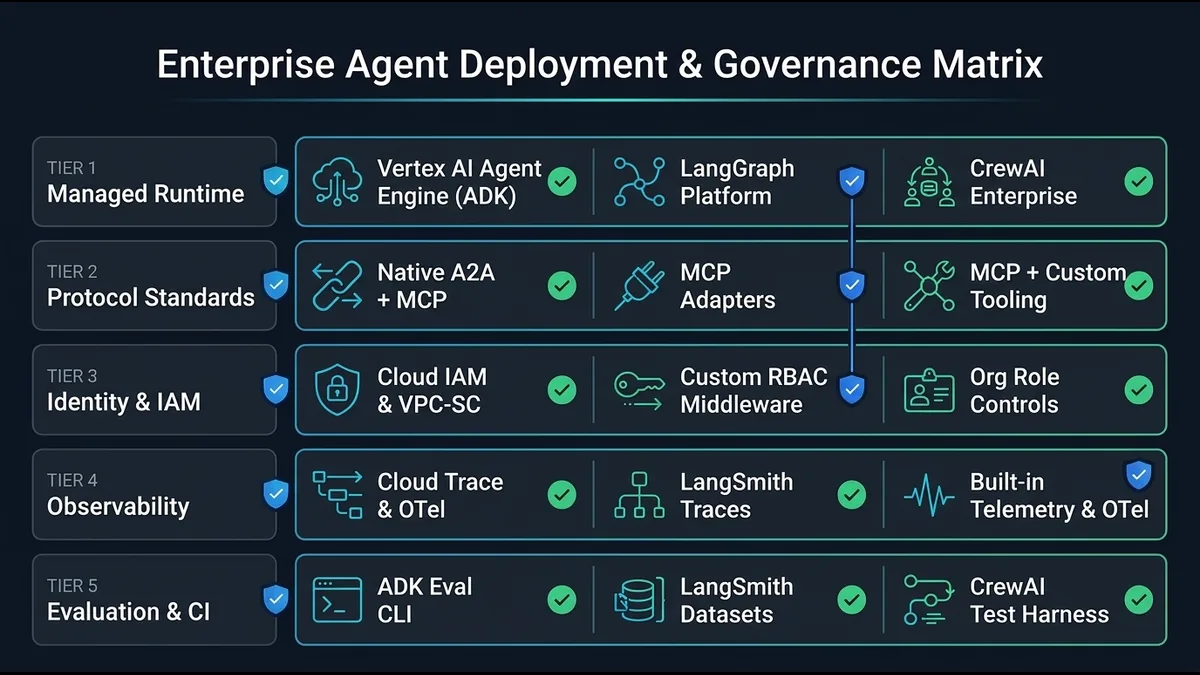 Figure 2: Enterprise deployment, protocol interoperability, IAM governance, and observability comparison across all three frameworks.
Managed Runtimes: Vertex AI Agent Engine, LangSmith Deployment, and CrewAI Cloud
Google ADK deploys natively to Vertex AI Agent Engine (part of the Gemini Enterprise Agent Runtime) as well as standard Cloud Run and GKE containers. Vertex AI Agent Engine provisions managed session storage, IAM-scoped service accounts, autoscaling, and Google Cloud Trace export out of the box.
LangGraph pairs with LangSmith Deployment (formerly LangGraph Platform) or self-hosted FastAPI/Docker workers backed by PostgreSQL. LangSmith replaced legacy per-run billing with resource-based LangSmith Units (1 LSU = $1.00) split into Serverless Deployments (scale to zero when idle; 1 Small Serverless server included free on the $39 per seat Plus plan, billing ~0.072 LSU per active hour) and Dedicated Deployments (24/7 isolated compute and database with zero cold starts).
CrewAI offers CrewAI Enterprise (hosted cloud, dedicated VPC, or on-premises containers) alongside uncapped self-hosted Python execution. While the free Basic cloud plan limits hosted runs to 50 workflow executions per month, Enterprise unlocks SSO, RBAC, PII redaction, policy enforcement, and managed connector governance.
Observability: ADK Web, LangSmith, and OpenTelemetry
| Operations Dimension | Google ADK | LangGraph | CrewAI |
|---|---|---|---|
| Built-In Local UI | adk web (step traces, event payloads, session state inspector) |
LangGraph Studio (graph visualizer and thread state editor) | CrewAI Studio and verbose CLI execution logs |
| Managed Cloud Tracer | Google Cloud Trace + Vertex AI Evaluation | LangSmith (5,000 free base traces/mo; ~$5.00 per 1,000 extra traces) | CrewAI Enterprise Control Plane |
| OpenTelemetry / Self-Hosted | Native OpenTelemetry export to Arize Phoenix, Langfuse, or Datadog | Runs 100% without LangSmith; native OTel hooks for Langfuse and Phoenix | OpenTelemetry / OpenInference instrumentation for self-hosted tracing |
| Automated CI Regression Eval | Built-in adk eval CLI for trajectory and response scoring |
LangSmith datasets and online evaluators (~$2.50/1k upgraded traces) | CrewAI CLI test runner and custom Pydantic assertions |
Teams deciding whether to pay for managed LangSmith tracing or self-host an OpenTelemetry stack should review our Langfuse vs Arize Phoenix vs LangSmith comparison before locking in observability budgets.
Security Guardrails and Serialization Hardening
Enterprise multi-agent security requires strict input validation, credential isolation, and safe state deserialization. In LangGraph production deployments, engineers must enable LANGGRAPH_STRICT_MSGPACK=true (or specify an explicit allowed_msgpack_modules allowlist) so PostgresSaver checkpoint deserialization blocks arbitrary object instantiation.
In Google ADK, isolate IAM permissions per LlmAgent toolset and avoid passing raw database credentials inside session state dictionaries. In CrewAI, enforce Pydantic output models (output_pydantic) on every task that triggers external write APIs, and pair Enterprise PII redaction or custom input hooks before sending customer records to third-party model endpoints.
Production Troubleshooting: Failure Modes and Deterministic Fixes
Moving multi-agent pipelines from local testing into production traffic surfaces recurring runtime crashes around session timeouts, database checkpointers, and context window saturation. The matrix below summarizes the highest-frequency production failure modes across all three frameworks.
| Framework | Production Failure Mode | Root Cause | Deterministic Fix |
|---|---|---|---|
| Google ADK | ValueError: Google search tool is not supported for model... |
Passing built-in google_search tool to a non-Gemini model via LiteLlm |
Replace built-in google_search with a custom Python function tool or MCP search server |
| Google ADK | Session state desynchronization / 60-second gateway timeout | Blocking synchronous tool calls exceed Cloud Run or API Gateway request timeouts | Use async tools end-to-end and offload >15s jobs to Cloud Tasks or Pub/Sub workers |
| LangGraph | PostgresSaver.setup() fails or raises TypeError on tuple indices |
Missing autocommit=True or row_factory=dict_row on manual psycopg connections |
Configure ConnectionPool(..., kwargs={"autocommit": True, "row_factory": dict_row}) |
| LangGraph | KeyError on in-flight threads after deploy |
Adding required keys to TypedDict state while old Postgres checkpoints lack them |
Annotate new keys with NotRequired and use .get() with safe defaults |
| LangGraph | GraphRecursionError or thread_id DB truncation |
Unbounded cyclic edges or raw query strings exceeding 255-char thread_id column |
Set recursion_limit in config, add explicit hop counters, and hash thread_id to UUIDs |
| CrewAI | RateLimitError / context length exceeded |
Short-term and long-term Crew memory compounds raw tool payloads across sequential tasks | Bound max_iter per agent, trim tool outputs, and attach an external vector embedder |
| CrewAI | Broken task replay after LLM timeout | Mid-task timeout writes malformed partial JSON into replay persistence | Enforce strict output_pydantic schemas on tasks and wrap tool calls in asyncio.wait_for |
Google ADK: Session Desyncs and LiteLLM Tool Conflicts
Google ADK relies on asynchronous event streams and persistent invocation_id tokens to coordinate distributed turns. If a synchronous tool blocks past a 60-second Cloud Run or API Gateway timeout, the client drops the connection while the backend session state advances unevenly. Decouple long-running jobs into background queues (Cloud Tasks or Pub/Sub) and always fetch the latest active session state from SessionService before retrying a failed invocation.
When running Claude 5.5 or GPT-6.2 inside Google ADK through LiteLlm, avoid attaching Gemini-native tools like google_search or built-in Vertex code execution. Wrap third-party search or sandbox APIs as standard typed Python function tools or MCP servers so your agent definitions stay portable across model providers.
LangGraph: Checkpointer Pool Traps and Schema Migration Crashes
A frequent deployment bug in the LangGraph GitHub Repository issue tracker occurs when teams deploy code containing MemorySaver() directly onto LangSmith Deployment, causing a ValueError conflict with the platform’s managed persistence layer. Gate local checkpointers behind an environment variable so production containers let the managed platform inject persistence or connect cleanly to a bounded psycopg_pool.ConnectionPool.
[!WARNING] Never mutate existing
StateGraphTypedDictschemas by introducing mandatory keys without defaults. Always wrap newly added fields intyping.NotRequiredand validate checkpoint deserialization withLANGGRAPH_STRICT_MSGPACK=truebefore rolling out new container revisions.
CrewAI: Context Window Bloat and Replay Cache Poisoning
In multi-step CrewAI pipelines with memory=True, verbose API responses and intermediate agent reasoning accumulate rapidly across tasks, triggering RateLimitError throttling or silent accuracy degradation. Set explicit max_iter ceilings on every Agent, summarize large tool outputs before returning them to the agent scratchpad, and follow structured AI agent memory systems architecture patterns to isolate deterministic validation inside a CrewAI Flow before payloads enter the Crew.
To prevent corrupted replay states after upstream model timeouts, attach strict output_pydantic contracts to every Task. If an LLM call times out or emits truncated JSON, Pydantic validation fails cleanly before corrupt data enters persistent memory or downstream tasks.
Frequently Asked Questions About Google ADK vs LangGraph vs CrewAI
Can Google ADK use non-Gemini models like Claude or GPT?
Google ADK is model-agnostic and routes requests to Claude 5.5, GPT-6.2, or local vLLM endpoints through its native LiteLlm wrapper. However, Gemini-specific built-in tools such as google_search only work with Gemini models and require custom function tools or MCP servers when using external providers.
Is CrewAI still built on top of LangChain?
CrewAI decoupled completely from LangChain starting in version 1.14 and now runs as a standalone MIT-licensed Python framework. It handles LLM routing natively through LiteLLM and direct provider SDKs without requiring LangChain packages.
Do you have to use LangSmith to run LangGraph in production?
LangGraph is open-source under the MIT license and runs entirely independently of LangSmith on any container or Kubernetes cluster. Teams can pair LangGraph with self-hosted PostgreSQL checkpointers and open-source OpenTelemetry tracers such as Langfuse or Arize Phoenix.
Which framework uses fewer tokens for multi-agent workflows?
LangGraph consistently consumes 30% to 40% fewer tokens on multi-step workloads because conditional Python edges handle routing deterministically instead of invoking an LLM for every handoff. Google ADK workflow agents achieve similar efficiency on structured pipelines, whereas unconstrained CrewAI roleplay loops incur higher conversational token overhead.
How does Google ADK handle multi-language enterprise stacks?
Google ADK ships first-class native SDKs for Python, TypeScript, Go, Java, and Kotlin, letting platform teams build agents in their existing service languages. Cross-service agents written in different languages can also delegate tasks over the standardized Agent-to-Agent (A2A) protocol.
When should you use CrewAI Flows instead of plain Crews?
Use plain Crews for open-ended collaborative tasks where autonomous roleplay agents benefit from dynamic delegation, such as research synthesis. Wrap Crews inside CrewAI Flows whenever production workloads require deterministic branching, typed Pydantic state, or explicit API triggers.
Which framework has the best human-in-the-loop and crash recovery?
LangGraph leads on crash recovery and human-in-the-loop workflows through PostgresSaver checkpointing, native interrupt() pauses, and time-travel state replay. Google ADK provides strong managed session durability on Vertex AI Agent Engine, while CrewAI requires explicit Flow persistence and Pydantic task guards for safe replay.
Final Architectural Recommendation
Standardize on Google ADK when your engineering organization spans Go, Java, Kotlin, TypeScript, and Python, runs primarily on Google Cloud and Gemini 4, or requires native A2A protocol interoperability alongside built-in adk web and adk eval tooling.
Choose LangGraph when your workloads demand deterministic cyclic routing, strict token efficiency, durable PostgreSQL checkpointing, and multi-cloud Kubernetes portability. Select CrewAI when a Python team needs to ship collaborative role-based multi-agent pipelines rapidly while keeping deterministic business logic isolated inside standalone CrewAI Flows.
Whichever runtime you adopt, decouple external tools behind Model Context Protocol (MCP) servers, enforce hard iteration and timeout ceilings on every agent node, and validate production state transitions with automated OpenTelemetry traces before scaling live traffic. Run a 48-hour shadow evaluation on real production tickets before committing to a long-term framework standard.