Perplexity Computer vs Claude Cowork: Agent Comparison (2026)
Compare Perplexity Computer cloud multi-model sub-agents vs Claude Cowork local desktop sandbox across architecture, pricing, security, MCP code, and fixes.
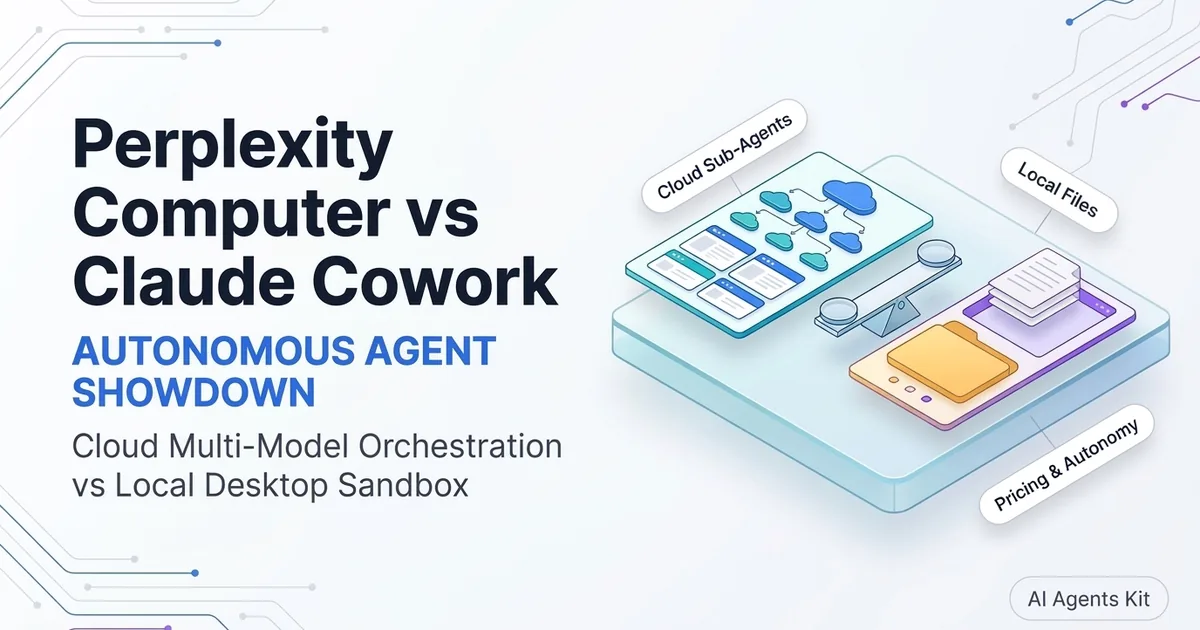
Evaluating Perplexity Computer vs Claude Cowork comes down to execution locality: cloud multi-model orchestration versus a local desktop micro-VM sandbox. Perplexity Computer spawns up to 16 parallel cloud sub-agents across 19+ frontier models at $200 per month on Perplexity Max. Claude Cowork runs Claude 5.5 and Claude Fable 5.2 directly against local folders starting at $20 per month on Claude Pro.
Choosing the wrong execution model wastes subscription budget and creates security friction. Teams that send proprietary local spreadsheets into cloud containers face data residency reviews, while analysts who force a desktop agent to scrape 50 live vendor sites exhaust rolling token quotas within an hour.
Key Takeaways
- Execution Locality Split: Perplexity Computer executes asynchronous web research and multi-model synthesis inside ephemeral cloud containers, while Claude Cowork operates directly inside user-selected local macOS and Windows folders via hypervisor sandboxing.
- 10x Entry Price Spread: Claude Cowork is bundled into Claude Pro at $20 per month ($100 to $200 per month on Claude Max for heavy runs), whereas full Perplexity Computer capacity requires Perplexity Max at $200 per month with 10,000 monthly Computer credits.
- Model Routing vs Deep Single-Provider Reasoning: Perplexity Computer dynamically routes subtasks across Claude Opus 5.5, GPT-6.2 Astra, Gemini 4 Carbon, and Grok 4.7 with Model Council cross-checking, while Claude Cowork relies exclusively on Claude Sonnet 5.5, Claude Opus 5.5, and Claude Fable 5.2.
- Hybrid Production Pattern: High-output engineering and finance teams run Perplexity API sweeps to export cited JSON datasets, then process those files locally inside a scoped Claude Desktop Model Context Protocol (MCP) workspace.
Perplexity Computer vs Claude Cowork: Executive Verdict and Comparison Matrix
In a direct Perplexity Computer vs Claude Cowork comparison, Perplexity Computer is the stronger choice for asynchronous, multi-source web research and cross-device cloud execution, while Claude Cowork is the better fit for local file organization, multi-sheet Excel automation, and strict on-device document workflows. Each platform solves a distinct operational bottleneck rather than acting as a drop-in replacement for the other.
Comparing an autonomous desktop agent vs cloud agent requires looking past surface chat features into runtime isolation, model routing, and billing mechanics. The specification matrix below summarizes the core architectural and commercial differences between both platforms in late 2026.
Head-to-Head Specification Matrix
| Dimension | Perplexity Computer | Claude Cowork |
|---|---|---|
| Execution Environment | Ephemeral cloud containers with headless browser and cloud filesystem | Local desktop app (macOS and Windows) backed by hypervisor micro-VM |
| Foundation Models | 19+ models routed dynamically (Claude Opus 5.5, GPT-6.2 Astra, Gemini 4 Carbon, Grok 4.7) | Anthropic models only (Claude Sonnet 5.5, Claude Opus 5.5, Claude Fable 5.2) |
| Parallel Concurrency | Up to 16 parallel cloud sub-agents in Multiagent mode plus Model Council | Local multi-task background queue and sub-agent threads inside Desktop |
| Primary Data Domain | Live web pages, APIs, SaaS connectors, and cloud-synced project spaces | Mounted local folders, CSV/Excel workbooks, PDFs, Markdown, and local apps |
| Sandbox Mechanism | Cloud container isolation, egress filtering, and short-lived proxy tokens | Apple Virtualization Framework (VZVirtualMachine) on macOS; Windows HCS |
| GUI / Browser Fallback | Headless cloud browser and Comet assistant integration | Built-in isolated side-panel browser plus opt-in desktop Computer Use |
| Context & Memory | Persistent cross-session cloud project memory synced across web and mobile | Local workspace files plus up to 1M token context window on flagship models |
| Entry Pricing | $20/mo Pro (light weekly meter); $200/mo Max (10,000 Computer credits) | $20/mo Claude Pro ($17/mo annual); $100 to $200/mo Claude Max |
| Quota Burn Profile | Credit-based burn per sub-agent, scrape call, and tool execution | Shared token pool across Chat, Claude Code, and Cowork (5x to 20x chat burn) |
| Extensibility Standard | 400+ managed SaaS integrations and Perplexity Agent/Search APIs | Native Model Context Protocol (MCP) servers, Skills, and Plugins |
How Execution Locality Shapes Your Agent Stack
Execution locality dictates latency, failure modes, and governance overhead. When an agent runs in the cloud, your laptop can go to sleep while 16 sub-agents fetch SEC filings, parse pricing tables, and assemble a report overnight. When an agent runs locally, your workstation stays awake during execution, but every gigabyte of financial spreadsheets remains on local SSD storage with zero manual upload step.
For a deeper look at how multi-agent systems partition planning, tool execution, and verification across distributed workers, review our breakdown of multi-agent coordination architecture. Understanding that underlying topology clarifies why Claude Cowork vs Perplexity Computer behaves differently under sustained production load.
Tool-by-Tool Technical Profiles: Strengths, Trade-Offs, and Pricing
Evaluating each platform in a self-contained technical profile prevents misattributing cloud credit limits to local sandboxes or confusing local filesystem mounts with remote SaaS connectors. Both profiles below reflect current late-2026 platform capabilities, frontier model lineups, and published subscription tiers.
Perplexity Computer: Verdict, Strengths, Trade-Offs, and Pricing
Verdict: Perplexity Computer is a cloud-hosted multi-model digital worker engineered for high-volume web intelligence, multi-step research synthesis, and asynchronous artifact generation. It stands out when accuracy depends on live web citations and cross-checking outputs across competing frontier model families rather than trusting a single provider.
Best for: Market intelligence analysts, technical product managers, venture research teams, and engineering leads running recurring competitive sweeps, multi-source due diligence, or overnight web-to-app research pipelines.
Strengths:
- Multi-Model Orchestration: Dynamically assigns reasoning to Claude Opus 5.5, broad retrieval synthesis to GPT-6.2 Astra or GPT-6.2 Sol, deep web fan-out to Gemini 4 Carbon, and fast social lookups to Grok 4.7.
- 16-Agent Parallel Fan-Out and Model Council: Runs up to 16 specialized sub-agents concurrently in Multiagent mode and cross-checks high-stakes conclusions across independent frontier models via Model Council.
- Persistent Cloud Continuity: Keeps project state, files, and task history synchronized across desktop web browsers and mobile devices without tying execution to a single laptop.
- Zero Local Execution Risk: Runs untrusted web scraping, code generation, and headless browsing inside isolated cloud sandboxes instead of your corporate endpoint.
Trade-offs:
- Steep Entry Cost for Serious Usage: Perplexity Pro ($20 per month) restricts Computer to a light weekly meter, forcing regular operators onto Perplexity Max at $200 per month.
- Opaque Model Routing and Credit Burn: Heavy multi-agent jobs with long context windows can burn through monthly Computer credits unpredictably, and users cannot manually pin every internal routing hop.
- Indirect Local File Access: Working on sensitive local folders requires uploading files or configuring bridge tools, adding friction compared to native desktop directory mounts.
Pricing: Perplexity Pro costs $20 per month ($17 per month billed annually) with a light weekly Computer meter. Perplexity Max costs $200 per month ($167 per month or $2,000 per year billed annually) and includes 10,000 monthly Computer credits, unlimited Deep Research, Multiagent effort modes, and Model Council access, as outlined in the Perplexity API and Platform Documentation.
Claude Cowork: Verdict, Strengths, Trade-Offs, and Pricing
Verdict: Claude Cowork is a local-first desktop agent workspace embedded directly inside Claude Desktop on macOS and Windows. It is the best autonomous AI agent for knowledge work when your daily deliverables live inside local folders, multi-tab spreadsheets, PDFs, and internal enterprise documents.
Best for: Financial analysts, operations managers, technical writers, legal reviewers, and engineers who need batch file renaming, structured spreadsheet reconciliation, local document synthesis, and MCP-connected desktop automation at a $20 monthly entry point.
Strengths:
- Direct Local Folder Choreography: Reads, transforms, and writes files inside user-selected host directories without manual upload loops or third-party cloud storage sync.
- Hypervisor-Level Desktop Sandboxing: Isolates agent commands inside a lightweight micro-VM (Apple Virtualization Framework on macOS and Host Compute System on Windows) rather than granting raw host shell access.
- Deep Anthropic Reasoning and Formatting Precision: Powered by Claude Sonnet 5.5, Claude Opus 5.5, and Claude Fable 5.2, delivering consistent schema adherence across long documents and multi-sheet workbooks.
- Native MCP Ecosystem and GUI Fallback: Connects directly to local databases, Git repositories, and SaaS APIs via Model Context Protocol servers, with opt-in Computer Use GUI control when no API exists.
Trade-offs:
- Single-Provider Lock-In: Runs exclusively on Anthropic models, meaning you cannot route subtasks to GPT-6.2 Astra or Gemini 4 Carbon inside the same native session.
- Shared Rolling Token Pool: Because Claude Pro shares one token budget across Chat, Claude Code, and Cowork, heavy agentic runs hit rate limits quickly unless you upgrade to Claude Max.
- Workstation-Bound State: Local files, skills, and task execution remain tied to the active desktop machine rather than running headlessly across cloud infrastructure while your laptop is closed.
Pricing: Claude Cowork is excluded from the Free tier and bundled into Claude Pro at $20 per month ($17 per month billed annually at $200 per year). Heavy operators scale to Claude Max at $100 to $200 per month for 5x or higher rolling token capacity, while Team plans start at $25 per user per month ($20 annually), as published on the official Anthropic Claude Subscription Pricing page.
Core Architecture: Cloud Multi-Model Routing vs Local Hypervisor Sandboxing
Perplexity Computer architecture centers on a cloud task-graph supervisor that dispatches subtasks across 19+ frontier models inside ephemeral containers, whereas the Claude Cowork local sandbox embeds an agentic loop inside a desktop client backed by a 512 MB guest micro-VM. Examining the wire and isolation layers exposes why each system excels in opposite operational domains.
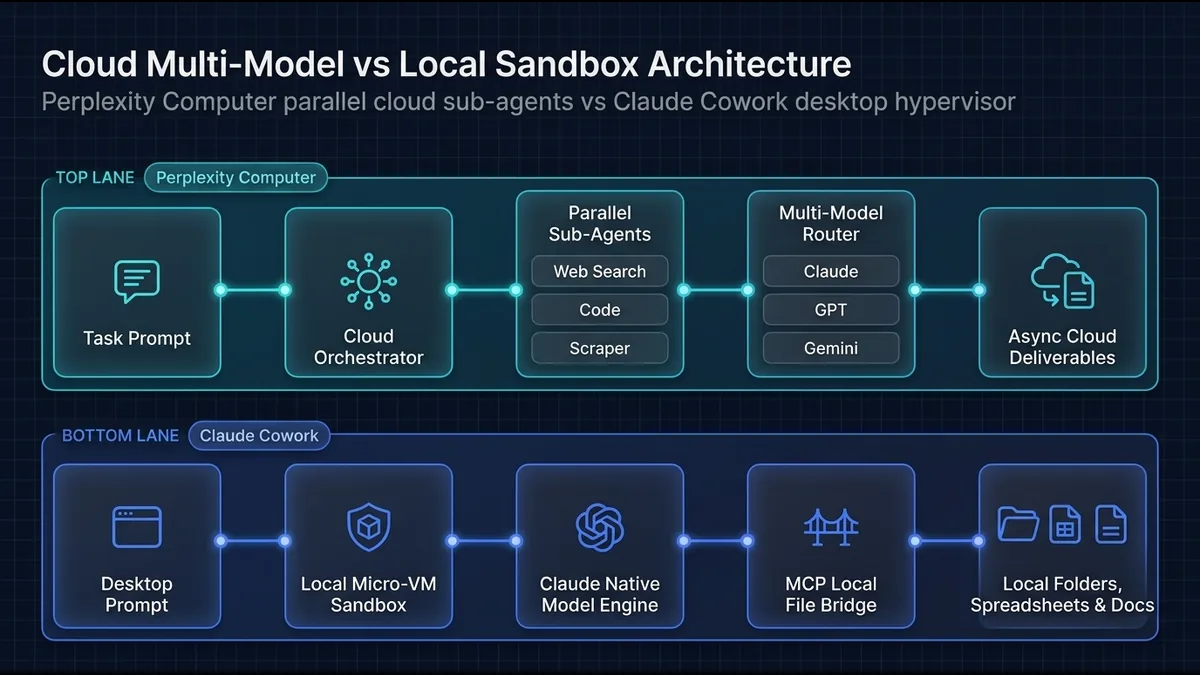 Figure 1: Architectural split between Perplexity Computer cloud multi-model routing and Claude Cowork local desktop hypervisor sandboxing.
Perplexity Computer Multi-Model Router, 16 Sub-Agents, and Model Council
When a user submits a project brief to Perplexity Computer, a lead planning model compiles the goal into a directed acyclic task graph. Rather than executing every node sequentially on one model, the orchestration supervisor matches each node’s requirements against a pool of more than 19 specialized models.
In Max-tier Multiagent mode, Perplexity Computer spawns up to 16 parallel sub-agents that share a cloud workspace filesystem and cross-check intermediate outputs. For high-stakes research or conflicting vendor data, the platform invokes Model Council: multiple frontier models independently evaluate the same prompt, and the supervisor surfaces consensus facts alongside explicit disagreements.
Every sub-agent operates inside a managed cloud sandbox equipped with a real Linux filesystem, a headless web browser, and programmatic “Search as Code” retrieval tools. For a complete teardown of the 19-model routing pool and cloud task-graph mechanics, see our dedicated Perplexity Computer technical guide.
Claude Cowork Hypervisor Isolation, VirtioFS Mounts, and Computer Use Fallback
Anthropic designed Claude Cowork around environmental containment rather than repetitive confirmation popups that trigger user alert fatigue. On macOS, Claude Desktop provisions a lightweight guest Linux environment through the Apple Virtualization Framework (VZVirtualMachine), maintaining a compact 512 MB RAM footprint. On Windows, the client runs an equivalent utility container via the Host Compute System (HCS).
When a user authorizes a specific folder, Claude Desktop mounts only that path into the guest VM using VirtioFS on macOS or Hyper-V shared folders on Windows. The agent plans file reads, Python or Node transformations, and spreadsheet edits inside the micro-VM while a host packet filter restricts outbound network egress to allowlisted domains.
When a legacy desktop app lacks an API or MCP connector, Claude Cowork can fall back to opt-in Computer Use. As detailed in the Anthropic Computer Use Developer Documentation, this mode captures screenshots and dispatches synthetic mouse and keyboard events under explicit approval, blocking restricted financial apps by default.
State Persistence: Cloud Spaces vs Local Filesystem State
| Architectural Layer | Perplexity Computer | Claude Cowork |
|---|---|---|
| Compute Runtime | Multi-tenant cloud containers with ephemeral per-run scratch disks | Local host CPU/RAM inside VZVirtualMachine or Windows HCS micro-VM |
| Memory Persistence | Cloud-synced persistent project memory (“Brain”) across web and mobile | Local Markdown/project files on host SSD plus session context window |
| Filesystem Access | Cloud workspace storage plus SaaS connectors (Drive, Notion, Snowflake) | Scoped host directory mount via VirtioFS or Hyper-V shared folder |
| Browser Engine | Managed headless cloud browser for programmatic web fan-out | Isolated side-panel browser separated from primary cookies and history |
| Model Switching | Automatic per-subtask routing across OpenAI, Anthropic, Google, xAI | Manual selection within Anthropic family (Sonnet 5.5, Opus 5.5, Fable 5.2) |
This state persistence divide creates a practical operational boundary. Perplexity Computer retains long-lived cloud context across days and devices, whereas Claude Cowork treats your local folder hierarchy as the canonical source of truth, making version control with Git or corporate backup tools straightforward.
Where Perplexity Computer Wins and Where Claude Cowork Wins
Deciding between Perplexity Computer and Claude Cowork depends on whether your bottleneck is gathering external web evidence or transforming internal local files. Neither platform dominates across every knowledge-work category, and forcing either agent outside its primary execution boundary degrades both accuracy and cost efficiency.
Where Perplexity Computer Wins
- Asynchronous Multi-Source Web Research: When a project requires crawling 40 SaaS pricing pages, parsing recent SEC filings, and aggregating analyst commentary into a cited matrix, Perplexity Computer’s 16 parallel cloud sub-agents finish in minutes without locking up your laptop.
- High-Stakes Fact Verification via Model Council: For competitive positioning, regulatory tracking, or investment memos where single-model hallucinations are unacceptable, running Model Council to compare outputs across Claude Opus 5.5, GPT-6.2 Astra, and Gemini 4 Carbon surfaces discrepancies automatically.
- Long-Running Overnight Pipelines: Because execution runs on Perplexity’s cloud infrastructure with persistent project memory, you can queue an end-to-end research-to-prototype build before closing your laptop and review the finished deliverables from mobile the next morning.
- Cross-Vendor Resilience Without Provider Lock-In: If one frontier provider suffers an API outage or trails on a specialized modality like visual diagramming or social search, Perplexity’s multi-model router shifts subtasks to another model family automatically.
Where Claude Cowork Wins
- Local Folder and Batch File Choreography: Organizing 300 vendor invoices, renaming media assets by extracted metadata, and reconciling mismatched CSV exports happen directly on disk via
VirtioFSmounts without uploading sensitive files to third-party cloud workspaces. - Complex Spreadsheet and Document Authoring: Powered by Claude Sonnet 5.5, Claude Opus 5.5, and Claude Fable 5.2, Claude Cowork maintains strict formula integrity, formatting conventions, and editorial nuance across multi-tab Excel files, Word reports, and PDF packets.
- Budget-Conscious Individual and Team Rollouts: At $20 per month inside Claude Pro (or $25 per seat on Claude Team), organizations can equip an entire analyst department with local agent automation for a fraction of Perplexity Max’s $200 per-seat entry price.
- Custom Local Tooling via MCP Servers: Engineering and operations teams can expose internal Postgres databases, local Git repos, Jira boards, or private APIs to Claude Cowork using standardized local MCP servers running directly inside the corporate VPN. For deeper implementation patterns on local directory sandboxing, see our Claude Cowork architecture guide.
Where Neither Tool Fits: When to Use Claude Code or Custom LangGraph
Both Perplexity Computer and Claude Cowork target interactive knowledge work rather than continuous production software engineering or high-throughput backend automation. When evaluating Perplexity Computer vs Claude Code for multi-repository software refactoring, CI test loops, and Git branch management, terminal-native Claude Code outperforms both tools because it integrates directly with compilers, linters, and shell toolchains.
Similarly, if you need deterministic, versioned multi-agent workflows handling 10,000 customer tickets per day with OpenTelemetry tracing and strict SLA guarantees, neither consumer desktop agent is appropriate. Those workloads belong in programmatic agent frameworks deployed on managed APIs with automated regression tests.
Pricing Economics: Credit Burn vs Token Quotas at Scale
Pricing for Perplexity Max vs Claude Pro pricing looks simple on the surface ($200 per month vs $20 per month), but real monthly spend depends heavily on task concurrency and token burn multipliers. Both platforms meter autonomous loops far more aggressively than conversational chat because multi-step agents repeatedly inspect tool outputs, retry failed steps, and carry large context payloads.
Perplexity Max Credit Math and Sub-Agent Multipliers
Perplexity Max includes 10,000 Computer credits per month for $200 monthly ($2,000 annually, or $167 per month). Simple single-agent web lookups consume roughly 30 credits, meaning light daily tasks stretch comfortably across the full billing cycle.
Credit burn accelerates sharply when you trigger Multiagent effort modes or Model Council sweeps. Spawning 12 to 16 parallel sub-agents that scrape live web pages, parse PDFs, and iteratively debug generated code can consume 400 to 1,200 credits in a single complex project. Teams running two heavy research builds per workday can exhaust the 10,000-credit monthly allocation before week three, requiring disciplined scoping of sub-agent parallelism.
Claude Pro vs Claude Max Token Burn Under Agentic Loops
Claude Cowork carries no separate SKU fee; it draws from your unified Anthropic subscription pool alongside web chat and Claude Code. While Claude Pro costs $20 per month ($17 per month billed annually), agentic workflows consume tokens 5x to 20x faster than standard chat turns.
Each multi-step Cowork task reads directory listings, ingests full spreadsheet contents, executes verification passes, and optionally captures high-resolution desktop screenshots for Computer Use. Power users who run batch document processing all day frequently hit Claude Pro’s rolling 5-hour usage ceilings within 60 to 90 minutes, making Claude Max ($100 to $200 per month for 5x+ higher quotas) the realistic tier for full-time agentic operators.
Monthly Cost Modeling by Team Persona
| Team Persona | Typical Weekly Workload | Recommended Tier | Estimated Monthly Cost | Primary Cost Driver |
|---|---|---|---|---|
| Solo Analyst / Writer | 5 to 10 local folder/spreadsheet tasks per week | Claude Pro (Cowork) | $20/mo ($17 annual) | Occasional rolling 5-hour quota pauses |
| Heavy Operations Lead | Daily batch PDF/Excel reconciliation and MCP queries | Claude Max (Cowork) | $100 to $200/mo | 5x to 20x agentic token burn multiplier |
| Market Research / VC Lead | Daily 15-source competitive sweeps and Model Council briefs | Perplexity Max | $200/mo ($167 annual) | Multiagent parallel sub-agent credit burn |
| Hybrid AI Engineering Team | Automated cloud web sweeps + local MCP workspace assembly | Perplexity API + Claude Pro | $40 to $85/mo | Metered API token spend + fixed Pro seat |
As the final row illustrates, engineering teams often beat the $200/month Perplexity Max ceiling by combining pay-as-you-go Perplexity API calls for structured web research with a $20/month Claude Pro seat running local Cowork workflows.
Security, Data Residency, and Sandboxing Trade-Offs
Comparing cloud container vs local micro-VM sandbox architectures reveals distinct threat models for enterprise security teams. Perplexity Computer protects your local workstation from untrusted web code at the cost of moving project artifacts into vendor-managed cloud containers, while Claude Cowork keeps raw files on your corporate endpoint at the cost of expanding local filesystem boundary risk.
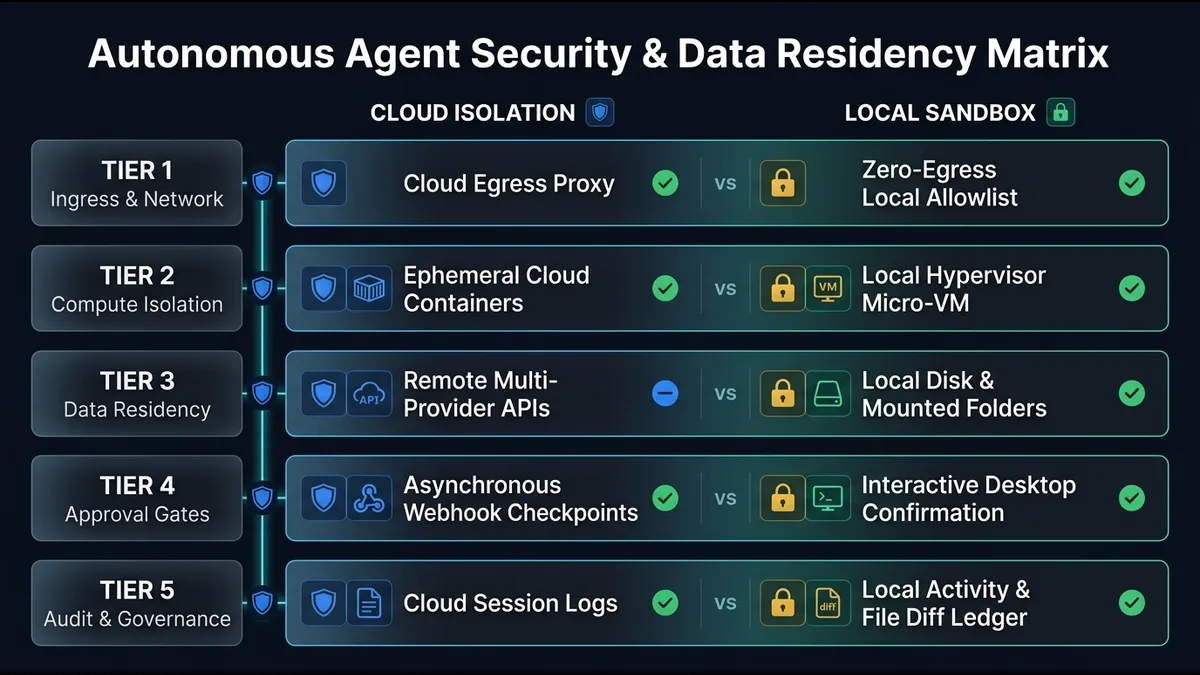 Figure 2: Defense-in-depth comparison across ingress filtering, compute isolation, local file permissions, and audit logging.
Cloud Container Boundaries and Proxy Token Handling in Perplexity Computer
Perplexity Computer executes generated code and headless browser sessions inside isolated cloud containers that never touch your host operating system. Rather than injecting raw, long-lived third-party API secrets into the container environment, the runtime relies on scoped, short-lived proxy tokens for SDK and connector calls.
Arbitrary outbound network calls from inside the cloud sandbox are filtered by egress policies to block reverse shells and unauthorized exfiltration. However, because containers are ephemeral, teams must treat the cloud workspace as transient compute: never paste unredacted customer PII, production database credentials, or regulated healthcare records into cloud sessions unless covered by an enterprise data processing agreement.
Local Hypervisor Containment, Symlink Risks, and Egress Allowlists in Claude Cowork
Claude Cowork runs its execution environment locally inside VZVirtualMachine on macOS or Windows HCS, confining the guest OS to a 512 MB RAM slice and mounting only user-approved folders. As documented on the Anthropic Claude Cowork Product Overview, this design prevents an agent from scanning ~/.ssh, browser password stores, or system directories outside the mounted workspace.
Even with hypervisor containment, security audits have highlighted two residual risks that administrators must actively mitigate:
- Symlink Traversal and SharedRoot Misconfiguration: If a user mounts a broad root directory or stores symbolic links inside a permitted folder pointing to sensitive host paths, a prompt-injected document could attempt to escape outside the intended workspace boundary.
- Model Inference Egress: While file transformations execute locally inside the micro-VM, the extracted text and tool arguments sent to Claude Sonnet 5.5 or Claude Opus 5.5 still travel over TLS to Anthropic’s inference servers. Regulated organizations must pair Cowork with Enterprise zero-data-retention terms and strict host egress allowlists.
For enterprise teams hardening MCP tool permissions and local agent boundaries across developer workstations, review our detailed guide to MCP enterprise security controls.
Threat Model Comparison Matrix
| Security Vector | Perplexity Computer (Cloud Sandbox) | Claude Cowork (Local Micro-VM) |
|---|---|---|
| Host OS Blast Radius | Zero direct host OS exposure (fully remote container) | Contained by VZVirtualMachine / HCS micro-VM boundary |
| Untrusted Web Prompt Injection | Contained to cloud session and connected SaaS scopes | Mitigated by isolated side-panel browser; risk if broad folders mounted |
| Local Credential Exposure | No access to host ~/.ssh or local OS keychain |
Protected unless user mounts home directory or exposes symlinks |
| Data Residency of Raw Files | Uploaded files and scraped artifacts reside in cloud workspace | Raw files remain on local SSD; prompt context sent to Anthropic API |
| Secret Management | Managed proxy tokens inside container runtime | Local OS keychain plus scoped MCP environment variables |
Runnable MCP and API Workflow Examples for Hybrid Pipelines
Production teams rarely need to pick a single tool when they can wire both ecosystems into a deterministic hybrid pipeline. The pattern below uses the Perplexity API to run bounded, cited cloud research with strict schema validation, then hands the saved JSON artifact to a least-privilege Claude Desktop MCP filesystem workspace for local spreadsheet and report synthesis.
Configuring a Scoped Claude Desktop MCP Filesystem Server
To give Claude Cowork deterministic, least-privilege access to a dedicated project folder alongside your local research exports, configure an explicit allowlist in claude_desktop_config.json following the Model Context Protocol Official Specification. Always pass absolute paths for both the npx binary and the permitted workspace directories to prevent non-interactive shell lookup failures.
{
  "mcpServers": {
    "cowork-research-workspace": {
      "command": "/usr/local/bin/npx",
      "args": [
        "-y",
        "@modelcontextprotocol/server-filesystem",
        "/Users/analyst/workspaces/market-intel/inbox",
        "/Users/analyst/workspaces/market-intel/deliverables"
      ],
      "env": {
        "NODE_ENV": "production"
      }
    }
  }
}
This manifest restricts the MCP filesystem server strictly to inbox and deliverables, preventing the agent from reading parent directories or system configuration files. For step-by-step setup instructions across macOS and Windows clients, check our Claude Desktop MCP configuration guide.
Running Asynchronous Perplexity Research with Retries and Schema Validation
Rather than paying $200 per month for interactive Perplexity Max runs on recurring competitor sweeps, engineers can execute structured Perplexity API research programmatically. The Python script below uses httpx and pydantic to enforce strict response schemas, handle 429 rate limits with exponential backoff, and write verified JSON directly into the Claude Cowork inbox directory.
import asyncio
import json
import os
from pathlib import Path
from typing import List

import httpx
from pydantic import BaseModel, Field, ValidationError


class CompetitorPricingRecord(BaseModel):
    vendor: str
    entry_tier_usd: float = Field(ge=0)
    enterprise_tier_notes: str
    source_urls: List[str] = Field(min_length=1)


class ResearchBatch(BaseModel):
    topic: str
    records: List[CompetitorPricingRecord]


async def run_perplexity_research(
    query: str,
    api_key: str,
    timeout_seconds: float = 45.0,
    max_retries: int = 3,
) -> ResearchBatch:
    url = "https://api.perplexity.ai/chat/completions"
    headers = {
        "Authorization": f"Bearer {api_key}",
        "Content-Type": "application/json",
    }
    payload = {
        "model": "sonar-pro",
        "messages": [
            {
                "role": "system",
                "content": (
                    "Return valid JSON matching the ResearchBatch schema "
                    "with verified pricing and official source_urls."
                ),
            },
            {"role": "user", "content": query},
        ],
        "response_format": {
            "type": "json_schema",
            "json_schema": {"schema": ResearchBatch.model_json_schema()},
        },
    }

    async with httpx.AsyncClient(timeout=timeout_seconds) as client:
        for attempt in range(1, max_retries + 1):
            try:
                response = await client.post(url, headers=headers, json=payload)
                if response.status_code == 429:
                    backoff = 2 ** attempt
                    await asyncio.sleep(backoff)
                    continue
                response.raise_for_status()
                raw_content = response.json()["choices"][0]["message"]["content"]
                return ResearchBatch.model_validate_json(raw_content)
            except (httpx.TimeoutException, httpx.HTTPStatusError, ValidationError) as exc:
                if attempt == max_retries:
                    raise RuntimeError(
                        f"Perplexity research failed after {max_retries} attempts: {exc}"
                    ) from exc
                await asyncio.sleep(2 ** attempt)

    raise RuntimeError("Unreachable retry loop exit")


async def main() -> None:
    api_key = os.environ["PERPLEXITY_API_KEY"]
    inbox_path = Path("/Users/analyst/workspaces/market-intel/inbox/pricing-sweep.json")
    inbox_path.parent.mkdir(parents=True, exist_ok=True)

    result = await run_perplexity_research(
        query="Compare 2026 subscription pricing for autonomous desktop and cloud AI agents.",
        api_key=api_key,
    )
    inbox_path.write_text(json.dumps(result.model_dump(), indent=2), encoding="utf-8")
    print(f"Saved {len(result.records)} validated records to {inbox_path}")


if __name__ == "__main__":
    asyncio.run(main())
The response_format parameter enforces structured JSON output matching ResearchBatch.model_json_schema(), while pydantic rejects malformed responses before anything lands on disk. When httpx encounters a 429 status or network timeout, exponential backoff (2 ** attempt seconds) prevents cascading retry storms.
Bridging Cloud Research Artifacts into Local Cowork Folders
Once pricing-sweep.json lands in /Users/analyst/workspaces/market-intel/inbox, open Claude Cowork inside Claude Desktop and point it at the market-intel workspace. Using Claude Opus 5.5 or Claude Fable 5.2 with up to a 1M token context window, Cowork can ingest the verified JSON alongside internal Excel models in deliverables/, update variance formulas, and output a formatted executive memo without ever uploading proprietary internal numbers to a cloud search container.
Production Troubleshooting: Common Sandbox and Agent Failure Modes
Both platforms fail in predictable ways when pushed beyond quick demos: Claude Cowork breaks around local virtualization daemons, non-interactive PATH lookups, and VirtioFS permissions, while Perplexity Computer hits synchronous sandbox timeouts, API rate limits, and ephemeral container resets. Diagnosing these failure modes quickly prevents lost work and wasted credits.
Fixing Claude Cowork Sandbox Startup Hangs, Exit Code 127, and EACCES Mounts
| Error Signature | Root Cause | Deterministic Remediation |
|---|---|---|
| Stuck on “Starting Sandbox…” | Orphaned VZVirtualMachine (macOS) or vmcompute (Windows) process, or low disk space (< 5 GB) |
Quit Claude Desktop (Cmd/Ctrl + Q), kill zombie VM processes, free at least 5 GB of SSD space, and relaunch |
| Exit Code 127 (Command Not Found) | Cowork’s non-interactive shell does not load .zshrc or .bashrc PATH exports |
Replace bare commands (npx, python3, uv) with absolute binary paths (/usr/local/bin/npx) in configs |
VirtioFS EACCES / Mount Failure |
Restricted OS folder permissions, symlink targets outside workspace, or invalid Windows C: path mapping |
Grant Full Disk/Folder permission to Claude Desktop, remove external symlinks, and mount a clean child folder |
| Rolling Quota Exhaustion Mid-Task | 5x to 20x agentic token burn from large raw CSVs or repeated Computer Use screenshots | Pre-filter large datasets into compact CSV slices, disable GUI fallback when MCP suffices, or upgrade to Claude Max |
When Claude Cowork hangs during macOS sandbox initialization, run the diagnostic command below to check free disk headroom and inspect orphaned virtualization processes before restarting the app.
#!/usr/bin/env bash
set -euo pipefail

echo "Checking available disk space on root volume:"
df -h /

echo "Inspecting active Apple Virtualization processes:"
pgrep -fl "VZVirtualMachine|Claude" || echo "No matching processes running."

echo "Resolving absolute binary paths for MCP configs:"
command -v npx || true
command -v python3 || true
Passing the exact binary paths printed by command -v into claude_desktop_config.json eliminates Exit Code 127 across macOS Homebrew and nvm installations where interactive shell hooks do not execute.
Mitigating Perplexity Computer Sandbox Timeouts and Rate Limits
[!WARNING] Preventing Silent State Loss in Ephemeral Cloud Sandboxes: Perplexity Computer containers are recycled after idle periods or service maintenance windows. Never rely on an open cloud thread as the sole storage location for generated code or datasets; export milestone artifacts to Git, Notion, or local disk after every major stage.
When running automated Perplexity workflows, three cloud failure modes require explicit handling:
- Synchronous
timed_outErrors: Long-running code compilation or deep multi-page scraping can exceed synchronous sandbox execution limits. Split monolithic prompts into staged checkpoints or switch to asynchronous background execution modes with webhook notifications. - SDK
rate_limit_exceededResponses: Preinstalled web-fetch and search tools inside the sandbox share tier-based quotas. Inspect rate-limit headers or response metadata returned alongsidesandbox_resultsand throttle concurrent sub-agent fan-out rather than retrying immediately. - Egress Blocking on Custom Endpoints: Cloud sandbox security policies filter arbitrary outbound connections. If a workflow must query an internal staging API behind a corporate firewall, run that step locally inside Claude Cowork via an MCP server instead of attempting to tunnel traffic into Perplexity’s cloud container.
Frequently Asked Questions About Perplexity Computer vs Claude Cowork
Is Perplexity Computer worth $200 a month compared to Claude Cowork?
Perplexity Computer justifies its $200 monthly Max subscription when your team runs daily multi-source web research, overnight market sweeps, and Model Council cross-verification that replace hours of analyst labor. If your workload centers on local documents, spreadsheets, and file organization, Claude Cowork inside Claude Pro at $20 per month delivers substantially stronger value.
Can Claude Cowork access local files and spreadsheets without uploading them to the cloud?
Claude Cowork reads, edits, and transforms files directly inside your mounted local folder using an isolated micro-VM on macOS or Windows without syncing your entire drive to cloud storage. However, the model inference itself still transmits the selected document text or tool context to Anthropic’s API endpoints over TLS unless your organization enforces enterprise zero-data-retention agreements.
Which AI models power Perplexity Computer vs Claude Cowork?
Perplexity Computer dynamically routes subtasks across more than 19 frontier models including Claude Opus 5.5, GPT-6.2 Astra, GPT-6.2 Sol, Gemini 4 Carbon, and Grok 4.7 depending on each step’s requirements. Claude Cowork runs exclusively on Anthropic’s model lineup, defaulting to Claude Sonnet 5.5 while scaling up to Claude Opus 5.5 and Claude Fable 5.2 for deep reasoning.
How do Perplexity Computer and Claude Cowork differ in security and sandboxing?
Perplexity Computer isolates execution inside ephemeral cloud containers that use short-lived proxy tokens and egress filtering to protect your local workstation from untrusted code. Claude Cowork isolates execution on your own machine via Apple Virtualization Framework or Windows Host Compute System micro-VMs, which keeps raw files local but requires strict folder scoping to prevent symlink traversal.
Can you use Perplexity Computer and Claude Cowork together in one workflow?
Engineering and research teams frequently combine both platforms by using Perplexity Computer or the Perplexity API to gather cited market data into structured JSON or CSV exports. Claude Cowork then ingests those local artifacts inside a scoped workspace folder to update financial models, reconcile internal spreadsheets, and generate formatted executive deliverables.
Why does Claude Cowork burn through Claude Pro limits faster than regular chat?
Autonomous agent loops execute multi-step planning, repeated file reads, verification checks, and optional desktop screenshots inside a single task, consuming 5x to 20x more tokens than a conversational chat turn. Heavy daily Cowork operators typically upgrade to Claude Max ($100 to $200 per month) to unlock 5x or higher rolling token windows.
How do you fix Exit Code 127 and sandbox startup hangs in Claude Cowork?
Exit Code 127 occurs because Claude Cowork launches a non-interactive shell that does not source user profile scripts like .zshrc, so pass absolute binary paths in your tool and MCP configurations. If the sandbox hangs on startup, quit Claude Desktop completely, terminate orphaned VZVirtualMachine or vmcompute processes, and verify at least 5 GB of free local disk space.
Conclusion: Picking the Right Autonomous Agent Runtime
Perplexity Computer vs Claude Cowork is not a winner-take-all benchmark battle; it is a choice between cloud-scale multi-model research and local-first desktop execution. Choose Perplexity Computer on Perplexity Max when your bottleneck is live web intelligence, 16-agent parallel synthesis, and cross-device cloud continuity.
Choose Claude Cowork on Claude Pro or Claude Max when your work lives inside local folders, spreadsheets, PDFs, and internal MCP-connected tools that demand on-device data control. For teams that need both capabilities without paying redundant enterprise seats, pair scheduled Perplexity API research scripts with a scoped Claude Desktop MCP workspace to keep external retrieval in the cloud and sensitive synthesis on disk.