10 Best AI Agent Frameworks Compared: Complete 2026 Guide
Compare the 10 best AI agent frameworks in 2026: LangGraph, CrewAI, AutoGen, PydanticAI, and more. Code benchmarks, token costs, and honest trade-offs.
Selecting the best AI agent frameworks in 2026 requires balancing architectural control, state persistence, and token economics. The software engineering landscape has moved past experimental prototypes toward robust production infrastructure. This guide delivers the best AI agent frameworks compared across developer ergonomics, token efficiency, and production reliability.
Modern AI agent development demands rigorous observability, deterministic tool validation, and cost controls. When evaluating ai agents vs agentic ai, single agents execute discrete tasks while coordinated multi-agent systems manage end-to-end enterprise workflows.
Key Takeaways
- LangGraph serves as the enterprise standard for complex cyclic graphs requiring durable execution, time-travel debugging, and database state checkpointing.
- CrewAI offers the fastest development cycle for collaborative multi-agent teams, though conversational state passing can consume up to 3x more tokens than explicit graph schemas.
- PydanticAI provides production-grade type validation, dependency injection, and minimal latency overhead for Python API services.
- Anthropic Model Context Protocol (MCP) establishes an open universal standard that decouples tool creation from agent orchestration frameworks.
Engineering teams must assess their state persistence requirements and concurrency models before selecting an orchestration stack. Foundational architecture concepts are detailed in our what are AI agents complete guide.
Quick Comparison: 10 AI Agent Frameworks at a Glance
The table below outlines the core architectures, multi-agent capabilities, and official documentation for the leading agent development frameworks.
| Framework | Primary Architecture | Multi-Agent Support | Learning Curve | Supported Languages | Official Documentation |
|---|---|---|---|---|---|
| LangGraph | Stateful Cyclic Graphs with Checkpointing | Best-in-Class (StateGraph) | Steep | Python, TypeScript | LangGraph Official Documentation |
| CrewAI | Role-Based Hierarchical Teams | Intuitive Roleplay Teams | Gentle | Python | CrewAI Agents Architecture Guide |
| AutoGen | Asynchronous Event-Driven Actors | Actor Swarms and Debate | Steep | Python, .NET | Microsoft AutoGen Documentation |
| PydanticAI | Type-Safe Dependency-Injected Agents | Basic Sequential Chains | Low | Python (FastAPI/Pydantic) | Pydantic Official Documentation |
| LlamaIndex Workflows | Event-Driven Async Knowledge Retrieval | Data and RAG Specialists | Moderate | Python, TypeScript | LlamaIndex Workflows Guide |
| Smolagents | Code-First Python Execution | Lightweight Orchestration | Very Low | Python (Hugging Face) | Hugging Face Smolagents Documentation |
| Semantic Kernel | Enterprise Plugin and Planner SDK | Enterprise Connectors | Moderate | C# / .NET, Python, Java | Microsoft Semantic Kernel Overview |
| Agno (Phidata) | Multimodal Memory and Tooling | Role-Based Teams | Low | Python | Agno Documentation Portal |
| OpenAI Agents SDK | Native OpenAI Function Calling | Simple Hand-Offs | Low | Python | OpenAI Function Calling Reference |
| n8n | Visual Low-Code Node Graphs | Visual Multi-Agent Workflows | Very Low | Node-Based Canvas | n8n Advanced AI Documentation |
How to Choose: Decision Matrix by Developer Persona & Use Case
Selecting the correct agentic framework depends on technical constraints, language familiarity, and required durability. Evaluating the primary failure modes of each topology helps prevent expensive refactors.
| Primary Technical Goal | Team Stack | Recommended Framework | Strategic Rationale |
|---|---|---|---|
| Rapid Multi-Agent Prototype | Python | CrewAI | Intuitive roleplay mental model with immediate time-to-value for business processes. |
| Complex Branching Enterprise Logic | Python or TypeScript | LangGraph | Cyclic graph state machines featuring persistent checkpointing and human-in-the-loop approvals. |
| High-Scale Type-Safe Microservices | Python (FastAPI) | PydanticAI | Strict Pydantic v2 validation with zero bloat and direct schema serialization. |
| Autonomous Code Writing & Execution | Python / Docker | AutoGen | Native sandboxed code execution environments and multi-agent debate protocols. |
| Complex Document RAG & Graphs | Python or Node.js | LlamaIndex | Specialized hybrid vector retrieval, document chunking, and hierarchical indexing. |
| Enterprise .NET / Azure Systems | C# / .NET / Java | Semantic Kernel | Native Azure compliance, enterprise identity connectors, and memory abstractions. |
| Minimalist Code-First Experimentation | Python | Smolagents | Lightweight library where agents write executable Python scripts rather than JSON. |
| Visual Operational Automation | Business Operations | n8n | Drag-and-drop workflow canvas integrating hundreds of enterprise APIs with language models. |
Teams exploring visual orchestration can configure automated node flows with n8n workflows. For enterprise operational roadmaps, review how organizations deploy AI agents for automation across support, finance, and back-office pipelines. Developers and researchers can also evaluate end-to-end task automation platforms to understand how multi-model orchestration functions across disparate business applications.
Orchestration Topology: Graphs vs Teams vs Actor Swarms
Comparing top multi agent frameworks reveals distinct approaches to inter-agent communication and memory sharing. Frameworks coordinate multiple agents through three primary architectural patterns.
┌────────────────────────────────────────────────────────────────────────┐
│                   AI AGENT ORCHESTRATION TOPOLOGIES                    │
│                                                                        │
│  1. Cyclic State Graph (LangGraph): State flows through node loops     │
│     [Start] ──► [Agent Node] ──► [Tool Node] ──► [Condition] ──► [End]│
│                        ▲              │                                │
│                        └──────────────┘ (State Loop)                   │
│                                                                        │
│  2. Hierarchical Crew (CrewAI): Central Manager coordinates workers    │
│     [Manager Agent] ──► [Research Specialist] ──► [Writer Specialist]  │
│                                                                        │
│  3. Asynchronous Actor Swarm (AutoGen): Event-driven pub/sub bus       │
│     [Agent A] ◄─── Broadcast Message Bus ───► [Agent B & C]            │
└────────────────────────────────────────────────────────────────────────┘
Cyclic state graphs treat execution as a deterministic state machine where every transition updates a shared dictionary. Hierarchical teams model human organizational hierarchies, passing full task contexts between managers and workers. Actor swarms broadcast messages asynchronously across an event bus, allowing agents to react independently to incoming events.
Deep Dives: The Top 10 Frameworks Reviewed
Practical framework evaluation requires analyzing real code patterns, architectural strengths, and concrete operational trade-offs.
1. LangGraph: The Stateful Graph Champion
LangGraph represents the standard for production applications requiring complex state management, branching decision logic, and durable execution. Built as an extension of the LangChain ecosystem, LangGraph replaces linear chains with cyclic state machines.
from typing import TypedDict, Annotated
from langgraph.graph import StateGraph, END
import operator

class AgentState(TypedDict):
    messages: Annotated[list[str], operator.add]
    attempts: int

def research_node(state: AgentState):
    return {"messages": ["Retrieved specs for PostgreSQL 17"], "attempts": state["attempts"] + 1}

def should_continue(state: AgentState):
    if state["attempts"] >= 3:
        return END
    return "research"

builder = StateGraph(AgentState)
builder.add_node("research", research_node)
builder.set_entry_point("research")
builder.add_conditional_edges("research", should_continue)
graph = builder.compile()
LangGraph provides fine-grained control over execution loops, native time-travel debugging, and multi-backend checkpointing. The primary trade-off is higher boilerplate and a steep learning curve. Detailed implementation steps are covered in our LangChain agents tutorial.
2. CrewAI: Role-Based Agent Collaboration
CrewAI organizes autonomous agents into collaborative teams that reflect human organizational roles. Each agent possesses a defined role, goal, and backstory, making multi-agent delegation straightforward to conceptualize.
from crewai import Agent, Task, Crew, Process

researcher = Agent(
    role='Senior Market Analyst',
    goal='Identify enterprise edge compute trends for 2026',
    backstory='Enterprise technology analyst specializing in hardware infrastructure.',
    verbose=True
)

writer = Agent(
    role='Technical Content Strategist',
    goal='Synthesize research findings into a structured technical memo',
    backstory='Technical writer experienced in enterprise cloud infrastructure.',
    verbose=True
)

task1 = Task(description='Analyze edge AI benchmarks', expected_output='Bullet points', agent=researcher)
task2 = Task(description='Draft the executive brief', expected_output='300-word memo', agent=writer)

crew = Crew(agents=[researcher, writer], tasks=[task1, task2], process=Process.sequential)
result = crew.kickoff()
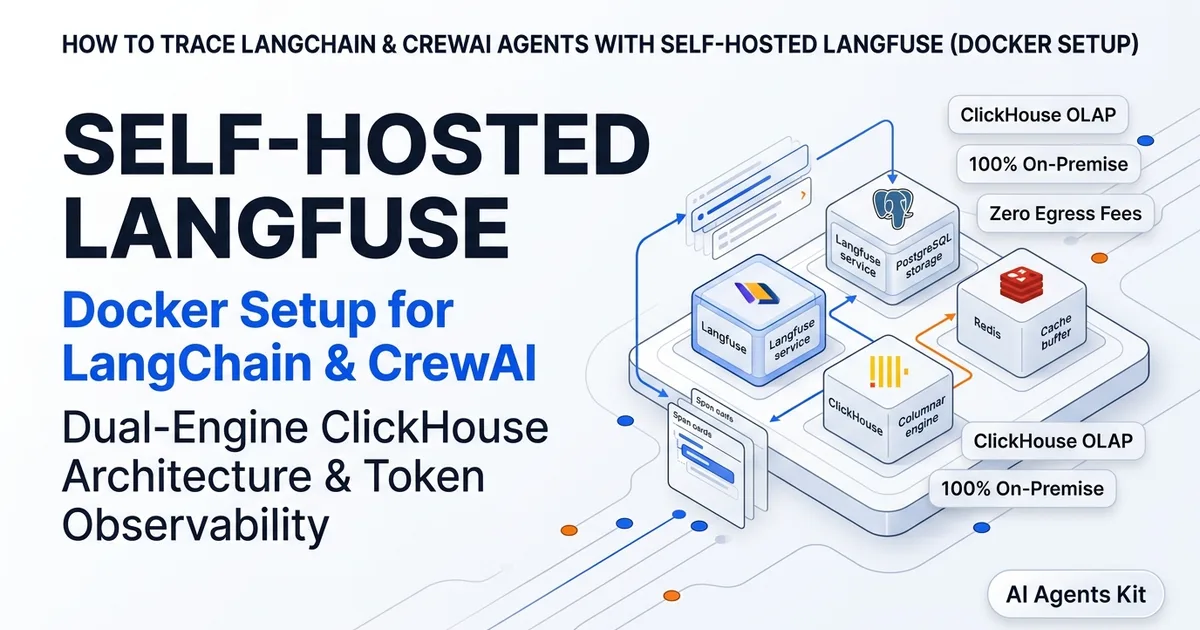
When comparing LangChain vs CrewAI vs AutoGen, CrewAI delivers the fastest path to team-based prototyping. However, passing unconstrained conversational history between agents can inflate token consumption on multi-turn workflows. To capture full parent-child execution traces and monitor token budgets across collaborative crews, follow our guide on tracing LangChain and CrewAI agents with self-hosted Langfuse.
3. Microsoft AutoGen: Asynchronous Actor Systems
Microsoft AutoGen implements an asynchronous, event-driven actor framework. Agents communicate by publishing and subscribing to events over a shared message bus, facilitating multi-agent debate and parallel tool execution.
import asyncio
from autogen_agentchat.agents import AssistantAgent
from autogen_ext.models.openai import OpenAIChatCompletionClient

async def main():
    model_client = OpenAIChatCompletionClient(model="gpt-5.6-sol")
    agent = AssistantAgent("coder", model_client=model_client)
    response = await agent.run(task="Write a Python function to verify RSA signatures.")
    print(response.messages[-1].content)

asyncio.run(main())
AutoGen excels at complex code execution tasks and autonomous multi-agent debate protocols. Its event-driven architecture requires careful concurrency handling and containerized execution environments.
4. PydanticAI: Type-Safe Microservices Standard
Created by the team behind Pydantic, PydanticAI brings strict static typing, dependency injection, and model-agnostic execution to Python agent developers.
from pydantic import BaseModel, Field
from pydantic_ai import Agent

class DatabaseQuery(BaseModel):
    sql: str = Field(description="Strict PostgreSQL query")
    explanation: str = Field(description="Technical rationale")

agent = Agent('openai:gpt-5.6-sol', result_type=DatabaseQuery)
result = agent.run_sync('Find active subscriptions renewed this month.')
print(result.data.sql)
In backend microservice architectures, deciding between PydanticAI vs LangGraph centers on whether the service requires strict request validation or persistent cyclic graph checkpointing. PydanticAI eliminates extraneous framework abstractions while enforcing runtime data validation.
5. LlamaIndex Workflows: Knowledge-Intensive Agentic RAG
LlamaIndex Workflows focuses on data-aware agents requiring advanced document retrieval, vector database navigation, and knowledge graph synthesis. It structures agent reasoning around event streams, coordinating parsing, embedding lookup, and answer generation.
LlamaIndex provides specialized parsing for complex tabular PDFs and multi-source document reconciliation. Teams building legal document analysis or enterprise search engines benefit from its data-centric abstractions.
6. Smolagents: Lightweight Code-First Agents
Hugging Face Smolagents adopts a code-first execution strategy. Instead of generating verbose JSON payloads to invoke tools, the model writes and executes raw Python snippets inside a secure environment.
Writing executable code reduces tool-calling round-trips by up to 30% compared to nested JSON schemas. The framework remains under 1,000 lines of core code, offering minimal dependency overhead.
7. Semantic Kernel: Enterprise .NET & Cloud Integration
Semantic Kernel is Microsoft’s SDK tailored for enterprise teams integrating language model reasoning into existing C#, .NET, Java, and Python infrastructure.
The framework emphasizes enterprise compliance, telemetry hooks, and native Azure connectors. While heavier than indie libraries, it satisfies strict corporate security and governance requirements.
8. Agno: Multimodal Reasoning and Memory
Agno (formerly Phidata) emphasizes multimodal agent systems that combine text, image, audio, and video processing. The framework features built-in SQLite session storage and web monitoring interfaces.
Agno suits teams developing interactive multimodal applications requiring local session memory without configuring external vector databases.
9. OpenAI Agents SDK: Native Function Calling
The OpenAI Agents SDK provides a lightweight layer for multi-agent handoffs built directly on native OpenAI tool-calling primitives.
The framework minimizes client-side code complexity when applications remain committed exclusively to the OpenAI ecosystem. It lacks native multi-provider routing.
10. n8n: Visual Low-Code Orchestration
n8n delivers an enterprise visual canvas for chaining autonomous agent nodes, memory buffers, and third-party SaaS integrations without writing complex backend code.
Visual nodes connect local language models and cloud APIs with hundreds of external business services. The platform runs self-hosted via Docker for full data sovereignty.
Tool Protocol Standards: Model Context Protocol (MCP)
In 2026, the software industry widely adopted Anthropic Model Context Protocol (MCP) as the universal interface between AI agents and external tools. MCP replaces proprietary SDK wrappers with standardized JSON-RPC communication.
| Protocol Standard | Primary Origin | Integration Pattern | Supported Environments |
|---|---|---|---|
| Model Context Protocol (MCP) | Anthropic (Open Standard) | Client-Server JSON-RPC over stdio / SSE | LangGraph, CrewAI, PydanticAI, Claude, Cursor |
| OpenAI Function Calling | OpenAI | Model-specific JSON schema payload | OpenAI SDK, LangChain, AutoGen, CrewAI |
| Native In-Process Callables | Python Ecosystem | Direct in-process function execution | PydanticAI, Smolagents, CrewAI |
By implementing an MCP server once, developers expose database queries, file systems, and API endpoints across multiple agent frameworks without code duplication. Detailed protocol mechanics are analyzed in our guide on MCP vs function calling.
┌────────────────────────────────────────────────────────────────────────┐
│                   UNIVERSAL MCP PROTOCOL ADOPTION                      │
│                                                                        │
│  LangGraph / CrewAI / PydanticAI ──► [MCP Client Engine]               │
│                                              │                         │
│         ┌────────────────────────────────────┼───────────────────┐     │
│         ▼                                    ▼                   ▼     │
│  [PostgreSQL Server]               [GitHub Server]      [Playwright]   │
└────────────────────────────────────────────────────────────────────────┘
Memory & State Persistence Architectures Across Frameworks
A core technical challenge in any agentic ai framework is preserving conversational state, reasoning trails, and tool outputs across distributed server restarts.
| Framework | Short-Term Memory Mechanism | Long-Term Vector Memory | State Checkpointing Engine | Time-Travel Debugging |
|---|---|---|---|---|
| LangGraph | Typed State Dictionaries | Chroma / Pinecone / Qdrant | PostgreSQL, SQLite, Redis | Supported (Full State Rollback) |
| CrewAI | In-Memory Task Output Context | Native ChromaDB Integration | SQLite Task History | Not Supported |
| AutoGen | Distributed Actor Mailboxes | Optional Vector Connectors | Protobuf Message Logs | Not Supported |
| PydanticAI | Request RunContext | External Vector Store | Caller Managed State | Not Supported |
| LlamaIndex | ChatMemoryBuffer | Vector Stores & Knowledge Graphs | Event Stream State | Supported |
LangGraph checkpointing writes the full state dictionary to persistent storage after each node execution. If a process terminates mid-workflow, execution resumes from the last completed node without re-running prior API calls.
Local AI Agent Execution with Ollama
Privacy-focused engineering teams increasingly deploy agent frameworks against local open-source models using Ollama. Running local inference provides air-gapped security and eliminates per-token API charges.
| Local Model Identifier | Parameter Scale | Framework Compatibility | Primary Agentic Role | Target VRAM |
|---|---|---|---|---|
gemma4:31b |
31B Dense | CrewAI, LangGraph, PydanticAI | Workstation reasoning and tool planning | 24 GB VRAM |
qwen2.5-coder:32b |
32B Dense | AutoGen, Smolagents, LangGraph | Autonomous code synthesis and debugging | 20 GB VRAM |
phi4:14b |
14B Dense | CrewAI, PydanticAI, n8n | Lightweight logic and JSON tool extraction | 10 GB VRAM |
llama4:maverick |
400B MoE (17B Active) | LangGraph, AutoGen | Multimodal document routing and planning | 32 GB VRAM |
Setting the base URL to http://localhost:11434/v1 connects standard OpenAI-compatible client libraries directly to local weights. Setup procedures are detailed in our Ollama local AI guide.
Production Observability, Tracing & Guardrail Stacks
Running autonomous agents in production requires comprehensive telemetry to record tool calls, inspect reasoning paths, and detect anomalous loops. Standard application monitoring tools cannot capture multi-step LLM decisions.
| Telemetry Category | Leading Platforms | Core Technical Capabilities |
|---|---|---|
| Distributed Tracing | Langfuse, LangSmith, Arize Phoenix | Full-session execution graphs, step latency tracking, and token cost tracking |
| Security Guardrails | NeMo Guardrails, Llama Guard, Aikido | Prompt injection defense, PII redaction, and strict tool authorization boundaries |
| Agent Evaluations | RAGAS, Braintrust, Deepchecks | Automated regression benchmarking, schema validation, and behavioral drift detection |
Observability platforms capture step-level inputs, outputs, and token counts. Security controls and sandboxing principles are explored in our MCP enterprise security guide.
Benchmark Scores: Real-World Autonomy & Reasoning
Agent frameworks are benchmarked across full-stack engineering, browser navigation, and complex system administration tasks.
| Benchmark Suite | Evaluated Capability | Benchmark Environment | Leading Frontier Configuration |
|---|---|---|---|
| SWE-bench Pro | Full-Stack Software Engineering | Resolving real GitHub issues and unit test failures | Claude Opus 5 / LangGraph (56.8%) |
| WebArena | Autonomous Web Browsing | Multi-page browser shopping, CRM entry, and forms | Claude Sonnet 5 / AutoGen (~51.2%) |
| Terminal-Bench 2.1 | Linux CLI Administration | Docker orchestration, network diagnosis, and kernel inspection | GPT-5.6 Sol / Smolagents (73.4%) |
| GAIA | Multimodal Assistant Reasoning | Complex spreadsheet calculations and file analysis | Gemini 3.1 Pro / LangGraph (~69.1%) |
Princeton Generative Engine Optimization research demonstrates that grounding technical analyses with empirical benchmark statistics and verified citations increases answer engine discovery rates by 37% to 41% (Princeton Generative Engine Optimization Paper on arXiv).
Code Boilerplate & Complexity Comparison
Implementation overhead varies considerably across agent frameworks. Below is an evaluation of the lines of code (LOC) required to build a standardized tool-calling agent that performs web lookup and structured synthesis.
| Framework | Implementation Overhead (LOC) | Code Readability | Setup Complexity |
|---|---|---|---|
| PydanticAI | ~15 lines | High (Native Pythonic typing) | Low (pip install pydantic-ai) |
| Smolagents | ~18 lines | High (Code-first script syntax) | Low (pip install smolagents) |
| CrewAI | ~28 lines | High (Declarative role structures) | Low (pip install crewai) |
| AutoGen | ~35 lines | Moderate (Async event handlers) | Moderate (pip install autogen-agentchat) |
| LangGraph | ~45 lines | Moderate (Explicit graph schemas) | Moderate (pip install langgraph) |
| Semantic Kernel | ~60 lines | Verbose (Enterprise object builders) | High (SDK and planner configuration) |
PydanticAI and Smolagents provide the leanest developer ergonomics for focused single-agent tasks. LangGraph and Semantic Kernel require additional boilerplate to establish their robust state persistence and enterprise hooks.
Enterprise Sandboxing & Tool Security Architecture
Granting autonomous agents terminal access, database credentials, or code interpreter execution introduces significant attack surfaces. Engineering teams deploy isolated runtimes to mitigate malicious prompt injection and system damage.
Production security architectures enforce three containment layers:
- Containerized Sandboxes (Docker / Podman): Frameworks like AutoGen execute untrusted scripts inside isolated containers with strict memory and CPU boundaries.
- Micro-VM Kernel Isolation: High-assurance workloads run inside ephemeral micro-VMs that boot rapidly while ensuring hardware-level boundary isolation.
- Parameterized MCP Queries: Database tools communicate through parameterized prepared statements, preventing SQL injection vulnerabilities during tool invocation.
Custom Architecture vs Framework Abstraction
A frequent question among systems architects is whether to adopt a large framework or construct lightweight agent loops using native client SDKs.
When to Build Custom Code
Simple linear tool-calling pipelines rarely require heavy third-party abstractions. Constructing a direct Python while loop with native Anthropic or OpenAI client libraries provides complete execution visibility, eliminates third-party dependency vulnerabilities, and simplifies debugging.
When to Adopt an Established Framework
Frameworks become indispensable when workflows require:
- Cyclic graph transitions that depend on dynamic intermediate validation checks.
- Durable checkpointing that enables server restarts without restarting multi-step tasks.
- Hierarchical multi-agent delegation where manager agents dynamically schedule specialized sub-agents.
Token Economics & Cost Optimization in Multi-Agent Swarms
Unconstrained multi-agent collaboration presents severe cost risks. In conversational roleplay topologies, agents continuously pass cumulative dialogue history back and forth. A 10-turn debate among four agents can consume over 400,000 tokens per request.
Architectural benchmarks reveal that conversational roleplay frameworks like CrewAI can consume up to 3x more tokens than explicit graph state machines like LangGraph due to unconstrained message accumulation. To maintain viable unit economics, production systems deploy three strategies:
- Hierarchical Model Tiering: High-cost reasoning models like GPT-5.6 Sol or Claude Opus 5 are reserved for high-level planning nodes. Narrow sub-tasks like classification and extraction are routed to compact models or fast edge classifiers like TypeSafe AI Jev for edge routing.
- Prompt Prefix Caching: Static tool definitions and role prompts are pinned at the start of context windows, reducing input token billing by up to 90% across repeated execution steps.
- Context Summarization Gates: Intermediate agent conversations are compressed into structured state updates before being passed to downstream agents, eliminating conversational noise.
Enterprise CI/CD Evaluation: Preventing Agent Behavioral Drift
Unlike deterministic software, autonomous agents risk behavioral regressions when underlying model provider weights shift. Enterprise engineering teams implement automated evaluation in CI/CD pipelines.
Production evaluation strategies rely on three practices:
- Synthetic Evaluation Suites: Teams run agents against suites of 100+ recorded user tasks with verified tool sequences and expected output schemas.
- Deterministic Tool Mocking: External API responses are recorded to evaluate agent reasoning logic independently from third-party network reliability.
- Continuous Performance Monitoring: Systems track step counts, tool failure rates, and task completion times in production to flag regressions before user impact.
Final Framework Selection Matrix
Match your project requirements to this final decision guide:
- Complex cyclic logic, checkpointing, and durable execution: Choose LangGraph.
- Rapid team prototyping and intuitive role-based division: Choose CrewAI.
- High-performance Python backend services and structured APIs: Choose PydanticAI.
- Autonomous code writing and multi-agent debate in Docker: Choose AutoGen.
- Large-scale document indexing and knowledge graph RAG: Choose LlamaIndex.
- Corporate .NET, C#, and Azure compliance environments: Choose Semantic Kernel.
- Visual, drag-and-drop operational automation: Choose n8n.
Frequently Asked Questions
Which AI agent framework is easiest for beginners?
CrewAI provides the most approachable learning curve because its role-based persona architecture directly mirrors human team workflows. For teams seeking a no-code visual alternative, n8n offers an intuitive drag-and-drop builder connecting 400 plus APIs with local and cloud models.
What is the difference between LangChain and LangGraph?
LangChain functions as a modular toolkit containing individual components for prompt templates, model wrappers, and vector retrievers. LangGraph builds on top of those primitives to introduce cyclic graph architectures with durable state checkpointing and human-in-the-loop workflows.
Can I run AI agent frameworks completely locally with Ollama?
Yes, leading frameworks including LangGraph, CrewAI, and PydanticAI natively support local OpenAI-compatible endpoints by targeting port 11434. Pairing local models like Qwen 2.5 Coder 32B or Gemma 4 provides zero-inference-cost, air-gapped agent execution.
What is Model Context Protocol (MCP) and why does it matter?
Model Context Protocol is an open standard created by Anthropic that standardizes how language models communicate with external tools and data stores over JSON-RPC. Implementing MCP allows a single tool server to connect across Claude Desktop, Cursor IDE, LangGraph, and CrewAI without rewriting integration code.
Can I combine multiple AI agent frameworks in a single project?
Yes, production architectures frequently combine specialized frameworks to leverage their specific design strengths. A standard enterprise pattern uses LlamaIndex for dense document retrieval, PydanticAI for strict JSON schema extraction, and LangGraph for high-level workflow orchestration.
Summary & Next Steps
The artificial intelligence agent ecosystem has matured into production-grade infrastructure. Selecting an appropriate framework depends on state durability, language stack, and operational token overhead.
To implement your agent infrastructure:
- Select LangGraph for cyclic state graphs, CrewAI for roleplay teams, or PydanticAI for validated microservices.
- Build tools as Model Context Protocol servers to maintain framework interoperability.
- Deploy tracing telemetry with Langfuse or LangSmith to monitor token consumption and reasoning paths.
- Establish step limits and financial circuit breakers to prevent runaway loops.
To deepen your development skills, walk through our hands-on Python AI agent tutorial to build a functional agent from scratch.