Structured Outputs & JSON Schemas in LLMs Explained: How AI Connects to Real Software
Learn how structured outputs and constrained decoding connect LLMs to production software. Compare JSON Mode vs schema enforcement with Pydantic examples.
Language models excel at generating natural prose, but production software applications cannot run on unstructured paragraphs. Having structured outputs llm explained clearly reveals how modern engineering teams force probabilistic foundation models to emit deterministic, type-safe data that downstream code can consume safely.
For years, developers relied on fragile prompt instructions like “return only valid JSON,” resulting in unpredictable syntax errors and missing keys under high load. When engineering autonomous AI agent workflows, structured outputs bridge the gap between creative AI reasoning and strict database schemas.
Key Takeaways:
- JSON Mode guarantees valid JSON syntax (matching braces and quotes) but provides zero schema adherence, frequently dropping keys or altering data types.
- Structured Outputs enforce 100% compliance with an exact JSON Schema using engine-level constrained decoding and logit masking.
- Constrained decoding uses Context-Free Grammars (CFGs) or Finite State Machines (FSMs) to set invalid token logits to negative infinity at every generation step.
- According to benchmarks published by open-source inference teams, constrained decoding achieves 100% schema adherence, eliminating retry loops that consumed 12% to 18% of API calls in standard JSON Mode.
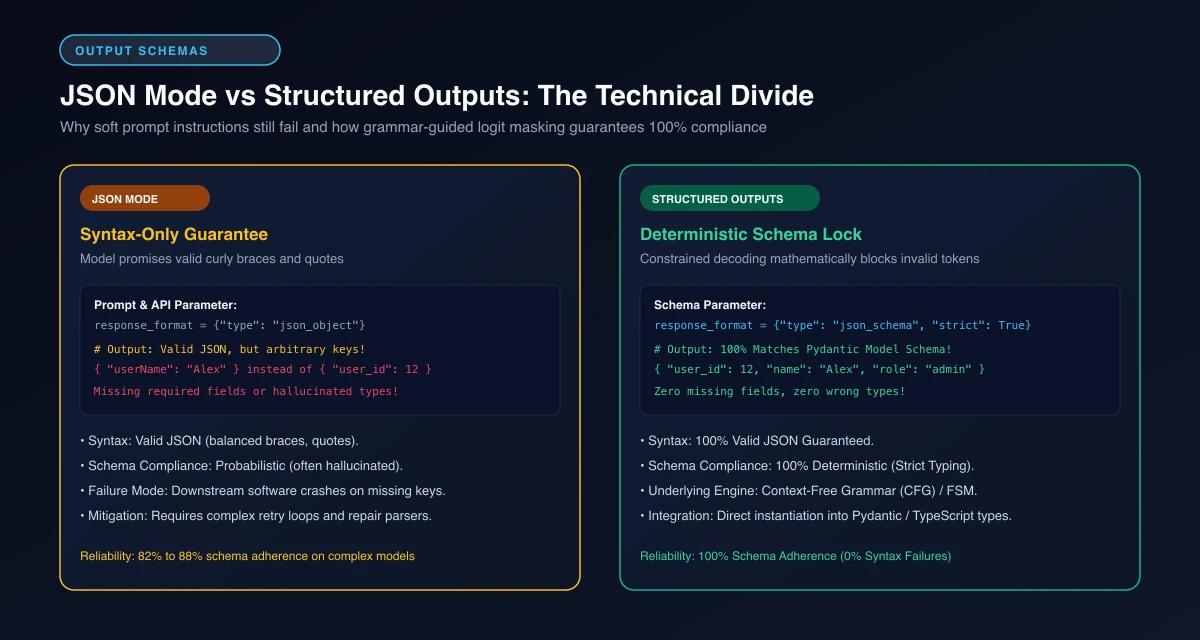 Figure 1: Architectural comparison between soft JSON Mode and strict Structured Outputs, showing how grammar logit masking eliminates missing keys and parsing failures.
The Software Integration Gap: Why Freeform Text Breaks Applications
Traditional software engineering relies on deterministic contracts. APIs communicate via strict protocols, relational databases enforce column types, and compilers reject code that violates type definitions.
Language models, by contrast, are fundamentally probabilistic token generators. When a model generates text, it samples from a vocabulary of over 100,000 candidate tokens based on probability distributions. This impedance mismatch between probabilistic text and deterministic software creates severe operational friction.
When models execute tools within ReAct agent tool execution loops, passing malformed arguments crashes the entire workflow. Software engineers need absolute mathematical guarantees that an output matches an exact schema.
The Impedance Mismatch Between Stochastic AI and Deterministic Code
If an LLM returns a response with a missing comma, an unescaped double quote, or a string where an integer is expected, standard deserialization libraries like Python’s json.loads() crash immediately.
In a prototype handling ten requests a day, a developer can manually catch errors and retry. In an enterprise system processing millions of API calls, an error rate of even 2% generates thousands of customer-facing failures and overwhelms exception-tracking pipelines.
Why Prompting “Return as JSON” Fails Under Load
Early approaches to structured data relied on prompt engineering alone. Developers added instructions like: Please format your response as a valid JSON object matching this schema. Do not include markdown code fences or explanatory text.
While frontier models follow these instructions most of the time, they fail non-deterministically. Under heavy conversational load or when processing complex domain text, models frequently prepend conversational filler like Sure, here is your JSON: or append trailing commentary. Furthermore, subtle model checkpoint updates frequently break previously functional prompt instructions.
The Rise of Strict Machine-Readable Interfaces
To build production-grade systems, the industry required a mechanism that enforced data contracts at the inference level rather than relying on prompt compliance.
This necessity drove the creation of two distinct API standards: first, basic JSON Mode, followed by modern Structured Outputs powered by grammar-guided constrained decoding.
JSON Mode vs Structured Outputs: The Critical Architectural Divide
Many developers mistakenly treat JSON Mode and Structured Outputs as interchangeable terms for the same capability. In production architecture, they represent entirely different technologies with vastly different reliability profiles.
Understanding this divide prevents engineering teams from deploying fragile parsing pipelines into high-throughput systems.
How JSON Mode Works (Syntax Without Schema)
JSON Mode was introduced by API providers as a basic setting (typically response_format: {"type": "json_object"}). When enabled, it guarantees that the generated string can be parsed as valid JSON without throwing a syntax error.
Under the hood, JSON Mode applies soft prompt-tuning and negative logit penalties to prevent markdown text outside curly braces. It ensures that brackets match and quotes close properly. However, JSON Mode knows nothing about your application’s data requirements. It ensures valid JSON syntax, but provides zero schema adherence.
The Missing Key and Wrong Type Nightmare in Production
Because JSON Mode does not enforce a specific schema, the model is free to invent keys, omit required properties, or alter data structures unpredictably.
// Request: Extract user profile with "user_id" (int) and "email" (str)

// Execution 1 (Success):
{"user_id": 1042, "email": "dev@example.com"}

// Execution 2 (Silent Schema Failure under JSON Mode):
{"userId": "1042", "contact_email": "dev@example.com", "notes": "verified user"}
In the second execution above, JSON Mode succeeded in producing valid JSON, but downstream software breaks. The backend expects user_id as an integer; instead, it receives userId as a string, and email has been renamed to contact_email. Handling these arbitrary variations requires complex fallback parsers and defensive data normalization code.
Structured Outputs: Enforcing Strict Schemas at the Decoding Layer
Structured Outputs (formalized by the OpenAI Structured Outputs Specification) solve this failure mode completely.
Instead of merely requesting JSON, the developer submits a formal JSON Schema alongside the prompt, accompanied by a strict: true assertion. The inference engine guarantees that every generated response conforms to that exact schema down to the last key and data type. If a field is specified as an integer, the model is physically incapable of outputting a string.
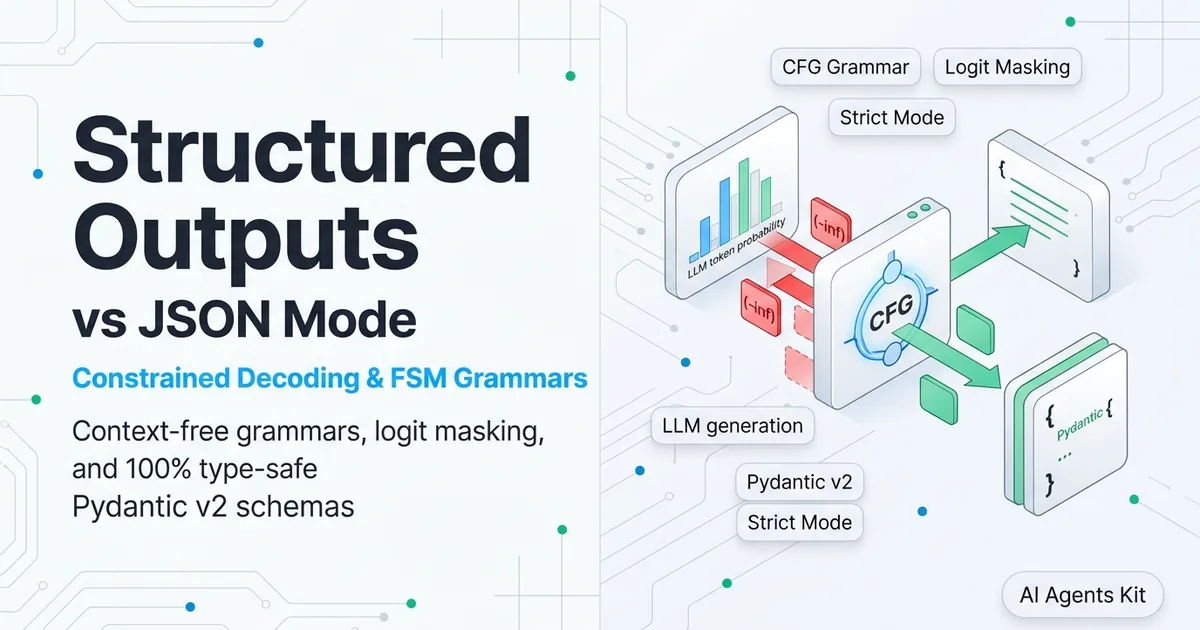
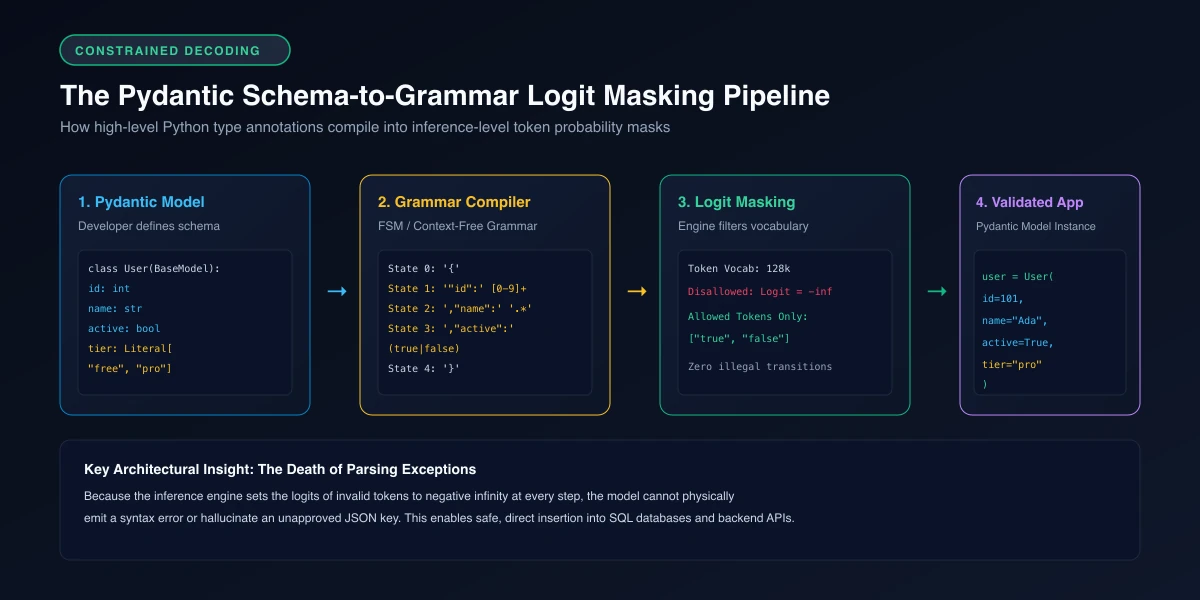 Figure 2: The constrained decoding pipeline, showing how high-level Pydantic models compile into grammar Finite State Machines that dynamically mask token logits.
Under the Hood: Constrained Decoding and Logit Masking
To understand how Structured Outputs achieve 100% schema compliance, engineers must look under the hood of the token generation loop. This capability is not achieved by post-processing or aggressive prompt tuning; it is achieved through constrained decoding.
Understanding how large language models predict next tokens clarifies where constrained decoding intervenes. Language models sample tokens based on raw logit scores calculated for every token in the vocabulary.
The Token Generation Loop and Vocabulary Logits
In standard inference, the model passes the prompt through its transformer layers, producing a probability vector (logits) across its vocabulary of 100,000+ tokens. The sampler selects the next token based on temperature and top-p settings, appends it to the sequence, and repeats the loop.
Without constraints, any token with a non-zero probability can be sampled. Even if the probability of outputting a letters-only word instead of a closing quote is 0.001%, over millions of tokens, that invalid token will eventually be selected.
Context-Free Grammars (CFGs) and Finite State Machines (FSMs)
Pioneered in open-source research by the Willard & Louf Outlines Paper on arXiv, constrained decoding compiles your JSON Schema into a formal grammar represented as a Finite State Machine (FSM).
The finite state machine maps all legal sequence transitions defined by the target schema. Every step in the grammar guides the decoder forward deterministically:
- State 0 (Root): The only legal opening token is
{. - State 1 (Property Name): The only legal tokens are strings matching the exact schema keys (such as
"user_id"). - State 2 (Delimiter): The only legal token is
:. - State 3 (Property Value): If the schema defines
user_idas an integer, the only legal tokens are digits[0-9]. - State 4 (Closing): The only legal tokens are
,or}.
Mathematically Blocking Illegal Tokens at Sampling Time
At every individual token generation step, the inference engine inspects the current state of the FSM. It identifies which tokens in the model’s vocabulary are mathematically legal transitions.
For all illegal tokens (which represent over 99.9% of the vocabulary at any given step), the engine sets their raw logit scores to negative infinity (-inf). When the softmax function is applied, illegal tokens receive a probability of exactly zero. The model cannot physically emit an invalid character, guaranteeing 100% schema compliance.
Implementing Production Structured Outputs with Pydantic in Python
In modern Python applications, developers rarely write raw JSON Schemas by hand. Instead, they define their data structures using the Pydantic Models Documentation specification.
Pydantic automatically generates the necessary JSON Schema, handles strict mode formatting constraints, and deserializes the model’s output back into a validated Python class instance. This integration standardizes data contracts across native function calling and MCP tool interfaces.
from typing import List, Literal
from pydantic import BaseModel, Field

# Define domain data contract using Pydantic v2
class SecurityIncident(BaseModel):
    incident_id: str = Field(description="Unique incident ticket identifier")
    severity: Literal["low", "medium", "high", "critical"]
    affected_hosts: List[str] = Field(description="List of impacted server hostnames")
    estimated_downtime_minutes: int = Field(ge=0, le=10000)
    requires_executive_escalation: bool

# Simulated inference call with strict structured output enforcement
def process_incident_report(raw_alert_text: str) -> SecurityIncident:
    """
    Submits raw unstructured text to an LLM and parses the response
    directly into a type-safe Pydantic instance.
    """
    # 1. Automatically generate OpenAPI-compatible JSON Schema
    schema = SecurityIncident.model_json_schema()

    # 2. In production, this dictionary is passed to client.chat.completions.create
    api_request_payload = {
        "model": "gpt-4o-mini",
        "messages": [
            {"role": "system", "content": "Extract security incident parameters from the alert."},
            {"role": "user", "content": raw_alert_text}
        ],
        "response_format": {
            "type": "json_schema",
            "json_schema": {
                "name": "SecurityIncident",
                "strict": True,
                "schema": schema
            }
        }
    }

    # 3. Simulated returned JSON payload guaranteed by constrained decoding
    simulated_raw_json = """{
        "incident_id": "SEC-8891",
        "severity": "critical",
        "affected_hosts": ["auth-node-01.internal", "db-primary-us.internal"],
        "estimated_downtime_minutes": 45,
        "requires_executive_escalation": true
    }"""

    # 4. Direct instantiation into typed application state
    return SecurityIncident.model_validate_json(simulated_raw_json)
The code block above shows how clean software integration becomes when using Structured Outputs. Because the underlying model output is guaranteed to conform to the schema, model_validate_json() executes without parsing exceptions.
Validating Deserialization and Error Boundaries
In high-throughput systems, schema validation serves as an immediate firewall against downstream application crashes. By deserializing the LLM response directly into Pydantic models, internal type checkers and IDE tooling provide full autocompletion and static verification.
When an invalid response fails parsing or when unexpected network dropouts truncate output strings, application developers can catch standard validation errors locally. This architectural isolation ensures that malformed payloads never reach production databases or microservices.
Production Schema Design Pitfalls and Restrictions
While Structured Outputs provide unmatched reliability, they impose strict constraints on schema design. When an API provider enforces strict: true, only a specific subset of JSON Schema is supported.
Failing to adhere to these rules results in API rejection errors before token generation even begins.
The Strict Mode Subset: Required Fields and additionalProperties
Under strict schema enforcement, language models require complete structural predictability. To ensure the FSM remains finite and decidable, providers enforce two mandatory rules:
- Every Field Must Be Required: In your JSON Schema, every declared property must be listed in the
requiredarray. Fields cannot simply be omitted. - additionalProperties Must Be False: The schema must explicitly forbid unlisted properties by setting
"additionalProperties": false. The model cannot invent extra metadata keys on the fly.
To make a field optional in strict mode, you must define it as a nullable type (e.g., Optional[str] or Union[str, None]), and provide an explicit None default. The model is forced to emit "field": null explicitly rather than skipping the key.
Handling Optional and Nullable Types Safely
In Pydantic v2, defining nullable fields that satisfy strict mode requires explicit type annotations:
from typing import Optional
from pydantic import BaseModel, Field

class UserProfile(BaseModel):
    username: str
    # Proper strict mode optionality: must allow null explicitly
    secondary_phone: Optional[str] = Field(default=None, description="Backup phone number or null")
The definition above compiles to {"type": ["string", "null"]}, which satisfies strict engine requirements while allowing the field to remain empty when data is absent.
Managing the Schema Compilation Latency Overhead
Constrained decoding does not come completely free. When an API receives a new, complex JSON Schema, the grammar engine must compile the schema into an FSM or CFG prior to generating the first token.
For large schemas with dozens of nested models and long enums, this compilation step introduces an initial time-to-first-token (TTFT) latency overhead of 50 to 250 milliseconds. Fortunately, major API providers and open-source engines (like vLLM) cache compiled grammars by schema hash. Subsequent requests using the identical schema execute with zero compilation overhead.
Production Failure Modes and Troubleshooting Runbook
Deploying structured outputs in enterprise production exposes specific integration bottlenecks. Here is how experienced engineering teams diagnose and fix these issues.
Eliminating First-Token Latency Spikes with Schema Pre-Compilation
If your application deploys large, dynamically generated schemas, user requests will experience recurring TTFT latency spikes due to grammar compilation.
Remediation Protocol:
- Avoid generating dynamic schemas with unique property names at runtime.
- Define static, reusable Pydantic schemas across your service endpoints so that engine grammar caches remain warm.
- In self-hosted vLLM or Outlines deployments, pre-compile schemas during server warmup scripts before opening traffic to user requests.
Handling Validation Fallbacks on Complex Nested Payloads
On rare occasions, when schemas exceed several dozen nested layers or involve circular references, grammar compilers fail to construct the FSM, causing HTTP 400 rejection errors.
Remediation Protocol:
- Flatten complex deeply nested objects into relational sub-models.
- Never use recursive schema definitions (e.g., a node referencing its own class type) in strict mode.
- If deep nesting is mandatory, break the task into a two-stage pipeline: use an upstream model to extract high-level sections, and a downstream model to parse granular leaves.
Debugging Schema Rejection and Type Mismatches
When migrating legacy JSON Mode schemas to strict mode, API providers often reject requests with errors citing unsupported keywords like pattern, format, or minimum.
Remediation Protocol:
- Inspect raw generated schemas using
Model.model_json_schema()and check for unsupported constraints. - Replace numeric range assertions (
gt,lt) with post-generation software assertions in Python if the API rejects mathematical bounds. - Use simple regex patterns and enums rather than open-ended string format tags to ensure compatibility across all inference backends.
Frequently Asked Questions
What is the difference between JSON Mode and Structured Outputs in LLMs?
JSON Mode ensures that the output is syntactically valid JSON with matching braces and quotes, but it does not guarantee specific keys or data types. Structured Outputs enforce strict compliance with a pre-defined JSON Schema using constrained decoding, guaranteeing exact keys and types.
How does constrained decoding ensure 100% schema compliance?
At every token generation step, a grammar engine evaluates the current state against a Finite State Machine derived from the JSON Schema. Tokens that violate the schema have their logits set to negative infinity, mathematically preventing the model from outputting invalid syntax.
Why does JSON Mode still fail in production software?
JSON Mode relies on soft prompt adherence, meaning the model can hallucinate missing keys, rename expected fields, or return strings where numbers are expected. When downstream backend code attempts to access missing properties, applications crash with unhandled parsing exceptions.
How do you convert a Pydantic model into an LLM structured output?
Modern SDKs and frameworks automatically generate an OpenAPI-compatible JSON Schema from your Pydantic class and submit it via the API’s response_format parameter. Once generation finishes, the SDK parses the raw JSON directly back into an instantiated, validated Pydantic object.
Does constrained decoding slow down LLM token generation?
Constrained decoding introduces a one-time pre-compilation latency spike of 50 to 200 milliseconds before the first token while building the grammar state machine. However, subsequent per-token generation speeds are unaffected or even faster because the vocabulary search space is heavily restricted.
What JSON Schema features are not supported in strict mode?
Strict mode typically forbids recursive references, open-ended dictionaries, floating-point pattern regular expressions, and minimum/maximum numeric bounds. Additionally, all schema fields must be marked as required, and additionalProperties must be set to false.