Knowledge Distillation in AI Explained: How Giant Frontier Models Teach Fast Small Models
Explore knowledge distillation in AI. Learn how massive teacher models transfer dark knowledge and reasoning traces to fast, compact student models.
Deploying frontier artificial intelligence models in production environments introduces immediate latency and cost bottlenecks. Running a 405B or 671B parameter system requires multiple high-bandwidth GPU nodes, consuming hundreds of watts and generating substantial inference bills. If you build on a fundamental large language model architecture, compressing these capabilities into compact, single-GPU footprints is essential for sustainable operations.
This operational reality drives knowledge distillation. Instead of forcing small models to learn everything from raw web text, engineers use massive teacher models to guide compact student models.
Understanding knowledge distillation llm explained requires analyzing two distinct methodologies: classical white-box logit matching and modern black-box sequence distillation.
Key Takeaways:
- Knowledge distillation transfers the capabilities, reasoning patterns, and representations of a massive teacher model into a compact, high-throughput student network.
- White-box logit distillation uses temperature scaling to expose soft probability distributions, capturing rich dark knowledge and inter-token relationships that hard ground-truth labels hide.
- Sequence-level reasoning distillation trains smaller models on millions of verified synthetic reasoning chains generated by frontier teachers, enabling 7B and 14B models to match older 70B systems.
- Distillation fundamentally differs from quantization: quantization lowers weight bit-depth, while distillation creates an entirely new, architecturally lighter model.
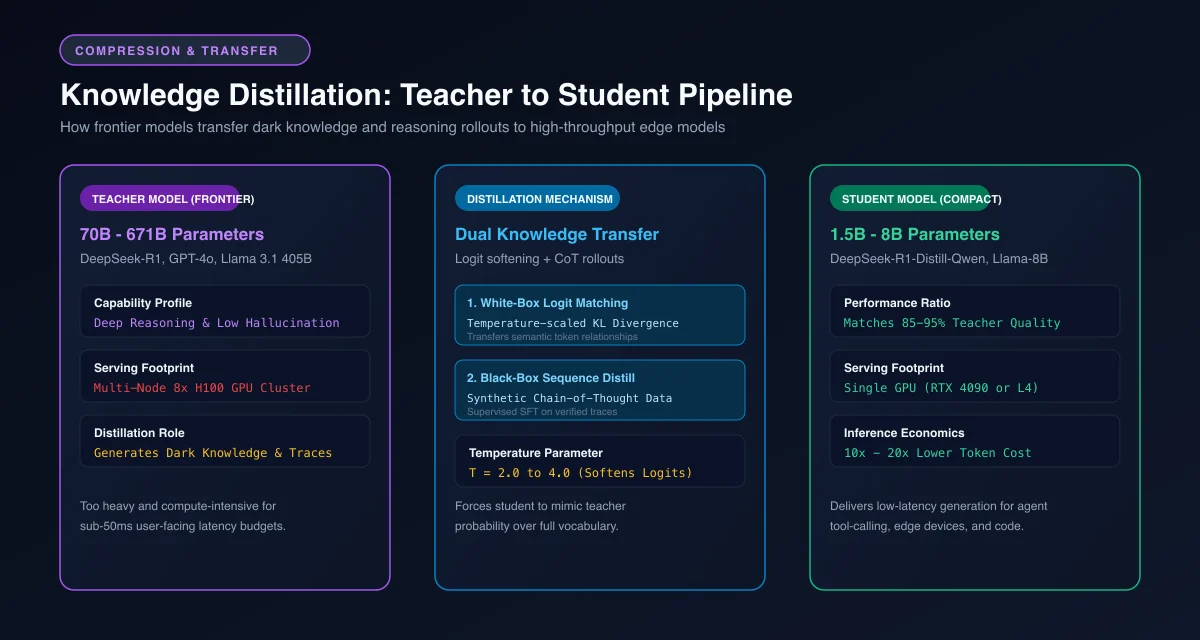 Figure 1: Knowledge distillation workflow transferring dark knowledge distributions and verified chain-of-thought traces from frontier models to compact edge models.
The Teacher-Student Paradigm: Why We Need Distillation
Training an 8B parameter model from scratch on raw internet text is notoriously sample-inefficient. Uncurated web dumps contain noisy syntax, ambiguous statements, and disorganized logic. The student model spends billions of tokens simply discovering basic grammar, syntax conventions, and separating factual truth from web spam.
A pretrained teacher model has already processed this noise during its supervised pretraining and alignment training stages. The teacher’s internal representations encode distilled representations of logic, common sense, and language structure.
By setting up a teacher-student framework, the student learns directly from the teacher’s clean predictive outputs. This allows small models to reach high accuracy thresholds with an order of magnitude fewer training tokens than training from raw data alone. Furthermore, distillation provides a powerful solution for on device local inference deployment, where resource-constrained hardware like phones and laptops cannot fit full-sized frontier models.
White-Box Logit Distillation: Soft Targets and Dark Knowledge
The mathematical foundation of knowledge distillation was formulated by Geoffrey Hinton and researchers in their foundational distillation paper. Their core insight was that hard classification labels (such as one-hot vectors) discard vital information about how the model views the world.
The Concept of Dark Knowledge
Consider a language model predicting the next token following: “The capital of France is”.
- Hard Label (Ground Truth):
Paris = 1.0, all other vocabulary tokens =0.0. - Teacher Soft Probabilities:
Paris = 0.88,Lyon = 0.05,Marseille = 0.03,London = 0.01,Banana = 0.0000001.
The non-target probabilities are not random noise. They reflect semantic relationships. The teacher indicates that while Lyon is technically incorrect, it is vastly more plausible than Banana because Lyon is a French city.
Hinton termed this nuanced probability distribution dark knowledge. By training the student to mimic the teacher’s relative distribution across non-target tokens, the student absorbs the teacher’s internal semantic hierarchy.
Temperature Scaling and the Distillation Loss Formula
In standard softmax calculations, the winning token probability dominates, forcing non-target probabilities near zero. To reveal dark knowledge, distillation introduces a temperature parameter $\tau > 1$:
$$q_i = \frac{\exp(z_i / \tau)}{\sum_j \exp(z_j / \tau)}$$
At standard temperature ($T = 1.0$), the output probability collapses almost entirely onto the winning token ($P(\text{Paris}) = 0.98$), squashing secondary predictions near zero. When the temperature is elevated to $T = 4.0$, the distribution softens ($P(\text{Paris}) = 0.55, P(\text{Lyon}) = 0.22, P(\text{London}) = 0.12$), exposing the latent semantic relationships that form the foundation of student learning.
The overall loss function combines the Kullback-Leibler (KL) divergence between teacher and student soft distributions with standard ground-truth cross-entropy:
$$\mathcal{L}{\text{total}} = \alpha \mathcal{L}{\text{CE}}(y, \sigma(z_s)) + (1 - \alpha) \tau^2 \mathcal{D}_{\text{KL}}(\sigma(z_t / \tau) \parallel \sigma(z_s / \tau))$$
The $\tau^2$ scaling factor is mathematically required because the gradients produced by softened logits scale inversely with $\tau^2$, ensuring gradient balance between the two loss terms.
The Modern Shift: Sequence-Level Reasoning Distillation
While logit distillation remains powerful for computer vision and small language models, it encounters significant friction with modern frontier LLMs. White-box distillation requires simultaneous GPU access to both teacher and student architectures, and demands that both models share an identical token vocabulary.
To bypass these constraints, modern AI engineering relies on sequence-level knowledge distillation, first formalized by Alexander Rush and team on sequence-level distillation.
Distilling Reasoning Traces: The DeepSeek-R1 Recipe
Instead of transferring token probabilities at every single forward step, sequence-level distillation uses the teacher to generate complete, high-quality reasoning traces.
In the DeepSeek-R1 distillation technical report, researchers demonstrated that distilling verified reasoning paths from a 671B model into small, open-source base models produces dramatic performance leaps. Compact models like DeepSeek-R1-Distill-Qwen-7B and Llama-3.3-8B-Instruct achieve benchmark scores that outpace previous generation 70B models on competitive programming and mathematics.
The sequence distillation pipeline operates across four synchronized phases:
- Diverse Frontier Sampling: The frontier 671B teacher generates diverse step-by-step reasoning trajectories across complex math and coding prompts.
- Automated Verification: Deterministic unit tests and symbolic math parsers execute each trajectory, immediately discarding erroneous or hallucinatory completions.
- Synthetic Corpus Assembly: Over 800,000 verified long-context reasoning rollouts are formatted into supervised fine-tuning records.
- Student SFT with Loss Masking: The compact 7B or 14B student trains on the verified traces using response loss masking, internalizing reflection tags and error-recovery behaviors.
By filtering synthetic outputs through automated verification environments, researchers eliminate teacher hallucinations before they reach the student. The compact model internalizes reflection tags (<think> ... </think>), structured error analysis, and backtracking behaviors natively. This allows software engineers to run frontier chain-of-thought reasoning architectures directly on commodity workstations.
Implementing Knowledge Distillation Loss in PyTorch
Building a custom logit distillation training loop in PyTorch requires calculating KL divergence over temperature-softened probability distributions while balancing standard cross-entropy on ground-truth tokens. Production training pipelines in Hugging Face TRL and PyTorch TorchDistill structure this objective using a dual-component loss module.
The first component computes Kullback-Leibler divergence between the teacher’s soft probability vector and the student’s predictions, scaled by the temperature hyperparameter $\tau$. The second component calculates cross-entropy loss against ground-truth tokens to anchor factual precision. A weighting parameter $\alpha$ dynamically balances soft dark knowledge against exact label matching, preventing gradient instability during early training steps.
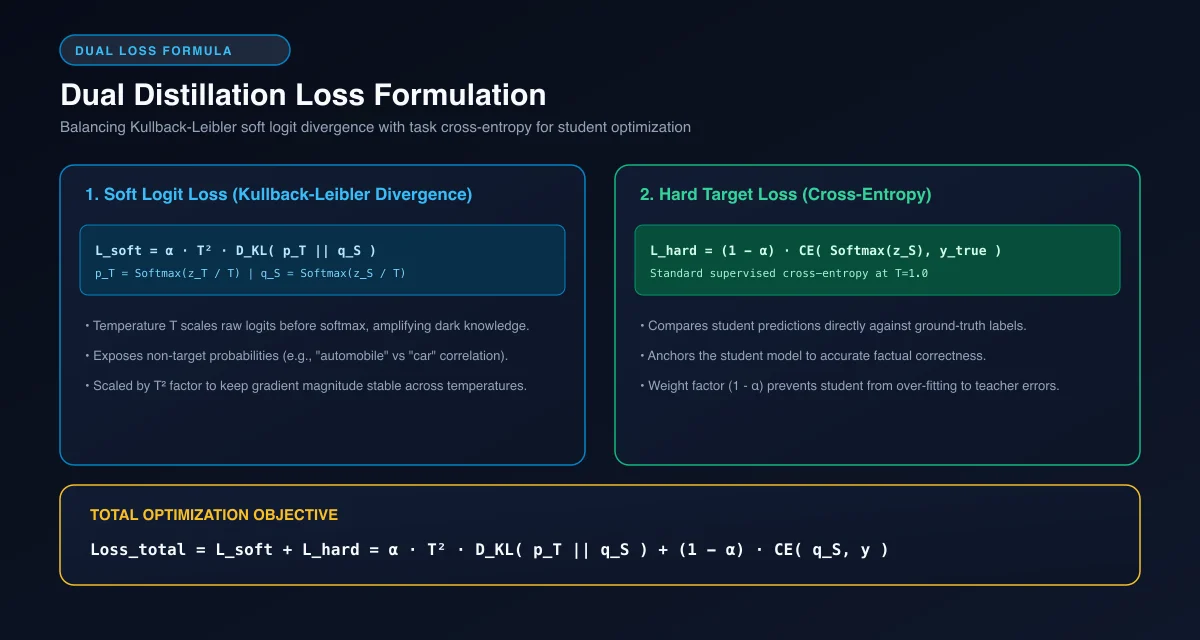 Figure 2: Dual distillation loss mechanics balancing soft Kullback-Leibler logit divergence with ground-truth task cross-entropy for student optimization.
import torch
import torch.nn as nn
import torch.nn.functional as F

class KnowledgeDistillationLoss(nn.Module):
    def __init__(self, temperature=3.0, alpha=0.5):
        super().__init__()
        self.temperature = temperature
        self.alpha = alpha
        self.kl_div = nn.KLDivLoss(reduction="batchmean")
        self.cross_entropy = nn.CrossEntropyLoss(ignore_index=-100)

    def forward(self, student_logits, teacher_logits, targets):
        """
        Calculates combined soft-target and hard-target distillation loss.
        student_logits: [batch_size, seq_len, vocab_size]
        teacher_logits: [batch_size, seq_len, vocab_size]
        targets: [batch_size, seq_len]
        """
        temp = self.temperature

        # 1. Soft-target loss: KL divergence between softened distributions
        soft_student = F.log_softmax(student_logits / temp, dim=-1)
        soft_teacher = F.softmax(teacher_logits / temp, dim=-1)

        # Multiply by temp^2 to maintain gradient scale
        loss_soft = self.kl_div(soft_student, soft_teacher) * (temp ** 2)

        # 2. Hard-target loss: Standard cross-entropy with ground truth
        shift_logits = student_logits[..., :-1, :].contiguous()
        shift_targets = targets[..., 1:].contiguous()
        loss_hard = self.cross_entropy(
            shift_logits.view(-1, shift_logits.size(-1)),
            shift_targets.view(-1)
        )

        # 3. Weighted combination
        return self.alpha * loss_hard + (1.0 - self.alpha) * loss_soft
This loss formulation allows the student to optimize between empirical ground truth accuracy and the teacher’s nuanced semantic representations. When applied across thousands of training batches, the student network gradually mirrors the teacher’s decision boundaries without ever loading the teacher’s internal hidden states.
Engineering Comparison: Distillation vs Quantization vs Fine-Tuning
Engineering teams frequently evaluate distillation vs quantization vs pruning when optimizing production inference pipelines. Examining their trade-offs clarifies when each technique should be deployed:
| Dimension | Knowledge Distillation | Post-Training Quantization (e.g., AWQ/GGUF) | Parameter-Efficient Fine-Tuning (LoRA) |
|---|---|---|---|
| Architectural Change | Creates a new, smaller model | Preserves exact model architecture | Attaches low-rank adapter layers |
| Parameter Reduction | 70% to 90% parameter drop | 0% parameter drop (Bits per weight drop) | 0% base parameter drop (<1% added) |
| Inference Latency | 3x to 10x faster generation | 1.5x to 2.5x faster generation | Identical to base model |
| VRAM Consumption | Slashes VRAM by parameter ratio | Slashes VRAM by 50% to 75% | Minimal runtime impact |
| Compute Required | High (Requires complete SFT run) | Low (Calibration run on small dataset) | Low (Few GPU hours) |
| Speculative Decoding | Generates fast draft models | Not applicable | Not applicable |
| Hardware Target | Edge devices, mobile, low-tier GPUs | Production server GPUs | Commodity workstations |
For teams already running existing foundation models, combining low-rank adapter fine-tuning alternatives with distilled base models yields the highest customization agility at minimal infrastructure expense.
Speculative Decoding: The Ultimate Production Synergy
One of the most valuable production applications of knowledge distillation is creating draft models for speculative decoding. High-throughput inference systems like vLLM use this technique to dramatically accelerate generation speeds without altering output text.
Speculative decoding pairs a compact distilled student model (such as a 1B parameter network) with a large target model (such as a 70B parameter network). Because the student was distilled directly on the target’s output distribution, its generated tokens align closely with the target’s probabilities.
The speculative decoding pipeline operates through three distinct steps:
- Rapid Draft Generation: The distilled 1B student generates a sequence of $K$ candidate tokens (e.g., $K = 4$) at high throughput with low memory bandwidth overhead.
- Parallel Target Evaluation: The massive 70B target model processes all $K$ proposed tokens simultaneously in a single forward pass, verifying their joint probabilities.
- Prefix Acceptance: The runtime accepts tokens up to the first divergence point and samples a replacement token, delivering 2x to 3.5x wall-clock speedups without output deviation.
The small draft model rapidly predicts four candidate tokens in serial. The large target model then evaluates all four tokens concurrently in a single parallel forward pass. When tokens are accepted, generation speed increases by 2x to 3.5x without any degradation in output quality or mathematical accuracy.
Production Failure Modes and Troubleshooting Runbook
Deploying knowledge distillation pipelines introduces subtle architectural failure modes. Here is how senior practitioners diagnose and resolve common production regressions.
1. Teacher Hallucination Amplification
If the teacher model produces subtle factual errors or hallucinations during sequence generation, the student internalizes those falsehoods as ground-truth facts. Small models lack the broad pretraining context required to correct or reject faulty teacher traces.
Troubleshooting Protocol:
- Implement automated rejection filters using external rule engines, unit tests, and consensus checks across multiple teacher models.
- Score synthetic completions using secondary reward verifiers; discard any generation with a quality rating below
0.85. - Mix 15% to 25% verified human-authored instruction datasets into the synthetic distillation corpus.
2. Teacher-Student Vocabulary Mismatch
In white-box logit distillation, calculating KL divergence requires identical vocabulary dimensions across teacher and student networks. If the teacher uses an OpenAI 100k tokenizer and the student uses a Llama 32k tokenizer, direct logit matching crashes due to matrix shape divergence.
Troubleshooting Protocol:
- If tokenizers diverge, switch immediately to sequence-level distillation, treating the teacher as an autoregressive text generator.
- For white-box setups, initialize the student embedding matrix by down-projecting the teacher’s exact vocabulary representations.
- Review our architectural guide on tokenization vocabulary alignment across models to resolve cross-tokenizer mappings.
3. Student Model Catastrophic Forgetting During Distillation
When distilling narrow domain knowledge into a compact student network, student model catastrophic forgetting during distillation frequently degrades general instruction-following and common-sense reasoning.
Troubleshooting Protocol:
- Blend general reasoning datasets like GSM8K and HumanEval into the domain distillation corpus at a 30% ratio.
- Keep learning rates strictly within the $1 \times 10^{-5}$ to $5 \times 10^{-6}$ range using AdamW with cosine decay.
- Apply parameter-efficient adapters like LoRA to freeze core student weights during distillation.
4. Degraded Long Context Retrieval in Distilled Models
Distilled models often experience degraded long context retrieval in distilled models when synthetic training sequences only feature short instruction turns (under 2,048 tokens).
Troubleshooting Protocol:
- Include synthetic multi-document reasoning traces that span 8,192 to 16,384 tokens in the distillation mix.
- Apply YaRN or RoPE theta frequency scaling during student training to maintain long-context positional attention.
- Evaluate needle-in-a-haystack retrieval benchmarks regularly throughout the distillation schedule.
Frequently Asked Questions
What is knowledge distillation in AI?
Knowledge distillation is a compression technique where a compact student neural network is trained to reproduce the behavior, reasoning, and semantic representations of a larger teacher network, achieving comparable accuracy with reduced inference latency.
How does a small model learn from a large model?
In white-box distillation, the student minimizes the difference between its probability distributions and the teacher’s softened output logits. In sequence-level distillation, the student trains on high-quality synthetic text and verified reasoning trajectories generated by the teacher.
What is dark knowledge in neural networks?
Dark knowledge refers to the rich semantic information hidden within non-winning token probabilities. For example, assigning a minor probability to a related word reveals structural relationships that one-hot ground-truth labels completely discard.
Why do modern distilled 7B models outperform older 70B models?
Modern distilled models train on verified chain-of-thought traces, high-density synthetic reasoning datasets, and clean token distributions produced by frontier models. This curriculum focuses training capacity exclusively on high-value cognitive patterns rather than web crawl noise.
What is the difference between distillation and quantization?
Quantization reduces the numerical bit-depth of an existing model’s parameters (such as converting 16-bit floats to 4-bit integers) without changing the network structure. Distillation trains an entirely new, smaller neural network with fewer total layers and parameters.
Can knowledge distillation run across models with different tokenizers?
White-box logit distillation requires matching vocabularies to compute cross-entropy over matching logit indices. However, sequence-level synthetic distillation functions across completely different tokenizers because the student trains on generated text strings rather than raw logit arrays.
How does temperature scaling work in distillation?
Temperature scaling divides raw logits by a constant factor $\tau$ before computing the softmax function. This softens the probability distribution, preventing the top token from dominating and exposing the subtle probability hierarchy of alternative tokens.