LoRA vs QLoRA vs Full Fine-Tuning Explained Visually: How Low-Rank Adapters Work
Compare LoRA, QLoRA, and full fine-tuning. Discover how low-rank matrix decomposition and 4-bit NormalFloat quantization slash GPU VRAM by over 65%.
Adapting large language models to specific enterprise tasks presents an immediate computational barrier. When you examine core large language model architectures, a foundational 8B or 70B parameter model represents gigabytes of frozen parameters. Updating every weight during task adaptation requires massive hardware infrastructure that remains out of reach for most engineering teams.
This challenge sparked the development of parameter-efficient fine-tuning (PEFT). Instead of retraining billions of parameters, modern machine learning relies on surgical modifications through low-rank adapters.
Understanding lora vs qlora vs full fine tuning requires analyzing how weight updates travel through linear layers, how memory is divided between weights and optimizer states, and how quantization preserves numeric precision.
Key Takeaways:
- Full fine-tuning updates every parameter in the model, delivering maximum domain adaptation capacity but requiring massive GPU clusters due to 16-bit AdamW optimizer states.
- Low-Rank Adaptation (LoRA) freezes the original base weights and injects small trainable rank-decomposition matrices, slashing trainable parameters by over 99% while matching full fine-tuning accuracy.
- QLoRA compresses the frozen base model into 4-bit NormalFloat (NF4) while computing gradients through 16-bit adapters, reducing active VRAM by over 65%.
- LoRA adapters can be merged directly into base weights for zero additional inference latency, or hot-swapped dynamically at runtime across multi-tenant deployments.
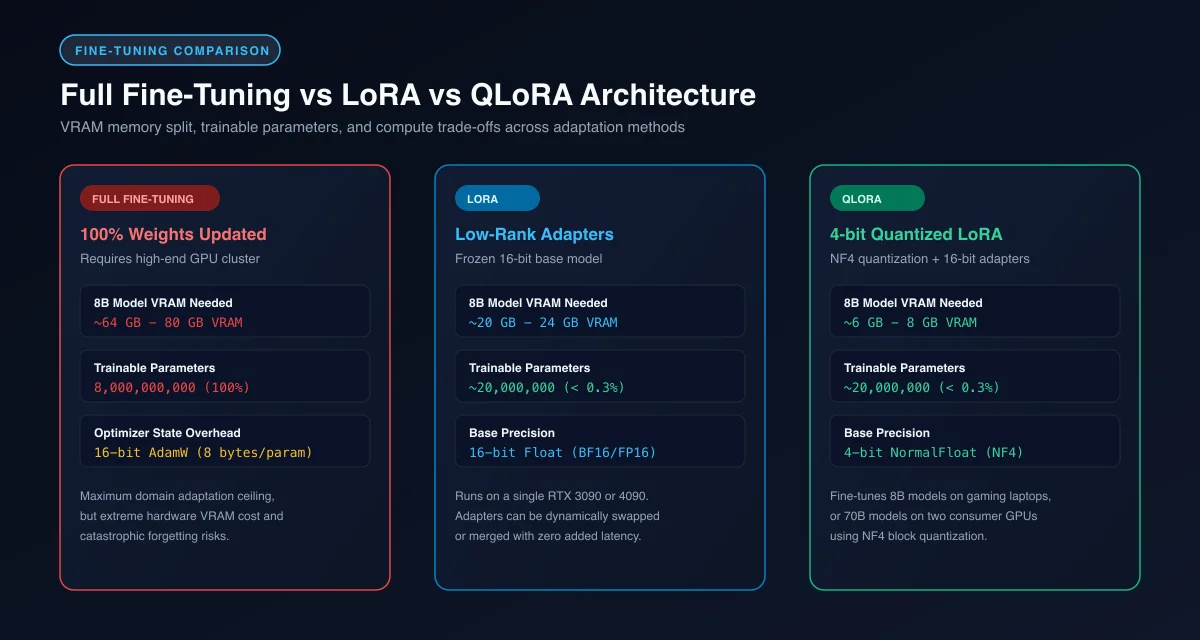 Figure 1: Architectural comparison of Full Fine-Tuning, LoRA, and QLoRA showing VRAM allocations and trainable parameter ratios.
The Fine-Tuning Spectrum: From Full Weights to Adapters
The choice between full fine-tuning, LoRA, and QLoRA represents a fundamental engineering trade-off between task adaptability, hardware expenditure, and operational agility. Not every domain adaptation scenario requires updating billions of neural network parameters, especially when adapting models for structured document extraction, conversational style, or specific API tool integration.
In the early days of generative AI, fine-tuning meant taking an entire base model checkpoint and running standard backpropagation across all layers. This matched the supervised fine-tuning stage of model development used by frontier labs to transition base models into instruction-following chat assistants.
However, full fine-tuning introduces two severe drawbacks: extreme VRAM requirements and catastrophic forgetting. Because every weight matrix drifts during gradient updates, the model easily overwrites its broad pretraining reasoning. Parameter-efficient adapters solve both issues by anchoring updates within tightly bounded subspaces, ensuring core capabilities remain intact while specializing on targeted workflows.
Full Fine-Tuning: The Maximum-Capacity Baseline
Full fine-tuning updates every parameter in the neural network ($W_{\text{new}} = W_0 + \Delta W$). Because all weights are active, the model possesses maximum capacity to absorb new domain representations.
The True Culprit: AdamW Optimizer States
Many developers assume that GPU memory is consumed primarily by model parameters. For an 8B parameter model stored in 16-bit precision (bfloat16), the weights occupy roughly 16GB of VRAM:
$$\text{Weight VRAM} = 8 \times 10^9 \text{ parameters} \times 2 \text{ bytes} \approx 16\text{ GB}$$
However, calculating backward gradients using the standard AdamW optimizer multiplies this requirement dramatically:
- Model Weights (FP16/BF16): 2 bytes per parameter (16GB).
- Gradients (FP16/BF16): 2 bytes per parameter (16GB).
- Optimizer Momentum ($m_t$ in FP32): 4 bytes per parameter (32GB).
- Optimizer Variance ($v_t$ in FP32): 4 bytes per parameter (32GB).
- Master Parameter Copy (FP32): 4 bytes per parameter (32GB).
In total, optimizer states and gradients demand between 16 and 20 bytes of memory per parameter. An 8B parameter model requires 80GB to 120GB of dedicated VRAM once activation buffers are accounted for, necessitating multiple enterprise GPUs simply to begin training.
Furthermore, deploying ten differently fine-tuned models requires hosting ten independent 16GB checkpoints in memory, multiplying infrastructure costs.
Low-Rank Adaptation: The Mathematical Foundation
To overcome this memory bottleneck, the seminal LoRA research paper by Edward Hu and team demonstrated a foundational insight: weight updates during adaptation possess a low intrinsic dimension.
Although a transformer projection matrix $W_0$ operates in high dimensions (such as $4,096 \times 4,096$), the change in weights $\Delta W$ necessary to learn a specialized task resides in a much smaller subspace.
The Matrix Factorization Trick
Instead of updating the full dense matrix $\Delta W \in \mathbb{R}^{d \times k}$, LoRA decomposes the update into the product of two low-rank matrices $B$ and $A$:
$$\Delta W = B \times A$$
Where $B \in \mathbb{R}^{d \times r}$ and $A \in \mathbb{R}^{r \times k}$, and the rank $r$ is an integer chosen such that $r \ll \min(d, k)$.
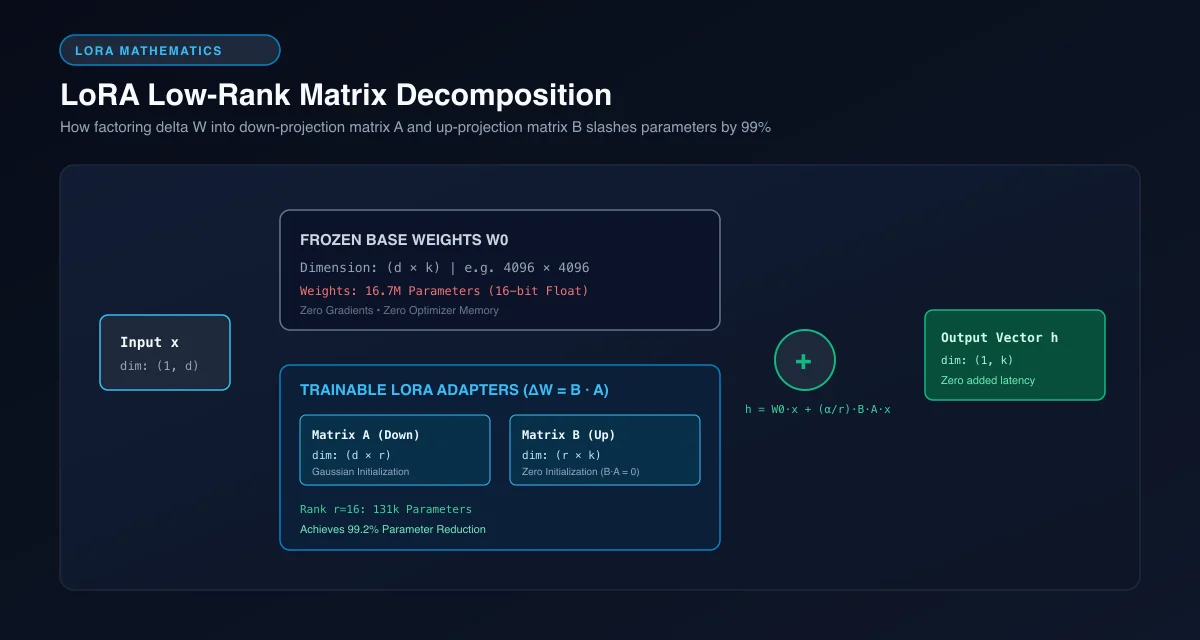 Figure 2: Mathematical breakdown of LoRA matrix decomposition, bypassing frozen base weights W0 with rank r matrices A and B.
During forward inference, the input vector $x$ passes through both the frozen base weights and the parallel adapter matrices:
$$h = W_0 x + \Delta W x = W_0 x + \frac{\alpha}{r} (B A x)$$
Here, $\alpha$ is a constant scaling hyperparameter. Matrix $A$ is typically initialized using a random Gaussian distribution, while matrix $B$ is initialized to all zeros. This ensures that $\Delta W = 0$ at the start of training, preserving original model behavior before the first gradient step.
Because $W_0$ is completely frozen, optimizer states are only tracked for matrices $A$ and $B$. This reduces the trainable parameter count by over 99%, dropping VRAM requirements for an 8B model from 80GB down to under 20GB.
QLoRA: Democratizing Fine-Tuning with 4-Bit NormalFloat
While LoRA made fine-tuning accessible, training a 70B parameter model still required hosting 140GB of 16-bit base weights across multiple GPUs.
The QLoRA paper by Tim Dettmers and researchers introduced three key innovations that allowed fine-tuning a 70B model on a single 48GB GPU without quality loss:
1. 4-Bit NormalFloat (NF4)
Standard integer quantization (such as INT4) spaces quantization bins uniformly across a numeric scale. However, neural network weights follow a normal (Gaussian) distribution centered at zero.
NormalFloat4 constructs information-theoretically optimal quantile bins where each bin has an equal probability of containing weights. This eliminates quantization error across dense weight clusters without requiring extra parameters.
2. Double Quantization (DQ)
Quantization requires storing scaling constants (quantization constants) to map 4-bit values back to floating-point numbers. In standard quantization, these constants consume significant memory.
Double Quantization applies an 8-bit quantization pass to the 32-bit quantization constants themselves. This reduces the memory footprint of constants from 0.5 bits per parameter down to 0.127 bits per parameter, saving roughly 3GB of VRAM on a 65B model.
3. Paged Optimizers
During long sequence training, activation peaks cause momentary VRAM spikes that trigger CUDA Out-of-Memory (OOM) crashes. QLoRA leverages NVIDIA unified memory to page optimizer states dynamically between GPU VRAM and CPU RAM during backward pass allocations.
The QLoRA execution pipeline operates through four synchronized steps:
- Compressed Weight Storage: The base transformer parameters reside in VRAM quantized to 4-bit NormalFloat (NF4).
- On-the-Fly Dequantization: As an input activation batch enters a linear layer, the required 4-bit weight block is temporarily dequantized to 16-bit bfloat16.
- Parallel Adapter Computation: Input activations pass concurrently through the 16-bit trainable LoRA adapters $A$ and $B$.
- Fused Summation: The base model output and scaled adapter output are summed ($h = W_0 x + \frac{\alpha}{r} B A x$), after which the temporary dequantized base weights are immediately released from cache.
Implementing QLoRA with Hugging Face PEFT and BitsAndBytes
Setting up QLoRA in modern environments takes only a few lines of configuration using the Hugging Face PEFT documentation and bitsandbytes. The workflow requires orchestrating three sequential steps: defining quantization parameters, freezing the base weights in 4-bit memory, and attaching low-rank trainable adapters to all linear projection layers.
When configuring BitsAndBytesConfig, setting bnb_4bit_compute_dtype=torch.bfloat16 ensures that while weights are stored in 4-bit NormalFloat, matrix additions and multiplications execute in 16-bit brain floating-point. This prevents numeric underflow during backpropagation while maintaining optimal hardware tensor core utilization. Calling prepare_model_for_kbit_training enables gradient checkpointing and casts normalization layer parameters to 32-bit floats for training stability.
import torch
from transformers import AutoModelForCausalLM, AutoTokenizer, BitsAndBytesConfig
from peft import LoraConfig, get_peft_model, prepare_model_for_kbit_training

# 1. Configure 4-bit NormalFloat quantization
bnb_config = BitsAndBytesConfig(
    load_in_4bit=True,
    bnb_4bit_quant_type="nf4",
    bnb_4bit_compute_dtype=torch.bfloat16,
    bnb_4bit_use_double_quant=True
)

# 2. Load frozen base model in 4-bit precision
model_id = "meta-llama/Llama-3.1-8B"
model = AutoModelForCausalLM.from_pretrained(
    model_id,
    quantization_config=bnb_config,
    device_map="auto"
)

# 3. Prepare model for k-bit training and gradient checkpointing
model = prepare_model_for_kbit_training(model)

# 4. Define LoRA adapter architecture
peft_config = LoraConfig(
    r=16,
    lora_alpha=32,
    target_modules=["q_proj", "k_proj", "v_proj", "o_proj", "gate_proj", "up_proj", "down_proj"],
    lora_dropout=0.05,
    bias="none",
    task_type="CAUSAL_LM"
)

# 5. Wrap base model with low-rank adapters
model = get_peft_model(model, peft_config)
model.print_trainable_parameters()
# Output: trainable params: 41,943,040 || all params: 8,072,204,288 || trainable%: 0.5196%
Developers can follow comprehensive tutorials such as our practical fine-tuning pipeline configurations to integrate this adapter architecture directly into active training loops. Notice that only 41 million parameters out of 8 billion require gradient calculation, keeping optimizer memory minimal.
Hardware Sizing and Memory Matrix: Full vs LoRA vs QLoRA
The following matrix compares required VRAM and infrastructure scale across model tiers during training:
| Architecture Tier | Full Fine-Tuning VRAM | 16-Bit LoRA VRAM | 4-Bit QLoRA (NF4) VRAM | Minimum Hardware Required (QLoRA) |
|---|---|---|---|---|
| 8B Parameter Model | ~75GB to 90GB | ~16GB to 20GB | ~8GB to 10GB | 1x Consumer GPU (RTX 4080 / 4090 16GB+) |
| 14B Parameter Model | ~140GB to 170GB | ~28GB to 36GB | ~14GB to 18GB | 1x Workstation GPU (RTX 4090 24GB or A5000) |
| 32B Parameter Model | ~320GB to 380GB | ~68GB to 80GB | ~24GB to 30GB | 1x A100 (40GB) or 2x RTX 4090 (24GB) |
| 70B Parameter Model | ~700GB to 850GB | ~150GB to 180GB | ~42GB to 48GB | 1x A100/H100 (80GB) or 2x RTX 4090 |
| Trainable Weight % | 100% | 0.2% to 1.5% | 0.2% to 1.5% | Not Applicable |
| Adapter Storage Size | 16GB (Full Checkpoint) | 50MB to 250MB | 50MB to 250MB | Not Applicable |
Production Use Cases: When to Choose Full, LoRA, or QLoRA
Choosing the correct method depends on your task scope, inference serving architecture, and available infrastructure:
Choose Full Fine-Tuning When:
- You are pretraining an existing model on a completely new language (such as adding Welsh or Sanskrit to a Western-focused LLM).
- You are altering foundational tokenizer representations or shifting model architectures.
- You have enterprise multi-node GPU clusters and require maximum parameter flexibility.
Choose Standard LoRA When:
- You require maximum training throughput speed (16-bit LoRA trains approximately 25% faster than QLoRA because it avoids on-the-fly dequantization).
- You are fine-tuning on high-end clusters (A100/H100) where fitting 16-bit base weights into VRAM is not a constraint.
- You plan to deploy multi-LoRA serving systems (like vLLM S-LoRA) that hot-swap adapter weights per user request.
Choose QLoRA When:
- You are training large models (14B, 32B, 70B) on budget infrastructure, single GPUs, or cloud rental instances.
- You want to experiment with multiple hyperparameter configurations simultaneously across commodity hardware.
- You are preparing specialized models for reinforcement learning and preference alignment workflows without needing enterprise datacenter allocations.
Production Failure Modes and Troubleshooting Runbook
Deploying parameter-efficient workflows in production introduces specific technical pitfalls. Here is how senior practitioners mitigate them:
1. LoRA Alpha Scaling Misconfiguration
A common bug involves altering the rank $r$ without understanding its relationship to $\alpha$. The effective learning rate multiplier applied to the adapter is $\frac{\alpha}{r}$.
If you increase rank $r$ from 16 to 64 while leaving $\alpha$ fixed at 32, the effective scaling drops from $2.0$ down to $0.5$. The model appears unresponsive to training and loss plateaus prematurely.
Troubleshooting Protocol:
- Maintain a fixed ratio between $\alpha$ and $r$ (the standard industry convention is $\alpha = 2 \times r$).
- When tuning rank, scale $\alpha$ proportionally, or set $\alpha = r$ and adjust the base AdamW learning rate explicitly.
2. Weight Merge Precision Drift in BFloat16
After fine-tuning, teams often merge adapter weights into base weights for zero-overhead inference:
$$W_{\text{final}} = W_0 + \frac{\alpha}{r} (B A)$$
When merging QLoRA adapters, base weights must first be dequantized from 4-bit NF4 to 16-bit bfloat16 before addition. Merging directly in 16-bit precision without careful rounding can introduce floating-point drift, degrading benchmark accuracy.
Troubleshooting Protocol:
- Dequantize base weights into 32-bit floating-point (
fp32) prior to merging. - Compute the matrix multiplication $B \times A$ in
fp32, apply scaling, and add to $W_0$. - Cast the merged weights back to
bfloat16only after addition is complete.
# Safe LoRA weight merging in FP32
def safe_merge_lora(model):
    """Safely merges PEFT adapters into base weights without precision loss."""
    model = model.merge_and_unload()
    return model
For teams looking to compress models even further for edge devices, pairing merged adapters with model compression and knowledge distillation pipelines creates lightweight, high-performance engines.
3. Target Module Under-Capacity
Early LoRA implementations only applied adapters to the attention query ($W_q$) and value ($W_v$) projection layers. While this worked for small classification tasks, complex reasoning and coding adaptation demand updating all linear projection layers, including the feed-forward networks (FFN: gate_proj, up_proj, down_proj).
Troubleshooting Protocol:
- Target all linear layers in the transformer block:
["q_proj", "k_proj", "v_proj", "o_proj", "gate_proj", "up_proj", "down_proj"]. - Expanding target modules to FFN layers yields significantly higher performance gains than simply increasing rank $r$ on attention layers alone.
Frequently Asked Questions
Does LoRA perform as well as full fine-tuning?
Yes. Multiple benchmark studies, including the original LoRA and QLoRA papers, demonstrated that low-rank adapters match or slightly exceed full fine-tuning performance on downstream instruction tasks. By constraining updates to low-rank subspaces, LoRA acts as a regularizer, preventing catastrophic forgetting.
What is the practical difference between LoRA and QLoRA?
LoRA freezes base weights in 16-bit precision (FP16 or BF16) and trains 16-bit adapters. QLoRA quantizes the frozen base weights into 4-bit NormalFloat (NF4), reducing VRAM requirements by over 65% while training 16-bit adapters on top.
Can you merge LoRA adapters back into the original base model?
Yes. LoRA updates are linear matrix additions ($W = W_0 + \frac{\alpha}{r} BA$). Once training finishes, you can mathematically merge the adapter matrices into the base weights, producing a standard checkpoint with zero inference latency overhead.
What rank r and alpha should I use for LoRA?
For standard conversational fine-tuning and task adaptation, a rank of $r=16$ and $\alpha=32$ provides an optimal balance between capacity and memory. For complex mathematical reasoning or code generation, increasing rank to $r=32$ or $r=64$ with $\alpha=64$ or $\alpha=128$ can provide minor performance gains.
Can I run multiple LoRA adapters on a single base model in production?
Yes. Because LoRA adapters are tiny (typically 50MB to 200MB), serving engines like vLLM and S-LoRA can host a single 4-bit or 16-bit base model in GPU memory and dynamically hot-swap adapters per request, enabling multi-tenant personalized AI at minimal cost.
Why does QLoRA use NormalFloat4 instead of standard INT4?
NormalFloat4 is an information-theoretically optimal quantization format designed specifically for normally distributed neural network weights. It allocates equal quantile probabilities to each quantization bin, minimizing rounding error compared to uniform integer INT4.
What hardware is required to fine-tune a 70B parameter model with QLoRA?
With QLoRA, a 70B parameter model can be fine-tuned on a single 48GB GPU (such as an NVIDIA A6000 or RTX 6000 Ada) or a dual 24GB GPU setup (such as two RTX 4090s) with 4-bit quantization, double quantization, and paged optimizers enabled.