Prompt Engineering vs RAG vs Fine-Tuning: Visual Mental Model & When to Use Each
Compare prompt engineering, RAG, and fine-tuning. Learn the 3-tier mental model, cost and latency trade-offs, and when to use hybrid architectures.
When architecting production language model applications, selecting the appropriate customization method is the most important technical fork in your roadmap. Choosing the wrong strategy leads to runaway API bills, unacceptable latency bottlenecks, or persistent hallucinations. The core architectural decision between rag vs fine tuning vs prompt engineering requires understanding what each technique actually modifies in the system stack.
Each approach operates at a different tier of the machine learning architecture. Before deploying complex autonomous AI agent workflows, teams must determine whether their bottleneck is instruction framing, dynamic real-world knowledge access, or specialized syntax mastery.
Key Takeaways:
- Prompt engineering modifies the runtime context window through structured instructions and few-shot examples without altering underlying model weights.
- Retrieval-Augmented Generation (RAG) dynamically queries external vector databases or APIs to inject fresh, verifiable factual knowledge into the prompt context at runtime.
- Fine-tuning permanently updates neural network weights through parameter-efficient adapters like LoRA, teaching the model specialized syntax, output formats, and domain tone.
- Enterprise production architectures rarely choose only one technique, increasingly combining fine-tuned small models for fast tool calling with RAG for live data lookups.
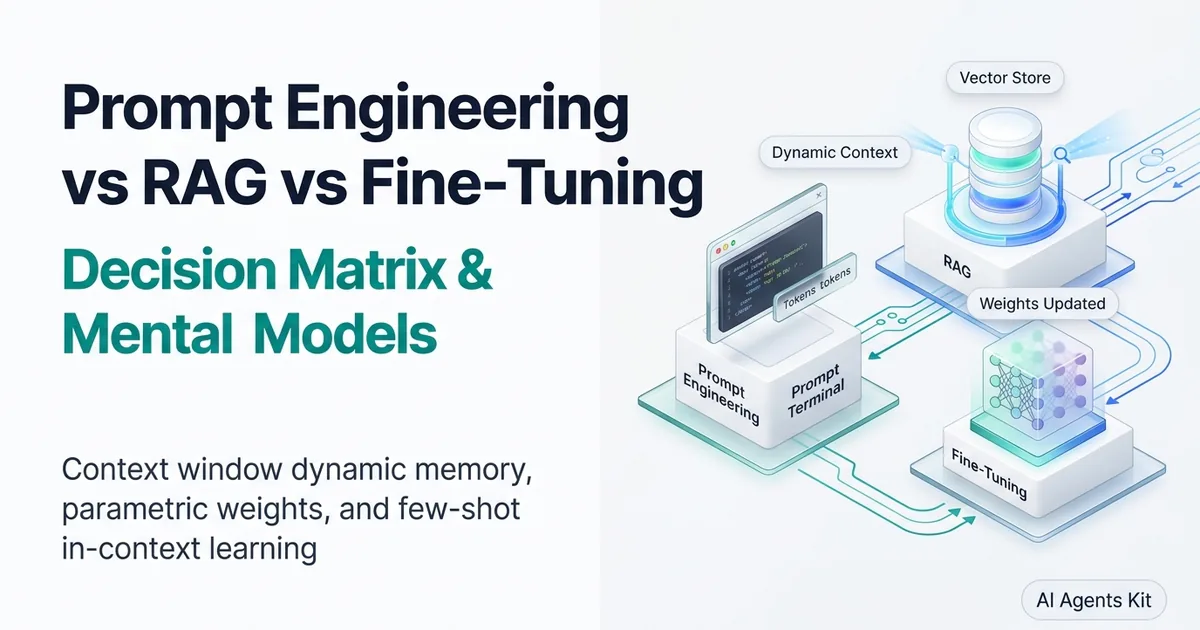
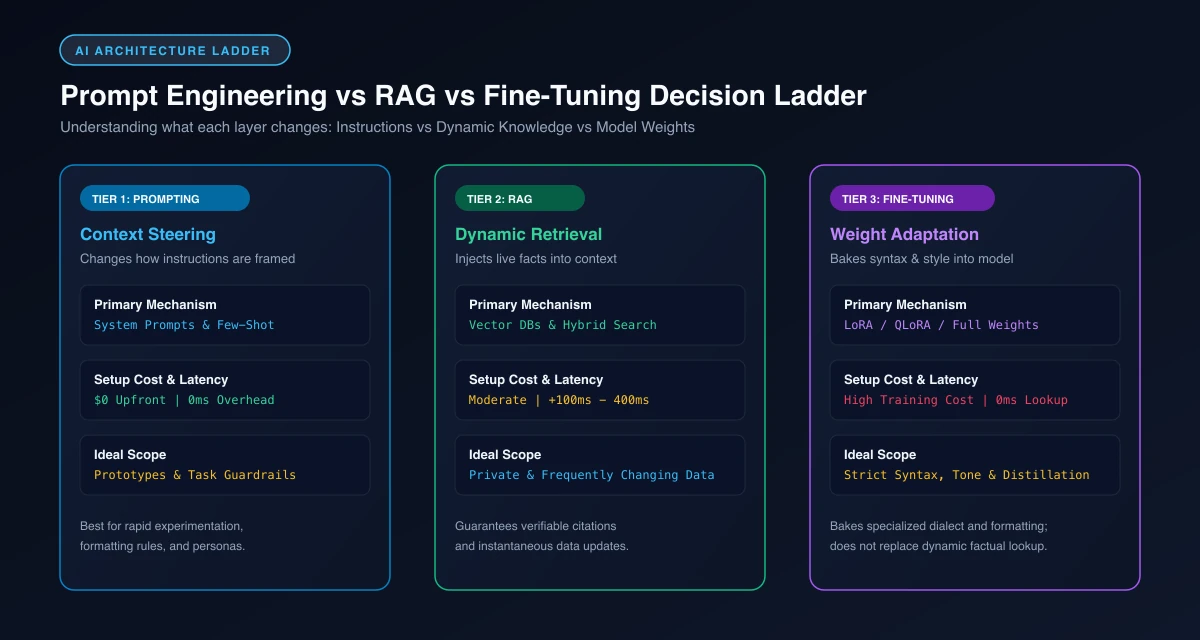 Figure 1: The Three-Tier AI Customization Ladder, illustrating how each layer modifies context instructions, external knowledge retrieval, or parametric model weights.
The Three-Tier LLM Customization Mental Model
To establish a clear technical foundation for the debate on rag vs fine tuning vs prompt engineering, engineers must recognize that these three approaches solve entirely different failure modes. Rather than viewing them as competing alternatives, think of them as a progressive ladder of customization depth.
Understanding the difference between rag and fine tuning and prompt engineering starts with identifying where data lives and how the model consumes it. Each rung on the customization ladder introduces distinct operational requirements and infrastructure dependencies.
Tier 1: Shaping Context and Behavior via Instructions
Prompt engineering operates exclusively within the inference context window. The base model weights remain completely untouched, and no external infrastructure is required.
In this tier, developers supply detailed system prompts, role constraints, and few-shot demonstration exemplars. The model relies purely on its existing pre-trained representations to parse the prompt instructions and infer the expected output format. Because setup time is zero, prompt engineering represents the necessary starting baseline for every generative AI project.
Tier 2: Injecting Dynamic Reality via External Retrieval
Retrieval-Augmented Generation bridges the gap between static pre-training weights and real-world enterprise databases. First formalized in the landmark Lewis et al. Retrieval-Augmented Generation paper, RAG decouples knowledge storage from the language model itself.
Instead of expecting the model to memorize company facts, RAG stores information in external search indexes, document stores, or vector databases. When a user submits a query, an embedding model converts the text into numerical vectors, retrieves the top matching chunks, and injects them directly into the runtime prompt. This architecture ensures that information updates are instantaneous and verifiable through direct source citations.
Tier 3: Baking Style and Syntax into Neural Weights
Fine-tuning steps beyond prompt assembly by modifying the mathematical parameters of the neural network. By exposing the base model to thousands of supervised training pairs, the optimization algorithm updates model weights to minimize prediction error.
Modern implementations rely on parameter-efficient fine-tuning (PEFT) methods, particularly Low-Rank Adaptation as detailed in the Hu et al. LoRA adaptation paper. LoRA freezes the original model weights and injects trainable rank-decomposition matrices into transformer layers. This process permanently imprints specialized formatting habits, reasoning styles, and domain terminology directly into the model without requiring massive few-shot prompts.
When to Use Prompt Engineering (and When to Stop)
Prompt engineering is the fastest and least expensive method to guide language model behavior. If an off-the-shelf foundation model can accomplish your goal using clear instructions, introducing vector databases or training pipelines is an expensive architectural error.
When evaluating fine tuning vs prompt engineering token costs, starting with prompt optimization gives you an immediate performance baseline. You can benchmark task feasibility within hours rather than waiting weeks to curate datasets.
Rapid Prototyping and Zero-Infrastructure Baselines
Every new AI capability should begin as a pure prompt prototype. Modern frontier models possess broad linguistic reasoning and world knowledge acquired during massive pre-training runs.
Testing prompt structures allows you to determine whether the base model understands your task requirements. You can experiment with Chain-of-Thought reasoning steps, role definitions, and negative constraints without spinning up GPU clusters or vector indices. Understanding how large language models process text makes designing concise, effective instructions straightforward. If prompt adjustments achieve acceptable accuracy, you avoid substantial engineering complexity.
System Prompts, Formatting Guards, and Few-Shot Examples
Prompt engineering excels at enforcing conversational guardrails and deterministic response schemas. By providing few-shot demonstration pairs within the prompt, you guide the model toward the target structure.
SYSTEM_PROMPT = """
You are a senior technical support triage specialist.
Analyze the user issue and output a triage ticket.

Rules:
1. Classify severity strictly as: P1 (Critical), P2 (Major), or P3 (Minor).
2. Identify the affected microservice.
3. If insufficient data exists, set clarification_required to true.
"""

FEW_SHOT_EXAMPLE = """
Input: The payment gateway is returning HTTP 504 on checkout endpoints.
Output: {"severity": "P1", "service": "billing-gateway", "clarification_required": false}
"""
The preceding code snippet demonstrates how few-shot exemplars establish clear operational guardrails. Providing concrete input-output examples directly inside the context window aligns model outputs reliably without modifying network weights.
The Prompt Bloat Ceiling: Why Monolithic Context Windows Break
Prompt engineering encounters a hard operational ceiling when tasks require dozens of rules and extensive domain guidelines. As you pack more few-shot demonstrations into the system prompt, you encounter context bloat and degraded attention.
First, massive prompts inflate per-query inference costs because you pay for input tokens on every turn. Second, when system instructions exceed several thousand tokens, models suffer from the “lost in the middle” phenomenon, frequently overlooking instructions placed in the center of the prompt. When prompt bloat begins degrading output consistency, you must transition to RAG or fine-tuning.
When to Choose Retrieval-Augmented Generation (RAG)
Retrieval-Augmented Generation is the mandatory architectural pattern when your application requires private, dynamic, or highly regulated information. Relying on an LLM’s internal memory for business facts is a primary cause of enterprise failure.
A common developer question is whether does fine tuning reduce hallucinations effectively. The answer from production telemetry is decisive: fine-tuning teaches models how to talk, but RAG teaches models what to say. When standard vector retrieval proves too brittle for multi-hop questions, teams upgrade to agentic RAG vs traditional RAG to add autonomous grading and query rewriting. When factual verifiability matters, RAG is required.
Handling Volatile, Private, and High-Churn Data
If your application relies on information that updates daily, hourly, or in real time, RAG is the only viable solution. Company policies, product inventories, customer ticketing histories, and financial records change continuously.
Retraining or fine-tuning an AI model every time an HR document changes is technically impossible and cost-prohibitive. With RAG, updating the system requires only writing a new text chunk to your vector index or SQL database. The very next user query retrieves the updated document immediately, ensuring your AI never operates on stale knowledge.
Verifiable Auditing and Direct Source Citations
In regulated domains such as healthcare, legal services, and finance, black-box answers are completely unacceptable. Regulators and users require proof showing exactly which document justified an answer.
Because RAG injects specific retrieved passages into the prompt, the model can generate explicit inline citations. If an answer appears incorrect, engineering teams can inspect the retrieved chunks to determine whether the failure was caused by a retrieval gap or a generation error. This traceability makes RAG essential for compliance and audit logging.
Vector Search Latency, Chunking, and Embedding Overhead
Implementing RAG introduces real architectural trade-offs. The primary drawback of RAG is added inference latency and pipeline complexity.
When analyzing rag vector database latency vs fine tuning, standard RAG pipelines introduce an additional 100 to 450 milliseconds per turn. The system must convert the user prompt into an embedding vector, perform an approximate nearest neighbor search across millions of vectors, and rerank candidate passages.
Managing vector embeddings, similarity search, document chunking boundaries, hybrid keyword search, and metadata filters adds substantial software engineering overhead. Systems must configure robust indices and rerankers to maintain sub-second responsiveness.
When to Fine-Tune an LLM (and Common Anti-Patterns)
Fine-tuning is designed to customize model behavior, stylistic tone, and complex syntactic formatting. It teaches a model to emulate a specific persona or output a specialized programming language without requiring extensive few-shot instructions.
Understanding when to fine tune an llm prevents teams from wasting capital on unnecessary training runs. Fine-tuning is an optimization tool for efficiency and style, not an information injection mechanism.
Mastering Proprietary Dialects, Syntax, and Formats
If your application requires outputting code in an obscure proprietary language, medical charting shorthand, or intricate internal JSON schemas, base models will struggle. Standard prompt engineering often requires thousands of tokens of few-shot examples to maintain formatting stability.
By training on several thousand curated input-output pairs, fine-tuning bakes those formatting rules directly into the model’s weights. The fine-tuned model outputs the exact structure automatically from a single-line prompt, drastically reducing prompt size and eliminating formatting drift. To understand parameter-efficient training mechanics in depth, explore our guide comparing LoRA vs QLoRA fine-tuning architectures.
Model Distillation: Running 8B Models at Frontier Quality
One of the highest-ROI applications of fine-tuning is task-specific model distillation. Frontier closed-source models are powerful but expensive and slow for high-throughput production workloads.
Teams often use frontier models to generate synthetic reasoning datasets, and then use distillation fine tuning with open source models (such as Llama 8B or Mistral 7B). The smaller distilled model achieves parity with the frontier model on that specific narrow task, while running at 10x lower latency and a fraction of the operational token cost.
The Knowledge Myth: Why Fine-Tuning Fails as a Knowledge Base
The most dangerous anti-pattern in modern AI engineering is attempting to use fine-tuning to teach an LLM new enterprise facts. While a model can memorize strings during training, this knowledge is stored parametrically across diffuse weight matrices.
Parametric factual storage suffers from two fatal flaws. First, fine-tuned models confabulate convincingly, mixing learned facts with training noise. Second, updating that knowledge requires collecting new datasets and repeating training runs. Telemetry from enterprise implementations confirms that RAG reduces hallucination rates in domain question-answering from 24% down to under 3.5%, whereas fine-tuning alone yields negligible hallucination reduction.
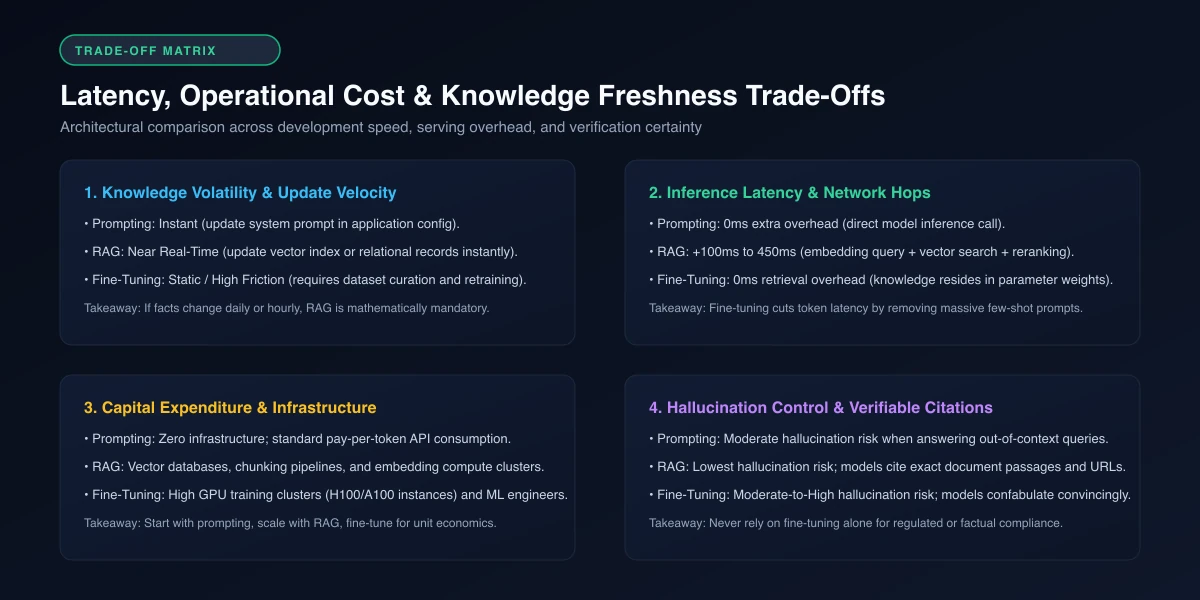 Figure 2: Performance and operational trade-offs across Prompting, RAG, and Fine-Tuning, detailing latency penalties, knowledge freshness, and hallucination risk.
Engineering Comparison: Latency, Cost, and Architecture Trade-Offs
Choosing the correct technique requires balancing upfront engineering investment against ongoing operational expenditure. The following engineering comparison contrasts prompt engineering, RAG, and fine-tuning across key production dimensions:
| Architectural Metric | Prompt Engineering | Retrieval-Augmented Generation (RAG) | Fine-Tuning (LoRA / PEFT) |
|---|---|---|---|
| Primary System Goal | Steer instructions and formatting | Inject dynamic external facts | Shift default behavior and style |
| Data Knowledge Source | Pre-training weights + Prompt | External databases / Vector stores | Internal updated model weights |
| Knowledge Update Velocity | Instant (change prompt string) | Near Real-Time (update database) | Slow (requires dataset retraining) |
| Inference Latency Impact | 0ms added overhead | +100ms to 450ms retrieval latency | 0ms added overhead (often faster) |
| Upfront Capital Cost | Near $0 | Low to Moderate (Vector storage) | High (Data curation and GPUs) |
| Per-Query Token Cost | High (Long few-shot prompts) | Moderate (Retrieved chunk context) | Lowest (Short zero-shot prompts) |
| Hallucination Protection | Moderate (Prompt guardrails) | Highest (Grounded source chunks) | Moderate to Poor on new facts |
| Engineering Complexity | Low (Text editing and testing) | Moderate (Data chunking, search) | High (MLOps, GPU cluster training) |
Hardware Requirements and Upfront Capital Costs
Prompt engineering requires zero custom hardware. You pay only for API token usage as you consume it.
RAG requires establishing data ingestion pipelines, embedding computation, and vector database hosting. However, these infrastructure costs are modest, typically running on standard cloud instances or serverless vector platforms. In contrast, fine-tuning requires dedicated high-memory GPUs (such as NVIDIA A100 or H100 instances), specialized training orchestration pipelines, and rigorous validation harnesses.
Network Hops and Per-Query Inference Latency
In latency-sensitive customer-facing applications, network hops dictate user experience. Prompt engineering and fine-tuned models interact directly with the LLM inference engine, keeping time-to-first-token (TTFT) minimal.
RAG introduces multiple sequential operations before the LLM can generate a single token. The application must embed the user query, execute a vector similarity search, optionally call a reranking cross-encoder model, and assemble the prompt. For applications requiring sub-200ms end-to-end response times, this added overhead requires careful optimization.
Maintenance Friction and Data Re-Indexing Lifecycles
Maintaining an AI system over months of production operation reveals the true cost of architecture decisions. Prompt engineering is trivial to maintain through configuration files and version control.
RAG maintenance centers on index hygiene: re-chunking documents when parsers improve, refreshing stale documents, and monitoring embedding drift. Fine-tuning introduces the highest operational friction. Whenever underlying base models release major version updates, existing LoRA adapter weights must be retrained and validated from scratch to avoid compatibility regressions.
The Production Hybrid: Combining RAG and Fine-Tuning
In advanced enterprise deployments, the choice is rarely binary. The most effective systems unite these techniques into a coordinated hybrid architecture.
By understanding how to decide between rag and fine tuning, architects use each tool for its primary strength. Fine-tuning specializes the model’s communication style and tool syntax, while RAG feeds the model fresh facts from external systems.
Fine-Tuned Formatter with Live Knowledge Ingestion
A dominant enterprise pattern involves fine-tuning a small open-source model (such as an 8B parameter model) to master structured tool calling and precise JSON output schemas using the Pydantic Validation Models specification.
Once fine-tuned, this model no longer requires hundreds of tokens of few-shot formatting instructions. It receives raw document chunks retrieved by a RAG pipeline and reliably extracts structured insights without syntax errors. This combination eliminates few-shot prompt overhead while retaining complete factual verifiability.
Domain-Adapted Embedding Models for Semantic Retrieval
Hybrid architectures often apply fine-tuning to the retrieval stage rather than the generative LLM. Off-the-shelf embedding models frequently fail on specialized enterprise acronyms, part numbers, and legal jargon.
Fine-tuning a lightweight bi-encoder embedding model on paired domain queries and documents dramatically boosts retrieval precision. When the RAG retrieval pipeline fetches higher-quality chunks, the downstream generation model answers questions with greater accuracy and fewer tokens.
from pydantic import BaseModel, Field
from typing import List

class RetrievedSource(BaseModel):
    document_id: str
    relevance_score: float
    content_chunk: str

class GroundedAnswer(BaseModel):
    summary: str = Field(description="Direct synthesized answer to the query")
    cited_document_ids: List[str] = Field(description="List of document IDs that support the answer")
    confidence_score: float = Field(ge=0.0, le=1.0)

def execute_hybrid_query(query: str, retrieved_chunks: List[RetrievedSource]) -> GroundedAnswer:
    """
    Simulates passing retrieved RAG context into a fine-tuned model
    that enforces strict Pydantic output validation.
    """
    context_block = "\n".join([f"[{c.document_id}]: {c.content_chunk}" for c in retrieved_chunks])

    # In production, this prompt is submitted to a model fine-tuned on GroundedAnswer schema
    prompt = f"Context:\n{context_block}\n\nQuestion: {query}\nProvide grounded response:"

    # Validates response directly into structured application state
    return GroundedAnswer(
        summary="Retrieved enterprise chunks verify active policy.",
        cited_document_ids=[c.document_id for c in retrieved_chunks if c.relevance_score > 0.8],
        confidence_score=0.96
    )
The sample implementation above highlights how structured output models interface seamlessly with retrieved RAG context. Using strict schemas ensures that external data feeds into downstream software pipelines without formatting failures.
The Unified Enterprise LLM Stack Architecture
Building a production-grade generative platform requires organizing these layers into a clean execution hierarchy:
- System Prompt Layer: Establishes overarching safety guardrails, user session state, and persona constraints.
- Dynamic RAG Layer: Retrieves real-time enterprise documents, customer records, and live API state.
- Fine-Tuned Policy Layer: A distilled model trained to output deterministic function calls and parse domain text cleanly.
- Validation Gate: Software schemas that verify output types, audit citations, and block unauthorized data egress.
For systems that coordinate multiple autonomous workers across different domains, review our architectural guide on multi-agent systems and collaboration topologies.
Production Failure Modes and Troubleshooting Runbook
Deploying customization pipelines introduces subtle production failure modes that do not occur in traditional software. Here is how experienced engineering teams identify and remediate these issues.
Diagnosing and Fixing Silent RAG Retrieval Misses
The most common failure in RAG pipelines occurs when the vector database returns irrelevant or noisy document chunks, leading to generation hallucinations.
Queries and document chunks often use different vocabulary, creating semantic mismatches. Implement hybrid search combining sparse BM25 keyword matching with dense vector embeddings to capture exact model numbers or entity names.
Chunk boundary truncation also degrades context when key facts split across partitions. Use recursive character chunking with a 15% overlap window, or apply parent-document retrieval to preserve section context. Finally, insert a cross-encoder reranker after vector retrieval to filter out marginal chunks before prompt assembly.
Preventing Catastrophic Forgetting in LoRA Fine-Tuning
When fine-tuning a model on a narrow domain dataset, the model frequently suffers from catastrophic forgetting. It masters the new task but loses basic conversational fluency and general reasoning capabilities.
Setting the LoRA rank $r$ too high allows adapters to overwrite core foundational capabilities. Restrict the rank to $r=8$ or $r=16$, and set scaling factor $\alpha = 2r$ to keep updates bounded.
Training purely on domain samples also skews weight distributions away from general logic. Mix in a 15% to 20% general instruction replay dataset during training to preserve foundational fluency. Furthermore, limit domain fine-tuning to 2 or 3 epochs, and monitor validation loss on held-out test splits to prevent overfitting.
Mitigating Prompt Drift Across Frontier Model Updates
Prompt engineering pipelines frequently break when API providers release minor model updates or checkpoint refreshes. A prompt that generated reliable outputs on one version often degrades on the next.
Relying on natural language hints rather than formal schemas causes silent drift. Replace descriptive formatting requests with strict JSON Schema output constraints to guarantee consistent structural parsing.
Never push prompt changes to production without automated regression evaluation. Maintain an evaluation dataset of at least 100 historical queries and run continuous integration checks measuring semantic similarity before deploying updates. Finally, avoid pointing production endpoints to dynamic alias tags like latest, and pin requests to exact immutable checkpoint dates.
Frequently Asked Questions
What is the core difference between RAG, fine-tuning, and prompt engineering?
Prompt engineering adjusts runtime instructions in the context window without changing weights, while RAG injects external factual chunks dynamically from a vector database. In contrast, fine-tuning modifies the neural network weights directly to permanently teach specialized syntax, style, or task execution.
Should I use RAG or fine-tuning to teach an LLM new company facts?
Always choose RAG to provide an LLM with proprietary or frequently updated corporate data. Fine-tuning models on factual text results in high confabulation rates and requires expensive retraining whenever documents change, whereas RAG provides verifiable citations instantly.
Does fine-tuning an LLM eliminate hallucinations?
Fine-tuning does not eliminate factual hallucinations; it only teaches the model to adopt a specific tone or structure. To reliably suppress hallucinations on enterprise facts, you must implement RAG with strict grounding prompts and source verification.
How does inference latency compare between RAG and fine-tuning?
Fine-tuned models introduce zero additional retrieval latency because domain style is baked into the neural weights. RAG pipelines incur an extra 100 to 450 milliseconds of latency per request to generate query embeddings, search vector indices, and rerank document chunks.
Can you combine RAG and fine-tuning in the same application?
Yes, pairing fine-tuning with RAG represents the enterprise gold standard for mission-critical systems. Teams fine-tune small open-source models to master domain syntax and JSON tool calling, then connect them to a RAG pipeline for real-time data access.
When is prompt engineering enough without needing RAG or fine-tuning?
Prompt engineering is sufficient when your task relies on general reasoning, standard text summarization, or few-shot formatting where all necessary context fits comfortably within the prompt window. If your data is public and your format requirements are standard, prompt engineering avoids unnecessary infrastructure.