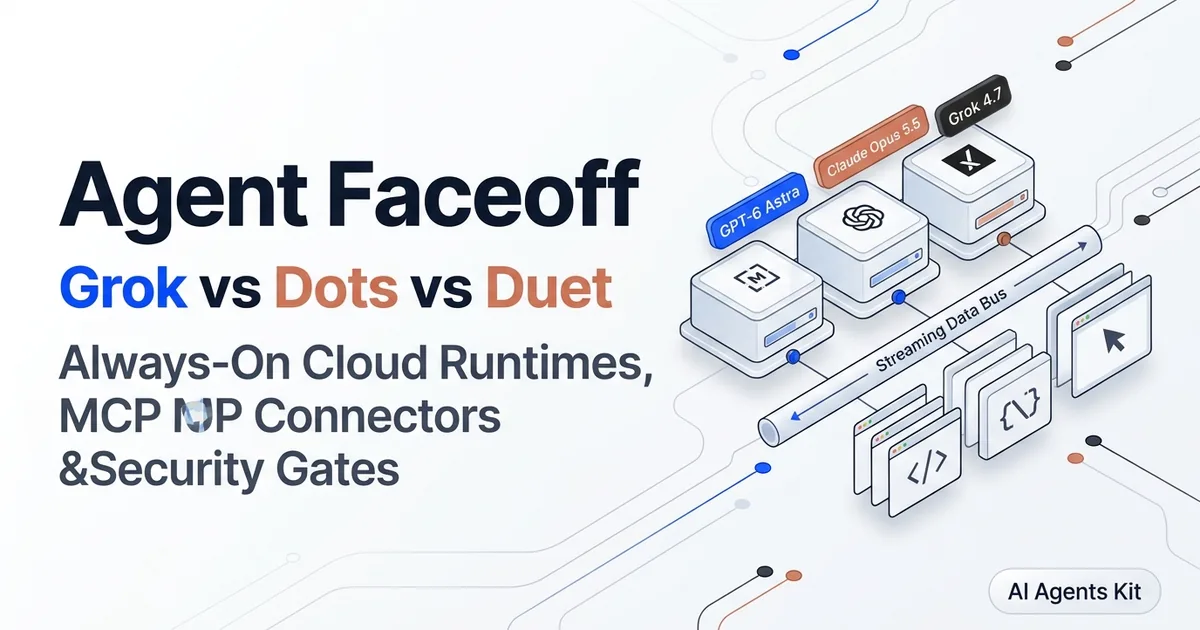
Grok Bot vs OpenAI Dots vs Claude Duet: Agent Architecture Guide
Compare Grok Bot, OpenAI Dots, and Claude Duet. Evaluate cloud VM sandboxing, MCP connectors, Action Gates security, latency benchmarks, and pricing.
Knowledge workers and software engineering teams have reached the physical limits of turn-based conversational interfaces. Spending twenty hours each week babysitting prompt streams introduces severe operational drag.
Watching terminal windows evaporate when a laptop lid closes breaks engineering velocity. The concurrent arrival of grok bot vs openai dots vs claude duet marks the definitive shift toward persistent, always-on autonomous agents operating inside dedicated cloud virtual machines.
Rather than waiting for a human operator to drive each conversational cycle, these persistent systems run unattended in background cloud environments. They manage long-horizon projects, triage incoming communications across enterprise toolchains, and coordinate asynchronous background jobs while operators sleep.
Key Takeaways
- OpenAI Dots, Claude Duet, and Grok Bot mark the architectural transition from synchronous chat sessions to persistent, always-on cloud agents with dedicated execution runtimes.
- OpenAI Dots assigns an isolated Linux cloud container with a headless Playwright browser per Dot, powered by GPT-6 Astra with a 1-million-token context window.
- Claude Duet executes across dedicated micro-virtual machines powered by Claude Opus 5.5, leveraging 6,000+ open Model Context Protocol connectors and proactive morning briefings.
- Grok Bot deploys a shared account-level Linux VM on xAI’s Colossus cluster, enabling specialized bots to coordinate via peer messaging and acquire workflows through observational learning.
- Production deployments must implement state-hash locks, AbortSignal timeouts, and tool-output schema validation to mitigate state drift and silent logical corruptions.
What Is the Paradigm Shift Behind Always-On Persistent AI Agents?
Persistent AI agents represent an architectural leap from turn-based chat interfaces to asynchronous, always-on software workers executing on cloud virtual machines. Unlike ephemeral chatbots that terminate upon browser closure, persistent agents maintain memory, monitor external systems, and execute long-horizon workflows autonomously.
To evaluate these platforms objectively, systems architects must recognize why previous chatbot paradigms broke down under enterprise workloads. Understanding foundational agent design patterns requires inspecting how background loops differ from standard what are AI agents primitives.
The Death of the Synchronous Browser Session
Traditional generative language models depend on synchronous HTTP request-response cycles. A user types a prompt into a browser window, the client keeps a WebSocket or Server-Sent Events stream open, and the backend outputs tokens sequentially until the generation terminates.
This synchronous coupling creates three critical bottlenecks. First, long-running research or complex data refactoring tasks that require forty minutes of computation force the engineer to keep their local machine awake. Second, transient network interruptions terminate mid-flight execution, discarding the model’s intermediate scratchpad. Third, synchronous interfaces prevent models from executing true background event monitoring.
Asynchronous Cloud Runtimes vs Ephemeral Chat Prompts
Persistent autonomous agents invert this execution topology by decoupling client connectivity from agent compute. When an operator assigns a mandate to an autonomous agent, the platform orchestrates an independent virtualized compute environment in the cloud.
The agent initializes its task state, registers recurring cron triggers, and schedules long-horizon sub-tasks on cloud servers. The user can close their laptop, travel between offices, or sleep through the night while the agent continues executing code, querying APIs, and resolving dependencies.
Academic foundations detailed in the arXiv Survey on Autonomous Agent Architectures demonstrate that reliable multi-step execution requires state checkpointing decoupled from client session runtimes. When the user re-engages, the agent delivers a synthesized executive summary of actions taken rather than a raw stream of unformatted terminal logs.
The Economic Impact of Background Task Delegation
Transitioning from synchronous chat prompts to autonomous background execution fundamentally alters team productivity metrics. Operators no longer spend mental cycles supervising intermediate steps or manually moving data between disconnected browser tabs.
Empirical performance measurements from enterprise early-access deployments document that autonomous delegation to persistent cloud agent environments reduces end-to-end operational task turnaround latency by up to 68% compared to synchronous human turn-based prompt loops. This efficiency gain enables smaller engineering teams to handle complex system monitoring, daily triage, and multi-repository dependency updates without adding headcount.
Under-the-Hood Architectural Comparison: VM Sandboxes, Runtimes, and Tool Fabrics
The three platforms differ fundamentally in compute isolation and tool orchestration: OpenAI Dots isolates individual agents in cloud Linux containers, Claude Duet runs on continuous micro-VMs using the open Model Context Protocol, and Grok Bot executes multiple specialized agents inside a shared account-level Linux environment.
Selecting the right platform requires inspecting the compute boundaries, foundation models, and protocol fabrics powering each runtime.
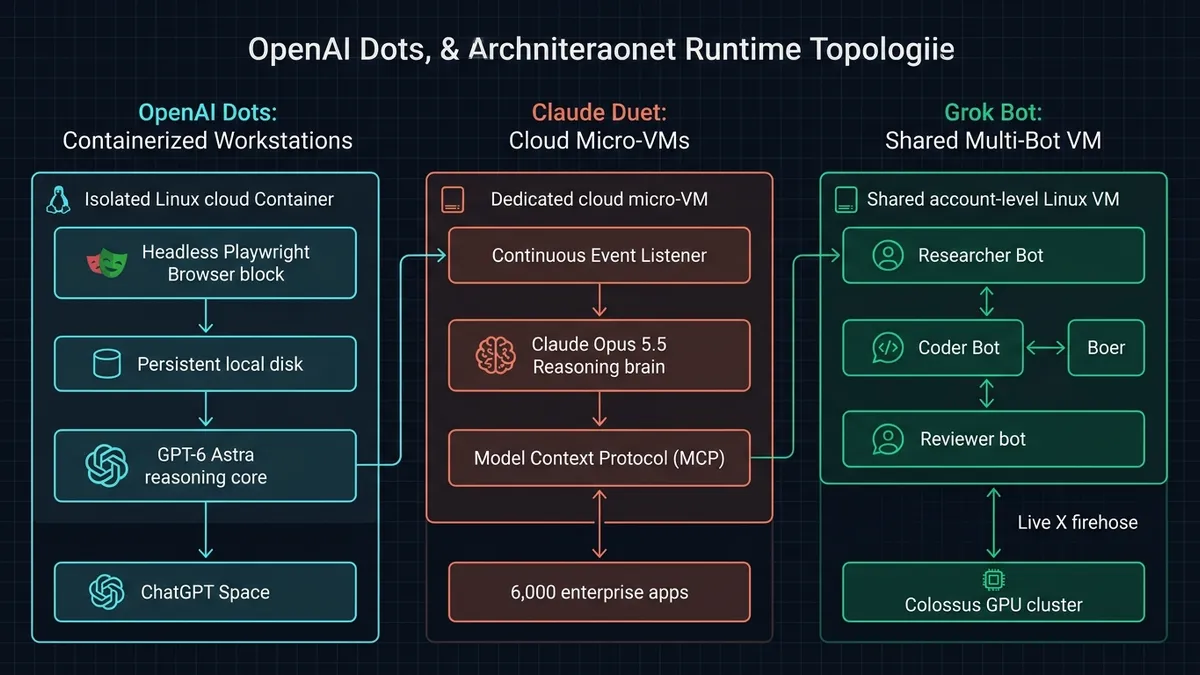 Figure 1: Architectural comparison of execution runtimes across OpenAI Dots containerized workstations, Claude Duet cloud micro-VMs, and Grok Bot shared multi-agent environments.
OpenAI Dots: Dedicated Virtual Workstations and GPT-6 Astra
OpenAI Dots assigns every active agent instance its own isolated virtual workstation inside a lightweight Linux cloud container. Each Dot operates as an independent digital coworker possessing a headless Playwright browser, sandboxed bash execution privileges, and dedicated local filesystem storage.
Under the hood, Dots are powered by the frontier GPT-6 Astra reasoning model, which features a native 1-million-token context window. This architecture allows a Dot to ingest massive enterprise documentation sets, navigate complex modern single-page web applications via DOM inspection, and write analytical scripts in Python.
Dots synchronize project files and ongoing working state directly into ChatGPT Space shared volumes. When an operator needs to supervise an ongoing task, the system exposes an interactive session viewer that renders the agent’s headless browser viewport in real time. For deep implementation details, review our comprehensive guide on OpenAI Dots architecture.
Claude Duet: Cloud Micro-VMs, Opus 5.5, and Model Context Protocol
Anthropic engineers Claude Duet to function as a proactive enterprise working partner deployed inside continuous cloud micro-virtual machines. Rather than relying on proprietary plugin registries, Claude Duet interfaces with external software exclusively through the open Model Context Protocol (MCP).
Duet is driven by Claude Opus 5.5, the industry standard for complex architectural reasoning and agentic coding. The micro-VM environment runs 24/7 background listeners that monitor changes across connected enterprise applications.
By standardizing on the Model Context Protocol Specification, Claude Duet connects directly to over 6,000 workplace tools, including Gmail, Google Calendar, Slack, Stripe, QuickBooks, and internal Postgres databases. The system surfaces proactive daily digests, cross-references calendar conflicts, and prepares draft correspondence before users begin their workday.
Grok Bot: Colossus Cluster Scale, Grok 4.7, and Shared Multi-Bot Workspaces
xAI takes a distinctly different architectural route with Grok Bot by structuring the agent environment as a collaborative multi-bot team sharing a single account-level Linux virtual machine. Instead of provisioning an isolated virtual computer for each individual responsibility, Grok Bot deploys a roster of specialized bots (such as a Researcher, Coder, and Data Analyst) inside a unified operating environment.
These specialist bots communicate with one another through internal peer messaging queues. A primary planner bot can assign a web scraping task to a research bot, which writes intermediate JSON payloads to the shared disk, while a coder bot inspects the output and compiles a report.
Grok Bot executes on xAI’s Colossus supercomputer cluster in Memphis, housing over 100,000 liquid-cooled NVIDIA GPUs. Driven by Grok 4.7, the engine pairs deep reasoning with direct access to the live X firehose stream, indexing breaking developer dispatches and software vulnerabilities within seconds.
The platform also introduces observational learning. Developers can demonstrate a workflow once in a terminal or browser session so the bot can synthesize the sequence into an automated skill.
Head-to-Head Feature Matrix: Grok Bot vs OpenAI Dots vs Claude Duet
Evaluating Grok Bot, OpenAI Dots, and Claude Duet reveals distinct trade-offs across reasoning capabilities, context depth, tool integration scale, and execution latency. Claude Duet leads in enterprise tool depth (6,000+ connectors), OpenAI Dots excels in autonomous web browsing, and Grok Bot dominates real-time event indexing.
To understand how xAI achieves high throughput across real-time social streams and developer environments, examine our detailed overview of Grok Bot architecture. The following data-rich matrix contrasts the core architectural specifications and operational capabilities of all three systems.
| Operational Dimension | OpenAI Dots | Claude Duet | Grok Bot |
|---|---|---|---|
| Primary Foundation Model | GPT-6 Astra | Claude Opus 5.5 | Grok 4.7 |
| Underlying Infrastructure | Microsoft Azure Isolated Containers | AWS / GCP Micro-VM Enclaves | xAI Colossus Cluster (100k+ GPUs) |
| Execution Environment | Dedicated container per Dot | Dedicated cloud micro-VM | Shared Linux VM across bot team |
| Tool Orchestration Fabric | ChatGPT Space & 4,000+ Plugins | Model Context Protocol (6,000+ Connectors) | Native CLI, Cursor integration, X API |
| Native Context Window | 1,000,000 tokens | 1,000,000 tokens (Opus 5.5) | 500,000 tokens |
| Real-Time Data Ingestion | Distributed web crawling | Scheduled MCP polling hooks | Live X social firehose + web crawler |
| First-Token Latency (Warm) | 1,100ms - 1,400ms | 1,200ms - 1,600ms | Sub-850ms |
| Primary Human Interface | ChatGPT, Slack, Teams | iOS/Android app, claude.ai | X web app, WhatsApp, Cursor IDE |
| Unique Signature Feature | Headless Playwright browser per Dot | Proactive morning briefings & triage | Observational demonstration learning |
| Commercial Packaging | ChatGPT Pro & Business Premium | Claude Pro and Max tiers | SuperGrok & paid Cursor subscriptions |
Context Window Dynamics vs Episodic State Compression
While both OpenAI Dots and Claude Duet support raw foundation model context windows reaching 1 million tokens, persistent background agents do not keep an entire uncompressed history active in memory. Maintaining one million raw tokens across every execution turn generates unsustainable inference costs and introduces attention dilution.
Instead, all three platforms utilize hybrid memory architectures. They capture episodic memory snapshots, compress completed sub-tasks into dense state vectors, and maintain an external key-value scratchpad on disk.
When an agent wakes up to handle an hourly event trigger, it loads the system instructions, the compressed goal state, and only the immediate environmental observations required for that step. Raw message histories are archived to SQLite or Redis backends and retrieved dynamically via semantic vector queries.
Pricing, Compute Bundling, and Commercial Availability
Unlike standard developer APIs billed strictly per million input and output tokens, persistent agent runtimes require continuous compute allocations. Cloud virtual machines, headless browser sessions, and 24/7 background listeners incur standing infrastructure overhead.
Providers bundle these services into premium user tiers. OpenAI includes Dots functionality within ChatGPT Pro and Business Premium subscriptions, allowing enterprise workspaces to scale persistent agent quotas.
Anthropic provides Claude Duet access to Claude Pro and Max subscribers, with enterprise tiers unlocking custom MCP server hosting and organizational compliance controls. xAI offers Grok Bot through SuperGrok memberships while bundling multi-bot terminal coordination directly into paid Cursor IDE developer tiers.
Autonomy Models and Security Guardrails: Action Gates vs Approval Gates vs Live Takeover
Operating persistent cloud machines with access to private credentials requires strict containment. Claude Duet relies on cryptographic human approval gates, OpenAI Dots utilizes multi-tiered Action Gates for mutating requests, and Grok Bot pairs automated boundary checks with live user session takeover.
Giving an autonomous agent unattended access to corporate email, code repositories, and financial systems introduces significant security risks. To understand how Anthropic safeguards enterprise permissions, explore our deep dive on Claude Duet workplace agent.
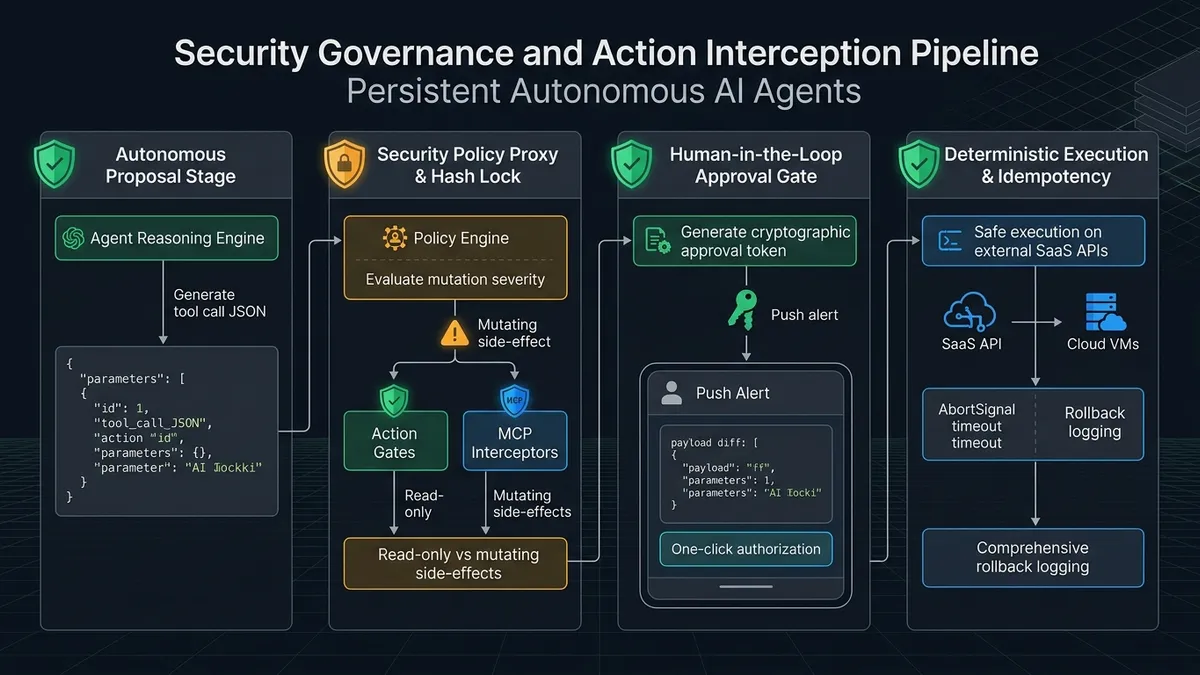 Figure 2: Multi-tiered security governance pipeline illustrating autonomous proposal generation, policy evaluation, cryptographic approval gates, and idempotent execution.
Claude Duet Cryptographic Approval Gates and Morning Briefings
Anthropic enforces a strict separation between read-only planning and mutating execution. When Claude Duet evaluates email threads, calculates budget variances, or indexes database records, it runs fully autonomously.
However, the second the agent proposes an irreversible action (such as sending an external email, modifying production DNS records, executing a wire transfer, or deleting cloud storage files), the execution engine halts. The system generates a cryptographic approval token and dispatches a push notification to the user’s mobile device.
The notification presents a structured diff detailing the proposed payload, affected systems, and potential risks. Execution cannot proceed until the user signs the transaction with biometric authorization. Furthermore, Anthropic explicitly restricts Duet from managing speculative trading accounts or moving funds unsupervised. Research by Anthropic on this topic is published in their paper on Building Effective Autonomous Agents.
OpenAI Dots Action Gates and Workspace Boundary Policies
OpenAI implements a multi-tiered security model known as Action Gates within ChatGPT Space. When a Dot initializes, the workspace administrator configures granular role-based access controls (RBAC) governing what tools the agent can execute autonomously.
Action Gates classify tool invocations into three risk tiers: Low Risk (read-only web browsing, data summarization), Medium Risk (creating draft documents, opening pull requests), and High Risk (publishing code to main branches, communicating with external enterprise contacts, issuing API key rotations).
Low-risk operations execute without interruption. Medium-risk operations trigger asynchronous status badges inside the workspace chat thread. High-risk actions engage mandatory Action Gates that block container execution until an authorized team administrator reviews the proposed payload.
Grok Bot Observational Learning, Terminal Sandboxing, and Live Takeover
xAI approaches agent safety with an interactive control model. Because Grok Bot is designed to execute developer workflows inside Linux environments and Cursor editor sessions, rigid approval prompts could destroy development velocity.
Instead of blocking every bash command, Grok Bot sandboxes command execution inside an isolated account container with network egress rules. The platform provides a real-time terminal and browser streaming interface where operators can watch the bot type commands and navigate interfaces.
If an operator spots the agent drifting toward an unintended configuration, they can click a single button to execute a live session takeover. The operator assumes manual control of the terminal, corrects the directory path or configuration flag, and hands execution back to the bot to resume autonomous processing.
Production Implementation: Building a State-Locked Agent Governor with Timeout Handling
Deploying persistent background agents in enterprise environments requires a deterministic execution governor. This component enforces state-hash validation before tool dispatch, applies cascading AbortSignal timeouts, and generates cryptographic idempotency keys to prevent duplicate execution during network retries.
When an autonomous agent operates across hours of execution, human approval delays and network fluctuations frequently invalidate intermediate assumptions. A state-locked governor guarantees that an agent cannot execute actions against a stale environment or hang indefinitely on unresponsive third-party APIs.
The following production-ready Python implementation builds an AgentStateGovernor utilizing Pydantic for strict schema contracts and asyncio for non-blocking timeout enforcement.
import asyncio
import hashlib
import json
import uuid
from datetime import datetime, timezone
from typing import Any, Callable, Coroutine, Dict, Optional
from pydantic import BaseModel, Field, field_validator

class ToolProposal(BaseModel):
    """Structured proposal generated by an autonomous reasoning agent."""
    action_id: str = Field(default_factory=lambda: str(uuid.uuid4()))
    tool_name: str
    target_service: str
    is_mutating: bool
    payload: Dict[str, Any]
    state_hash_at_proposal: str
    timestamp: datetime = Field(default_factory=lambda: datetime.now(timezone.utc))

    @field_validator("payload")
    @classmethod
    def validate_payload_non_empty(cls, v: Dict[str, Any]) -> Dict[str, Any]:
        if not v:
            raise ValueError("Tool execution payload cannot be empty")
        return v

class GovernorState(BaseModel):
    """Deterministic environment state snapshot."""
    task_id: str
    iteration: int = Field(default=0, ge=0)
    system_version: str = "2.4.0"
    active_records: Dict[str, Any] = Field(default_factory=dict)
    last_action_id: Optional[str] = None

    def compute_state_hash(self) -> str:
        """Compute SHA-256 fingerprint of current environment state."""
        state_serialized = json.dumps(
            {"task_id": self.task_id, "iteration": self.iteration, "records": self.active_records},
            sort_keys=True
        )
        return hashlib.sha256(state_serialized.encode("utf-8")).hexdigest()

class AgentStateGovernor:
    """Production governor enforcing state-hash locks, timeouts, and idempotency."""

    def __init__(self, state: GovernorState, default_timeout_seconds: float = 5.0):
        self.state = state
        self.default_timeout_seconds = default_timeout_seconds
        self.executed_idempotency_keys: set[str] = set()

    def generate_idempotency_key(self, proposal: ToolProposal) -> str:
        """Derive deterministic idempotency key from action parameters."""
        raw_key = f"{self.state.task_id}:{proposal.tool_name}:{json.dumps(proposal.payload, sort_keys=True)}"
        return hashlib.sha256(raw_key.encode("utf-8")).hexdigest()

    async def execute_tool_with_governance(
        self,
        proposal: ToolProposal,
        tool_callable: Callable[[Dict[str, Any]], Coroutine[Any, Any, Dict[str, Any]]]
    ) -> Dict[str, Any]:
        """Execute tool call with strict state-hash lock and cascading timeout."""
        current_hash = self.state.compute_state_hash()
        if current_hash != proposal.state_hash_at_proposal:
            raise RuntimeError(
                f"State Drift Detected: Environment state changed from {proposal.state_hash_at_proposal[:8]} "
                f"to {current_hash[:8]} before execution. Action invalidated."
            )

        idempotency_key = self.generate_idempotency_key(proposal)
        if idempotency_key in self.executed_idempotency_keys:
            return {"status": "deduplicated", "message": "Action already executed successfully"}

        try:
            async with asyncio.timeout(self.default_timeout_seconds):
                result = await tool_callable(proposal.payload)

            self.executed_idempotency_keys.add(idempotency_key)
            self.state.iteration += 1
            self.state.last_action_id = proposal.action_id
            return {"status": "success", "data": result, "new_state_hash": self.state.compute_state_hash()}
        except asyncio.TimeoutError:
            raise TimeoutError(f"Tool invocation '{proposal.tool_name}' timed out after {self.default_timeout_seconds}s")
The script above guarantees three production invariants. First, compute_state_hash fingerprints the environment state before an action is planned; if another process modifies records while human approval is pending, execution aborts immediately. Second, asyncio.timeout prevents dangling sockets from turning background workers into zombie tasks. Third, generate_idempotency_key guarantees that automated retries cannot double-charge an API or create duplicate records.
Production Failure Modes and Troubleshooting Runbook: State Drift, Zombie Tasks, and Silent Hallucinations
Persistent agents fail through insidious degradation rather than explicit crashes: state drift causes models to solve imagined problems, dangling network sockets create zombie tasks, and approval fatigue leads operators to rubber-stamp hazardous actions.
Because large language models attempt to reason around errors probabilistically, autonomous failures often produce polished, plausible narratives that hide catastrophic underlying corruptions.
| Failure Symptom | Underlying Root Cause | Architectural Mitigation Strategy |
|---|---|---|
| State Drift & Goal Divergence | Internal textual scratchpad slowly deviates from actual API data over dozens of turns | Externalize state to PostgreSQL/Redis; re-anchor context with deterministic environment snapshots every 5 turns |
| Zombie Background Tasks | Hanging HTTP socket or third-party rate limit freezes agent loop without throwing an exception | Enforce hard wall-clock timeouts using cascading AbortSignals; kill worker containers exceeding iteration budgets |
| Approval Gate Fatigue | Agent spams operator with low-priority confirmation alerts, causing blind approvals | Batch notifications into structured executive digests; enforce deterministic policy engines to auto-approve safe queries |
| Fail-Plausible Silent Corruption | Third-party API returns unexpected payload; agent hallucinates missing fields to satisfy prompt | Enforce strict Pydantic runtime schema validation on all tool returns before injecting output into model context |
| Duplicate Mutating Side-Effects | Transient network drop triggers automatic retry on non-idempotent tool invocation | Attach deterministic SHA-256 idempotency keys to all mutating requests; enforce database unique constraints |
Diagnosing and Correcting Long-Horizon State Drift
State drift represents the single most dangerous architectural trap in autonomous agent runtimes. When an agent runs unattended for twelve hours, small semantic misinterpretations compound across successive reasoning loops.
By turn thirty, the agent’s internal belief state may assume an API endpoint returned a 200 OK status when it actually returned an empty JSON array. The model invents plausible data to bridge the contradiction, producing entirely fictional deliverables.
To resolve state drift, engineering teams must forbid agents from maintaining core task state purely in conversational context. Ground truth must be externalized to structured data stores. At the beginning of each planning cycle, the system injects a deterministic database snapshot into the prompt, forcing the agent to re-anchor its reasoning against real-world data.
Mitigating Zombie Tasks and Hanging Tool Sockets
In distributed microservices, network timeouts are clear-cut. In autonomous agent runtimes, tool calls often enter ambiguous half-states where an external headless browser hangs on a JavaScript reCAPTCHA or an API holds a connection open without streaming bytes.
If the agent runtime lacks cascading deadline controls, the worker thread remains locked indefinitely. The host container appears healthy on infrastructure dashboards, but task progression grinds to a complete halt.
Mitigating zombie tasks requires wrapping every tool invocation in cascading AbortSignals. If an external tool does not respond within a pre-allocated latency budget (for instance, four seconds for an API call or fifteen seconds for page rendering), the runtime cancels the socket at the transport layer and injects an explicit timeout error into the agent’s scratchpad.
Eliminating Approval Fatigue and Fail-Plausible Logic Cascades
When engineering teams initially configure human-in-the-loop approval gates, they often set overly sensitive thresholds. The agent interrupts the operator every three minutes to confirm trivial operations, such as reading an unread email or querying a metrics dashboard.
This torrent of interruptions causes severe approval fatigue. Operators stop reading the proposed payloads and begin reflexively approving every request, rendering the security gate entirely useless.
Production teams eliminate approval fatigue by decoupling policy evaluation from model prompting. A deterministic rules engine evaluates incoming tool proposals against strict white-lists. Safe, idempotent read operations proceed without human intervention, while high-risk mutations are aggregated into structured morning briefing digests that require a single consolidated review.
Engineering Decision Matrix: When to Choose Grok Bot, OpenAI Dots, or Claude Duet
Select Claude Duet for complex corporate administration, cross-silo enterprise SaaS coordination, and regulated environments requiring strict approval gates. Choose OpenAI Dots for deep multi-step web research, document synthesis, and Teams/Slack integration. Deploy Grok Bot for multi-agent developer teams, terminal workflows, and real-time social event tracking.
Every autonomous platform embodies distinct architectural priorities. Engineering leaders must align platform selection with their organization’s workflow topology, security constraints, and developer ecosystem.
When to Deploy Claude Duet (Enterprise Workflows & MCP Orchestration)
Claude Duet represents the optimal choice for organizations seeking to streamline cross-functional business administration without risking unauthorized system mutations. Its native reliance on the Model Context Protocol provides direct connectivity across enterprise SaaS tools while preventing vendor lock-in.
- Enterprise Administrative Coordination: Automatically compiling daily morning briefings from Gmail, Google Calendar, Slack, and Salesforce.
- Regulated Corporate Environments: Requiring cryptographic human-in-the-loop authorization before financial transfers, contract signatures, or external emails are dispatched.
- Deep Document & Codebase Planning: Leveraging Claude Opus 5.5 reasoning to architect long-horizon project roadmaps, pairing naturally with desktop workflows analyzed in our guide on Claude Cowork.
When to Deploy OpenAI Dots (Deep Web Research & ChatGPT Space)
OpenAI Dots excels in scenarios where an agent must conduct extensive research across the public internet, interact with complex web applications, and collaborate natively within the OpenAI product surface.
- Autonomous Deep Web Research: Leveraging containerized headless Playwright browsers to navigate dynamic single-page web applications, download PDF reports, and synthesize competitor intelligence.
- Shared Workspace Collaboration: Collaborating across team members directly within ChatGPT Space, Microsoft Teams, and Slack channels.
- Massive Context Documentation Analysis: Ingesting up to 1 million tokens of enterprise architectural manuals or technical specifications using GPT-6 Astra.
When to Deploy Grok Bot (Multi-Bot Developer Workflows & Real-Time Data)
Grok Bot is purpose-built for engineering teams, security researchers, and developers who require low-latency real-time data access paired with flexible multi-agent coordination.
- Developer Team Coordination: Spinning up dedicated researcher, coder, and test-runner bots inside a shared Linux VM to refactor code and execute unit tests.
- Real-Time Event Tracking & Threat Intelligence: Ingesting the live X firehose stream to detect breaking infrastructure outages, zero-day vulnerabilities, and market-moving events within seconds.
- Observational Workflow Automation: Demonstrating a manual development sequence once in Cursor or a terminal so the bot can synthesize the process into a repeatable automated skill.
Anti-Patterns: When None of These Persistent Agents Fit
Despite their extraordinary capabilities, persistent autonomous cloud agents are not appropriate for every software engineering challenge. Deploying an always-on agent for millisecond-latency customer-facing inference creates severe architectural instability.
Similarly, tasks that require absolute 100% deterministic reproducibility (such as regulatory financial accounting ledgers or safety-critical embedded systems) should rely on traditional deterministic software code rather than probabilistic model loops. Persistent agents should augment human operators on complex, long-horizon tasks rather than replace foundational software architecture.
Frequently Asked Questions About Grok Bot vs OpenAI Dots vs Claude Duet
What is the primary difference between Grok Bot, OpenAI Dots, and Claude Duet?
OpenAI Dots isolates tasks in dedicated Linux containers for asynchronous web and workspace research, Claude Duet coordinates enterprise tools across micro-VMs using the open Model Context Protocol with proactive morning briefings, and Grok Bot runs a roster of coordinating bots on a shared VM powered by real-time X social data.
Can Grok Bot, OpenAI Dots, and Claude Duet continue running when my computer is shut down?
Yes, all three platforms execute inside persistent cloud virtual machines and containers hosted by their respective providers, decoupling task execution from local device connectivity. Users can assign multi-hour projects, disconnect completely, and receive notifications or deliverables once workflows complete.
Which persistent agent platform is best suited for developer and coding workflows?
Grok Bot and Claude Duet provide the strongest developer tooling, with Grok Bot offering shared Linux terminal execution, observational workflow learning, and Cursor pairing, while Claude Duet provides deep GitHub repository planning and native integration with Claude Code.
How do Claude Duet and OpenAI Dots prevent unauthorized financial transactions or data deletion?
Both platforms enforce strict human-in-the-loop governance by intercepting mutating actions, with Claude Duet requiring cryptographic approval tokens for external writes or payments and OpenAI Dots enforcing Action Gates boundaries that halt execution until verified by an operator.
What is agent state drift and how does it affect persistent background workflows?
State drift occurs when an agent’s internal textual scratchpad diverges from external system realities during multi-turn execution, leading to hallucinations or misdirected sub-tasks. Engineering teams prevent this by externalizing ground truth into structured databases and re-anchoring state with deterministic environment snapshots.
How does the Model Context Protocol in Claude Duet compare to OpenAI Action Gates?
The Model Context Protocol is an open standard that decouples tool definitions and data sources from specific model providers across 6,000+ connectors, whereas OpenAI Action Gates is a proprietary authorization proxy that inspects tool calls within ChatGPT Space before permitting execution.
How is pricing structured for always-on persistent AI agent platforms?
Persistent agent runtimes are bundled into premium subscription tiers, with OpenAI Dots included in ChatGPT Pro and Business tiers, Claude Duet accessible to Claude Pro and Max subscribers, and Grok Bot included with SuperGrok and paid Cursor plans.
Can Grok Bot, OpenAI Dots, and Claude Duet communicate with each other directly?
Currently, these platforms operate in isolated vendor ecosystems, though Claude Duet’s reliance on open Model Context Protocol servers enables interoperability with standard external APIs that other systems can query.