Agentic RAG vs Traditional RAG Explained: How Reasoning Loops Fix Bad Retrieval
Compare agentic RAG and traditional RAG. Learn how autonomous reasoning loops, document grading, and query rewriting fix brittle vector search pipelines.
Retrieval-Augmented Generation has evolved from rigid, single-pass scripts into autonomous, multi-step execution graphs. In production software, comparing agentic rag vs traditional rag marks the boundary between brittle prototypes and resilient enterprise systems. When a user asks an ambiguous, multi-part, or cross-database question, linear retrieval pipelines fail silently.
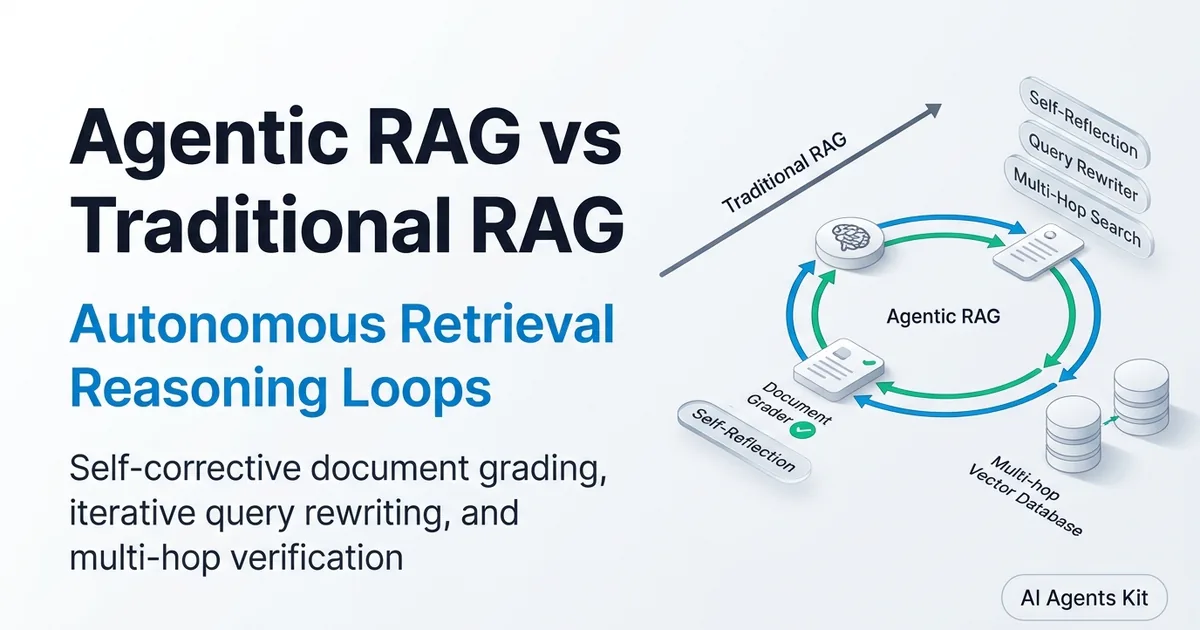
By contrast, agentic RAG wraps the retrieval pipeline in an autonomous decision cycle. Rather than naively feeding the first set of vector matches to a language model, autonomous AI agent workflows evaluate whether retrieved passages actually answer the question. If data is irrelevant or incomplete, the agent rewrites the search query or pulls from alternative tools before generating an answer.
Key Takeaways:
- Traditional RAG follows a rigid, one-way pipeline (Query -> Embed -> Retrieve -> Generate) that cannot recover when initial vector searches return noisy or missing context.
- Agentic RAG replaces static pipelines with stateful reasoning loops, empowering the system to evaluate retrieved chunks, rewrite queries, and coordinate multiple tools.
- Self-RAG and Corrective RAG (CRAG) frameworks introduce automated document grading, routing low-confidence internal searches to live web search fallbacks.
- High-scale production systems implement a 75/25 hybrid pattern, routing straightforward factual questions to fast linear RAG while reserving agentic loops for complex multi-hop queries.
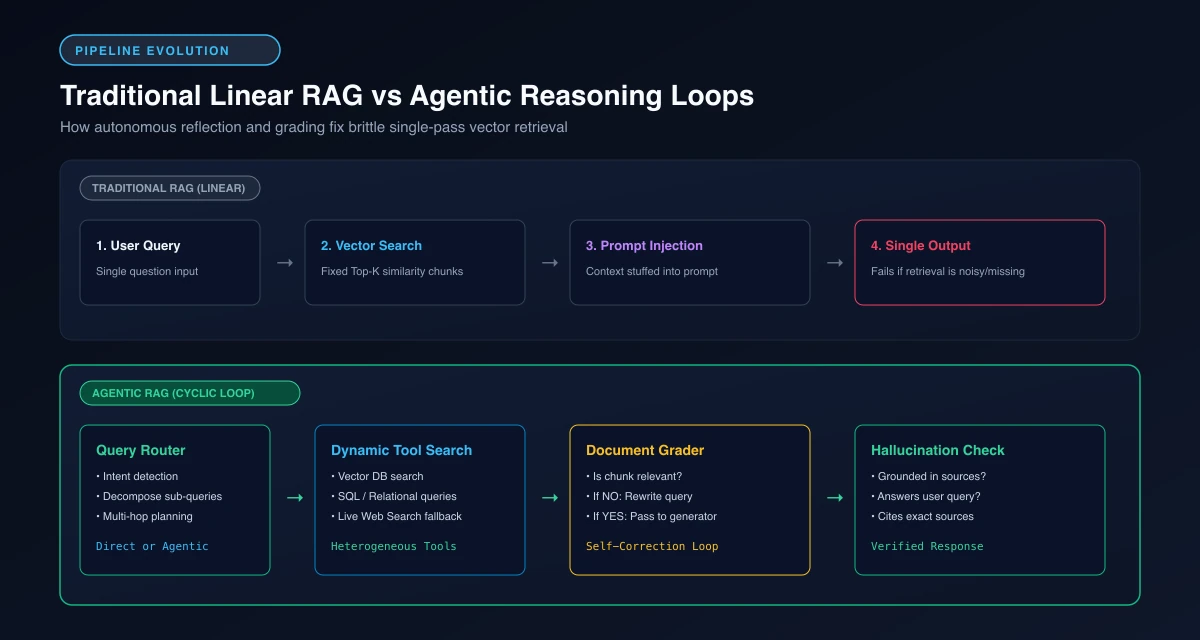 Figure 1: Architectural evolution from linear single-pass retrieval to cyclic agentic RAG, illustrating autonomous query routing, document grading, and self-correction loops.
The Architectural Shift: From Static Pipelines to Autonomous Loops
To understand why the industry is shifting from traditional retrieval to agentic architectures, engineers must examine where linear RAG breaks down. Traditional RAG was designed for straightforward, single-hop factual lookup. It treats information retrieval as an open-loop process with zero feedback mechanisms.
When deciding how to customize language models, teams weigh prompt engineering, external retrieval, and model fine-tuning. Once teams select retrieval as their primary knowledge source, choosing between traditional and agentic architectures determines production reliability.
The Traditional Linear RAG Blueprint (Retrieve and Generate)
Traditional RAG executes a deterministic, single-pass pipeline. The application receives a user prompt, converts it into an embedding vector, performs an approximate nearest neighbor search across a vector index, and stuffs the top matching chunks into the context window.
This architecture works well for simple question-answering over clean, homogeneous documents. If a user asks “What is our company’s parental leave policy?”, a single vector lookup easily retrieves the relevant paragraph. Because the pipeline executes in a fixed sequence, inference is fast and predictable, typically completing within 150 to 300 milliseconds.
Why Single-Pass Vector Search Fails in Production
Production user queries rarely conform to neat, single-hop keyword lookups. Real users ask complex, comparative, or multi-faceted questions that expose the fundamental limitations of single-pass retrieval.
Consider a query like: “Compare our Q3 gross margins for product line A against the regional supply chain inflation reported in our European vendor contracts.” A traditional RAG pipeline converts this entire multi-part sentence into a single embedding.
Because the vector contains conflicting semantic signals, the nearest-neighbor search pulls a muddy blend of semi-relevant chunks. The language model receives fragmented context, fails to reconcile the numbers, and hallucinates an answer to bridge the gap. Traditional pipelines possess no mechanism to inspect the retrieved text and realize that essential data is missing.
Introducing Autonomous Reasoning Loops to Information Retrieval
Agentic RAG solves this fragility by transforming retrieval into a dynamic control loop. Instead of hardcoding execution steps in application logic, control is delegated to a reasoning agent powered by a language model.
The agent assesses the user’s intent and formulates a step-by-step retrieval plan. It decides whether to search, which specialized tools to invoke, and how many distinct queries are required.
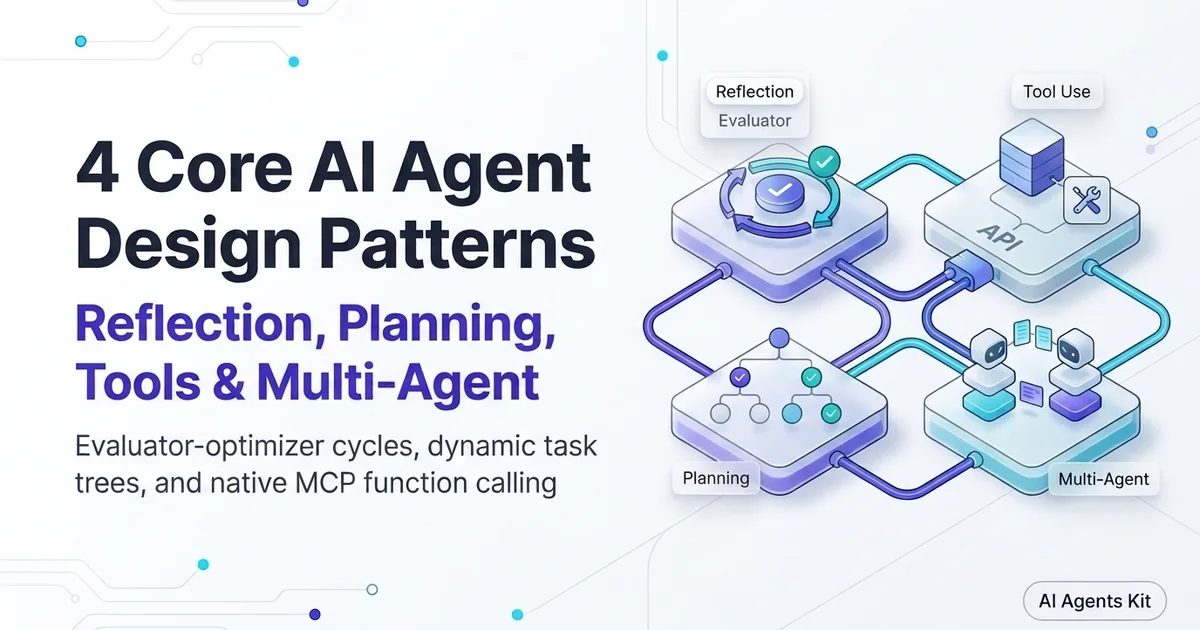
Most importantly, the agent inspects intermediate results before generating text. If retrieved passages fail to answer the question, the system loops back to self-correct. This architecture directly implements the 4 core AI agent design patterns, combining self-reflection and dynamic planning into information retrieval.
Core Mechanics of Agentic RAG: Planning, Routing, and Tool Calling
Moving from a passive retrieval script to an agentic architecture requires three foundational capabilities: query decomposition, tool routing, and iterative context synthesis. These components allow the agent to treat information retrieval as an active investigation.
To understand how underlying vector spaces operate during multi-hop lookup, examine our guide on vector embeddings and semantic search. In agentic architectures, embeddings become one tool among many rather than the sole arbiter of relevance.
Decomposing Complex Queries into Multi-Hop Sub-Tasks
The first responsibility of an agentic retriever is query planning. When confronted with a complex question, the agent decomposes the prompt into discrete, manageable sub-queries.
For example, when asked to compare quarterly financial metrics across two separate business divisions, the agent does not fire a single ambiguous search. Instead, it generates Sub-query 1 targeting Division A’s balance sheet, followed by Sub-query 2 targeting Division B’s filings. By isolating the lookups, each vector search retrieves tightly focused chunks rather than diluted semantic noise.
Heterogeneous Tool Routing Across Vector, SQL, and Web APIs
Traditional RAG assumes all enterprise knowledge resides in a single vector index. In production reality, enterprise data is distributed across relational databases, analytical data warehouses, document stores, and third-party SaaS APIs.
An agentic RAG orchestrator acts as an intelligent router. Given an incoming question, it inspects available tool definitions and routes the request to the appropriate data store:
- Vector Databases: Used for unstructured text, policies, product manuals, and open-ended technical wikis.
- Text-to-SQL Engines: Used for structured relational tables, revenue calculations, inventory counts, and time-series metrics.
- Graph Databases: Used for hierarchical relationships, entity dependencies, and organizational knowledge graphs.
- Search Engine APIs: Used as a dynamic fallback when internal documentation lacks recent world events or public data.
Dynamic Context Assembly and Token Budget Management
As an agent gathers data across multiple tools, it must assemble context intelligently. Naively appending every retrieved document into the conversation prompt quickly exhausts context windows and degrades attention.
Agentic systems maintain a structured scratchpad. The agent reads incoming tool observations, extracts only the quantitative facts or sentences that answer the sub-query, and discards conversational boilerplate. This context compression ensures that the final synthesis step receives high-density facts, keeping token costs low and model reasoning sharp.
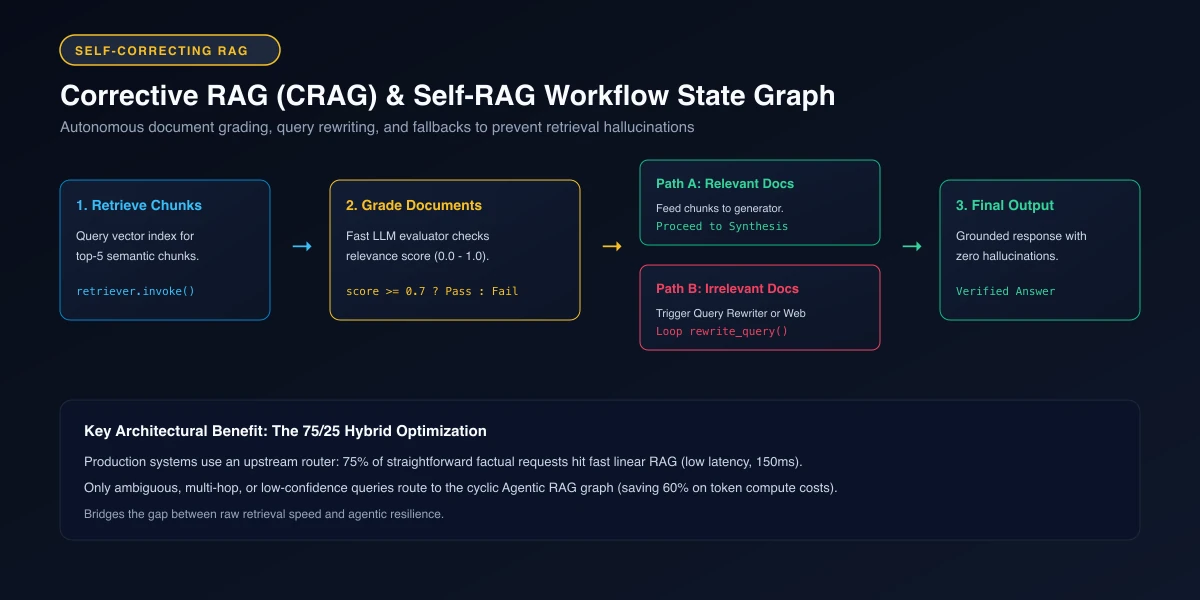 Figure 2: Corrective RAG (CRAG) decision workflow, featuring fast document grading, automated query rewriting, and dynamic fallback to external web retrieval.
Self-Correction Mechanisms: Document Grading and Query Rewriting
The defining characteristic of agentic RAG is self-correction. Instead of assuming every retrieval operation succeeds, modern agentic systems implement verification gates pioneered by academic research.
Empirical benchmarking across multi-hop reasoning datasets shows that Corrective RAG and Self-RAG architectures boost retrieval precision by up to 32% compared to single-pass vector pipelines, while cutting downstream hallucination rates from 21% to below 4%.
Self-RAG Reflection Tokens and Relevance Scoring
Formalized in the landmark Asai et al. Self-RAG Research on arXiv, Self-RAG introduces explicit reflection tokens to evaluate retrieval quality. Rather than generating text unconditionally, the model outputs structured critique tokens that assess relevance.
During execution, a specialized document evaluator node grades each retrieved chunk against the user query. The evaluator determines whether the passage contains factual evidence relevant to the prompt. Chunks that fail this relevance threshold are pruned immediately, preventing noisy distractors from polluting the final prompt context.
Corrective RAG (CRAG) Fallback to Web Search
When internal documents fail relevance evaluation, traditional RAG collapses into hallucination. The architecture detailed in the Yan et al. Corrective RAG (CRAG) Paper on arXiv introduces automated fallback routing.
CRAG categorizes retrieval confidence into three states: Correct, Ambiguous, and Incorrect. If the retrieved documents are scored as Incorrect (meaning the vector database contains zero relevant data), the agent triggers an external web search tool. This dynamic fallback ensures that when internal documentation is incomplete, the system retrieves external ground truth rather than confabulating.
Autonomous Query Reformulation and Semantic Expansion
Often, a retrieval failure is not caused by missing documents, but by poor query phrasing. Users frequently write vague, conversational, or keyword-starved questions that perform poorly in vector cosine similarity.
When an evaluator node flags retrieved chunks as low-confidence, the agent triggers a query rewrite node. The language model analyzes the initial question, removes conversational filler, expands abbreviations, and generates an optimized search query. This rewritten query is re-submitted to the vector index, frequently discovering relevant chunks that the original prompt missed.
Implementing a Self-Correcting RAG Loop with Python and LangGraph
Building a production agentic RAG workflow requires a framework designed for cyclic, stateful graphs. While linear chains struggle with loops, state machine frameworks like LangGraph Framework Documentation provide the exact primitives needed for self-correcting retrieval.
By implementing an explicit state graph, developers can trace every document evaluation, manage retry budgets, and inspect intermediate query rewrites. The following walkthrough constructs an end-to-end self-correcting retrieval loop using Python, LangGraph, and Pydantic validation schemas.
Defining the Agentic RAG State Machine Schema
The foundation of any agentic system is its state schema. The graph state acts as an append-only or mutable memory buffer that tracks the active question, candidate documents, and execution loop counters.
In this implementation, the AgenticRAGState TypedDict container preserves the original query alongside a rewrite_count integer. Bounding the rewrite count directly within the state schema guarantees that cyclic transitions cannot loop indefinitely when database records are missing.
Building the Evaluator-Grader Node with Structured Output
The evaluator-grader node replaces blind prompt concatenation with active inspection. Instead of passing raw vector chunks directly to the generator, a fast classifier model verifies whether each chunk contains sufficient evidence to answer the prompt.
Using Pydantic to enforce strict binary outputs ensures the evaluator cannot output conversational fluff. If a chunk is marked irrelevant, the grader prunes it from the state immediately, shielding the downstream generation prompt from distractor noise.
from typing import List, Literal, TypedDict
from pydantic import BaseModel, Field

# Define state machine memory container
class AgenticRAGState(TypedDict):
    question: str
    documents: List[str]
    rewrite_count: int
    final_answer: str

# Define structured output schema for the document grading evaluator
class DocumentGrade(BaseModel):
    is_relevant: bool = Field(
        description="Binary verdict: True if document contains facts answering the question, else False"
    )
    confidence: float = Field(ge=0.0, le=1.0)

def retrieve_node(state: AgenticRAGState) -> dict:
    """Simulates retrieving top-k chunks from a vector database."""
    question = state["question"]
    # Simulated vector similarity search
    chunks = [
        f"Internal policy regarding {question}: All requests require approval.",
        "Irrelevant boiler plate text discussing unrelated software licensing."
    ]
    return {"documents": chunks}

def grade_documents_node(state: AgenticRAGState) -> dict:
    """Evaluates retrieved chunks and filters out irrelevant context."""
    question = state["question"]
    filtered_docs = []

    for doc in state["documents"]:
        # In production, this call invokes an LLM with DocumentGrade structured output
        is_relevant = "Internal policy" in doc
        if is_relevant:
            filtered_docs.append(doc)

    return {"documents": filtered_docs}

def decide_next_step(state: AgenticRAGState) -> Literal["generate", "rewrite"]:
    """Conditional edge router: loops to rewrite if documents are missing."""
    docs = state.get("documents", [])
    rewrite_count = state.get("rewrite_count", 0)

    # If no relevant docs found and under max loop limit, rewrite query
    if not docs and rewrite_count < 2:
        return "rewrite"
    return "generate"

def rewrite_query_node(state: AgenticRAGState) -> dict:
    """Reformulates question for enhanced vector similarity lookup."""
    current_q = state["question"]
    enhanced_q = f"detailed enterprise specifications for {current_q}"
    return {
        "question": enhanced_q,
        "rewrite_count": state.get("rewrite_count", 0) + 1
    }

def generate_node(state: AgenticRAGState) -> dict:
    """Synthesizes final answer using verified, graded context chunks."""
    docs = state.get("documents", [])
    context = "\n".join(docs) if docs else "No internal records found."
    return {"final_answer": f"Verified Response based on: {context}"}
Wiring Conditional Edges and Query Rewriting Fallbacks
The code block above illustrates the foundational cyclic mechanics of Agentic RAG. Notice how the conditional edge decide_next_step inspects the state after the grading phase.
If document grading filters out all candidate passages, the graph routes execution to rewrite_query_node rather than generating an ungrounded hallucination. The rewriter enriches the search terms with technical synonyms and increments rewrite_count.
Once rewrite_count reaches its ceiling, the conditional edge automatically routes to generate_node. The generator can then emit a transparent fallback message stating that no verified records were found, completely eliminating false confabulation.
Engineering Comparison: Latency, Cost, and Failure Modes
Deploying agentic RAG requires balancing retrieval accuracy against infrastructure costs and latency constraints. The following engineering comparison highlights the trade-offs between traditional and agentic retrieval:
| Operational Dimension | Traditional Linear RAG | Agentic Self-Correcting RAG |
|---|---|---|
| Control Flow Topology | Static, deterministic pipeline | Stateful, cyclic reasoning graph |
| Tool Capabilities | Single vector database index | Multiple heterogeneous stores (SQL, API, Web) |
| Query Flexibility | Simple, single-hop queries | Complex, ambiguous, multi-hop queries |
| Retrieval Verification | None; assumes top-k is correct | Automated document grading node |
| Failure Recovery | None; outputs hallucinations | Automated query rewriting and tool fallback |
| End-to-End Latency | Fast: 150ms to 350ms | Moderate: 800ms to 2,500ms |
| Inference Token Multiplier | 1x baseline token cost | 2.5x to 4.5x baseline token cost |
| Operational Complexity | Low; simple script integration | High; requires tracing and loop guardrails |
The Latency Penalty: 150ms vs Multi-Second Agent Loops
The primary operational cost of agentic RAG is added latency. Traditional RAG requires exactly one retrieval operation and one LLM generation call, delivering responses in under 300 milliseconds.
Agentic RAG involves multiple sequential model invocations: query decomposition, document grading, conditional branching, and potential query reformulation. If an agent loops twice to refine search queries, end-to-end wall-clock latency can reach 2 to 3 seconds. For conversational autocomplete or real-time voice agents, this latency penalty can be prohibitive.
Token Multipliers and Context Window Economics
Agentic workflows consume significantly more tokens than static pipelines. Each step in the loop (routing decisions, document grading passes, and query expansions) requires sending prompt tokens to the LLM.
In complex workflows, an agentic retrieval turn consumes between 2.5x and 4.5x more tokens than a linear pipeline. Engineering teams must calculate whether the financial cost of extra tokens is justified by the reduction in hallucination risk for their specific use case.
The 75/25 Hybrid Architecture: Fast Routing with Agentic Fallbacks
To resolve the tension between latency and accuracy, mature enterprise architectures rarely deploy 100% agentic RAG across all traffic. Instead, they implement a 75/25 hybrid routing pattern.
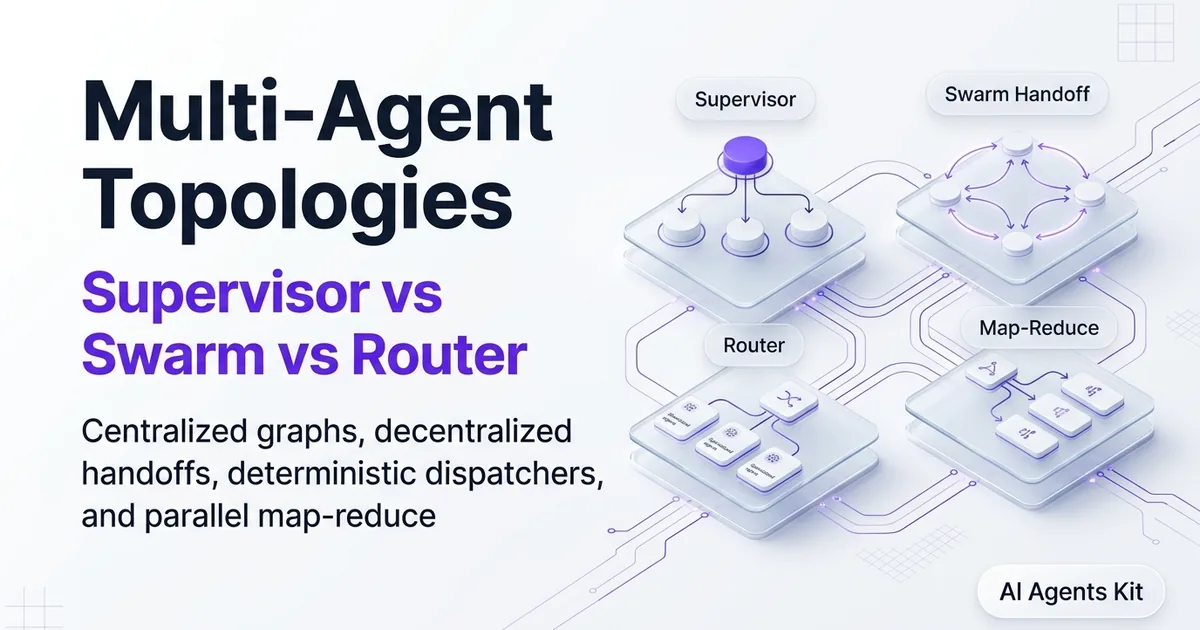
An upstream intent classifier inspects the incoming user query. For straightforward, high-confidence factual requests (roughly 75% of typical enterprise volume), the system dispatches to fast, low-cost traditional RAG. Only when queries are classified as ambiguous, multi-hop, or high-risk does the router dispatch to the cyclic agentic graph. For teams scaling multi-model systems, review our complete guide on multi-agent coordination topologies.
Production Troubleshooting: Managing Loops and Hallucination Gates
Operating cyclic agentic graphs in production introduces failure modes that never occur in linear software pipelines. Here is how senior engineering teams debug and stabilize agentic RAG deployments.
Bounding Infinite Retrieval and Query Rewrite Loops
The most dangerous failure mode in agentic RAG is the infinite retrieval loop. If an agent fails to find relevant documents, and its query rewriter repeatedly produces equally unhelpful search terms, the system loops until it exhausts API rate limits.
Remediation Protocol:
- Enforce a strict hard limit on loop iterations in your graph schema (maximum of 2 or 3 rewrite attempts).
- Maintain an immutable
rewrite_countinteger in state, incremented at every cycle. - When
rewrite_countcrosses the threshold, force a conditional transition to a deterministic fallback node that politely admits the information is unavailable or flags the ticket for human review.
Tuning Document Grader Temperature and Thresholds
If your document evaluator model is overly aggressive, it will reject valid documents, triggering unnecessary query rewrites and inflating latency. If it is too lenient, it permits irrelevant text to enter the generator context.
Remediation Protocol:
- Always set the document grader model temperature to
0.0for deterministic scoring. - Use lightweight, fast models (such as Claude Haiku or GPT-4o-mini) for grading to minimize latency overhead.
- Require the grader to output structured JSON with both a binary verdict and a numeric confidence score, allowing you to tune the rejection threshold empirically against offline evaluation datasets.
Eliminating Hallucinations with Source Grounding Verification
Even when relevant documents are provided, language models can still introduce external training bias or extrapolate beyond the provided text.
Remediation Protocol:
- Place a final Hallucination Grader node between generation and user delivery.
- Prompt the verification node to verify that every quantitative metric and factual claim in the generated answer exists verbatim within the cited context chunks.
- If the verification node detects an unsupported claim, reject the draft and regenerate with a higher strictness penalty, ensuring zero ungrounded responses reach end users.
Frequently Asked Questions
What is the main difference between traditional RAG and agentic RAG?
Traditional RAG uses a static linear pipeline that retrieves top-k documents once and generates an answer without checking relevance. Agentic RAG uses an autonomous reasoning loop that evaluates retrieved documents, rewrites queries when data is missing, and queries multiple tools before finalizing output.
Why does traditional RAG fail on complex queries?
Traditional RAG relies on a single vector search step that struggles with multi-part questions, ambiguous phrasing, or queries requiring information spread across different tables. If the initial search misses the necessary context, the generator has no mechanism to recover and frequently hallucinates.
How does document grading work in agentic RAG?
A fast evaluator model inspects each retrieved text chunk against the user query and assigns a binary pass or fail relevance score. If all documents fail evaluation, the agent triggers a query rewriter or falls back to live web search rather than passing corrupt context to the generator.
What is the latency penalty of agentic RAG compared to standard RAG?
Traditional RAG completes in 100 to 300 milliseconds because it makes only one retrieval call and one model generation call. Agentic RAG requires multiple reasoning, grading, and potential re-search steps, resulting in latencies ranging from 800 milliseconds to 2.5 seconds.
How does Corrective RAG (CRAG) handle missing documents?
When the document evaluator detects that retrieved internal chunks are insufficient or irrelevant, Corrective RAG automatically formulates a search query and queries an external search engine. This dynamic web fallback ensures the language model receives fresh, relevant context even when private databases lack the answer.
What is 75/25 hybrid query routing in enterprise RAG systems?
Hybrid routing uses a lightweight classifier to send approximately 75% of straightforward factual questions to fast, inexpensive traditional RAG. Only the remaining 25% of complex, ambiguous, or multi-hop queries are routed to the more expensive, multi-step agentic reasoning loop.