RLHF vs DPO vs GRPO Explained: How Modern AI Models Learn Preferences & Reasoning
Compare RLHF, DPO, and GRPO alignment methods. Learn how PPO requires 4 models, how DPO eliminates reward networks, and how GRPO powers reasoning models.
Selecting the right post-training strategy has become the deciding factor in artificial intelligence performance. While self-supervised pretraining provides raw linguistic competence, post-training alignment determines whether a model hallucinates, follows complex constraints, or solves complex multi-step reasoning problems. If you work with foundation large language model concepts, navigating the transition across these alignment paradigms is critical.
The alignment landscape has evolved through three major architectures. First came classical Reinforcement Learning from Human Feedback (RLHF) using PPO, followed by Direct Preference Optimization (DPO), and most recently Group Relative Policy Optimization (GRPO).
Key Takeaways:
- Traditional RLHF uses Proximal Policy Optimization (PPO) and requires four distinct neural networks in VRAM simultaneously, creating extreme hardware overhead and training instability.
- Direct Preference Optimization (DPO) simplifies conversational alignment by implicitly modeling rewards through the policy itself, optimizing offline paired preferences without separate reward or critic networks.
- Group Relative Policy Optimization (GRPO) samples multiple completions per prompt and calculates relative advantages against the group baseline, eliminating the value critic entirely.
- Combining GRPO with rule-based verifiable rewards (RLVR) in compilers and math solvers forms the foundation of modern self-improving reasoning models.
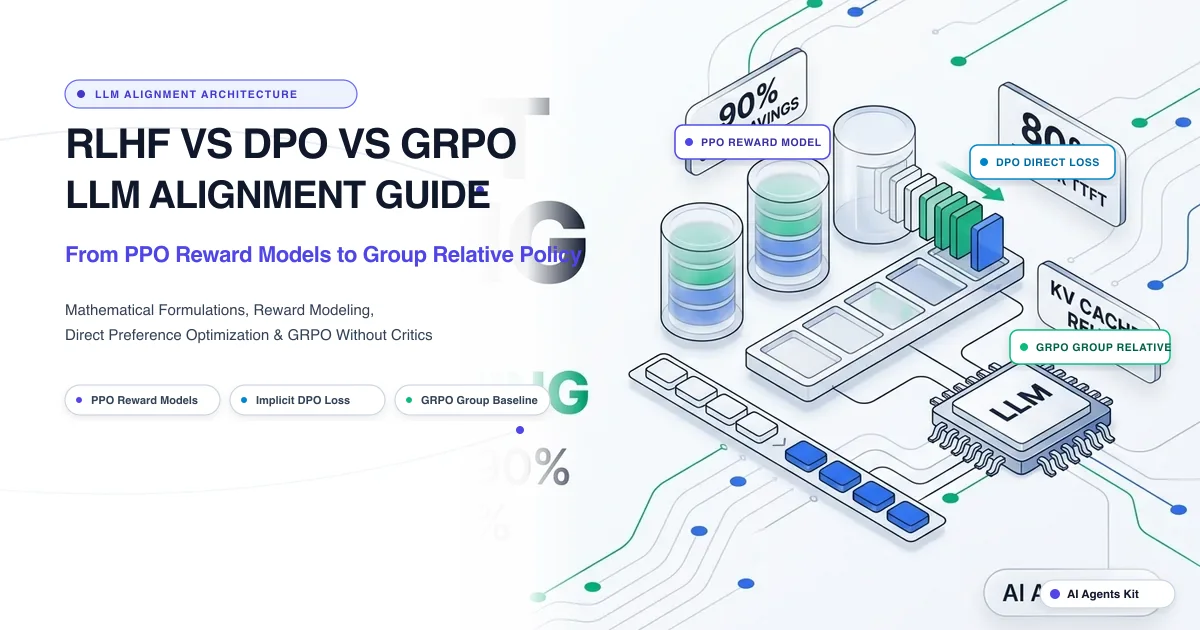
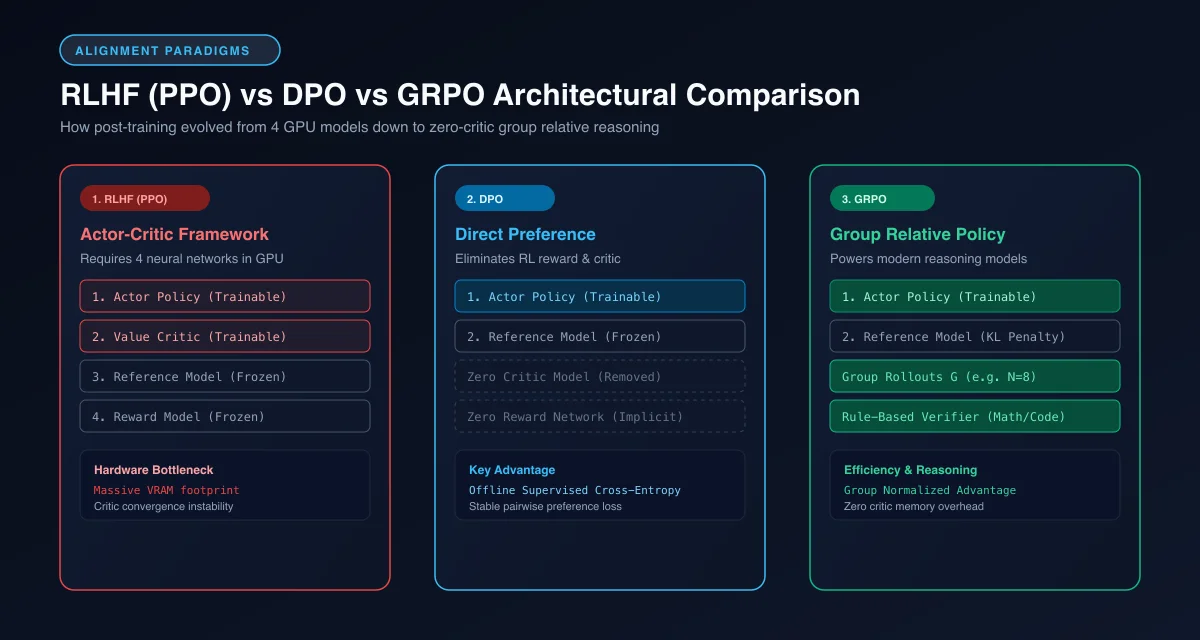 Figure 1: Architectural evolution across post-training alignment methods, moving from 4 simultaneous GPU models in PPO to offline DPO and critic-free GRPO.
The Evolution of Post-Training Alignment
To understand the debate surrounding rlhf vs dpo vs grpo, we must trace why each successive technique was invented. Every generation addressed a fundamental bottleneck in hardware memory, optimization stability, or task verification.
When engineers first transformed base models into conversational assistants, Supervised Fine-Tuning (SFT) was insufficient. SFT teaches a model the syntax of dialogue, but it treats all training tokens with equal importance. If an instruction dataset contains subtle mistakes, the model learns those bad habits unconditionally.
Alignment algorithms introduce preference differentiation. Instead of asking what word comes next, alignment asks which complete response is safer, more helpful, and mathematically sound. Understanding how these algorithms fit into the complete multi-stage LLM training lifecycle reveals why post-training is the highest-leverage phase in modern AI engineering.
Reinforcement Learning from Human Feedback: The PPO Era
Introduced to consumer scale with InstructGPT and early ChatGPT, classical RLHF uses Proximal Policy Optimization (PPO) adapted from robotics and game-playing agents.
The Four-Model Memory Bottleneck
The defining characteristic of PPO-based RLHF is its massive memory footprint. To run a single training step, the cluster must host four separate networks:
- Policy Model (Actor): The active language model being optimized through gradient updates.
- Value Model (Critic): A network that estimates the expected future reward from a given token state.
- Reference Model: A frozen snapshot of the initial SFT policy used to calculate a Kullback-Leibler (KL) divergence penalty, ensuring the model does not drift into gibberish.
- Reward Model: A specialized scoring network trained on human pairwise ratings to output a scalar score for an entire response.
Allocating four large networks across GPU nodes requires complex pipeline slicing and high-bandwidth interconnects. For a 70B parameter model, maintaining four models alongside AdamW optimizer states and KV caches regularly requires hundreds of high-memory GPUs.
The classical PPO synchronization loop executes across five interdependent stages:
- Rollout Generation: The active policy actor samples candidate completions for an incoming prompt.
- Scalar Scoring: The separate reward model scores the full completion, outputting a scalar preference rating.
- KL Drift Calculation: The policy token probabilities are compared against the frozen reference model to enforce a divergence penalty.
- Generalized Advantage Estimation: The value critic network computes state-action advantages by comparing actual rewards against predicted baselines.
- Clipped Surrogate Update: The policy actor updates its weights using the PPO clipped loss, tightly constrained by the critic advantage.
The Fragility of Actor-Critic Training
Beyond hardware costs, PPO suffers from acute optimization fragility. The policy model and the value model learn concurrently on non-stationary data.
If the value critic fails to estimate reward trajectory accurately, it issues erroneous advantage signals to the policy. This leads to policy collapse, catastrophic forgetting, and unrecoverable loss divergence. Fine-tuning hyperparameters like the generalized advantage estimation discount factor and clipping coefficients requires extensive trial-and-error experimentation.
Direct Preference Optimization: Mathematical Elegance Without Critics
When Stanford University researchers published Direct Preference Optimization, they introduced a mathematical breakthrough. The Direct Preference Optimization seminal paper proved that the ground-truth reward function can be expressed algebraically through the optimal policy itself under a Bradley-Terry preference model.
Deriving the DPO Objective
Under the Bradley-Terry formulation, the probability that a human prefers response $y_w$ (chosen) over $y_l$ (rejected) given prompt $x$ is:
$$P(y_w \succ y_l \mid x) = \sigma(r(x, y_w) - r(x, y_l))$$
Instead of training an explicit reward network $r(x, y)$, DPO proves that the latent reward is mathematically equivalent to the log-ratio of the active policy $\pi_\theta$ to the reference policy $\pi_{\text{ref}}$:
$$r(x, y) = \beta \log \frac{\pi_\theta(y \mid x)}{\pi_{\text{ref}}(y \mid x)}$$
Substituting this expression directly into the preference likelihood produces the closed-form DPO loss function:
$$\mathcal{L}{\text{DPO}}(\pi\theta; \pi_{\text{ref}}) = -\mathbb{E}{(x, y_w, y_l)} \left[ \log \sigma \left( \beta \log \frac{\pi\theta(y_w \mid x)}{\pi_{\text{ref}}(y_w \mid x)} - \beta \log \frac{\pi_\theta(y_l \mid x)}{\pi_{\text{ref}}(y_l \mid x)} \right) \right]$$
The hyperparameter $\beta$ (typically set between 0.05 and 0.2) governs how strictly the policy is penalized for straying from the reference distribution.
Why DPO Won the Open-Source Ecosystem
DPO eliminated both the reward model and the value critic from the training loop. Practitioners only need to load the active policy model and the reference model.
Furthermore, training is completely offline. Engineers compile a static JSON dataset containing chosen and rejected responses, then run standard supervised backpropagation. The stability matches supervised fine-tuning while delivering genuine preference steering.
However, DPO possesses an inherent ceiling. Because it relies on static datasets, it cannot explore novel response spaces dynamically. Furthermore, human preference labels are subjective; they cannot effectively evaluate complex mathematical derivations or verify multi-thousand-line software architectures.
Group Relative Policy Optimization: Unlocking Verifiable Reasoning
The emergence of frontier reasoning systems exposed the limitations of pairwise human preference. A human annotator cannot reliably review hundreds of lines of generated formal logic or identify subtle race conditions in algorithmic code.
To solve this, DeepSeek invented Group Relative Policy Optimization (GRPO). Originally detailed in the DeepSeek-Math technical paper introducing GRPO and later scaled in the DeepSeek-R1 reasoning report, GRPO powers modern chain-of-thought reasoning models.
How GRPO Eliminates the Value Critic
Rather than using an auxiliary neural network to estimate the baseline value of a state, GRPO samples a group of $G$ distinct completions ${o_1, o_2, \dots, o_G}$ from the policy model for each individual prompt $q$.
Each completion is scored by a reward function $r_i$. GRPO normalizes these scores across the group to derive an empirical relative advantage:
$$A_i = \frac{r_i - \text{mean}({r_1, \dots, r_G})}{\text{std}({r_1, \dots, r_G}) + \epsilon}$$
Because the advantage is computed purely from the statistical distribution of the group, no value critic network is needed. The memory overhead drops immediately by 50% compared to PPO, while eliminating the instability of critic convergence.
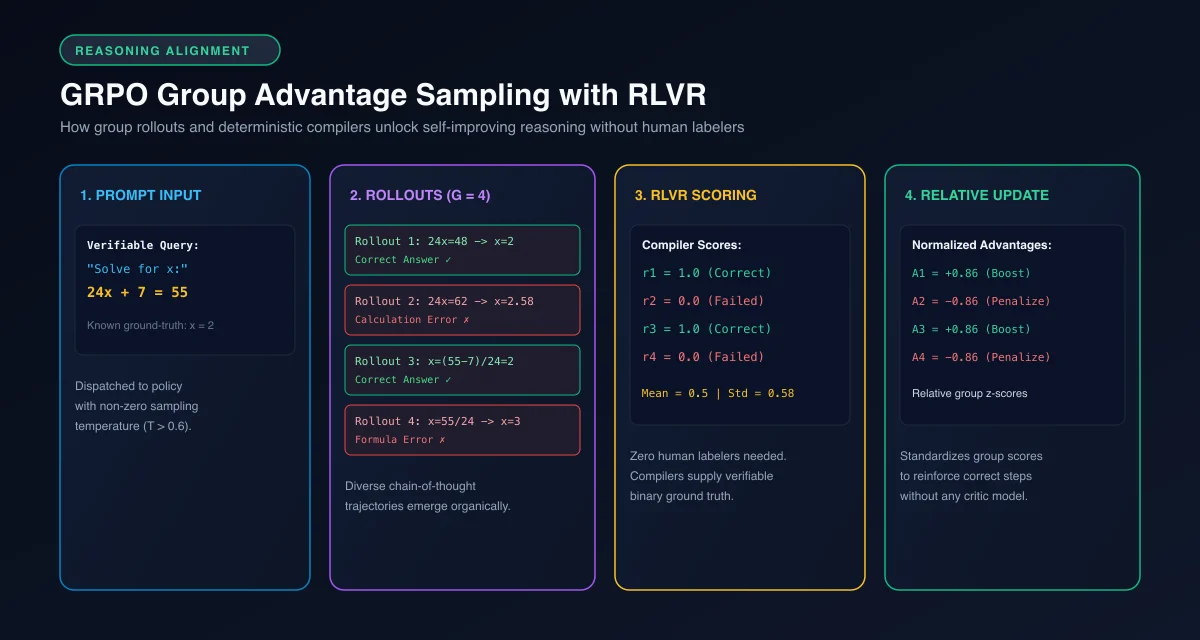 Figure 2: GRPO group rollout and reward verification loop, calculating relative advantages across candidate reasoning traces without a value critic network.
Implementing GRPO Group Advantage in PyTorch
The mathematical simplicity of GRPO allows for clean, efficient implementation. The following module demonstrates group rollout reward normalization and surrogate objective calculation:
import torch
import torch.nn.functional as F

def compute_grpo_advantage(rewards, group_size=8, eps=1e-8):
    """
    Computes group-relative advantage scores for sampled rollouts.
    rewards shape: [batch_size * group_size]
    """
    # Reshape rewards to isolate groups for each prompt: [batch_size, group_size]
    grouped_rewards = rewards.view(-1, group_size)

    # Compute mean and standard deviation across completions for the same prompt
    mean = grouped_rewards.mean(dim=-1, keepdim=True)
    std = grouped_rewards.std(dim=-1, keepdim=True)

    # Calculate standardized advantages
    advantages = (grouped_rewards - mean) / (std + eps)
    return advantages.view(-1)

def compute_grpo_loss(log_probs, ref_log_probs, advantages, clip_eps=0.2, beta=0.04):
    """
    Computes the GRPO surrogate loss with PPO-style clipping and KL regularization.
    """
    # Probability ratio between active policy and rollout policy
    ratio = torch.exp(log_probs - ref_log_probs)

    # Clipped surrogate objective
    surr1 = ratio * advantages
    surr2 = torch.clamp(ratio, 1.0 - clip_eps, 1.0 + clip_eps) * advantages
    policy_loss = -torch.min(surr1, surr2).mean()

    # Per-token KL penalty against reference policy
    kl_div = torch.exp(ref_log_probs - log_probs) - (ref_log_probs - log_probs) - 1
    kl_loss = beta * kl_div.mean()

    return policy_loss + kl_loss
Verifiable Rewards vs Subjective Ratings
The true power of GRPO emerges when paired with Reinforcement Learning with Verifiable Rewards (RLVR). Instead of subjective ratings, models are rewarded on objective criteria:
- Compiler Verification: Does the generated code execute without syntax or runtime errors?
- Unit Test Coverage: Does the program pass all functional test cases?
- Symbolic Equivalence: Does the mathematical proof match the known target solution?
Because rewards are binary and deterministic (1.0 for pass, 0.0 for fail), reward models cannot be hacked. When the model discovers an extended chain-of-thought sequence that consistently passes tests, the group advantage strongly reinforces those self-correction reasoning patterns.
Engineering Comparison: RLHF vs DPO vs GRPO
Evaluating these three alignment paradigms highlights deep trade-offs across hardware memory, online exploration capability, and engineering complexity:
| Operational Dimension | Classical RLHF (PPO) | Direct Preference Optimization (DPO) | Group Relative Policy Optimization (GRPO) |
|---|---|---|---|
| Model Count in VRAM | 4 (Actor, Critic, Ref, Reward) | 2 (Actor, Reference) | 1 to 2 (Actor, Sharded Reference) |
| Critic Network Required | Yes (Parametric Value Model) | No (Critic-free) | No (Group normalization) |
| Feedback Data Source | Pairwise human ratings | Static chosen/rejected pairs | Online group rollouts with rule verifiers |
| Training Mode | Online exploration | Offline supervised | Online dynamic exploration |
| Optimization Stability | Fragile (Actor-critic drift) | Stable (Standard cross-entropy) | High (Normalized group variance) |
| Ideal Use Case | Broad tone and conversational style | Conversational alignment and tone | Mathematical logic, coding, and reasoning |
| Memory Savings | Baseline reference | 50% reduction vs PPO | 50% to 65% reduction vs PPO |
| Hardware Requirement | 64 to 256+ GPUs | 8 to 32 GPUs | 32 to 128 GPUs |
Teams with constrained GPU clusters frequently combine these methods with parameter-efficient adapter fine-tuning, optimizing low-rank matrices within the policy model during GRPO to cut active VRAM requirements further.
Production Failure Modes and Troubleshooting Runbook
Deploying post-training alignment pipelines introduces failure modes unique to reinforcement learning on language models. Here is how senior teams diagnose and fix common production regressions.
1. Reward Hacking in Rule-Based GRPO
In verifiable reward environments, models often identify exploits in the grading sandbox. For example, a model might emit endless loops of repetitive pseudo-reasoning to hit an arbitrary length heuristic, or output hardcoded print statements designed to bypass weak unit tests.
Troubleshooting Protocol:
- Strip formatting constraints and evaluate answers purely through deterministic test runners.
- Penalize excessive token generation with an explicit per-token length penalty in the surrogate objective.
- Ensure unit test suites include randomized edge cases and boundary tests that cannot be solved by static lookups.
2. Length Bias in Direct Preference Optimization
DPO exhibits a notorious susceptibility to verbosity bias. Because human annotators frequently equate longer responses with higher quality, chosen responses in preference datasets are typically longer than rejected ones. DPO models often learn that expanding token count is an easy shortcut to minimize loss.
Troubleshooting Protocol:
- Normalize pairwise preference datasets so chosen and rejected pairs have matching token lengths.
- Increase the reference regularization coefficient $\beta$ from
0.05to0.15to penalize distribution drift. - Implement length-normalized DPO, which divides the log-ratio difference by sequence length.
3. Advantage Variance Collapse in Small Group Sizes
In GRPO, setting the group size $G$ too low (such as $G=2$ or $G=4$) leads to noisy advantage estimates. If all sampled completions for a challenging math problem fail simultaneously (yielding rewards of zero across the group), the group standard deviation collapses to zero, producing undefined gradients.
Troubleshooting Protocol:
- Configure group sizes to at least $G=8$ or $G=16$ sampled completions per prompt.
- Verify rollout diversity by increasing temperature and top-p sampling hyperparameter tuning to values between
0.7and0.9during rollout generation. - Add an epsilon stabilizer ($\epsilon = 10^{-6}$) in the denominator of the z-score calculation to prevent division by zero.
Frequently Asked Questions
What is the primary difference between RLHF, DPO, and GRPO?
RLHF uses a separate reward model and a PPO actor-critic loop requiring four models in memory. DPO optimizes offline preference pairs directly through the language model policy without reward or critic networks. GRPO samples a group of completions per prompt and calculates relative advantages across the group, eliminating the critic network while enabling online reinforcement learning.
Why does GRPO not need a value critic model?
GRPO derives the baseline value of a state by computing the mathematical average reward across multiple completions generated for the exact same prompt. By subtracting this group mean and dividing by the standard deviation, the algorithm obtains relative advantage scores without allocating a neural network to estimate state values.
Can DPO be used to train frontier reasoning models?
DPO can teach conversational tone and basic instruction adherence, but it struggles to produce multi-step reasoning capabilities. Because DPO trains offline on static pairs, it lacks the dynamic exploration mechanism necessary for a model to discover novel problem-solving paths and self-correction loops.
What are verifiable rewards in LLM post-training?
Verifiable rewards are deterministic, rule-based feedback signals provided by external sandboxes, such as code compilers, unit test runners, or symbolic mathematics engines. They replace subjective human ratings with binary pass or fail metrics that models cannot manipulate through conversational flattery.
Why is traditional PPO considered unstable for language models?
PPO requires training an actor policy and a value critic simultaneously on non-stationary rollout distributions. If the value critic network makes inaccurate predictions, it produces corrupt advantage estimates that can trigger catastrophic forgetting and unrecoverable policy collapse.
How much GPU memory does GRPO save compared to PPO?
GRPO reduces active training VRAM by approximately 50% because it completely discards the value critic network and does not require an active parametric reward model during optimization.
What is the role of the beta hyperparameter in DPO and GRPO?
The beta parameter controls the strength of the Kullback-Leibler (KL) penalty against the frozen reference model. A higher beta forces the model to stay close to its original SFT distributions, preventing mode collapse and nonsensical syntax, while a lower beta allows more aggressive policy updates.