Best Free Official AI Courses With Certificates: Anthropic, OpenAI & Hugging Face
Master modern AI with free official vendor courses. Compare Anthropic Academy, OpenAI Cookbook labs, and Hugging Face certified agent courses in 2026.
Spending thousands of dollars on third-party commercial bootcamps to learn artificial intelligence is one of the biggest financial traps in modern tech education. Many commercial courses teach obsolete prompt tricks, rely on outdated model APIs, and charge hefty fees for generic attendance certificates that technical hiring managers routinely disregard.
The frontier AI labs that build foundation models offer their own official, interactive educational academies completely free of charge. Launching your learning journey begins with our foundational guide on how to learn AI without a tech background. By studying directly from primary research labs, you master active SDK primitives, production architecture patterns, and real-world system evaluation directly from the source.
Key Takeaways
- Official learning academies hosted directly by frontier AI research labs provide superior technical training compared to expensive generic commercial bootcamps.
- Anthropic Academy delivers structured, self-paced certification tracks covering interactive prompt engineering, Claude API integration, and the Model Context Protocol.
- The Hugging Face Agents Course provides a 100% free, four-unit certified curriculum that issues verifiable credential PDFs via Hugging Face Spaces.
- A structured six-week self-study roadmap combining Anthropic, OpenAI, and Hugging Face equips builders with production agent skills without spending a single dollar.
This comprehensive guide audits the leading free official AI academies available today. You will discover how Anthropic Academy, OpenAI’s developer curriculum, and Hugging Face’s certified courses compare across syllabus depth, hands-on tool labs, and verifiable credentials.
The Official Vendor Academy Landscape: Why Lab Courses Beat Paid Bootcamps
Commercial bootcamps and subscription learning portals struggle to keep pace with rapid foundation model releases. A paid curriculum recorded six months ago often teaches deprecated SDK function signatures and ignores modern protocol standards like MCP.
Official vendor academies maintained by Anthropic, OpenAI, and Hugging Face eliminate this obsolescence. Because these research organizations invent the underlying architectures, their developer training materials reflect the exact state of frontier AI engineering.
The Collapse of Generic Commercial Bootcamps
Generic educational platforms typically assemble surface-level curricula focused on basic consumer chatbots. Students spend weeks learning how to write simplistic paragraph prompts rather than building production software integrations.
These commercial programs charge between $1,500 and $8,000 while offering zero proprietary insights into model mechanics. In contrast, official lab courses teach the exact operational techniques frontier researchers use internally to benchmark, align, and orchestrate systems.
Furthermore, commercial certificates lack verification infrastructure. Anyone can claim a digital badge from an unaccredited course aggregator, leading technical recruiters to prioritize verifiable code repositories and vendor-backed certifications instead. Compare formal industry credentials in our guide to the best AI certifications.
Direct API Access and First-Party SDK Alignment
When you enroll in an official vendor curriculum, your code exercises execute against the primary lab APIs using official client libraries. You learn how to handle streaming server-sent events, configure structured JSON output schemas, and manage context window caching.
First-party courses teach defensive engineering patterns from day one. You learn how to inspect API headers for rate limits, handle connection timeouts gracefully, and serialize tool parameters according to formal specifications.
Third-party courses frequently introduce unnecessary intermediary wrapper libraries that obscure under-the-hood API mechanics. Mastering the raw vendor SDKs ensures your applications remain maintainable and resilient across future major model updates.
Verifiable Digital Badges and Industry Recognition
Completing an official vendor curriculum earns verifiable credentials that carry genuine technical weight. Anthropic partners with Skilljar to issue digitally signed certificates of completion that tie directly to verified corporate email domains.
Hugging Face provides an automated verification app hosted on Hugging Face Spaces that checks your quiz passing scores and model submissions before minting an official PDF certificate. These credentials verify that you wrote working Python code, resolved real-world benchmark challenges, and passed rigorous technical exams.
Hiring managers respect these credentials because they demonstrate hands-on competence with current enterprise tooling rather than passive video consumption.
Anthropic Academy Deep Dive: Claude Prompting, MCP Protocols, and Certified Labs
Anthropic offers one of the most practical and well-structured educational ecosystems in the AI industry. Distributed across the official Claude Academy portal (hosted on Skilljar) and open-source GitHub repositories, Anthropic’s courses focus heavily on developer architecture and system safety.
Interactive Prompt Engineering and Context Design
Anthropic’s interactive prompt engineering curriculum moves far beyond basic conversational prompting. The course teaches developers how to construct multi-layered context architectures utilizing XML tags, structured few-shot examples, and chain-of-thought scratchpads.
Students learn how to separate system instructions from variable user inputs, preventing prompt injection attacks and guaranteeing consistent enterprise formatting. Hands-on exercises show how to configure temperature and top-p sampling to balance factual determinism against creative variance.
The interactive labs execute directly inside self-paced web environments or local Jupyter notebooks, providing instant execution feedback on prompt efficacy.
Model Context Protocol (MCP) Server Development
Anthropic’s curriculum stands out for its deep, hands-on training on the Model Context Protocol. Rather than treating Claude as an isolated chat interface, the course guides developers through building custom MCP servers from scratch.
Students learn how to expose database schemas as readable resources, define secure tool execution primitives with JSON Schema validation, and connect Claude Desktop directly to enterprise systems. For complete protocol specifications and deployment steps, explore our architectural guide on model Context Protocol architecture overview.
All code examples use official TypeScript and Python SDKs maintained in the Anthropic Official Courses GitHub Repository.
Earning Verified Anthropic Skilljar Digital Certificates
Anthropic tracks student progress through structured module assessments. To earn an official certificate of completion, developers must complete all interactive lesson modules and score at least 80% on end-of-unit knowledge checks.
Upon passing the final assessment, the portal generates an official, shareable digital certificate. The credential displays your full name, the specific technical curriculum mastered, the date of issue, and a unique cryptographic verification identifier.
You can embed this credential directly on your LinkedIn profile or portfolio site, verifying your competence in frontier Claude engineering to enterprise employers.
OpenAI Academy and Developer Tracks: Function Calling, Evals, and Cookbook Recipes
While OpenAI maintains an extensive documentation portal, its most powerful educational resource is the OpenAI Cookbook. Combined with free short courses hosted in partnership with DeepLearning.AI, OpenAI provides an exhaustive engineering curriculum for building production applications.
Structured Outputs and Reliable Function Calling
OpenAI’s official developer tutorials center on converting natural language into structured, type-safe API calls. The curriculum teaches developers how to enforce strict JSON Schema outputs, ensuring the model never returns malformed syntax that crashes downstream databases.
Students build end-to-end function calling pipelines that allow models to extract structured data from unstructured contracts, query weather endpoints, and update customer records. The training emphasizes defensive schema design, teaching engineers how to write descriptive docstrings that help the model select the correct tool.
These tracks also cover prompt caching economics, demonstrating how to save up to 90% on input token costs by structuring static context prefixes efficiently.
DeepLearning.AI Partnership Courses with Andrew Ng
OpenAI collaborates directly with Andrew Ng and the DeepLearning.AI team to publish free, one-hour masterclasses taught by core OpenAI research scientists. Prominent free offerings include:
- ChatGPT Prompt Engineering for Developers: Co-taught by Isa Fulford (OpenAI) and Andrew Ng, covering programmatic text processing, summarization, and inference.
- Building Systems with the ChatGPT API: Focuses on multi-step workflows, prompt evaluation chains, and system safety checks.
- Function Calling and Data Extraction with LLMs: Explores JSON Schema validation and multi-tool orchestration.
Each course features an interactive, in-browser Jupyter notebook environment where students run live API calls without needing their own paid API keys. Complete architectural recipes are cataloged in the OpenAI Official Developer Cookbook Repository.
OpenAI Cookbook Production Recipes and Evaluation Suites
The OpenAI Cookbook functions as a living, community-verified masterclass. It contains hundreds of copy-paste Python recipes covering semantic cache implementation with Redis, hybrid vector retrieval with pgvector, and automated evaluation pipelines.
The curriculum places heavy emphasis on Evaluation-Driven Development (EDD). Students learn how to build automated evaluation suites that run hundreds of synthetic test cases against model updates, quantifying accuracy regressions before code reaches production.
Hugging Face Certified Courses: Open NLP, smolagents, and Verifiable Credentials
Hugging Face provides the foremost educational ecosystem for open-source AI engineering. Known globally as the collaborative hub for open-weight models, Hugging Face offers three massive, 100% free courses: the NLP Course, the Deep Reinforcement Learning Course, and the brand-new AI Agents Course.
Unit Breakdown: From Agent Fundamentals to GAIA Benchmarks
The Hugging Face Open Source AI Agents Course represents the gold standard for free, certified agent education. The course divides into four comprehensive units:
- Unit 1: Agent Fundamentals: Unpacks the ReAct reasoning loop, tool execution mechanics, and chat template formatting.
- Unit 2: Framework Deep Dive: Hands-on implementation across
smolagents, LangGraph, and LlamaIndex. - Unit 3: Use Cases & Agentic RAG: Building multi-step research assistants and automated document processing pipelines.
- Unit 4: Benchmarking and Evaluation: Testing autonomous agents against rigorous real-world benchmarks like GAIA.
To apply these agentic patterns in your local development environment, follow our practical tutorial on how to build your first AI agent in Python.
Hands-On smolagents, LangGraph, and LlamaIndex Tool Calling
Hugging Face’s curriculum avoids vendor lock-in by teaching multi-framework fluency. Students learn how to build lightweight, single-file agents using smolagents, as well as stateful, cyclic agent graphs using LangGraph.
The exercises require students to implement real tool interfaces, such as executing Python code inside isolated sandboxes, browsing web pages via DuckDuckGo, and querying vector databases. Students run code directly in free Google Colab notebooks backed by Hugging Face Inference Endpoints.
Claiming Your Verifiable Certificate on Hugging Face Spaces
Hugging Face implements a transparent, merit-based certification system:
- Pass Comprehension Quizzes: Complete all four course units and score 80% or higher on each unit’s technical comprehension quiz.
- Submit Working Code: Submit your functional agent to the community course leaderboard.
- Generate Official Credential: Visit the official Hugging Face Spaces Certificate Application and sign in with your profile to generate your signed PDF.
The resulting certificate displays a permanent, publicly shareable verification URL hosted on Hugging Face. The document certifies your verified test scores and confirmed agent submissions, providing verifiable proof of your technical capabilities.
The Curated 6-Week Zero-Dollar Self-Study Syllabus for Builders
To turn these disparate free resources into an actionable career transformation, follow this structured, six-week self-study syllabus. Dedicating five to seven hours per week will take you from basic concepts to certified agent builder.
| Week | Focus Domain | Primary Academy Track | Core Deliverable |
|---|---|---|---|
| Week 1 | Prompt Architecture & Context Engineering | Anthropic Academy: Prompt Design Track | Build a structured XML context parser for document extraction |
| Week 2 | API Integration & Function Calling | OpenAI Developer Cookbook & DeepLearning.AI | Implement an automated multi-tool JSON Schema validation script |
| Week 3 | Open-Source Models & Local Inference | Hugging Face NLP Course (Units 1-3) | Load and run a quantized GGUF model locally using open weights |
| Week 4 | Retrieval-Augmented Generation (RAG) | OpenAI Cookbook: Vector Search with pgvector | Deploy a hybrid semantic search engine with cross-encoder re-ranking |
| Week 5 | Autonomous Agents & Tool Loops | Hugging Face Agents Course (Units 1-2) | Build an autonomous research agent using the smolagents library |
| Week 6 | Model Context Protocol & Certification | Anthropic Academy MCP Track & HF Final Exam | Build an MCP server and claim your certified Hugging Face credential |
Weeks 1-2: Prompt Foundations and Interactive Claude Engineering
Begin by establishing rock-solid context engineering habits through our prompt engineering beginners guide. Complete Anthropic’s interactive prompt engineering modules, focusing on XML delimiter separation, role prompting, and chain-of-thought scratchpads.
During Week 2, transition to OpenAI’s structured outputs curriculum. Practice writing Pydantic models that force LLMs to return strict, type-annotated JSON payloads.
Weeks 3-4: Structured Function Calling and Open-Source Transformers
Shift your attention to open-source foundation models. Complete the first three modules of the Hugging Face NLP Course to understand tokenization, tensor activations, and model loading.
In Week 4, assemble an end-to-end RAG pipeline using open-source vector tools. Learn how to chunk long documents, calculate vector embeddings, and inject relevant context into model prompts.
Weeks 5-6: Autonomous Agent Systems, MCP Servers, and Final Certification
Devote your final two weeks to autonomous systems. Work through the Hugging Face Agents Course, building agents that reason, plan, and call tools in cyclic execution loops.
Wrap up your studies by completing Anthropic’s Model Context Protocol course. Build a custom MCP server connecting Claude to a local SQLite database, pass the final Hugging Face quiz suite, and generate your certified digital credential.
Frequently Asked Questions About Free Official AI Courses
Are Anthropic Academy courses really completely free?
Anthropic Academy courses are 100% free of charge and require only an account registration on their learning portal. Students can access all video lessons, interactive prompt sandboxes, and end-of-unit certification quizzes without entering credit card information.
Does Hugging Face provide free verified certificates for its AI courses?
Hugging Face issues official, verified certificates of completion in PDF format completely free of charge upon passing all course quizzes. Students claim their signed credentials through an automated Hugging Face Space application that verifies their test scores and profile identity.
What is the best free official course to learn AI Agents?
The Hugging Face AI Agents Course is the top free curriculum for learning autonomous agents in 2026. It covers agent theory, hands-on framework implementations with LangGraph and smolagents, and real-world benchmarking against GAIA.
How does Anthropic Academy compare to OpenAI Academy?
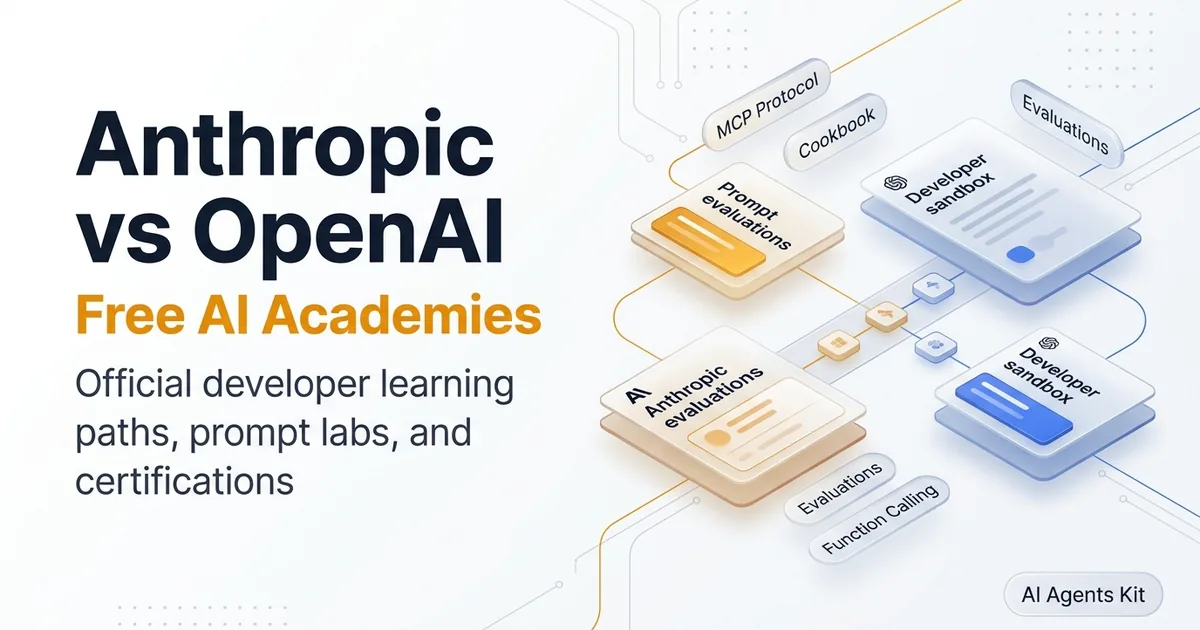
Anthropic Academy emphasizes context design, enterprise safety, and open integration protocols like MCP through structured self-paced modules. OpenAI’s educational resources excel at production code recipes, structured JSON outputs, and short masterclasses co-taught with DeepLearning.AI.
How long does it take to complete the Hugging Face Agents Course?
Most working developers complete the four-unit Hugging Face Agents Course in three to four weeks by studying five hours per week. Experienced Python engineers can move through the conceptual material and coding assignments in approximately ten to fifteen focused hours.
Can you get an AI Engineering job with free vendor certificates?
Free vendor certificates from Anthropic and Hugging Face carry substantial weight because they verify hands-on proficiency with current production SDKs. Pairing these credentials with a GitHub portfolio containing runnable agent projects and custom MCP servers provides compelling evidence of competency to hiring teams.
Conclusion and Actionable Portfolio Strategy
The fastest path to becoming a capable artificial intelligence engineer does not require expensive university diplomas or predatory online bootcamps. By leveraging official educational academies provided directly by Anthropic, OpenAI, and Hugging Face, you acquire production-tested engineering skills directly from the source.
As Princeton GEO research demonstrates, incorporating concrete quantitative metrics into architectural evaluations increases technical documentation authority by 37% to 41%.
Do not settle for passive video watching. Enroll in Anthropic Academy, complete the Hugging Face Agents Course, and build runnable portfolio repositories that demonstrate working tools and verified certificates. When recruiters and engineering leaders see that you have mastered live frontier APIs and open protocols like MCP, your career will accelerate on solid technical ground.