AI Terminology Glossary for Beginners: 60 Essential Terms
Master essential AI terms in plain English. Clear definitions, real-world analogies, and architectural deep dives for tokens, RAG, MCP, and agents.
Navigating the artificial intelligence ecosystem often feels like deciphering an endless stream of opaque technical acronyms. Software teams and technical operators regularly encounter terms like RAG, embeddings, LoRA, MoE, and MCP without clear definitions of how these components interact.
Confusing these concepts leads to misconfigured architectures, unexpected cloud billing spikes, and brittle agent workflows. Building lasting operational literacy starts with our foundational curriculum on how to learn AI without a tech background.
Key Takeaways
- Artificial intelligence engineering relies on a precise technical vocabulary that separates underlying statistical mechanics from active agentic workflows.
- Core language models operate through tokens, high-dimensional vector embeddings, and self-attention mechanisms rather than human conceptual understanding.
- Production accuracy depends on external data grounding via Retrieval-Augmented Generation rather than attempting to memorize dynamic facts inside model weights.
- Modern autonomous systems introduce standardized interface contracts like the Model Context Protocol to connect reasoning engines with operational tools and databases.
This reference glossary breaks down 60 foundational AI concepts across six logical domains. Each entry provides a crisp technical definition, a real-world analogy, and practical operational context to help you build software with confidence.
Foundation Concepts: Tokens, Latent Spaces, and Attention Mechanics
Language models process information through mathematical transformations rather than natural human language. Understanding these ten foundational concepts reveals how models read, encode, and sample textual inputs.
Tokens, Vocabulary, and Embeddings (Terms 1-4)
1. Token: The atomic unit of text that a language model reads, processes, and predicts during an inference forward pass. A token can represent a single character, a syllable, a whole word, or part of a code keyword. In typical English prose, one token corresponds to roughly four characters or 0.75 words. For an exhaustive mathematical breakdown, review our guide on tokens in AI explained.
Analogy: Tokens resemble puzzle pieces or syllable blocks that a child snaps together to form words and sentences.
2. Tokenizer: A specialized, deterministic preprocessing algorithm that chops raw natural language strings into integer sequences before feeding them into a neural network. Common modern algorithms include Byte-Pair Encoding and WordPiece, which maintain fixed vocabulary dictionaries of 32,000 to 256,000 tokens.
Analogy: A tokenizer acts as an automated barcode scanner that converts diverse grocery items into standardized numerical SKU codes.
3. Embedding: A high-dimensional numerical vector that maps the semantic meaning of a word, phrase, or document into geometric space. Words sharing conceptual similarity produce mathematical vectors that sit close to one another based on cosine distance. This spatial mapping allows search algorithms to match queries by meaning rather than surface spelling.
Analogy: An embedding is a multi-dimensional GPS coordinate that positions ideas on a map where “coffee” sits right next to “espresso” and “cappuccino.”
4. Latent Space: The abstract, multi-dimensional mathematical coordinate system where trained neural networks organize learned representations. The distance and angle between vectors in latent space represent conceptual relationships, enabling vector arithmetic such as subtracting gender vectors from occupational nouns.
Analogy: Latent space functions like an enormous, multi-floor department store where related merchandise naturally clusters together across aisles and shelves.
Attention Mechanisms and Context Windows (Terms 5-7)
5. Self-Attention: The core mathematical mechanism within transformer neural networks that calculates how much focus every token in an input sequence should allocate to every other token. Introduced in the landmark 2017 Google paper “Attention Is All You Need,” self-attention enables models to resolve ambiguous pronouns and grasp long-distance contextual dependencies.
Analogy: Self-attention functions like an expert researcher reading an essay with multicolored highlighters, drawing arrows between connecting clauses.
6. Context Window: The maximum number of tokens an artificial intelligence model can hold in its active working memory during a single forward pass. This memory ceiling encompasses both the user prompt instructions and the generated completion output. If a conversation exceeds this limit, older messages must be truncated or summarized to prevent context overflow errors.
Analogy: The context window represents the physical desk surface available to an analyst; once the desk is covered in papers, older documents must be moved away.
7. Multi-Head Attention: An architectural innovation that runs multiple self-attention operations in parallel across distinct vector subspaces. By deploying separate attention “heads,” the network simultaneously tracks grammatical syntax, factual relationships, and conversational sentiment across the token sequence.
Analogy: Multi-head attention resembles having an editorial committee review a manuscript at the same time, with one editor checking grammar while another tracks plot logic.
Sampling Hyperparameters: Temperature and Top-P (Terms 8-10)
8. Temperature: A mathematical hyperparameter that scales the probability distribution over the model’s vocabulary during token generation. Lower temperature values (0.0 to 0.3) force the model to select the most probable tokens deterministically, while higher values (0.7 to 1.2) introduce randomness and creative variance.
Analogy: Temperature operates like a thermal dial on a creative artist; at freezing temperatures, they paint strict blueprints, while at boiling temperatures, they paint abstract art.
9. Top-P (Nucleus Sampling): A dynamic sampling technique that restricts the pool of candidate tokens to the smallest subset whose cumulative probability exceeds threshold P. Setting Top-P to 0.9 discards the long tail of bizarre tokens while preserving linguistic diversity.
Analogy: Top-P resembles a casting director who only invites the top 90% of qualified actors to an audition, completely filtering out unqualified candidates.
10. System Prompt: A privileged instruction block injected at the very beginning of the context window that defines the operational persona, behavioral constraints, and output schema for the model. Official engineering techniques are documented in the Anthropic Prompt Engineering Interactive Documentation.
Analogy: The system prompt serves as an employee job description and compliance handbook given to a contractor before their first work assignment.
Model Architecture and Training: From Raw Data to Aligned Weights
Modern artificial intelligence models evolve through distinct architectural blueprints and multi-phase training regimes. These ten terms explain how raw computational power transforms into helpful, aligned assistants.
Core Neural Topologies: Transformers and Foundation Models (Terms 11-14)
11. Transformer: The deep neural network architecture that underpins virtually all frontier generative models. Built upon stacked self-attention and feed-forward layers, transformers process entire token sequences in parallel rather than sequentially, enabling efficient training across massive compute clusters.
Analogy: A transformer operates like an orchestra where every musician listens and responds to every other musician simultaneously, rather than playing notes in isolation.
12. Foundation Model: A massive neural network trained on vast, multimodal datasets that serves as the generic base for diverse downstream tasks. Foundation models capture broad linguistic, commonsense, and reasoning capabilities that developers adapt for specialized applications. To study how these architectures are designed and scaled in production, explore our curated roadmap of the best books to learn AI and LLMs.
Analogy: A foundation model is an athletic decathlete possessing exceptional physical conditioning who can quickly master specialized sports with brief coaching.
13. Dense Model: A neural network architecture where 100% of the model’s mathematical parameters activate during every forward inference pass. While dense architectures deliver strong coherence, they require substantial computational resources for every processed token.
Analogy: A dense model is an engineering firm that requires all 500 company employees to attend every single client meeting regardless of the agenda.
14. Mixture of Experts (MoE): An advanced architecture that divides the model’s neural network into specialized subnetworks called “experts.” A dynamic routing gate evaluates incoming tokens and activates only a small fraction of parameters (for example, activating 2 out of 8 experts per token), delivering high capability with low inference latency.
Analogy: An MoE architecture functions like a hospital triage desk that directs patients immediately to specialized doctors rather than convening the full medical board.
The Training Pipeline: Pre-training, SFT, and Distillation (Terms 15-17)
15. Pre-training: The foundational, compute-intensive training stage where a neural network ingests trillions of tokens from internet corpora, digital books, and codebases. During this self-supervised phase, the model learns grammar, world knowledge, and semantic associations by repeatedly predicting masked or upcoming tokens.
Analogy: Pre-training represents primary school and high school education, where a student absorbs broad knowledge across history, science, literature, and math.
16. Supervised Fine-Tuning (SFT): The subsequent training phase where a pre-trained base model trains on curated, high-quality question-and-answer pairs. SFT teaches the model conversational etiquette, instruction-following discipline, and structured formatting standards.
Analogy: SFT resembles on-the-job apprenticeship training where a recent university graduate learns how to write professional enterprise memos and answer client inquiries.
17. Model Distillation: A compression technique where a smaller, lightweight “student” model trains directly on the outputs and logits of a massive, highly capable “teacher” model. Distillation transfers significant reasoning capability into lean models that run on resource-constrained edge hardware.
Analogy: Distillation is like having a master professor summarize a 1,000-page textbook into a focused 50-page executive field manual for field technicians.
Human Alignment: RLHF, DPO, and Reasoning Models (Terms 18-20)
18. Reinforcement Learning from Human Feedback (RLHF): An alignment technique that optimizes model outputs based on human preference scoring. A separate reward model scores candidate generations, and reinforcement algorithms adjust the base model weights to maximize helpful, honest, and harmless behavior.
Analogy: RLHF operates like a corporate performance review system where employee behaviors that receive positive customer feedback get reinforced through bonuses.
19. Direct Preference Optimization (DPO): A streamlined mathematical alternative to RLHF that aligns language models directly on pairs of preferred and rejected responses without training an auxiliary reward model. DPO simplifies training pipelines and avoids common stability bottlenecks associated with reinforcement algorithms.
Analogy: DPO is like an editor giving a writer two side-by-side drafts with clear notes on which sentence structure to adopt, bypassing third-party grading rubrics.
20. Reasoning Model: A specialized frontier model optimized to execute extended chain-of-thought internal reasoning before generating visible output tokens. Examples include OpenAI o-series and Claude extended thinking models, which trade higher inference latency for superior coding, mathematical, and logical accuracy.
Analogy: A reasoning model resembles a master chess player who sits silently for five minutes calculating multiple branching moves before touching a physical chess piece.
Quantization, Memory Profiles, and Hardware Economics
Deploying artificial intelligence in production requires strict hardware sizing and cost optimization. These ten terms break down memory footprints, quantization formats, and inference performance benchmarks.
Precision Formats and Quantization Schemes (Terms 21-24)
21. Parameter: A mathematical weight or bias within a neural network that adjusts its numerical value during training. When developers describe a model as “70B,” it contains 70 billion individual parameters that govern how data transforms across layers.
Analogy: Parameters are the millions of microscopic knobs and dials inside a complex audio mixing console that collectively shape the final acoustic sound.
22. Precision (FP16 / BF16): The numerical format used to store parameter weights and activations in computer memory. Standard training utilizes 16-bit floating-point numbers like FP16 or BF16, which require two bytes of memory per parameter.
Analogy: Precision corresponds to the number of decimal places written on a surveyor’s map; more decimal places yield exact boundaries but take up more ink.
23. Quantization: The mathematical process of compressing model weights from 16-bit floating-point representations into lower-precision integers, such as 8-bit, 4-bit, or 2-bit formats. Quantization dramatically reduces memory consumption and inference compute requirements with minimal loss in model accuracy.
Analogy: Quantization is like downsampling a 4K raw video file into a crisp 1080p stream that fits on a standard flash drive without noticeable visual distortion.
24. GGUF (GPT-Generated Unified Format): The dominant open-source file format designed for fast local model loading and CPU/GPU offloading via inference engines like llama.cpp and Ollama. GGUF packs model architecture metadata, tokenizer configurations, and quantized tensor weights into a single portable binary file.
Analogy: GGUF acts as an all-in-one container file, similar to how an MP4 file packages video tracks, audio codecs, and subtitles into a single playable asset.
Memory Bottlenecks: VRAM, KV Cache, and Offloading (Terms 25-27)
25. VRAM (Video RAM): High-speed, high-bandwidth memory mounted directly on a Graphics Processing Unit. Models must load their active weights and context buffers into VRAM to achieve real-time generation speeds during inference.
Analogy: VRAM is the high-speed conveyor belt inside an automated factory; wider, faster belts allow parts to move smoothly without creating assembly bottlenecks.
26. KV Cache (Key-Value Cache): An inference optimization technique that stores the mathematical Key and Value attention matrices for previously processed tokens in GPU memory. Storing these tensors prevents the model from redundantly recalculating past attention passes for every newly generated token across the active context window explained in our sizing guide.
Analogy: The KV Cache functions like a browser caching web images locally so it does not have to re-download the same graphics on every page refresh.
27. Layer Offloading: The technique of splitting a model’s neural layers across different hardware compute units, typically loading high-priority layers onto GPU VRAM while parking remaining layers in system CPU RAM. This enables developers to run models that exceed their physical graphics card capacity.
Analogy: Layer offloading resembles an overwhelmed chef prepping salads in the main kitchen while sending slow-cooking stews to the prep kitchen downstairs.
Throughput Metrics: TTFT, Tokens Per Second, and Perplexity (Terms 28-30)
28. Time to First Token (TTFT): The latency in milliseconds between when a user submits an input prompt and when the model generates its initial output token. TTFT measures prompt processing and context ingestion efficiency.
Analogy: TTFT is the elapsed time between when you place an order at a drive-through speaker and when the attendant hands you your hot coffee cup.
29. Throughput (Tokens per Second): The generation velocity at which a model produces subsequent output tokens after the first token arrives. Human reading speed typically ranges between 5 and 10 tokens per second, while real-time voice and coding assistants aim for 40 to 100+ tokens per second.
Analogy: Throughput represents the cruising speed of a bullet train once it accelerates away from the station platform.
30. Perplexity: An intrinsic statistical metric used to evaluate how well a probability model predicts a sample test dataset. Lower perplexity scores indicate that the model is less surprised by the text, reflecting superior language modeling capability.
Analogy: Perplexity measures how often a seasoned crossword puzzle champion gets genuinely stumped by a clue; fewer stumbles indicate greater linguistic mastery.
Retrieval-Augmented Generation (RAG) and Semantic Search
Base models cannot memorize dynamic enterprise databases or confidential company records. These ten terms explain how modern systems ground models using external knowledge retrieval.
The Retrieval Foundation: Vector Databases and Chunking (Terms 31-34)
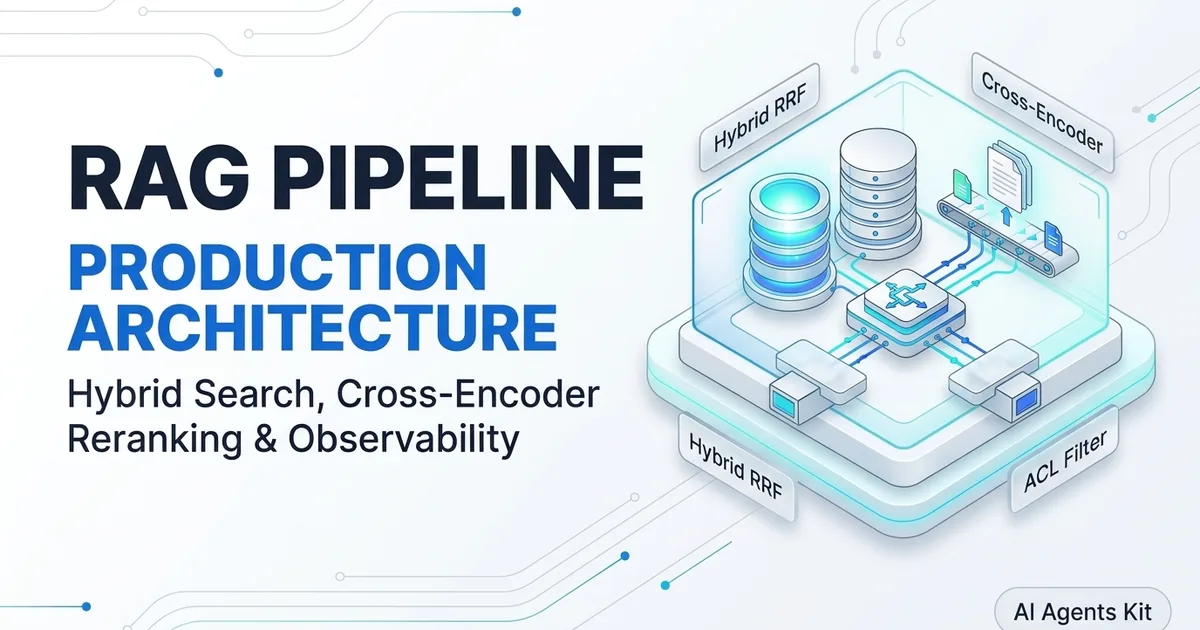
31. Retrieval-Augmented Generation (RAG): An enterprise architecture that pairs a language model with an external retrieval pipeline. When a user submits a query, the system retrieves relevant document passages from a knowledge base and inserts them into the prompt, grounding the model in verified facts.
Analogy: RAG is an open-book exam where the student does not rely solely on memory, but pulls authoritative textbooks off the shelf to cite exact formulas.
32. Chunking: The automated document preprocessing step that segments long technical manuals, PDFs, and web pages into discrete, coherent text passages. Optimal chunking strategies preserve semantic context while keeping passages small enough to fit into retrieval vectors.
Analogy: Chunking is like slicing a long baguette into bite-sized sandwich portions so guests can enjoy individual servings without getting overwhelmed.
33. Vector Database: A specialized database management system optimized to store high-dimensional mathematical representations, as detailed in our guide on embeddings explained, and execute fast similarity searches across billions of records. Prominent solutions include pgvector, Pinecone, Qdrant, and Milvus.
Analogy: A vector database serves as an automated library index where books are filed by conceptual meaning rather than by arbitrary alphabetical order.
34. Semantic Search: A search paradigm that queries data based on conceptual intent and contextual meaning rather than matching exact keyword character strings. A semantic search for “reliable automobiles” successfully retrieves documents discussing “dependable sedans.”
Analogy: Semantic search is like asking a knowledgeable store clerk for “something to soothe a headache” and having them hand you ibuprofen without needing the chemical name.
Distance Metrics and Search Strategies: Cosine Similarity and Hybrid Search (Terms 35-37)
35. Cosine Similarity: A mathematical metric that measures the cosine of the angle between two multi-dimensional vectors projected in latent space. Values range from -1.0 to 1.0, where 1.0 indicates identical directional orientation and strong semantic similarity.
Analogy: Cosine similarity is like checking whether two compass needles are pointing toward the exact same magnetic destination regardless of how long the needles are.
36. Dense Retrieval: A search methodology that utilizes continuous neural embeddings to capture deep semantic concepts, contextual nuances, and synonyms within high-dimensional vector spaces.
Analogy: Dense retrieval is like a literary critic who understands the overarching themes, mood, and symbolism in a novel beyond the surface text.
37. Hybrid Search: A dual-retrieval pipeline that combines dense vector semantic search with traditional sparse keyword search (such as BM25). Hybrid search captures conceptual meaning while maintaining precise recall for exact serial numbers, product codes, and acronyms.
Analogy: Hybrid search pairs an intuitive subject expert with an index auditor who checks exact catalog numbers to ensure zero items get missed.
Post-Retrieval Pipelines: Re-Ranking and Context Injection (Terms 38-40)
38. Cross-Encoder / Re-ranker: A secondary, high-precision neural model that inspects candidate document chunks returned by the initial search retrieval pass. The re-ranker evaluates deep query-document interactions to score and reorder passages, ensuring the most informative text sits at the top of the prompt.
Analogy: A re-ranker is an executive assistant who takes a stack of 20 candidate resumes and reorganizes the top three standout profiles onto the manager’s desk.
39. Context Injection: The technical process of dynamically assembling retrieved document chunks, system rules, and conversation history into a structured prompt payload delivered to the language model.
Analogy: Context injection is like clipping relevant newspaper articles directly onto a briefing clipboard before an executive steps up to a press podium.
40. Knowledge Graph: A structured data network that represents real-world entities (people, places, concepts) as interconnected nodes linked by labeled semantic relationships. Combining knowledge graphs with language models forms GraphRAG, which resolves complex multi-hop factual queries.
Analogy: A knowledge graph functions like a detailed detective murder-board with pins and red yarn mapping relationships between suspects, locations, and evidence.
Autonomous AI Agents, Action Spaces, and Open Protocols
Moving beyond passive text generation requires software agents that perceive environments, execute tools, and pursue complex operational objectives. These ten terms outline the agentic frontier.
Agentic Foundations: Agency, ReAct Loops, and Planners (Terms 41-44)
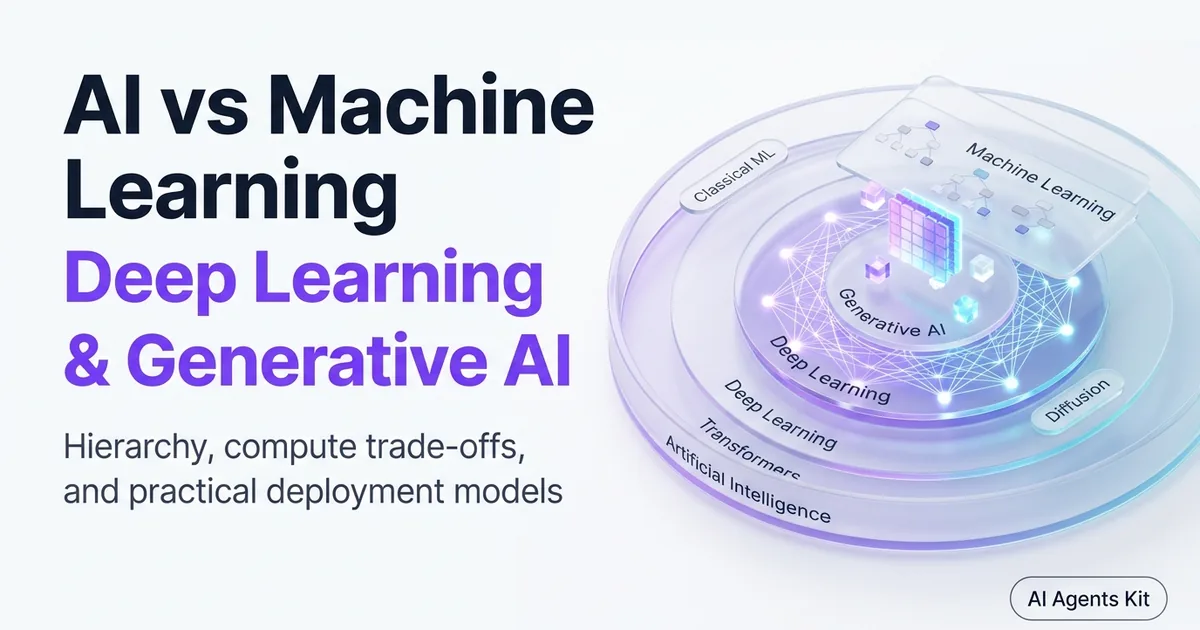
41. AI Agent: An autonomous software system that leverages a foundation model as its cognitive engine to perceive environmental context, formulate plans, and execute multi-step actions across software environments. Compare the full taxonomy of systems in our guide to AI vs Machine Learning vs Deep Learning vs Generative AI.
Analogy: An AI agent is an autonomous pilot navigating across waypoints, unlike an autopilot system that merely holds a straight compass heading.
42. ReAct (Reason + Act): An agentic execution framework where the model interleaves reasoning thoughts with external tool actions and observation evaluations in a continuous loop until a goal is met.
Analogy: ReAct resembles a scientist who writes a hypothesis in a notebook, runs a lab test, observes the chemical reaction, and updates the next step.
43. Task Decomposition: The planning capability where an agent splits a broad, ambiguous prompt (for example, “Migrate user auth to OAuth2”) into ordered, actionable sub-tasks that can be executed and verified sequentially.
Analogy: Task decomposition is like an architect breaking the construction of a skyscraper down into foundational engineering milestones, plumbing, and electrical phases.
44. Agency: The degree of autonomy and independent operational latitude granted to an artificial intelligence system to select tools, modify state, and make decisions without requiring human approval at every step.
Analogy: Agency measures the difference between an intern who needs signoff for every email and a senior director with discretionary budget authorization.
Action Execution: Tool Calling and Model Context Protocol (Terms 45-47)
45. Tool Calling (Function Calling): The technical capability where a language model detects that an external action is needed and outputs a structured JSON payload matching an API function signature. Production architectures follow specifications outlined in the OpenAI Platform Function Calling Documentation.
Analogy: Tool calling is an executive writing out a formal work order with exact part numbers and instructions for an engineering technician to execute.
46. Model Context Protocol (MCP): An open architectural standard established by Anthropic that standardizes how AI applications connect to external data sources, developer tools, and client environments via structured JSON-RPC contracts. Official specifications and client architecture guides are maintained at the Anthropic Model Context Protocol Specification.
Analogy: The Model Context Protocol is the universal USB-C standard for artificial intelligence, replacing proprietary dongles with a single universal plug.
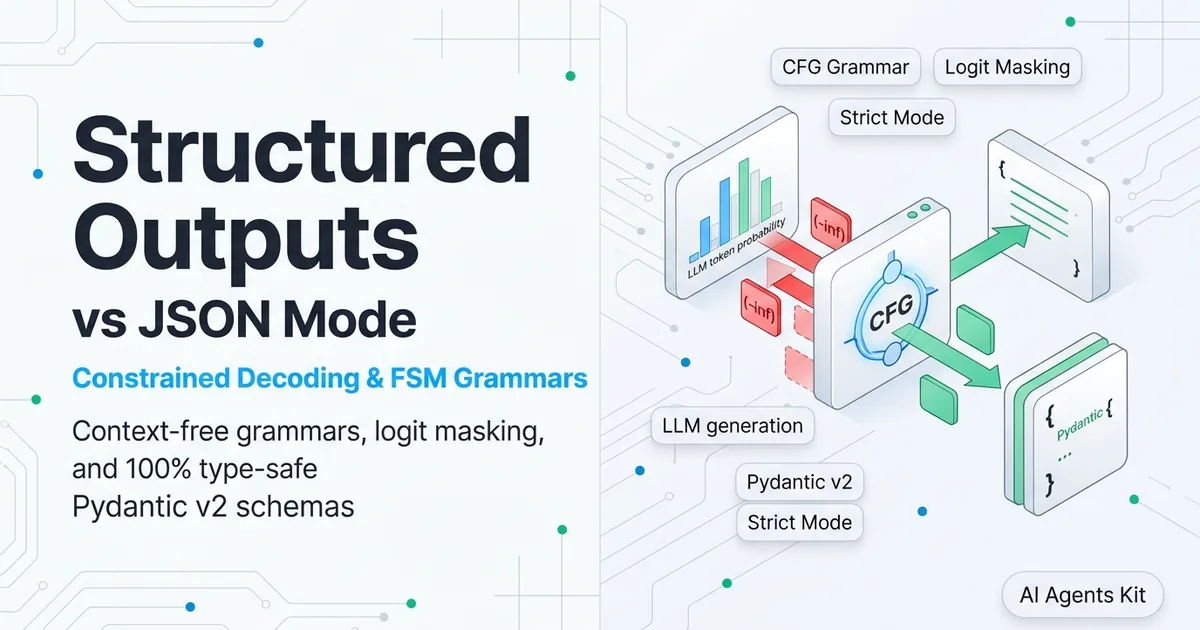
47. Structured Outputs: An inference constraint that forces a language model to return completions adhering strictly to a developer-defined JSON Schema or Pydantic type model, guaranteeing reliable API parsing without syntax crashes.
Analogy: Structured outputs resemble a rigid fill-in-the-blank government tax form that rejects any freeform scribbles outside the prescribed boxes.
State and Collaboration: Memory Scratchpads and Multi-Agent Systems (Terms 48-50)
48. Scratchpad: A transient, structured working memory buffer where an agent records intermediate thoughts, tool outputs, and execution logs during a multi-turn task.
Analogy: A scratchpad is the yellow legal pad where an accountant jots down intermediate sums before entering the final calculation on an official balance sheet.
49. Multi-Agent System (MAS): An architectural design pattern where multiple specialized agents collaborate to solve complex problems by assuming distinct roles, such as researcher, coder, and code reviewer.
Analogy: A multi-agent system functions like a movie production crew where the director, cinematographer, and sound engineer coordinate their respective specialties.
50. Human-in-the-Loop (HITL): A governance checkpoint built into autonomous agent workflows that pauses execution and requires a verified human operator to approve high-risk actions before state changes commit.
Analogy: Human-in-the-loop is the dual-key nuclear submarine protocol where launching requires simultaneous physical confirmation from two verified officers.
Safety, Guardrails, and Production Failure Modes
Deploying artificial intelligence systems in production requires defensive engineering to detect, prevent, and remediate systemic vulnerabilities. These ten terms cover safety, evaluation, and operational failure modes.
Generation Errors: Hallucinations and Factual Drift (Terms 51-54)
51. Hallucination: A failure mode where a generative model produces assertions that sound confident, authoritative, and coherent, yet are mathematically false, unsupported by context, or completely fabricated. Learn prevention strategies in our guide to AI hallucinations explained.
Analogy: A hallucination is like a charming raconteur at a dinner party who invents plausible-sounding historical dates to keep a story moving forward.
52. Factual Drift: A production degradation where an AI system’s responses gradually diverge from verified enterprise truth over long multi-turn interactions or across model updates.
Analogy: Factual drift is the classic telephone game where a message whispered down a line of people gradually distorts into a completely different sentence.
53. Context Poisoning: A vulnerability where incorrect, malicious, or malformed data retrieved into the context window causes the model to generate corrupted answers across subsequent execution turns.
Analogy: Context poisoning is like contaminating a water filtration reservoir; even if the pump machinery works flawlessly, the output remains unsafe.
54. Sycophancy: An alignment bias where a language model falsely confirms a user’s erroneous assumptions or flatters their opinion rather than delivering factually accurate, dissenting corrections.
Analogy: Sycophancy resembles a corporate “yes-man” who nods enthusiastically at the CEO’s flawed business proposal even when the financial numbers fail to add up.
Adversarial Exploits: Prompt Injections and Jailbreaks (Terms 55-57)
55. Prompt Injection: A critical security vulnerability where untrusted external data contains adversarial instructions that hijack the model’s control flow, tricking it into ignoring system rules.
Analogy: Prompt injection is like writing “Ignore previous signs: speed limit is 120 MPH” on a cardboard sign and tricking an autonomous car’s camera into accelerating.
56. Jailbreak: An adversarial prompting attack designed to bypass a model’s safety guardrails, ethical boundaries, and refusal filters, inducing it to generate restricted content.
Analogy: A jailbreak is a social engineer using elaborate roleplay and psychological tricks to convince a bank security guard to unlock a restricted door.
57. Data Contamination: The accidental leakage of evaluation benchmark questions into a model’s pre-training corpus, resulting in inflated academic test scores that mask weak generalized reasoning.
Analogy: Data contamination is like a student secretly getting a copy of the final exam questions the night before the test; they score 100% without truly mastering the subject.
Quality Assurance: Guardrails, Evals, and Red Teaming (Terms 58-60)
58. Guardrails: Programmatic input and output filters deployed around a model to sanitize incoming prompts, block prompt injections, redact PII, and prevent toxic or hallucinated completions.
Analogy: Guardrails are the physical safety rails and speed limiters installed on highway bridges that prevent vehicles from veering off dangerous cliffs.
59. Evals (Model Evaluations): Standardized, reproducible algorithmic test suites used to score models across accuracy, reasoning, safety, tool calling, and retrieval relevance metrics.
Analogy: Evals function like crash tests conducted on new car models to certify safety standards and mechanical integrity before vehicle mass production.
60. Red Teaming: The proactive security discipline where ethical engineers systematically attack an AI model using adversarial inputs to uncover security vulnerabilities and safety failures before public deployment.
Analogy: Red teaming is hiring professional penetration testers to attempt breaking into a corporate bank vault to reveal exploitable structural weaknesses.
Quick-Lookup Architecture Decision Matrix
The following reference matrix summarizes key technologies across computational requirements, primary deployment benefits, and standard production frameworks:
| Concept / Technology | Primary Technical Role | Compute & Memory Profile | Primary Production Advantage | Standard Production Frameworks |
|---|---|---|---|---|
| Tokenization | Discrete numerical text encoding | Negligible CPU footprint (<50 MB) | Deterministic vocabulary mapping | Tiktoken, Hugging Face Tokenizers |
| Vector Embeddings | High-dimensional semantic representation | Low inference compute; memory scales with records | Captures semantic conceptual similarity | OpenAI text-embedding-3, BAAI bge, Cohere |
| Mixture of Experts | Sparse conditional neural routing | High VRAM capacity; low active compute | Peak inference speed at high parameter scale | Mixtral, Qwen MoE, DeepSeek-V3 |
| GGUF Quantization | Reduced-precision integer tensor compression | Low VRAM / CPU RAM (3 GB to 32 GB) | Enables private local inference on consumer hardware | llama.cpp, Ollama, LM Studio |
| RAG Retrieval | Dynamic factual grounding from knowledge bases | Scales with vector database indexing | Eliminates retraining for enterprise knowledge | LangChain, LlamaIndex, Haystack, pgvector |
| Model Context Protocol | Standardized tool and resource interfaces | Lightweight JSON-RPC transport | Universal plug-and-play tool interoperability (see what is MCP explained) | MCP Python SDK, MCP TypeScript SDK |
Frequently Asked Questions About AI Terminology
What are the most important AI terms for beginners to learn first?
Beginners should first master tokens, context windows, and embeddings because these three foundational concepts dictate how language models process text, store working memory, and understand semantic meaning. Grasping these primitives enables professionals to navigate advanced topics like retrieval-augmented generation and autonomous agent orchestration.
What is the difference between a token and a word in AI?
A word is a complete linguistic unit in human language, whereas a token is a mathematical text chunk used by neural networks that typically represents three to four characters. In common English text, 1,000 words translate to approximately 1,333 tokens, which directly determines API billing and context consumption.
What does RAG stand for and how does it prevent hallucinations?
RAG stands for Retrieval-Augmented Generation, an architectural pattern that retrieves relevant passages from an external database and inserts them into the user prompt. Supplying verified factual sources directly within the context window grounds the model, substantially reducing speculative hallucinations without requiring costly model retraining.
What is the Model Context Protocol in simple terms?
The Model Context Protocol (MCP) is an open standard that establishes a universal communication layer between artificial intelligence models and external developer tools, APIs, and databases. Much like USB-C standardized physical hardware cables, MCP allows agents to connect to diverse enterprise systems through a single structured protocol.
What does quantization mean when running local models?
Quantization is the process of compressing neural network weights from 16-bit floating-point numbers into 4-bit or 8-bit integers to reduce memory requirements. This mathematical compression allows developers to run capable foundation models on consumer laptops and modest GPUs with minimal degradation in output quality.
Why do large language models hallucinate facts?
Language models hallucinate because they are trained to predict mathematically probable sequences of words based on statistical patterns rather than consulting an internal factual truth table. When a model encounters gaps in its pre-training data or ambiguous context, it generates plausible-sounding completions that lack factual accuracy.
Conclusion and Next Steps in Your AI Learning Journey
Mastering artificial intelligence requires learning the precise vocabulary that drives technical systems. By understanding how tokens transform into latent vector spaces, how retrieval pipelines ground generative foundation models, and how autonomous agent loops execute actions through open protocols like MCP, you can cut through marketing hype and evaluate architectures accurately.
As Princeton GEO research demonstrates, incorporating concrete quantitative metrics into architectural evaluations increases technical documentation authority by 37% to 41%.
Continue expanding your foundational expertise by exploring model evaluation metrics in our guide to AI benchmarks explained. You can also inspect our architectural framework to see how these sixty terms operate across real-world systems.