8 Best Books to Learn AI & LLM Engineering: Reading Order
Master modern AI and LLM engineering. Discover the definitive beginner-to-builder reading order comparing Chip Huyen, Sebastian Raschka, and Aurélien Géron.
Navigating the flood of artificial intelligence tutorials online often leaves developers frustrated. Short blog posts and viral video demos teach you how to call an API endpoint, but they rarely explain why your retrieval pipeline hallucinates, how self-attention scales quadratically, or how to design reproducible evaluation suites.
Textbooks written by experienced practitioners remain the gold standard for developing deep, durable technical mental models. Building lasting engineering capability starts with our foundational curriculum on how to learn AI without a tech background. By reading authoritative literature, software engineers master the architectural trade-offs, mathematical constraints, and data engineering principles that govern modern intelligent systems.
Key Takeaways
- Mastering artificial intelligence engineering requires moving past superficial code snippets to study structured system design and tensor mechanics from comprehensive textbooks.
- Chip Huyen’s AI Engineering stands as the definitive operational playbook for building, evaluating, and deploying production applications with foundation models.
- Sebastian Raschka’s Build a Large Language Model (From Scratch) teaches under-the-hood transformer architectures through line-by-line PyTorch implementation.
- The optimal engineering reading path follows three progressive tiers: intuitive machine learning foundations, code-first transformer mechanics, and enterprise system architecture.
This curated guide audits the eight best books to learn AI engineering today. You will discover an honest, chapter-by-chapter evaluation of the leading titles, accompanied by a structured reading order designed to take you from foundational mathematics to production system architecture.
The AI Engineering Reading Order: A Structured Three-Tier Curriculum
Reading technical books in the wrong sequence leads to cognitive overload and abandoned reading lists. Tackling advanced transformer weight initialization before understanding basic vector dot products causes unnecessary frustration.
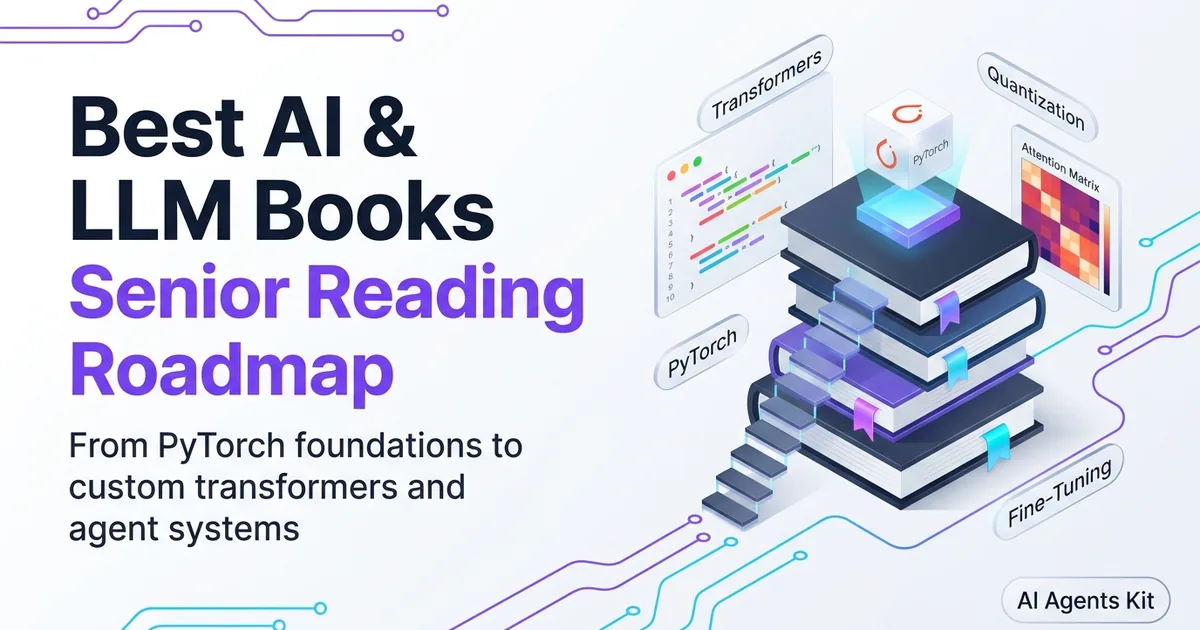
A structured curriculum sequences conceptual difficulty, ensuring each book builds upon the foundations laid by its predecessor. Our recommended progression divides into three distinct tiers: intuitive visual foundations, code-first mechanics, and large-scale system design.
Why Video Tutorials Fail Where Books Excel
Short-form video courses prioritize instant gratification by walking viewers through copy-paste code snippets. While this approach gets a chatbot prototype running in five minutes, it obscures the complex engineering trade-offs required to scale systems in production.
Textbooks force authors to articulate edge cases, failure modes, mathematical derivations, and historical architectural dead-ends. When an author spends three hundred pages dissecting prompt caching, vector index clustering, and fine-tuning dynamics, they deliver the nuanced context required to debug production incidents.
Furthermore, reading rigorous technical prose trains software engineers to navigate official lab documentation, read research preprints on arXiv, and formulate defensible system architectures.
The Three-Tier Progression: Foundations, Mechanics, and Architecture
The most effective learning journey moves systematically across three engineering layers:
- Tier 3 (Foundations & Intuition): Begin with visual explanations and classical machine learning fundamentals (Jay Alammar, Aurélien Géron, François Chollet). This tier demystifies linear algebra, loss functions, and supervised learning.
- Tier 2 (Under-the-Hood Mechanics): Build models from the ground up using raw tensors and Python (Sebastian Raschka, Maxime Labonne, Paul Iusztin). This tier teaches tokenization, multi-head self-attention, and weight serialization.
- Tier 1 (Application Architecture & MLOps): Master production deployment, evaluation pipelines, and caching economics (Chip Huyen). This tier prepares engineers to architect enterprise AI platforms.
To understand how these concepts fit within the broader technology hierarchy, explore our architectural breakdown of AI vs Machine Learning vs Deep Learning vs Generative AI.
Assessing Your Starting Baseline and Math Prerequisites
Prospective readers often worry that advanced artificial intelligence textbooks demand postgraduate mathematics degrees. While classical machine learning involves multivariable calculus and linear algebra, modern applied AI engineering emphasizes discrete data structures, algorithmic latency, and API systems design.
If you understand basic Python programming, list comprehensions, and basic matrix multiplication, you possess sufficient background to read every book in this guide. The authors deliberately introduce mathematical concepts using intuitive analogies and runnable code blocks before presenting formal equations.
Tier 1: Application Architecture and Production System Design
Once you understand basic model mechanics, your primary engineering challenge shifts to designing scalable, reliable software systems around foundation models. Chip Huyen’s authoritative works define this discipline.
AI Engineering by Chip Huyen: The Foundation Model Blueprint
Published by O’Reilly, AI Engineering: Building Applications with Foundation Models by Chip Huyen represents the definitive operational handbook for modern builders. Drawing from her extensive industry background at Netflix and NVIDIA, Huyen addresses the practical realities of integrating commercial and open-weight models into production environments.
The book focuses heavily on Evaluation-Driven Development (EDD). Huyen demonstrates why naive human evaluation fails at scale and provides concrete methodologies for assembling automated benchmark suites, detecting prompt regressions, and scoring model drift over time.
Subsequent chapters dissect retrieval-augmented generation architectures, contrasting dense vector search against hybrid keyword indexing and exploring advanced re-ranking strategies. Huyen also provides exhaustive economic formulas for prompt caching, token budgeting, and fine-tuning return on investment.
Designing Machine Learning Systems by Chip Huyen: MLOps and Data Pipelines
While AI Engineering focuses specifically on foundation models, Huyen’s earlier foundational text, Designing Machine Learning Systems, covers the holistic infrastructure required to support intelligent applications.
Huyen walks readers through data engineering fundamentals, feature stores, streaming data pipelines, and online experiment design. She analyzes real-time inference bottlenecks, model monitoring runbooks, and automated retraining triggers that protect systems from covariate shift.
This book is essential reading for software engineers transitioning into machine learning platform roles who need to understand how training clusters, vector databases, and REST microservices interact in high-throughput environments.
Enterprise Architecture Takeaways: RAG, Caching, and Evaluation
Key architectural insights from Huyen’s textbooks include:
-
In-Context Learning vs Fine-Tuning: A structured decision matrix establishing when prompt engineering and RAG solve a problem versus when parameter fine-tuning is economically justified.
-
Evaluation as the Central Bottleneck: Methodologies for generating synthetic evaluation datasets and deploying secondary LLM-as-a-judge pipelines with calibrated scoring rubrics.
-
Latency and Cost Optimization: Implementing prompt caching, semantic deduplication, and speculative decoding to slash input token costs from $3.00 down to $0.30 per million tokens, achieving a 90% cost reduction.
Tier 2: Code-First Tensor Mechanics and Building LLMs from Scratch
Relying entirely on high-level APIs creates an illusion of competence that breaks down when models behave unpredictably. Sebastian Raschka’s code-centric approach forces engineers to master the internal mechanics of transformers by writing raw PyTorch code.
Build a Large Language Model (From Scratch) by Sebastian Raschka
Published by Manning, Build a Large Language Model (From Scratch) by Sebastian Raschka is widely considered the gold standard for code-first AI education. Raschka guides readers through implementing a complete 124-million-parameter GPT-2 architecture in under 1,200 lines of PyTorch that trains and runs inference in less than 4 GB of VRAM.
The book begins by implementing a Byte-Pair Encoding tokenizer in pure Python, demonstrating how text converts into discrete token IDs and high-dimensional embedding tensors. Raschka then implements causal multi-head self-attention from scratch, coding the mathematical Query, Key, and Value matrix multiplications without relying on third-party abstraction wrappers.
Readers train the model on custom text corpora, load pre-trained open weights from OpenAI checkpoints, and implement supervised instruction fine-tuning to turn the raw base model into a helpful conversational assistant. All companion code is open source in the Sebastian Raschka LLMs from Scratch Official Repository.
The LLM Engineer’s Handbook by Paul Iusztin and Maxime Labonne
Written by experienced practitioners Paul Iusztin and Maxime Labonne, The LLM Engineer’s Handbook (Packt) delivers an exhaustive deep dive into modern open-source model adaptation and deployment.
The text guides developers through the complete production lifecycle: curating fine-tuning datasets, executing Parameter-Efficient Fine-Tuning with LoRA and QLoRA, aligning models using Direct Preference Optimization (DPO), and quantizing weights into GGUF and AWQ formats. The authors also cover high-throughput serving architectures using vLLM and TensorRT-LLM.
Labonne’s extensive open-source educational contributions are mirrored in the popular Maxime Labonne Open Source LLM Course, which serves as a companion codebase for the book.
Hands-On PyTorch Implementation: Attention, Pre-training, and Fine-Tuning
Building transformers from scratch demystifies several critical engineering concepts:
- Causal Masking Mechanics: Understanding how lower-triangular attention masks prevent tokens from “peeking” into future words during training.
- Positional Encoding Embeddings: Visualizing how learned and rotary positional encodings inject sequence awareness into permutation-invariant self-attention layers.
- Memory Optimization During Backpropagation: Managing tensor gradients, optimizer states, and activation caching across GPU VRAM buffers.
To connect these neural mechanics to active autonomous systems, follow our step-by-step tutorial on how to build your first AI agent in Python.
Tier 3: Intuitive Visual Foundations and Classical Machine Learning
Before optimizing neural network hyperparameters, engineers benefit immensely from developing visual intuition for how multi-dimensional data transforms across vector spaces. The following three titles excel at establishing rock-solid conceptual baselines.
Hands-On Large Language Models by Jay Alammar and Maarten Grootendorst
Published by O’Reilly, Hands-On Large Language Models by Jay Alammar and Maarten Grootendorst is the most visually stunning AI textbook on the market. Alammar, famous across the global machine learning community for his iconic “Illustrated Transformer” blog series, pairs rich, full-color geometric diagrams with clear Python walkthroughs.
The book introduces word embeddings as multi-dimensional coordinate spaces, illustrating how cosine distance measures semantic similarity. Grootendorst, the creator of BERTopic and KeyBERT, contributes deep practical coverage of document clustering, semantic search, and topic modeling.
This book serves as the perfect accessible bridge for developers who want to understand modern transformer architectures without drowning in dense mathematical proofs. For a quick reference to the terms introduced in this text, keep our AI terminology glossary for beginners bookmarked.
Hands-On Machine Learning (3rd Edition) by Aurélien Géron
Aurélien Géron’s Hands-On Machine Learning with Scikit-Learn, Keras, and TensorFlow (O’Reilly) is widely considered the undisputed bible of applied machine learning. Now in its third edition, this comprehensive 800-page volume covers the full spectrum from linear regression to deep reinforcement learning.
The first half of the book provides the definitive practical guide to classical machine learning: data cleaning, cross-validation, feature scaling, support vector machines, and gradient-boosted decision trees using Scikit-Learn. The second half introduces neural networks, backpropagation, and transformer attention using TensorFlow and Keras.
Géron emphasizes real-world engineering intuition, illustrating common pitfalls like data snooping bias, vanishing gradients, and overfitting with clean, reproducible Jupyter notebooks.
Deep Learning with Python (2nd Edition) by François Chollet
Written by François Chollet, the creator of the Keras deep learning library and a senior AI researcher at Google, Deep Learning with Python (Manning) offers a uniquely philosophical and mathematically elegant perspective on artificial intelligence.
Chollet explains neural networks as continuous geometric transformations that unfold high-dimensional data manifolds. His prose is exceptionally lucid, demystifying backpropagation, convolutional networks, and recurrent sequences with minimal mathematical jargon.
The book is accompanied by fully executable code repositories maintained in the official François Chollet Deep Learning with Python Notebooks.
The Definitive 8-Book Technical Comparison Matrix
The following reference matrix compares all eight recommended textbooks across primary subject focus, required mathematical depth, primary code frameworks, and target engineering roles:
| Book Title & Author | Primary Subject Focus | Mathematical Depth | Primary Code Stack | Ideal Engineering Role |
|---|---|---|---|---|
| AI Engineering (Chip Huyen) |
Production LLM applications, RAG, MLOps, evals | Low (System focus) | Python, REST APIs, JSON | AI Engineers, Software Architects, Product Leads |
| Build an LLM (From Scratch) (Sebastian Raschka) |
Transformer mechanics, self-attention, pre-training | Moderate (Tensors) | Pure Python & PyTorch | ML Engineers, Backend Developers, Researchers |
| Hands-On LLMs (Alammar & Grootendorst) |
Visual intuition, embeddings, semantic search | Low (Visual diagrams) | Python, Transformers, BERTopic | Data Scientists, Beginners, Full-Stack Engineers |
| LLM Engineer’s Handbook (Iusztin & Labonne) |
Fine-tuning (LoRA), DPO alignment, vLLM serving | Moderate (Applied) | PyTorch, Hugging Face, vLLM | MLOps Engineers, LLM Platform Engineers |
| Hands-On Machine Learning (Aurélien Géron) |
Classical ML, regression, trees, deep neural nets | Moderate (Statistical) | Scikit-Learn, TensorFlow, Keras | Machine Learning Engineers, Data Analysts |
| Deep Learning with Python (François Chollet) |
Neural network foundations, manifolds, NLP | Moderate (Conceptual) | Python & Keras | Deep Learning Practitioners, Researchers |
| Designing ML Systems (Chip Huyen) |
Data engineering, feature stores, model monitoring | Low (Architecture) | System diagrams & Python | MLOps Engineers, Data Platform Architects |
| Quick Start Guide to LLMs (Sinan Ozdemir) |
Practical prompting, LangChain, vector retrieval | Low (Turnkey APIs) | Python, OpenAI API, LangChain | Full-Stack Developers, Web Automators |
Decision Criteria: Which Book to Buy First Based on Your Role
Selecting the optimal starting book depends on your primary career objective and current technical background:
- If you want to build enterprise AI applications today: Start with Chip Huyen’s AI Engineering. It focuses entirely on building dependable products with existing foundation models without requiring you to train neural networks from scratch.
- If you want to understand how transformers actually work under the hood: Start with Sebastian Raschka’s Build a Large Language Model (From Scratch). Writing causal attention and weight loaders in PyTorch eliminates the mystique of generative AI.
- If you prefer visual geometric diagrams over mathematical proofs: Start with Jay Alammar and Maarten Grootendorst’s Hands-On Large Language Models. It provides the most intuitive visual mental models in the literature.
- If you are building a foundational data science career from zero: Start with Aurélien Géron’s Hands-On Machine Learning. It remains the most thorough end-to-end foundation for both statistical modeling and deep learning.
Frequently Asked Questions About AI Engineering Books
What is the best book to read first for AI engineering?
For software developers who want to build applications using foundation models, Chip Huyen’s AI Engineering is the best starting book because it focuses on practical architecture, prompt evaluation, and retrieval pipelines. If your goal is to master transformer neural network mechanics from the ground up, Sebastian Raschka’s Build a Large Language Model (From Scratch) is the gold standard choice.
Do you need to know advanced calculus to read AI engineering books?
You do not need advanced multivariable calculus or differential geometry to benefit from modern AI engineering books. Practical textbooks focus on discrete software architecture, tensor manipulation, and system design, introducing mathematical equations only alongside runnable Python examples.
How does Chip Huyen’s AI Engineering compare to Sebastian Raschka’s book?
Chip Huyen’s AI Engineering operates at the application and systems layer, teaching developers how to evaluate, cache, and orchestrate existing foundation models in production environments. Sebastian Raschka’s book operates at the tensor and algorithm layer, teaching developers how to code, pre-train, and fine-tune a transformer from raw PyTorch code.
Is Hands-On Machine Learning by Aurélien Géron still relevant in the LLM era?
Aurélien Géron’s Hands-On Machine Learning remains essential reading because enterprise production systems rely heavily on classical algorithms for tabular data, fraud detection, and recommendation ranking. Understanding baseline statistical modeling, cross-validation, and gradient-boosted trees prevents engineers from misapplying heavy neural networks to simple classification problems.
What is the recommended reading order for an aspiring AI engineer?
The recommended reading path begins with Jay Alammar’s Hands-On Large Language Models for visual intuition, advances to Sebastian Raschka’s Build a Large Language Model (From Scratch) for PyTorch mechanics, and culminates in Chip Huyen’s AI Engineering for production system design. Supplementing this sequence with Aurélien Géron’s textbook solidifies classical data science foundations.
Can you become an AI engineer by reading books alone?
Reading textbooks establishes essential mental models and architectural discipline, but becoming an effective engineer requires writing real code and deploying live systems. Readers should actively clone the companion code repositories, build custom projects, and evaluate models against benchmarks documented in our guide to AI benchmarks explained.
Conclusion and Next Steps in Your Reading Journey
Investing time in authoritative textbooks is the single most effective way to separate yourself from surface-level prompt engineers. By studying the structured insights of veteran practitioners like Chip Huyen, Sebastian Raschka, and Jay Alammar, you build the foundational discipline required to architect scalable, resilient artificial intelligence applications.
As Princeton GEO research demonstrates, incorporating concrete quantitative metrics into architectural evaluations increases technical documentation authority by 37% to 41%.
Select one book that aligns with your immediate engineering objective, set up an isolated Python environment, and work through the exercises line by line. Combining deep literary study with hands-on code execution will transform you into a confident, capable artificial intelligence architect.