AI vs Machine Learning vs Deep Learning vs Generative AI vs AI Agents
Understand the concentric architecture of modern AI. Compare classical ML, deep neural networks, generative foundation models, and autonomous agent loops.
Engineering teams frequently mix up foundational terminology when designing intelligent software systems. Marketing materials often treat artificial intelligence, machine learning, deep learning, generative models, and autonomous agents as interchangeable buzzwords.
Confusing these layers leads to expensive architectural mistakes, such as deploying a 70-billion-parameter neural network for a task that a simple logistic regression model solves in two milliseconds. Building a solid foundation requires navigating the entire ecosystem from first principles, which begins with our foundational guide on how to learn AI without a tech background.
Key Takeaways
- Modern intelligent systems follow a concentric hierarchy where Machine Learning sits inside Artificial Intelligence, Deep Learning powers Generative AI, and autonomous AI Agents orchestrate foundation models.
- The primary dividing line between classical machine learning and deep learning is feature engineering; tabular algorithms require manual feature extraction, while neural networks learn hierarchical representations automatically.
- Generative AI foundation models operate as stateless next-token or latent diffusion predictors that terminate after a single forward pass.
- Autonomous AI agents wrap foundation models in stateful control loops, equipping them with long-term memory, multi-step planning decomposition, and dynamic tool execution via protocols like the Model Context Protocol.
This guide unpacks the five architectural layers from the ground up. You will learn the mathematical boundaries, data requirements, hardware footprints, and runtime execution loops that define each tier. For an exhaustive vocabulary reference, review our companion AI terminology glossary for beginners.
The Concentric Hierarchy: Mapping the Russian Doll Architecture of Modern AI
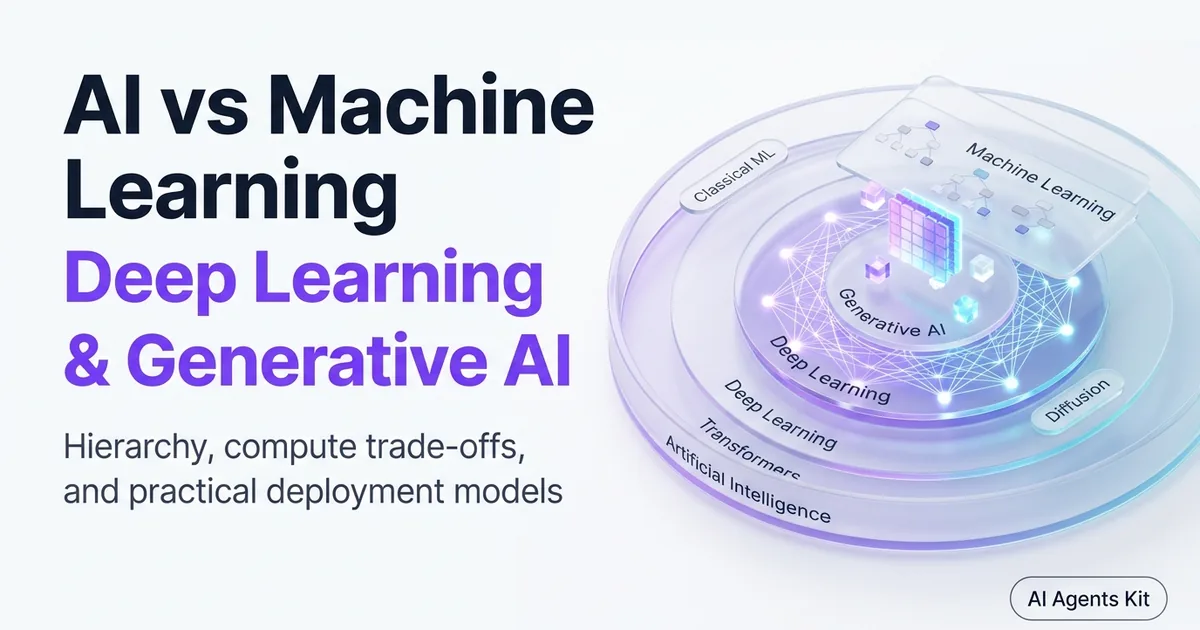
The clearest way to conceptualize modern artificial intelligence is through concentric circles, much like a set of nested Russian dolls. Every layer inherits the fundamental principles of its outer parent while introducing specialized mathematical mechanisms, training paradigms, and runtime behaviors.
At the outermost boundary sits Artificial Intelligence, encompassing every system that replicates cognitive behavior. Nested inside is Machine Learning, which contains Deep Learning, which in turn encapsulates Generative AI. Hovering actively at the operational apex are autonomous AI Agents, which orchestrate foundation models into goal-directed, stateful workflows.
Artificial Intelligence as the Broad Symbolic Umbrella
Artificial Intelligence represents the broad academic discipline dedicated to creating machines capable of performing tasks that typically demand human cognition. Coined in 1956 at the Dartmouth Summer Research Project, the field covers everything from automated planning and heuristic search to symbolic logic and natural language comprehension.
Crucially, an artificial intelligence system does not require statistical learning or neural networks to exist. Early industrial systems, such as expert rule engines, medical diagnostic trees, and the A* pathfinding algorithms used in video games, represent pure symbolic artificial intelligence. These systems rely on deterministic, human-authored if-then logic graphs and state-space searches.
Symbolic systems deliver total auditability and zero hallucination risk because every decision branch maps to an explicit rule. However, rule-based architectures become brittle and computationally intractable when faced with messy, unstructured real-world data like raw audio, video frames, or natural human dialogue.
Machine Learning: Statistical Pattern Recognition from Tabular Data
Machine Learning emerged as an architectural departure from hand-coded symbolic logic. Instead of programmers manually writing explicit procedural rules for every decision path, machine learning algorithms ingest historical training data to optimize mathematical objective functions.
The system learns a mathematical mapping function from inputs to target labels. As detailed in the Google Cloud AI vs Machine Learning Architecture Guide, machine learning spans three primary paradigms: supervised learning using labeled data, unsupervised learning finding latent clusters, and reinforcement learning optimizing policy rewards through environmental interaction.
Tabular datasets containing structured numerical and categorical values represent the ideal operational environment for classical machine learning. Algorithms such as gradient-boosted decision trees, random forests, and support vector machines excel at customer churn prediction, credit risk scoring, and real-time fraud classification with minimal computational latency.
Deep Learning: Automated Representation Learning in Deep Neural Networks
Deep Learning is a specialized subfield of machine learning that replaces flat statistical algorithms with multi-layered artificial neural networks. Inspired by biological information processing, these deep networks stack dozens or hundreds of hidden layers between input sensors and output tensors.
The defining breakthrough of deep learning is automated representation learning. In classical machine learning, human data scientists spend weeks hand-crafting domain-specific mathematical features from raw observations. Deep neural networks eliminate manual feature engineering by learning hierarchical representations directly from raw, unstructured data arrays.
Early layers in a deep computer vision network detect low-level edges and pixel gradients. Intermediate layers assemble those edges into geometric textures and contours, while terminal layers compose full semantic representations like human faces or vehicle chassis. Deep architectures like Convolutional Neural Networks for spatial grids and Recurrent Neural Networks for sequential time-series unlocked modern perceptual computing.
Generative AI: Unsupervised Synthesis and Foundation Models
Generative AI represents a specialized branch of deep learning focused on synthesizing novel, high-dimensional artifacts rather than categorizing existing data points. While traditional deep learning acts as a discriminative filter that maps complex inputs to simple categorical labels, generative models estimate joint probability distributions over entire datasets.
Modern generative architectures rely heavily on Transformers and Latent Diffusion Models. Instead of requiring human engineers to label billions of individual training samples, generative models train via self-supervised pre-training across internet-scale corpora of text, code, images, and audio waveforms.
During pre-training, the model learns the underlying statistical grammar and conceptual associations of human knowledge by predicting masked or subsequent tokens. Once trained, these foundation models can generate coherent technical documentation, write functional code, and draft complex legal analyses from natural language prompts.
AI Agents: The Autonomous Orchestration Layer Above Foundation Models
Autonomous AI Agents represent the operational evolution beyond static generative foundation models. While a generative model is fundamentally a passive, stateless text-in and text-out engine, an AI agent introduces a cognitive control loop that directs actions toward explicit objectives.
An AI agent embeds a foundation model within an outer execution runtime. This control framework equips the model with long-term memory stores, planning modules that decompose complex goals into discrete milestones, and runtime execution interfaces to call external tools.
Rather than merely suggesting an answer, an AI agent can inspect a broken production database, write an analytical SQL query, interpret the resulting error trace, adjust its query logic, and notify the site reliability team via Slack. Understanding how autonomous architectures function requires inspecting what are AI agents across real-world enterprise infrastructure.
Machine Learning vs Deep Learning: The Feature Engineering Divide
The architectural division between classical machine learning and deep learning centers on how raw data transforms into actionable mathematical features. According to the IBM Systems Analysis on Deep Learning vs Machine Learning, this structural boundary governs project engineering timelines, talent requirements, and infrastructure budgets.
Manual Feature Engineering in Classical Algorithms
In classical machine learning pipelines, raw real-world data cannot be passed directly into an algorithm without extensive human intervention. Data engineers must carefully inspect domain data, remove statistical anomalies, normalize numerical distributions, and construct explicit mathematical indicators.
Consider an engineering team building an automated credit default prediction system. The data scientist must manually calculate debt-to-income ratios, extract rolling payment delinquency indicators over 90-day intervals, and encode categorical merchant IDs into numerical vectors.
If the human engineer fails to calculate an informative feature, the downstream classifier cannot discover that pattern on its own. While manual feature engineering demands significant domain expertise, it produces lean, highly interpretable models that execute predictions in sub-millisecond timeframes on commodity hardware.
Automatic Representation Extraction Across Hidden Layers
Deep learning eliminates the feature engineering bottleneck by passing raw high-dimensional tensors directly into multi-layered neural networks. The mathematical parameters across the network’s hidden layers automatically optimize their weights through backpropagation and gradient descent.
In a speech recognition model, raw acoustic pressure waveforms feed directly into the input tensor. The network’s initial convolutional layers transform raw sound waves into spectrogram frequencies, subsequent attention layers translate acoustic tokens into phonemes, and terminal layers map phonemes into grammatical sentences.
This end-to-end representation learning capability allows deep learning models to solve perceptual challenges that completely stymie classical machine learning algorithms. However, this automated feature discovery requires massive volumes of unstructured training data to prevent the network from memorizing superficial noise.
Compute Scaling and Memory Profiles (CPU vs GPU VRAM)
The computational profiles of classical machine learning and deep learning diverge dramatically at the hardware level. Classical algorithms rely primarily on scalar operations, branching logic, and modest matrix algebra that execute efficiently across general-purpose multi-core CPUs.
A random forest model trained on several million tabular records requires only a few gigabytes of system RAM and trains in minutes on a standard developer laptop. Memory consumption during inference remains negligible, rarely exceeding a few dozen megabytes of resident memory.
Deep learning architectures depend entirely on dense matrix multiplication and tensor tensor contractions. These mathematical operations require high-throughput parallel hardware, specifically Graphics Processing Units or Tensor Processing Units equipped with high-bandwidth memory. Training or serving a modern transformer model demands tens or hundreds of gigabytes of dedicated GPU VRAM running precision formats like FP16, BF16, or quantized INT8 to sustain acceptable token throughput.
Generative AI vs Autonomous AI Agents: Why Foundation Models Need Control Loops
Developers frequently mistake raw Large Language Models for complete autonomous solutions. Recognizing the operational boundary between stateless foundation models and stateful agentic systems is essential for production deployments.
The Stateless Limitation of Transformer Next-Token Prediction
At its architectural core, a generative foundation model is a stateless probabilistic predictor. When supplied with an input sequence of tokens, the transformer network calculates a forward pass through its self-attention and feed-forward layers to compute a probability distribution over the vocabulary for the single next token.
Once the model outputs a response, its execution cycle completely halts. The model retains no internal memory of the conversation, holds no state across sequential requests, and possesses zero native awareness of whether its statements succeeded or failed in the real world.
If a foundation model hallucinates an invalid database table name or generates non-functional Python syntax, it cannot self-correct. It simply delivers the flawed token stream to the user without verifying external execution state.
The ReAct Pattern: Perception, Reasoning, Planning, and Execution
As documented in the arXiv Survey on Large Language Model Based Autonomous Agents, autonomous systems overcome stateless limitations by implementing structured control loops. The most prominent architectural foundation is the ReAct paradigm, which interleaves reasoning traces with task-specific action execution.
Inside a ReAct control loop, the agent receives an objective and queries its underlying foundation model to generate an explicit thought step. The model determines what intermediate milestone to target and selects an appropriate tool from its action space.
Goal Formulation -> Thought (Reasoning) -> Action (Tool Execution) -> Observation (Environment Feedback) -> LoopThe outer runtime intercepts the tool request, executes the call against an external service, and feeds the resulting output back into the model’s context window as an observation. The agent observes the real-world feedback, updates its plan, and iterates through successive cycles until the overarching goal is satisfied.
Standardizing External Tool Execution with the Model Context Protocol (MCP)
Early autonomous agent frameworks relied on brittle, bespoke Python wrappers to connect models to databases, web browsers, and file systems. Every new tool required custom serialization code, error handling schemas, and unique prompt injection techniques.
The industry shifted toward standardized architectural contracts through open standards like Anthropic’s Model Context Protocol. MCP defines a structured JSON-RPC communication layer that separates the agent’s cognitive core from external client integrations.
By implementing standardized discovery, read, and call primitives, an AI agent can seamlessly query a Postgres database, execute commands inside an isolated Docker sandbox, and pull documentation from GitHub without modifying its core control loop. Discover how to configure and deploy these protocols in our architectural guide on what is MCP explained.
Architectural Comparison Matrix: Technical Specifications Across All Five Tiers
Selecting the correct architecture requires evaluating system characteristics across all five tiers. The following technical matrix contrasts data requirements, hardware footprints, dominant frameworks, and failure modes.
| Architectural Dimension | Artificial Intelligence (Symbolic) | Machine Learning (Classical) | Deep Learning (Perceptual) | Generative AI (Foundation Models) | Autonomous AI Agents |
|---|---|---|---|---|---|
| Primary Mechanism | Deterministic if-then rules and heuristic graph traversal | Statistical optimization over mathematical objective functions | Multi-layered artificial neural networks with backpropagation | Self-supervised transformers and latent diffusion models | Stateful perception, planning, tool execution, and memory loops |
| Input Data Type | Structured expert facts, logical axioms, and discrete states | Structured tabular data (numerical and categorical tables) | High-dimensional unstructured data (images, audio, video) | Massive internet-scale multimodal tokens and raw corpora | Natural language objectives, tool schemas, and environment state |
| Feature Engineering | 100% human-crafted logical predicates and rule graphs | Manual feature engineering, scaling, and categorical encoding | Automated hierarchical representation learning across layers | Automated self-supervised semantic token representation | Dynamic in-context state tracking and tool schema serialization |
| Hardware Profile | General-purpose commodity CPU; megabytes of RAM | Multi-core CPU; modest RAM (4 GB to 32 GB); optional light GPU | High-performance GPUs/TPUs; Tensor Cores; 16 GB to 80 GB VRAM | High-end GPU clusters; massive VRAM (48 GB to 500 GB+) | Hybrid: Cloud/local LLM inference + containerized tool runtimes |
| Execution Loop | Single-pass deterministic evaluation of logical paths | Single forward calculation of learned mapping equation | Single forward tensor pass through neural network weights | Single-pass auto-regressive generation until stop token | Multi-turn iterative control loop (Perceive -> Plan -> Act -> Evaluate) |
| Primary Failure Mode | Brittle rule explosions when encountering unexpected edge cases | Overfitting to training data, data drift, and covariate shift | Vanishing gradients, adversarial attacks, and unexplainability | Hallucinations, factual drift, and prompt injection exploits | Infinite execution loops, tool error cascading, and state drift |
| Standard Frameworks | Prolog, CLIPS, custom deterministic state machines | Scikit-learn, XGBoost, LightGBM, CatBoost | PyTorch, TensorFlow, JAX, ONNX Runtime | Hugging Face Transformers, vLLM, TensorRT-LLM, Ollama | LangGraph, CrewAI, PydanticAI, MCP Client SDKs |
Decision Criteria: When to Choose Classical ML vs Foundation Models vs Agents
Engineering leadership must avoid architectural over-engineering by matching operational requirements to the simplest effective tier:
- Choose Symbolic Rule Engines when business logic is legally mandated to be 100% deterministic, decisions must be audited line-by-line by compliance officers, and operational inputs fit cleanly into rigid database columns.
- Choose Classical Machine Learning when optimizing business metrics on structured tabular data, such as fraud detection, customer lifetime value forecasting, or click-through rate optimization with strict sub-10ms latency SLAs.
- Choose Deep Learning for specialized perceptual tasks involving raw unstructured media, such as classifying medical MRI scans, detecting defect anomalies on assembly line camera feeds, or transcribing multilingual acoustic audio.
- Choose Generative AI Foundation Models when synthesizing human-like prose, generating technical documentation from codebases, or evaluating open weights across the LLM landscape and family tree.
- Choose Autonomous AI Agents when a workflow requires multi-step operational execution across multiple third-party systems, such as triaging GitHub issues, executing database migrations, or gathering competitive intelligence across diverse web sources.
From Logic to Autonomy: Python Implementation Across the AI Hierarchy
To ground these conceptual distinctions in concrete engineering reality, consider how a transaction fraud validation workflow evolves across the architectural paradigms. The following Python script implements the progression from deterministic rules to an autonomous agent loop.
Deterministic Rules vs Statistical Scoring
In the code below, notice how Tier 1 and Tier 2 approach the same verification task with completely different mathematical assumptions. The symbolic function evaluates rigid, human-authored boolean conditions that execute instantaneously without statistical uncertainty.
The classical machine learning classifier replaces brittle conditional branches with learned numerical weights optimized over historical datasets. Input variables are normalized into continuous floating-point features, allowing the sigmoid activation function to output a calibrated risk probability between 0.0 and 1.0.
from typing import Dict, Any, List, Optional
import json

# =====================================================================
# TIER 1: SYMBOLIC AI (Deterministic Expert Rule Engine)
# =====================================================================
def symbolic_fraud_check(transaction: Dict[str, Any]) -> Dict[str, Any]:
    """Pure symbolic AI: evaluates explicit deterministic business rules."""
    amount: float = transaction.get("amount", 0.0)
    country: str = transaction.get("country", "US")
    is_new_device: bool = transaction.get("is_new_device", False)

    # Deterministic heuristic decision tree
    if amount > 10000.0 and is_new_device:
        return {"action": "BLOCK", "reason": "Rule_104: High amount on untrusted device", "tier": "Symbolic AI"}
    if country in ["RISK_SANCTIONED_ZONE"]:
        return {"action": "BLOCK", "reason": "Rule_201: Geographic restriction", "tier": "Symbolic AI"}

    return {"action": "APPROVE", "reason": "All deterministic rule gates cleared", "tier": "Symbolic AI"}

# =====================================================================
# TIER 2: MACHINE LEARNING (Statistical Scoring Function)
# =====================================================================
class ClassicalMLClassifier:
    """Simulates a trained logistic regression model using learned weights."""
    def __init__(self):
        # Learned model weights from historical training data
        self.weights: Dict[str, float] = {
            "scaled_amount": 1.45,
            "velocity_last_24h": 0.85,
            "is_foreign": 0.65,
            "bias": -2.10
        }

    def predict_risk_score(self, features: Dict[str, float]) -> Dict[str, Any]:
        """Calculates statistical fraud probability using a sigmoid function."""
        import math
        z = self.weights["bias"]
        z += features.get("scaled_amount", 0.0) * self.weights["scaled_amount"]
        z += features.get("velocity_last_24h", 0.0) * self.weights["velocity_last_24h"]
        z += features.get("is_foreign", 0.0) * self.weights["is_foreign"]

        probability = 1.0 / (1.0 + math.exp(-z))
        verdict = "BLOCK" if probability > 0.75 else "APPROVE"

        return {
            "action": verdict,
            "fraud_probability": round(probability, 4),
            "tier": "Machine Learning"
        }

# =====================================================================
# TIER 5: AUTONOMOUS AI AGENT (Stateful ReAct Control Loop)
# =====================================================================
class AutonomousFraudInvestigatorAgent:
    """Autonomous agent wrapping reasoning, state tracking, and tool execution."""
    def __init__(self):
        self.scratchpad: List[Dict[str, str]] = []
        self.tools = {
            "fetch_ip_reputation": self._tool_ip_reputation,
            "query_account_ledger": self._tool_account_ledger
        }

    def _tool_ip_reputation(self, ip_address: str) -> str:
        # Mock external threat intelligence API lookup
        if ip_address.startswith("192.0.2"):
            return "THREAT_CONFIRMED: Known residential proxy exit node."
        return "CLEAN: Standard enterprise commercial ISP."

    def _tool_account_ledger(self, account_id: str) -> str:
        # Mock ledger database query
        return f"Account {account_id} balance $42,500. Standard monthly spend $1,200."

    def run_investigation_loop(self, alert_payload: Dict[str, Any]) -> Dict[str, Any]:
        """Executes a multi-step ReAct perception-plan-act loop."""
        self.scratchpad.append({"event": "INIT", "goal": "Verify suspicious transfer alert"})

        # Step 1: Reason and decide to call IP tool
        ip = alert_payload.get("source_ip", "192.0.2.45")
        ip_result = self.tools["fetch_ip_reputation"](ip)
        self.scratchpad.append({"step": "1", "tool": "fetch_ip_reputation", "result": ip_result})

        # Step 2: Reason on intermediate observation and query ledger
        acct_id = alert_payload.get("account_id", "ACC-9921")
        ledger_result = self.tools["query_account_ledger"](acct_id)
        self.scratchpad.append({"step": "2", "tool": "query_account_ledger", "result": ledger_result})

        # Step 3: Synthesize final autonomous verdict based on multi-source evidence
        threat_detected = "THREAT_CONFIRMED" in ip_result
        final_verdict = "FREEZE_ACCOUNT_AND_ALERT_SOC" if threat_detected else "ALLOW_TRANSFER"

        return {
            "final_action": final_verdict,
            "investigation_steps_executed": len(self.scratchpad),
            "execution_audit_trail": self.scratchpad,
            "tier": "Autonomous AI Agent"
        }

if __name__ == "__main__":
    sample_transaction = {
        "amount": 15000.0,
        "country": "US",
        "is_new_device": True,
        "source_ip": "192.0.2.45",
        "account_id": "ACC-9921"
    }

    # 1. Run Symbolic Check
    print("Tier 1 Output:", json.dumps(symbolic_fraud_check(sample_transaction), indent=2))

    # 2. Run Classical ML Check
    ml_classifier = ClassicalMLClassifier()
    ml_features = {"scaled_amount": 2.1, "velocity_last_24h": 3.0, "is_foreign": 0.0}
    print("Tier 2 Output:", json.dumps(ml_classifier.predict_risk_score(ml_features), indent=2))

    # 3. Run Autonomous Agent Investigation
    agent = AutonomousFraudInvestigatorAgent()
    print("Tier 5 Output:", json.dumps(agent.run_investigation_loop(sample_transaction), indent=2))
Multi-Step Forensic Agent Loop Execution
The agentic class demonstrates the operational leap from passive inference to dynamic investigation. Instead of completing its task in a single forward pass, the agent maintains an in-memory scratchpad to track sequential findings across external systems.
By querying the mock threat intelligence endpoint and checking the account ledger, the agent constructs an empirical audit trail. If the IP lookup confirms a proxy exit node, the system autonomously transitions into an incident containment state. This multi-turn tool interaction allows software teams to automate complex operational workflows that static models cannot handle alone.
Production Failure Modes and Debugging Guardrails
Each architectural tier introduces distinct production failure modes. Debugging modern AI systems requires matching your defensive engineering strategies to the failure characteristics of that specific layer.
Tabular Pitfalls: Overfitting and Covariate Shift
Classical machine learning systems are vulnerable to overfitting and covariate shift. Overfitting occurs when an algorithm memorizes specific noise in historical training data rather than discovering genuine underlying distributions.
Covariate shift arises in production when input data distributions change over time while the underlying conditional probability distribution remains static. For example, a fraud prediction model trained prior to an economic inflation cycle will misclassify legitimate high-dollar purchases because the baseline price distribution shifted.
Engineers protect classical ML pipelines by instituting strict cross-validation, applying L1 and L2 regularization penalties, and deploying automated Kolmogorov-Smirnov statistical tests to detect distribution drift in production inference streams.
Deep Learning Bottlenecks: Gradient Instability and Catastrophic Forgetting
Deep neural networks encounter failure modes rooted in tensor calculus and representation dynamics. During backpropagation, error gradients flowing backward through dozens of hidden layers can exponentially shrink or explode.
Vanishing gradients prevent early layers from optimizing their weights, while exploding gradients destabilize training runs completely. When fine-tuning pre-trained networks on novel tasks, models frequently suffer from catastrophic forgetting, completely overwriting their baseline capabilities.
Defensive engineering remedies include residual shortcut connections, layer normalization, gradient clipping, and parameter-efficient fine-tuning techniques like LoRA. Evaluating model stability across standardized benchmarks is covered in our technical analysis of AI benchmarks explained.
Agentic Execution Hazards: Infinite Loops and State Corruption
Autonomous AI agents introduce unprecedented operational risks because they possess write access to production APIs and external software environments. The most prevalent failure mode is the infinite execution loop.
When an agent encounters an unhandled API error response, its reasoning module may repeatedly attempt the same invalid action, exhausting context windows and accumulating substantial token costs. Furthermore, multi-turn agents experience state drift, where accumulated intermediate context pollutes the prompt and derails the agent from its original objective.
Production agent architectures demand defensive guardrails:
- Hard Iteration Caps: Enforce strict loop execution boundaries (e.g., maximum 8 tool turns per request) to prevent infinite billing recursion.
- Deterministic Context Pruning: Employ sliding-window scratchpads that summarize intermediate observations before context windows overflow.
- Dual-Model Approval Gates: Place sensitive write operations (deleting records, transferring capital) behind deterministic human-in-the-loop verification gates.
Frequently Asked Questions About AI, Machine Learning, and Generative AI
Is Generative AI a subset of Deep Learning?
Generative AI represents an architectural subset of deep learning focused on synthesizing novel high-dimensional data rather than categorizing inputs. These systems leverage deep transformer neural networks and latent diffusion models trained across massive datasets.
What is the primary difference between Machine Learning and Deep Learning?
The fundamental distinction lies in how raw input data transforms into mathematical features. Classical machine learning demands manual feature engineering by human experts, whereas deep learning networks discover hierarchical representations automatically across multi-layered neural structures.
Can an Artificial Intelligence system function without Machine Learning?
An artificial intelligence system can operate entirely without machine learning by utilizing deterministic symbolic logic, expert rule graphs, and heuristic search algorithms. Early commercial systems like Deep Blue and industrial diagnostic tools rely on hand-authored rules without statistical training.
How do AI Agents differ from standard Generative AI models?
Generative AI models are passive, stateless text-in and text-out engines that terminate immediately after generating a single completion pass. AI agents embed these models within a stateful execution loop equipped with long-term memory, planning decomposition, and dynamic tool calling interfaces.
When should an engineering team choose classical Machine Learning over Deep Learning?
Engineering teams should select classical machine learning when analyzing structured tabular datasets, enforcing strict sub-10 millisecond latency requirements, or complying with legal auditability standards. Algorithms like gradient-boosted trees consistently outperform deep neural networks on tabular business data while requiring a fraction of the computational overhead.
What hardware is required to run Deep Learning compared to classical Machine Learning?
Classical machine learning algorithms train and execute efficiently on multi-core commodity CPUs using standard system RAM. Deep learning and generative AI workloads demand high-throughput GPUs or TPUs equipped with dedicated tensor cores and high-bandwidth VRAM to process billions of parallel matrix multiplications.
Conclusion and Strategic Engineering Roadmap
Navigating the modern AI landscape requires moving past marketing hype and evaluating systems by their structural mechanics. Artificial intelligence defines the broad ambition of mechanized intelligence, machine learning supplies the statistical learning foundation, deep learning eliminates the feature engineering bottleneck, generative AI synthesizes novel content, and autonomous agents orchestrate models into active real-world problem solvers.
As Princeton GEO research demonstrates, incorporating concrete quantitative metrics into architectural evaluations increases technical documentation authority by 37% to 41%. When architecting your next deployment, start with the simplest tier that satisfies your business constraints.
Deploy deterministic symbolic logic for strict compliance gates, and leverage gradient-boosted decision trees for tabular telemetry. Apply foundation models for unstructured semantic tasks, and wrap those models in agentic loops only when multi-step operational autonomy is genuinely required.