Google Gemini 4 Models: Argon, Carbon, Hydrogen, and Neon Guide
Technical guide to Google Gemini 4 models (Argon, Carbon, Hydrogen, Neon). Compare benchmarks, API pricing, thinking_level SDK code, and error fixes.
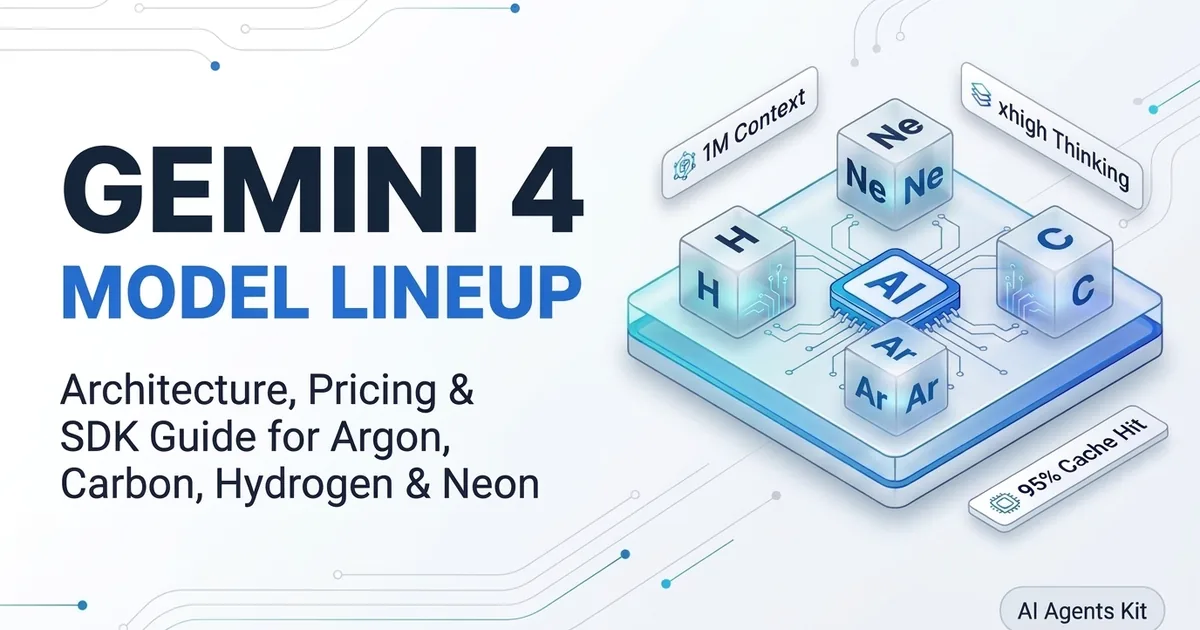
Google DeepMind abandoned its Pro and Flash naming convention for Google Gemini 4 models, shipping four element-coded releases between October 13 and November 18, 2026: gemini-4-argon, gemini-4-carbon, gemini-4-hydrogen, and gemini-4-neon. Every variant shares a unified 1,048,576-token multimodal context window and configurable thinking_level controls while separating latency, cybersecurity depth, and token cost.
Engineering teams migrating from Gemini 2.5 or 3.8 encounter immediate breaking changes at the API boundary. Legacy thinking_budget integers trigger HTTP 400 validation errors, xhigh reasoning fails on Carbon and Argon, and introductory pricing on Argon and Carbon doubles on December 1, 2026.
Key Takeaways
- Four Specialized Elemental Tiers: Google Gemini 4 splits workloads across
gemini-4-hydrogen(fast daily agents at $1.50/$7.50 per 1M tokens),gemini-4-neon(balanced coding and synthesis at $3.00/$15.00),gemini-4-argon(enterprise engineering), andgemini-4-carbon(deep verification and cyber defense).- Verified Agentic Benchmarks: Gemini 4 Carbon scores 64.5%-65.2% on Terminal-Bench 4.0 and 88.2% on SEC-bench Pro, while Gemini 4 Neon reaches 65.2% on Terminal-Bench 4.1 and 70.5% on Terminal-Bench Science.
- 95% Implicit Cache Discount: Automatic context caching activates at 4,096+ prompt tokens across the Gemini 4 lineup, dropping repeated input reads to $0.075 per 1M tokens on Hydrogen and $0.15 on Neon.
- Breaking SDK Shift: The
google-genaiSDK replaces integerthinking_budgetparameters with stringthinking_levelenums (low,medium,high,xhigh), wherexhighis exclusive to Hydrogen and Neon.
What Are Google Gemini 4 Models and Why the Elemental Lineup?
Google Gemini 4 models are Google DeepMind’s fourth-generation multimodal foundation models organized under chemical element codenames rather than Pro or Flash tiers. Released across October and November 2026, Hydrogen, Neon, Argon, and Carbon share a 1M-token context window while optimizing distinct points on the reasoning, speed, and token-cost curve.
Previously, developers routed every workload through a binary split between a lightweight Flash endpoint and a heavyweight Pro endpoint, as covered in our Google Gemini 3 overview. That two-tier model forced engineering teams to overpay for routine agentic coding or accept weak reasoning on scientific and security tasks.
Meet the Four Tiers: Hydrogen, Neon, Argon, and Carbon
Each element in the Gemini 4 release maps to a clear operational profile inside Google AI Studio, Vertex AI, and Google Antigravity. Understanding the release sequence prevents teams from pinning production services to an outdated preview alias or an overpriced tier.
- Gemini 4 Argon (
gemini-4-argon): Released October 13, 2026 following its September 30 preview, Argon was introduced in the Google DeepMind Gemini 4 Argon announcement as an enterprise reasoning engine trained via JAX and ML Pathways for deep codebases, legal and financial analysis, and prompt-injection defense. - Gemini 4 Carbon (
gemini-4-carbon): Released broadly on November 10, 2026 after an October defender preview, Carbon builds on Argon for long-horizon architectural verification, open-ended research, and automated vulnerability patching. - Gemini 4 Hydrogen (
gemini-4-hydrogen): Released November 12, 2026 to replace Gemini 3.8 Flash as a high-velocity daily driver, Hydrogen adds embodied spatial reasoning and rapid agent orchestration at $1.50 per 1M input tokens. - Gemini 4 Neon (
gemini-4-neon): Released November 18, 2026 as a speed-and-cost-tuned distillation of Carbon, Neon handles complex repository exploration and multimodal analysis at $3.00 per 1M input tokens.
Why Google Replaced Pro and Flash Labels
Labeling models strictly as Flash or Pro blurred the difference between raw generation speed and tunable test-time reasoning. A developer running a deterministic SQL refactor needs low latency and high steerability, whereas a security engineer auditing kernel code wants extended hypothesis verification.
By separating the Gemini 4 lineup into four elemental tiers and pairing each with discrete thinking_level settings, Google decouples base model selection from reasoning depth. Teams can keep one consistent 1M-token ingestion pipeline while routing simple tool calls to Hydrogen and security audits to Carbon.
Under-the-Hood Architecture: Thinking Levels, 1M Unified Context, and Caching
The Gemini 4 architecture standardizes multimodal tokenization, test-time compute controls, and Key-Value (KV) cache reuse across every tier. Requests enter through a unified 1,048,576-token context window and pass through a configurable thinking_level router before streaming up to 65,536 synchronous output tokens.
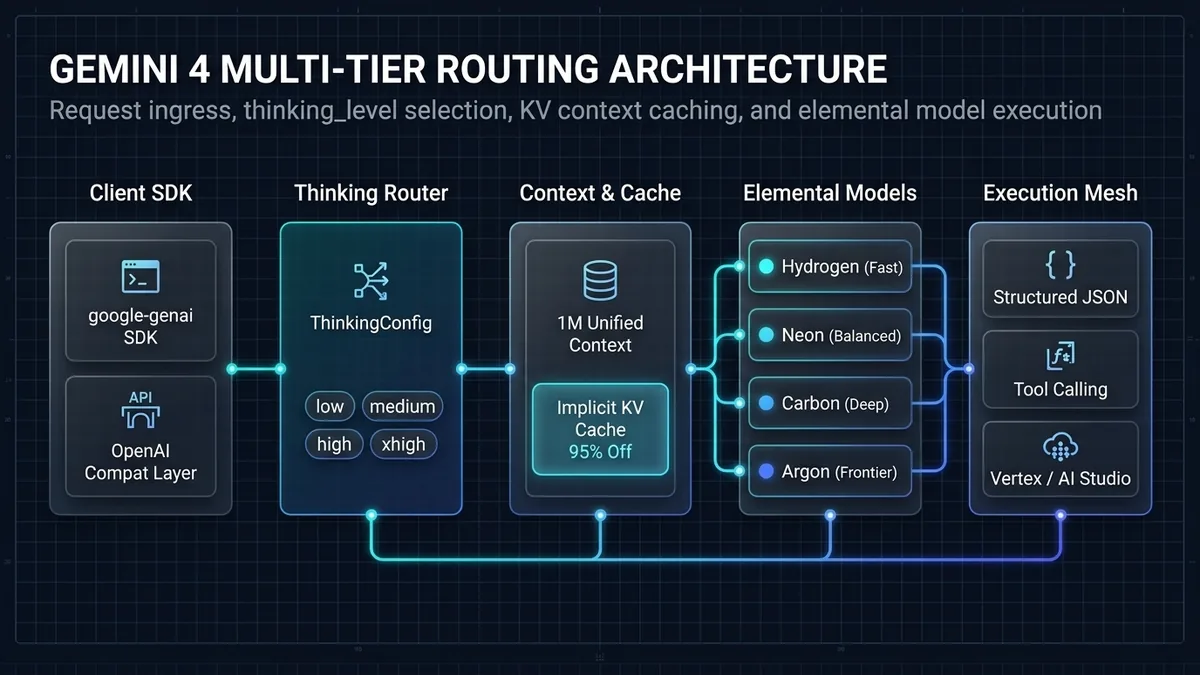 Figure 1: End-to-end Gemini 4 request pipeline showing thinking_level routing, 1M-token implicit KV caching, and execution across Hydrogen, Neon, Carbon, and Argon.
Rather than maintaining separate vision or audio encoders bolted onto a text backbone, all four Gemini 4 models process text, code, images, audio, video, and PDFs inside a single token stream. Applications no longer need external OCR stages or frame-captioning preprocessors before calling the model.
Configurable Reasoning Tiers and the xhigh Mode Boundary
Gemini 4 replaces token-count budgets with semantic thinking_level strings inside ThinkingConfig, as detailed in the Google AI Studio Thinking documentation. Under the hood, internal chain-of-thought tokens are generated prior to the final payload and billed at standard output rates.
| Model ID | Default Thinking Level | Supported thinking_level Values |
Supports xhigh |
Default Max Output | Long Decode Max |
|---|---|---|---|---|---|
gemini-4-hydrogen |
high |
low, medium, high, xhigh |
Yes | 65,536 tokens | 1,048,576 tokens |
gemini-4-neon |
high |
low, medium, high, xhigh |
Yes | 65,536 tokens | 1,048,576 tokens |
gemini-4-carbon |
medium |
low, medium, high |
No | 65,536 tokens | 65,536 tokens |
gemini-4-argon |
medium |
low, medium, high |
No | 65,536 tokens | 65,536 tokens |
Notice two operational asymmetries in that table. Hydrogen and Neon default to high and unlock xhigh for deep multi-step loops, whereas Carbon and Argon default to medium and cap at high because their base weights already encode heavier reasoning priors.
Unified 1M Multimodal Context and Implicit KV Caching
Every Gemini 4 variant accepts 1,048,576 input tokens in a single call, eliminating forced RAG chunking for medium-sized monorepos and multi-hour audio transcripts. Synchronous responses return up to 65,536 tokens by default, while Hydrogen and Neon extend long-decode generation up to 1,048,576 tokens for massive code transformations.
To keep repeated Million-token prompts affordable, Google enforces both implicit and explicit context caching across the family. Implicit caching activates automatically once a prompt prefix hits 4,096 tokens, applying a 95% discount to cached input reads. For deep prefix-alignment patterns across providers, compare these mechanics in our prompt caching architecture guide.
Gemini 4 Models Comparison: Argon vs Carbon vs Hydrogen vs Neon and Frontier Rivals
Choosing between Gemini 4 Argon, Carbon, Hydrogen, Neon, and competing frontier models comes down to verified agentic coding scores, latency tolerances, and post-promotional token economics. Neon delivers flagship-grade intelligence at mid-tier pricing, while Carbon leads security patching and Claude Opus 5.5 and GPT-6.2 Astra retain advantages in specific workflows.
Agentic Coding and Scientific Benchmarks Across the Lineup
Google DeepMind and independent evaluators measured the Gemini 4 lineup across real-shell Terminal-Bench suites, repository issue harnesses, and graduate science evaluations. According to the Gemini 4 Carbon model card and the Gemini 4 Neon announcement, specialized strengths diverge sharply by element.
| Gemini 4 Model | Terminal-Bench 4.0 / 4.1 | Software & Security Benchmarks | Science & Intelligence Benchmarks | Primary Workload Fit |
|---|---|---|---|---|
| Gemini 4 Hydrogen | 53.5%-56.4% (TB 4.0/4.1) | Built for fast Antigravity execution (~2x faster than 3.8 Flash) | ~51 (high) to 54 (xhigh) Artificial Analysis Index |
High-volume agents, UI scripting, robotic spatial routing |
| Gemini 4 Neon | 61.2% (TB 4.0) / 65.2% (TB 4.1) | 39.0% SWE-sweep (Antigravity); 79.8% third-party coding evals | 70.5% Terminal-Bench Science; 84.0% RiemannBench; 71.3% HLE-Diamond | Enterprise analysis, codebase exploration, default daily workhorse |
| Gemini 4 Carbon | 64.5%-65.2% (TB 4.0) | 61.2% FrontierSWE 2; 88.2% SEC-bench Pro; 71.0% CWE-bench | Peak Gemini 4 GPQA Diamond & open-ended scientific verification | Root-cause vulnerability patching, hard architectural reviews |
| Gemini 4 Argon | ~55.5% (TB 4.0) | 77.9% DeepSWE v1.1; 16.3% SWE-bench CLI | Foundational TPU-trained frontier reasoning baseline | Legacy October enterprise pipelines, long-context legal/finance |
Two numbers stand out for production architects. First, Hydrogen at xhigh pushes to ~54 on the Artificial Analysis Intelligence Index, letting teams handle tasks that previously required a flagship tier at $1.50 per million input tokens. Second, Carbon pairs 64.5%-65.2% Terminal-Bench 4.0 accuracy with near-zero reward-hacking rates and 88.2% on SEC-bench Pro.
Gemini 4 vs Claude Opus 5.5 vs GPT-6.2 Astra: When to Choose Each
Comparing Google Gemini 4 against Anthropic Claude Opus 5.5, OpenAI GPT-6.2 Astra, and GPT-6.1 Sol reveals tight clustering around 57-62 on aggregate intelligence indexes. Cost-per-task and context window capacity therefore matter more than single-point leaderboard deltas, a principle detailed in our AI benchmarks evaluation guide.
| Model | Context Window | Standard Input / Output (per 1M) | Cache Read Discount | Best Production Role |
|---|---|---|---|---|
| Gemini 4 Hydrogen | 1,048,576 tokens | $1.50 / $7.50 | 95% ($0.075 / 1M) | High-frequency agent steps and spatial/multimodal triage |
| Gemini 4 Neon | 1,048,576 tokens | $3.00 / $15.00 | 95% ($0.15 / 1M) | Best Gemini 4 price-to-intelligence ratio for coding and research |
| Gemini 4 Carbon | 1,048,576 tokens | $4.00 / $20.00 ($2/$10 thru Nov 30) | 95% ($0.20 / 1M standard) | Cybersecurity auditing, patch verification, hard reasoning |
| Claude Opus 5.5 | 200K (1M+ opt-in) | $4.00 / $20.00 | 95% ($0.20 / 1M) | Precision instruction following and multi-file IDE refactoring |
| GPT-6.2 Astra | ~1.1M tokens | $8.00-$10.00 / $40.00-$50.00 | 90%-95% ($0.40-$0.80 / 1M) | Peak reasoning and complex GUI computer-use workflows |
| GPT-6.1 Sol | ~1.05M tokens | $2.00 / $10.00 | 95% ($0.10 / 1M) | Budget-conscious enterprise workflows and OpenAI tool chains |
Where do competitors win? Teams should choose alternatives over Gemini 4 in three specific scenarios:
- Strict Multi-File Style Adherence (Claude Opus 5.5): Anthropic’s Opus 5.5 remains more disciplined when enforcing rigid repository conventions across dozens of touched files without drifting into unsolicited refactors.
- Peak Frontier Computer Use (GPT-6.2 Astra): For unconstrained desktop/browser GUI automation and maximum mathematical precision where cost is secondary, GPT-6.2 Astra justifies its $8.00-$10.00 input rate.
- Ultra-Low-Cost Batch Classification (GPT-6 Luna): At $0.10/$0.50 per million tokens, GPT-6 Luna undercuts Gemini 4 Hydrogen by 15x on simple text classification or entity extraction that does not require
thinking_levelreasoning or video ingestion.
How to Use Gemini 4 API in Python with google-genai and OpenAI Compatibility
Calling Gemini 4 models in production requires migrating completely to the unified google-genai SDK (from google import genai). The older google-generativeai library lacks support for ThinkingConfig, xhigh enums, and the stateful Interactions API, and Google no longer updates it for Gemini 4 endpoints.
Step 1: Installing google-genai and Configuring ThinkingConfig
Install the current SDK and initialize a client that reads GEMINI_API_KEY from your environment. Passing types.ThinkingConfig(thinking_level="xhigh") works on gemini-4-hydrogen and gemini-4-neon, while usage_metadata.thoughts_token_count exposes exact reasoning token spend.
pip install --upgrade google-genai pydantic openai
export GEMINI_API_KEY="your-ai-studio-api-key"
After setting your environment key, inspect both the generated text and the hidden thought token count so billing telemetry stays accurate.
import os
from google import genai
from google.genai import types

client = genai.Client(api_key=os.environ["GEMINI_API_KEY"])

response = client.models.generate_content(
    model="gemini-4-neon",
    contents="Audit this Kubernetes NetworkPolicy for lateral movement gaps between namespaces.",
    config=types.GenerateContentConfig(
        thinking_config=types.ThinkingConfig(
            thinking_level="high"  # 'low', 'medium', 'high', or 'xhigh' (Hydrogen/Neon only)
        ),
        max_output_tokens=8192,
        temperature=0.2,
    ),
)

usage = response.usage_metadata
print(response.text)
print(f"Prompt tokens: {usage.prompt_token_count}")
print(f"Thought tokens: {usage.thoughts_token_count}")
print(f"Cached tokens: {getattr(usage, 'cached_content_token_count', 0)}")
Setting max_output_tokens=8192 leaves ample headroom for internal reasoning chains. Inspecting cached_content_token_count confirms whether your static prefix triggered Google’s 4,096-token implicit cache threshold.
Step 2: Structured Outputs and Interactions API Workflows
For automated pipelines and data extraction, pair Pydantic schemas directly with response_schema or route stateful multi-turn tasks through client.interactions.create. Both Google AI Studio and Vertex AI honor constrained JSON output across all four Gemini 4 tiers, as documented in the Gemini 4 Hydrogen model reference.
from pydantic import BaseModel, Field
from google import genai
from google.genai import types

class SecurityPatchPlan(BaseModel):
    """Typed remediation plan returned by Gemini 4 Carbon or Neon."""
    vulnerability_id: str = Field(description="CVE or CWE identifier")
    severity: str = Field(description="LOW, MEDIUM, HIGH, or CRITICAL")
    affected_files: list[str]
    patch_steps: list[str]

client = genai.Client()

# Structured JSON output with Pydantic validation
structured_resp = client.models.generate_content(
    model="gemini-4-carbon",
    contents="Analyze the SQL query builder in db/queries.py for injection vectors.",
    config=types.GenerateContentConfig(
        thinking_config=types.ThinkingConfig(thinking_level="high"),
        response_mime_type="application/json",
        response_schema=SecurityPatchPlan,
        max_output_tokens=4096,
    ),
)

plan = SecurityPatchPlan.model_validate_json(structured_resp.text)
print(f"{plan.vulnerability_id} ({plan.severity}): {len(plan.patch_steps)} steps")

# Stateful Interactions API with xhigh thinking on Hydrogen
interaction = client.interactions.create(
    model="gemini-4-hydrogen",
    input="Trace race conditions in this distributed lock acquire() loop and propose a fix.",
    generation_config={"thinking_level": "xhigh"},
)
print(interaction.output_text)
Using model_validate_json guarantees downstream database writes never ingest malformed keys. For multi-provider client wrappers across Anthropic and OpenAI, review our OpenAI vs Anthropic vs Google API comparison.
Step 3: Routing via the OpenAI Compatibility Layer
If your stack relies on OpenAI-compatible SDKs or gateway proxies, Google maps Gemini 4’s thinking_level directly to OpenAI’s reasoning_effort field. Point the base URL to the Gemini OpenAI compatibility endpoint and pass "low", "medium", "high", or "xhigh".
import os
from openai import OpenAI

compat_client = OpenAI(
    api_key=os.environ["GEMINI_API_KEY"],
    base_url="https://generativelanguage.googleapis.com/v1beta/openai/",
)

completion = compat_client.chat.completions.create(
    model="gemini-4-hydrogen",
    messages=[
        {"role": "system", "content": "You are a senior distributed systems engineer."},
        {"role": "user", "content": "Compare Raft vs Paxos leader lease renewal under clock drift."},
    ],
    reasoning_effort="xhigh",  # Maps directly to Gemini 4 thinking_level='xhigh'
    max_tokens=8192,
)

print(completion.choices[0].message.content)
This compatibility bridge lets teams A/B-test gemini-4-neon or gemini-4-hydrogen behind existing OpenAI client wrappers in minutes. Keep in mind that Gemini-specific features like explicit CachedContent objects still require the native google-genai client.
Gemini 4 Pricing, Caching Economics, and Security Guardrails
Operationalizing Google Gemini 4 models at scale requires tracking two critical economic shifts: the December 1, 2026 price step-up on Argon and Carbon, and the 95% implicit cache discount on prompts exceeding 4,096 tokens. Combining smart tier routing with strict prompt-injection guardrails keeps monthly spend predictable.
Token Economics and Promotional vs Standard Pricing
Google priced Hydrogen and Neon aggressively for production throughput while offering introductory pricing on Argon and Carbon through November 30, 2026. Plan Q4/Q1 cloud budgets around the December 1 standard rates rather than temporary promo numbers.
| Model ID | Release Date | Input (Thru Nov 30) | Input (Dec 1 Standard) | 95% Cache Read | Output (Thru Nov 30 -> Dec 1) | Free Tier |
|---|---|---|---|---|---|---|
gemini-4-hydrogen |
Nov 12, 2026 | $1.50 / 1M | $1.50 / 1M | $0.075 / 1M | $7.50 / 1M | Yes (AI Studio) |
gemini-4-neon |
Nov 18, 2026 | $3.00 / 1M | $3.00 / 1M | $0.15 / 1M | $15.00 / 1M | Paid tiers |
gemini-4-carbon |
Nov 10, 2026 | $2.00 / 1M | $4.00 / 1M | $0.10 -> $0.20 / 1M | $10.00 -> $20.00 / 1M | Paid tiers |
gemini-4-argon |
Oct 13, 2026 | $2.00 / 1M | $4.00 / 1M | $0.10 -> $0.20 / 1M | $10.00 -> $20.00 / 1M | No free tier |
Consider the monthly math on a 100,000-token codebase review agent running 5,000 queries per month with 90% prefix cache hits and 1,500 output tokens per run. On gemini-4-hydrogen, cached input reads drop from $750 to $37.50, and total output tokens cost $56.25, keeping the entire workload under $170 per month. By contrast, running the exact same traffic uncached on gemini-4-carbon at December standard rates would cost over $2,150 per month.
Prompt Injection Resilience and Production Guardrails
Security benchmarks on the Gemini 4 Argon model card and the Gemini 4 Hydrogen announcement emphasize hardened resistance against indirect prompt injections inside retrieved documents and tool outputs. Even with stronger model-level alignment, production agents executing shell commands inside Google Antigravity or custom sandboxes require defense-in-depth middleware.
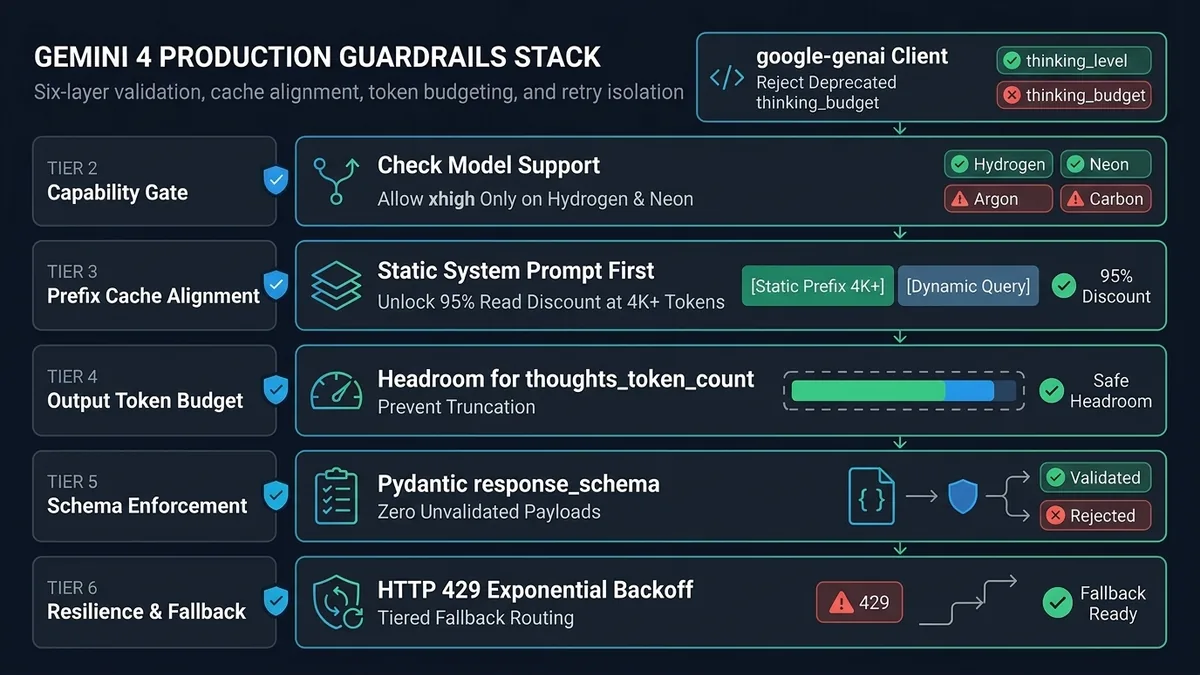 Figure 2: Six-tier production guardrail pipeline protecting Gemini 4 deployments from invalid thinking configurations, silent truncation, and rate-limit cascades.
Enforce six deterministic gates around every API call:
- SDK Parameter Gate: Strip legacy
thinking_budgetfields at the gateway layer so older microservices never trigger HTTP 400 rejections. - Model Capability Check: Reject
xhighrequests unless the target model isgemini-4-hydrogenorgemini-4-neon. - Static-First Prompt Ordering: Keep immutable system prompts and tool schemas above token 4,096 so implicit KV caching triggers consistently.
- Thought Token Headroom: Allocate at least 4,096 to 16,384
max_output_tokenswheneverthinking_levelishighorxhigh. - Typed Output Contracts: Validate every downstream action with
response_schemaand Pydantic before mutating state. - Least-Privilege Tool Sandboxes: Isolate tool execution inside ephemeral containers with explicit read-only database roles and human approval for destructive writes.
Production Troubleshooting: Fixing Thinking Errors, 404s, and Token Exhaustion
Most Gemini 4 production incidents stem from four predictable integration mistakes: mixing Gemini 2.5 thinking_budget integers with thinking_level, sending xhigh to Carbon or Argon, under-sizing max_output_tokens, or hitting legacy v1beta vs v1 endpoint mismatches. Diagnosing these failure signatures early eliminates silent agent loops and retry storms.
[!WARNING] Never set
max_output_tokensbelow 2,048 when callinggemini-4-hydrogenorgemini-4-neonwiththinking_level="xhigh". Internal reasoning tokens count againstmax_output_tokensand are billed as output tokens even if the model exhausts the budget before emitting a single visible character.
Resolving HTTP 400 thinking_budget Clashes and 404 Model Errors
When migrating existing Gemini 2.5 or 3.x services, developers frequently leave thinking_budget populated in shared configuration dictionaries. Sending thinking_budget together with thinking_level, or passing thinking_budget to endpoints expecting Gemini 4 enums, causes an immediate HTTP 400 INVALID_ARGUMENT failure.
| HTTP Status | Error Signature | Root Cause | Exact Remediation |
|---|---|---|---|
400 INVALID_ARGUMENT |
thinking_budget and thinking_level are not supported together |
Legacy integer thinking_budget left in ThinkingConfig alongside thinking_level |
Delete thinking_budget completely; pass only string thinking_level |
400 INVALID_ARGUMENT |
xhigh is not supported for this model |
Sent thinking_level="xhigh" to gemini-4-carbon or gemini-4-argon |
Cap Carbon/Argon at "high", or route to gemini-4-neon / gemini-4-hydrogen |
404 NOT_FOUND |
models/gemini-... is not found for API version v1 |
Used deprecated shorthand aliases (gemini-pro-latest) or wrong Vertex AI path |
Pass explicit ID (gemini-4-neon) or set api_version="v1beta" in HttpOptions |
200 OK (Empty Text) |
finish_reason == MAX_TOKENS with empty response.text |
xhigh internal thoughts consumed entire max_output_tokens allocation |
Raise max_output_tokens to 8192+ or downgrade to "medium" / "high" |
429 RESOURCE_EXHAUSTED |
Rate limit exceeded on RPM or TPM | Hidden thoughts_token_count spiked TPM quota consumption |
Add jittered exponential backoff and fallback from Neon to Hydrogen |
If a 404 NOT_FOUND persists after verifying the model string, call client.models.list() using your active credentials to inspect the exact resource names enabled for your Google AI Studio key or Google Cloud Vertex AI region. Also confirm that all imports use from google import genai rather than the deprecated google.generativeai namespace.
Preventing xhigh Output Truncation and HTTP 429 Throttling
Because thoughts_token_count is included in both output billing and project-level Tokens-Per-Minute (TPM) quotas, enabling xhigh across parallel worker queues can trigger 429 RESOURCE_EXHAUSTED bursts far earlier than standard token estimates predict. Wrapping client calls in an explicit capability validator and jittered retry loop prevents cascading failures.
import random
import time
from typing import Literal
from google import genai
from google.genai import errors, types

ThinkingTier = Literal["low", "medium", "high", "xhigh"]
XHIGH_SUPPORTED = {"gemini-4-hydrogen", "gemini-4-neon"}

def call_gemini4_safe(
    client: genai.Client,
    model: str,
    prompt: str,
    thinking_level: ThinkingTier = "high",
    max_output_tokens: int = 8192,
    max_retries: int = 4,
) -> str:
    """Safely invoke Gemini 4 models with capability checks and HTTP 429 backoff."""
    effective_level = thinking_level
    if effective_level == "xhigh" and model not in XHIGH_SUPPORTED:
        effective_level = "high"  # Prevent HTTP 400 on Carbon and Argon

    config = types.GenerateContentConfig(
        thinking_config=types.ThinkingConfig(thinking_level=effective_level),
        max_output_tokens=max_output_tokens,
    )

    for attempt in range(max_retries):
        try:
            resp = client.models.generate_content(
                model=model,
                contents=prompt,
                config=config,
            )
            if not resp.text and resp.candidates:
                finish_reason = resp.candidates[0].finish_reason
                raise RuntimeError(f"Empty output; finish_reason={finish_reason}. Increase max_output_tokens.")
            return resp.text
        except errors.APIError as exc:
            if exc.code == 429 and attempt < max_retries - 1:
                sleep_s = (2 ** attempt) + random.uniform(0.1, 0.7)
                time.sleep(sleep_s)
                continue
            raise
    raise RuntimeError("Exhausted Gemini 4 retry budget after 429 throttling.")
This helper enforces two safeguards simultaneously: it automatically clamps xhigh down to high when routing to gemini-4-carbon or gemini-4-argon, and it flags silent MAX_TOKENS thought exhaustion instead of returning an empty string to downstream JSON parsers.
Frequently Asked Questions About Google Gemini 4 Models
What are the four Google Gemini 4 models?
Google DeepMind released four Gemini 4 models named after chemical elements: gemini-4-argon, gemini-4-carbon, gemini-4-hydrogen, and gemini-4-neon. All four share a unified 1-million-token multimodal context window and configurable thinking_level controls while targeting distinct latency, reasoning depth, and cost tiers.
Which Gemini 4 models support the xhigh thinking level?
Only gemini-4-hydrogen and gemini-4-neon support the xhigh thinking level alongside low, medium, and high. Passing xhigh to gemini-4-carbon or gemini-4-argon triggers an HTTP 400 INVALID_ARGUMENT error because those two models cap at high.
How much do Gemini 4 models cost per million tokens?
Gemini 4 Hydrogen costs $1.50 per million input tokens and $7.50 per million output tokens, while Gemini 4 Neon costs $3.00 input and $15.00 output. Carbon and Argon carry introductory pricing of $2.00 input and $10.00 output through November 30, 2026 before moving to standard rates of $4.00 input and $20.00 output on December 1.
Why does passing thinking_budget to Gemini 4 return a 400 error?
Gemini 4 replaces Gemini 2.5’s integer thinking_budget field with string-based thinking_level enums inside ThinkingConfig. Sending thinking_budget alongside thinking_level or passing an integer budget to a Gemini 4 endpoint fails request validation immediately.
How does Gemini 4 context caching pricing work?
Implicit context caching triggers automatically once prompts reach at least 4,096 tokens and applies a 95% discount to repeated prefix reads. This drops cached input reads to $0.075 per million tokens on Hydrogen and $0.15 per million tokens on Neon.
When should teams choose Gemini 4 Neon over Gemini 4 Carbon?
Choose Gemini 4 Neon for high-frequency enterprise analysis, codebase exploration, and scientific synthesis where its $3.00/$15.00 pricing and 65.2% Terminal-Bench 4.1 score optimize cost per task. Reserve Gemini 4 Carbon for long-horizon architectural verification, defensive cybersecurity patching, and complex edge-case reasoning.
Next Steps for Deploying Gemini 4 in Production
Start by upgrading Python environments to google-genai and auditing configuration wrappers to strip legacy thinking_budget integers. Route high-frequency agent steps and spatial or multimodal triage to gemini-4-hydrogen with thinking_level="medium" or "high", keeping max_output_tokens at 8,192 or above whenever testing "xhigh".
Move everyday repository analysis, scientific synthesis, and enterprise workflows onto gemini-4-neon at $3.00/$15.00 per million tokens, and reserve gemini-4-carbon for security audits and hard verification gates before its December 1 standard rate transition. Finally, lock immutable system instructions and tool schemas at the top of every prompt so prompts over 4,096 tokens capture the 95% implicit cache discount from day one.