
Prompt Caching Guide: Cut LLM Costs by 90% and Latency by 80%
Master prompt caching across Anthropic, OpenAI, DeepSeek, and Gemini. Learn KV cache reuse, prefix matching rules, pricing models, and Python code.
Autonomous AI agents, enterprise retrieval pipelines, and complex coding workflows frequently transmit thousands of identical prompt tokens on every request. Re-evaluating expansive system instructions, database schemas, and multi-file code context on every single turn creates severe latency bottlenecks and exhausts engineering budgets.
Prompt caching solves this economic bottleneck by retaining the precalculated Key-Value attention activations of repetitive prompt segments on server-side hardware. Instead of recalculating identical token sequences from scratch, inference engines reuse existing memory states to process subsequent interactions at a fraction of standard cost and turnaround time. To cut LLM API costs prompt caching provides an immediate 50% to 90% reduction across repetitive prompt tokens.
Key Takeaways
- Prompt caching stores precalculated Key-Value (KV) attention states across repeated requests, reducing cached input token costs by up to 90% and Time-to-First-Token latency by up to 80%.
- Anthropic enforces explicit cache control markers with a default 5-minute time-to-live window, whereas OpenAI automatically caches stable prompt prefixes exceeding 1,024 tokens.
- DeepSeek delivers automated disk-backed prefix caching from token index zero with up to 98% discounts, while Google Gemini combines a 90% read discount with hourly memory retention fees.
- Cache invalidation is strictly prefix-dependent: placing volatile elements like timestamps or dynamic session identifiers before the cache breakpoint invalidates the entire downstream cache.
What Is Prompt Caching and How Does It Reduce LLM Costs?
Prompt caching is an inference optimization mechanism that saves the internal computational state of static prompt prefixes across sequential API calls. By bypassing redundant attention recalculations for shared instructions, documents, and tool definitions, the inference cluster bills cached tokens at 10% to 50% of regular input prices while accelerating response delivery.
In standard autoregressive language modeling, processing an input prompt involves a compute-heavy prefill phase. The model processes the entire prompt simultaneously to generate attention representations before generating the first new output token. When an agent loops through twenty turns with a 15,000-token system context, standard processing forces the cluster to recompute that exact 15,000-token attention matrix twenty individual times.
Prompt caching decouples static prompt context from unique runtime variables. The infrastructure writes the computed attention matrices to high-speed memory or local solid-state storage after the initial request. Subsequent API calls referencing the identical prefix skip the mathematical prefill calculations entirely.
Empirical benchmarks published across the Anthropic Claude Prompt Caching Documentation confirm that reusing cached prefixes reduces cached token costs by up to 90% ($0.30 per million tokens versus $3.00 per million tokens on Claude Sonnet 5.5). To reduce time to first token ttft latency by up to 80%, serving clusters load precalculated matrices directly into memory, transforming sluggish multi-second pauses into instantaneous responses.
Engineers structuring complex multi-agent architectures often pair prompt caching with structured token budgeting techniques. You can study fundamental token mechanics and pricing structures in our detailed guide on tokens in AI explained.
How KV Cache Reuse Operates Under the Hood in Transformer Attention
Key-Value cache reuse operates by preserving the intermediate projection matrices generated during the scaled dot-product attention calculation of early Transformer layers. Rather than executing matrix multiplications across the static prefix for every forward pass, the inference runtime binds new query vectors directly against stored Key and Value tensors.
During the prefill stage of Transformer execution, input tokens transform into query, key, and value vectors across every attention head and layer:
$$\text{Attention}(Q, K, V) = \text{softmax}\left(\frac{QK^T}{\sqrt{d_k}}\right)V$$
Calculating these key and value vectors across long sequences demands significant memory bandwidth and compute cycles proportional to the context length. In standard stateless requests, the hardware discards these computed states as soon as generation finishes.
Request 1 (Cold Start):
[Static System Prompt (12,000 Tokens)] -> Full Prefill Compute -> Save KV Cache -> Generate Response
Cost: 1.25x Write Surcharge | TTFT: 2,400ms
Request 2 (Warm Cache Hit):
[Read Cached KV Tensors (12,000 Tokens)] + [New User Query (150 Tokens)] -> Compute Only Query -> Generate Response
Cost: 0.10x Read Discount | TTFT: 380ms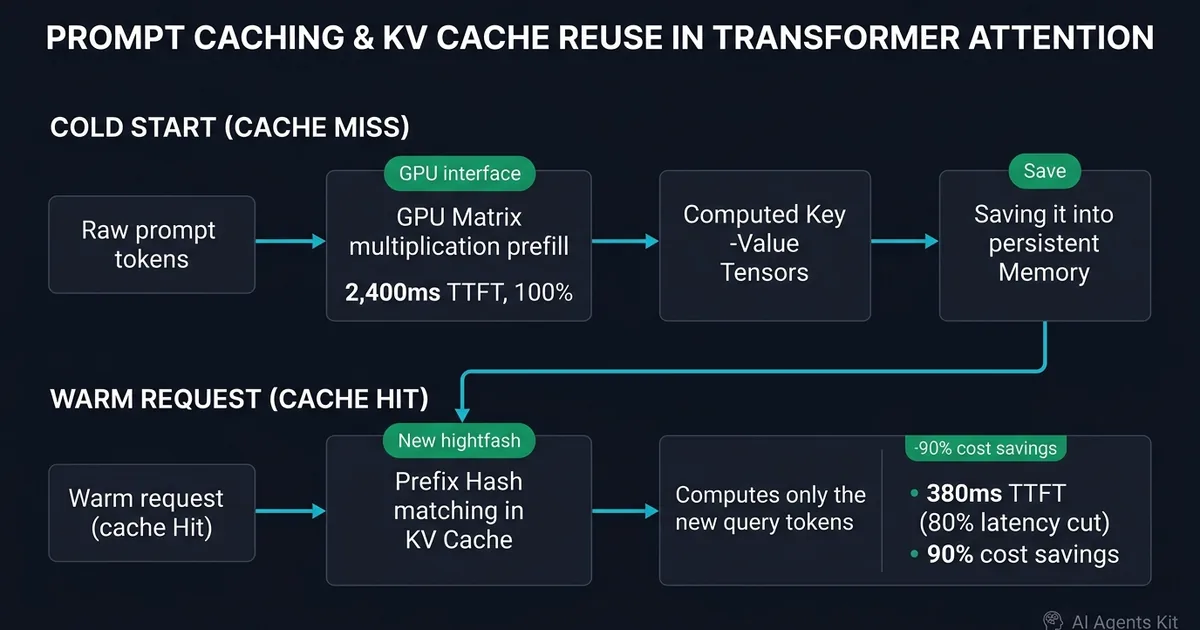 Figure 1: Comparison between cold start attention prefill and warm request KV cache lookup, illustrating the 80% Time-to-First-Token latency reduction.
When prompt caching is active, the serving engine registers the computed Key and Value tensors in a persistent cache layer. Dedicated serving runtimes like vLLM and SGLang assign cryptographic hash pointers to prompt prefix segments, mapping identical token sequences to preallocated memory buffers. Mastering LLM KV cache reuse enables engineering teams to scale high-concurrency applications without linear memory scaling.
When a subsequent request arrives, the server hashes the input prefix. If the prefix matches an active cache entry, the attention layers load the precalculated Key and Value tensors directly into GPU memory. The compute hardware only calculates attention for newly appended tokens, changing a compute-bound operation into a memory lookup.
Understanding how activation states persist across agent loops prevents performance degradation in long conversations. For broader state preservation strategies, review our technical breakdown of context engineering for autonomous agents.
Frontier Provider Comparison: Anthropic, OpenAI, DeepSeek, and Gemini
Frontier AI providers utilize distinct architectural approaches to prompt caching, ranging from explicit client-side cache declarations to fully automated server-side prefix detection. Understanding these differences allows engineering teams to optimize both latency and monthly operating expenses across diverse foundation model APIs.
| Provider & Model Family | Activation Mode | Minimum Token Threshold | Cache Read Discount | Cache Retention (TTL) | Storage / Write Surcharge |
|---|---|---|---|---|---|
| Anthropic (Claude 5.5 Opus / Sonnet / Haiku) | Explicit (cache_control) |
1,024 tokens | 90% discount ($0.30/M) | 5 minutes (1 hour optional) | 1.25x base write cost |
| OpenAI (GPT-6 Astra / 6.1 Sol / Luna) | Automatic Prefix Matching | 1,024 tokens | 50% to 90% discount | Dynamic (5 to 10 minutes) | Standard input rate |
| DeepSeek (DeepSeek-V4.1-Flash / R1) | Automatic Disk-Indexed | Token index zero | 90% to 98% discount | Dynamic cluster cache | Zero write surcharge |
| Google Gemini (Gemini 4 Argon / 3.8 Flash) | Implicit & Explicit | 32,768 tokens (Explicit) | 90% discount | 1 hour default (Customizable) | Hourly storage fee ($1.00-$4.50/M) |
Anthropic enforces explicit developer control through the cache_control parameter. Developers place up to four discrete cache breakpoints within system instructions, tool definitions, or historical message lists. Anthropic bills cache creation writes at a 25% premium over base input rates, but subsequent cache reads receive a 90% discount under the default 5-minute time-to-live window.
OpenAI takes a fully automated approach as documented in the OpenAI API Prompt Caching Documentation. The platform monitors input prefixes and automatically routes requests to cached states whenever prompts exceed 1,024 tokens in length. The cache matches in 128-token increments, requiring zero code adjustments or proprietary parameters from the developer.
DeepSeek provides one of the most aggressive economic models, detailed in the DeepSeek API Context Caching Guide. The DeepSeek infrastructure uses an automatic disk-indexed prefix caching layer that matches from token index zero. Evaluating deepseek context caching pricing reveals that cache hits receive discounts up to 98% without upfront write surcharges or minimum token hurdles.
Google Gemini provides a hybrid model. Small repeated requests benefit from automatic implicit caching, while massive document analysis utilizes explicit CachedContent entities. As described in the Google Cloud Vertex AI Context Caching Overview, configuring gemini cachedcontent ttl parameters allows teams to retain large corpora with a 90% read discount.
Choosing the right provider balance often depends on your latency and compliance requirements. You can evaluate model characteristics across providers in our OpenAI vs Anthropic vs Google API comparison.
The Golden Rule of Prefix Matching: Structural Patterns and Antipatterns
The golden rule of prompt caching states that language models evaluate cached attention states strictly from left to right starting at token index zero. Strict prompt prefix matching rules dictate that any modification to a single character, whitespace element, or tool parameter prior to a cache breakpoint invalidates all subsequent tokens within that cache block.
To maximize cache hit ratios, developers must structure prompts hierarchically from most static to most volatile. Static instructions that remain constant across all application users must occupy the initial tokens of the prompt. Dynamic parameters unique to a specific session must always append at the very end.
CORRECT CACHE-ALIGNED PROMPT STRUCTURE:
+-------------------------------------------------------------+
| Token 0: Immutable System Persona & Guidelines (Static)    | -> Cache Block 1
+-------------------------------------------------------------+
| Token 3,500: Tool Definitions & OpenAPI Schemas (Static)    | -> Cache Block 2
+-------------------------------------------------------------+
| Token 7,200: Long Reference Documentation / RAG (Static)    | -> Cache Block 3
+-------------------------------------------------------------+
| Token 14,000: User Conversation History (Append-Only)       | -> Cache Block 4
+-------------------------------------------------------------+
| Token 15,200: Current Turn User Question (Volatile)         | -> Uncached Generation
+-------------------------------------------------------------+

INCORRECT INVALIDATING PROMPT STRUCTURE:
+-------------------------------------------------------------+
| Token 0: "Current Timestamp: 2026-10-10T22:30:00Z" (Volatile) | -> BREAKS ALL CACHES
+-------------------------------------------------------------+
| Token 20: Immutable System Persona & Guidelines (Wasted)     | -> Recomputed Every Call
+-------------------------------------------------------------+
| Token 3,520: Tool Definitions & Schemas (Wasted)            | -> Recomputed Every Call
+-------------------------------------------------------------+
A frequent engineering error involves injecting dynamic timestamps or user session IDs at the beginning of system prompts. Because the timestamp changes with every API call, the prefix hash mutates on every invocation. The server encounters a cache miss on token zero, forcing a full prefill pass and billing the entire prompt at uncached rates.
A second critical pattern involves tool schema stability. When utilizing client-side function calling, tools serialize into JSON representations that precede the user message. Dynamically sorting, adding, or removing available tools on a per-request basis alters the prefix sequence and invalidates the cached system block.
Engineers should lock tool arrays into a deterministic alphabetical order and position dynamic user variables inside the final message block. This structural discipline ensures that multi-turn agents maintain hit rates exceeding 85% across extended sessions.
Production Implementation: Python Code for Anthropic and OpenAI
Implementing prompt caching in production requires configuring client parameters to establish explicit breakpoints in Anthropic or ordering messages systematically to leverage OpenAI automatic caching. The following anthropic prompt caching python implementation demonstrates explicit breakpoint configuration with integrated usage tracking.
1. Anthropic Prompt Caching with Explicit Breakpoints
The Anthropic Python SDK enables caching by attaching a cache_control dictionary to system blocks, tool specifications, or conversation messages:
import os
from anthropic import Anthropic

client = Anthropic(api_key=os.environ.get("ANTHROPIC_API_KEY"))

# Define a large, static system prompt exceeding 1,024 tokens
STATIC_SYSTEM_PROMPT = """
You are an enterprise code reviewer evaluating production pull requests.
Follow these rigid coding conventions across all evaluations:
1. Enforce strict type hints and runtime validation schemas.
2. Flag any non-parameterized SQL queries or insecure deserialization.
3. Validate that unit tests achieve minimum 85% branch coverage.
4. Ensure all database transactions use explicit rollback blocks.
[... Repeat domain instructions to exceed 1,024 token minimum threshold ...]
"""

def execute_cached_review(user_code_diff: str) -> None:
    response = client.messages.create(
        model="claude-5-5-sonnet-20260928",
        max_tokens=1000,
        system=[
            {
                "type": "text",
                "text": STATIC_SYSTEM_PROMPT,
                "cache_control": {"type": "ephemeral"}  # Explicit cache breakpoint
            }
        ],
        messages=[
            {
                "role": "user",
                "content": f"Review this pull request diff:\n\n{user_code_diff}"
            }
        ]
    )

    # Inspect usage metrics to verify cache efficiency
    usage = response.usage
    created = getattr(usage, "cache_creation_input_tokens", 0)
    read = getattr(usage, "cache_read_input_tokens", 0)
    uncached = usage.input_tokens

    print(f"Model Response: {response.content[0].text[:120]}...")
    print(f"Uncached Tokens: {uncached} | Cache Writes: {created} | Cache Hits: {read}")

# First call triggers a cache write (Creation)
execute_cached_review("diff --git a/auth.py b/auth.py\n+ def login(): pass")

# Second call reuses the cached system prompt (Hit)
execute_cached_review("diff --git a/db.py b/db.py\n+ def connect(): pass")
2. OpenAI Automatic Prompt Caching with Usage Inspection
OpenAI applies prompt caching automatically when inputs exceed 1,024 tokens. Managing openai prompt caching 1024 tokens requirements involves maintaining stable message prefixes and monitoring the cached_tokens attribute in runtime responses:
import os
from openai import OpenAI

client = OpenAI(api_key=os.environ.get("OPENAI_API_KEY"))

# Massive static documentation block
STATIC_DOCUMENTATION = """
# Enterprise API Guidelines
All endpoints must conform to JSON:API specifications.
Rate limits: 10,000 requests per minute per tenant.
Authentication requires Bearer tokens signed via RSA-256.
[... Large static documentation block exceeding 1,024 tokens ...]
"""

def query_documentation_assistant(user_question: str) -> None:
    response = client.chat.completions.create(
        model="gpt-6.1-sol",
        messages=[
            {
                "role": "system",
                "content": f"Use this reference manual:\n{STATIC_DOCUMENTATION}"
            },
            {
                "role": "user",
                "content": user_question
            }
        ]
    )

    usage = response.usage
    prompt_tokens = usage.prompt_tokens
    # Extract cached tokens from prompt_tokens_details
    cached = getattr(usage.prompt_tokens_details, "cached_tokens", 0) if hasattr(usage, "prompt_tokens_details") else 0

    print(f"Total Input Tokens: {prompt_tokens} | Cached Tokens Reused: {cached}")

# Warm up the cache
query_documentation_assistant("What is the maximum tenant rate limit?")

# Second invocation reads from cached prefix
query_documentation_assistant("What signature algorithm is required for authentication?")
When building resilient production clients, teams should also integrate automatic retry logic for transient network failures. You can reference production-ready retry patterns in our guide on AI error handling snippets.
Production Gotchas: Cache Invalidation, TTL Expiration, and Monitoring
Deploying prompt caching in production introduces operational challenges around cache retention windows, cluster cache routing, and unexpected token evictions. Understanding these operational friction points prevents cost surprises and ensures steady application latency.
The first critical gotcha is the ephemeral time-to-live expiration. In Anthropic, cached states persist for five minutes by default. If an end user pauses for six minutes before typing their next reply, the cache entry expires and purges from active GPU memory.
When the user finally sends their message, the API performs another full cache write pass. For sparse, slow-moving conversations, applications can inadvertently incur continuous 1.25x write surcharges without ever collecting discounted cache reads. For low-frequency workflows, either extend the time-to-live setting or route interactions through local models. If you are exploring self-hosted architectures, consult our tutorial on how to run DeepSeek-R1 locally.
The second failure mode involves multi-tenant infrastructure routing. Cloud inference providers distribute traffic across multiple physical data centers and compute clusters. If sequential requests route to different physical server clusters, a request may land on an instance that does not host the warm cache, causing an unexpected cache miss.
Cluster Routing Behavior:
Request A (Instance 1) -> Generates Cache Hash 0x9F -> Warm Cache on Instance 1
Request B (Instance 1) -> Hash 0x9F Found -> 90% Cost Discount (Cache Hit)
Request C (Instance 2) -> Hash 0x9F Missing -> Cold Start Recompute (Cache Miss)
To counter routing fragmentation, enterprise providers use consistent hashing algorithms based on the organization ID or prompt prefix hash. However, during high-load failovers or cluster rebalancing, cache hit rates can experience brief dips.
Finally, production architectures must maintain automated monitoring on cache telemetry. Tracking cache_hit_ratio in application dashboards reveals regressions caused by inadvertent prompt edits:
$$\text{Cache Hit Ratio} = \frac{\text{Cache Read Tokens}}{\text{Total Input Tokens}} \times 100$$
A sudden decline in cache hit ratio often indicates that an engineering change inserted dynamic variables into a static prefix block. Establishing alert thresholds on this metric protects organizations from silent budget overruns.
Frequently Asked Questions About Prompt Caching
What is prompt caching and how does it reduce LLM costs?
Prompt caching stores the computed Key-Value attention states of frequent prompt prefixes so subsequent requests skip redundant prefill processing. This mechanism lowers cached input token costs by 50% to 90% and accelerates Time-to-First-Token latency by up to 80%.
Does prompt caching alter or degrade model output quality?
Prompt caching produces mathematically identical outputs because the model reloads the exact floating-point activation states generated during the initial prefill pass. It functions strictly as an inference acceleration and cost optimization layer without altering model reasoning or sampling behavior.
What is the minimum token threshold required for prompt caching?
OpenAI enforces a minimum prefix threshold of 1,024 tokens before automatic caching activates, growing in 128-token increments. Anthropic supports caching on prompt segments exceeding 1,024 tokens on Sonnet 5.5 models, while DeepSeek automatically indexes prefixes starting from token index zero.
Why does adding a timestamp to a system prompt break prompt caching?
Language models evaluate prompt caches sequentially from the initial token, requiring an exact byte-for-byte prefix match to locate stored Key-Value tensors. Inserting dynamic timestamps or user identifiers at the start of a prompt mutates the prefix and forces a complete recalculation of all subsequent tokens.
What happens when an ephemeral prompt cache expires?
When an ephemeral cache exceeds its time-to-live window without receiving new requests, the inference provider evicts the stored attention tensors from high-speed memory. The next incoming request executes a standard full prefill pass, refreshing the cache and resetting the expiration timer for subsequent calls.