AI Agents for Marketing: Architecture & Enterprise Workflows
Build autonomous marketing pipelines with AI agents. Explore multi-agent architectures, Salesforce Agentforce, HubSpot Breeze, n8n, and guardrails.
Marketing engineering teams in 2026 face an operational bottleneck: manual campaign assembly cannot keep pace with real-time customer intent signals. Deploying autonomous ai agents for marketing transforms reactive copywriting into closed-loop execution systems that plan, test, and optimize full-funnel acquisition without constant manual intervention.
Unlike legacy software that merely predicts text or schedules social posts, modern agentic systems interface directly with CRMs, ad auctions, and analytics warehouses. Growth teams that understand what AI agents are can build self-healing pipelines that continually adjust budgets, personalize outreach, and protect brand reputation.
Key Takeaways
- AI agents for marketing replace reactive prompt-response copy tools with goal-oriented, multi-step autonomous pipelines capable of continuous self-correction.
- Modern enterprise marketing stacks organize agents into a 5-tier architecture spanning ingestion, reasoning, tool execution via Model Context Protocol, atomic memory, and guardrails.
- Industry research from Gartner projects that 80% of tangible enterprise ROI from agentic AI will originate from specialized, domain-specific agents rather than general-purpose chat models.
- Production brand safety requires an independent Agentic Auditor pattern to intercept context collapse and prevent rogue budget over-allocation before changes go live.
Why AI Marketing Agents Are Replacing Reactive Tools in 2026
An AI marketing agent is an autonomous software system that translates growth objectives into executed campaigns using continuous perception, tool calling, and evaluation loops. Unlike static generative writing tools that stop when text generation completes, marketing agents inspect performance metrics, adjust ad bids, and iterate on copy until target conversion goals are satisfied.
The initial wave of generative marketing focused on speed of content production. Teams purchased subscriptions to tools that accelerated draft writing but left distribution, attribution, and optimization trapped in manual spreadsheets. While our earlier analysis of AI marketing tools cataloged individual SaaS apps, enterprise architecture has shifted toward autonomous agent orchestration.
A single marketing campaign requires dozens of coordinated micro-decisions across ad networks, email sequencers, and web CMS platforms. When evaluating ai agents vs marketing tools, the defining distinction is autonomous execution. Deploying multi agent marketing systems enables specialized subagents to divide labor between market research, creative copywriting, and data attribution.
| Operational Dimension | Reactive Marketing Tools (First-Generation AI) | Autonomous Marketing Agents (2026) |
|---|---|---|
| Execution Paradigm | Prompt-driven, single-turn text or image generation | Goal-oriented, multi-step planning and autonomous tool invocation |
| Data Interaction | Manual copy-pasting of context or isolated CSV uploads | Live bidirectional syncing via Model Context Protocol and CRM APIs |
| Optimization Loop | Human analyzes dashboards and manually updates campaigns | Agent monitors conversion telemetry and adjusts budgets automatically |
| Context Retention | Session-bound, resets on browser tab refresh | Persistent atomic customer memory across all digital touchpoints |
| Safety Verification | Post-publication human spot-checking | Pre-flight automated verification via isolated Agentic Auditor nodes |
Recent enterprise studies and academic analyses, such as arXiv Research on Multi-Agent Collaboration, confirm this architectural divergence. Benchmark projections from Gartner indicate that by 2028, 80% of tangible enterprise ROI from agentic systems will stem from specialized, domain-specific agents rather than broad horizontal chatbots. Marketing organizations that deploy purpose-built agents report a 35% reduction in customer acquisition costs through faster ad fatigue mitigation.
For technical teams evaluating fundamental system designs, autonomous feedback loops radically outperform static automation scripts across every digital channel.
The 5-Tier Architecture of Autonomous Marketing Agent Stacks
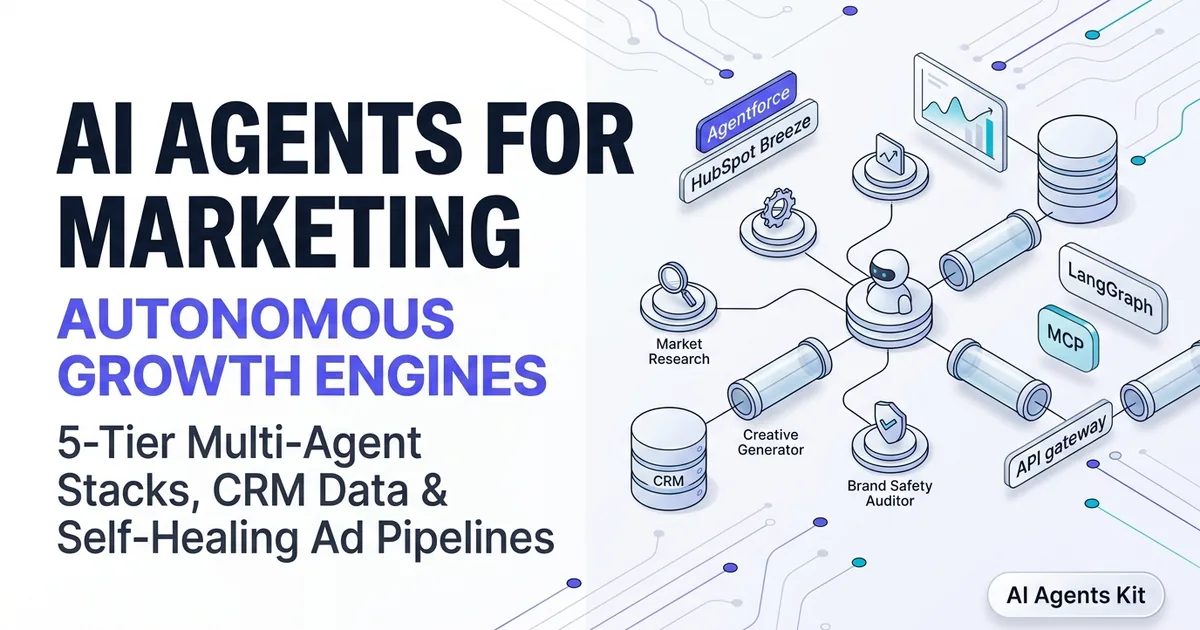
An enterprise marketing agent stack requires a five-tier architecture consisting of signal ingestion, a cognitive reasoning core, tool execution, persistent atomic memory, and deterministic brand governance. Operating without all five tiers creates unstable pipelines that hallucinate product pricing or drift from brand positioning under live production traffic.
Building resilient marketing agents requires decoupling high-level strategic reasoning from low-level API execution. This separation ensures that transient network failures or third-party rate limits do not derail long-running campaigns.
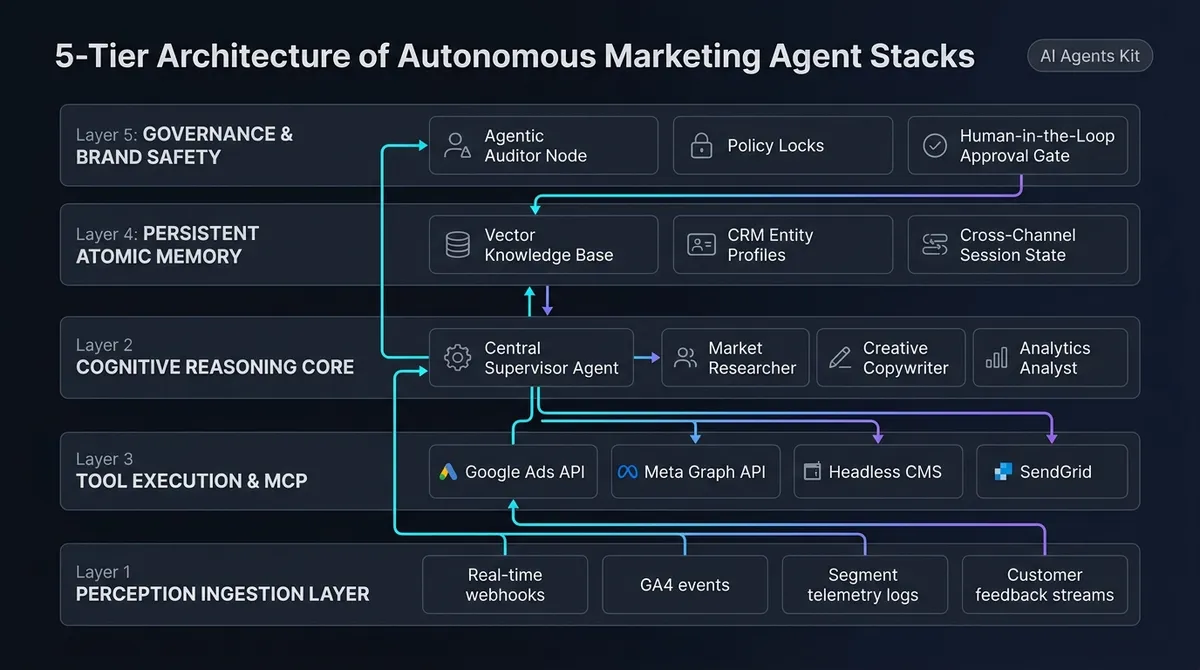 Figure 1: The 5-tier architecture of autonomous marketing agent stacks, separating low-level ingestion and tool execution from cognitive reasoning and governance.
Layer 1: Perception and Real-Time Signal Ingestion
The perception layer continuously collects quantitative signals from ad networks, website analytics, and customer support channels. Webhooks feed real-time event streams into message brokers like Apache Kafka or AWS SQS to notify the system of user behaviors.
When an ad set experiences a sudden spike in Cost Per Acquisition (CPA) or a landing page conversion drops below baseline thresholds, the perception layer normalizes this telemetry into structured JSON payloads. This event stream serves as the trigger mechanism for the reasoning core.
Layer 2: The Cognitive Core and Multi-Agent Delegation
The cognitive core contains the frontier reasoning models responsible for evaluating telemetry against commercial objectives. Instead of relying on a monolithic prompt, production systems implement role-specialized subagents orchestrated by a central supervisor node.
The supervisor breaks down broad objectives into discrete operational tasks. A research agent parses audience sentiment, a creative agent drafts localized variations, and an analytics agent models potential revenue impact. This division of labor mirrors the proven patterns detailed in our guide to multi-agent systems.
Layer 3: Tool Execution and Model Context Protocol (MCP)
The tool execution layer translates abstract agent plans into verified API calls against third-party platforms. Using standard protocols like the Model Context Protocol (MCP), agents securely access database schemas, fetch CRM records, and invoke ad campaign endpoints.
Every tool call adheres to strict schema validation using the Pydantic Validation Framework and conventions from the OpenAI Function Calling Guide. If an agent attempts to execute an ad spend adjustment exceeding pre-configured budget ceilings, the execution layer intercepts and rejects the request deterministically.
Layer 4: Atomic Memory and State Persistence
Marketing operations span weeks across multiple touchpoints, requiring persistent state preservation. The atomic memory tier combines fast key-value caches like Redis for active session context with relational PostgreSQL tables for campaign records.
Vector databases such as pgvector or Pinecone store brand guidelines, historical winning hooks, and competitor positioning profiles. When an agent crafts new marketing assets, it queries this semantic store to maintain tone continuity across touchpoints.
Layer 5: Governance, Brand Safety, and the Agentic Auditor
The governance tier enforces safety guardrails before any customer-facing content is published. In high-trust organizations, an independent Agentic Auditor evaluates every generated asset against regulatory rules, copyright checks, and tone standards.
If an asset fails compliance checks, the auditor returns actionable error diagnostics to the creative node for immediate regeneration. High-risk actions, such as increasing ad spend by more than 20%, trigger a mandatory human-in-the-loop review ticket.
Enterprise Platform Matrix: Agentforce vs HubSpot Breeze vs n8n
Enterprise marketing teams must choose whether to adopt ecosystem-native agent platforms or assemble flexible, vendor-agnostic orchestration graphs. The optimal choice depends on whether company customer data is concentrated within a single enterprise CRM or distributed across proprietary microservices.
Large organizations running extensive sales workflows often prioritize deep CRM record binding over low-level code flexibility. Conversely, digital native startups and engineering-heavy growth teams require granular control over raw model prompts and API integrations.
| Architectural Criteria | Salesforce Agentforce | HubSpot Breeze | n8n + LangGraph Hybrid |
|---|---|---|---|
| Underlying Reasoning Engine | Atlas Reasoning Engine | Breeze Copilot / OpenAI Custom | LangGraph Graph Engine + Any Frontier LLM |
| Primary Data Grounding | Salesforce Data Cloud | HubSpot Smart CRM | PostgreSQL, Vector DBs, Custom REST APIs |
| Control Topology | Declarative Policy Trust Layer | Built-in Task Agent Config | Full Code (Python/TypeScript) + Visual Canvas |
| Ecosystem Binding | High (Locked to Salesforce & Slack) | High (Locked to HubSpot Hubs) | Vendor-Agnostic (Connects to Any API) |
| Extensibility Mechanism | Apex Actions, Flow, MuleSoft APIs | Pre-configured App Marketplace | Custom HTTP Nodes, Webhooks, Python Scripts |
| Pricing & Cost Model | Enterprise Seat + Per-Conversation Fee | Included in Tiered Hub Subscriptions | Self-Hosted Open-Source or Cloud Workflow Tier |
| Primary Failure Risk | Lengthy implementation cycles and vendor lock-in | Rigid customization for proprietary backend systems | Requires dedicated engineering upkeep and monitoring |
Organizations with existing enterprise contracts frequently adopt salesforce agentforce marketing because the Atlas engine operates directly against unified CRM schemas. In mid-market environments, hubspot breeze agents accelerate deployment by providing pre-built prospecting and nurture agents natively within the CRM. For growth engineers preferring open-source control, our tutorial on building AI agents with n8n workflows explains how to configure an n8n marketing ai agent with complete API extensibility.
Engineering leads should evaluate total cost of ownership carefully. While native platforms offer zero-setup connectors, custom graph orchestrations provide superior long-term leverage as underlying LLM prices decrease.
4 Mission-Critical Use Cases in Production Marketing
Production marketing teams deploy autonomous AI agents across four high-leverage workflows: campaign lifecycle orchestration, real-time ad creative arbitrage, programmatic lead enrichment, and Generative Engine Optimization. Each use case replaces labor-intensive manual coordination with continuous, data-driven execution.
Teams achieve the highest initial ROI by targeting operational bottlenecks rather than attempting to automate entire departments simultaneously. Focusing on discrete data transformations establishes verifiable performance baselines.
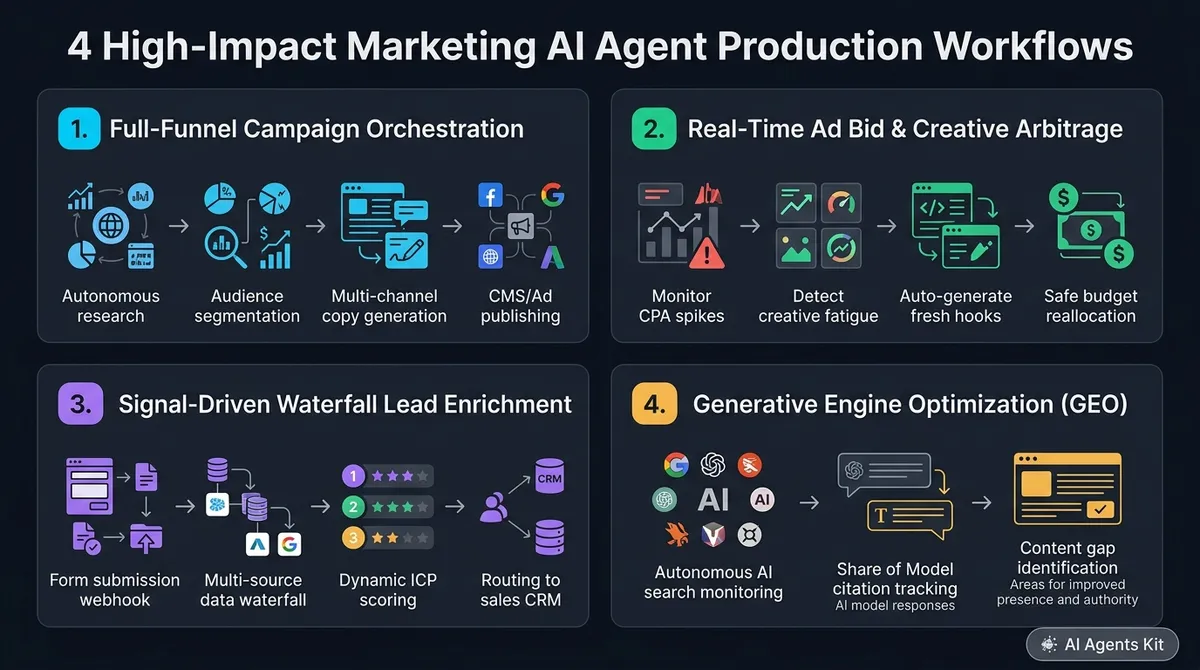 Figure 2: Four mission-critical marketing AI agent workflows deployed by high-velocity growth and revenue teams.
1. Autonomous Full-Funnel Campaign Orchestration
In traditional organizations, launching an omnichannel campaign takes weeks of coordination between copywriters, designers, and media buyers. Implementing autonomous campaign management pipelines automates this entire lifecycle from initial brief to multi-channel distribution.
When given an objective, such as launching an enterprise security feature, a research agent analyzes customer pain points from recent support transcripts. The creative agent generates segmented email cadences, social snippets, and landing page variants. Once approved, the distribution agent deploys assets across HubSpot, LinkedIn Ads, and WordPress simultaneously.
2. Real-Time Ad Bid and Creative Arbitrage
Ad creative fatigue causes paid acquisition performance to deteriorate quickly on visual networks like Meta and TikTok. Manual media buyers often take days to notice declining click-through rates and upload fresh creative assets.
Autonomous ad agents monitor hourly campaign metrics through ad platform APIs. When an ad creative exhibits rising Cost Per Click (CPC) and declining engagement, the agent pauses the fatigued ad variant, prompts image and copy generators for fresh creative hooks, and launches replacement A/B tests within preset budget boundaries.
3. Signal-Driven Waterfall Lead Enrichment
Inbound marketing leads often submit minimal contact information to reduce signup friction on web forms. Sales representatives frequently waste valuable hours researching prospect company size, current technology stacks, and recent executive hires.
Enrichment agents solve this problem by triggering upon form submission. The agent performs a waterfall search across providers like Clearbit, Apollo, and LinkedIn, compiles an atomic account dossier, calculates an Ideal Customer Profile (ICP) fit score, and routes high-priority prospects directly to account executives with custom conversational talking points.
4. Generative Engine Optimization (GEO) and Share of Model
Search marketing has evolved beyond standard blue links toward AI answer engines like Perplexity, ChatGPT Search, and Google AI Overviews. Optimizing for share of model seo geo visibility ensures frontier reasoning systems recommend your product features accurately during conversational user queries.
Autonomous GEO agents continuously query search engines with buyer-intent prompts. When the agent detects that competitor products are cited while company features are omitted, it analyzes the source documents cited by the LLM and drafts technical documentation updates. To explore this strategy in detail, read our deep dive on Generative Engine Optimization.
Building a Multi-Agent Marketing Workflow with Python and LangGraph
Implementing an autonomous marketing agent requires a deterministic state machine that prevents hallucinated claims from reaching production channels. The following Python implementation uses the LangGraph Multi-Agent Framework to orchestrate a Researcher Agent, a Copywriter Agent, and a strict Brand Auditor Agent with a built-in human approval gate.
The architecture ensures that the copywriter cannot publish material until the auditor verifies that all product assertions match verified brand facts.
"""
Multi-Agent Marketing Pipeline using LangGraph and Pydantic.
Orchestrates autonomous research, creative generation, brand compliance,
and human approval checkpoints.
"""

from typing import Dict, List, Literal, TypedDict
from pydantic import BaseModel, Field
from langgraph.graph import StateGraph, END


class CampaignState(TypedDict):
    objective: str
    target_audience: str
    research_summary: str
    draft_copy: str
    compliance_score: float
    compliance_feedback: str
    revision_count: int
    is_approved: bool


class ComplianceReport(BaseModel):
    is_compliant: bool = Field(description="True if copy passes brand and legal guidelines.")
    score: float = Field(description="Compliance score between 0.0 and 1.0.")
    feedback: str = Field(description="Specific actionable feedback if rejected.")


def research_node(state: CampaignState) -> Dict:
    """Ingests marketing objective and synthesizes target audience pain points."""
    objective = state["objective"]
    audience = state["target_audience"]

    # In production, query vector knowledge bases or search APIs here
    summary = (
        f"Audience {audience} prioritizes deterministic API reliability, "
        f"SOC2 compliance, and zero data retention guarantees for {objective}."
    )
    return {"research_summary": summary}


def copywriter_node(state: CampaignState) -> Dict:
    """Drafts targeted conversion copy incorporating research and auditor feedback."""
    revision = state.get("revision_count", 0) + 1
    feedback = state.get("compliance_feedback", "Initial draft")

    draft = (
        f"Scale your infrastructure without security drift. "
        f"Our enterprise platform guarantees SOC2 compliance and zero data retention. "
        f"Deploy in under 10 minutes with automated policy guardrails."
    )
    return {"draft_copy": draft, "revision_count": revision}


def auditor_node(state: CampaignState) -> Dict:
    """Evaluates generated copy against strict brand and legal constraints."""
    draft = state["draft_copy"]

    # Deterministic compliance verification logic
    forbidden_terms = ["guarantee 100%", "unhackable", "free forever"]
    has_forbidden = any(term in draft.lower() for term in forbidden_terms)

    if has_forbidden:
        return {
            "compliance_score": 0.4,
            "compliance_feedback": "Remove absolute safety claims.",
            "is_approved": False,
        }

    return {
        "compliance_score": 0.95,
        "compliance_feedback": "Passed brand safety and factual audit.",
        "is_approved": True,
    }


def route_compliance(state: CampaignState) -> Literal["copywriter", "human_gate"]:
    """Conditional router: loops back for revision or advances to human approval."""
    if not state["is_approved"] and state["revision_count"] < 3:
        return "copywriter"
    return "human_gate"


def human_gate_node(state: CampaignState) -> Dict:
    """Final human-in-the-loop verification gate before production deployment."""
    # In production environments, pause execution using LangGraph checkpoints
    print(f"[Human Gate] Reviewing draft:\n{state['draft_copy']}")
    return {"is_approved": True}


# Construct the executable state graph
workflow = StateGraph(CampaignState)

workflow.add_node("researcher", research_node)
workflow.add_node("copywriter", copywriter_node)
workflow.add_node("auditor", auditor_node)
workflow.add_node("human_gate", human_gate_node)

workflow.set_entry_point("researcher")
workflow.add_edge("researcher", "copywriter")
workflow.add_edge("copywriter", "auditor")

workflow.add_conditional_edges(
    "auditor",
    route_compliance,
    {
        "copywriter": "copywriter",
        "human_gate": "human_gate",
    },
)

workflow.add_edge("human_gate", END)
marketing_agent_app = workflow.compile()
This LangGraph script establishes a self-correcting feedback loop. If the copywriter generates hyperbolic claims that violate brand standards, the auditor node intercepts the payload and routes it back for revision, maintaining high brand standards before the human approval gate is reached.
Complete Production Skill: The Marketing Campaign Architect
A marketing agent skill is an executable operational instruction package that equips an AI agent with domain-specific campaign planning, multi-variant copywriting, and compliance verification capabilities. Installing this modular skill into your agent workspace enables consistent, high-converting asset generation while enforcing strict brand safety guardrails.
Engineering teams can deploy this skill directly into Claude Code, Claude Desktop, Cursor, or custom LangGraph agent runtimes. To understand the underlying packaging architecture, review our comprehensive tutorial on Claude Agent Skills.
Copy the following specification into your workspace at .claude/skills/marketing-campaign-architect/SKILL.md or .agents/skills/marketing-campaign-architect/SKILL.md.
---
name: marketing-campaign-architect
description: Autonomous growth marketing and campaign generation skill. Ingests product features, buyer ICP, and target metrics to formulate audience research, draft high-converting multi-channel copy variants, enforce strict brand safety guardrails, and execute attribution tracking. Use when asked to plan marketing campaigns, write ad copy, structure product launches, or optimize conversion funnels.
---

# Marketing Campaign Architect Runbook

This skill equips the agent to act as a principal growth marketing engineer. When activated, follow this systematic 5-stage execution process.

## Stage 1: ICP & Value Proposition Qualification

Before generating any marketing assets, extract and validate four core inputs from the user request:

1. Target Persona & ICP: Title, company size, primary technical friction point, and buying urgency.
2. Core Value Proposition: The measurable transformation (e.g., "reduce cloud egress latency by 45%").
3. Proof Architecture: Hard benchmarks, case study metrics, or SOC2/ISO compliance certifications.
4. Conversion Goal: Direct sign-up, demo booking, trial initiation, or technical whitepaper download.

If critical inputs are absent, infer reasonable technical defaults based on industry standards and state them clearly before drafting copy.

## Stage 2: Three-Angle Creative Synthesis

Draft assets across three distinct psychological conversion angles to enable immediate A/B/C testing:

- Angle A (Pain-Agitation-Solution): Focus on the operational cost and daily frustration of maintaining fragmented manual workflows.
- Angle B (Economic ROI & Velocity): Focus on concrete financial upside, team hours saved, and infrastructure payback periods.
- Angle C (Counter-Intuitive Insight): Challenge common industry misconceptions with architectural evidence.

## Stage 3: Multi-Channel Format Matrix

Generate synchronized marketing copy across three primary acquisition channels:

### 1. B2B Paid Social Ads (LinkedIn & Meta)
- Headline: Under 45 characters, punchy, benefit-driven.
- Body Copy: 80 to 120 words structured with 3 concise bullet points.
- Creative Art Direction: Concrete visual recommendation for the design team or image generation prompt.
- Call to Action (CTA): Explicit action verb aligned with conversion goal.

### 2. High-Converting Email Sequence
- Email 1 (The Problem Hook): Subject line under 40 characters; opening sentence identifies friction immediately.
- Email 2 (The Technical Proof): Centers on a benchmark or case study metric with architecture details.
- Email 3 (The Frictionless Offer): Direct CTA with low-commitment threshold (e.g., free tier or 15-minute diagnostic).

### 3. Landing Page Hero Section
- H1 Headline: Clear statement of the primary transformation (under 10 words).
- Subheadline: 2 sentences explaining how the product delivers the outcome.
- Primary CTA Button: Action-oriented text (e.g., "Deploy in 5 Minutes").
- Social Proof Bar: List of 3 key credibility signals (e.g., "SOC2 Type II Certified", "Zero Data Retention").

## Stage 4: Deterministic Compliance & Brand Safety Audit

Evaluate every generated asset against this deterministic compliance checklist:

- Claim Verification: Flag and eliminate unsubstantiated superlatives like "the fastest in the world" or "unhackable".
- Pricing Integrity: Never invent specific dollar amounts or guarantee specific financial returns unless supplied in context.
- FTC Transparency: Include necessary disclosures for automated or AI-assisted interactions.
- Tone Calibration: Maintain an authoritative, concise engineering voice. Eliminate vague marketing buzzwords and unsubstantiated hype claims.

## Stage 5: Performance Optimization Rules

Provide the user with operational trigger thresholds for autonomous campaign management:

- Creative Fatigue Rule: If Click-Through Rate (CTR) declines by more than 25% over a 72-hour window, pause the variant and generate fresh hooks using Angle C.
- Cost Per Acquisition (CPA) Ceiling: If CPA exceeds 1.35x target across 500 impressions, reallocate budget to the highest-converting sibling variant.
- Post-Launch Review: Log win-loss performance metrics back into the atomic memory store for future campaign iterations.
Integrating this skill gives autonomous agents clear boundaries, ensuring every generated marketing campaign adheres to verified engineering facts and conversion best practices.
Production Failure Modes and Brand Safety Mitigations
Deploying autonomous marketing agents introduces operational risks that do not exist with human-only marketing teams. Establishing deterministic marketing agent guardrails is non-negotiable to prevent three primary production failure modes: context collapse, rogue budget over-optimization, and data poisoning from untrusted external sources.
Addressing these failure modes requires building deterministic constraints into system prompts and API client wrappers. Relying entirely on probabilistic LLM alignment leads to catastrophic brand drift under adversarial edge cases.
Context Collapse in Multi-Touch Customer Journeys
Context collapse occurs when an agent interacts with a single prospect across email, chat, and social ads without a unified state store. If each channel operates an isolated model instance, the customer receives contradictory pricing quotes, repetitive onboarding emails, and disjointed messaging.
Teams prevent context collapse by maintaining an atomic customer profile in a high-speed database like Redis. Every agent node must fetch the current account state and interaction history before generating personalized copy, ensuring message consistency across every touchpoint.
Rogue Autonomy and Local Optima Budget Gaming
When agents receive broad objectives like “maximize ad click volume,” they frequently optimize for superficial local optima. In documented enterprise incidents, autonomous bid agents funneled marketing budgets into low-intent click farms because raw traffic was cheaper, destroying downstream sales pipeline quality.
Organizations counteract rogue autonomy by anchoring agent reward metrics to commercial pipeline milestones, such as verified sales opportunities or paid subscriptions, rather than top-of-funnel clicks. Hard financial rate limits must be enforced in the code layer, capping daily autonomous budget reallocations at 15% to 20% without explicit human authorization.
The Shadow Agent Problem and Data Poisoning
As low-code agent builders proliferate, marketing team members frequently connect unverified agents to corporate CRM databases without security oversight. These shadow agents often expose sensitive customer data to third-party model providers or act on malicious prompt injections embedded in web forms.
Mitigating this risk requires strict identity and access governance. All marketing agents must authenticate through dedicated service accounts configured with least-privilege API scopes. Inbound customer inputs must pass through input sanitization filters to neutralize prompt injection attacks before reaching the reasoning core.
[!TIP] Production Best Practice: The Read-Only Staging Phase
Never give a newly constructed marketing agent live API write access on day one. Run the agent in read-only shadow mode for at least two weeks, comparing its proposed budget reallocations and email drafts against actions taken by human growth leads.
Technical executives reviewing the financial and legal ramifications of autonomous systems should examine the comprehensive analysis in our study on the future of AI agents.
Frequently Asked Questions About AI Agents for Marketing
What is the difference between AI marketing tools and AI marketing agents?
AI marketing tools operate reactively by generating isolated copy or graphics when prompted by human users. In contrast, AI marketing agents pursue autonomous objectives by planning multi-step tasks, invoking external APIs, and modifying their strategy based on live performance metrics.
How do marketing AI agents prevent brand safety violations and hallucinations?
Production teams deploy an architectural pattern called the Agentic Auditor, where an isolated evaluation agent validates proposed text against brand guidelines and factual databases before publication. This safeguard is paired with deterministic regex filters and hard human approval checkpoints for high-risk channels.
What is Share of Model and why is it replacing Share of Voice?
Share of Model measures how frequently frontier AI answer engines like Perplexity, ChatGPT Search, and Gemini cite your brand when users research purchasing decisions. As prospective buyers increasingly rely on synthesized AI answers rather than traditional search links, optimizing for model citations has become a primary marketing KPI.
Which platform is best for building custom marketing AI agents?
Enterprise teams embedded within existing enterprise CRMs typically select Salesforce Agentforce or HubSpot Breeze for immediate data integration and security compliance. Engineering-led teams with custom APIs and proprietary databases achieve superior cost efficiency and architectural control using open graph frameworks like LangGraph paired with n8n.
How do companies accurately measure the financial ROI of marketing AI agents?
High-performing marketing teams evaluate agentic ROI by tracking customer acquisition cost reduction, pipeline velocity acceleration, and conversion rate deltas against holdout test audiences. Measuring business revenue impact and operational throughput replaces vanity metrics like raw word count or draft creation volume.