
AI for Real Estate Agencies: The Complete Stack (2026)
Discover the complete AI stack for real estate agencies: CRM, lead gen, valuation, marketing and ops tools — with ROI data and implementation guide.
Something shifted quietly in brokerages across the country over the past 18 months. The same real estate AI adoption patterns seen in accounting and law — early resistance, then rapid uptake once ROI becomes undeniable — are now playing out at scale in residential and commercial property.
According to an RPR/NAR survey released in February 2026, 82% of real estate agents are now integrating AI tools into their business, with 71% citing time savings as the primary benefit — and 34% reporting over four hours saved every week.
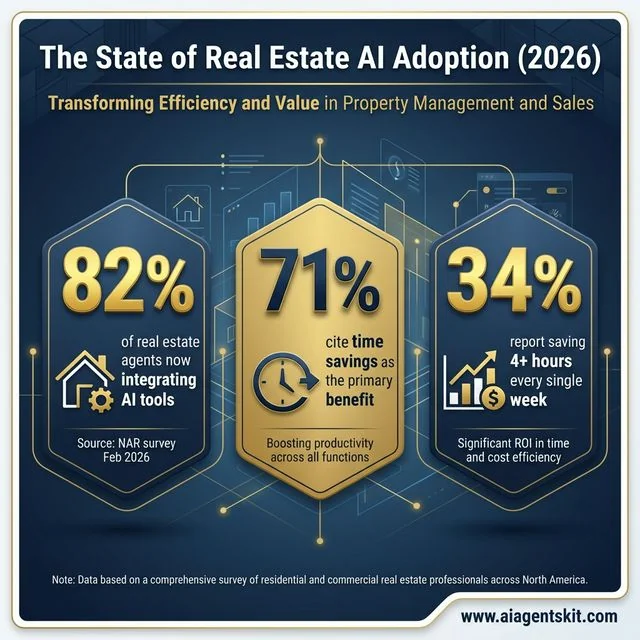 The State of Real Estate AI Adoption (2026): Key statistics from the RPR/NAR survey released in February 2026 reveal a decisive shift in how real estate professionals operate. An overwhelming 82% of agents are now actively integrating AI tools into their daily business workflows — confirming that this is no longer an experimental edge but a mainstream operating standard. Of those adopters, 71% identify time savings as the single most impactful benefit, reflecting how AI is eliminating the repetitive, time-heavy tasks that historically consumed agent schedules. Most strikingly, 34% of agents report recovering more than four hours every single week through AI automation — time that redirects to client relationships, negotiation preparation, and business development. These numbers signal clearly that agencies still running on purely manual processes face a compounding efficiency gap that widens with every quarter.
The problem most agencies face isn’t a shortage of AI tools — there are hundreds of them, and that’s precisely the issue. This guide maps the complete AI stack for real estate agencies — CRM, valuation, marketing, operations, and admin — so teams can adopt strategically rather than reactively.
What Is a Real Estate Agency AI Stack?
A “stack” is the integrated set of AI tools that covers each critical business function — working together rather than creating data silos. Most agencies accumulate tools without a strategy: an AI chatbot here, a listing description generator there, a CRM upgrade somewhere else. The result is overlapping costs, fragmented data, and agents who ignore half the tools because they don’t connect.
The modern real estate AI stack has five distinct layers:
- CRM & Lead Management — AI-powered customer relationship management, lead scoring, and follow-up automation
- Valuation & Market Intelligence — Automated valuation models (AVMs), predictive market analytics, CMA tools
- Marketing & Content — Listing descriptions, virtual staging, email nurturing, social media automation
- Operations & Transaction — Document processing, scheduling, transaction coordination, compliance automation
- Admin & Back Office — Reporting, tenant communication, maintenance prediction, workflow automation
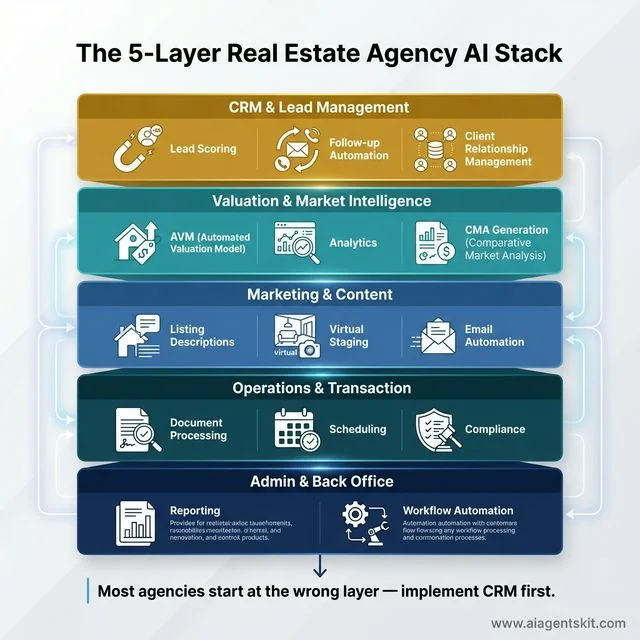 The 5-Layer Real Estate Agency AI Stack: A layered architecture diagram illustrating how a modern real estate agency should structure its AI tooling across five distinct functional tiers. The foundation begins with Admin and Back Office automation — reporting, workflow orchestration — and builds upward through Operations and Transaction coordination for document processing and scheduling compliance. The Marketing and Content layer sits in the middle, covering listing description generation, virtual staging, and email nurturing sequences. The Valuation and Market Intelligence layer powers automated valuation models, CMA generation, and predictive analytics. At the apex, CRM and Lead Management serves as the command layer, scoring, routing, and following up with leads autonomously. The core principle this diagram illustrates: most agencies build their AI stack in the wrong order, purchasing marketing tools before establishing a CRM foundation — leading to fragmented data and overlapping subscription costs.
The key distinction experienced teams make is between general-purpose AI tools (like ChatGPT) and purpose-built real estate AI platforms. General tools are flexible but require significant prompt engineering and workflow configuration. Purpose-built tools — Lofty, Follow Up Boss, HouseCanary — come pre-integrated with MLS data, IDX feeds, and real estate-specific workflows that an agency team can actually learn in a day.
Understanding how AI agents in real estate workflows operate is the first step — these aren’t passive tools but systems that take autonomous actions on behalf of agents, from qualifying leads to booking appointments without human intervention at each step.
Many brokerages learn the hard way that buying AI tools one by one creates data silos that cost more to untangle than to prevent. According to Gartner’s 2025 Strategic Technology Trends report, 40% of enterprise applications will integrate task-specific AI agents by 2026, up from under 5% in 2025. Agencies without a stack strategy will find themselves retrofitting integrations while competitors operate cohesive, automated pipelines.
Even among experts, genuine debate continues on whether all-in-one platforms (Lofty, kvCORE) or best-of-breed tool combinations deliver stronger long-term ROI. The answer depends heavily on team size and technical capacity — a point worth weighing carefully before signing any platform contract.
AI CRM & Lead Management: Where to Start First
The CRM is where the AI stack begins, and it’s the highest-leverage decision an agency makes. Every other tool either feeds into or pulls from the CRM. Getting this wrong creates cascading problems across lead routing, follow-up timing, and agent accountability.
The three platforms dominating AI-powered CRM for real estate agencies in 2026 are Lofty, Follow Up Boss, and Sierra Interactive. Each takes a meaningfully different approach to AI, and choosing the wrong fit for a team’s workflow creates friction that undercuts the software’s value regardless of feature depth.
Agencies exploring automated lead generation strategies will find that the CRM selection determines which automations are even possible — so this decision deserves more deliberate analysis than most brokers give it.
McKinsey estimates that generative AI could generate $110 billion to $180 billion or more in additional value for the real estate industry, with the largest share coming from automated client engagement and lead qualification — both are CRM-driven functions.
Lofty vs. Follow Up Boss vs. Sierra Interactive
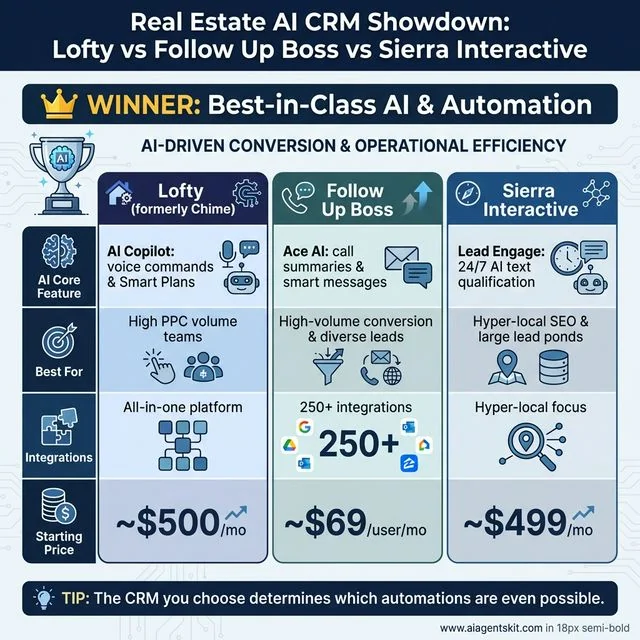 Real Estate AI CRM Showdown — Lofty vs. Follow Up Boss vs. Sierra Interactive: A structured comparison of the three dominant AI-powered CRM platforms for real estate agencies in 2026. Lofty (formerly Chime) leads on automation depth with its AI Copilot using voice commands and Smart Plans, making it ideal for teams heavily invested in Google PPC lead generation. Follow Up Boss differentiates through its Ace AI for predictive lead prioritization and call summaries, with 250+ native integrations that make it the strongest choice for high-volume conversion teams with diverse lead sources. Sierra Interactive wins for agencies prioritizing hyper-local SEO and large lead nurturing volumes through its Lead Engage 24/7 text qualification. The critical strategic point: the CRM you select defines which automations across your entire stack are even possible — making this the most consequential platform decision an agency makes.
| Platform | AI Core Feature | Best For | Starting Price |
|---|---|---|---|
| Lofty (formerly Chime) | AI Copilot: voice commands, Smart Plans, automated lead capture | Teams with high Google PPC volume; all-in-one platform buyers | ~$500/month (team) |
| Follow Up Boss | Ace AI: call summaries, predictive lead prioritization, smart messages | High-volume conversion; teams with diverse lead sources and 250+ integrations | ~$69/user/month |
| Sierra Interactive | Lead Engage: 24/7 AI text qualification, behavior-based automation | Hyper-local SEO focus; large-volume lead nurturing campaigns | ~$499/month (team) |
Lofty leads on automation depth. Its AI Copilot allows voice-led instructions — agents describe a task and the system executes it. The platform’s Smart Plans automatically route leads based on source, behavior, and engagement signals without manual configuration after initial setup.
Follow Up Boss is the conversion specialist. Ace AI generates smart follow-up messages based on lead activity, automatically tags high-intent leads from portals like Zillow, and delivers call summaries agents can review post-call. With 250+ integrations, it’s the most flexible choice for teams already invested in a specific tool ecosystem.
Sierra Interactive wins on nurturing scale. Its Lead Engage feature runs 24/7 AI-powered text conversations that qualify leads, assess readiness and budget, and alert agents only when leads hit a defined interest threshold. For teams managing large “lead ponds” of cold prospects, Sierra’s behavior-based nurturing is particularly effective.
What to Look for in a Real Estate AI CRM
Five capabilities to evaluate before committing to any platform:
- Lead scoring transparency — Can agents see why a lead was flagged as high priority?
- Native MLS integration — Does the CRM update property data without manual imports?
- AI follow-up quality — Are the AI-generated messages distinguishable from generic template texts?
- Pipeline reporting — Does the AI surface bottleneck insights, not just activity counts?
- Mobile experience — Does full AI functionality work on mobile, where agents spend most of their time?
Platforms that score high on marketing dashboards but low on agent-facing mobile tools rarely get consistent adoption — and adoption rate drives ROI more than any feature specification.
AI Predictive Analytics: Finding Motivated Sellers Before They List
One of the sharpest competitive advantages in real estate AI isn’t about responding faster — it’s about knowing earlier. Predictive analytics platforms analyze hundreds of data points per household to identify homeowners likely to sell weeks or months before they formally decide to list.
These systems don’t guess — they pattern-match. Life events (divorce filings, estate openings, job relocations), financial signals (equity thresholds, payment histories, refinance activity), and behavioral indicators (utility changes, permit applications, sustained Zillow browsing) are combined into a propensity-to-list score that agents can act on before a property ever hits the MLS.
According to AI use cases documented across business sectors, firms using AI analytics close deals 40% faster and identify investment opportunities 3–5 days ahead of competitors relying on traditional data sources.
The platforms delivering this capability in 2026:
Smartzip uses over 250 data points per household to generate a SmartTargeting score, ranking homeowners by likelihood of selling within 12 months. Agents receive a territory-specific, ranked prospect list updated monthly — replacing cold outreach with data-backed contact to homeowners who are statistically predisposed to sell.
Goliath Data takes a similar approach but layers in a built-in AI agent that handles initial prospect outreach — texting and calling leads, qualifying interest, and routing warm contacts to agents only when engagement thresholds are met.
Fello’s Property Intelligence focuses on an agent’s existing sphere of influence, scoring current database contacts for propensity to transact based on equity position and market timing. Agents consistently report: they already know many of their next sellers — they just didn’t have the data to identify which ones to call this week.
PropStream and BatchLeads serve the off-market prospector: agents and investors targeting properties before they list by analyzing distressed-property signals — pre-foreclosures, tax delinquencies, absentee owners, and estate situations. BatchLeads adds list stacking and skip tracing to make outreach to identified owners actionable within the same platform.
The practical output for a typical agency: instead of waiting for inbound leads, agents receive a prioritized outreach list each week ranked by AI-scored likelihood to sell. Early adopter data from Smartzip shows the top 10% of scored leads convert at 3–5× the rate of cold outreach, with substantially lower cost-per-acquisition than paid portal leads.
How AI Tools Handle Real Estate Property Valuation
Automated valuation models have matured faster than most agents expected. Five years ago, the standard AVM carried an error rate of 10–15%, making it useful as a rough reference at best. Today, the most advanced models achieve error rates as low as 2.8% on well-traded residential properties — a shift that’s reframing how agencies approach comparative market analyses.
The underlying mechanism: AI ingests historical sales data, neighborhood trend lines, property characteristics, days-on-market patterns, school district ratings, and micro-market supply/demand signals simultaneously. What took an analyst four hours of pulling comparables now takes seconds, with the model weighing dozens of variables that human analysts often approximate.
Teams focused on tracking AI tool performance metrics find that valuation accuracy is one of the most measurable benchmarks available — agencies can compare AI estimates against eventual sale prices quarterly to quantify the tool’s contribution objectively.
The leading valuation tools each serve different use cases:
- HouseCanary — Used by institutional investors and lenders; granular neighborhood-level analytics and risk scoring
- CoreLogic — Enterprise-grade AVM with extensive comparable data, used by large brokerages and lenders
- Zillow’s Zestimate — Consumer-facing but increasingly referenced by agents for rapid sanity checks
- RPR (Realtors Property Resource) — NAR’s exclusive tool; CMA builder with AI-assisted comparable selection
According to HomeBuyingInstitute’s 2025 analysis, AI-powered valuation models now achieve error rates as low as 2.8%, a dramatic improvement from the 10–15% range just five years ago — driven by better training data, satellite imagery integration, and real-time MLS feeds.
What surprises most practitioners is how dramatically the accuracy curve has improved in such a short time. What was once a curiosity tool has become a genuine first-pass analyst that agents trust for initial pricing strategy.
That said, AI valuations still struggle with properties lacking comparable sales data, unique architectural features, or those in rapidly shifting micro-markets where historical data trails actual conditions by 60–90 days. Experienced agents use AVM outputs as a starting point and a sanity check — the AI as analyst, the agent as advisor. That distinction is the sustainable model most successful teams have landed on.
7 AI Marketing Tools Realtors Are Using Right Now
Marketing is where AI delivers the most immediate, visible impact for real estate agencies. Tasks that once took hours now take minutes — and quality, in most cases, has improved rather than declined.
Deloitte’s 2024 Commercial Real Estate Outlook found that 72% of global real estate owners and investors are already committing or plan to commit to AI-enabled solutions, with marketing and content generation ranking among the top three implementation priorities across surveyed firms.
Agencies see the fastest marketing ROI from two or three integrated tools, not from maximizing the number of subscriptions. The AI marketing automation strategies that work in other service industries map directly to real estate — find the highest-time-cost task and automate that first.
1. AI Listing Description Generators — Platforms like Copy.ai and Jasper, trained on high-performing MLS listing copy, produce compelling property descriptions from a bullet list of features in under 90 seconds. ChatGPT with a well-crafted prompt achieves comparable results for teams that prefer flexibility over templates.
2. Virtual Staging AI — REimagineHome, Stager.ai, and Virtual Staging AI render furnished versions of empty rooms in under two minutes. The cost differential is striking: AI staging runs $14–$99 per month for unlimited credits versus $1,500–$3,000 per property for physical furniture staging companies.
3. Social Media AI — Buffer’s AI assistant and Hootsuite Insights generate caption suggestions, optimal posting schedules, and engagement analysis. Jasper’s social media templates handle Reels scripts, LinkedIn posts, and neighborhood spotlight content for multi-platform campaigns.
4. AI Email Nurturing — Ylopo and kvCORE’s AI assistant automate lead nurturing email sequences that adapt to engagement signals. If a lead opens a property alert three times without inquiring, the system triggers a targeted follow-up campaign automatically, without agent intervention.
5. Video AI — HeyGen generates spokesperson-style property walkthrough introductions for listings without requiring agents to record custom video for each property.
6. AI Photography Enhancers — Photoroom and Luminar AI remove unwanted objects, correct exposure, and enhance interior lighting in listing photos — reducing professional retouching time from hours to minutes per listing.
7. Market Report Generators — RPR and Smartzip produce AI-generated neighborhood market reports agents can co-brand and share with seller clients before listing appointments, demonstrating local expertise without hours of manual research.
AI Listing Description and Content Generators
The prompt matters more than the platform for listing copy. A vague prompt (“write a listing description for a 3-bedroom house”) produces generic output. A structured prompt — including square footage, unique architectural details, neighborhood selling points, and target buyer profile — produces copy agents typically publish with light edits only.
Speed benchmark agents report consistently: under 90 seconds to generate a publishable first draft versus an average 20-minute manual writing process. At 50 listings per year, that’s over 16 hours of agent time recovered annually — time that redirects to client consultation and relationship building.
One caution worth noting: always review AI-generated listing copy for fair housing compliance before publishing. Even purpose-built real estate AI tools occasionally produce language that can imply demographic preferences not compliant with the Fair Housing Act. This is a non-negotiable human review step.
Virtual Staging and Property Photo AI Tools
REimagineHome has become the default choice for residential agencies: upload a photo of an empty room, select a design style, and receive a furnished render in about 30 seconds. The platform earns a 4.5/5 accuracy rating from independent reviews, and agent feedback consistently notes that “buyers can’t tell it’s virtual” for wide-angle, well-lit photography.
The economics have decisively shifted the conversation from “should we stage?” to “how should we stage?” Physical staging still wins for luxury properties where buyers expect to walk through a fully furnished space. For properties under $600,000, AI staging combined with professional photography has become standard practice among efficiency-focused agencies — and the visual results are increasingly indistinguishable from physical staging to most buyers.
AI Chatbots for Real Estate Websites: Capture Every Lead
A real estate website without an AI chatbot in 2026 is the equivalent of an agency office that goes dark after 6 PM. The majority of buyer and seller inquiries arrive outside business hours — and the first agent to respond wins the lead at a disproportionate rate.
AI chatbots close this response gap by engaging visitors the moment they land, qualifying their intent, answering common questions, and booking showings — without an agent needing to be online. The difference between an AI chatbot and a contact form isn’t marginal: response time is the single biggest predictor of lead conversion in real estate, and AI responds in under three seconds, every time.
Understanding exactly how AI agents differ from chatbots matters for choosing the right tool — some solutions operate as full AI agents that negotiate, qualify, and book autonomously, while simpler chatbots handle FAQ routing only. The distinction has real implications for setup cost and conversion outcomes.
Purpose-built real estate chatbot tools:
Ylopo’s Raiya AI is one of the most widely deployed real estate-specific AI chat tools. It engages leads from Ylopo’s IDX website via AI-powered text conversations, qualifies timeline, budget, and property preference, then routes the lead to the appropriate agent with a full conversation summary attached. Raiya also maintains long-term drip follow-up — contacting cold leads for up to 12 months without requiring agent involvement.
CINC’s AI Chat (partnered with Structurely) provides 24/7 engagement for leads arriving from CINC campaigns. When a new lead registers on the IDX site, the AI initiates contact within seconds, runs through a qualification sequence, and alerts the assigned agent only when the lead is engaged and ready for a real conversation.
Tidio ($29/month) and Intercom AI are general-purpose chatbot platforms configurable for real estate workflows. Tidio integrates with most website builders and can be trained on a custom FAQ document covering common buyer and seller questions — a viable option for smaller agencies that want website chat without a purpose-built real estate tool subscription.
Five must-configure settings in any real estate AI chatbot:
- Opening fork — “Are you buying, selling, or exploring?” routes the conversation from the first message into the right qualification path
- Timeline question — “When are you hoping to make a move?” flags urgency without pressure and separates immediate from future leads
- Location qualifier — Neighborhood or price range question routes to the right agent or team specialist
- Appointment trigger — Direct booking link fires automatically once intent and timeline are confirmed, removing the scheduling friction that kills conversions
- Hot lead SMS alert — Push notification to the assigned agent’s phone when a lead hits pre-set qualification criteria — response within 5 minutes at that point closes significantly more appointments
Agencies deploying AI chatbots on IDX websites consistently report capturing 20–35% more inquiries than form-only contact methods — the gains come primarily from off-hours visitors who would otherwise bounce without an immediate response option.
How Realtors Are Using ChatGPT, Claude, and Gemini: Real Examples
Before agents reach for purpose-built real estate AI, most start with the general-purpose models — and many find they never need to move beyond them for a significant chunk of their workload. ChatGPT, Claude, and Gemini aren’t just useful starting points; for certain tasks, they outperform purpose-built tools.
The key is knowing which model excels at which task. All three are capable across the board, but each has a distinct strength profile that shapes how top-producing agents actually use them. Agents who want to explore further will find a full library of ChatGPT prompts for real estate agents worth bookmarking.
ChatGPT (GPT-5): Content, Communication, and Client Nurturing
ChatGPT’s hallmark is speed and versatility for client-facing text. Agents use it daily for listing descriptions, follow-up email sequences, offer cover letters, and social media captions — tasks where volume and fast turnaround matter more than deep document analysis.
Ready-to-use prompts agents are copy-pasting right now:
Listing description (structured prompt):
“Write a 150-word MLS listing description for a 3-bed, 2-bath craftsman bungalow at 1842 Oak Lane. Key features: original 1920s hardwood floors, fully updated kitchen with quartz counters, detached 2-car garage, private backyard with mature oak trees. Target buyer: young professional couple or small family. Tone: warm and specific, no generic phrases like ‘must-see’ or ‘won’t last long’.”
Post-showing follow-up email:
“Write a short follow-up email (under 120 words) to a buyer named Sarah who toured a 4-bed colonial in Westfield yesterday. She seemed excited about the backyard but concerned about the kitchen size. Tone: friendly, not salesy. Mention we can discuss options at her convenience.”
Objection-handling prep before a listing appointment:
“Give me 5 likely objections a seller might raise when I pitch a list price 8% below their expectation, and a one-sentence response to each that validates their concern before pivoting to data.”
ChatGPT’s Custom Instructions feature and Projects allow agents to save their brokerage voice, persistent property details, and recurring prompt templates — so generating a listing description becomes a matter of dropping in the property address details, not starting from scratch each time.
Claude: Document Analysis and Contract Intelligence
Claude’s competitive advantage is long-context document processing. It can ingest a full purchase agreement, addendum set, or inspection report and return a structured summary in seconds — work that previously required a transaction coordinator’s full attention for 20–30 minutes per document.
Agents find Claude particularly valuable during the offer review and due diligence phase, where fast, accurate document analysis directly affects negotiation leverage.
Ready-to-use prompts:
Purchase agreement clause review:
“Review this California Residential Purchase Agreement [paste full text]. Summarize the key contingency deadlines, flag any clause that deviates from the standard CAR RPA form, and note anything that increases liability for the buyer. Format the output as a bullet list with a risk level (low/medium/high) for each flagged item.”
Inspection report triage:
“Here is a home inspection report [paste text]. Identify the top 5 issues by severity and estimated repair cost range based on typical contractor pricing. Group findings into: request-for-repair worthy, future maintenance items, and cosmetic only. Keep the response under 300 words.”
Comparative offer analysis:
“Compare these three purchase offers [paste offer terms]. Score each on: price vs. list, contingency strength, close timeline, and financing risk. Present the comparison as a table and give a one-paragraph recommendation on which offer best protects the seller’s position.”
Claude’s extended context window (200,000+ tokens) means it handles a full transaction file — purchase agreement, addenda, disclosures, and inspection reports — in a single session without losing context, something shorter-context tools can’t reliably do.
Gemini: Market Research, Data Synthesis, and Google Workspace Integration
Gemini’s strongest real estate application is synthesizing data into client-ready formats — and its native integration with Google Workspace makes it practically invisible overhead for agents already working in Docs, Sheets, and Slides.
Teams use Gemini to turn raw market data into polished CMA narratives, neighborhood reports, and seller presentations directly inside Google Slides — without exporting, copy-pasting, or reformatting.
Ready-to-use prompts:
CMA narrative from raw data:
“Here is a table of 12 recent comparable sales in the 94110 zip code [paste data]. Write a 200-word CMA narrative for a seller whose property is a 3-bed, 1,850 sq ft Victorian. Highlight the price-per-square-foot trend, average days on market, and list-to-sale price ratio. Tone: consultative, data-backed, and confident.”
Neighborhood buyer guide section:
“Write a 250-word ‘neighborhood snapshot’ section for a buyer moving to Montclair, Oakland. Cover: commute options, school district rating, walkability, restaurant/café scene, and typical buyer profile. Cite local knowledge patterns without making specific legal or financial promises.”
Gemini in Google Slides (for listing presentations):
“Using the sales data I’ve pasted in the notes section, create 3 slides: (1) Current Market Snapshot, (2) Comparable Sales Analysis, (3) Recommended Pricing Strategy. Use a clean, professional layout with one key stat prominently featured on each slide.”
Gemini also connects natively to real-time Google search data, giving it an edge on rapidly shifting market conditions — a February 2026 neighborhood trend is accessible in a Gemini query in a way that ChatGPT’s training cutoff can miss.
Which Model for Which Task?
| Task | Best Model | Why |
|---|---|---|
| Listing descriptions, email copy, social captions | ChatGPT | Speed, tone flexibility, Custom Instructions save templates |
| Contract review, inspection triage, offer comparison | Claude | Long-context accuracy, structured output, document reasoning |
| CMA narratives, market reports, Google Slides content | Gemini | Data synthesis, real-time search, Workspace integration |
| Objection handling prep and role-play | ChatGPT | Conversational training, voice mode for practicing cold calls |
| Multi-document transaction file analysis | Claude | 200K+ token context window handles full file sets reliably |
| Neighborhood research synthesis | Gemini | Real-time web access, integrated with research workflows |
The strategic play is using all three rather than picking one. Many high-producing agents run ChatGPT for daily client communication, Claude during transaction review phases, and Gemini for market research and seller presentations — three distinct workflows, three distinct tools, each performing at its ceiling.
AI for Real Estate Operations and Transaction Automation
The back office is where agencies leave the most time on the table. Transaction coordination, document processing, scheduling, and compliance tracking are largely repetitive, rules-based tasks — exactly the type of work where AI consistently outperforms manual processes.
Deloitte projects that AI innovations could lead to $34 billion in efficiency gains for the real estate industry by 2030, with operational automation — particularly transaction processing and data management — representing the largest share of that value.
Teams implementing workflow automation with AI agents often find the operations layer most transformative in terms of staff hours recovered, even though it requires more integration work than the marketing or CRM layers.
AI Tools for Transaction Coordination and Docs
Luminance applies AI to contract review and risk detection. It identifies missing clauses, flags unusual terms relative to standard agreements, and highlights inconsistencies across multiple addenda — work that previously required a transaction coordinator to review line-by-line, often catching issues only at the final review stage.
Docusign AI goes beyond electronic signature by analyzing document completion status, automatically sending reminder nudges to lagging parties, and flagging incomplete fields before submission. The practical impact is measurable: transaction coordinators managing 15+ concurrent deals report significant reduction in the “where are we on the contract?” messages from agents chasing parties for signatures.
SkySlope and Dotloop — the two dominant transaction management platforms — have both integrated AI-assisted checklist validation that flags missing documents before a file reaches broker review stage.
AI-assisted transaction coordination reduces the average document-to-close review time from 12–16 hours of manual work per deal to 4–6 hours — not by eliminating human review, but by surfacing only the items that genuinely require human judgment rather than presenting every document at the same priority level.
Automating Scheduling and Client Communication
Structurely is widely adopted for the scheduling and lead qualification layer. Its AI assistant (“Aisa Holmes”) operates via SMS, email, and phone, qualifying inbound leads through natural conversation, answering common questions, and booking showing appointments — all without agent involvement until a lead meets pre-set qualification criteria. Pricing runs $179–$499 per month depending on lead volume, with the growth plan at $299/month handling up to 125 leads.
For property management specifically, Funnel Leasing automates tenant inquiry responses, schedules tours, and handles lease renewal outreach through an AI communication layer that responds 24/7. Tenants report faster response times; property managers report fewer after-hours interruptions for standard questions that previously required direct agent attention.
Calendly’s AI scheduling features handle the simpler use case: syncing agent availability across time zones, automatically clustering showings geographically to minimize drive time, and sending preparation reminders to buyers before consultations.
What’s the Real ROI for Real Estate Agencies Using AI?
ROI expectations in real estate AI are inconsistent — not because the tools don’t work, but because implementation quality varies dramatically. The data from 2026 makes the distinction sharp and actionable.
According to a February 2026 analysis by The AI Consulting Network, CRE firms with structured AI implementation programs reported returns of 300% to 500% within the first 12 months. Firms without structured plans saw minimal or negative ROI, regardless of tool quality or budget size.
The typical cost profile for a complete real estate AI stack runs $25,000–$75,000 annually — covering tool subscriptions, onboarding, integration, and training. The measurable value range for agencies operating with a documented implementation plan: $100,000 to $400,000 per year in recovered time, increased transaction volume, and reduced operational overhead.
The evidence strongly suggests that ROI from real estate AI isn’t about the tool budget — it’s about implementation structure. Agencies investing $75,000 with a documented plan consistently outperform those spending $150,000 without defined workflows for how agents use each AI touchpoint daily.
ROI by function, based on current industry data:
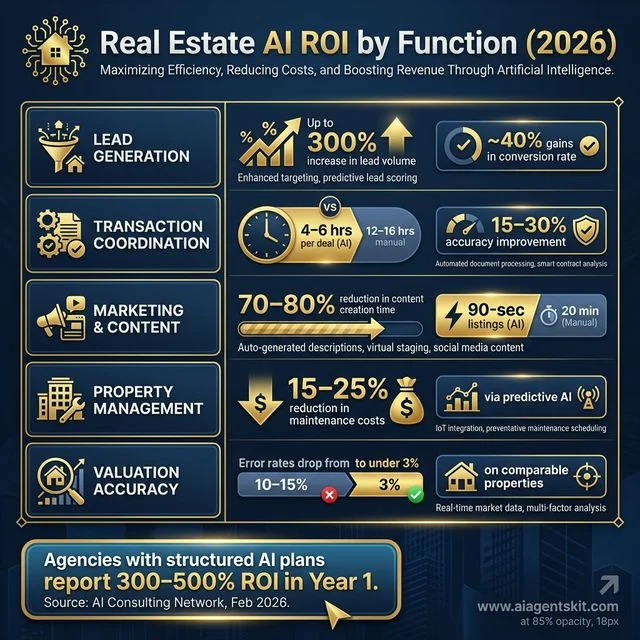 Real Estate AI ROI by Function (2026): A function-by-function breakdown of the measurable returns agencies are achieving through structured AI implementation. Lead Generation delivers the highest headline impact — up to a 300% increase in qualified lead volume paired with roughly 40% gains in conversion rates, driven by 24/7 AI qualification responding within seconds of inquiry. Transaction Coordination compresses deal review time from 12–16 manual hours down to 4–6 hours per file, with a 15–30% improvement in accuracy via automated document analysis. Marketing and Content tools produce 70–80% reductions in content creation time — a listing description that took 20 minutes now takes 90 seconds. Property Management AI cuts maintenance costs 15–25% through predictive scheduling. Valuation accuracy has leapt dramatically, with error rates falling from 10–15% to under 3% on comparable properties. The bottom-line finding: agencies with structured implementation plans report 300–500% ROI within the first 12 months.
| Function | Typical Impact |
|---|---|
| Lead generation | Up to 300% increase in lead volume; ~40% gains in conversion rate |
| Transaction coordination | 4–6 hours per deal vs. 12–16 hours manual; 15–30% accuracy improvement |
| Marketing | 70–80% reduction in content creation time; 90-second listing descriptions vs. 20 minutes |
| Property management | 15–25% reduction in maintenance repair costs via predictive maintenance |
| Valuation | Error rates reduced from 10–15% to under 3% on well-comparable properties |
For context, consider what tracking performance looks like in practice: agencies that track AI tool adoption rates weekly — not quarterly — consistently catch disengagement early, before it compounds into tools that no one is actively using despite ongoing subscription costs.
Phased adoption timeline that consistently works:
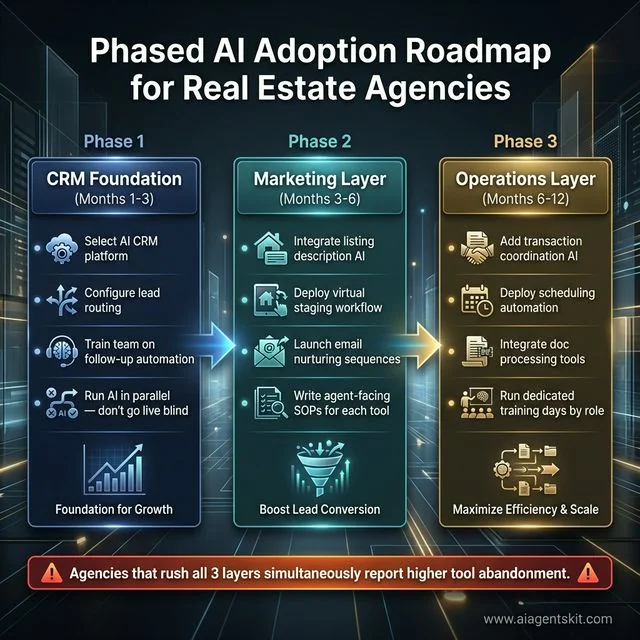 Phased AI Adoption Roadmap for Real Estate Agencies: A three-phase implementation timeline designed to maximize agent adoption rates and minimize the tool abandonment that derails most agency AI programs. Phase 1 (Months 1–3) focuses exclusively on the CRM foundation — selecting the platform, configuring intelligent lead routing, training on follow-up automation, and running the AI in parallel with existing processes to build baseline performance data before full transition. Phase 2 (Months 3–6) introduces the Marketing Layer with listing description AI, virtual staging workflow integration, email nurturing sequences, and agent-facing SOPs that define exactly how each tool is used per-task. Phase 3 (Months 6–12) deploys the Operations Layer — transaction coordination AI, scheduling automation, and document processing — with dedicated role-specific training days. The critical warning shown at the bottom: agencies that attempt all three phases simultaneously consistently report significantly higher tool abandonment within 90 days.
- Month 1–3: CRM foundation — select, configure, and train on the AI CRM. Focus only on lead routing and follow-up automation initially. Don’t try to use every feature at once.
- Month 3–6: Marketing layer — integrate listing description AI, virtual staging, and email nurturing into existing workflows with clear agent-facing SOPs.
- Month 6–12: Operations layer — deploy transaction coordination AI, scheduling automation, and document processing tools with dedicated training days.
Agencies that rush all three layers simultaneously consistently report lower adoption rates and higher tool abandonment after 90 days. The phased approach isn’t slow — it’s the fastest path to sustained ROI.
Best Free AI Tools for Real Estate Agents (2026)
A full enterprise AI stack isn’t the right starting point for every agency. For solo agents, small teams, or brokerages evaluating AI before committing to platform subscriptions, a surprisingly capable toolkit is available at no cost — covering listing copy, image enhancement, market research, and client communication.
Free doesn’t mean ineffective here. The free tiers of the major AI platforms cover most of what agents need for daily tasks before purpose-built tools become worth their monthly cost.
ChatGPT Free (GPT-4o) — OpenAI’s free tier provides access to GPT-4o with a usage cap of approximately 40 messages per three-hour window. Sufficient for writing listing descriptions, follow-up emails, and objection-handling prep throughout a typical workday. Includes basic image generation via DALL-E at lower resolution than the paid plan.
Google Gemini Free — Unlimited access to Gemini 2.0 Flash on the free tier, with full native integration across Google Docs, Sheets, and Gmail. Genuinely capable for market research synthesis, CMA narrative drafting, and neighborhood buyer guides — all without a subscription.
Canva AI (Free Plan) — Includes Magic Write for AI copy generation and limited AI image generation credits monthly. For creating open house flyers, social media graphics, and simple listing presentations, the free plan handles most use cases for agents processing fewer than 20 listings per year.
REimagineHome (Free Credits) — New accounts receive 3–5 free virtual staging credits on signup. Enough to test the complete workflow — photo upload, style selection, furnished render — before committing to a paid subscription ($14–$99/month).
Loom Free (Listing Walk-throughs) — The free tier allows unlimited recordings with a 5-minute cap per video. For short property walk-through videos, agent introduction videos, and visual market update content for social media, the free tier covers most residential agents’ video needs.
Grammarly Free — Catches grammar and clarity issues in listing copy, client emails, and agent bio content. A simple but high-leverage addition to the quality review step before publishing any client-facing text.
The honest limitation: Free tiers carry usage caps, reduced context windows, and lack the MLS integrations found in purpose-built real estate platforms. They’re ideal for evaluation and low-volume workflows — not for teams managing 50+ annual transactions, where the ROI on paid subscriptions materializes quickly and the time savings outweigh the cost many times over.
AI for Real Estate Agencies: Frequently Asked Questions
What are the best AI tools for real estate agencies in 2026?
The highest-impact starting point is an AI-powered CRM — Lofty, Follow Up Boss, or Sierra Interactive, depending on team size and lead strategy. From there, agencies prioritize valuation intelligence (HouseCanary or RPR) and listing content generation (Copy.ai or Jasper). Operations tools like Structurely and Luminance offer strong ROI but require more integration work and are best introduced after the CRM and marketing layers are stable and actively used by agents.
How does AI help real estate lead generation and conversion?
AI tools improve lead generation through 24/7 automated qualification — AI text and phone assistants like Structurely engage leads within seconds of inquiry and route warm leads to agents in real-time. AI CRMs use behavioral signals to prioritize which leads agents contact first. Firms using AI for lead generation and follow-up have reported up to a 300% increase in lead volume and approximately 40% gains in conversion rates compared to non-AI workflows.
Can AI replace real estate agents?
No — and the evidence doesn’t support this concern for the foreseeable future. AI replaces specific tasks: repetitive follow-up, document formatting, listing copy drafting, and scheduling. The functions that define an agent’s value — negotiation, relationship management, market judgment in edge cases, and empathetic guidance during major financial decisions — remain distinctly human. The more accurate framing is that AI shifts what agents spend time on, not whether agents are needed.
What ROI can a real estate agency expect from AI tools?
Agencies with structured AI implementation programs report 300–500% ROI within the first 12 months. The typical investment runs $25,000–$75,000 annually in tools, training, and integration, with measurable returns of $100,000–$400,000 in recovered time, increased transaction volume, and reduced operational overhead. Agencies without an implementation plan consistently report near-zero or negative ROI, regardless of tool quality or subscription costs.
How accurate is AI property valuation compared to agent CMAs?
Modern AI valuation models now achieve error rates as low as 2.8% on well-comparable residential properties — a significant improvement from 10–15% five years ago. Agents use these models as the foundation for CMAs rather than a replacement. AI valuation tools struggle most on unique properties with few direct comparables, rapidly shifting micro-markets, and listings where non-quantifiable factors — renovation quality, curb appeal, neighborhood character — drive pricing premiums beyond the data’s reach.
How much does a complete real estate AI stack cost?
A full stack for a mid-size agency typically runs $500–$3,000 per month in tool subscriptions, depending on team size and platform tier. Individual tools range from $14/month (AI staging credits) to $500+/month (enterprise CRM platforms). Training, integration, and first-year optimization add $10,000–$30,000 for agencies starting from scratch. The total annual investment range: $25,000–$75,000, with strong, documented ROI for agencies that implement with a defined plan.
What is the best AI CRM for real estate teams?
There’s no single winner — the best fit depends on team workflow and lead sources. Lofty is strongest for teams investing heavily in paid lead generation, particularly Google PPC, and wanting deep automation with minimal manual configuration after setup. Follow Up Boss is preferred for conversion-focused teams with diverse lead sources and existing tool ecosystems. Sierra Interactive suits agencies prioritizing hyper-local organic lead generation and large-volume long-term lead nurturing.
How do real estate agencies get started with AI without disrupting operations?
Start with the CRM layer in months 1–3, focusing only on lead routing and follow-up automation — not a full platform overhaul at once. Run the AI CRM in parallel with existing processes for 30 days to establish baseline performance data, then transition fully. Expand to marketing tools in months 3–6 and operations tools in months 6–12. Agencies with the highest adoption rates consistently introduce one new AI tool per quarter, not all tools simultaneously.
Can AI tools integrate with existing property management systems?
Most modern AI platforms offer API integrations with popular property management systems including AppFolio, Buildium, Yardi, and Rent Manager. Purpose-built real estate AI tools — Lofty, Sierra Interactive, Follow Up Boss — have pre-built MLS and IDX integrations. General AI tools require more configuration. Before purchasing, confirm which integrations are native and which require Zapier or third-party middleware — middleware dependencies add complexity and potential failure points worth understanding upfront.
What are the main challenges of AI adoption in real estate?
Three challenges consistently surface across agencies. First, agent resistance — particularly from experienced agents who view AI tools as threats to their expertise rather than amplifiers of it. The solution is leading adoption with tools that visibly save time on tasks agents already dislike, like follow-up texts and document chasing. Second, data quality — AI tools are only as accurate as the data fed to them; agencies with poor CRM hygiene will find AI recommendations consistently less reliable. Third, tool adoption without implementation plan — the most common reason for failed AI adoptions is deploying tools without defined, documented workflows for how agents use them daily.
The Stack Is the Strategy
Real estate AI isn’t a set of features — it’s an operating model. The agencies building sustainable competitive advantages in 2026 aren’t the ones with the most AI subscriptions; they’re the ones that have designed each tool around a specific workflow problem and track whether it’s actually being used week over week.
Three concrete actions worth taking this week: audit which business functions still run on manual follow-up and reactive document chasing; select one AI CRM from the three profiled here and request a structured demo focused specifically on the lead-to-appointment workflow; and benchmark current listing-to-close timelines before deploying any operations AI — so the improvement is measurable, not assumed.
The pattern of AI adoption across professional services firms — law, accounting, and now real estate — is consistent: the organizations that moved early with a structured implementation plan captured meaningful market share while competitors were still debating whether the tools were ready. In real estate, that window is narrowing faster than most agency owners realize.