
15 Real-World AI Agent Use Cases You Should Know (2026)
Discover 15 proven AI agent use cases transforming businesses in 2026—from customer service to coding. Real companies, real results, actionable insights.
Last month, I had a 15-minute support conversation that completely solved a billing issue. Account updated, refund processed, confirmation email received. It wasn’t until the email arrived that I noticed the signature: “AI Assistant - powered by [Company] Intelligence.”
I’d been chatting with an AI agent the entire time and hadn’t realized it.
That moment crystallized something I’d been observing: AI agents aren’t a future technology anymore. They’re here, deployed across industries, handling real work that used to require human intervention. But with so much hype flying around, it’s hard to separate genuine use cases from demo-ware that looks impressive but doesn’t actually work in production.
So let’s cut through the noise. Here are 15 AI agent use cases that are actually delivering results in 2026—with real companies, real metrics, and real lessons. If you want to understand what AI agents are at a fundamental level, start there. But if you’re ready to see what they actually do—keep reading.
What Makes AI Agents Different From Traditional Automation
Before we dive into use cases, let’s address something that trips people up: why do AI agents matter when automation has existed for decades?
Traditional automation follows scripts. If X happens, do Y. Great for predictable, repetitive tasks. But throw in ambiguity—a customer complaint that doesn’t match your decision tree, a document format you didn’t anticipate—and rule-based automation breaks down.
AI agents are different. They reason. They adapt. They figure out how to achieve a goal rather than following a predetermined path.
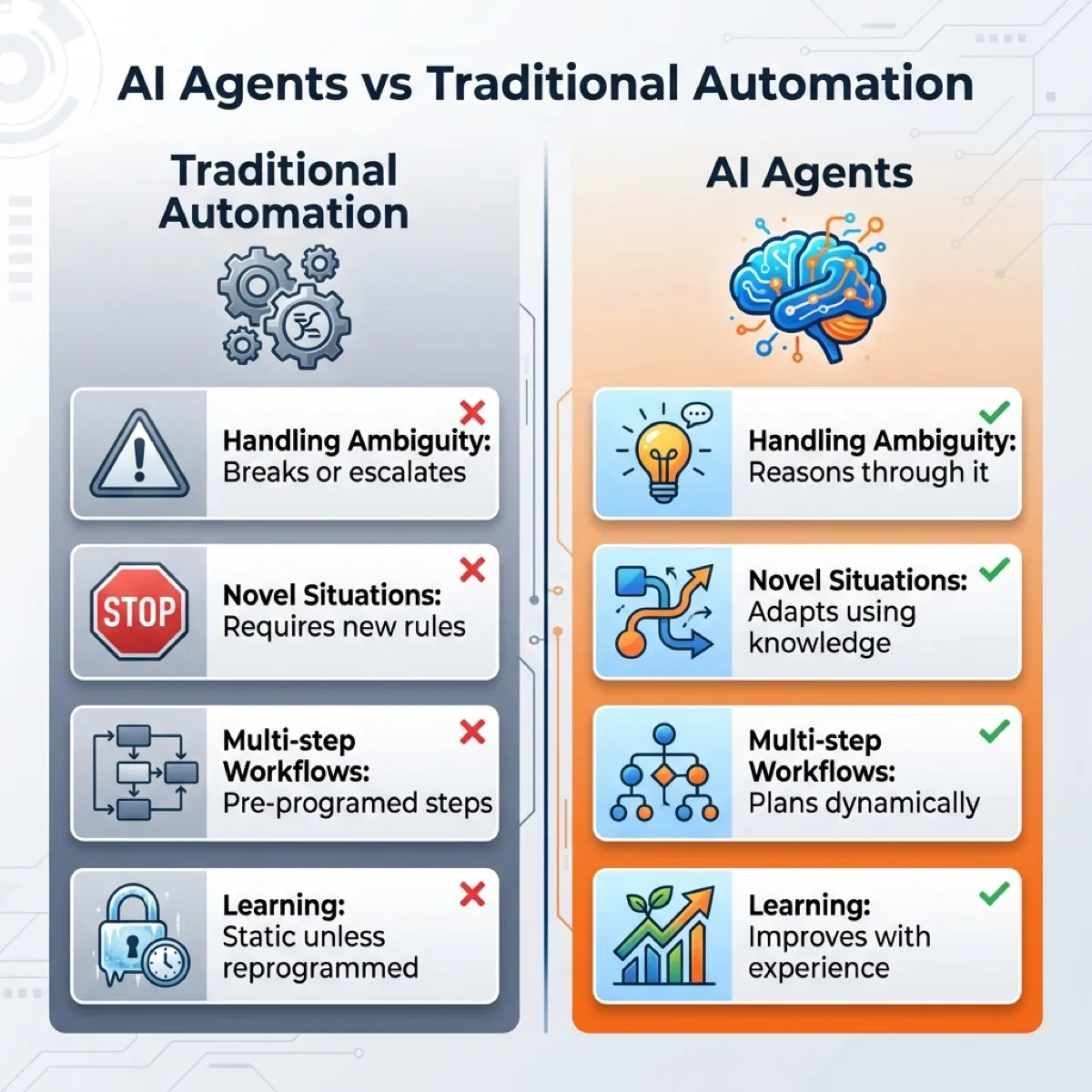 AI agents reason through ambiguity and adapt to novel situations, while traditional automation follows predetermined scripts
| Aspect | Traditional Automation | AI Agents |
|---|---|---|
| Handling ambiguity | Breaks or escalates | Reasons through it |
| Novel situations | Fails or requires new rules | Adapts using general knowledge |
| Multi-step workflows | Each step pre-programmed | Plans steps dynamically |
| Learning | Static unless reprogrammed | Improves with experience |
Here’s the stat that caught my attention: Gartner predicts that 40% of enterprise applications will integrate task-specific AI agents by the end of 2026—up from less than 5% in 2025. That’s not incremental change. That’s a fundamental shift. See our roundup of the top AI startups in 2026 to understand who’s driving this change.
This distinction matters because it determines which use cases make sense. AI agents shine where tasks are complex, variable, and require judgment. For simple, perfectly predictable workflows? Traditional automation is still cheaper and more reliable. For teams ready to move from understanding to action, the complete guide to AI agents for automation covers implementation steps, framework selection, and real enterprise adoption patterns in depth.
If you’re curious about the difference between AI agents and chatbots, we’ve covered that in detail. The short version: chatbots talk, agents do.
Now, let’s look at what they’re actually doing.
1. Customer Service & Support Automation
This is the most mature use case—and honestly, the one that impressed me most. Customer service AI has moved far beyond the frustrating chatbots of 2020 that made everyone scream for a human representative.
Modern customer service agents don’t just answer questions. They resolve issues end-to-end: processing refunds, updating accounts, scheduling callbacks, tracking orders. They access your customer history, understand context across channels, and escalate to humans only when genuinely necessary.
Real examples:
- Bank of America’s Erica handles over 2 million customer requests daily, resolving 78% of questions within 41 seconds. That’s not a typo—forty-one seconds.
- E.ON achieved a 70% automation rate across more than 2 million customer calls using AI agents
- Wiley (the educational publisher) reported a 40% increase in case resolution during peak periods
The pattern I see: companies aren’t replacing their support teams. They’re using AI agents to handle the repetitive stuff—password resets, order status, basic billing questions—so human agents can focus on complex issues that actually require human judgment.
The economic math is compelling. A typical customer service call costs $8-15 when handled by a human agent. An AI agent handling the same interaction? Pennies. Scale that across millions of interactions and the savings become significant. But the real value isn’t just cost—it’s capacity. When AI agents handle 70% of routine queries, human teams can actually spend time on the complex cases that need expertise.
One thing that surprises people: customer satisfaction often goes up with AI agents. Why? Faster resolution times. No hold queues. Available 24/7. For straightforward issues, most customers don’t care who (or what) helps them—they just want their problem fixed. The key is matching the right technology to the right use case. Simple queries to AI, complex situations to humans.
2. Sales Outreach & Lead Qualification
If customer service is where AI agents are most mature, sales is where they’re moving fastest.
The boring but critical work of sales—lead scoring, initial outreach, scheduling meetings—is exactly what AI agents handle well. They don’t get tired of sending personalized emails. They don’t forget to follow up. And they can prioritize leads based on behavioral signals that humans might miss.
Real examples:
- HubSpot’s AI Lead Scoring analyzes engagement patterns to prioritize high-potential leads
- Drift’s Conversational AI handles early-stage sales conversations and books meetings directly into calendars
- Salesforce Einstein predicts which leads are most likely to convert, helping sales teams focus their time
What I find interesting: the best implementations don’t try to have AI agents close deals. They qualify leads, book meetings, and warm up prospects—then hand off to human salespeople for the relationship-building and negotiation that still requires human skill.
That said, I’ve talked to sales leaders who are nervous about this. “Won’t customers feel tricked if they’re talking to a bot?” In my experience, transparency helps. The agent that handled my support issue identified itself clearly. Most people are fine with AI for transactional interactions—they just don’t want to feel deceived.
3. Personalized Shopping Assistants
Retail is betting big on AI agents—and the results are showing up in conversion rates.
Unlike basic recommendation engines (“customers who bought X also bought Y”), AI shopping assistants actually have conversations. They understand preferences, consider constraints, and guide customers toward products that fit their needs.
Real examples:
- H&M’s virtual shopping assistant resolves 70% of queries automatically and has increased conversion rates by 25%
- Sephora’s chatbot helps customers find products based on skin type, preferences, and past purchases
- Walmart uses AI agents to help customers track orders, find products, and manage returns
The retail use case highlights something important: AI agents work best when they’re integrated with backend systems. H&M’s assistant isn’t just chatting—it’s connected to inventory, CRM, and order management. It can actually tell you if something’s in stock at your nearest store, not just guess.
For a comprehensive guide on implementing AI agents specifically for ecommerce—including Shopify integration, tool recommendations, and automation strategies—see our detailed guide on AI agents for ecommerce.
4. HR & Recruitment Automation
Here’s a use case that doesn’t get enough attention: HR teams are drowning in administrative work, and AI agents are providing relief.
Recruiting alone involves screening hundreds of resumes, scheduling interviews, sending updates to candidates, managing onboarding paperwork… Each task is manageable individually, but the volume is crushing.
What AI agents handle:
- Resume screening and candidate matching at scale
- Interview scheduling that coordinates across multiple calendars
- Onboarding workflows—document collection, system access, orientation scheduling
- Answering common candidate questions about benefits, process, timeline
One HR director told me their recruiting team used to spend 40% of their time on scheduling logistics. Now it’s near zero. That time goes into actually talking to candidates and making better hiring decisions.
The bias question comes up often here. It’s valid. AI trained on biased historical data can perpetuate discrimination. The responsible implementations I’ve seen treat AI as a tool to surface candidates—not make final decisions—and regularly audit for bias in outcomes.
5. Supply Chain & Logistics Optimization
If you want to see AI agents with measurable, bottom-line ROI, look at supply chain.
Logistics is complex: weather changes, traffic patterns, demand fluctuations, inventory constraints, carrier availability. Traditional optimization software handles this with pre-defined rules. AI agents adapt in real-time.
Real examples:
- DHL’s Agentic AI system continuously updates delivery routes based on traffic, weather, and demand—leading to 30% more punctual deliveries and 20% reduced fuel costs
- UPS uses AI agents to optimize routing across their massive delivery network
- Amazon’s fulfillment centers use AI agents to coordinate inventory movement, picking routes, and shipping decisions
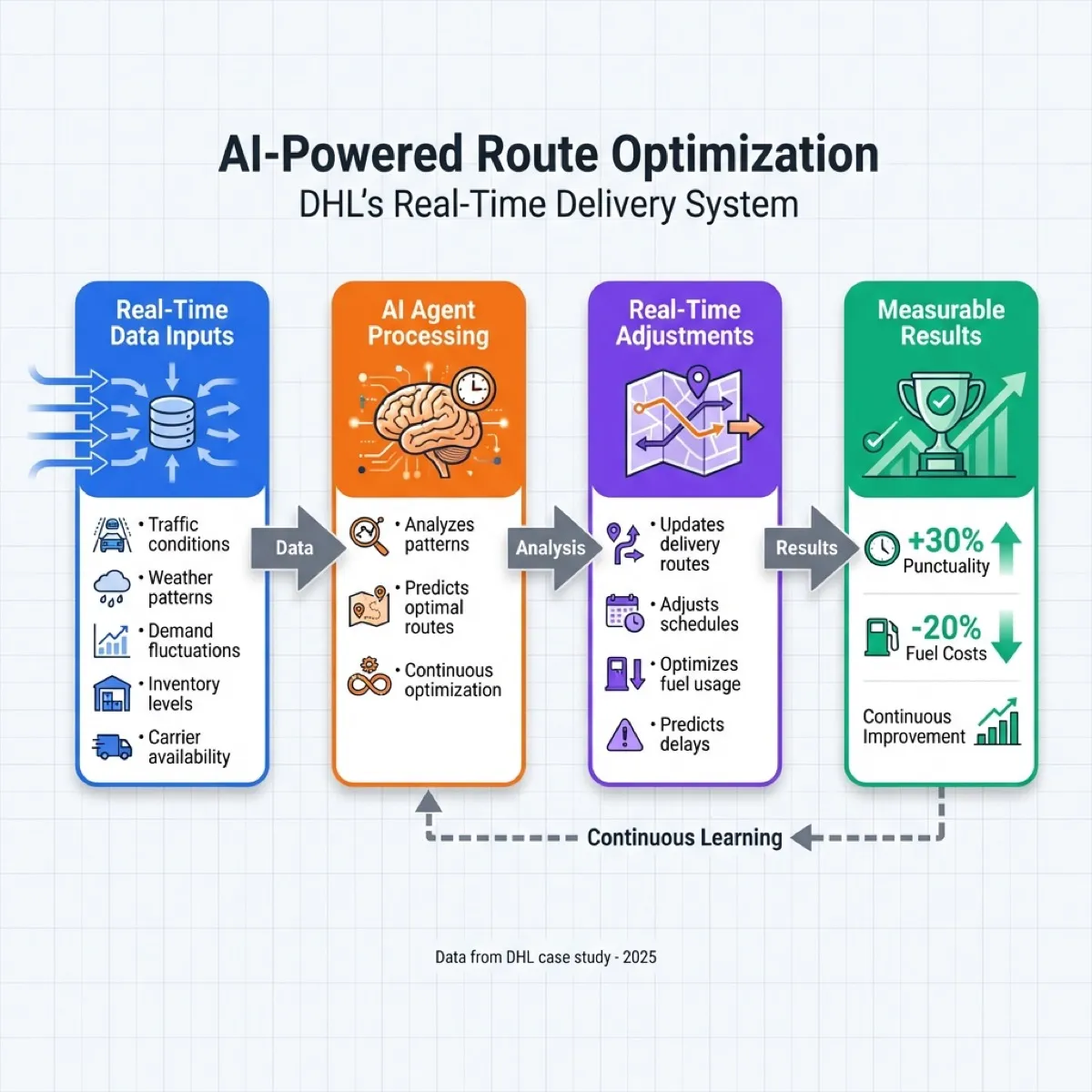 How DHL’s AI agent system processes real-time data to continuously optimize delivery routes, achieving significant cost savings and performance improvements
The DHL stat jumped out at me. 20% reduction in fuel costs is significant—both financially and environmentally. This is one of those use cases where AI agents create obvious win-wins.
What makes supply chain compelling: the optimization never stops. An agent continuously monitoring conditions and adjusting plans outperforms batch optimization that runs once a day. Real-time beats scheduled.
6. Finance & Accounting Automation
Financial services might be the most regulated industry—which means AI agents need to be incredibly reliable. But the use cases here are strong.
Where AI agents work well:
- Transaction monitoring and fraud detection: AI agents analyze patterns across millions of transactions in real-time, flagging anomalies faster than any human team could
- Claims processing: Insurance agents verify coverage, extract information from documents, and process straightforward claims automatically
- Accounts payable/receivable: Invoice processing, payment matching, exception handling
Real example:
- Uber’s Finch is a conversational AI agent that streamlines financial data retrieval. Ask it a question in natural language—“What was our driver payout in Chicago last quarter?”—and it translates that into structured data queries, returning the answer instantly.
The compliance angle matters here. AI agents that follow rules consistently—never cutting corners, never having a bad day—can actually improve regulatory compliance. They create audit trails automatically. For a comprehensive look at how AI is reshaping fraud detection, credit scoring, agentic banking, and regulatory compliance across the full financial services sector, see the complete guide to AI in fintech.
But I’ll be honest: finance is also where I see the most caution. High-stakes errors are expensive. Most implementations keep humans in the loop for anything above certain thresholds.
7. Code Generation & Development
Okay, this one’s personal. AI coding agents have genuinely changed my workflow.
GitHub Copilot, Cursor, and similar tools have evolved beyond autocomplete. They’re becoming actual agents that understand your codebase, suggest refactors, write tests, and even debug issues.
What I’ve experienced:
- Generating boilerplate code from natural language descriptions
- Getting explanations of unfamiliar code in legacy codebases
- Having tests written for functions I just created
- Getting refactoring suggestions that improve code quality
A team at Salesforce reportedly embedded AI across their development toolchain for code generation, test creation, explanation, refactoring, and bug identification. This isn’t a single tool—it’s an agentic approach to software development where AI assists at every stage of the software lifecycle.
The productivity gains are substantial. Developers using AI coding assistants report completing tasks 30-55% faster, according to various industry studies. For companies struggling to hire enough developers—which is most companies—this is a multiplier on their existing talent. One senior developer with an AI agent can accomplish what previously required a larger team for routine coding tasks. If you’re exploring career options in this space, see our comparison of AI engineer vs ML engineer vs data scientist roles, or browse remote AI jobs.
Here’s my honest take: coding agents are the sleeper hit of 2026. Customer service gets the headlines, but the productivity gains in software development—where skilled labor is expensive and in limited supply—may have bigger economic impact. The math is straightforward: if AI agents make developers 40% more productive, that’s the equivalent of adding 40% more engineering capacity without hiring anyone.
The caveat: you still need to review everything. AI agents make mistakes. They confidently propose code that doesn’t work, hallucinate APIs that don’t exist, and sometimes introduce subtle bugs. Treat them as a very fast junior developer who needs code review, not as an infallible authority. The best implementations include automated testing and code review processes that catch AI mistakes before they hit production.
For those wanting to build agents themselves, check out the best AI agent frameworks compared.
8. Real Estate Lead Generation & Management
Real estate is a high-stakes, 24/7 industry where “speed to lead” is the difference between a listing and a lost lead. AI agents are transforming how agents handle the “top of funnel” chaos.
Where AI agents work well:
- Instant Qualification: Engaging web leads at 3 AM to identify budget, timeline, and motivation.
- Nurture Loops: Sending personalized property matches based on a lead’s past browsing behavior.
- Appointment Scheduling: Interfacing with calendars to book tours and listing appointments without human intervention.
For a deep dive into the specific tools and strategies for this industry, see our guide on AI agents for real estate lead generation.
9. IT Help Desk & Support
Password resets. Access provisioning. “Have you tried turning it off and on again?” IT help desks handle a massive volume of repetitive requests.
AI agents are naturals for this:
- Automatically resetting passwords after identity verification
- Provisioning software access based on role and approval workflows
- Troubleshooting common issues with guided walkthroughs
- Generating audit logs and compliance documentation
Example:
- Dropbox Dash uses AI agents to improve internal search and knowledge management—summarizing documents, answering questions, and surfacing relevant information from across the company
The internal use case for AI agents is underrated. External customer service gets attention, but internal IT support has similar dynamics: high volume, repetitive requests, employees frustrated by wait times. AI agents help employees get back to work faster.
9. DevOps & Incident Management
If something breaks at 3 AM, you want to know immediately—not when the first customer complaint arrives at 9 AM.
AI agents in DevOps (sometimes called “AIOps”) don’t just alert on problems. They predict them, diagnose them, and sometimes fix them automatically.
What they do:
- Predictive monitoring: Analyzing metrics, logs, and traces to predict outages before they impact users
- Incident response: Detecting anomalies, correlating related issues, suggesting (or executing) remediation steps
- Auto-scaling: Predicting resource needs and scaling infrastructure preemptively
Real examples:
- Shopify uses AI agents to predict resource needs, automate scaling, and reduce cloud costs
- Siemens uses predictive maintenance AI to monitor sensors, detect anomalies, and trigger maintenance before breakdowns—reducing unplanned downtimes by up to 50%
That Siemens stat—50% reduction in unplanned downtime—represents significant operational savings. Equipment that breaks unexpectedly is expensive to fix and disrupts production.
The shift here is from reactive to proactive. Instead of waiting for something to break and scrambling to fix it, AI agents help operations teams stay ahead of problems.
10. Healthcare Patient Management
Healthcare is complicated: patient privacy regulations, clinical accuracy requirements, high stakes. AI agents here need to be implemented thoughtfully—but the use cases are compelling.
Where they’re working:
- Appointment scheduling and reminders: Reducing no-show rates by managing bookings, sending reminders, and handling rescheduling. This is particularly transformative in specialized clinics, as detailed in our guide on AI for dental practices.
- Clinical documentation: Summarizing EHR entries, generating clinical notes, drafting consultation summaries—freeing clinicians to focus on patients
- Insurance verification: Checking coverage, processing prior authorizations, flagging documentation issues before they cause claim denials
- Patient follow-up: Structured post-treatment check-ins to monitor recovery and adherence
The documentation burden on doctors is real. Studies suggest physicians spend hours on paperwork for every hour of patient care. AI agents that handle clinical documentation—accurately—could transform the profession.
That said, I see more caution here than in most industries. Mistakes in healthcare can harm people. The responsible deployments use AI to assist clinicians, not replace clinical judgment. Human oversight remains essential.
11. Legal Contract Review & Research
Lawyers spend a lot of time on documents. Reading contracts. Researching precedents. Checking compliance. AI agents are starting to help.
Use cases:
- Contract review: Scanning documents for risk clauses, unusual terms, and compliance issues
- Legal research: Searching across millions of cases, statutes, and rulings to find relevant precedents
- Compliance monitoring: Continuously scanning regulatory changes and flagging impacts
The shift in legal is from reactive document review to proactive intelligence. Instead of waiting for someone to ask “does this contract have any problems?”, AI agents can flag issues automatically as documents enter the system.
I’ve heard skepticism from lawyers about this—understandably. Legal work is nuanced. Context matters enormously. But even skeptics acknowledge that AI agents handling the first-pass review saves time. The human lawyer still makes the judgment call. For firms ready to move beyond individual tool experiments into a structured operational approach, the complete guide to AI for law firm management covers vendor selection, governance frameworks, and practice-area-specific tool recommendations.
12. Education & Personalized Learning
AI tutors that adapt to individual students have been a holy grail of edtech. We’re getting closer.
What’s working:
- Personalized learning paths: Adjusting content, pacing, and exercises based on how a student is actually performing
- 24/7 tutoring support: AI agents available anytime to answer questions, explain concepts, and provide practice problems
- Automated grading: Immediate feedback on assignments, freeing teachers to focus on higher-value instruction
The personalization aspect is key. A human teacher with 30 students can’t customize instruction for each one. An AI agent working with each student individually can—at least for certain types of learning.
Early deployments report significant performance improvements in students using AI tutors. Makes sense: immediate feedback and personalized pace beats one-size-fits-all instruction.
13. Research & Market Intelligence
For anyone who’s spent hours gathering competitive intelligence or researching market trends, AI agents offer relief.
What they do:
- Competitor monitoring: Tracking pricing changes, new product launches, marketing campaigns
- Report summarization: Digesting long reports and delivering key takeaways
- Trend analysis: Surfacing patterns across news, social media, and industry publications
Example:
- ThriveAI is developing AI agents that act as junior product managers—handling tasks like sprint planning, user research summarization, and roadmap recommendations
The value here is time savings. Research that used to take a day can be done in an hour. Not because AI agents are smarter than human researchers—but because they can process more information faster.
14. Voice Agents & Call Centers
Voice is the next frontier for AI agents. Typing is fast, but talking is natural—and for many customers, preferred.
What’s different now:
- Natural conversation, not robotic menus
- Multilingual support without translation delays
- 24/7 availability without staffing costs
Real examples:
- Intercom’s Fin Voice handles customer calls, answers questions, and escalates to human agents when needed
- Spotify uses generative AI for real-time translation, allowing any support agent to respond to global customers regardless of language
Voice agents are particularly interesting for phone-first demographics and use cases where hands-free matters (driving, accessibility needs). The technology has improved dramatically—voices are natural, latency is low, comprehension is good.
My prediction: within two years, most business phone systems will have voice AI as the first point of contact.
15. Multi-Agent Orchestration
Here’s the frontier: multiple specialized AI agents working together on complex workflows.
Instead of one super-agent that tries to do everything (and gets confused), you build teams:
- A “researcher” agent gathers information
- A “planner” agent structures the approach
- A “writer” agent drafts content
- An “editor” agent reviews and refines
- A “compliance” agent checks for issues
Each agent is simpler and more focused, but together they handle complex tasks that no single agent could manage well. Think of it like a software development team: you don’t want one person doing design, coding, testing, and deployment. Specialization works.
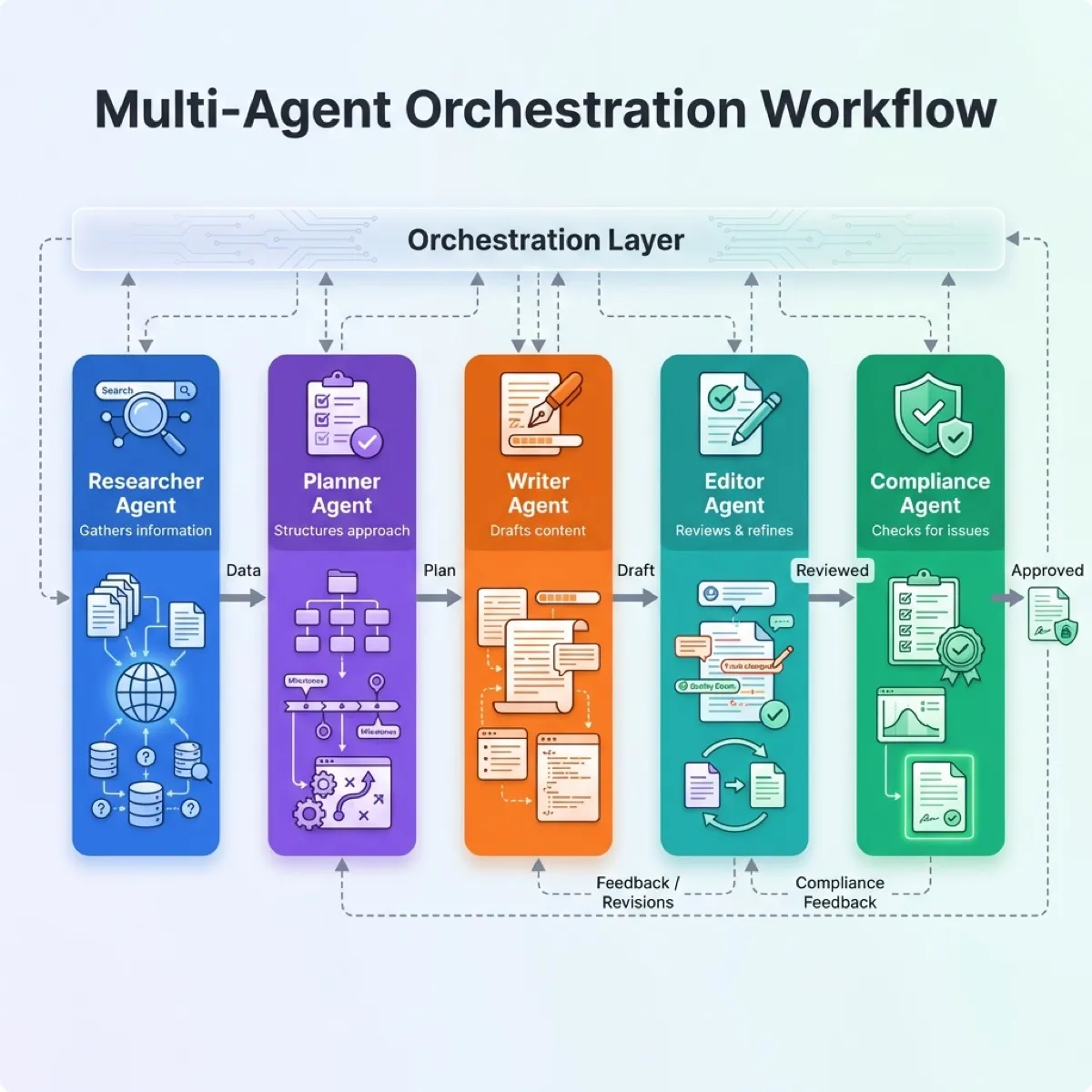 How specialized AI agents collaborate in a multi-agent system—each with a focused role, coordinated by an orchestration layer
The technical challenges are real: agents need to share context effectively, handle failures gracefully when one agent in the chain struggle, and maintain coherent state across multiple interactions. Frameworks like CrewAI and AutoGen are emerging to address these orchestration challenges, providing tools for agent communication and workflow management. For a detailed comparison of these tools — including their orchestration models, production readiness, and decision framework — see the complete guide to agentic AI frameworks.
Honestly? We’re still in the early innings here. Multi-agent systems are impressive in demos, but production deployments at scale are still being figured out. The challenges—coordination, error handling, context sharing between agents, and maintaining coherent memory—are significant. Most production multi-agent systems today involve just 2-4 agents working together, not the complex swarms you might imagine.
But this is clearly where things are heading. The industry is moving from “how do we make one agent smarter?” to “how do we orchestrate multiple agents effectively?” Some predict we’ll see “agent-in-chief” roles emerging—people whose job is coordinating and managing teams of AI agents, much like managing human teams today.
If you want to build simple agents yourself, start with our guide on building your first AI agent with Python. For a comprehensive look at self-hosting an AI agent with full system access, check our Moltbook & OpenClaw complete guide—it covers installation, security, and real-world deployment of personal AI agents.
Challenges and What Could Go Wrong
I’d be doing you a disservice if I didn’t mention the problems.
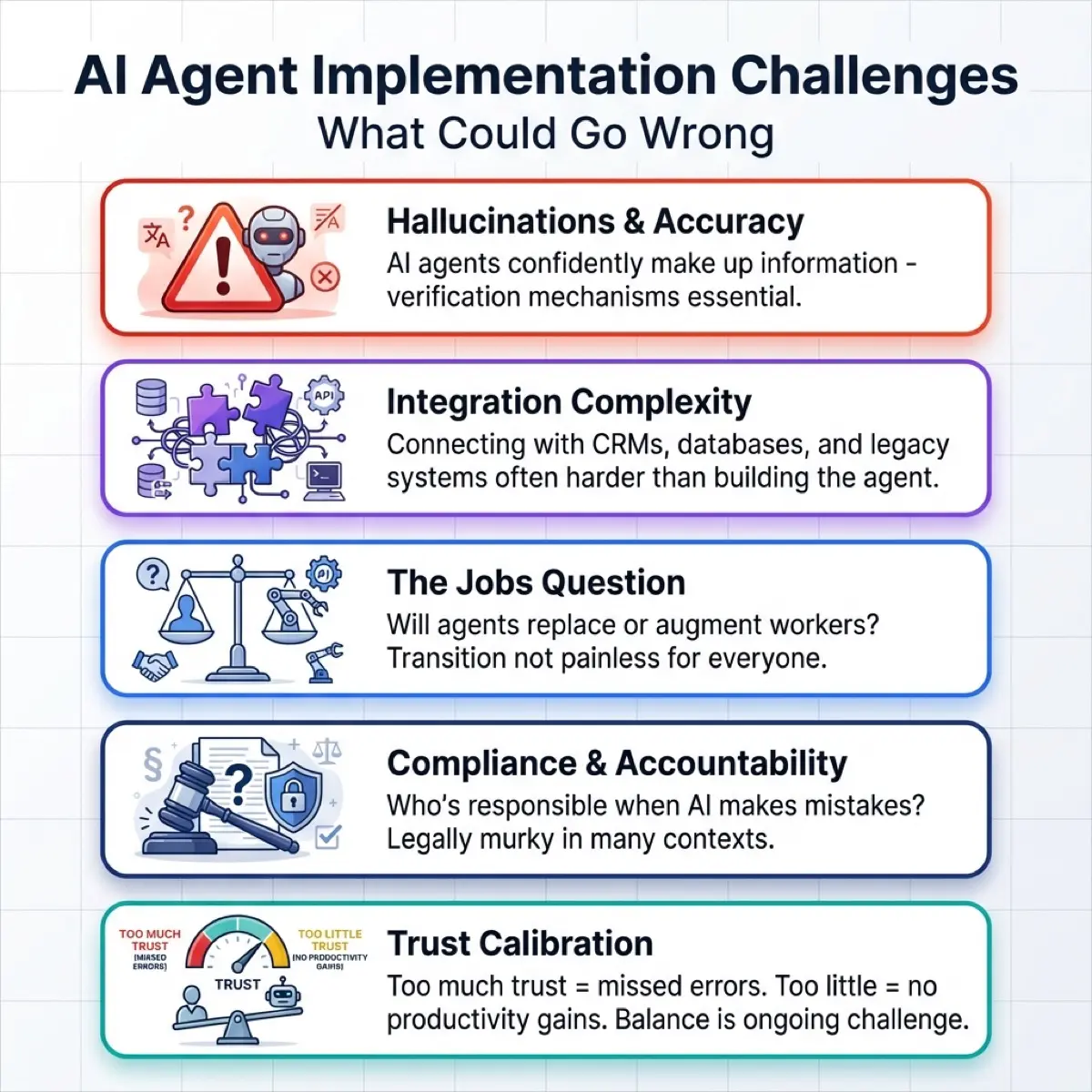 Five major challenges organizations face when deploying AI agents in production environments
Hallucinations and Accuracy
AI agents make stuff up. Confidently. If your agent is providing information that matters—medical advice, financial data, legal interpretation—you need verification mechanisms.
Integration Complexity
Most valuable AI agents need to connect with existing systems: CRMs, databases, APIs. This integration work is often harder than building the agent itself. Legacy systems especially.
The Jobs Question
Will AI agents replace jobs? Some, probably. Many routine roles will change. But the pattern I’ve seen more often is augmentation: employees spending less time on tedious tasks, more time on work that requires human judgment.
Still, I won’t pretend the transition is painless for everyone affected.
Compliance and Accountability
When an AI agent makes a mistake, who’s responsible? This is legally murky in many contexts. Regulated industries need clear accountability structures.
Trust Calibration
Trusting AI agents too much leads to missed errors. Trusting them too little negates the productivity benefits. Finding the right balance is an ongoing challenge.
Frequently Asked Questions
What are real examples of AI agents in use?
Bank of America’s Erica handles 2 million+ daily customer requests. DHL uses AI agents for route optimization, achieving 30% better punctuality. GitHub Copilot assists developers with code generation. Siemens uses predictive maintenance agents that reduced unplanned downtime by 50%. These are production systems, not experiments.
How are companies using AI agents today?
Customer service (handling support inquiries and resolutions), sales (lead qualification and outreach), operations (supply chain optimization), and IT (help desk automation) are the most common deployments. According to PwC research, 79% of companies have already adopted AI agents with two-thirds reporting measurable value.
Are AI agents replacing human workers?
Mostly, they’re augmenting rather than replacing. AI agents handle repetitive tasks—password resets, data entry, initial customer queries—freeing humans for work requiring judgment, creativity, and relationship-building. Some routine roles will decline, but new roles in AI oversight and management are emerging.
What industries use AI agents the most?
Customer service and financial services lead adoption, followed by retail, healthcare, and technology. McKinsey’s 2025 survey found 62% of organizations are at least experimenting with AI agents, with 23% already scaling production deployments.
What’s the difference between AI agents and regular automation?
Traditional automation follows predetermined scripts: “if X, then Y.” AI agents reason through problems, adapt to novel situations, and pursue goals rather than executing steps. Agents handle ambiguity that would break rule-based automation. For deeper exploration, see our piece on AI agents vs. chatbots.
How much can AI agents reduce operational costs?
Industry analyses suggest 20-30% reduction in operational costs is typical for well-implemented AI agent deployments. Some companies report employees saving 40-60 minutes daily on routine tasks. ROI varies significantly based on implementation quality and use case fit.
Conclusion
Fifteen use cases. Real companies. Measurable results.
The pattern is clear: AI agents are no longer experimental technology. 57% of companies have them running in production. 40% of enterprise applications will embed them by end of 2026. The projections from major analysts all point in the same direction: this is adoption at scale, and it’s accelerating.
What surprised me researching this piece: the diversity. Customer service gets the headlines because it’s the most visible. But AI agents are quietly transforming supply chains, legal research, software development, healthcare administration, and financial services. The technology is horizontally applicable in ways that weren’t obvious even two years ago.
The ROI data is compelling: 20-30% reduction in operational costs. 40-60 minutes saved daily per employee on routine tasks. 50% reduction in unplanned downtime for manufacturing. These aren’t theoretical projections—they’re measured outcomes from production deployments.
If I had to bet on one sleeper hit? Coding agents. The productivity gains for software development—where skilled talent is expensive and in short supply—could have economic impact that dwarfs other use cases. When every developer becomes 40% more productive, that’s transformative.
But here’s what I’d warn against: trying to do everything at once. Pick one use case. The companies seeing the best results started focused. They picked customer service, or code review, or a specific workflow—and got that working well before expanding.
My suggestion: identify one use case from this list that’s relevant to your work. Just one. Try an AI agent there. Pay attention to what works and what doesn’t. That hands-on experience is worth more than reading ten more articles. Start small, learn fast, then scale what works.
Ready to build? Once you’ve identified your use case, follow our complete guide to build AI agents with n8n workflows and turn these ideas into working automations.
The question isn’t whether AI agents will change how we work. It’s whether you’ll figure out how to use them before your competitors do.