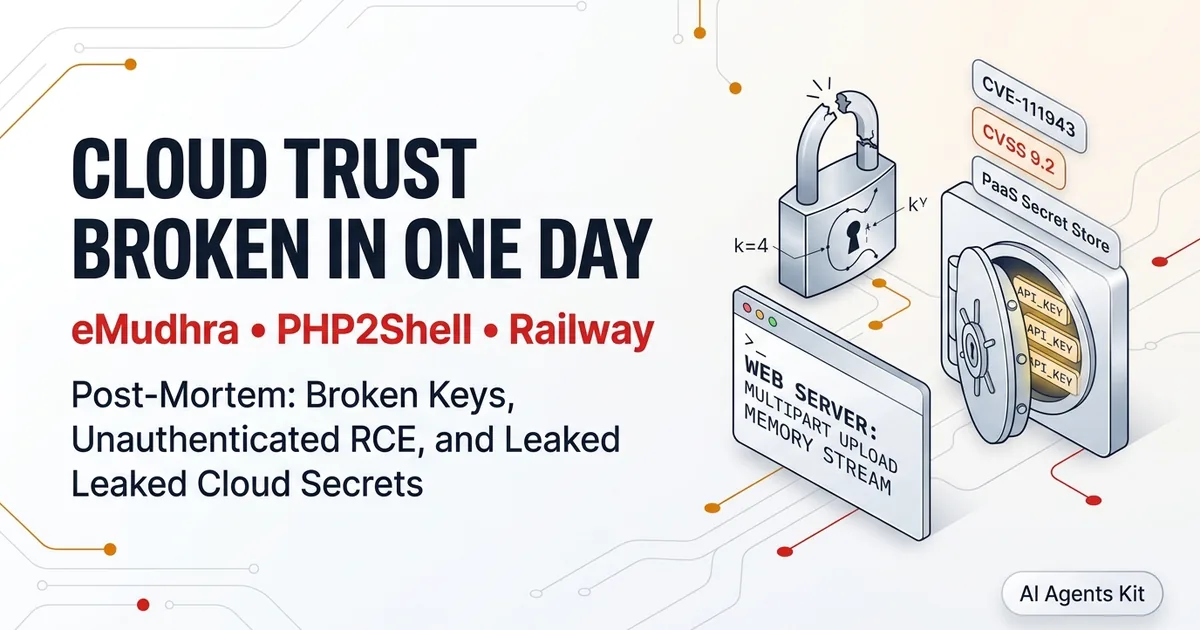
The Day Cloud Trust Broke: Inside eMudhra's Broken Keys, PHP2Shell RCE, and Railway's Secret Breach
A technical post-mortem of the October 21 security shocks: eMudhra's entropy-4 private keys, PHP2Shell unauthenticated RCE, and Railway's PaaS secret breach.
On October 21, 2026, the global technology community witnessed an unprecedented cluster of simultaneous, high-severity security disclosures. Within a span of twelve hours, three foundational layers of modern software architecture experienced critical breakdowns: the public key infrastructure that authenticates web traffic, the runtime engine interpreting billions of web requests, and the cloud secret stores housing production artificial intelligence credentials.
Software engineers arriving at work were met with urgent advisories across major platforms. Security teams scrambled to assess whether their HTTPS traffic was intercepted, whether their PHP-based web applications were executing malicious shell payloads, and whether their hosted environment variables had been scraped by threat actors hunting for autonomous agent credentials.
Understanding how these independent failures converged is essential for every engineer managing internet-facing infrastructure. The incident was not a single coordinated exploit, but a simultaneous collapse across identity, runtime execution, and cloud secrets management that exposed systemic architectural blind spots.
Key Takeaways
- eMudhra intermediate certificates under emSign Root TLS CA G3 suffered a key generation flaw, reducing P-384 elliptic curve entropy from 384 bits to single-digit integers (including private key value 4), enabling 740-millisecond private key recovery from public certificates.
- PHP2Shell (CVE-2026-109618 and CVE-2026-109619, CVSS 9.2) introduces unauthenticated remote code execution across ten years of PHP releases through multipart POST parser crashes before application frameworks initialize.
- Railway.app suffered an unauthorized intrusion targeting encrypted customer environment variables where threat actors decrypted secrets, specifically hunting AI inference API keys for OpenAI, Anthropic, and Google Gemini alongside production database credentials.
- Indian domestic Digital Signature Certificates (DSC) and eSign frameworks regulated by the Controller of Certifying Authorities operate on an isolated PKI hierarchy and remain completely unaffected by the eMudhra global TLS intermediate compromise.
- Immediate remediation requires upgrading to PHP 8.5.12, 8.4.27, 8.3.36, or 8.2.35 (or setting
session.upload_progress.enabled = 0), updating operating system CA trust stores, and rotating all PaaS-hosted API keys.
Executive Summary: The Anatomy of an Unprecedented Zero-Trust Day
The events of October 21 demonstrated that modern software systems rely on implicit trust assumptions that fail under subtle operational defects. Security teams frequently prioritize application-level code audits while treating upstream cryptographic roots and managed runtime interpreters as infallible black boxes.
The simultaneous disclosures shattered this assumption across three critical boundaries. When an intermediate Certificate Authority generates eMudhra weak private keys with negligible entropy, the green padlock in browser address bars becomes useless. When a language interpreter crashes during out-of-memory cleanup before framework routers load, network firewalls and input validation libraries cannot intervene.
When developer platform-as-a-service providers store production credentials in shared storage tiers, attackers bypass application perimeters entirely to harvest high-value assets. In modern cloud stacks, the primary target of secret exfiltration has shifted from legacy databases to autonomous agent tokens and high-throughput AI model inference keys.
Organizations deploying multi-agent topologies should review our architectural guide on ai agent security best practices to ensure credential boundaries and execution sandboxes prevent lateral movement during PaaS compromises. The following sections dissect the root cause mechanics of each vulnerability, evaluate their real-world blast radius, and provide an actionable incident response checklist for engineering teams.
The eMudhra Private Key Catastrophe: How a P-384 Key Became the Integer 4
The most alarming cryptographic incident involved Bengaluru-based Certificate Authority eMudhra, tracked under CERT-In Advisory CIAD-2026-0050 and CVE-2026-111943. An intermediate Certificate Authority holds the authority to sign subordinate digital certificates on behalf of an established root CA embedded in consumer operating systems.
Standard cryptographic protocols require that asymmetric key generation possesses uniform randomness across vast mathematical spaces. For the P-384 elliptic curve (secp384r1), a secure private key requires 384 bits of cryptographic entropy, representing a search space so massive (approximately 3.94 × 10^115 possible combinations) that brute-force derivation remains impossible with all known computing hardware.
During an automated key generation ceremony under the emSign Root TLS CA G3, a procedural script error occurred during the key wrapping and unwrapping routine. Instead of deploying the intended high-entropy private keys generated inside the Hardware Security Module (HSM), the operational pipeline inadvertently created and deployed a secondary set of eMudhra weak private keys.
According to technical post-mortems published by Cloudflare Security Engineering Research, the effective entropy of these defective private keys collapsed from 384 bits down to between 3 and 8 bits. Rather than occupying a random position across a 384-bit integer continuum, several private keys were small scalar integers.
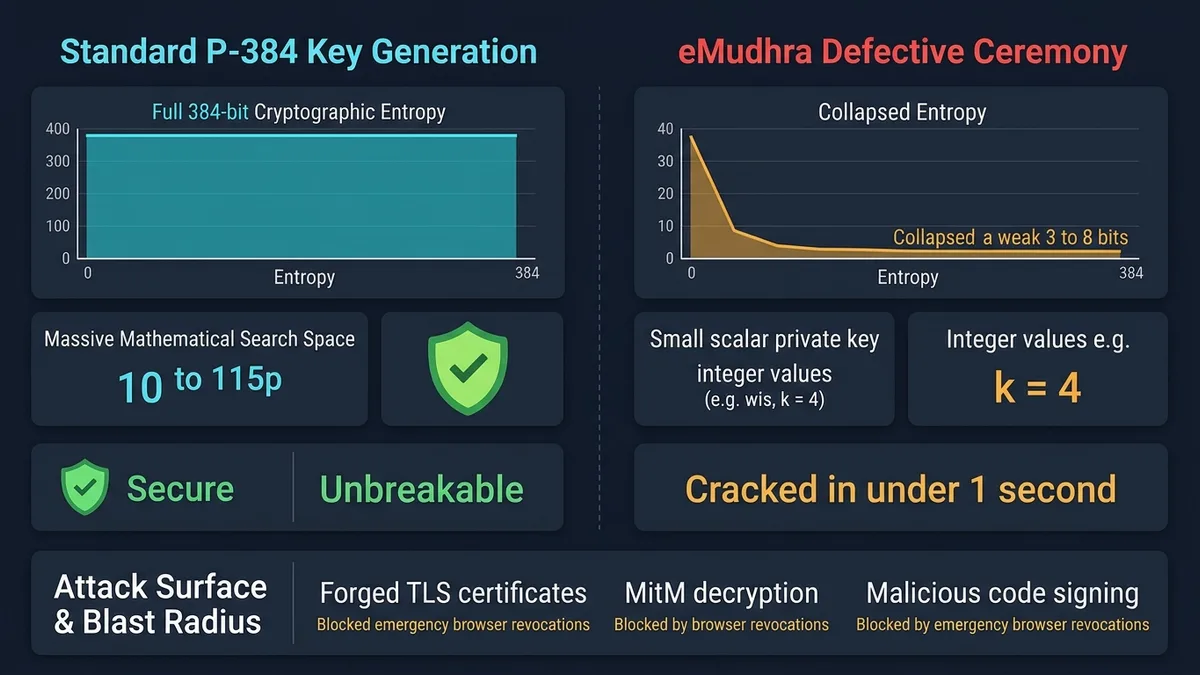 Figure 1: Comparison between standard P-384 cryptographic entropy and the defective eMudhra key ceremony.
One intermediate CA private key was literally the integer 4. Because elliptic curve public keys represent a point multiplication of the private scalar by the curve base generator point G, deriving the private scalar from the public point when the scalar is a single-digit integer requires trivial computational overhead.
Independent security researcher “Way” discovered the anomaly by analyzing public certificates logged in Certificate Transparency (CT) monitors. Using standard Python scripts on an entry-level consumer laptop, the researcher solved the discrete logarithm problem for the defective curve points and extracted the valid private keys in exactly 740 milliseconds.
Possession of these intermediate private keys created an immediate existential threat to internet security. An attacker holding an intermediate CA private key can generate mathematically valid, globally trusted TLS certificates for any domain name, including major banking portals, identity providers, and government services.
Because the parent emSign Root TLS CA G3 certificate was pre-installed in default trust stores across Microsoft Windows, Apple macOS, Google Android, and Linux distributions, client machines had no native mechanism to reject the fraudulent certificates. Threat actors with network access could execute transparent Man-in-the-Middle (MitM) traffic decryption without triggering browser certificate warnings.
Beyond TLS encryption, two of the compromised intermediate certificates were designated for software code-signing. Attackers could digitally sign malicious binary executables, allowing malware payloads to bypass Microsoft Defender SmartScreen, Gatekeeper checks, and enterprise endpoint detection policies.
Browser vendors and operating system maintainers initiated an emergency response. Google Chrome deployed an out-of-band CRLSet update, Mozilla pushed an immediate OneCRL blocklist revocation, and Apple updated its System Trust store to revoke trust in all eight intermediate certificates.
Are Indian Digital Signatures and eSign Services Affected by eMudhra?
The eMudhra vulnerability is strictly confined to eight international intermediate certificates used for web HTTPS encryption and software code signing under the commercial G3 root. Domestic Indian Digital Signature Certificates (DSC) and Aadhaar-based eSign services operate on a completely segregated PKI infrastructure governed by the Controller of Certifying Authorities (CCA) and remain secure.
When news of the eMudhra disclosure broke, enterprise organizations in India expressed immediate concern regarding the integrity of government filings, corporate tax portals, legal document signing, and banking authentication tokens. Because eMudhra is a prominent certifying authority in India, rumors circulated that citizen digital signatures were compromised.
India’s Ministry of Electronics and Information Technology (MeitY) and CERT-In issued public clarifications to dispel these misconceptions. The Indian domestic digital signature framework operates under the National Root Certificate Authority of India (NRCAI) managed by the CCA under the Information Technology Act.
The compromised certificates were created specifically for eMudhra’s global commercial expansion into international browser trust programs. The private key generation ceremony for those international TLS intermediates was executed independently from the air-gapped, audited key generation rituals used for Indian domestic CCA roots.
Organizations utilizing eMudhra USB cryptographic tokens for MCA21 filings, GST submissions, income tax verification, or internal document eSign workflows do not need to revoke or replace their user certificates. However, systems administrators must understand how to check eMudhra compromised certificates across corporate reverse proxies and load balancers to ensure legacy endpoints do not trust the revoked intermediate chain.
PHP2Shell (CVE-2026-109618 & CVE-2026-109619): Unauthenticated Pre-Execution RCE
While the cryptographic foundation of web traffic was compromised by eMudhra, the web application runtime layer suffered an equally devastating shock. Security research teams from Wiz Research, Calif, and contributors to the GitHub PHP Core Security Advisories Tracker jointly disclosed two critical vulnerabilities in the core PHP interpreter, christened PHP2Shell.
Tracked as CVE-2026-109618 and CVE-2026-109619 with an emergency CERT-In advisory (CIVN-2026-0510), the flaws carry a CVSS v4.0 severity rating of 9.2 (Critical). The vulnerability affects all PHP versions across a decade of releases, spanning PHP 5.4.0 through modern PHP 8.5.11 builds.
According to web technology surveys, PHP powers over 76.8% of all websites utilizing server-side programming languages, including content management systems like WordPress and Drupal alongside modern enterprise microservices running on Laravel and Symfony. The severity of PHP2Shell arises from where the exploit executes inside the request lifecycle.
Traditional web application vulnerabilities like SQL injection or cross-site scripting occur within application logic written by software developers. In contrast, CVE-2026-109618 triggers inside the low-level C codebase of the PHP engine itself during multipart POST body parsing, before any PHP application scripts or security middleware execute.
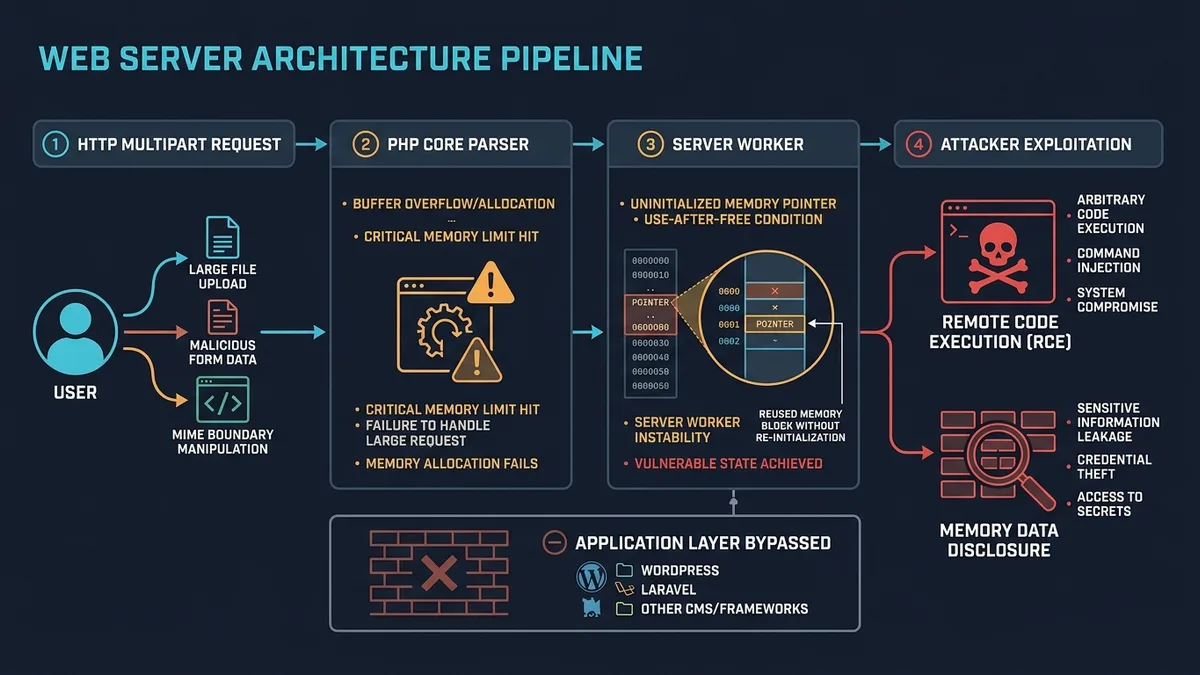 Figure 2: Execution pipeline of the PHP2Shell vulnerability bypassing application middleware to corrupt worker heap memory.
The primary flaw centers on PHP’s session upload progress feature (session.upload_progress.enabled = On), which is enabled by default in standard PHP installations. This creates a dangerous session upload progress use after free condition when an incoming HTTP payload is crafted so that the request exceeds PHP’s configured memory_limit during a specific allocation cycle.
When the memory limit (typically 128MB or 256MB) is exhausted, the PHP engine invokes zend_error() with an E_ERROR severity. To abort execution, the engine invokes the low-level C runtime function longjmp(). This creates a classic PHP out of memory longjmp RCE vulnerability.
This abrupt jump interrupts the upload progress tracking routines before memory pointers can be fully initialized. During subsequent memory pool teardown, the Zend Engine’s memory manager attempts to free uninitialized memory structures that contain attacker-controlled bytes supplied in the multipart request body.
This sequence produces a persistent heap corruption state. Because the memory manager retains stale pointers across requests handled by persistent worker pools (such as Apache mod_php and PHP-FPM), a secondary HTTP request can manipulate the heap layout to execute arbitrary shell code under the web server’s system user.
Beyond remote code execution, CVE-2026-109618 functions as a remote memory disclosure vulnerability. Attackers can trigger the out-of-memory cleanup without executing a shell payload, causing the PHP process to serialize and reflect uninitialized worker memory back in the HTTP response.
This memory leak functions similarly to the historic OpenSSL Heartbleed vulnerability. By inspecting the leaked memory buffer, remote attackers can harvest sensitive data residing in the worker process memory space, including database passwords, user session tokens, and cleartext environment variables containing third-party API keys.
A notable dimension of the disclosure was the method of discovery. Frontier artificial intelligence models aligning with OpenAI API Platform Production Security Standards and Google Gemini reasoning architectures were integrated into automated dynamic fuzzing pipelines to uncover and synthesize the multi-step heap corruption primitive. What historically required months of manual memory analysis was achieved by autonomous testing agents in days.
The official PHP Group Security Release Notes detail the emergency security updates. Organizations must deploy the official PHP 8.5.12 patch, or the corresponding 8.4.27, 8.3.36, and 8.2.35 maintenance updates to permanently close the exploit vector.
What to Do If You Are Running PHP in Production
Engineering teams operating PHP backends must treat the PHP2Shell vulnerability as an active operational emergency. Because the exploit triggers during core request parsing before application routers dispatch incoming traffic, firewalls inspecting application-level parameters cannot detect malicious payloads.
The first step is auditing every running interpreter instance across your infrastructure. Execute the following terminal commands to check your active PHP version and verify whether the upload progress module is currently active:
# Check the active PHP CLI version
php -v

# Inspect whether session upload progress is enabled in the active configuration
php -i | grep -i "session.upload_progress"
If your output reports session.upload_progress.enabled => On => On, your server is vulnerable to CVE-2026-109618 until patched or reconfigured. Teams running Debian or Ubuntu servers using the Ondřej Surý PPA repository should update their packages immediately:
# Update repository package metadata
sudo apt-get update

# Upgrade PHP packages across installed versions
sudo apt-get --only-upgrade install -y "php8.*" "php8.*-fpm" "php8.*-cli"

# Restart the PHP-FPM daemon to load patched binaries into worker memory
sudo systemctl restart php8.4-fpm
For teams running legacy PHP branches that have reached official End-of-Life, including PHP 7.4, 8.0, and 8.1, the PHP Group has not issued public security binaries. If your legacy application cannot be upgraded to PHP 8.2 or higher today, you must apply the configuration stopgap directly in your php.ini file:
; /etc/php/7.4/fpm/php.ini or /etc/php/8.1/fpm/php.ini
; Disable the vulnerable upload progress tracking mechanism
session.upload_progress.enabled = 0

; Force immediate cleanup of any orphaned session buffers
session.upload_progress.cleanup = 1
After updating php.ini, confirm the setting is applied by running php -r 'echo ini_get("session.upload_progress.enabled");'. If the command outputs 0 or an empty string, the attack surface for CVE-2026-109618 is effectively neutralized.
What to Do If You Are Running WordPress, WooCommerce, or Drupal
Content management systems represent the primary target for automated scanning scripts exploiting PHP2Shell. Because WordPress accepts incoming HTTP POST requests across public entry points such as wp-login.php, wp-admin/admin-ajax.php, and the WordPress REST API, an attacker can submit crafted multipart payloads without requiring an authenticated user account.
WordPress security plugins and nonce verification mechanisms cannot protect unpatched servers against this vulnerability. The PHP interpreter processes the malformed multipart body before WordPress core initializes or loads the active theme functions file.
If your website is hosted on a managed WordPress platform such as WP Engine, Kinsta, or Cloudways, the hosting provider manages the underlying PHP runtime. Contact your hosting support desk or check their status dashboard to verify that your container environment has received the upstream PHP maintenance patch.
If you self-host WordPress on an unmanaged virtual private server, cPanel droplet, or dedicated hardware, you must take manual responsibility for your runtime configuration. Log into your server via SSH, verify your PHP configuration file, and disable upload progress as described in the previous section.
If immediate server patching is delayed due to deployment freezes or staging requirements, you can deploy edge Web Application Firewall rules to block exploitation attempts. In Cloudflare or AWS WAF, create an edge firewall rule that blocks incoming HTTP POST requests containing the upload progress identifier:
# Cloudflare WAF Expression to block malicious upload progress triggers
(http.request.method eq "POST" and http.request.body.mime_type eq "multipart/form-data" and raw.http.request.body contains "PHP_SESSION_UPLOAD_PROGRESS")
For web servers running Nginx as a reverse proxy in front of PHP-FPM, you can neutralize the exploit at the proxy layer. Add the following inspection block inside your primary Nginx server configuration to drop suspicious multipart requests before they reach the FastCGI socket:
# Drop requests attempting to pass PHP upload progress tracking keys
if ($request_body ~* "PHP_SESSION_UPLOAD_PROGRESS") {
    return 403 "Blocked by security policy";
}
WooCommerce store owners should test payment gateway callbacks and file download checkout flows after applying configuration updates. Disabling session.upload_progress.enabled does not interfere with standard media uploads in the WordPress administration dashboard or WooCommerce product management.
The Railway.app Breach: Why Attackers Are Targeting PaaS Providers for AI Inference Keys
The third component of the October 21 security crisis struck cloud hosting platform Railway (railway.app). While eMudhra undermined cryptographic identity and PHP2Shell compromised runtime execution, Railway suffered a targeted breach of its customer secrets management infrastructure.
Railway published an urgent security disclosure notifying customers that anomalous activity was detected within the database systems responsible for storing project environment variables. An unauthorized third party gained unauthorized read access to the encrypted storage volumes and successfully decrypted the contents for a subset of hosted applications.
Environment variables represent the central repository of sensitive credentials in modern cloud-native architectures. Projects hosted on Railway frequently store database connection strings, AWS S3 secret keys, GitHub private access tokens, and API authentication credentials for third-party SaaS services.
In their official disclosure, Railway noted that the intrusion appeared to be part of a coordinated PaaS AI inference provider attack campaign. The primary objective of the threat actors was not to harvest payment card details or launch ransomware, but to exfiltrate artificial intelligence inference API keys.
The rise of generative artificial intelligence applications has fundamentally altered the economics of credential theft. High-tier API keys for frontier language models, including OpenAI GPT models, Anthropic Claude engines, and Google Gemini endpoints, command between $15 and $50 per verified account on illicit developer forums.
Evolution of Exfiltrated Secret Value:
Early Cloud Era: Credit Card Databases & Personal Identifiable Information (PII)
Container Era: AWS Root Keys & Cloud Compute Instances (Crypto-mining)
Autonomous AI Era: Frontier AI Inference API Keys (OpenAI, Anthropic, Gemini Tokens)
Stolen inference credentials allow malicious operators to bypass model safety filters, run unauthorized model fine-tuning jobs, extract proprietary embedding indices, and execute massive inference requests without incurring computational costs. In enterprise environments, compromised tier-5 API keys have resulted in over $10,000 in unauthorized token inference within 48 hours.
Developers building autonomous systems frequently configure their projects with elevated credentials. When integrating external capabilities, engineers often supply API keys with unrestricted administrative scopes rather than adhering to the principle of least privilege. In our analysis of agent skills security, we documented how unvetted extensions and Railway leaked API keys allow malicious actors to pivot from local assistants into corporate infrastructure.
Railway responded by immediately pausing all platform builds and container deployments globally while isolating the compromised database tier. The engineering team performed mass automated revocations for platform-managed credentials, invalidating AWS S3 access keys and severing GitHub OAuth application integrations.
However, platform-level revocations cannot reset third-party API keys generated by individual users. Railway advised all engineering teams to immediately rotate every environment variable stored on the platform, audit service logs for anomalous traffic spikes, and review version control repositories for signs of persistence.
The Triad of Infrastructure Failure: Comparison and Impact Matrix
Evaluating the October 21 incidents side-by-side demonstrates how distinct security failures compound to compromise an entire application lifecycle. The following matrix compares the attack vectors, impact scopes, and remediation pathways across all three events.
| Incident & Target | Root Failure Mechanism | Severity / CVSS | Exposed Assets | Immediate Mitigation | Permanent Architectural Solution |
|---|---|---|---|---|---|
| eMudhra CA (CVE-2026-111943) | Script error during key wrapping ceremony collapsed P-384 entropy to 3-8 bits (key = 4). | Critical (CAs revoked) | Global HTTPS traffic, software code-signing integrity, MitM defense. | Update operating system and Java CA trust stores (update-ca-certificates). |
Enforce automated Certificate Transparency monitoring and mandatory post-ceremony key entropy audits. |
| PHP2Shell (CVE-2026-109618) | longjmp() abort during OOM multipart upload progress causes heap Use-After-Free. |
9.2 Critical (CVSS v4.0) | Web server runtime process, system memory buffers, database credentials. | Upgrade to PHP 8.5.12+, or set session.upload_progress.enabled = 0. |
Migrate legacy monolithic runtimes to memory-safe micro-isolates and enforce strict worker recycling. |
| Railway.app Exfiltration | Unauthorized access to backend data stores containing encrypted environment variables. | High (Targeted breach) | Customer API keys, OpenAI / Anthropic inference tokens, production DBs. | Revoke and rotate all environment variables; inspect model usage logs. | Replace static environment variables with short-lived OpenID Connect (OIDC) identity tokens. |
| PingCAP TiDB Incident | Stolen service account credentials allowed exfiltration of operational metadata. | Medium / High | 10.6 TB control-plane telemetry, cluster metadata, SQL editor logs. | Rotate TiDB Cloud API tokens and audit cross-project IAM permissions. | Implement continuous service account credential rotation and zero-standing-privilege access policies. |
When analyzing the matrix, notice how an attacker could combine these vulnerabilities into a devastating exploit chain. An adversary possessing an eMudhra TLS intermediate key could intercept traffic between a client and a vulnerable PHP web application.
The attacker could then deploy a PHP2Shell exploit payload to achieve remote code execution on the backend server. Once inside the application container, the attacker could extract environment variables hosted on Railway, capturing OpenAI API keys to drain inference budgets or exfiltrate sensitive corporate prompts.
Organizations comparing inference model capabilities and pricing structures should review our benchmark of OpenAI vs Anthropic vs Google API to understand rate limiting, token pricing, and access controls across major providers. Understanding provider security models is crucial when managing enterprise API budgets.
Emergency Remediation Runbook for Engineering Teams
Securing production environments following the October 21 disclosures requires a structured, multi-tier response. The following technical runbook outlines concrete commands and configuration updates required to protect your systems.
Step 1: Audit and Refresh System CA Trust Stores
To ensure your servers reject fraudulent certificates signed by the compromised eMudhra intermediate CAs, update your operating system certificate bundles. Web browsers like Chrome and Firefox update their revocation lists automatically, but backend servers, Docker containers, and API microservices rely on operating system trust stores.
On Debian, Ubuntu, and containerized Linux environments, refresh your certificate authority certificates using the following commands:
# Update local package repositories and install the latest ca-certificates package
sudo apt-get update && sudo apt-get install --only-upgrade -y ca-certificates

# Force a clean regeneration of the system SSL trust store
sudo update-ca-certificates --fresh

# Verify that the compromised eMudhra G3 intermediate certificates are excluded
openssl certhash /etc/ssl/certs | grep -i "emSign" || echo "System certificate trust store clean"
For applications running in Alpine Linux Docker images, ensure your base image pulls the latest certificate package during build:
# Ensure Alpine containers do not inherit outdated trust stores
FROM alpine:latest
RUN apk update && apk add --no-cache ca-certificates && update-ca-certificates
Java enterprise applications running on Tomcat or Spring Boot maintain an independent trust store (cacerts). Verify your Java runtime is upgraded to the latest minor version (which incorporates the vendor blacklists) or manually inspect the keystore using keytool.
Step 2: Apply the PHP2Shell Emergency Patch and Hardening Config
The definitive resolution for CVE-2026-109618 and CVE-2026-109619 is upgrading your PHP binary to the latest security releases: PHP 8.5.12, 8.4.27, 8.3.36, or 8.2.35.
If your operational procedures require several days to test and deploy language interpreter upgrades, apply the following immediate configuration stopgap in your php.ini file to disable the vulnerable upload progress parser:
; /etc/php/8.x/fpm/php.ini or /etc/php/8.x/cli/php.ini
; Immediate mitigation for CVE-2026-109618 (Upload-Progress Use-After-Free)
session.upload_progress.enabled = 0
session.upload_progress.cleanup = 1

; Optional: Disable fatal error backtrace generation in PHP 8.5.x
fatal_error_backtraces = 0
Next, configure your PHP-FPM process manager pool to terminate and recycle worker processes frequently. This prevents an attacker from exploiting stale memory references left behind by aborted requests:
; /etc/php/8.x/fpm/pool.d/www.conf
; Recycle worker processes after 100 requests to clear corrupted heap state
pm.max_requests = 100

; Enforce strict memory limits to trigger predictable aborts
memory_limit = 256M
After modifying the configuration files, reload your PHP-FPM service to activate the new settings:
sudo systemctl reload php8.4-fpmStep 3: Rotate Railway Environment Variables and AI Model Credentials
If your team maintains applications hosted on Railway, assume that all environment variables stored prior to October 21 may have been accessed. Execute the following credential rotation checklist:
- Rotate Frontier AI Provider Keys: Navigate to your OpenAI, Anthropic Console, and Google AI Studio dashboards. Delete your existing active secret keys and generate fresh keys with scoped project permissions.
- Rotate Database Connection URIs: Change the administrative and application passwords for all hosted PostgreSQL, MySQL, and Redis instances.
- Update Railway Project Variables: Use the Railway CLI or web dashboard to update the variables in production environments:
# Authenticate to the Railway CLI
railway login

# Update the production environment variable with the new secret key
railway variables --set OPENAI_API_KEY="sk-live-new-scoped-token-sample" \
                  --set ANTHROPIC_API_KEY="sk-ant-api03-new-token-sample"

# Trigger a clean deployment using the updated variables
railway up --detach- Audit Token Consumption: Review your AI provider billing dashboards for unusual token consumption patterns between October 10 and October 21. If unexpected inference spikes occur, export request logs and file an incident ticket with the provider’s security desk.
Engineers structuring complex prompts or multi-agent workflows should consult our context engineering guide to learn how isolating model context windows reduces the blast radius of compromised tokens.
Modernizing Cloud Security: Beyond Static Secrets and Implicit Trust
The events of October 21 provide a crucial lesson for systems architects: the operational practices of the past decade are inadequate for the demands of modern cloud computing. Relying on static long-lived credentials stored in plain text environment variables creates systemic vulnerability.
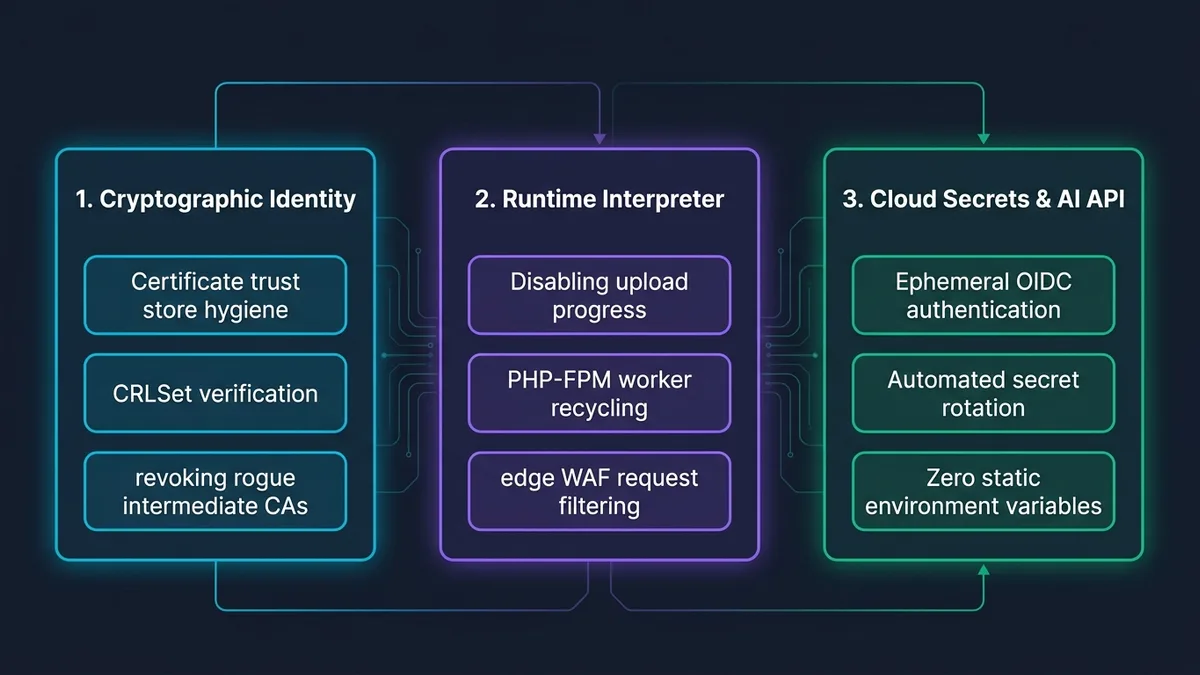 Figure 3: Multi-tier architectural defense model uniting certificate store hygiene, runtime hardening, and ephemeral secret federation.
Engineering teams must accelerate their transition toward short-lived identity federation. Using OpenID Connect (OIDC) workflows, application containers authenticate with cloud platforms by exchanging cryptographic identity claims for ephemeral tokens that expire in minutes. If an unauthorized party accesses an environment variable store containing OIDC configurations, they obtain an empty identity descriptor rather than a valid API key.
Simultaneously, the eMudhra failure highlights the need for continuous trust store monitoring. Organizations should implement automated tools that audit server root certificates against Certificate Transparency logs, alerting administrators whenever an intermediate CA in their trust chain is placed under regulatory scrutiny.
Security is not a static state achieved after running an automated scanner. It is a continuous operational discipline that requires skepticism toward upstream dependencies, rigorous separation of privileges, and rapid incident response capabilities when foundational platforms fail.
Frequently Asked Questions About the October 21 Incidents
Is my Indian digital signature certificate (DSC) or eSign compromised by the eMudhra vulnerability?
Domestic Indian digital signature certificates (DSC) and Aadhaar eSign services operate under a separate PKI hierarchy regulated by India’s Controller of Certifying Authorities and are completely isolated from the compromised international G3 TLS root. The vulnerability is strictly confined to eight international intermediate certificates used for web HTTPS encryption and software code-signing.
Why did major web browsers trust an eMudhra intermediate certificate with a private key equal to 4?
Browsers rely on Certificate Authority root programs that validate public mathematical proofs rather than testing private key entropy at signing time. Once the parent emSign Root TLS CA G3 signed the defective intermediate public keys, standard X.509 verification chains considered them globally authentic until browser vendors manually pushed revocation lists.
Does PHP2Shell (CVE-2026-109618) affect WordPress and Laravel installations?
Because the vulnerability triggers inside PHP’s multipart POST parser and session upload-progress handler before application code executes, every framework running on vulnerable PHP runtimes is exposed. Upgrading to patched releases (PHP 8.5.12, 8.4.27, 8.3.36, or 8.2.35) or setting session.upload_progress.enabled = 0 in php.ini is required regardless of your CMS or framework.
What immediate actions should engineering teams take if their OpenAI API keys were stored on Railway?
Teams must immediately revoke the existing API keys in their OpenAI dashboard, generate fresh restricted-permission keys, and update their Railway environment variables. Additionally, review OpenAI usage dashboards and Railway service logs for unexpected token consumption spikes or unauthorized inference calls.