AI for HR: Recruiting, Onboarding, Training, and Retention (2026 Guide)
The complete 2026 guide to AI for HR — recruiting, onboarding, training, retention, workforce planning, payroll compliance, and agentic AI. Compare top HR AI tools and build a practical implementation roadmap.
The numbers tell a striking story: 93% of Fortune 500 CHROs have already started integrating AI tools into their operations — yet only 8% of HR leaders believe their managers have the skills to use those tools effectively, according to Gartner’s 2025 research. That gap between investment and readiness is now shaping everything in HR.
Most organizations aren’t facing a shortage of AI tools for their HR functions. What they’re missing is a clear picture of which applications deliver real results, how to sequence implementation without disrupting core operations, and how to manage the very real risks — from algorithmic bias to data privacy exposure. Exploring AI tools for teams of all sizes often reveals just how fragmented the vendor landscape looks when you’re starting from scratch.
This guide covers AI for HR across the full employee lifecycle — recruiting, onboarding, training, retention, workforce planning, compliance, and the emerging frontier of agentic AI. The goal isn’t to catalog every vendor — it’s to give HR professionals a sharper understanding of what’s actually working in 2026 and how to build around it.
📊 AI in HR: Key Numbers at a Glance (2026)
| Metric | Data Point |
|---|---|
| Fortune 500 CHROs integrating AI | 93% |
| HR professionals adopting AI in 2025 | 72% (up from 58% in 2024) |
| Companies using AI for candidate screening | 88% |
| Time-to-hire reduction with AI video interviewing | 50–70% |
| New hire retention improvement with AI onboarding | 82% |
| Cost savings per new hire with AI onboarding | $18,000+ |
| Predictive accuracy for employee flight risk | 87% |
| Payroll error reduction with AI | 69% |
| Employees who receive sufficient AI training | 12% (EY, 2025) |
| L&D teams planning to adopt AI within 2 years | 32% |
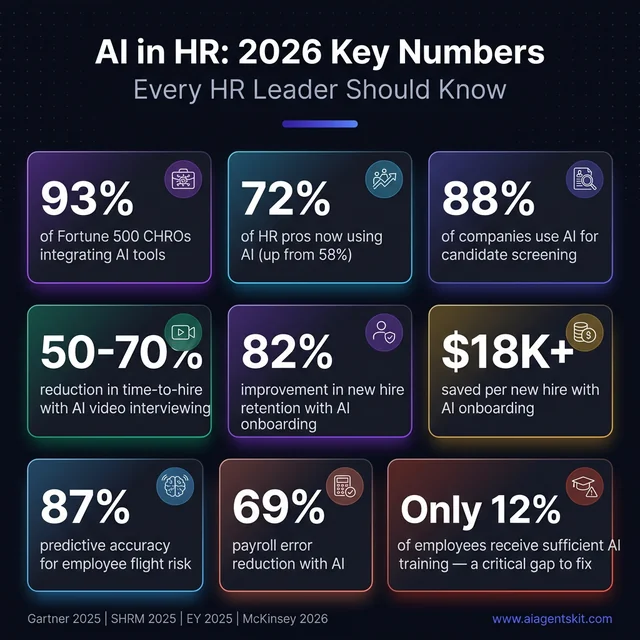
Key AI in HR statistics for 2026 — from talent acquisition adoption rates to payroll accuracy gains
What Is AI in HR and How Does It Actually Work?
AI in HR refers to intelligent software systems that analyze patterns in data, make predictions, and automate complex tasks that previously required human judgment. The term covers everything from a chatbot scheduling interviews to a predictive analytics engine forecasting which employees are most likely to resign in the next ninety days.
The critical distinction from traditional HR software: traditional systems execute rules that humans configure. AI systems learn from data and surface insights or take actions that humans may not have anticipated. An applicant tracking system filters resumes based on keywords an admin specified. An AI-powered talent intelligence platform analyzes which skills and career trajectories correlate with long-term success at that specific organization — and surfaces candidates who match those patterns, even when they lack the expected job titles or keywords.
Four capabilities define what AI brings to HR that didn’t exist before:
- Prediction — Which candidate is likely to succeed in this role? Which employee is at risk of leaving in the next quarter?
- Personalization — What development path fits this specific employee’s goals, skill gaps, and learning style?
- Pattern recognition — What do high performers have in common? What signals precede burnout or disengagement?
- Unstructured data processing — Analyzing video interview responses, sentiment in open-ended survey answers, and natural language inputs that traditional databases can’t parse
According to Gartner’s 2025 HR research, only 8% of HR leaders believe their managers possess the necessary skills to effectively use AI, and just 14% of organizations provide managers with structured support for integrating generative AI into daily workflows. That manager readiness gap — not tool availability — is the primary constraint on AI ROI in HR today.
What surprises many CHROs is that the resistance to scaling AI isn’t usually coming from front-line employees, who often welcome tools that streamline administrative friction. The resistance tends to cluster in the middle management layer, where comfort with data-informed decision-making varies widely and where the guidance on how to act on AI recommendations is nearly absent.
AI for Recruiting: 5 Ways Hiring Is Changing in 2026
Recruiting is where most HR organizations first encounter AI at scale — and for good reason. The function is data-rich, process-heavy, and has clear metrics: time-to-hire, cost-per-hire, offer acceptance rates, quality-of-hire. According to SHRM’s 2025 research on AI in HR, 72% of HR professionals are now adopting AI in their work, up from 58% in 2024, with talent acquisition leading adoption across functions.
AI-Powered Resume Screening and Candidate Matching
The era of keyword-matching ATS filters is giving way to contextual candidate evaluation. Modern AI screening systems understand that “led cross-functional project teams” and “project manager” describe overlapping capabilities. They identify transferable skills across industries, flag candidates whose career trajectories mirror previous successful hires, and surface talent that rigid keyword filters would miss.
Research compiled by recruiting technology analysts indicates that 88% of companies now employ some form of AI for initial candidate screening. The shift isn’t just about speed — it’s also changing who gets through. Skills-based hiring powered by AI can expand candidate talent pools by 3 to 5 times and increase workforce diversity by 16%, by deprioritizing credentials in favor of demonstrated capability.
The teams achieving the strongest results aren’t using AI to eliminate human involvement from screening — they’re using it to ensure human attention goes to the candidates most worth evaluating.
AI Chatbots for Candidate Engagement and Scheduling
Candidates increasingly expect near-instant responses when they apply. An unanswered application that sits for five days is an opportunity cost, particularly for in-demand roles. AI chatbots like Paradox’s Olivia handle initial candidate questions, schedule interviews, send reminders, and conduct preliminary screening conversations — around the clock, seven days a week.
In 2026, 79% of hiring managers report their organizations use AI somewhere in the hiring process, with candidate communication and scheduling automation among the most widely deployed applications. At high-volume employers in retail, healthcare, and logistics, conversational AI has compressed what used to be a multi-day back-and-forth into a fifteen-minute candidate interaction.
The most effective deployments use AI prompts for HR workflows trained on the organization’s specific hiring context — not generic chatbot templates that frustrate candidates with irrelevant questions.
AI Video Interviewing and Skills Assessments
AI-powered video interviewing has matured considerably since early systems faced criticism for analyzing facial expressions and vocal patterns. Modern platforms focus almost entirely on what candidates say — using natural language processing to evaluate competencies, communication clarity, and role-specific knowledge — rather than non-verbal cues.
HireVue’s 2026 platform data indicates these tools can reduce time-to-hire by 50 to 70% while maintaining or improving quality-of-hire metrics. Skills-based simulations that put candidates in realistic work scenarios are gaining adoption particularly quickly, since they evaluate actual decision-making rather than self-reported experience.
Top AI Recruiting Platforms in 2026:
| Tool | Best For | Key Feature |
|---|---|---|
| Eightfold AI | Talent intelligence, internal mobility | Deep skills matching across 1B+ career data points |
| Paradox (Olivia) | High-volume hiring, hourly roles | Conversational AI for 24/7 candidate engagement |
| HireVue | Structured enterprise hiring | AI-assisted video + skills assessments |
| Phenom | End-to-end talent experience | AI for both candidate and employee journeys |
| Workday Recruiting | Organizations on Workday HCM | Unified compliance + AI within single platform |
| SeekOut | Technical + diversity sourcing | AI-powered talent graph with diversity filters |
| Findem | Attribute-based talent sourcing | 3D people data for precise candidate targeting |
When evaluating platforms, integration capability matters more than feature depth. AI that can’t access performance data can’t learn which hire attributes correlate with long-term success.
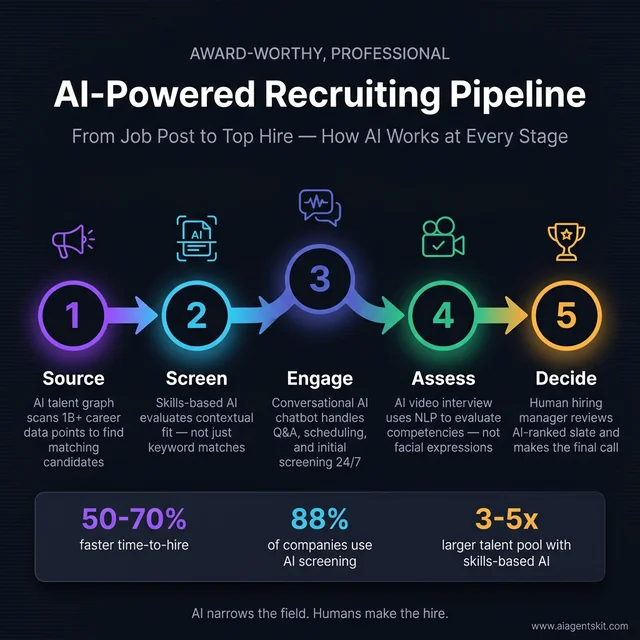
The 5-stage AI recruiting pipeline — how modern HR teams move from job post to top hire with AI at every step
AI for Employee Onboarding: Faster Starts, Better Retention
Recruiting a great candidate is only the first challenge. What happens in the first ninety days determines whether that investment pays off. AI is fundamentally reshaping employee onboarding — moving it from a paperwork exercise into a personalized, data-driven experience that measurably improves retention and time-to-productivity.
The business case is compelling: companies using AI-powered onboarding report an 82% improvement in new hire retention and save more than $18,000 per new hire in reduced administrative burden and turnover-related costs, according to research aggregated across multiple HR technology studies. AI-assisted onboarding processes complete 53% faster than traditional approaches, and new hires reach full productivity 40 to 50% sooner.
How AI Personalizes the New Hire Experience From Day One
Traditional onboarding suffers from a fundamental problem: every new hire gets the same experience regardless of their role, experience level, location, or learning style. An experienced engineer joining a software company doesn’t need the same day-one materials as a first-time manager in a retail environment — but most onboarding programs treat them identically.
AI onboarding platforms address this by building individualized journeys from the moment an offer is accepted. The system analyzes the new hire’s role requirements, prior experience, department, location, and sometimes even their responses to a brief pre-boarding assessment, then generates a tailored path: which compliance modules come first, which product training is relevant, which team members they should meet in week one, and what milestones signal successful integration by day thirty, sixty, and ninety.
Platforms like BambooHR use AI for smart task assignment and predictive analytics on new hire engagement. Enboarder specializes in experience-driven onboarding with AI personalization across the full preboarding-to-productivity journey. Rippling automates cross-functional workflows spanning HR, IT, and payroll simultaneously — so equipment is provisioned, accounts are created, and compliance documents are completed before day one, all triggered by a single hire event.
AI Onboarding Compliance Automation: What Gets Automated and What Doesn’t
Compliance onboarding — I-9 verification, benefits enrollment, state-specific training modules, policy acknowledgements — is where AI delivers the fastest and clearest ROI. These tasks are high-volume, rule-based, error-prone when done manually, and carry significant legal exposure when done incorrectly.
AI-powered compliance onboarding tools track which documents have been collected, flag missing items before deadlines, automatically trigger reminders to new hires and their managers, and generate audit trails that satisfy GDPR, CCPA, and EEOC documentation requirements. For organizations managing multi-state or global onboarding, AI compliance monitoring is especially valuable — the system tracks jurisdiction-specific requirements and adjusts onboarding checklists automatically when regulations change.
What doesn’t get fully automated: the cultural integration. The team relationships, the informal knowledge transfers, the sense of belonging that determines whether a new hire feels genuinely welcomed or merely processed. The organizations seeing the best retention outcomes from AI onboarding are deliberate about using automation to clear the administrative path so that managers have more time for meaningful human connection in those critical first weeks — not less.
AI-powered onboarding chatbots like those built into Leena.ai or Workday’s conversational interface handle the 24/7 question load that overwhelms HR teams in new hire cohorts — benefits questions, equipment status, policy clarifications — freeing HR staff to focus on the interactions that actually require human judgment.
How AI Is Transforming Employee Training and Development
Once new hires are onboarded, the question becomes how to develop them. AI is fundamentally changing the answer by replacing standardized, one-size-fits-all training programs with adaptive, data-driven learning experiences.
Personalized Learning Paths Powered by AI
Traditional corporate training shares one chronic problem: it treats every learner identically. New hires sit through onboarding modules covering skills they already have. Experienced employees sit through annual compliance training that has no connection to their actual development gaps. The result is expensive, inefficient, and often counterproductive.
AI learning platforms analyze each employee’s current skill levels, role requirements, career goals, and past learning patterns to build individualized paths. When an employee struggles with a concept, the AI surfaces additional resources. When they demonstrate mastery, they progress faster. Research consistently shows that AI-tailored learning paths produce significant improvements in both engagement and knowledge retention compared to static programs — with some studies reporting learning efficiency gains of 50%+ within the first training cohort.
The teams benefiting most are those that connect learning data to performance data. When the system can see whether training intervention X improved metric Y, it gets smarter about future recommendations.
Generative AI for L&D Content Creation
The throughput constraint on most L&D teams isn’t creativity or expertise — it’s time. Developing a single e-learning module used to take four to six weeks of instructional design effort. Generative AI is compressing that timeline dramatically, now handling the first-draft generation of training scripts, role-play scenarios, knowledge check questions, and even localized versions for global teams.
AIHR’s analysis of AI adoption in HR identifies L&D as one of the leading functions in AI implementation, noting that 34% of companies have already implemented AI in training programs with another 32% planning to do so within two years. The organizations moving fastest aren’t replacing instructional designers — they’re repositioning them. AI handles content generation and iteration; humans handle strategy, quality review, and the high-touch facilitation work that requires expertise.
Platforms worth evaluating include Docebo for AI-powered LMS personalization, 360Learning for collaborative AI-assisted content creation, and Degreed for upskilling with AI-powered skill assessments. The AI productivity tools that save hours used by L&D teams routinely include generative writing tools that accelerate content development by 60% or more.
What Does AI Do for Employee Retention and Engagement?
Recruiting and training are expensive. Losing an employee six to eighteen months after investing in them is more expensive still. AI is increasingly central to identifying retention risk early — when intervention is still possible — and building the continuous engagement practices that reduce that risk in the first place.
Predictive Turnover Analytics: Seeing Who Might Leave
The most valuable thing about AI-powered retention tools isn’t their ability to predict turnover — it’s how early they can predict it. By the time an employee gives notice, they’ve typically begun mentally leaving weeks or months earlier. AI systems analyzing multiple data streams can identify that shift long before the resignation letter arrives.
People analytics research consistently demonstrates that AI-driven predictive models can identify flight risk employees with accuracy rates reaching 87% when trained on comprehensive organizational data. The signals the system monitors span multiple dimensions:
- Engagement survey trend lines — declining scores or participation rates
- Career progression patterns — time since last promotion or meaningful role change
- Communication and collaboration changes — reduced interaction with peers or managers
- External market factors — demand for an employee’s specific skills outside the organization
- Manager relationship indicators — patterns that historically precede departures in similar roles
The goal isn’t to surveil employees — it’s to enable proactive conversations before disengagement becomes irrecoverable. McKinsey’s research on AI in people operations notes that only 7% of organizations currently provide managers with guidance on how to act on AI-generated workforce insights — which is the gap where most retention AI value evaporates.
Connecting AI agent use cases across business functions reveals a consistent pattern: HR AI tools work best when they feed into human judgment, not around it. The manager who receives an AI-generated flag and knows how to act on it is orders of magnitude more valuable than a system that generates accurate predictions that no one acts on.
AI-Driven Continuous Performance Management
The annual performance review is losing ground — not because organizations have given up on performance management, but because AI makes more frequent, more accurate feedback possible. Continuous performance management platforms powered by AI offer real-time prompts, data-driven calibration support, and bias detection built into the evaluation process.
What’s particularly notable: HR Grapevine’s 2025 research found that 87% of employees believe AI can offer fairer evaluations than human managers — a finding that reflects years of accumulated frustration with inconsistent, relationship-dependent performance processes. AI doesn’t play favorites. It surfaces the same calibration questions regardless of who the manager likes.
Leading platforms include Visier for predictive workforce analytics, Lattice for performance plus engagement in one system, CultureAmp for AI sentiment analysis, and Betterworks for OKR tracking with AI feedback prompts.
AI HR Chatbots and Employee Self-Service: What Modern EX Looks Like
The employee experience (EX) layer of HR is where generative AI is moving fastest — and where the distance between 2022 chatbots and 2026 AI assistants is most dramatic. Early HR chatbots were essentially interactive FAQs: useful for scripted queries, frustrating for anything nuanced. Generative AI HR assistants understand context, maintain conversation history, handle follow-up questions naturally, and crucially, can now take action rather than just surfacing information.
The operational impact is significant. Organizations deploying modern AI HR assistants report savings of 15 to 20 hours per week in HR team administrative time, with reductions in HR contact volume of 30 to 40% for routine inquiries. The categories of questions that consume the most HR time — benefits eligibility, leave policy, payroll questions, IT access requests — are precisely the queries that generative AI handles most effectively.
Six HR Workflows Generative AI Chatbots Handle End-to-End
The most mature deployments in 2026 go well beyond answering questions. Generative AI HR assistants now handle complete workflows:
- Benefits enrollment guidance — walking employees through plan options, eligibility windows, dependent coverage, and HSA/FSA elections conversationally rather than through static PDF guides
- Leave request processing — explaining policies, calculating entitlement, submitting requests to the HRIS, and notifying managers without HR involvement
- Policy clarification — interpreting expense policies, travel guidelines, code of conduct questions, and remote work eligibility instantly and consistently across all geographies
- Onboarding Q&A for new hires — answering the hundreds of questions that overwhelm HR teams during new hire cohort weeks
- Performance check-in prompts — proactively prompting managers and employees to complete regular feedback exchanges, summarizing team sentiment trends
- Offboarding initiation — triggering equipment return workflows, exit interview scheduling, benefits continuation notices, and knowledge transfer checklists
Platforms leading this space include MoveWorks (enterprise IT and HR service delivery), Kore.ai (conversational AI for HR workflows), Leena.ai (agentic HR chatbot with compliance automation), and ServiceNow HR Service Delivery. All integrate with major HRIS platforms including Workday, SAP SuccessFactors, and ADP.
When AI Self-Service Works — and When Humans Need to Step In
The boundary that separates effective AI self-service from frustrating dead ends is consequentiality. AI handles well: information retrieval, process initiation, status checks, and routine transactions where errors are easily corrected. Humans need to stay involved in: performance disputes, harassment investigations, accommodation requests, termination-adjacent conversations, and any situation where an employee is clearly distressed or seeking genuine empathy, not information.
The organizations getting this right have designed explicit escalation paths — the conversation never dead-ends. When the AI recognizes a query that requires human judgment or emotional support, it routes immediately to an available HR professional with a summary of the conversation context. This keeps the efficiency benefits while avoiding the most damaging version of AI self-service: an employee in genuine distress who can’t reach a real person.
Multi-channel deployment matters too. The most effective HR AI assistants are available where employees already work — Microsoft Teams, Slack, mobile apps, and email — rather than requiring employees to navigate to a separate HR portal.
AI for Workforce Planning: Connecting Talent to Business Strategy
Traditional workforce planning ran on spreadsheets, annual cycles, and educated guesses about future headcount. AI is transforming it into a continuous, data-driven capability that connects HR directly to business strategy — enabling organizations to anticipate skill gaps before they create operational problems, model scenarios for different business outcomes, and make internal mobility decisions based on actual capability data rather than tenure and relationships.
The workforce analytics market reflects this shift: it’s projected to grow from $2.37 billion in 2025 to $7.12 billion by 2034, according to research compiled by workforce analytics analysts. The growth isn’t driven by new data — organizations have always had workforce data. It’s driven by AI’s ability to make that data actionable at a speed and granularity that human analysts cannot match.
Skills-Based Workforce Planning: What AI Makes Possible
The shift from job-based to skills-based workforce planning is one of the most significant structural changes in how organizations think about talent. Traditional planning asks: how many people do we have in each job code? AI-powered skills-based planning asks: what capabilities does the organization actually have, where are the gaps relative to the strategy, and what’s the fastest path to closing them — through hiring, redeployment, or development?
AI platforms that support skills-based planning — including Eightfold AI’s talent intelligence modules, Phenom’s workforce intelligence, and SAP SuccessFactors’ Skills Graph — maintain a continuously updated inventory of employee capabilities drawn from multiple signals: job history, completed training, project contributions, peer feedback, and external credentials. When a business unit leader identifies a new strategic initiative, the system can immediately surface which internal employees have relevant adjacent skills, what development investment would be needed to close the gap, and what the acquisition cost would be if internal development isn’t faster.
Internal mobility is one of the clearest ROI stories in AI workforce planning. McKinsey research consistently shows that employees who make internal moves are significantly more likely to stay with the organization — and AI makes those moves more transparent and meritocratic by surfacing opportunities based on capability match rather than manager visibility.
Scenario Modeling With AI: Planning for Multiple Futures
The most strategically valuable application of AI in workforce planning is scenario modeling — the ability to run parallel analyses of different business trajectories and understand the talent implications of each. What does the workforce need to look like if the company grows revenue by 30%? What happens to the skill profile if the primary growth vector shifts from product development to sales expansion? What is the attrition risk in the engineering organization if a competitor launches in the same geography?
Tools like Orgvue, Anaplan People Planning, Visier Workforce Analytics, and ChartHop bring predictive modeling into HR planning that previously required weeks of manual analysis. HR leaders can now run these scenarios in real time during business planning conversations — shifting from “we’ll come back with the numbers” to “here’s the workforce impact of each option you’re considering.”
The organizations that use AI workforce planning most effectively position their people analytics function as a business partner to finance and strategy — not an HR internal service. When workforce data informs capital allocation decisions, headcount planning stops being a budgeting exercise and becomes a strategic capability.
Agentic AI in HR: Beyond Chatbots to Autonomous Workflows
Most HR AI deployments in 2023 and 2024 were reactive: the AI responded when asked, generated content when prompted, surfaced insights when queried. Agentic AI represents a fundamentally different model — AI systems that can independently initiate multi-step workflows, make decisions within defined boundaries, and take action across multiple HR systems without waiting for a human to move each step forward.
The distinction matters in practice. A generative AI chatbot answers the question “What’s the onboarding checklist for a new engineer in Germany?” An agentic AI system executes that checklist — creating the HRIS record, initiating the IT equipment request, enrolling the employee in the required compliance training for their jurisdiction, scheduling orientation sessions, notifying the manager of each milestone, and flagging exceptions that require human approval, all autonomously from the moment the hire event is recorded.
What Agentic AI Does That Chatbots Cannot
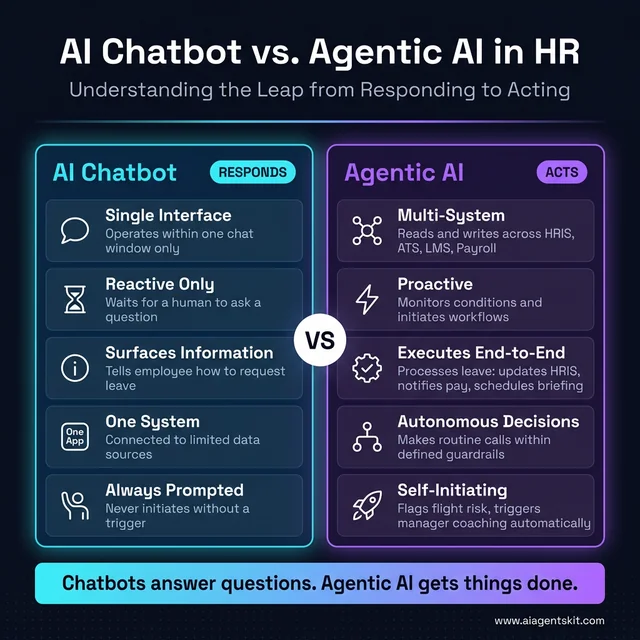
AI chatbots respond to questions; agentic AI executes complete workflows across every system in your HR tech stack
Agentic AI is distinguished by three capabilities that chatbots lack:
Multi-system orchestration. Chatbots operate within one interface. Agentic AI operates across your entire HR tech stack — reading from and writing to your HRIS, ATS, LMS, payroll system, and IT provisioning tools simultaneously. An agentic onboarding workflow doesn’t just tell someone what to do; it does it across every relevant system.
Autonomous decision-making within guardrails. Agentic AI can make routine decisions based on defined rules without waiting for human approval. If a new hire’s compliance training isn’t completed within five business days of their start date, the system can automatically escalate, reschedule, and notify the manager — without an HR team member manually monitoring every new hire’s checklist.
Proactive initiation. Rather than waiting to be asked, agentic AI monitors conditions and initiates actions when those conditions are met. When a flight risk score crosses a defined threshold, the agent schedules a stay interview. When an employee’s skills profile indicates readiness for a specific role, the agent surfaces the opportunity. When a payroll anomaly is detected, the agent flags it for review before the payroll run closes.
Five Agentic AI Workflows Already Running in HR Departments
The most mature agentic AI deployments in 2026 are handling these workflows with minimal human touchpoints:
- End-to-end offer-to-onboard pipeline — From offer acceptance to day-one readiness, spanning background check initiation, document collection, system provisioning, and equipment ordering across departments
- Multi-country onboarding orchestration — Managing jurisdiction-specific compliance requirements, translated materials, and local HR notifications for global hires without per-country manual coordination
- Payroll validation and exception handling — Running pre-payroll anomaly detection, flagging irregularities, requesting approvals for exceptions, and logging audit trails before final payroll submission
- Proactive retention intervention — Monitoring flight risk signals and initiating manager coaching prompts or HR check-in scheduling when thresholds are crossed
- Policy update propagation — When compliance policies change, automatically identifying affected employees, updating relevant training assignments, sending acknowledgment requests, and tracking completion
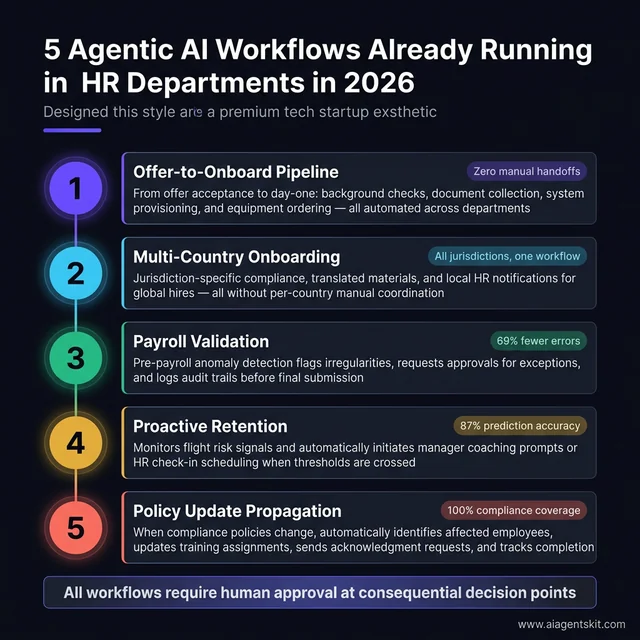
The 5 agentic AI workflows transforming HR operations in 2026 — each with real-world performance metrics
The CHRO role is evolving significantly in response. Deloitte’s 2026 Global Human Capital Trends research notes that forward-looking HR leaders are repositioning from process owners to AI governance leads — defining the boundaries within which agentic systems operate, auditing their decisions, and ensuring human oversight at consequential touchpoints rather than managing every workflow manually.
The guardrails for agentic AI in HR are non-negotiable: performance improvement plans, disciplinary actions, termination workflows, accommodation decisions, and compensation changes should always require explicit human approval before any action is initiated. The value of agentic AI is in eliminating low-stakes manual coordination — not bypassing the human judgment that HR exists to provide.
AI for HR Compliance and Payroll: Reducing Risk at Scale
HR compliance has always been complex. In 2026, with distributed workforces spanning multiple states and countries, rapidly evolving AI-specific regulations, and growing employee data privacy expectations, it’s genuinely difficult to manage manually at any meaningful scale. AI is shifting compliance from a reactive, catch-it-when-it-breaks function to a proactive, continuously monitored capability.
The payroll accuracy impact alone justifies attention: AI payroll systems are projected to reduce payroll errors by 69% compared to manual processes, according to industry research. For organizations running payroll for thousands of employees across multiple jurisdictions with different tax rules, overtime regulations, and benefit structures, that error rate reduction translates to real financial and legal risk reduction.
How AI Monitors Regulatory Changes So HR Teams Don’t Have To
The volume of regulatory change that affects HR operations has grown substantially, particularly for distributed workforces. AI compliance monitoring systems continuously scan regulatory databases, government publications, and legal analysis feeds across all relevant jurisdictions, then automatically identify which policies, documents, and training materials need to be updated when regulations change.
Practical applications include:
- Multi-state labor law tracking — automatically adjusting minimum wage fields, overtime thresholds, and required posting updates when state laws change
- Global tax compliance — monitoring withholding requirement changes across countries for remote and expatriate employees
- I-9 and right-to-work — tracking document expiration dates and triggering re-verification workflows before deadlines
- AI-specific compliance — monitoring emerging regulations like NYC Local Law 144 (AI hiring bias audits) and the EU AI Act’s requirements for high-risk HR AI deployments
Platforms active in this space include Rippling (cross-functional compliance automation), Ceridian Dayforce (global payroll + compliance), Workday HCM (integrated compliance management), and Paychex Flex (SMB-focused AI payroll with compliance alerts).
AI Payroll Accuracy: What a 69% Error Reduction Means in Practice
AI payroll systems catch errors at three stages where manual processes typically fail. Before the payroll run, anomaly detection algorithms flag inconsistencies — an employee whose compensation changed without the expected approval workflow, a contractor who appears in both the payroll and accounts payable systems, a benefits deduction that doesn’t match the enrollment record. During processing, real-time validation checks ensure that each calculation reflects current tax tables, benefit elections, and garnishment orders. After the run, post-payroll analysis identifies patterns in corrections that indicate systemic issues in data entry or system integration.
The downstream impact of payroll accuracy extends beyond cost savings. Payroll errors erode employee trust faster than almost any other HR failure — underpayment feels like theft, overpayment creates angst about repayment, and late corrections signal organizational dysfunction. AI payroll systems that catch errors before employees notice them protect a dimension of employee trust that is surprisingly fragile and expensive to rebuild.
Real-time payroll is an emerging capability enabled by AI — the shift from monthly batch processing to continuous, event-triggered payroll calculation that supports pay-on-demand programs. For organizations competing for hourly talent against employers offering instant pay, AI payroll infrastructure is becoming a talent acquisition tool, not just an administrative one.
AI Workforce Planning Tools: Full Platform Comparison
The market now includes platforms optimized for different aspects of AI in HR. Here’s an expanded comparison across all major function areas:
Recruiting & Talent Acquisition
| Tool | Best For | Key AI Feature |
|---|---|---|
| Eightfold AI | Talent intelligence, skills matching | Skills-based matching across 1B+ career data points |
| Paradox (Olivia) | High-volume hourly hiring | Conversational AI for 24/7 candidate engagement |
| HireVue | Enterprise structured hiring | NLP-powered video assessment + skills simulations |
| Phenom | End-to-end talent experience platform | AI for candidate AND employee journeys |
| Workday Recruiting | Workday HCM customers | Unified compliance + ML matching in one platform |
| SeekOut | Technical + diversity sourcing | AI talent graph with diversity signal filters |
Onboarding
| Tool | Best For | Key AI Feature |
|---|---|---|
| Enboarder | Experience-driven onboarding | Journey mapping + personalization engine |
| BambooHR | SMB all-in-one HR | Smart task assignment + predictive engagement analytics |
| Rippling | Cross-functional onboarding automation | Unified HR + IT + payroll onboarding in one workflow |
| Leena.ai | AI HR assistant + onboarding | Agentic chatbot with compliance workflow automation |
| Workday | Enterprise global onboarding | Multi-country compliance + agentic HR assistant |
Learning & Development
| Tool | Best For | Key AI Feature |
|---|---|---|
| Docebo | AI-powered LMS | Content curation + personalized learning recommendations |
| 360Learning | Collaborative learning | AI course creation + peer learning analytics |
| Degreed | Skills-based upskilling | Skill assessments + learning pathway recommendations |
| Cornerstone | Enterprise L&D suite | AI content tagging + personalized development plans |
| LinkedIn Learning | Broad content library | AI-powered course recommendations based on role + skills |
Retention, Engagement & Performance
| Tool | Best For | Key AI Feature |
|---|---|---|
| Visier | Predictive workforce analytics | Turnover prediction + people analytics dashboards |
| CultureAmp | Employee sentiment | AI survey analysis + driver identification |
| Lattice | Performance + engagement combined | Continuous feedback + OKR tracking with AI insights |
| 15Five | Manager effectiveness | AI-powered check-ins + performance signals |
| Betterworks | OKR-driven performance | AI feedback prompts + calibration support |
Workforce Planning & Analytics
| Tool | Best For | Key AI Feature |
|---|---|---|
| Orgvue | Org design + workforce planning | Scenario modeling + skills gap visualization |
| Visier | People analytics | Predictive analytics + HR benchmarking |
| ChartHop | People analytics + org charts | Real-time workforce data + headcount planning |
| Anaplan | Enterprise workforce modeling | Financial + people planning integration |
| Oracle Cloud HCM | Full-suite enterprise HCM | AI workforce planning embedded across all modules |
Payroll & Compliance
| Tool | Best For | Key AI Feature |
|---|---|---|
| Rippling | All-in-one HR/IT/Payroll | Automated compliance + unified workflow orchestration |
| Ceridian Dayforce | Global enterprise payroll | Real-time continuous payroll + compliance monitoring |
| Workday | Enterprise HCM + payroll | Integrated AI anomaly detection across HR + finance |
| Gusto | SMB payroll + HR | AI-assisted compliance alerts + automated filings |
| Paychex Flex | Mid-market payroll | AI-powered payroll accuracy + regulatory monitoring |
Measuring ROI from HR AI: The Metrics That Actually Matter
Most HR AI ROI analyses get the math wrong — they measure tool cost against hours saved, then declare success or failure based on whether the license fee seems justified. That framing misses most of the value. The real ROI of HR AI flows through talent outcomes: better hires, faster ramp times, lower turnover, stronger engagement, and fewer compliance failures. These are the metrics worth measuring.
The Five Metrics That Capture True HR AI Value
1. Time-to-hire reduction
Baseline before AI deployment. Measure at 90 days and 12 months post-deployment. AI video interviewing and scheduling automation consistently deliver 50–70% reductions. Even a 30% improvement in time-to-hire for high-volume roles translates to significant revenue impact when role vacancy has measurable productivity loss.
2. New hire retention at 12 months
The single most valuable metric for onboarding AI. The industry benchmark for first-year attrition in most sectors runs 20–30%. Organizations with AI-powered personalized onboarding report first-year retention improvements of 82% on average. Calculate the dollar value using fully-loaded replacement cost (typically 50–200% of annual salary depending on role complexity).
3. Cost-per-hire savings
AI screening tools reduce the recruiter hours required to move from job posting to qualified candidate slate. Measure recruiter time per successful hire before and after AI deployment. Add sourcing efficiency gains (AI identifies passive candidates faster than manual sourcing). Organizations using AI for screening consistently report 30–40% cost-per-hire reductions.
4. Training efficiency and time-to-competency
For L&D AI, the key metric is time-to-competency — how long until a employee reaches defined proficiency in a role-critical skill. AI-personalized learning paths consistently accelerate this compared to standardized training programs. Link training completion data to performance data within six to twelve months to validate whether faster completion produced better performance.
5. Turnover rate change in flagged populations
For retention AI, measure the turnover rate among employees who were flagged as flight risks and received intervention, versus historical turnover in comparable cohorts. If the system predicted correctly and the intervention worked, this population should show meaningfully lower turnover. This validates both the AI’s predictive accuracy and the effectiveness of the manager response to its signals.
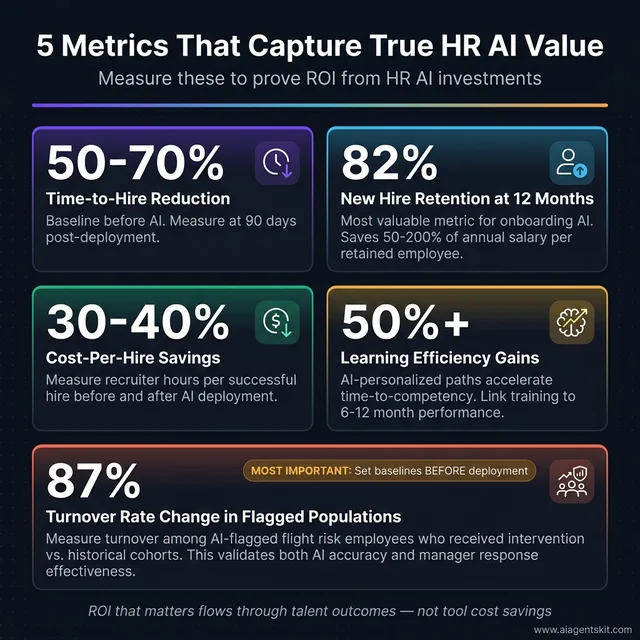
The 5 metrics HR leaders must track to prove AI ROI — set baselines before deployment for every one of these
How to Build an HR AI ROI Baseline Before Deployment
The most common ROI failure mode is deploying AI without baseline metrics — then having no way to demonstrate value when leadership asks whether the investment paid off. Before any HR AI deployment, document:
- Current time-to-hire by role category
- Current cost-per-hire by role category
- Current first-year attrition rate by department and manager
- Current training completion rates and time-to-competency for key roles
- Current payroll error rate and correction frequency
- Recruiter hours per hire, HR admin hours per new hire, compliance incident rate
These numbers take roughly two to four weeks to compile if they don’t already exist. The investment is worthwhile: they transform the AI deployment from a strategy into a measured experiment — and give HR a credible business case when it’s time to expand.
How to Implement AI in Your HR Department: A Roadmap
Understanding what AI can do and successfully deploying it in an HR organization are different problems. Most implementation failures don’t come from poor tool selection — they come from poor sequencing and under-investment in change management.
Step 1: Audit current HR processes for high-friction areas
Before selecting any tool, document where the bottlenecks actually live. Where do candidates fall through the cracks? Where do managers spend time on coordination instead of judgment? Where does HR spend hours on data entry that creates no insight? Recruiting — particularly high-volume roles — is the most common starting point because the friction is visible, the data is structured, and the ROI metrics are clear.
Step 2: Pick one use case and solve for it completely
The organizations achieving durable AI ROI in HR didn’t try to transform everything simultaneously. They identified one high-impact, measurable use case — usually resume screening or interview scheduling — ran a controlled pilot, measured results rigorously, and only expanded after the proof was in place. The AI implementations that fail are almost always those deployed too broadly, too fast.
Step 3: Prioritize integrated platforms over standalone tools
The power of HR AI multiplies when systems share data. A recruiting AI that can access long-term performance data learns which candidate attributes actually predict success. A retention predictor that lacks training completion data misses a major signal. McKinsey’s people analytics research consistently shows that integrated HR technology ecosystems outperform collections of best-of-breed point solutions because connected data enables better AI.
Step 4: Build HR AI literacy before deploying to the organization
EY’s 2025 Work Reimagined Survey of 15,000 employees and 1,500 employers found that only 12% of employees receive sufficient AI training to fully leverage the technology’s benefits, while 77% of employers say they intend to reskill their workforce for AI — a gap that represents significant organizational risk. HR teams must build their own AI fluency before asking the broader organization to adopt AI-augmented processes. That means understanding what the tools actually do, how to interpret AI recommendations versus AI decisions, and how to explain the systems to employees in ways that build trust rather than suspicion.
Step 5: Establish measurement baselines and governance before launch
AI decisions in HR affect real people’s careers and livelihoods. Every deployment should have: baseline metrics established before launch; a human review checkpoint for any consequential decision; a regular cadence for auditing AI outputs for bias or drift; and a clear policy on how AI insights are used by managers. This isn’t bureaucracy — it’s the difference between HR AI that builds organizational trust and HR AI that creates legal and reputational exposure.
Reviewing AI use cases by industry reveals that HR is actually one of the more mature sectors for AI adoption, with established patterns for both what works and what to avoid.
AI in HR: Ethical Risks, Bias, and What Good Governance Looks Like
Responsible AI implementation in HR requires confronting risks directly, not deferring them to legal or compliance teams. Three categories of risk demand active management.
How to Identify and Audit Bias in AI Hiring Systems
AI systems learn from historical data. If past hiring decisions favored certain demographics — and most organizations’ historical data reflects systemic biases that accumulated over years — the AI trained on that data will replicate and potentially amplify those patterns. Documented cases have shown AI systems downranking candidates from women’s colleges, penalizing resumes with certain cultural names, and disadvantaging non-linear career paths that correlate with particular demographic groups.
Understanding how algorithmic bias works is a prerequisite for deploying AI in any hiring context. Mitigation requires active work at multiple levels:
- Audit training data before deployment — identify historical patterns that shouldn’t be encoded as success signals
- Test for disparate impact regularly — run AI recommendations through demographic analysis and compare outcomes across groups
- Demand algorithmic transparency from vendors — any platform that can’t explain how its recommendations are generated shouldn’t be trusted with consequential hiring decisions
- Maintain human review for all final hiring decisions — AI should narrow the field, not determine the outcome
Even among AI ethics researchers, there’s genuine debate about whether AI reduces or merely redistributes hiring bias, which makes continuous monitoring non-negotiable rather than a one-time compliance exercise.
Data Privacy and Legal Exposure
AI HR systems process some of the most sensitive personal data that exists: salary information, performance reviews, health-adjacent patterns, and communication metadata. GDPR, CCPA, and AI-specific legislation like New York City’s Local Law 144 — which requires bias audits for AI hiring tools — are establishing legal floors that will rise over time. Organizations collecting employee data for AI training should have documented data minimization policies, clear consent frameworks, and established retention limits.
The principle that builds the most organizational trust isn’t transparency about what AI can do in theory — it’s transparency about what it actually does in the specific deployment context. Employees who understand that AI is flagging patterns for manager review (not determining their fate) respond very differently than employees who sense they’re being evaluated by an opaque system with no recourse.
AI as Copilot, Not Decision-Maker
The framing that consistently produces better outcomes in HR AI implementations is copilot rather than autopilot. AI surfaces insights — which candidates to review, which employees may be disengaging, which training paths fit a specific role. Humans make the calls. This isn’t a temporary concession to organizational skepticism; it’s the architecturally sound model for deploying AI in domains where decisions carry career and livelihood consequences. HR professionals who embrace this framing find that AI makes their judgment better-informed rather than redundant.
AI for HR: Frequently Asked Questions
Will AI replace HR professionals?
No — but it will significantly change what HR professionals spend their time doing. AI handles high-volume administrative tasks: screening resumes, scheduling interviews, tracking training completion, surfacing engagement risks. That frees HR professionals to focus on functions where human judgment is irreplaceable: complex employee relations, leadership development, organizational design, and building the trust that employees need to navigate difficult situations. The HR professionals most at risk are those who specialize exclusively in tasks that AI now performs faster and cheaper — not those who focus on the strategic and relational dimensions of the role.
How is AI used in HR recruiting?
AI in recruiting is deployed across the full candidate lifecycle. Resume screening AI evaluates applications contextually rather than by keyword match. Conversational AI chatbots handle candidate questions, initial screening, and interview scheduling. Video interview platforms use NLP to analyze candidate responses for competencies and communication clarity. Predictive analytics tools identify which sourcing channels and candidate profiles produce the best long-term hires. Most organizations begin with screening or scheduling automation and expand to other applications once the initial deployment demonstrates value.
What is AI in HR and how does it work?
AI in HR refers to machine learning and language model systems that analyze workforce data to make predictions, automate processes, and personalize experiences at scale. Unlike traditional HR software that executes predefined rules, AI learns from patterns in outcomes — past hiring successes, employee engagement trends, learning completion rates — and uses those patterns to generate recommendations. The underlying technologies include natural language processing for text and speech analysis, predictive modeling for risk and outcome forecasting, and recommendation engines for personalized learning and career development paths.
How much do AI HR tools cost?
Pricing varies substantially by platform type and organization size. Talent intelligence platforms like Eightfold AI are typically priced per employee per year, ranging from $5 to $20+ depending on modules. Conversational AI recruiting tools like Paradox are priced on custom enterprise arrangements based on hiring volume, generally running $50,000 to $200,000+ annually for large employers. Engagement and performance platforms like Lattice or CultureAmp range from $6 to $15 per employee per month. SMB-focused tools generally offer more accessible entry points. ROI calculations typically center on reduced time-to-hire, lower turnover costs, and HR team efficiency gains — numbers that can justify even significant platform investments when measured accurately.
Is AI resume screening biased?
AI resume screening can be biased — and the risk is significant enough that organizations should treat it as a given until proven otherwise through regular auditing. AI systems learn from historical hiring decisions, which in most organizations contain patterns of demographic bias accumulated over years. If past hiring favored candidates from certain schools or background types in ways that correlated with protected characteristics, the AI will learn to replicate those preferences. Well-governed implementations conduct regular disparate impact testing, require vendor algorithmic transparency, and maintain human review at all final decision points.
Can small businesses use AI in HR?
Yes, and the case for starting is often stronger at smaller organizations because the administrative burden per HR staff member is typically higher. Free and low-cost entry points exist across most application areas: AI chatbots for initial candidate engagement, AI-assisted job description writing, basic skills assessment tools, and pulse survey platforms with AI sentiment analysis. The key is starting with one workflow where manual process is creating the most friction, demonstrating measurable value, and expanding only after the first implementation is stable and well-understood.
What is predictive turnover analytics in HR?
Predictive turnover analytics refers to AI systems that analyze workforce data — engagement survey trends, career progression patterns, compensation relativities, manager relationship signals, and sometimes external market factors — to forecast which employees face elevated flight risk in the near term. The output is typically a risk score or flag that prompts HR or a manager to initiate a proactive retention conversation. Research suggests these systems can achieve accuracy rates of 87% or higher when trained on comprehensive organizational data. The value isn’t in the prediction itself — it’s in enabling human intervention before disengagement becomes resignation.
What skills do HR professionals need to work with AI?
The core competencies emerging from organizations that have successfully scaled HR AI adoption include: data literacy (understanding what the AI is measuring and how to interpret its outputs); critical evaluation (knowing when to trust and when to override AI recommendations); communication (explaining AI-driven processes to employees and candidates in ways that build rather than erode trust); and governance awareness (understanding bias risks, privacy obligations, and the evolving regulatory environment). Technical coding skills are generally not required for HR AI users — but comfort with data, dashboards, and analytical thinking is increasingly essential for senior HR roles.
How does generative AI change HR operations?
Generative AI is having its most immediate impact on HR content creation: job descriptions, offer letter drafts, training scripts, performance review templates, and HR policy documents. Models like GPT-5 and Claude 4 can generate high-quality first drafts that HR professionals then refine, cutting content development time substantially in documented deployments. Generative AI is also enabling more conversational interfaces for HR self-service — employees asking chatbots benefits questions, policy clarifications, and leave process guidance — reducing HR team contact volume while improving response speed and consistency.
What are the legal risks of using AI in hiring?
The regulatory environment for AI in hiring is evolving rapidly and varies significantly by jurisdiction. New York City’s Local Law 144, in effect since 2023, requires employers using AI hiring tools to conduct and publish annual bias audits and notify candidates when AI is used. The EU AI Act classifies employment decision tools as high-risk AI with strict transparency and auditability requirements. EEOC guidance in the U.S. makes clear that employers remain legally liable for discriminatory outcomes even when those outcomes are produced by third-party AI tools. Organizations should obtain contractual commitments from vendors on algorithmic transparency, conduct their own regular audits, and maintain human decision authority over all consequential hiring outcomes.
What is the difference between AI HR software and traditional HRIS?
Traditional HRIS (Human Resource Information Systems) are systems of record — they store and organize HR data but don’t learn from it or generate recommendations. AI HR software adds a layer of intelligence on top of that data: it identifies patterns, makes predictions, automates judgment-based tasks, and personalizes experiences at scale. Many organizations use both: the HRIS as the authoritative data source and the AI layer (sometimes built into the same platform, sometimes a separate solution) as the intelligence layer that makes that data actionable.
How does AI help with HR compliance in multi-state or global companies?
Distributed workforces create compliance complexity that scales non-linearly with headcount. An organization with employees in fifteen U.S. states plus three countries faces different minimum wage laws, overtime thresholds, leave entitlements, tax withholding requirements, posting obligations, and I-9 equivalents in each jurisdiction — and those regulations change continuously. AI compliance monitoring systems track regulatory changes across all relevant jurisdictions, automatically identify which policies and employee records are affected, and trigger update workflows before compliance exposure occurs. This is one of the clearest cases where manual compliance management simply cannot keep pace with regulatory velocity at scale.
What is agentic AI and how is it different from AI chatbots in HR?
AI chatbots respond to prompts — they answer questions and surface information when an employee or HR professional initiates an interaction. Agentic AI initiates action, executes multi-step workflows across multiple systems, and can make decisions within defined parameters without waiting for a human to move each step. In HR, the practical difference is: a chatbot tells an employee how to request parental leave; an agentic AI system processes that request, updates the HRIS, notifies payroll, initiates benefits coordination, and schedules a manager briefing — all autonomously from a single employee request, with human approval required only for the decisions that policy designates as requiring it.
What are free or low-cost AI tools for HR teams in 2026?
Several accessible entry points exist for organizations that aren’t ready for enterprise platform investment. For job description writing: ChatGPT (with HR-specific prompting) and Workable’s AI writing tools. For interview question generation: many ATS platforms now include AI-generated interview kits at no additional cost. For pulse surveys with AI analysis: Lattice’s free tier and Culture Amp’s starter packages. For basic onboarding automation: BambooHR and Gusto include AI workflow features in their base plans for SMBs. The best free starting point depends on where the greatest manual friction exists — identify that first, then find the lowest-cost tool that addresses specifically that problem.
Conclusion
The pattern that separates organizations seeing real ROI from HR AI from those sitting on expensive, underused technology is consistent: they start narrow, measure rigorously, and build from evidence rather than enthusiasm.
AI for HR isn’t a one-time initiative — it’s a set of capabilities that mature over time as systems learn from organizational data and as HR professionals develop fluency with AI-augmented workflows. Recruiting, onboarding, training, retention, workforce planning, compliance, and the emerging frontier of agentic AI each offer clear applications delivering measurable results for organizations that sequence them correctly and maintain human oversight at consequential decision points.
The central challenge isn’t selecting the right tool. It’s building the organizational readiness — in HR teams, in managers, in governance frameworks — that lets AI deliver its actual value rather than becoming another underused technology investment. Understanding AI’s impact on specific job roles provides important context for the workforce conversations that HR teams are increasingly being asked to lead.
For ready-to-use workflows and prompts, explore the guide on AI prompts for HR professionals covering recruiting, onboarding, engagement, and retention workflows.