Generative Engine Optimization: The Complete GEO Guide
Generative engine optimization (GEO) is how brands get cited in AI search results. Learn proven strategies for ChatGPT, Perplexity, and Google AI Overviews.
Something fundamental shifted in search behavior — and most marketing teams haven’t caught up. Gartner predicts a 25% drop in traditional search engine query volume by 2026 as users shift to AI chatbots for answers instead of clicking through ranked links.
Generative engine optimization (GEO) is the discipline addressing this shift — optimizing content not for a ranking position, but for citation inside AI-generated responses. It requires an entirely different playbook from traditional SEO, one that’s still missing from most marketing strategies alongside prompt engineering fundamentals.
This guide breaks down what GEO is, how it differs from SEO, and the exact tactics content teams are using to appear in ChatGPT, Perplexity, and Google AI Overviews — with platform-specific strategies most guides overlook.
What Is Generative Engine Optimization (GEO)?
Generative engine optimization is the practice of optimizing digital content so that AI-powered search systems retrieve, cite, and synthesize it when generating responses to user queries. Rather than targeting a position on a traditional search engine results page, GEO targets inclusion as a trusted source inside the AI-generated answer itself.
The shift this represents is significant. When a user asks ChatGPT “what’s the best project management software for remote teams?”, the AI doesn’t display ten links and leave the user to decide. It synthesizes an answer from multiple sources and may cite one or two. Being cited — or being the unnamed source the AI drew from — is the new metric of visibility.
The major AI platforms driving GEO adoption include:
- Google AI Overviews (formerly Search Generative Experience) — synthesizes web sources into a paragraph-style answer at the top of search results, appearing alongside organic results
- Perplexity AI — a conversational search engine that cites live web sources in real time with direct attribution links
- ChatGPT with browsing — uses real-time web data in search mode; draws on training data in base mode, which makes training data inclusion its own long-term GEO consideration
- Claude and Gemini — increasingly used as research tools with web connectivity, each with their own crawlers and evaluation frameworks
The core insight of GEO is that AI systems don’t rank content — they select it. A page that ranks #8 in organic search could still be cited by Google AI Overviews if it answers a specific question more clearly and concisely than the #1 result. This partially inverts the traditional SEO assumption that ranking = visibility.
GEO emerged as a recognized discipline in 2023-2024 as AI Overviews and Perplexity gained mainstream traction. Early academic research from Princeton, Georgia Tech, and IIT Delhi examined what content attributes predicted AI citation likelihood, finding that citation probability correlated strongly with authoritative sourcing, structured formatting, and high information density rather than traditional SEO signals like domain authority or keyword density. Practitioners quickly adapted these findings into operational frameworks.
Importantly, GEO doesn’t replace SEO. Traditional organic rankings still drive substantial traffic, and appearing in AI Overviews often correlates with strong organic performance anyway. The most resilient content strategy treats GEO as an additional optimization layer, not a competing one. Teams that abandon SEO fundamentals to chase GEO-only tactics consistently underperform those that build both simultaneously.
GEO vs SEO: 5 Key Differences That Matter in 2026
The difference between GEO and SEO runs deeper than a definition — it changes how content teams research, write, structure, and measure success. McKinsey research (2025) found that approximately 50% of consumers are already using AI-powered search tools for everyday inquiries, and McKinsey projects that $750 billion in US revenue will be influenced by AI-powered search by 2028. Understanding the structural differences between GEO and SEO is commercially essential, not academically interesting.
Here’s how the disciplines compare across the five dimensions that matter most in practice:
| Dimension | SEO | GEO |
|---|---|---|
| Primary Goal | Rank in organic search results | Get cited in AI-generated answers |
| Traffic Model | Click-through traffic to website | Zero-click impressions within AI response |
| Optimization Focus | Keywords, backlinks, technical SEO | Authority, answer structure, entity clarity |
| Success Metrics | Rankings, CTR, organic traffic | AI citation frequency, brand mention share |
| Target Platforms | Google, Bing, Yahoo | ChatGPT, Perplexity, Google AI Overviews, Claude |
These differences matter operationally. A traditional SEO campaign might focus on building backlinks from high-domain-authority sites to lift rankings for a target keyword cluster. A GEO campaign would instead focus on building brand mentions across trusted publications (linked and unlinked), ensuring content is structured for AI extraction, and demonstrating comprehensive topic coverage that makes the brand the obvious reference point when AI generates an answer.
Consider a practical example: a SaaS company selling HR software wants to appear when users ask Perplexity AI “what are the best HR tools for startups?” Traditional SEO would optimize for “HR software for startups” as a keyword. GEO would ask: what does Perplexity cite when it answers this? Which publications’ reviews does it pull from? What content structure does it extract cleanly? The answers shape a different kind of content investment.
One fundamental shared between GEO and SEO is E-E-A-T — Google’s framework for Experience, Expertise, Authoritativeness, and Trustworthiness. AI systems are trained to favor content that signals genuine expertise. The autonomous AI agents and AI-driven systems that power these platforms increasingly function as sophisticated editorial filters, evaluating trustworthiness at a signal level that goes far beyond keyword matching.
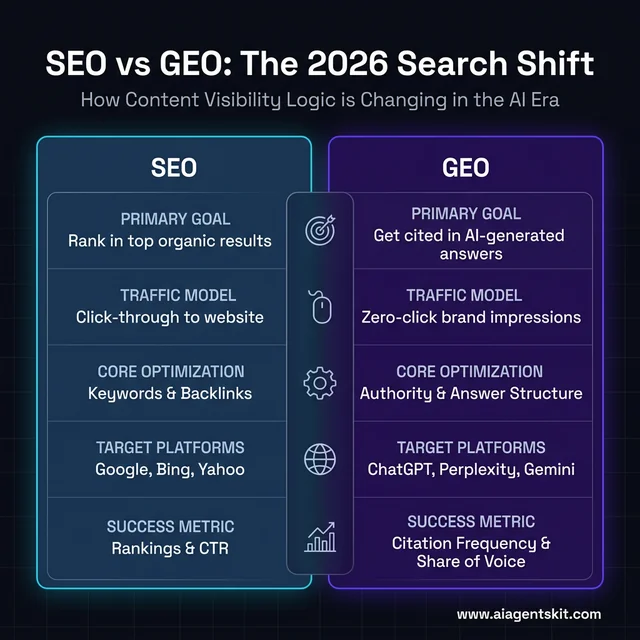
The fundamental differences between SEO and GEO across goals, traffic models, and core success metrics.
Another shared priority is technical accessibility. Googlebot, PerplexityBot, OpenAI’s GPTBot, and Anthropic’s Claude crawler all need clean, unrestricted access to content. Content blocked in robots.txt or hidden behind JavaScript rendering is invisible to AI citation systems, regardless of how good it is.
The teams seeing the strongest GEO performance in 2025-2026 are those that didn’t treat it as a pivot away from SEO — they treated it as an upgrade. GEO adds a layer of intent: “Is this content structured so that an AI system can extract a coherent answer from it?” When the answer is yes, both traditional rankings and AI citation rates improve together.
Answer Engine Optimization vs GEO: Are They the Same?
A common point of confusion in AI search circles is the relationship between answer engine optimization (AEO) and generative engine optimization (GEO). The short answer: they describe the same goal with different vocabulary from different eras of AI search evolution.
Answer engine optimization is the older term, coined when AI-powered answers first appeared in mainstream search through Google’s featured snippets and voice search assistants. AEO focused on structuring content to win “position zero” — the direct answer box that appears above organic results. At this stage, answer engines were pattern-matching systems that extracted pre-existing sentences from web pages and displayed them verbatim.
Generative engine optimization emerged when AI systems shifted from extracting to synthesizing — building original answers from multiple sources rather than pulling a single pre-existing sentence. ChatGPT, Perplexity, and Google AI Overviews all synthesize. They don’t just copy; they compose. This compositional behavior created a new set of optimization requirements beyond what AEO addressed.
| Aspect | AEO (Older Term) | GEO (Current Term) |
|---|---|---|
| AI Behavior | Extracts verbatim sentences | Synthesizes new responses from multiple sources |
| Target Feature | Featured snippets, voice answers | ChatGPT, Perplexity, AI Overviews |
| Key Tactic | Concise, quotable sentences | Authority, entity clarity, answer-first structure |
| Traffic Model | Some click-through retained | Predominantly zero-click |
| Scope | Single source extracted | Multi-source synthesis |
The practical takeaway is that AEO tactics are a subset of GEO tactics. Content optimized for AEO — clear answers, FAQ sections, structured data — already performs well under GEO frameworks. GEO extends those foundations with additional layers: brand entity authority across third-party sources, topical depth across content clusters, platform-specific technical configuration, and AI citation performance measurement. Teams searching for “answer engine optimization” and “generative engine optimization” are solving the same problem.
How AI Search Engines Decide Which Sources to Cite
Understanding what drives AI citation decisions is essential before investing in any specific GEO tactic. According to Semrush’s 2025 research, AI search traffic grew 527% year-over-year when comparing January–May 2024 to the same period in 2025. With that kind of growth, the citation selection mechanisms of these platforms carry enormous commercial consequences for any brand operating online.
The research on what influences AI citation probability consistently surfaces five primary factors:
1. E-E-A-T and source credibility
AI systems are designed to emulate human editorial judgment. Content from well-known brands, credentialed experts, or pages with strong citation patterns (via backlinks and third-party mentions) earns priority. AI platforms evaluate source credibility through patterns learned during training — websites that receive consistent citation in academic papers, journalism, and authoritative publications are recognized as high-trust sources. Unknown blogs that cite only other blogs score poorly in this evaluation, even if their content is technically accurate.
2. Answer-first content structure
AI models extract information far more efficiently from content that provides direct answers at the top of each section. A paragraph that opens with “Generative engine optimization (GEO) is the practice of…” is more extractable than one that spends two sentences on context before arriving at the definition. Think of it as writing for two audiences simultaneously: the human reader who appreciates flow, and the AI parser that needs to extract a coherent answer in 40-60 words.
3. Topical depth and comprehensiveness
AI platforms strongly favor sources that demonstrate expertise across an entire topic domain, not just a single isolated page. A website with 15 interlinking articles covering AI marketing from multiple angles — strategy, tools, measurement, case studies — is more likely to be consistently cited than a site with one exceptionally strong page. This is why topic cluster strategies, originally developed for SEO crawl efficiency, have become even more critical in GEO contexts.
4. Content freshness and update signals
For fast-moving topics like AI, content recency carries significant weight — especially for real-time citation systems like Perplexity. Pages last updated two or three years ago compete poorly against content reviewed quarterly. Beyond statistical freshness, adding an explicit “Last updated” timestamp and refreshing examples and statistics regularly sends crawlable signals that the content stays current.
5. Technical crawlability and indexability
Every major AI platform deploys its own crawler: PerplexityBot for Perplexity AI, GPTBot for ChatGPT, Anthropicbot for Claude, and Googlebot for Google AI Overviews. Content behind authentication walls, rendered exclusively in JavaScript, or blocked in robots.txt is invisible to these systems. Teams exploring the best ChatGPT prompts to understand AI behavior often discover that the first requirement is simply making content accessible to AI crawlers — a technical baseline that many sites fail without realizing it.
What’s notably absent from this list: raw keyword density. AI systems assess meaning, context, and authority — not keyword frequency. Heavy keyword repetition actively degrades readability signals and reduces citation probability. Content written for AI citation should read naturally, with keywords appearing because they’re the correct terminology, not because they’ve been strategically placed for density.
Understanding these factors reveals an important truth: most GEO optimization is really just making content genuinely better. Clearer writing, stronger sourcing, more logical structure, deeper topic coverage — these all serve human readers and AI citation systems simultaneously.
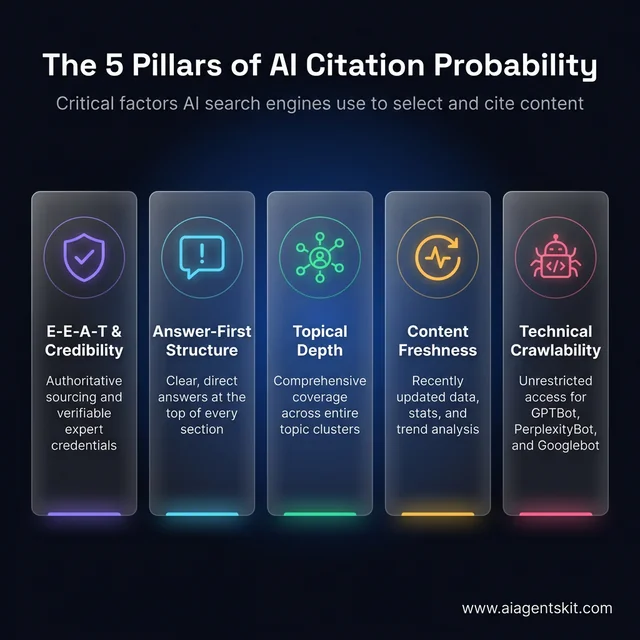
Five critical factors that determine whether an AI search engine will cite or ignore your content.
9 Proven GEO Strategies to Boost AI Search Visibility
The GEO market reflects the scale of investment flowing toward this discipline. IntelMarketResearch projects the global GEO services market to grow from USD 1.01 billion in 2025 to USD 17.02 billion by 2034, a compound annual growth rate of 45.5%. That level of capital follows strategies with measurable ROI. Here are the nine approaches that practitioners are consistently finding effective.
Prioritize E-E-A-T to Build Authority With AI
The single most impactful GEO investment is building genuine expertise signals that AI systems can verify. This means going beyond surface-level author bios — content should cite verifiable credentials, reference original research or first-hand industry experience, and link outward to the primary sources that inform its claims.
Brands seeing strong GEO performance in 2025 consistently invest in several specific practices:
- Named expert attribution — articles written or reviewed by credentialed individuals, with verifiable profiles on LinkedIn or institutional sites that AI crawlers can cross-reference
- Original data and research — proprietary surveys, internal analytics, or case studies that AI systems can’t find anywhere else. Original data is highly citable because it creates genuine information value
- Third-party validation — positive mentions in industry publications, trade associations, and review platforms (G2, Trustpilot, Clutch) that AI systems draw on when assessing brand trustworthiness
- Editorial standards transparency — clearly documented review processes, updated timestamps, and correction policies signal to AI systems that content is maintained and trustworthy
The underlying logic is that AI systems are trained to emulate human editorial judgment. Authoritative content earns AI citations the same way it earns academic references — through demonstrated expertise, verifiable sourcing, and a record of accuracy.
Structure Content for AI Comprehension
Content structure is the most immediately actionable GEO lever — and also one of the most frequently underestimated. AI extraction systems parse HTML structure before prose, meaning heading hierarchy, paragraph length, and list formatting directly influence whether a system can extract a coherent, citable answer from a page.
The key structural principles proven to improve AI citation rates:
- Answer-first paragraphs — lead every major section with the core answer in 40-60 words, then expand. AI systems frequently grab the opening sentence or two of a section that directly answers a query match. If those sentences are context-setting instead of answer-delivering, the content gets passed over.
- Consistent H2/H3 hierarchy — clear heading structure helps AI systems identify where topics begin and end, improving extraction accuracy across the entire document
- Short, dense paragraphs — 2-3 sentences per paragraph is significantly more machine-readable than 6-8 sentence blocks. Each paragraph should make one clear point.
- FAQ sections with question-format headings — standalone
### Question?headings with 60-100 word answers are purpose-built for AI citation, mirroring how Google’s featured snippets and PAA (People Also Ask) boxes work at the algorithmic level - Comparison tables — well-structured tables are highly extractable for AI systems generating comparative answers. A GEO vs SEO comparison table will be used differently by a human reader (scanned) and an AI system (parsed for structured comparison data)
- Schema markup — FAQ schema, Article schema, and HowTo schema give AI systems explicit metadata about content structure, which reduces ambiguity in extraction
Content teams that leverage AI research tools to analyze which competitor pages are being cited in AI responses consistently identify structured content as the most common differentiator between cited and non-cited pages at equivalent quality levels.
Earn Credible Third-Party Mentions and Citations
Digital PR has always been valuable for SEO via backlinks. For GEO, its value is even more direct: unlinked brand mentions in authoritative publications signal to AI systems that a brand is widely recognized and trusted, contributing to entity authority that affects citation decisions across all AI platforms.
The most effective third-party mention strategies include:
- Industry publication pitching — getting quoted in outlets like Search Engine Land, MarketingProfs, or niche trade publications builds domain-specific authority that AI systems recognize when evaluating source credibility
- Expert community participation — meaningful, helpful contributions to Reddit threads, Quora answers, and niche forums appear in AI training datasets and are indexed by real-time crawlers like PerplexityBot. A well-sourced, detailed answer on Reddit can drive consistent AI citation exposure
- Citation gap analysis — identifying which publications cite competitors but haven’t mentioned your brand, then proactively pitching value-add content, original data, or expert commentary to those publications
- Review platform presence — maintaining accurate, positive profiles on G2, Capterra, and industry directories builds the third-party mention footprint AI systems use to assess brand legitimacy
Research consistently shows that brands appearing in more diverse, authoritative third-party contexts receive AI citations at higher rates — even when their own website content wasn’t the primary source. AI systems build composite pictures of brand authority across multiple signals, not just page-by-page quality assessments.
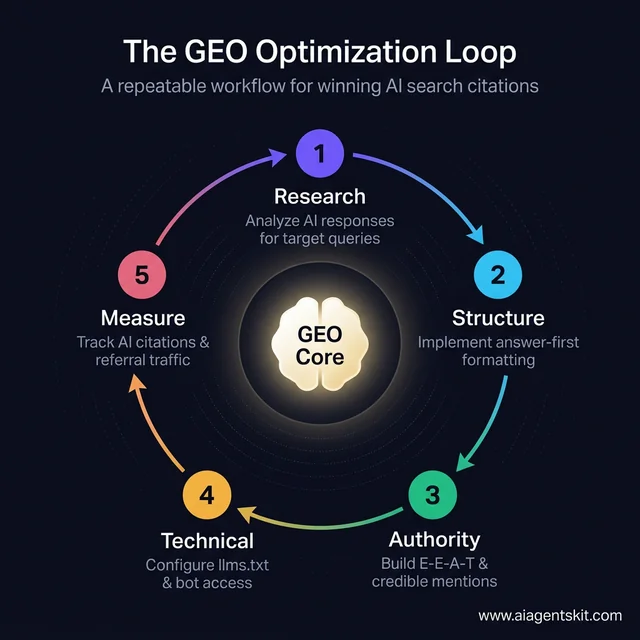
A continuous five-step loop for building and maintaining AI search authority over time.
GEO by Industry: Tailored Strategies for B2B, Ecommerce, and Local Business
GEO is not a one-size-fits-all discipline. The queries users ask AI systems, the content formats AI prioritizes as citations, and the third-party sources AI trusts differ significantly across industries. The following vertical-specific frameworks help teams focus GEO investment on the highest-return tactics for their specific context.
GEO for B2B and SaaS Companies
B2B buyers increasingly turn to AI platforms as their first research channel when evaluating software and services. McKinsey research confirms that 44% of AI-powered search users consider it their primary source for purchase research — a figure that carries outsized implications for B2B SaaS where buying cycles involve extensive research across multiple decision-makers.
High-value GEO targets for B2B: Conversational queries like “what is the best [software category] for [use case]?” and “how does [product] compare to [competitor]?” These questions appear constantly in ChatGPT and Perplexity sessions — and the brands cited become shortlisted before a human salesperson is ever contacted.
GEO tactics with the strongest B2B return:
- Category definition content — become the authoritative source for what your product category is. When AI systems answer “what is [category]?” and cite your brand, you get positioned as the market leader before the buyer has evaluated any vendor
- Comparison content built for AI extraction — structured comparison tables contrasting your product against named competitors are highly citable because they directly answer research queries AI users commonly ask
- Case study content with specific outcome data — AI platforms cite case studies with precise metrics (“reduced onboarding time by 47%”) for queries about ROI and outcomes. Generic case studies without numbers rarely get extracted
- Third-party review platform signals — G2, Capterra, and Gartner Peer Insights are high-trust domains that AI systems draw from heavily when generating software comparisons. Maintaining strong review presence there amplifies GEO authority beyond owned content
GEO for Ecommerce
Ecommerce GEO is evolving rapidly. Shopify reported an eightfold increase in AI-driven traffic and a fifteenfold increase in AI-driven orders between January and mid-2025 — evidence that consumer purchase journeys increasingly run through AI platforms before reaching product pages.
High-value GEO targets for ecommerce: “Best [product category] for [use case or person],” “what should I look for when buying [product]?”, “is [brand] worth it?” — these conversational queries are appearing with dramatically increasing frequency in ChatGPT and Google AI Overviews.
GEO tactics with the strongest ecommerce return:
- Product category guide content — comprehensive “how to choose a [product]” pages with structured criteria, comparison tables, and specific product recommendations get cited heavily. These pages serve both human researchers and AI systems
- Product schema implementation — Product and Offer schema markup helps AI systems identify specific product details, pricing ranges, and review aggregates that appear in AI-generated shopping responses
- User review integration — aggregate review data integrated via schema is extracted by AI systems when generating product recommendations. Structured review content on-site complements third-party review platforms
- Recency signaling — ecommerce content decays quickly; AI systems downweight outdated product specs, pricing, and availability. Regular content refresh cycles maintain AI citation competitiveness in fast-moving categories
GEO for Local Business
Local GEO sits at the intersection of generative AI and Google’s Local Knowledge Graph. When Gemini answers “best [service] near [city]?” or “what should I know before hiring a [local service provider]?”, it draws from two primary sources: Google Business Profile data and expert-written local service content.
GEO tactics with the strongest local return:
- Google Business Profile optimization — Gemini, as Google’s AI engine, treats GBP data as a primary local signal. Complete, accurate, and regularly updated GBP listings appear far more frequently in Gemini-powered local responses than incomplete profiles
- Local service content with FAQ sections — “How much does [service] cost in [city]?”, “What questions should I ask a [local service provider]?” — these are high-frequency AI search queries with almost no good local answers. Writing genuinely helpful local content with schema-marked FAQs gives local businesses an immediate competitive opening
- Service area pages with specific local context — AI systems respond better to service area pages that include specific local context (neighborhood names, regional regulatory requirements, local pricing data) than to generic “serving [city]” filler. Specificity signals genuine local expertise
The common thread across all three verticals is the same principle underlying all GEO: be the most genuinely useful, authoritative source for the specific question a user is asking an AI system. The platform changes; the principle doesn’t.
Platform-Specific GEO: ChatGPT, Perplexity, and Google AI Overviews
The most critical gap in most GEO guides is platform specificity. ChatGPT, Perplexity, and Google AI Overviews have meaningfully different citation mechanisms, crawler behaviors, and content preferences — and tactics optimized for one platform don’t automatically transfer to another. Understanding the distinctions between platforms is essential for efficient resource allocation. A comparison of ChatGPT vs Claude vs Gemini illustrates this well — even functionally similar AI systems have different training emphases and response generation patterns that require platform-specific thinking.
Optimizing for ChatGPT and OpenAI
ChatGPT’s citation behavior splits significantly based on whether users access it in base mode (drawing on training data) or search mode (incorporating real-time web data via GPTBot crawling).
For training data inclusion — which affects base mode responses — the relevant distribution channel is Common Crawl, the large-scale web archive that contributes substantially to LLM training datasets. Consistently publishing well-structured, factual, trustworthy content ensures future model versions incorporate accurate brand information. This is a long-horizon GEO strategy: training considerations lag real-world publication by six to eighteen months.
For ChatGPT search mode (real-time web access), the optimization priorities are more immediate:
- Conversational writing style performs measurably better — ChatGPT’s NLP models are optimized for natural language understanding, meaning content that reads like expert explanation rather than technical documentation gets parsed more effectively than jargon-heavy corporate copy
- Factual, verifiable claims take priority; ChatGPT reduces confidence in content that contains marketing hyperbole, undefined superlatives, or claims without supporting evidence
- Question-format content — articles structured around natural questions (“What is GEO?”, “How does AI search ranking work?”) mirrors the conversational query patterns ChatGPT receives and improves extraction alignment
- Technical accuracy over SEO optimization — ChatGPT’s system is trained to prioritize information quality over keyword signals
Optimizing for Perplexity AI
Perplexity operates as a live-citation search engine: every response includes linked source citations, and its PerplexityBot crawler indexes live web content continuously. This architecture makes Perplexity the most transparent GEO target — practitioners can directly observe which sources are cited and reverse-engineer the selection patterns.
Key Perplexity-specific optimization factors:
- Crawlability is foundational — verify that PerplexityBot is not blocked in
robots.txt(userobots.txttesting tools to confirm) and that critical content pages carry no noindex tags - Content recency carries significant weight — Perplexity shows strong and consistent preference for recently updated content. Adding explicit publication and “last updated” dates, plus regularly refreshing statistics, substantially improves competitive positioning against stale content from otherwise authoritative sources
- Domain authority as a trust signal — established domains with consistent, long-term publication patterns appear more frequently than newer sites or irregular publishers. Domain age and publication consistency matter more for Perplexity than for most traditional SEO scenarios
- User engagement signals compound performance — Perplexity’s algorithm incorporates engagement metrics. Content that genuinely satisfies search intent (low bounce rates, high dwell time) creates a self-reinforcing citation loop: good content gets cited, citation drives traffic, traffic engagement signals quality, quality drives more citations
- Answer-first structure is critical — Perplexity often samples the first sentence or two from source paragraphs to generate citations. Content that buries the answer after three sentences of context gets passed over for content that leads with the answer
Optimizing for Google AI Overviews
Google AI Overviews reached 2 billion monthly users and appeared in 13% of search queries as of March 2025 — a figure that had nearly doubled from 6.49% in January 2025 alone. For most brands, Google AI Overviews represents the highest-volume GEO target by a significant margin. The strategic advantage here is that optimizing for it reinforces traditional SEO, not competes with it.
Research from multiple sources consistently shows that content appearing in AI Overviews typically already ranks within the top 10 organic results. This means the path to AI Overview inclusion runs directly through SEO fundamentals — technical performance, E-E-A-T, and high-quality content — with specific structural additions:
- Featured snippet optimization doubles as AI Overview optimization — AI Overviews frequently extract from the same paragraphs that would have appeared as featured snippets. A well-structured, direct-answer paragraph targeting a specific query serves both objectives simultaneously
- Structured data implementation compounds extraction probability — FAQ schema and Article schema provide Google’s systems with explicit metadata about content structure, reducing inference requirements during AI Overview generation
- E-E-A-T investment is especially weighted — Google applies its established E-E-A-T quality framework to AI Overview source selection, meaning the same editorial signals that drive organic authority also drive AI Overview citation rates. This alignment makes Google AI Overview optimization the most cost-efficient GEO investment for teams already doing rigorous SEO
For most brands, a practical starting point is auditing which existing top-10-ranking pages already have FAQ sections and structured answers — those pages are the highest-probability AI Overview candidates, and minor structural improvements there will deliver the fastest GEO returns.
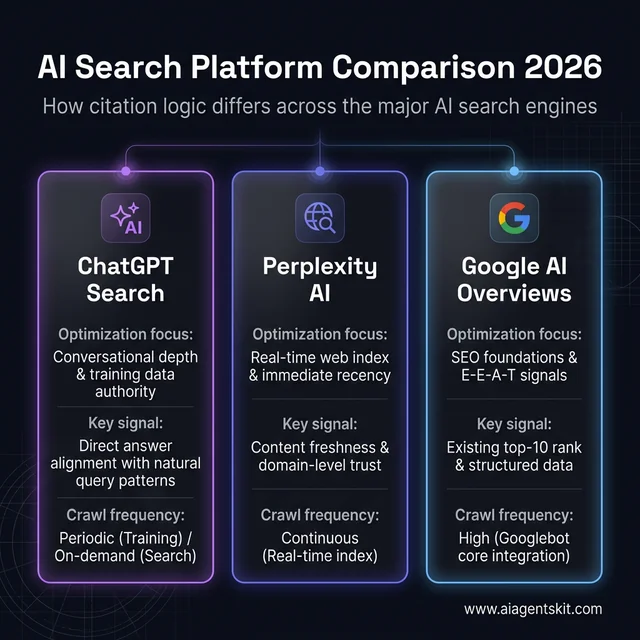
A comparison of citation logic and crawl behaviors across the major generative search platforms.
The llms.txt Standard: Give AI Crawlers a Direct Map to Your Best Content
One of the most actionable and underused technical GEO tactics in 2026 is creating an llms.txt file — a plain-text, Markdown-formatted document placed at the root of a website that gives AI language models a curated, structured overview of the site’s most authoritative content.
Think of llms.txt as a sitemap.xml for large language models. While a sitemap tells search engine crawlers where every page lives, llms.txt tells AI systems which pages matter most, why they are authoritative, and what each one covers. Anthropic adopted the standard on its own domain. GPTBot, ClaudeBot, and PerplexityBot all represent significant and growing portions of website server traffic — and configuring content for them now carries near-zero competition from other publishers.
Step 1: Configure robots.txt to Welcome AI Crawlers
Many websites accidentally block AI crawlers with overly restrictive robots.txt directives. Explicitly permitting reputable AI bots is the technical baseline for any GEO strategy:
User-agent: GPTBot
Allow: /

User-agent: ClaudeBot
Allow: /

User-agent: Google-Extended
Allow: /

User-agent: PerplexityBot
Allow: /

User-agent: meta-externalagent
Allow: /
Before adding these directives, verify the current robots.txt doesn’t contain blanket Disallow rules that override them. Test with each bot’s user-agent string using Google Search Console’s robots.txt tester or equivalent tools.
Step 2: Create the llms.txt File
Place this file at https://yourdomain.com/llms.txt. The structure is a Markdown document — clean, concise, and machine-readable:
# Brand Name

> A 2-3 sentence summary of what the site covers, who it's for,
> and why it's authoritative. Write this as a statement of expertise,
> not a marketing tagline.

## Core Guides
- [Pillar Page Title](https://yourdomain.com/page.md): One sentence
  explaining the unique value or key insight this page provides
- [Key Topic Page](https://yourdomain.com/topic.md): Why this is the
  definitive reference for this specific subtopic

## Data and Research
- [Original Study Title](https://yourdomain.com/research.md): Key
  finding summary in one sentence

## Tools and Resources
- [Tool Name](https://yourdomain.com/tool.md): What this resource does
  and why it's useful
The .md extension in URLs signals to AI systems that Markdown-formatted versions of pages are available — cleaner and more machine-readable than HTML. If Markdown versions don’t exist, standard HTML page URLs work as well.
Step 3: Validate AI Crawler Access
After deploying llms.txt, confirm AI crawlers are actively indexing the site by checking server access logs for user-agent strings from GPTBot, ClaudeBot, and PerplexityBot. Most hosting providers surface these logs in dashboards. Regular visits from these bots confirm that the configuration is working and that the site is eligible for real-time AI citation consideration.
The competitive advantage of llms.txt is disproportionately large in the near term: the majority of websites haven’t implemented it, meaning early adopters effectively lay out a welcome mat for AI crawlers while competitors leave them to guess.
How to Track and Measure Your GEO Performance
Measurement is the most underdeveloped aspect of GEO in 2026. McKinsey reports that only 16% of brands currently track AI search performance systematically — a startling gap given the scale of the shift underway. For brands that invest in measurement early, this gap creates a significant first-mover advantage: establishing a GEO citation baseline now allows data-informed optimization while most competitors are still operating blind.
Core GEO metrics to establish and track:
- AI citation frequency — how often brand content is cited in AI responses to relevant queries over a given time period
- Share of voice in AI responses — brand citations as a percentage of all AI citations for key topic areas, benchmarked against named competitors
- Mention sentiment — positive, neutral, or negative framing of brand mentions in AI-generated content; important because AI systems that cite a brand in a negative context can actively harm brand perception
- AI-referred traffic — configure GA4 custom channel grouping to track sessions originating from AI platform referrals (ChatGPT.com, Perplexity.ai referral sources)
- Citation accuracy — whether AI systems accurately represent brand claims, products, and positioning when citing content
Tracking AI referral traffic in GA4:
AI platforms now generate measurable referral traffic that GA4 captures if configured correctly. Create a custom channel group in GA4 that identifies sessions from chatgpt.com, perplexity.ai, claude.ai, and gemini.google.com as a distinct AI Referral channel. This allows direct measurement of traffic volume, session quality, and conversion rates from AI search — separate from direct, organic, or social channels. Research from Search Engine Land (2025) shows AI referral traffic grew 357% year-over-year, making this channel increasingly material for traffic reporting.
Manual testing as a complement to tools:
No automated tool captures the full context of AI citations. Regularly querying ChatGPT, Perplexity, and Google AI Overviews with key brand and topic searches provides qualitative context: Is the brand cited accurately? Are competitors cited instead? Is the brand’s content being paraphrased in a way that preserves the intended meaning? Manual testing takes 15-20 minutes weekly and surfaces insights that dashboards miss.
The free 5-question citation audit:
Paste published content into ChatGPT or Claude and ask these five questions monthly:
- “Is this the most complete answer to [target query]? What’s missing?”
- “If you were a Google quality rater, what score would you assign this? What would earn a perfect score?”
- “Flag any factual claims that seem uncertain or unverified.”
- “A user asks me [target query]. Would you cite this article? What would you quote from it?”
- “What E-E-A-T signals are present? What’s missing?”
Any gap identified by two or more questions is a high-priority edit. Gaps identified by only one question are candidates for the next content refresh cycle.
Establishing the baseline:
Before optimizing, GEO teams should document the current AI citation status for 10-15 key queries related to the brand’s core topics. This baseline reveals three things: which queries already surface brand content (reinforcement opportunities), which queries surface competitors instead (displacement opportunities), and which queries surface no relevant brand content (creation opportunities). The highest-value GEO investments target displacement and creation opportunities first. For teams already leveraging AI productivity tools in their content workflows, integrating weekly GEO audits into existing review processes is the most sustainable long-term measurement approach.
How to Win in a Zero-Click Search Environment
The zero-click search era fundamentally reframes what “winning” means in search. When Google AI Overviews answer a query directly in the SERP — without the user clicking anything — traditional click-through traffic disappears. Around 60–69% of Google searches in 2025 already end without a click, according to Semrush research. On mobile devices, that figure reaches 75–77%.
For brands accustomed to measuring success in clicks, zero-click search feels like a loss. The strategic reframe: zero-click impressions are brand awareness at scale, delivered inside a trusted AI interface. A brand cited in a Google AI Overview for a relevant query reaches thousands of users who may never visit the website — but who encounter the brand name positioned as an authoritative, trusted source. That citation has brand-building value even without directly generating traffic.
The zero-click conversion strategies that actually work:
- Optimize for the queries that retain clicks — not all AI Overviews suppress clicks equally. Commercial-intent queries (“best [product] to buy”) and navigational queries still drive click-through behavior even when AI Overviews appear, because users want to purchase or find a specific page. Investing GEO effort in commercial-intent content retains traffic value while building AI citation presence
- Treat AI citation as top-of-funnel reach — track whether branded search volume (direct searches for brand name) increases correlating with periods of high AI citation activity. Research shows brands cited consistently in AI responses see measurable increases in branded search queries as awareness compounds
- The cited source halo effect — being named as a source by ChatGPT or Perplexity carries a credibility transfer. Users who later seek more information often navigate directly to the cited brand. Brands seeing strong GEO citation rates consistently report improvements in direct traffic alongside reduced organic click-through rates — the audience finds them through different paths
- Conversion architecture for AI-referred visitors — AI-referred visitors convert at 4.4× the rate of traditional organic search visitors according to Semrush. When they do click through, they arrive with high intent and research depth. Optimizing landing pages for visitors arriving with existing awareness (no need to explain the basics) improves conversion rates for this already-primed audience
- Brand mention monitoring as a business signal — tools like Profound and Semrush AI Visibility track how often your brand appears in AI responses even when users don’t click anywhere. Rising AI citation share is a leading indicator of brand authority growth that eventually translates to both organic traffic and direct navigation
The brands that frame zero-click search as an opportunity to reach high-intent audiences at the top of their research journey — rather than a threat to existing traffic — are the ones building durable positions in AI-first search.
Best GEO Tools Compared (2026)
The GEO tool market grew significantly through 2025 as the commercial stakes of AI search visibility became measurable. The six platforms below represent the current functional landscape — from enterprise-grade citation tracking to accessible options for smaller teams.
| Tool | Best For | Key GEO Feature | Pricing |
|---|---|---|---|
| Profound | Enterprise teams | LLM prompt volume tracking, AI crawler analytics, citation monitoring across 10+ AI engines | Enterprise (custom) |
| Rankscale | SMB to mid-market | Multi-platform AI rank tracking, brand sentiment analysis, GPT-5 and Perplexity monitoring | From €20/month |
| Semrush AI Visibility | Teams already on Semrush | Unified SEO + AI visibility dashboard; AI Visibility Score, Citation Authority Score | Semrush subscription |
| AthenaHQ | Mid-market and enterprise | Competitive AI citation benchmarking, content gap analysis for AI | Custom |
| Peec AI | Mid-market | Brand mention tracking in AI outputs across ChatGPT, Gemini, Perplexity | Mid-market pricing |
| Ahrefs AI Insights | Teams already on Ahrefs | AI Overview keyword tracking integrated with existing rank tracking | Ahrefs subscription |
Profound is the most comprehensive enterprise platform as of 2026. Its “LLM prompt volume” metric — measuring how frequently users query AI systems about a brand or category — is a genuinely new kind of search intelligence with no traditional SEO equivalent. Profound tracks real-time citations across more than 10 AI engines, generates content briefs based on citation gap analysis, and monitors AI crawler behavior directly in the platform. It’s the right choice for brands treating AI search visibility as a board-level strategic priority.
Rankscale fills the practical middle market. Its AI rank tracking functions analogously to traditional keyword rank tracking — specific queries are monitored across ChatGPT, Perplexity, and Gemini to show how citation position evolves over time. The competitive benchmarking and sentiment analysis features help teams identify where competitors are cited more favorably and what content changes close those gaps. Entry pricing at €20/month makes it accessible for teams that need structured AI citation data without enterprise-scale budget.
Semrush’s integrated AI Visibility Toolkit (launched in its unified “Semrush One” platform in October 2025) is the most practical choice for teams already using Semrush for traditional SEO. Monitoring 100+ million relevant LLM prompts globally, it provides an AI Visibility Score alongside traditional rank tracking in a single dashboard. The AI PR Toolkit feature identifies publications that AI systems cite frequently for specific topics — enabling more targeted digital PR outreach than guesswork-based publication pitching.
For teams without tool budgets, manual testing is a functional zero-cost alternative. Querying the five major AI platforms weekly with 10-15 target questions, recording citation data in a spreadsheet, and tracking changes month-over-month provides surprisingly robust GEO performance data. The GA4 custom channel group configuration for AI referral traffic provides the missing piece — actual traffic and conversion data from AI-referred sessions — for free, inside existing analytics infrastructure.
The tool selection decision ultimately reduces to scale and existing stack. Teams with large existing SEO budgets should integrate AI visibility into their existing platform (Semrush or Ahrefs). Teams managing GEO as a standalone initiative should evaluate Profound (enterprise) or Rankscale (SMB). Teams with constrained budgets should start with manual testing and GA4 configuration before committing to dedicated tools.
Generative Engine Optimization: Frequently Asked Questions
What is generative engine optimization?
Generative engine optimization (GEO) is the practice of optimizing digital content and brand presence to be cited, referenced, or synthesized by AI-powered search systems like ChatGPT, Google AI Overviews, Perplexity AI, and Claude. Unlike traditional SEO, which targets keyword rankings in organic search results pages, GEO focuses on becoming a trusted source that AI platforms select when generating answers to user queries. The goal shifts from “ranking in results” to “being cited inside the answer.”
How is GEO different from traditional SEO?
The core difference is the optimization target and success metric. SEO aims for high positions in a ranked list of search results, measured by clicks and organic traffic. GEO aims for citation inside AI-generated answers, measured by citation frequency and brand mention share. Optimization methods also diverge: SEO centers on keyword relevance, backlink authority, and technical performance; GEO centers on content authority, answer-first structure, topical comprehensiveness, and entity recognition. Both disciplines share a foundation of technical accessibility and high-quality content.
Does GEO replace SEO completely?
No — GEO complements SEO rather than replacing it. Traditional organic search traffic remains commercially significant, and strong SEO performance actually correlates with AI Overview inclusion for Google specifically. The most resilient content strategy in 2026 invests in both simultaneously: SEO fundamentals ensure visibility in traditional search results, while GEO-specific tactics improve citation probability in AI responses. Teams that abandon SEO to focus exclusively on GEO typically sacrifice stable, measurable traffic for uncertain AI citation exposure.
What is answer engine optimization and how does it relate to GEO?
Answer engine optimization (AEO) is the predecessor to GEO. AEO focused on winning featured snippets and voice search answers when AI systems extracted single sentences from web pages. GEO addresses generative AI systems that synthesize responses from multiple sources rather than extracting single quotes. AEO tactics — concise answers, FAQ sections, structured data — remain valid as a subset of GEO strategy, but GEO extends the discipline to cover brand entity authority, topical depth, platform-specific technical configuration, and citation performance measurement across ChatGPT, Perplexity, and AI Overviews.
How do I get my content cited by AI search engines?
Three tactics have the strongest and most consistent impact on AI citation probability. First, demonstrate clear expertise: named author credentials, original research, and verifiable claims signal the authority that AI systems use as a citation selection criterion. Second, structure content for AI extraction: lead each section with a direct answer in 40-60 words, use clear heading hierarchies, include FAQ sections with question-format headings, and implement relevant schema markup. Third, build credible third-party mentions across trusted publications, industry forums, and review platforms — AI systems evaluate brand authority across the entire web, not just the brand’s own domain.
What is the role of schema markup in generative engine optimization?
Schema markup provides AI systems with explicit, machine-readable metadata about content purpose, structure, and relationships. FAQ schema signals that a section contains question-answer pairs optimized for direct extraction, making it easier for AI systems to identify citable content accurately. Article schema identifies the author, publication date, and content category — all factors that influence citation selection decisions. HowTo schema organizes step-by-step processes for AI systems that generate instructional responses. Schema doesn’t guarantee citation, but it substantially reduces the ambiguity that causes AI systems to select alternative sources over better-quality content.
How does Perplexity AI decide which sources to cite?
Perplexity cites live web sources that PerplexityBot has indexed, with citation selection weighted by several compounding factors. Domain authority and publication consistency earn baseline trust — established domains with regular publishing patterns are indexed and sampled more frequently. Content recency carries significant weight for fast-moving topics; recently updated pages outcompete stale content from otherwise authoritative sources. Crawlability is a baseline requirement: content blocked by robots.txt or noindex tags doesn’t exist for Perplexity. Answer-first structure improves extraction accuracy because Perplexity frequently samples the opening sentences of source paragraphs to generate citations.
Is generative engine optimization worth investing in for small businesses?
GEO represents a meaningful opportunity for small businesses precisely because the competitive barrier remains lower than in traditional SEO. A well-structured, genuinely authoritative piece of content from a small business can be cited in AI responses alongside enterprise content — AI systems evaluate content quality and authority signals, not company size or domain age exclusively. The practical starting point for resource-constrained teams is concentrating GEO efforts on a narrow topic area, building comprehensive coverage across five to ten interlinking pages, and implementing FAQ schema on high-value content. Focused depth outperforms broad shallow coverage in AI citation contexts.
What tools can I use to track GEO performance?
The leading dedicated GEO monitoring tools in 2026 include Profound (enterprise-grade, tracks brand mentions, citations, and sentiment across 10+ AI engines), Rankscale (SMB-friendly AI rank tracking from €20/month), and Semrush’s integrated AI Visibility Toolkit (for teams already on Semrush). Manual testing — directly querying ChatGPT, Perplexity, and Google AI Overviews with relevant brand and topic searches weekly — complements automated tools at zero cost. Configuring GA4 with custom channel groups for AI referral sources (chatgpt.com, perplexity.ai, claude.ai) captures AI-driven traffic directly in existing analytics without additional tool spend.
What is an llms.txt file and does my website need one?
An llms.txt file is a Markdown-formatted document placed at your website’s root (/llms.txt) that provides AI language models with a curated, structured guide to your most important content — similar to how sitemap.xml guides search engine crawlers. It lists key pages with brief descriptions of their value and expertise, helping AI systems understand what your site covers and which pages to prioritize when generating cited responses. While not yet universally supported or required, it represents a forward-looking technical investment with near-zero implementation cost. Adoption is growing: Anthropic uses llms.txt on its own domain, and GPTBot, ClaudeBot, and PerplexityBot bots are now significant portions of server traffic for most content-focused websites.
How do I win in a zero-click search environment?
Zero-click search doesn’t eliminate value — it redistributes it. Winning in a zero-click environment means treating AI citations as brand awareness at scale rather than traffic drivers. Practical strategies include: optimizing commercial-intent content that retains click-through behavior even with AI Overviews present; monitoring branded search volume as a proxy for AI citation’s brand-building effect; tracking AI-referred traffic in GA4 (which converts at 4.4× the rate of organic traffic when clicks do occur); and building brand mention presence across authoritative publications that AI systems trust. The brands that reframe zero-click exposure as a top-of-funnel reach channel — rather than a traffic threat — are the ones gaining durable AI search positioning.
GEO Builds Durable AI Search Visibility Over Time
The brands building GEO capabilities in 2026 are positioning for a search landscape where being cited matters more than being ranked. McKinsey projects that $750 billion in US revenue will be influenced by AI-powered search by 2028, yet only 16% of brands are currently measuring their position in this environment. That gap between commercial impact and organizational readiness represents the largest early-mover advantage in digital marketing since the original rise of SEO.
The practical reality for content teams is that GEO doesn’t require starting from scratch. The highest-impact changes — restructuring existing high-traffic content with answer-first paragraphs, adding FAQ sections with question-format headings, implementing schema markup, deploying an llms.txt file, and refreshing statistics — can be applied to a portfolio of existing content in a matter of weeks. Citations and authority build incrementally, rewarding consistent application rather than one-time campaigns.
GEO also isn’t purely a content discipline. Technical teams must ensure AI crawlers have unrestricted access. PR teams need to shift toward securing brand mentions alongside backlinks. Analytics teams need new measurement frameworks for AI citation performance. The brands that treat GEO as a cross-functional capability — not just a content team initiative — are the ones building durable AI search visibility that compounds over time.
For teams ready to translate GEO principles into broader organizational capability, developing an AI strategy for your business is the natural next step — connecting content visibility goals to measurable commercial outcomes and building the cross-functional alignment that sustainable GEO performance requires.