AI for Real Estate: Tools Agents Actually Use
Discover the best AI tools for real estate agents in 2026 — virtual staging, AI listing generators, CRM automation, property management AI, and predictive lead scoring.
A listing sat on the market for 62 days with zero showings. Same price point, same neighborhood as properties selling in under a week. The difference? Copy-paste MLS descriptions, mediocre photos, and zero marketing follow-up.
The agent switched to AI-generated listing descriptions, virtual staging, and automated lead follow-up. The next listing sold in 11 days with multiple offers.
The industry is catching up fast. Major portals like Zillow have integrated AI features. Brokerages are deploying proptech AI at scale. PropTech startups are racing to bring specialized real estate automation tools to market. This isn’t about replacing agents—it’s about amplifying what good agents already do.
Why Real Estate Agents Are Embracing AI in 2026
The real estate profession hasn’t fundamentally changed in decades. But the tools agents use are transforming rapidly.
The numbers make it clear: the AI in real estate market reached $301.58 billion in 2025 and is projected to hit $404.9 billion by 2026, a compound annual growth rate of 34.3%, according to The Business Research Company. More than 75% of real estate firms plan to increase their AI investment in the next 12 months — not as an experiment, but as a competitive necessity.
Consider what consumes an agent’s time:
- Writing listing descriptions (for every property)
- Following up with leads (endlessly)
- Creating marketing content (social, email, print)
- Answering common questions (over and over)
- Analyzing market data (for pricing conversations)
AI excels at exactly these repetitive, time-consuming tasks. Agents who offload them to AI spend more time on what actually matters: building relationships and closing deals. Similar patterns are emerging across industries — see how AI is transforming finance for another example of the same shift.
The results are compelling:
- Agents using AI tools report 30-50% time savings on administrative tasks
- AI-generated listings often receive more engagement than traditional descriptions
- Automated follow-up increases lead conversion rates measurably
The agents who resist AI aren’t being replaced by AI — they’re being outcompeted by agents using AI.
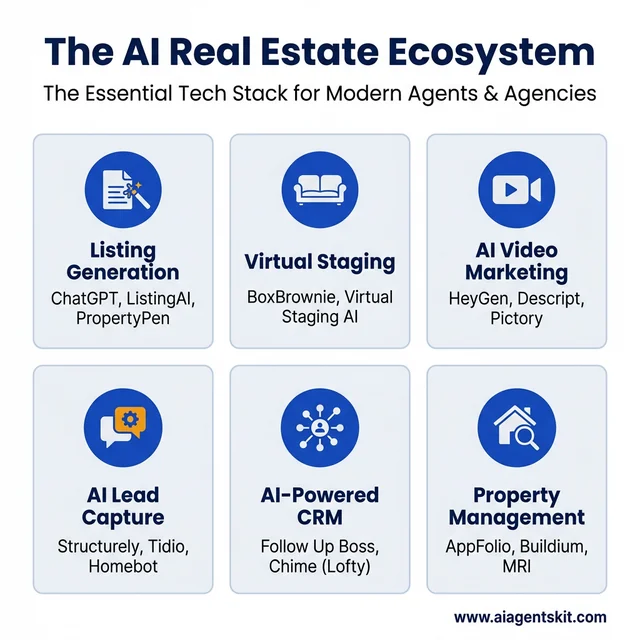
The Essential tech stack for modern real estate agents and agencies in 2026.
AI for Property Listings: Generators, Tools, and Prompt Templates
Writing compelling listing descriptions is tedious. Every property needs one. Most end up sounding identical.
Using ChatGPT for Listings
The simplest approach requires no special tools — just ChatGPT with good prompts. For a complete beginner’s guide, see how to use ChatGPT.
Example prompt template:
Write a compelling MLS listing description for this property:

- 3 bedroom, 2 bath single-family home
- 1,850 sq ft on 0.25 acre lot
- Updated kitchen with quartz counters
- Primary bedroom with walk-in closet
- Two-car garage
- [Neighborhood] area, near [amenities]
- Asking price: $425,000

Make it engaging without being hyperbolic. Target first-time homebuyers.
150-200 words.
What makes this work:
- Specific property details prevent generic output
- Target audience helps tone matching
- Word count prevents AI rambling
- “Without being hyperbolic” keeps it professional
5 ChatGPT Prompt Templates for Real Estate Listings
Practitioners who get the most from AI listing copy use varied, structured prompts — not the same template every time. Here are five proven patterns:
1. Lifestyle-First Prompt:
Describe this 2BR condo for a young professional buyer who commutes downtown daily.
Features: [list features]. Lead with the lifestyle, not the specs.
2. Investor ROI Prompt:
Write an MLS description for this duplex targeting real estate investors.
Current rents: $X/unit. Cap rate: Y%. Net operating income: $Z.
Keep it factual and numbers-driven.
3. Luxury Appeal Prompt:
Generate a high-end listing narrative for this 5BR estate.
Features: [list]. Avoid clichés like "stunning" or "breathtaking."
Use specific, sensory language — materials, finishes, views.
4. Motivated Seller Prompt:
Write a listing that conveys urgency without desperation.
Property: [details]. Seller has relocated. Use "priced to sell quickly."
5. Neighborhood Story Prompt:
Create a description that leads with the neighborhood, not the house.
Neighborhood: [name]. Walk score: X. Key amenities: [list].
Property details: [list]. Target: families with school-age children.
Specialized AI Real Estate Listing Generator Tools
Several tools are purpose-built for real estate:
ListingAI Pro — Generates descriptions from MLS data imports. Learns the agent’s writing style over time. Monthly subscription model.
PropertyPen — Browser extension that generates descriptions from photos. Identifies features automatically.
Epique AI — Comprehensive real estate AI platform including listing generation, marketing, and client communications.
Write.Homes — Purpose-built for real estate professionals. Generates MLS listings, email campaigns, and social media content with real estate SEO built in.
For most agents, ChatGPT with good prompts is sufficient. Specialized MLS description generator tools add convenience but aren’t essential to start.
AI Video Listing Scripts
Video content is increasingly expected in listing marketing — especially for out-of-area buyers and luxury properties. AI significantly reduces the friction of creating video scripts.
Descript — AI video editing, transcription, and script generation. Agents can record rough walk-throughs and Descript cleans up the script automatically.
HeyGen — Generates AI avatar videos so agents don’t need to be on camera for every listing. Enter the script and generate a polished walk-through video.
Pictory — Converts written listing descriptions into short social video clips automatically.
The workflow many top agents use: ChatGPT drafts the script, HeyGen or Descript delivers the video, Opus.pro cuts it into short clips for Instagram Reels and TikTok.
Making AI Listings Sound Human
The biggest risk with AI listings: they all start sounding the same. To avoid this:
- Add specific details the AI can’t know — nearby coffee shops, morning light, noise levels
- Edit the output rather than using it verbatim
- Vary your prompts to avoid repetitive phrasing
- Include personal observations you’d make during a showing
The goal is AI as a starting point, not a replacement for expertise.
Virtual Staging and Photography AI for Real Estate
Seller won’t stage? House cluttered or dated? AI solves both problems at a fraction of physical staging cost.
Virtual Staging Platforms
Virtual staging has evolved dramatically. Modern AI staging:
- Removes existing furniture realistically
- Adds new furniture that fits the space
- Costs $15-50 per image (vs. $2,000+ for physical staging)
- Delivers in hours, not days
Top virtual staging tools:
| Tool | Cost Per Image | Turnaround | Quality | Best For |
|---|---|---|---|---|
| Virtual Staging AI | $15-25 | 30 minutes | Excellent | Budget-conscious agents |
| BoxBrownie | $24 | 24 hours | Excellent | Mid-range and luxury |
| Stuccco | $29 | Same day | Very good | High-volume teams |
| REimagine Home | Free tier available | Instant | Good | Testing before committing |
| Collov.ai | $10-20 | 15 minutes | Good | Speed-prioritized workflows |
Tips for best results:
- Use well-lit photos as inputs
- Clear rooms of clutter first if possible
- Review output carefully — AI can create perspective issues
- Disclose virtual staging in listings (required in most US markets by MLS rules and state real estate commissions)
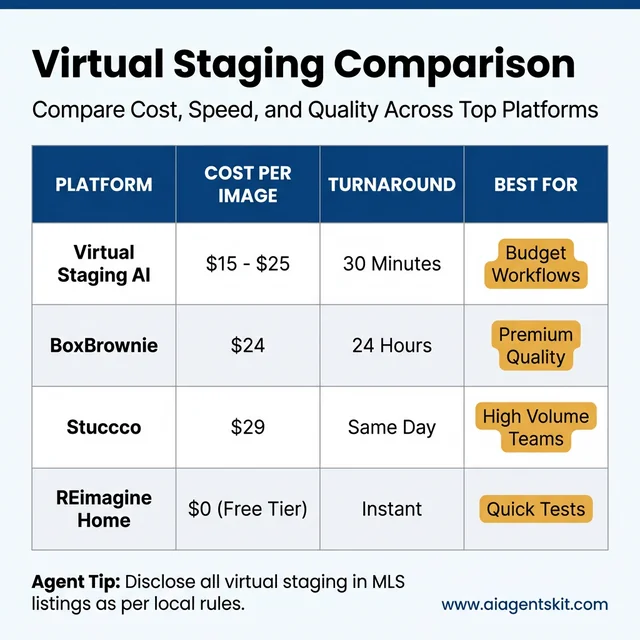
Choosing the right virtual staging partner based on your listing volume and quality requirements.
Virtual Staging for Luxury Real Estate Marketing
Luxury listings carry higher expectations and — critically — higher stakes if staging looks artificial. The pattern practitioners observe: AI staging tools used for luxury properties need more curation, not less.
BoxBrownie’s premium tier and Stuccco’s luxury package both offer human review of AI outputs before delivery, making them better suited for $1M+ listings. The key differentiator isn’t the AI engine; it’s the staging design aesthetic and furniture quality rendered.
For truly high-end properties, the most effective approach is to run AI staging for online listing photos while still using professional photography for print materials and MLS hero images.
Photo Enhancement AI
Beyond staging, AI enhances photos rapidly:
Sky replacement — Gray day? AI adds blue skies and clouds. Most tools include this.
Twilight conversion — Transform daytime exteriors to dusk shots with warm interior lights.
HDR enhancement — Improve exposure and color balance automatically.
Clutter removal — Remove minor items without full staging.
Recommended tools:
- Photoroom — Quick background replacement and enhancement
- Luminar Neo — Professional-grade photo editing with AI
- Topaz Photo AI — Upscaling and noise reduction
Most MLS photos would benefit from basic AI enhancement. It takes minutes and makes listings stand out.
3D Tours and Floor Plans
AI is making 3D tours more accessible:
Matterport — Industry standard for 3D tours, now with AI-enhanced features
EyeSpy360 — More affordable 3D tour creation
CubiCasa — AI that creates floor plans from photos in minutes
High-quality tours aren’t always necessary, but for luxury properties or out-of-area buyers, they’ve become expected.
How Does AI for Real Estate Lead Generation Actually Work?
Most leads go nowhere. AI helps identify which ones matter — and engages them before a competitor does.
AI Chatbots for Real Estate Websites
A chatbot on a website or property page can:
- Answer common questions 24/7
- Collect lead information
- Pre-qualify based on budget and timeline
- Schedule showings automatically
Popular options:
Tidio — Easy setup, good real estate templates, affordable
Structurely — Purpose-built for real estate, integrates with CRMs
CINC — Comprehensive real estate platform with AI assistant
ChatGPT-based customs — More technical, but fully customizable
What a good real estate chatbot for website lead capture handles:
- “Is this property still available?”
- “What’s the HOA fee?”
- “Can I schedule a showing?”
- “What’s nearby?”
- “What’s my home worth?” (instant AVM trigger as a lead magnet)
How AI Lead Scoring Works in Real Estate CRMs
Not all leads are equal. AI lead scoring prioritizes follow-up by processing behavioral signals through machine learning models — the step-by-step workflow typically looks like this:
- Signal collection — The system tracks page views, listing saves, email opens, response times, search filter patterns, and return visit frequency
- Feature weighting — A machine learning model assigns weights to each signal based on historical closed-deal data from the brokerage’s CRM
- Score generation — Leads receive a real-time priority score (typically 0-100), updated with each interaction
- Alert threshold — When a lead crosses a predefined score, the agent receives a push notification with a recommended action (“Call now — this lead viewed 4 listings in your target area in the last 2 hours”)
- Feedback loop — Closed and lost deal outcomes are fed back into the model to continuously improve scoring accuracy
Platforms with AI lead scoring:
- Follow Up Boss (AI Lead Scoring feature)
- Chime (AI-powered CRM with Smart Plans)
- Ylopo (AI lead ranking via rAIya)
Focusing time on high-scoring leads improves conversion rates measurably — the difference between a 3% conversion rate and a 12% conversion rate typically comes down to follow-up timing. For a deeper look at how autonomous AI handles the entire lead qualification pipeline, see the guide to AI agents for real estate lead generation.
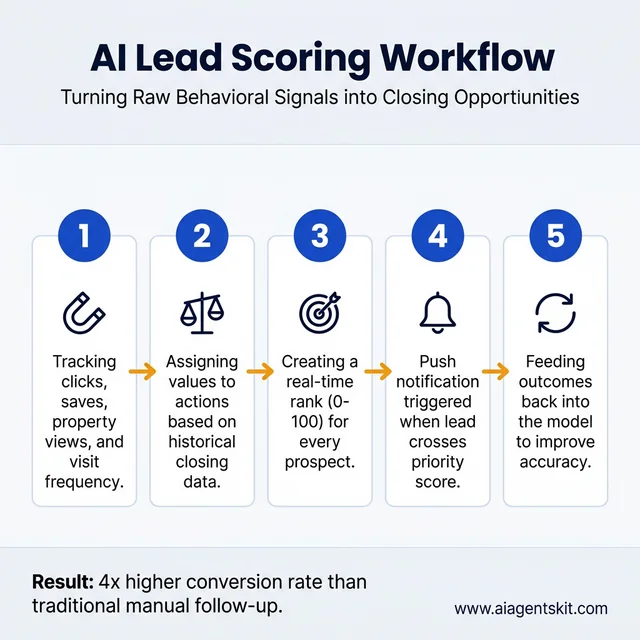
The step-by-step process of how AI identifies high-intent leads for immediate follow-up.
AI for Real Estate Cold Outreach Automation
Beyond inbound leads, AI is transforming outbound prospecting — particularly for investor-focused agents and commercial specialists.
NextProp — Investor-focused outbound automation. Scrapes distressed property listings, finds owner contact information, and initiates first contact via AI-driven SMS that qualifies interest before a human agent gets involved. The AI understands investor terminology: ARV (After Repair Value), MAO (Maximum Allowable Offer), cap rates.
Reply.io — AI-powered email sequence tool that personalizes outreach at scale. Agents can build cold email campaigns targeting expired listings, FSBOs, or geographic farm areas with high lead-response rates.
Apollo.io — Lead database + AI sequencing for commercial real estate prospectors. Particularly effective for agents targeting landlords, commercial property owners, and relocation-bound buyers.
The evidence shows that timing matters more than volume in cold outreach. AI tools that detect engagement signals (email opens, link clicks) and trigger immediate follow-up calls see 3x the response rates of batch-and-blast approaches.
Instant Home Valuation as a Lead Magnet
Automated Valuation Models (AVMs) aren’t just for agent research — they’re powerful lead generation tools when embedded directly in the agent’s website.
Homebot — Provides automated monthly home value updates to clients, keeping the agent top of mind. Generates warm inbound seller leads from homeowners who become curious about their equity.
HomeSnap — Instant AVM lookup with agent branding. Buyers and sellers who use the agent’s branded HomeSnap link self-identify as active market participants.
ValueMyHome widget — Simple embeddable AVM that exchanges a property address for an email address, creating a qualified lead at the top of the funnel.
Predictive Analytics for Seller Lead Generation
Some platforms predict who’s likely to sell before they list:
Offrs — Claims to identify 70%+ of future sellers 6-12 months before they list, based on 250+ behavioral and property data signals.
Likely.AI — Identifies homeowners likely to list based on life event triggers: job changes, marriages, divorces, children aging out of the school district.
SmartZip — Predictive analytics for geographic farming. Agents buy exclusive “territories” and receive ranked lists of homes most likely to sell in the next 12 months.
These tools are expensive and results vary by market. They’re worth evaluating for experienced agents with established marketing budgets — not for those just starting with AI.
AI for Real Estate CRM: The Intelligence Layer
The gap between a basic CRM and an AI-powered CRM isn’t a matter of convenience — it’s a structural difference in how follow-up happens. Traditional CRMs wait for the agent to act. AI CRMs act on behalf of the agent. Gartner’s CRM research consistently shows that AI-augmented CRM implementations outperform conventional systems on lead conversion velocity — a finding that holds specifically in high-volume, relationship-driven industries like real estate.
How AI CRMs Differ from Traditional CRMs
Three capabilities separate AI-driven real estate CRMs from their predecessors:
Predictive lead prioritization — Instead of showing leads in chronological order, AI CRMs surface the leads statistically most likely to transact in the next 30-90 days based on behavior patterns, budget signals, and engagement velocity.
Automated task generation — When a lead triggers a behavioral signal (returning to the website, saving a new listing, opening three emails in 24 hours), the AI CRM creates a follow-up task automatically and routes it to the assigned agent with recommended messaging.
Sentiment analysis of communications — Advanced AI CRMs like Follow Up Boss analyze the tone and content of email threads and call transcripts to surface leads showing buying or selling intent signals the agent may have missed.
Top AI CRM Platforms for Real Estate Agents
| Platform | Core AI Feature | Best For | Approx. Price |
|---|---|---|---|
| Follow Up Boss | Ace AI — lead priority scores, call summaries | High-volume teams with diverse lead sources | ~$69/user/month |
| Chime (now Lofty) | Smart Plans — automated follow-up sequences | Teams with high Google PPC volume | ~$500/month (team) |
| Wise Agent | AI email drafts + scheduling suggestions | Solo agents and small teams | ~$49/month |
| HubSpot Breeze | Automated workflow AI, data enrichment | Tech-forward agents and brokerages | ~$45+/month |
| CINC | AI lead scoring + automated nurture | Large teams, enterprise brokerages | Custom pricing |
Setting Up AI Lead Scoring in a Real Estate CRM
Getting the most from AI lead scoring requires a setup phase most agents skip. Here’s the practical sequence:
- Connect all lead sources — MLS inquiry forms, Zillow leads, website chatbot, open house sign-ins, Google PPC campaigns. The AI model needs unified data to score accurately.
- Weight behaviors — In most platforms, agents can adjust which behaviors carry more weight (e.g., “booking a showing” should score higher than “opening an email”).
- Set alert thresholds — Decide the score at which an agent gets a notification. Too low and the system creates alert fatigue; too high and hot leads go cold.
- Review and calibrate — After 60 days, review which leads converted and which didn’t. Most platforms allow score recalibration based on closed deal data.
The right answer depends on the volume of leads and the agent’s follow-up capacity. For agents handling 50+ leads per month, AI lead scoring becomes essential, not optional.
AI for Property Management: Automation Beyond the Sale
The conversation about AI real estate tools often stops at the transaction — listing, lead generation, closing. But one of the highest-ROI applications of AI for real estate professionals is property management, where repetitive operational tasks compound at scale across dozens or hundreds of units. The same autonomous capabilities covered in real-world AI agent use cases apply directly to property operations — just with a real estate data layer.
AI for Tenant Screening and Qualification
Traditional tenant screening is slow and manual — applications arrive, agents pull credit reports, verify employment, and cross-reference rental history one document at a time. AI streamlines the entire intake process.
Modern AI tenant screening platforms:
AppFolio AI — Intelligent leasing assistant that handles initial inquiry responses, collects application documents, and performs preliminary background screening before a human property manager is involved.
Buildium AI — Automated application processing with built-in fraud detection. The platform flags inconsistencies in submitted documents — pay stubs with editing artifacts, bank statements with round-number deposits — that human reviewers often miss.
Tenant Turner — AI-powered showing scheduling that qualifies tenants on basic criteria (budget, move-in timeline, pets) via automated text conversation before scheduling an in-person or virtual showing.
The pattern practitioners observe consistently: AI tenant screening tools don’t replace the human judgment needed to make final decisions, but they eliminate 60-80% of the manual processing time in the pre-qualification funnel.
AI for Maintenance Request Automation and Triage
Maintenance is the operational bottleneck in property management — requests arrive at all hours, priorities are unclear, and routing to the right vendor requires institutional knowledge.
AI maintenance triage works by:
- Classifying the request — Is this an emergency (flooding, no heat in winter) or routine (dripping faucet)? AI models trained on historical maintenance data classify tickets automatically upon submission.
- Routing to the appropriate vendor — Based on trade category (HVAC, plumbing, electrical) and geographic availability, the AI dispatches the request to a preferred vendor without manager intervention.
- Communicating with the tenant — The system sends automated status updates (“Your maintenance request has been assigned to ABC Plumbing. Expected response: within 24 hours.”) without human involvement.
- Escalation thresholds — If a request isn’t acknowledged within a set timeframe, the AI escalates to a backup vendor and notifies the property manager.
MRI Software and Entrata AI both offer comprehensive maintenance automation as part of their property management suites. For smaller portfolios, Buildium’s maintenance workflow automation handles the same triage at a lower price point.
Predictive Maintenance with AI and IoT
Beyond reactive maintenance, AI is enabling predictive maintenance — identifying unit or system failures before they become costly emergencies.
The infrastructure: IoT sensors installed in HVAC systems, water heaters, and electrical panels transmit real-time performance data. AI models trained on failure patterns detect anomalies (a compressor running hotter than baseline, a water heater cycling more frequently) and issue preemptive maintenance alerts.
According to McKinsey’s operations research, organizations that implement predictive maintenance programs reduce equipment downtime by 30-50% and maintenance costs by 10-25% compared to reactive approaches.
For real estate operators managing large multifamily portfolios, the math is compelling: preventing one emergency HVAC replacement ($3,000-8,000) per 10 units annually more than offsets the cost of sensor installation and AI monitoring software.
Vacancy Reduction with AI Lead Nurturing for Rentals
When a unit becomes vacant, every day of turnover costs money. AI leasing tools reduce vacancy periods by maintaining 24/7 engagement with prospective tenants from the moment a listing is posted.
Knock CRM — Automated follow-up sequences for rental leads. When a prospect inquires about a unit, Knock initiates a personalized text and email sequence that nurtures them toward a showing — without requiring the property manager to respond manually.
RealPage AI — Enterprise-grade AI for large multifamily operators. The platform’s AI leasing assistant handles inquiries, qualifies prospects, schedules tours, and generates lease documents automatically.
Conversational AI for rental inquiries typically reduces time-to-lease by 15-25% in markets where the speed of follow-up determines which unit a prospective tenant chooses.
How Accurate Are AI Property Valuation Tools for Real Estate?
Pricing conversations are among the most emotionally charged moments in real estate. AI makes data analysis faster — but understanding where AI valuation tools are accurate and where they fall short is essential.
What Is an Automated Valuation Model (AVM)?
An Automated Valuation Model (AVM) is an algorithm that estimates property value using statistical analysis of comparable sales data, tax records, MLS data, and in some cases aerial imagery. AVMs are the backbone of tools like Zillow’s Zestimate, HouseCanary, and the instant home value estimators embedded on most real estate websites.
AVMs differ fundamentally from traditional appraisals in three ways:
| Factor | AVM | Traditional Appraisal |
|---|---|---|
| Method | Algorithm — comparable sales + data signals | Licensed appraiser — physical inspection + judgment |
| Speed | Instant | 3-10 business days |
| Cost | Free to $50/report | $300-$600 |
| Required for mortgage | ❌ No | ✅ Yes (conventional loans) |
| Accuracy | ±3.5% suburban; wider rural/luxury | Within 5-10% of eventual sale price |
The evidence shows that AVMs are most accurate in dense suburban markets with high transaction volume and uniform housing stock. They’re least reliable in rural markets, luxury segments, or neighborhoods with unique properties where comparable sales data is thin.
AI-Powered CMA Tools for Real Estate Agents
Comparative Market Analysis traditionally requires pulling comps and manual analysis. AI accelerates this considerably:
Cloud CMA — Polished presentations with automated comp analysis. Agents import an address and receive a branded report in minutes.
RPR (Realtors Property Resource) — NAR member tool with AI-enhanced valuations and an extensive comparable sales database.
PropStream — Data platform with AI-enhanced filtering for investment-grade analysis including distressed properties and off-market opportunities.
PropStream vs HouseCanary: AI Valuation Features Compared
| Feature | PropStream | HouseCanary |
|---|---|---|
| Primary user | Investors and wholesalers | Institutional lenders and large brokerages |
| AVM accuracy | Good for median-priced markets | Industry-leading for neighborhood-level granularity |
| Comparable sales | ✅ Comprehensive | ✅ Comprehensive |
| Foreclosure data | ✅ Strong | ⚠️ Limited |
| Rental AVM | ✅ Yes | ✅ Yes — strong for multifamily |
| API access | ✅ Available | ✅ Available |
| Price | ~$99-199/month | Custom enterprise pricing |
PropStream wins on affordability and investor-specific data. HouseCanary wins on institutional-grade accuracy for lenders and large commercial operators.
Using AI for Pricing Conversations
Beyond tools, AI can help prepare for difficult pricing discussions with sellers. The gap between a seller’s expectation and market reality is one of the most common friction points in the listing process:
Example prompt:
I'm meeting with sellers who think their home is worth $550K.
Similar homes have sold for $475-495K. How do I navigate this
conversation tactfully while being honest about market conditions?
AI can help prepare talking points and anticipate objections — valuable preparation for conversations where emotions run high and data needs to be delivered with sensitivity.
How AI Automates Real Estate Client Communication
Follow-up wins deals. Consistent follow-up is humanly difficult, particularly at scale. The evidence is clear: most leads need 7-12 touches before converting; maintaining that cadence manually across 100+ leads is effectively impossible without automation. Agents building out their communication stack often start with AI email tools reviewed in depth before moving into full CRM sequence automation.
AI Email Sequences Mapped to Tools
The problem: Most leads need 7-12 touches before converting. Manually managing this is exhausting — and inconsistent.
A practical 5-touch AI email sequence with tool mapping:
| Touch | Timing | Content | Tool |
|---|---|---|---|
| 1 | Day 0 | Personalized initial response (name + property referenced) | ChatGPT draft → agent sends manually |
| 2 | Day 2 | Helpful market info for the buyer’s target area | Mailchimp automated trigger |
| 3 | Day 5 | 3 related listings matching stated preferences | CRM (Follow Up Boss) automated |
| 4 | Day 10 | Check-in with a question (“Has anything changed in your timeline?”) | Reply.io AI personalization |
| 5 | Day 30 | Monthly market update for target neighborhood | Mailchimp automated batch |
AI solutions for real estate email automation:
Mailchimp + AI — AI-generated subject lines and content suggestions with strong deliverability.
Reply.io — AI-powered email sequences with dynamic personalization based on CRM data.
Jasper — Content generation for email campaigns at scale.
AI for Text Message Follow-Up in Real Estate
Text message response rates in real estate lead follow-up significantly outperform email — industry practitioners consistently report 3-5x higher open rates for SMS versus email.
Structurely SMS — Purpose-built conversational AI for real estate text qualification. The AI handles the initial back-and-forth to qualify a lead’s budget, timeline, and intent before routing to a live agent.
Ylopo’s rAIya — Conversational AI that contacts leads via text, qualifies them based on behavioral data from the Ylopo platform, and books appointments directly into the agent’s calendar.
Lead qualification via AI text typically handles:
- Budget confirmation (“Are you looking to stay under $500K?”)
- Timeline clarity (“Are you looking to move in the next 3-6 months?”)
- Agency confirmation (“Are you currently working with a buyer’s agent?”)
- Appointment booking (“Would Thursday at 2pm work to connect with one of our agents?”)
Transaction Updates and Review Automation
Keep clients informed without manual updates:
Dotloop + automation — Status change triggers client notifications throughout the transaction.
SkySlope — Transaction management with automated communications and compliance tracking.
Custom Zapier workflows — Connect preferred tools for automated status updates.
Reviews drive future business. Automated review requests timed for 1-3 days after a successful closing — when client satisfaction peaks — consistently outperform requests sent days or weeks later.
BirdEye — Automated review requests after closing with multi-platform management.
GatherUp — Multi-platform review collection with AI-guided response templates.
7 AI Marketing Tools Real Estate Agents Are Using Right Now
Social media, newsletters, advertising — all need content. AI removes the barrier for agents who struggle to produce content consistently.
Social Media Content at Scale
Buffer + AI — Schedule posts with AI-generated captions and hashtag suggestions.
Canva Magic Write — Generate social content alongside graphics in one workflow.
ChatGPT — Draft posts, hashtags, and content calendars in minutes.
Example social prompts:
Write 5 Instagram captions for a just-listed 4BR home in [area].
Include relevant hashtags. Keep them under 150 characters each.
Create a weekly content calendar for a real estate agent focused on
[neighborhood]. Include mix of listings, market tips, and local content.AI for Real Estate Short-Form Video (Reels and TikTok)
Short-form video drives more organic reach on social platforms than any other content format in 2026 — and AI has made production accessible for agents without video production experience.
Opus.pro — Automatically cuts long-form videos (property walk-throughs, market update recordings) into optimized short clips with captions, pacing adjustments, and aspect ratio conversion for Instagram Reels, TikTok, and YouTube Shorts.
CapCut AI — Mobile-first video editor with AI caption generation, background music suggestions, and trending template integration. Particularly effective for agents creating their own short-form content.
HeyGen — AI avatar videos for agents who prefer not to be on camera. Enter a script, select an avatar, and receive a polished video — useful for market updates and neighborhood spotlights where on-camera presence isn’t required.
A practical short-form content calendar pattern that high-performing agents use:
- Monday: Listing showcase (new or active)
- Wednesday: Local market data (average days on market, price per sqft trend)
- Friday: “Just sold” social proof + celebration
- One per week: Neighborhood spotlight or agent behind-the-scenes
AI for Real Estate Newsletter Content
Regular newsletters keep agents top of mind between transactions — the touch point that generates referrals long after a deal closes.
Mailerlite + AI — Newsletter creation with AI assistance for subject lines, section generation, and A/B test variations.
Constant Contact — AI-enhanced templates for real estate with neighborhood market data auto-population.
Video Scripts and Walk-Through Narration
Descript — AI video editing and script generation for property walk-throughs and market update videos.
Pictory — Convert written listing descriptions or blog content into video with auto-selected B-roll footage.
ChatGPT — Write video scripts and talking points given a bullet-point property outline.
Getting Started Without Breaking the Bank
Agents don’t need expensive tools to benefit from AI — the entry point is genuinely free.
Free or Nearly Free Starting Point
ChatGPT Free — Writing, brainstorming, email drafts, listing copy, objection prep.
Canva Free — Graphics with AI design features and real estate templates.
Google’s Gemini — AI assistance for research, drafts, and market summaries.
REimagine Home — Free tier for virtual staging test images.
Monthly cost: $0
Budget AI Stack ($50-100/month)
ChatGPT Plus — $20/month for GPT-5 access with image generation.
Canva Pro — $13/month for full AI features.
Tidio — $19/month starter plan for website chatbot.
Virtual staging — $15-30/image as needed.
Monthly cost: ~$50-100 plus per-image costs
Full AI Stack ($200-500/month)
All of the above, plus:
CRM with AI — Follow Up Boss, Chime, or similar (~$70-100/user/month).
AI listing tools — Specialized platforms ($30-50/month).
Lead scoring — Predictive analytics add-ons.
For high-volume agents, this investment pays for itself quickly — a single additional closed transaction from better lead follow-up typically represents 10-50x the monthly tool cost.
ROI Framework
Before adding any tool, ask:
- How much time will this save weekly?
- What would happen with that reclaimed time?
- Will this demonstrably help close more deals?
A $50/month tool that saves 5 hours weekly is a no-brainer. A $500/month tool that adds complexity without measurable output might not be.
For a comprehensive breakdown of every AI tool category an agency needs — CRM, valuation, chatbots, predictive analytics, marketing, and operations — with platform comparisons and ROI benchmarks, see the complete AI stack guide for real estate agencies.
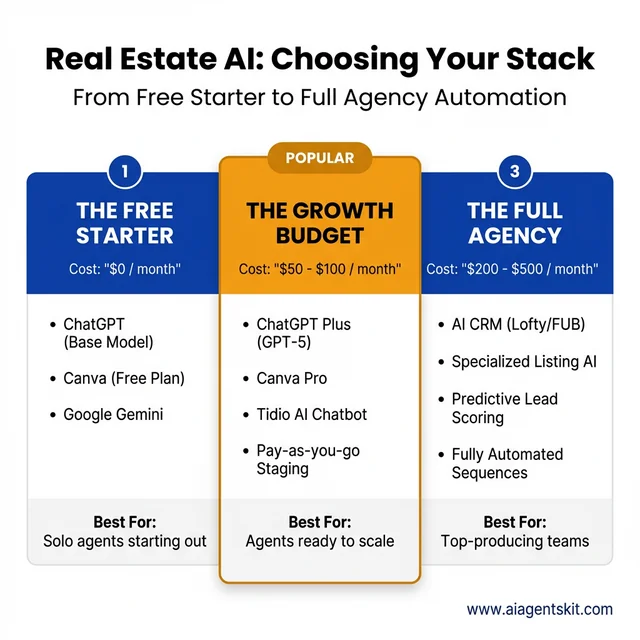
Selecting the right AI investment level based on your current business stage.
Frequently Asked Questions About AI for Real Estate
Will AI replace real estate agents?
No. AI handles tasks, not relationships. Buyers and sellers still want a human who knows the local market, negotiates on their behalf, and guides them through emotionally complex decisions. According to the National Association of Realtors, successful agents are increasingly differentiating through technology adoption — not being displaced by it. AI makes good agents more effective; it doesn’t replace what good agents do.
How accurate is AI home valuation?
AVMs are typically within 3.5% of actual sale price for suburban properties in high-transaction markets. Accuracy widens considerably for rural properties, luxury homes above $1.5M, and markets with low transaction volume where comparable sales data is thin. AI home valuation tools are best used for quick sanity checks and lead magnets — not as replacements for a licensed appraisal, which remains legally required for most conventional mortgage transactions.
What is the difference between AI property valuation and a traditional appraisal?
An AVM is algorithmic: it analyzes comparable sold properties, tax records, and property data to generate an instant estimate. A traditional appraisal is conducted by a licensed appraiser who physically inspects the property and applies professional judgment. Lenders require traditional appraisals for mortgage underwriting. AI valuations serve agents in pricing conversations, lead generation, and pre-listing analysis — not in replacing the formal appraisal process.
Does AI-generated real estate content comply with Fair Housing rules?
Generally yes, but review everything. AI doesn’t inherently understand Fair Housing Act prohibitions. Language that references neighborhood demographics, school district quality in proximity to a protected characteristic, or descriptors that could signal who is or isn’t welcome violates Fair Housing rules — whether written by a human or generated by AI. Agents are legally responsible for content they publish, not the AI tool that generated it. Run AI listing copy through a Fair Housing compliance review before posting.
Can AI tools help real estate investors as well as agents?
Yes — with different tool sets. Investors focused on off-market acquisition, distressed properties, and underwriting benefit most from tools like NextProp (automated seller outreach), PropStream (distressed property data + AVM), and DealMachine AI (driving-for-dollars + AI-assisted owner outreach). These tools understand investor-specific terminology: ARV (After Repair Value), MAO (Maximum Allowable Offer), cap rate analysis, and wholesaling workflows. They’re largely distinct from the listing-and-lead generation tools suited to buyer’s agents.
How do agents automate real estate follow-up emails with AI?
The practical setup: connect lead sources to a CRM (Follow Up Boss, Chime, or Wise Agent), build trigger-based email sequences for each lead source type, use ChatGPT or Jasper to draft sequence templates, and configure the CRM to personalize dynamically with lead name, property address, and neighborhood. The first touch should always be manually reviewed for highly personalized leads; subsequent touches can be fully automated. Review sequence performance monthly and update templates quarterly to avoid content decay.
What is the learning curve for AI real estate tools?
Most tools are accessible within a week of regular use. ChatGPT requires learning good prompting — which improves with practice. Specialized platforms like virtual staging tools and CRM AI features typically include onboarding tutorials. The steeper learning curves appear in multi-tool integration: connecting lead sources to CRMs to email sequences via tools like Zapier requires more setup time but delivers the highest return once configured.
Which AI tool should a real estate agent start with?
ChatGPT. It’s the most versatile, the cheapest (free tier available), and teaches agents how to structure requests for AI — a skill that transfers to every other AI tool they’ll use. Once comfortable, add virtual staging for the next listing, then basic email automation. Expand from there based on what’s actually creating friction in the business — not based on what’s trending in real estate tech circles.
The competitive advantage in real estate increasingly belongs to agents who use AI effectively and consistently. That doesn’t mean becoming a technology expert — it means systematically using AI tools to do more of what successful agents already do well.
Clients don’t care if AI wrote the listing description. They care that they found their dream home and had a great experience. AI helps agents deliver both — at scale, without burning out.
Agents who want to go further will find a comprehensive category-by-category breakdown in best AI tools everyone should use — many of the platforms there translate directly into a real estate context.