AI in Education: How AI Transforms Learning in 2026
Explore how AI in education transforms classrooms, personalizes learning, and supports teachers. Real statistics, real tools, and what research shows.
Something shifted in classrooms around the world over the last two years — not gradually, but all at once. By 2025, DemandSage’s AI in Education Report found that 92% of students across age groups were already using AI tools in some capacity, while the global AI in education market had surpassed $7.5 billion and was growing by nearly 40% annually. That’s not a trend on the horizon — it’s the current state.
The challenge for educators, administrators, and students isn’t whether to engage with AI in education — it’s how to do so effectively. Most institutions are caught between the genuine promise of personalized learning and the very real concerns about academic integrity, data privacy, and widening inequalities.
This guide covers how AI in education actually works across K-12 and higher education settings, which tools are making measurable differences, how institutions are navigating the harder questions that no technology can answer on its own, and what students and teachers need to know about AI literacy, special education applications, and the policy landscape that’s still being written. Taking a look at ChatGPT for students is a useful starting point for understanding how AI is already showing up in college dorms and school libraries near you.
What Is AI in Education and How Does It Work?
Artificial intelligence in education refers to the application of machine learning, natural language processing, and adaptive algorithms to teaching, learning, and school administration. It’s not a single tool — it’s a broad family of technologies that can analyze student performance data in real time, generate learning content on demand, provide feedback on written work, and help teachers manage the administrative workload that has long consumed hours of their week.
At the core of most modern AI education tools are large language models and machine learning systems — the same foundation that powers tools like ChatGPT, Claude 4, and Gemini 3. When a student interacts with an AI tutor that asks Socratic questions rather than just providing answers, or when a learning platform adjusts the difficulty of a math problem based on how a student performed in the last five sessions, those interactions are being driven by ML models trained on vast educational datasets. To understand what’s actually powering these systems, it helps to first understand what large language models are and how they generate language.
Machine Learning, NLP, and Generative AI: What’s Actually Different
Not all AI in education works the same way. Understanding the distinction between three main types helps set realistic expectations for what any given tool can actually do.
Machine learning (ML) powers the adaptive and predictive functions — the systems that track student performance over time, identify patterns in engagement data, and adjust content difficulty. These are the engines behind platforms like IXL Learning and Carnegie Learning. They don’t generate new content; they make decisions about what existing content to serve next based on behavioral data.
Natural language processing (NLP) enables AI tools to understand and respond to written and spoken language — meaning students can ask questions in their own words and get coherent answers. Automated essay feedback, AI tutoring conversations, and writing analysis tools all rely heavily on NLP.
Generative AI — the category that includes GPT-5, Claude 4, and Gemini 3 — goes further. It creates new content: explanations, quiz questions, feedback, summaries, lesson plans. Generative AI is what made the 2023–2026 adoption wave so dramatic, because it finally made AI capable of producing the kinds of outputs educators and students actually need, not just categorizing or routing information.
The most powerful education tools in 2026 combine all three: adaptive ML for pacing, NLP for interaction, and generative AI for content creation. That combination is what separates today’s AI education tools from the digital learning platforms of the 2010s.
Intelligent tutoring systems — a category that dates back to the 1970s — were the earliest precursors to modern AI tutors. Today’s equivalents are far more capable, leveraging natural language understanding to respond to open-ended student questions, generate custom practice problems, and flag patterns that suggest a student is disengaged or struggling before a teacher might notice.
According to UNESCO’s 2025 report on AI and the Future of Education, 90% of higher education professionals are already using AI tools in some aspect of their work. That number illustrates just how quickly the theoretical has become the operational — across disciplines, institutions, and resource levels.
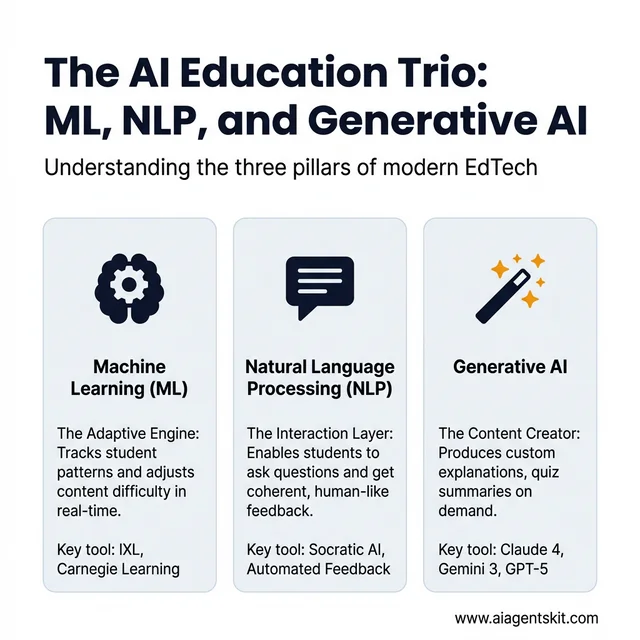
The AI Education Trio: How ML, NLP, and Generative AI collaborate to create modern learning environments.
The key distinction that matters for educators: AI in education isn’t about replacing human judgment. It’s about augmenting what educators can do with the time and data available to them. AI can grade a hundred short-answer responses and flag the three that need a teacher’s attention. What it can’t do — at least not reliably — is build the kind of trust that changes a student’s relationship with learning.
7 Ways AI in Education Is Changing How Students Learn
Artificial intelligence isn’t arriving as a single disruptive monolith. It’s showing up in at least seven distinct ways that are already changing what it means to be a student.
1. Personalized learning paths that adapt in real time. Traditional classrooms move at a pace set by the curriculum, not the individual. AI-powered adaptive learning platforms analyze how each student engages with material and continuously adjust pacing, content, and practice type. Students who grasp fractions quickly are moved forward; those who struggle with foundational concepts get additional scaffolded support before moving on. This kind of differentiated instruction at scale would be impossible without AI.
2. 24/7 access to on-demand tutoring. Khanmigo (Khan Academy’s AI tutor), Duolingo Max, and tools built on GPT-5 and Claude 4 mean students don’t have to wait for office hours or the next class session to get unstuck. That availability matters most for students from lower-income families who may not have access to paid tutoring services.
3. Instant, targeted feedback on written work. AI tools can analyze student essays for argumentation clarity, grammar, vocabulary diversity, and citation accuracy — providing immediate feedback on multiple dimensions simultaneously. When paired thoughtfully with human review, these tools help students understand where to improve before submitting a final draft.
4. Language learning acceleration. Duolingo Max’s AI-powered roleplay and explanation features simulate immersive conversation practice. Students don’t just memorize vocabulary — they practice deploying it in context, with an AI conversation partner that has effectively unlimited patience. Research consistently shows that conversational practice is essential for language acquisition.
5. Accessibility support for students with diverse needs. Real-time captioning, text-to-speech, AI-powered speech recognition, and automatic translation are removing barriers that previously limited what students with disabilities or language differences could access in a standard classroom. Several of these tools have become embedded in standard learning management systems.
6. Research assistance and synthesis. Students across higher education are using AI tools as research companions — generating first-pass summaries of complex papers, identifying related sources, and stress-testing their theses. The debate about whether this helps or harms deep learning is ongoing, but the practice is already widespread.
7. Immersive, gamified experiences. From VR science labs where students can safely perform chemistry experiments to AI-generated game scenarios that require applying historical knowledge, the more engaging end of AI-powered education is producing experiences that traditional textbooks simply can’t match.
Research compiled by education technology analysts, including findings aligned with McKinsey’s broader generative AI research, indicates that students using AI-powered learning tools demonstrated a 25% improvement in subject mastery and a 27% increase in engagement levels compared to students in traditional learning environments. Those numbers should be treated with appropriate caution — the research landscape here is still maturing — but they’re consistent with what many practitioners are observing firsthand. For a clearer picture of what separates genuinely intelligent tools from simple automation, AI-powered tutoring platforms represent a useful frame for comparison.
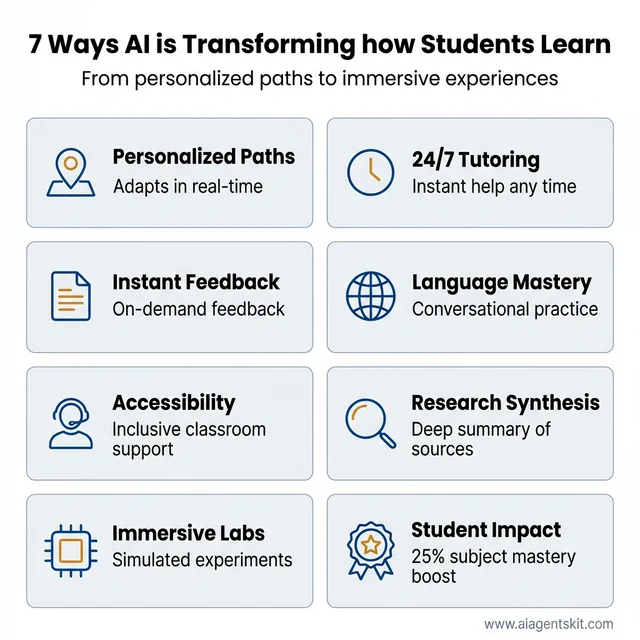
7 Ways AI is Enhancing Learning: From personalized study paths to 24/7 AI tutoring access.
What Is AI Literacy and Why Every Student Needs It
There’s a difference between using AI and understanding it — and increasingly, education systems around the world are recognizing that difference matters enormously. “AI literacy” has emerged as the organizing concept for what students should know and be able to do with AI, beyond simply using it to complete tasks.
UNESCO’s AI Competency Framework for Students, released in 2025, defines AI literacy as a set of knowledge, skills, values, and attitudes that enable students to understand how AI systems work, evaluate their outputs thoughtfully, engage with them productively, and participate as informed citizens in decisions about how AI is deployed in society. The framing is deliberately broader than technical skill — it encompasses the ethical, social, and critical dimensions that pure tool training misses.
The urgency here is real. By 2026, AI literacy is expected to be as foundational as digital literacy was in the 2010s — integrated into classrooms, assessment frameworks, and learning platforms rather than treated as an optional enrichment topic or a single standalone course.
The 5 Core Competencies of Student AI Literacy
Most emerging AI literacy frameworks converge on five interconnected competency areas:
1. Understand AI. Students should have a conceptual model for how AI systems work — not necessarily at a coding level, but enough to understand that AI learns from data, that the data itself reflects human decisions and biases, and that outputs are probabilistic rather than certain. A student who understands why an AI image generator trained on particular datasets tends to produce certain types of images is better positioned to think critically about AI output than one who treats AI as a neutral oracle.
2. Use AI effectively. This includes practical skills: how to write effective prompts, how to evaluate AI-generated responses, how to use AI as a research and thinking tool rather than a replacement for thinking. This is what most current conversations about AI in schools focus on — but it’s only one piece of the picture.
3. Evaluate AI outputs. AI systems hallucinate, amplify bias, and reflect the limitations of their training data. Students need the skills to verify claims AI makes, identify when an AI response is plausible but wrong, and recognize when a question requires human judgment that no current AI can reliably provide.
4. Create with AI. Productive AI literacy includes the ability to use AI as a creative and intellectual collaborator — brainstorming, generating options, getting feedback — while maintaining authorial ownership of the work. This means understanding the difference between AI as a tool that amplifies human thought and AI as a substitution that bypasses it.
5. Question and shape AI. The highest-order competency is civic: understanding who designs AI systems, whose interests they serve, how they can be governed, and how students can participate in those conversations as future citizens and professionals. This dimension connects AI literacy to media literacy, civic education, and broader critical thinking frameworks.
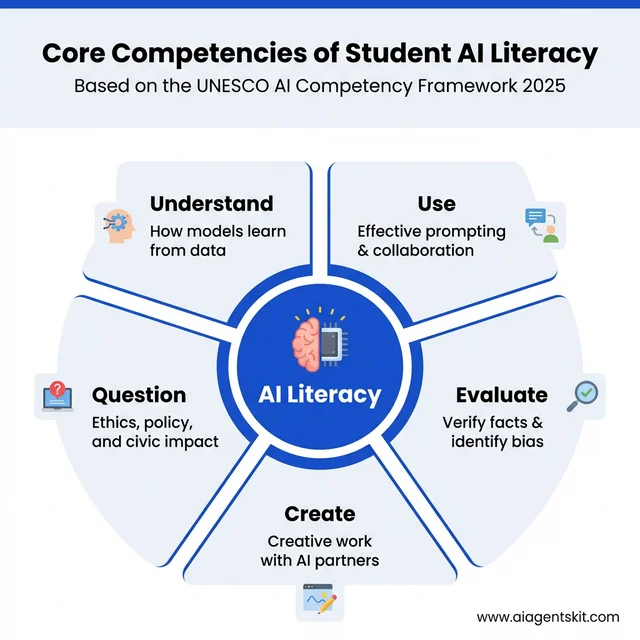
The 5 Pillars of AI Literacy: A roadmap for preparing students to work alongside artificial intelligence.
How Schools Are Teaching AI Literacy in 2026
Practical AI literacy is making its way into curricula through several routes. The AI4K12 Initiative, a joint project with CSTA and AAAI, has developed grade-banded AI literacy standards for K-12 that align with existing computer science frameworks. These aren’t hypothetical — they’re being implemented in school districts across the US and informing parallel frameworks internationally.
In practice, AI literacy shows up in English classes (analyzing AI-generated text, evaluating source credibility), math and science classes (discussing how ML models are trained and validated), social studies (examining AI governance and policy), and computer science electives (building simple AI applications to understand how they work from the inside out).
The MIT RAISE initiative and several major EdTech platforms have developed free AI literacy curricula that teachers can integrate without needing a computer science background. The direction is clear: AI literacy is being threaded into existing subjects rather than siloed into a single elective — and that cross-disciplinary approach is considered more effective by most education researchers.
How to Use Generative AI in the Classroom Effectively
Generative AI — the kind that produces text, explanations, quizzes, summaries, and feedback on demand — is what most educators mean when they talk about AI in classrooms today. But there’s a wide gap between using generative AI in ways that enhance learning and using it in ways that bypass it.
The most useful framing isn’t “should students use generative AI?” — the answer is increasingly yes, across most institutions. The more important question is: what role should it play, and how does that role differ depending on what a student is trying to learn?
AI Tools as Thinking Partners, Not Ghostwriters
The distinction that separates productive from counterproductive generative AI use in education comes down to whether the student is doing the cognitive work or whether the AI is doing it in their place.
When a student uses ChatGPT to understand why a particular historical argument is contested before writing their own analysis, or asks Claude to identify the weaknesses in a thesis they’ve drafted, or uses Gemini to find three sources on a topic and then evaluates those sources themselves — AI is functioning as a thinking partner. The student’s intellectual engagement is higher, not lower, than it would have been without the tool.
When a student asks AI to write the essay, summarize the entire reading without engaging with it, or generate answers to homework problems without attempting them first — AI is a ghostwriter. The student has learned nothing except how to delegate and, potentially, how to deceive.
The challenge for educators is that these two modes look identical from the outside, which is why the pedagogical shift happening in education isn’t primarily about detection — it’s about assessment redesign. Assignments that require demonstrated understanding (oral defense, in-class writing with specific constraints, portfolios of process work) don’t give the ghostwriter model anywhere to hide.
Practical Prompting Strategies for Students and Teachers
Effective use of generative AI in academic contexts is a learnable skill — and students who are taught it explicitly get more out of these tools than students who figure it out through trial and error.
For students:
- Use AI to get unstuck, not to get done. When stuck on a math problem, ask AI to explain the concept the problem is testing — not to solve the problem itself. The understanding sticks; the copied answer doesn’t.
- Prompt for questions, not answers. “What are three questions I should be able to answer after reading this chapter?” is a better prompt than “summarize this chapter.” The former builds engagement; the latter replaces it.
- Ask AI to push back. “Here’s my thesis argument. What are the three strongest objections to this position?” turns AI into an intellectual sparring partner. Students who use this technique consistently produce stronger work.
- Verify everything specific. AI systems confidently state incorrect facts, fabricate citations, and fill in gaps with plausible-sounding errors. Any specific factual claim, statistic, or source from an AI response should be independently verified before being used in academic work.
For teachers:
- Use generative AI to create differentiated versions of materials. A teacher can input a reading passage and ask AI to produce versions at three different reading-level adjustments, with comprehension questions appropriate to each level. This saves hours and allows genuinely differentiated instruction.
- Generate diverse assessment questions from curriculum standards. AI can produce dozens of formative assessment questions from a learning objective in seconds, giving teachers a bank to draw from while retaining editorial control over which questions actually get used.
- Draft parent communications and documentation first, then edit. The blank-page problem is where AI helps most. Teachers who use AI to produce a first draft of an IEP update, a parent progress note, or a differentiation plan report consistently that editing is faster than writing from scratch.
- Never publish AI output without review. Generative AI in educational contexts is a starting-point tool, not a finished-product tool. Factual errors, inappropriate content, and alignment gaps all require human review before anything reaches students.
How AI Is Transforming K-12 Classrooms Right Now
The K-12 space is seeing AI adoption that, frankly, moved faster than most education researchers expected. The 2024-25 school year produced data points that would have seemed implausible three years ago.
AI-Powered Adaptive Learning in K-12 Settings
Platforms like Khan Academy’s Khanmigo, IXL Learning, and Carnegie Learning aren’t pilot programs in a handful of Silicon Valley schools anymore. They’re active in districts across dozens of countries, serving students who range from early readers to high school seniors preparing for college entrance exams.
What distinguishes the best adaptive learning platforms from earlier educational software is the sophistication of the response loop. When a student answers a question incorrectly, a well-designed adaptive system doesn’t just mark it wrong — it analyzes why the answer was given, identifies the likely conceptual gap, and serves a targeted intervention before moving forward. That depth of diagnosis was previously available only through one-on-one tutoring.
A 2025 survey by the Center for Democracy and Technology found that 86% of students and 85% of teachers used AI tools during the 2024-25 school year. Those are not niche adoption numbers — they represent a sector-wide shift happening faster than any previous educational technology wave.
How Teachers Are Using AI to Reduce Administrative Work
The part of AI’s impact on K-12 that often gets overlooked is what it’s doing for teachers rather than students. The administrative burden on educators — grading, scheduling, parent communication, lesson planning, compliance documentation — has expanded significantly over the past decade without a corresponding increase in support staff.
AI tools are helping address this directly. Teachers using AI tools for teachers like MagicSchool AI and Brisk Teaching report creating differentiated lesson plans, generating quiz variants for different learning levels, and drafting parent communications in a fraction of the time these tasks previously required.
The data on time savings is striking. Teachers who regularly use AI tools are saving an average of six weeks per school year, according to survey data aggregated by Programs.com in 2025. That’s six weeks of recaptured time that can be redirected toward student relationships, professional development, or simply a more sustainable workload.
That said, it would be misleading to ignore the concerns. Automated feedback, AI-generated lesson plans, and delegation of administrative work raise genuine questions about the skills teachers develop over time through doing these tasks. The best implementations treat AI as a starting point, not a finished product — giving teachers more capacity to focus on the work that only they can do.
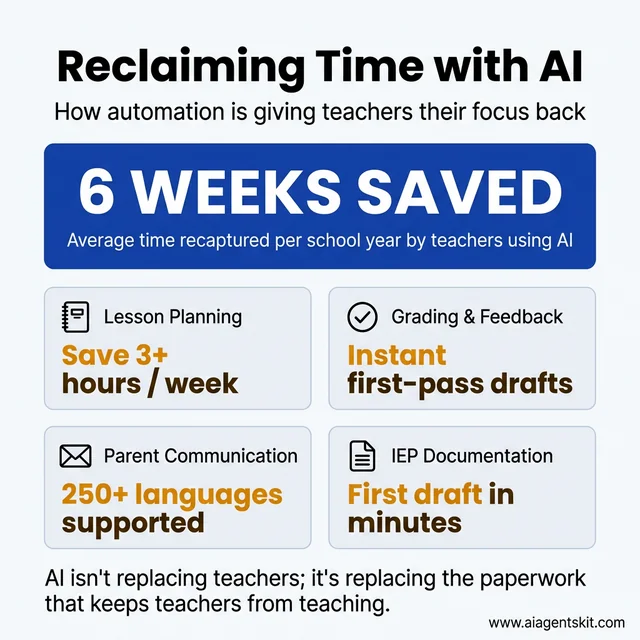
Reclaiming Teacher Focus: How AI automation saves an average of 6 weeks per school year.
How AI in Education Supports Students with Disabilities and ELL Learners
Special education and English Language Learner (ELL) support may represent AI’s highest-impact application in K-12 — an area where the technology’s specific strengths align almost perfectly with long-standing unmet needs.
Students with disabilities have historically faced a frustrating gap: the accommodations and individualized support they need are both effective and expensive to provide at scale. AI isn’t closing that gap entirely, but it’s providing tools that make certain forms of support more accessible, more consistent, and less dependent on specialist availability.
AI Tools for Students with Learning Disabilities
Dyslexia and reading difficulties are among the most common learning challenges in K-12 schools, and AI has produced genuinely useful tools for students in this category. Text-to-speech systems driven by AI — including tools like Speechify, NaturalReader, and Microsoft’s built-in Immersive Reader — have improved significantly in naturalness and accuracy. For students who struggle with decoding, these tools provide access to grade-level content without the friction of reading difficulties creating a ceiling on what they can understand.
AI-powered reading level adapters can rewrite complex texts at lower Lexile scores while preserving the conceptual content, meaning students with reading difficulties can engage with the same curriculum material as their peers in a format they can actually process.
Autism spectrum support is an emerging AI application area. Predictive routine systems help students who depend on predictability manage transitions and unexpected schedule changes. Social skills practice apps — some now AI-powered — create safe environments for role-playing social scenarios without the high-stakes anxiety of real-world practice.
Speech and language challenges are addressed by AI speech recognition and speech therapy practice tools that work between sessions with licensed SLPs. Apps like Articulation Station and AI-enhanced tools from major therapy platforms give students structured practice with immediate feedback on articulation — something that previously required a specialist present.
Students with ADHD benefit from AI-powered focus tools that reduce distraction in digital environments, provide structured task breakdowns, and use gamification to make sustained attention more rewarding. Some LMS platforms now offer AI-assisted “chunking” of assignments that automatically breaks long tasks into sequenced steps with built-in progress markers.
AI Support for English Language Learners
For the estimated 5 million ELL students in US public schools alone — and tens of millions more globally — AI is providing language support at a scale traditional programs never could.
Real-time AI translation in classroom tools means ELL students can access lesson content in their native language while learning in the target language — reducing the cognitive overload of learning content and language simultaneously. Google’s built-in translation features and AI captioning tools provide this in real time during class, not just for homework.
Vocabulary scaffolding AI analyzes which English terms are likely unfamiliar to a student based on their native language and learning history, and surfaces definitions and usage examples contextually — essentially providing a personal glossary that follows the student through content rather than requiring them to look terms up manually.
AI-powered writing support for ELL students is particularly valuable: tools that can identify grammatical patterns common in a student’s native language that are being transferred incorrectly to English (a common challenge called language transfer) provide targeted feedback that a general grammar checker wouldn’t catch.
Communication between schools and non-English-speaking families is also being transformed. AI translation tools now allow schools to send progress updates, meeting notices, and curriculum information to families in over 250 languages — a change that meaningfully increases family engagement for students whose parents don’t speak the dominant school language.
AI-Assisted IEP Development: What’s Working
Individualized Education Programs are critical documents — legal agreements about what a school will provide to a student with disabilities — but they’re also notoriously time-consuming to write. Special education teachers routinely report spending 5–10 hours per IEP on documentation alone.
AI tools like MagicSchool AI’s IEP generator, IEP Copilot, and similar platforms can produce a first-draft IEP in minutes based on student assessment data, teacher input, and prior IEP history. These drafts still require significant teacher review and editing — and should, since IEPs require professional judgment and legal accuracy — but they eliminate the blank-page problem and reduce redundant documentation work substantially.
What’s emerging in more sophisticated implementations is AI that tracks IEP goal progress automatically across daily classroom interactions, surfaces data for annual review meetings, and identifies when a student’s performance suggests a goal may need adjustment before the annual review cycle. That kind of continuous monitoring is genuinely difficult for special education teachers to manage manually across caseloads that can include 15–30 students.
The cautionary note: AI-assisted IEP tools must be vetted for IDEA (Individuals with Disabilities Education Act) compliance, and any AI tool that stores or processes special education student data has heightened FERPA privacy obligations. Schools adopting these tools need clear data governance policies before rolling them out.
AI in Higher Education: Campuses Leading the Shift
Higher education is being reshaped by AI in ways that span the entire student lifecycle — from admissions and orientation to classroom learning, advising, and career transitions.
AI Tutoring Systems in University Classrooms
Universities including Georgia Tech, Harvard Extension School, and Carnegie Mellon have moved beyond simply permitting AI tool use and are actively deploying AI systems as teaching infrastructure. Georgia Tech’s AI teaching assistant “Jill Watson,” built on IBM Watson, answered student questions in online course forums so convincingly that students didn’t realize they weren’t interacting with a human TA for months.
The latest generation of AI tutoring goes further. Students can have extended Socratic conversations with AI tutors at 2 AM before an exam, with the AI redirecting complex or nuanced questions to human instructors while handling the high volume of routine clarifications itself. This triage model is proving effective not just for student access but for faculty workload.
Student adoption in higher education is nearly universal. DemandSage’s 2025 data shows 86% of students in higher education are using AI as a primary research and brainstorming partner, a figure that represents a dramatic shift from just two years prior. The question isn’t whether students are using AI — it’s whether institutions are providing the guidance and structure to ensure that usage supports genuine learning.
Platforms like Grammarly Business specifically target the higher-ed market with structured writing feedback tools, while Turnitin has repositioned itself as an academic integrity platform that works with AI rather than simply trying to detect its use.
Predictive Analytics for Student Success and Retention
One of the highest-stakes applications of AI in higher education is student retention. Dropping out of college often represents significant financial and personal costs for students, and universities have long struggled to identify at-risk students early enough to intervene effectively.
AI systems that analyze attendance patterns, assignment submission timing, grade trajectories, and even learning management system engagement are now providing early warning signals that advisors can act on. When a first-year student’s engagement in their required English course drops sharply in week four, a predictive system can flag that pattern and prompt an advisor to reach out — before the student misses a critical deadline or stops attending.
According to Gartner’s Predicts 2025 report for Higher Education, by 2028, over 70% of educational content will be developed with the assistance of Generative AI. That projection implies not just AI-assisted grading but AI-involved curriculum development — a more fundamental shift in how institutions think about academic content. For practitioners exploring these tools today, a list of essential AI tools provides useful context for where to focus.
Course recommendation engines powered by ML are helping students make better decisions about their academic paths — identifying courses aligned with their strengths, flagging prerequisites they might be overlooking, and surfacing electives they might not have found through a traditional catalog search.
How AI Is Transforming Online Education
Online education — a sector that expanded dramatically during and after the pandemic — faces a structural challenge that AI is unusually well-suited to address: the distance between instructor and student creates gaps in feedback, engagement, and support that traditional online formats struggle to fill.
AI tutors in online courses provide the kind of on-demand clarification that campus students get from office hours and after-class conversations. When an online student gets confused during a recorded lecture at 11 PM, an AI tutor can answer the question immediately rather than requiring the student to either push through the confusion or wait until the next scheduled synchronous session.
Learning management system integrations are making AI native to online course environments. Canvas, Blackboard, and Moodle have all introduced AI-powered features in recent years — including AI-assisted assignment feedback, intelligent search across course materials, and automated quiz generation from course content. These aren’t standalone AI tools requiring separate subscriptions; they’re becoming part of the core LMS experience that instructors and students already use daily.
The scale problem in online education — where a single course might have 500 or 50,000 students — is one that human teaching alone can never solve. AI makes truly personalized support possible at that scale. A student in an online section of a university course with 2,000 enrolled students can get substantive feedback on a draft essay in minutes from an AI writing tool integrated into the course — something that would require hundreds of human TAs to replicate manually.
AI in Education: Pros, Cons, and What the Research Actually Says
The honest version of the AI-in-education conversation requires holding both the promise and the problems simultaneously. Here’s what the evidence actually shows — without the promotional framing from EdTech vendors or the reflexive skepticism from critics who conflate AI misuse with AI use.
The Clear Benefits: What the Evidence Shows
Personalization that wasn’t previously possible. Adaptive learning platforms can provide individualized instruction at a scale and consistency that would require dramatically more teachers and resources to replicate through human-only approaches. A classroom of 28 students effectively gets 28 different lesson pathways — something no single teacher can sustain through manual differentiation alone.
Reduced administrative burden, redirected toward students. Teachers spend an estimated 40–50% of their working hours on tasks other than direct instruction — grading, planning, documentation, communication. AI tools that reclaim even a fraction of that time have the potential to meaningfully increase the quality of teacher-student interaction by freeing human attention for where it matters most.
24/7 access without economic barriers. A student from a low-income family who can’t afford a private tutor now has access to an AI tutor that’s available any time. Free tools like Khanmigo and Google’s education AI features have genuinely democratized access to on-demand academic support in a way that has no good precedent.
Early identification of students at risk. AI systems that monitor engagement patterns can surface struggling students weeks before a teacher would notice through observation alone. Early intervention, triggered by AI-identified patterns, gives advisors and teachers more time to act before the consequences (course failure, dropout) become harder to reverse.
Accessibility improvements for underserved students. Students with disabilities, students learning in a second language, and students in under-resourced schools all benefit disproportionately from AI tools that can adapt content, provide language support, and reduce the resource requirements for individualized accommodation.
Consistent, immediate feedback. Human grading introduces inconsistency (the same paper scored differently depending on where it falls in a grading stack, or how a teacher is feeling at the time). AI feedback can be more consistent, faster, and more actionable — students don’t wait two weeks to find out their argument structure missed the mark.
The Real Drawbacks: What Gets Overlooked
The digital divide is real and widening. AI’s benefits disproportionately flow to students in well-resourced schools with good internet, capable devices, and trained teachers. UNESCO’s data shows two-thirds of schools globally don’t have regular access to AI-enhanced learning tools. A technology that could democratize education is, in its current distribution, reinforcing existing inequalities.
Academic integrity is genuinely destabilized. The institutional responses to generative AI misuse (detection tools, blanket bans, disclosure requirements) are all imperfect. Detection tools produce false positives at rates that create real injustice. Bans are largely unenforceable. Disclosure-only policies require student honesty that isn’t always present. This is a genuine unsolved problem, not a challenge that’s been managed away.
Teacher training hasn’t kept pace. 87% of educators reported receiving no AI training as part of professional development, per 2025 survey data. Teachers are making high-stakes decisions — about which AI tools to permit, how to evaluate AI-assisted student work, how to redesign assessments — without the preparation to make those decisions well. Good tools deployed without skilled practitioners don’t produce good outcomes.
Over-reliance creates skill gaps. If students consistently offload tasks to AI that they should be developing the capacity to do themselves — mathematical problem-solving, research synthesis, extended writing — they may graduate with credential-level markers of competence that don’t reflect actual capability. This is a real risk that’s easier to see in hindsight than to prevent in practice.
Bias in AI systems affects students unevenly. AI systems trained on historical data can reflect and amplify existing biases. Automated grading tools that were trained primarily on writing from certain demographics may systematically undervalue stylistic choices more common in other communities. Predictive analytics that flag “at-risk” students based on patterns derived from historical dropout data can perpetuate the inequities built into that history.
Privacy and data governance lag behind adoption. Many schools are using AI tools that collect student data without the governance infrastructure to protect it adequately. Student behavior data, learning performance data, and even biometric data in some tools create privacy risks that FERPA compliance alone doesn’t fully address.
The balanced assessment: AI’s benefits in education are real and documented, but they’re also contingent on thoughtful implementation, equitable access, trained educators, and strong policy frameworks. The tools aren’t good or bad independent of context — what matters is how, where, and for whom they’re deployed.
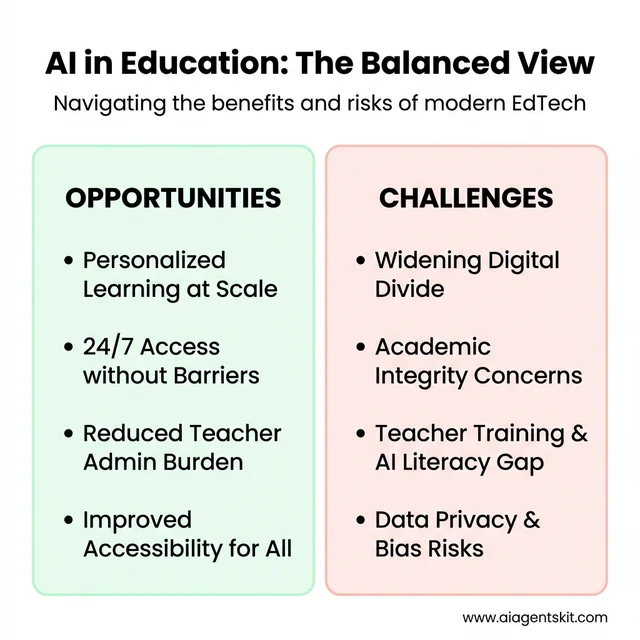
The Balanced View: Comparing the transformative opportunities of EdTech AI against systemic challenges.
What Are the Biggest Challenges of AI in Education?
Honest engagement with AI in education requires looking directly at the challenges — not as edge cases to be managed, but as genuinely difficult problems that the field is still working through.
Academic Integrity in the Age of Generative AI
The integrity question is the one that generates the most heat in faculty meetings and school board discussions, and for understandable reasons. DemandSage’s 2025 data indicates that 88% of students are using generative AI for assessments — up dramatically from 53% in 2024. That’s a staggering increase in a single year.
The institutional responses vary widely. Some schools have banned AI entirely — an approach that most educators who specialize in this area describe as both unenforceable and educationally counterproductive. Others have adopted disclosure requirements: students must flag where and how AI was used in any submitted work. Still others are redesigning assessments altogether, moving toward formats that are harder to outsource to AI — oral exams, in-class writing, project-based work that requires demonstrated process.
Khan Academy’s Khanmigo represents a design philosophy that takes the academic integrity problem seriously at the product level. Rather than providing answers, Khanmigo is intentionally built to ask guiding questions — moving students toward understanding rather than producing finished output on their behalf. That distinction matters, but it requires that students actually engage with the guiding process rather than just prompting for a shortcut.
There’s also the question of AI detection tools and their limitations. Concerns about AI hallucinations and accuracy concerns apply here too — AI detectors frequently produce false positives, flagging native speakers of certain languages at higher rates and creating situations where students must prove a negative. Most leading academics in this space now recommend against over-relying on detection tools as a primary strategy.
The Digital Divide: Who Gets Left Behind?
The transformative potential of AI in education comes with a critical caveat: it’s not evenly distributed. UNESCO’s 2025 analysis found that 2.6 billion people globally remain offline — a gap that represents not just a technology access problem but a compounding educational inequality.
Even within countries with widespread internet access, the distribution of AI-enhanced learning tools is uneven. UNESCO’s guidance on generative AI in education notes that only 34% of schools provide access to AI-enhanced learning tools — meaning two-thirds of students globally don’t have regular access to the adaptive learning platforms, AI tutors, and intelligent feedback systems that their more resourced peers do.
The teacher training gap compounds this. Despite high usage rates, 71% of teachers globally report a lack of formal AI training. Teachers are navigating powerful tools with little institutional support, making decisions about when to use AI, when to restrict students from using it, and how to evaluate AI-assisted work — often without clear guidance.
The risk, as many education equity advocates note, is that AI doesn’t simply amplify existing educational advantages — it could actively widen the gap between well-resourced and under-resourced institutions. If the schools with strong infrastructure, trained teachers, and engaged communities adopt AI quickly while others are left behind, a technology that could be democratizing ends up being differentiating in the wrong direction.
AI in Education Policy: What Schools and Governments Are Getting Right
Policy development for AI in education is happening at every level simultaneously — individual schools, districts, states, national governments, and international bodies — and the quality of those frameworks varies enormously. What’s emerging is a rough picture of what effective AI policy for education actually requires.
The numbers reveal a striking gap: by 2025, 86% of students were using AI tools in schools, but only 13% of institutions had a comprehensive AI governance framework in place. Technology is outpacing policy by years — a pattern that education systems have seen before with smartphones and social media, and haven’t always managed well.
The Three Approaches Schools Are Taking
The prohibition approach — banning student AI use — was the first instinct at many institutions and has proven largely ineffective. Students continue to use AI regardless of policy, meaning prohibition primarily teaches students how to use AI covertly rather than how to use it responsibly. It also puts teachers in the unenviable position of enforcing a policy that most can’t actually verify.
The disclosure-and-permission approach has emerged as the most common middle ground. Under this framework, AI use is permitted for specified purposes, students are required to disclose how AI was used in submitted work, and assessments are designed to make AI-only submissions distinguishable from AI-assisted human work. This approach builds student awareness without trying to close a barn door that’s already open. The US Department of Education’s 2025 guidance document largely endorses this direction, recommending that schools focus on transparent AI use policies rather than blanket prohibition.
The integration approach — the most sophisticated and still least common — treats AI as a tool to be taught alongside the curricula it touches. Schools taking this approach build AI literacy into existing courses, train teachers explicitly in AI pedagogy, redesign assessments for an AI-present environment, and engage students as active participants in defining what responsible use looks like. Early evidence from districts taking this approach suggests it produces better outcomes for academic integrity than either prohibition or disclosure alone.
What an Effective AI Policy for Schools Includes
Based on guidance from the US Department of Education, UNESCO, and ISTE (International Society for Technology in Education), effective school AI policies share several characteristics:
Clear purpose statements. Effective policies explain why the school is taking the approach it is — what learning outcomes it’s protecting, what equity concerns it’s addressing, and what competencies it’s trying to develop. Policies without rationale tend to be ignored or inconsistently applied.
Differentiation by use type. Research support, brainstorming, feedback on drafts, and submission of AI-generated content as original work are fundamentally different activities that warrant different guidance. Policies that treat all AI use as equivalent fail to prepare students for the nuanced decisions they’ll actually need to make.
Teacher support and training. A policy without corresponding professional development is a statement on paper. Effective AI policies include explicit teacher training on how to use AI themselves, how to help students use it responsibly, and how to design assessments that work in an AI-present environment.
Student voice in policy development. The institutions that have found the most traction with AI policies have included students in the development process. Students have insights into how their peers actually use AI, what pressures they face, and what policies feel principled versus arbitrary — insights that adult policymakers often miss.
Scheduled review cycles. AI capabilities are changing fast enough that a policy written in 2024 may be substantially inadequate by 2026. Effective frameworks include explicit commitments to regular review — ideally annually — rather than treating policy as a static document.
The international picture is worth noting: countries with centralized curriculum frameworks (Finland, Singapore, South Korea) have been able to develop and implement AI education policies more rapidly than systems with highly decentralized control. The US and similar federal systems are seeing enormous variance in AI policy quality between districts — a gap that is itself a form of educational inequality.
The Best AI Tools for Students and Teachers in 2026
The AI education tools landscape has grown faster than most practitioners can track, but several platforms have emerged as genuinely useful across a range of contexts.
Top AI Tutoring and Learning Platforms
Khanmigo (Khan Academy): Khan Academy’s AI tutor is the most widely discussed example of AI-in-education done thoughtfully. Khanmigo uses a Socratic method approach — asking questions, offering hints, and guiding students toward answers rather than providing them directly. The platform covers math from basic arithmetic through calculus, along with SAT prep, history, and writing feedback. It’s free for students and being actively expanded for teachers.
Duolingo Max: The AI-powered tier of Duolingo brings GPT-5-powered features including “Explain My Answer” (which explains why a user’s response was right or wrong in their native language) and “Roleplay” (which simulates real conversations with fictional characters in the target language). These features represent a meaningful upgrade from drill-based language learning.
Wolfram Alpha / Chegg Mathway: For STEM subjects particularly, step-by-step problem solving tools have long been valuable. The latest versions integrate natural language queries and can adapt their explanation depth based on what level of understanding a student demonstrates.
Gemini for Education / Google AI for Learning: Google’s Gemini 3 is becoming increasingly integrated into Google Workspace for Education, offering students drafting assistance, research support, and study aid generation that works within the apps schools already use.
Quizlet with AI features: Quizlet’s AI-generated study plans, practice tests, and flashcard recommendations have made it one of the most used educational apps globally. The platform analyzes what a student knows and doesn’t know across a topic and adjusts study material accordingly.
AI Tools That Help Teachers Save Hours Every Week
For educators looking to reduce their administrative load without compromising the quality of their professional work, a growing category of AI tools specifically targets teacher workflows. These platforms have been designed with the realities of a teacher’s day in mind — not as enterprise software that requires IT support, but as tools a teacher can open between class periods.
MagicSchool AI: One of the fastest-growing tools in K-12, MagicSchool provides over 60 AI-powered templates for educators — covering IEP generation, differentiated lesson plans, rubric creation, parent emails, and grade-level text adaptation. Teachers using it consistently report saving hours each week on planning and documentation.
Diffit: Diffit solves one of the most time-consuming differentiation challenges: adapting the same reading material for students at different reading levels. Teachers input a topic or paste in text, and Diffit generates leveled versions with comprehension questions tailored to each level.
Brisk Teaching: A Chrome extension that works within Google Docs and Classroom, Brisk Teaching can create quizzes from any content, adjust language complexity, provide personalized student feedback, and generate discussion questions — all within the tools teachers already use.
Turnitin with AI Writing Feedback: Turnitin has expanded its platform beyond plagiarism detection to include AI-assisted writing feedback that students can access before submitting work. This shifts the tool from purely punitive to genuinely formative, helping students improve before the final grade.
Curipod: An interactive lesson creation tool that generates slides, polls, and activities from a topic prompt. Teachers input what they want to teach, and Curipod produces an immediately usable lesson with built-in student engagement mechanisms.
The Future of AI in Education: What Comes Next
The 2026 AI education landscape is sophisticated compared to 2023 — but it’s almost certainly primitive compared to what 2030 will look like. The direction of travel is clear enough to draw implications even if the specific tools aren’t.
AI-Native Institutions and What They Look Like
The concept of an “AI-native” educational institution — one that has redesigned its processes, culture, and curriculum around AI rather than added AI onto existing structures — is moving from thought experiment to emerging reality.
In 2026, the most forward-leaning higher education institutions are doing things that would have seemed implausible five years ago: AI systems that help design personalized degree pathways for individual students based on their interests, existing competencies, and career goals; AI-assisted academic advising that tracks student progress against those pathways in real time; and AI-generated course materials that update automatically when foundational knowledge in a field changes significantly.
The curriculum shift that’s coming is more fundamental than tool adoption. If AI can teach students the content of most subjects at a high level — explaining concepts, answering questions, providing practice — then the question of what human teachers uniquely contribute becomes urgent. The emerging answer in forward-leaning institutions: teachers are curators, mentors, and experience architects. They design learning experiences that AI can’t replicate, facilitate discussions that require human judgment, and build relationships that fundamentally shape who students become.
Competency-based micro-credentials — short, verifiable certificates that demonstrate mastery of specific skills — are gaining traction alongside traditional degrees, partly because AI makes assessment of competency faster and more granular. A student might complete a 40-hour AI-assisted learning program on data analysis and receive a verified credential based on demonstrated performance, rather than seat time in a semester-long course.
The Changing Role of Teachers in an AI-Assisted World
The “will AI replace teachers?” question gets the most attention, but it’s arguably the least interesting question. The more important question is: what will teaching look like, and what will it require, in a world where AI handles many of the tasks that currently define a teacher’s day?
The direction is reasonably clear from what’s happening in early-adopter institutions. Teachers are spending less time on content delivery — because AI can deliver content effectively — and more time on facilitation, mentorship, feedback on complex work, and the cultivation of classroom community. The skills that matter most for teachers are becoming more interpersonal and less content-centric.
Professional development is shifting accordingly. The teachers most effective with AI tools are those who understand both the tools’ capabilities (so they can delegate to AI intelligently) and their limitations (so they know what needs to stay with a human). That combination requires ongoing learning in a field that’s changing fast.
The teachers who will struggle are those whose professional identity is too tightly bound to the tasks AI can replicate — the lecture, the worksheet, the scored quiz — and whose comfort with redesigning those tasks is limited. This isn’t a prediction that those teachers will lose their jobs; it’s an observation that their current approach will become less effective and less sustainable as the tools change around them.
One reasonably confident prediction: by 2030, AI literacy will be as standard a requirement for teacher certification as pedagogy and subject-matter knowledge. Institutions that start building those requirements now — and providing the training to back them up — will produce teachers significantly better prepared for the classroom that’s actually waiting for them.
AI in Education: Frequently Asked Questions
How is AI currently being used in education?
AI in education is being used in several interconnected ways: adaptive learning platforms adjust content difficulty based on individual student performance; AI tutoring systems provide 24/7 personalized academic support; automated assessment tools give students immediate feedback on written work; predictive analytics help universities identify at-risk students early; and administrative AI tools help teachers reduce time spent on grading, lesson planning, and documentation. The scale of adoption has grown remarkably — by 2025, 86% of educational organizations were using generative AI, the highest rate of any industry sector.
Will AI replace teachers in schools?
No — the evidence and expert consensus are clear on this point. AI tools are designed to and, in practice, do augment teacher effectiveness rather than replicate it. Teachers provide relationship, mentorship, nuanced emotional judgment, and the kind of adaptive human connection that fundamentally shapes how students develop as learners and people. What AI can do is take on the administrative and diagnostic work that consumes teacher time, freeing educators to focus on the interactions that only they can provide. The more accurate framing isn’t replacement — it’s reallocation of where teacher attention goes in a classroom day.
How does AI personalize learning for individual students?
AI personalizes learning through continuous analysis of student interaction data. When a student engages with an adaptive learning platform, the system tracks which concepts they master quickly, where they get stuck, how much time they spend on different problem types, and what kind of practice seems most effective for them. Based on that data, the AI adjusts the sequence and difficulty of content in real time — surfacing reinforcement exercises for weak areas, accelerating through concepts the student has already demonstrated mastery of, and modulating the complexity of new material to stay within the student’s zone of proximal development.
What are the pros and cons of AI in education?
The clearest benefits are personalization at scale, 24/7 tutoring access regardless of income, early identification of struggling students, significant reduction in teacher administrative workload, and improved accessibility for students with disabilities or language differences. The documented drawbacks include uneven access that reinforces existing inequalities, genuine disruption to academic integrity systems, the risk of over-reliance that leaves students without skills they should develop, AI bias in grading and assessment systems, and data privacy concerns in institutions that haven’t established adequate governance. Neither the benefits nor the risks are evenly distributed — which students attend which kind of school matters enormously for whether AI’s net effect is positive or negative for any given learner.
How is AI being used in special education?
AI in special education includes text-to-speech tools for students with dyslexia, speech practice applications for students with language disorders, social skills simulation for students on the autism spectrum, AI-assisted IEP drafting that reduces documentation time, and automated tracking of IEP goal progress. For ELL students, AI provides real-time translation, vocabulary scaffolding, language transfer-aware writing feedback, and school communications to families in 250+ languages. These applications address long-standing resource gaps in special education where specialist time and individualized attention have perpetually fallen short of what students need.
What is AI literacy and why does it matter for students?
AI literacy is the ability to understand how AI works, use it effectively, evaluate its outputs critically, create with it productively, and engage with questions about how AI is governed and deployed in society. It matters because students who only know how to use AI tools without understanding their limitations are poorly equipped to catch errors, recognize bias, or make informed decisions about when to rely on AI versus human judgment. UNESCO and major education bodies now treat AI literacy as foundational — comparable to digital literacy in the 2010s — and frameworks for K-12 AI literacy education are being integrated into national curricula in multiple countries.
What are the biggest benefits of AI for K-12 schools?
The most consistently documented benefits in K-12 settings include: differentiated instruction at scale (reaching students at different learning levels simultaneously), early identification of struggling students before they fall behind significantly, reduction in teacher administrative workload (enabling more focus on relationship-building and complex instruction), improved accessibility for students with learning differences, and personalized feedback that students can act on immediately rather than waiting for graded work to be returned.
How can teachers prevent students from cheating with AI tools?
The most effective approach isn’t primarily about detection — it’s about assessment redesign. Teachers are finding that oral examinations, in-class writing sessions, project-based assessments with documented process portfolios, and assignments that require students to engage with specific class materials or recent events make AI-generated responses much harder to pass off as original work. Alongside assessment redesign, establishing explicit classroom norms around AI use — discussing what kinds of assistance are appropriate and why — tends to produce better outcomes than blanket bans, which are difficult to enforce and don’t build student understanding of responsible AI use.
Is student data safe when using AI tools in schools?
Data privacy is a genuine and evolving concern in AI-assisted education. Reputable educational AI platforms are required to comply with FERPA in the United States, GDPR in Europe, and equivalent student data protection laws in other jurisdictions. Schools should vet AI tools to confirm they don’t train their models on student data without consent, have clear data retention and deletion policies, and provide transparency about how student data flows through their systems. The concern raised most often by privacy advocates is that many schools are adopting AI tools faster than they’re establishing the data governance frameworks needed to protect students.
How do schools afford AI education technology tools?
The cost landscape varies widely. Some tools — including the core Khan Academy platform and Khanmigo for students — are free. Google’s AI education tools are included in the Google for Education bundle that many districts already use. For premium tools like MagicSchool AI Pro or district-level adaptive learning contracts, funding often comes from Title I funds, ESSER (Elementary and Secondary School Emergency Relief) grants, or E-rate programs in the United States. In other countries, national education ministry grants and EdTech public-private partnership programs have funded adoption. Even among districts with budget constraints, many teachers have found individual free tiers of AI tools that meaningfully help with their day-to-day work.
What is an AI tutoring system and how does it work?
An AI tutoring system is a software application that uses machine learning and natural language processing to engage students in educational dialogue, assess their understanding, provide targeted feedback, and guide them through learning content. Modern AI tutoring systems work by maintaining a model of each student’s current knowledge state (tracking what they know and don’t know), selecting next learning activities based on that model, generating or retrieving appropriate instructional content, and continuously updating the student model as new interactions provide data. The most effective AI tutoring systems, like Khanmigo, are designed to ask guiding questions rather than provide direct answers, simulating effective human tutoring techniques.
How should students use AI tools ethically for their studies?
Ethical AI use in academic contexts starts with understanding what a given institution’s policies allow — and following those policies even when enforcement seems improbable. Beyond policy compliance, productive ethical frameworks encourage students to use AI for the tasks it’s genuinely suited to: brainstorming, getting unstuck on a concept, checking understanding, and getting feedback on drafts. Using AI to produce final work and submitting it as original thought is academically dishonest by virtually any institutional standard, and it also undermines the skill development that education is designed to provide. The most useful long-term framing for students: AI that helps you learn something is an accelerator; AI that learns something instead of you is a substitute that leaves you no better prepared than before.
Can AI detect cheating in online exams?
AI detection tools for academic work exist and are widely deployed — Turnitin, GPTZero, and Copyleaks among them — but their accuracy is genuinely limited. False positive rates remain a significant problem: native English speakers with formal writing backgrounds, non-native speakers whose writing patterns differ from training data, and students who work in multiple drafts can all be flagged incorrectly. AI detection also faces a fundamental arms race problem — as detection tools improve, so do the tools that help users evade detection. The emerging expert consensus is that AI detection should be used as a signal among many rather than as definitive proof, and that assessment design changes are more reliable than detection technology for managing academic integrity.
Which countries are leading in AI education adoption?
Singapore, South Korea, and Finland consistently lead in structured AI education integration, partly because their centralized curriculum systems allow faster policy implementation. China has invested heavily in AI education infrastructure at scale, with adaptive learning platforms deployed across large districts. In the US, adoption is highly variable — some districts lead globally in specific applications while others have seen minimal implementation. The UK, Australia, and Canada have developed national AI education frameworks that are influencing institutional adoption, though implementation pace varies by province and region. UNESCO’s data suggests that adoption gaps between high- and low-income countries are widening rather than narrowing, which represents a significant global equity concern.
The Real Transformation Is Still Being Negotiated
The evidence that AI is changing education is overwhelming and accelerating. What’s less settled — and what makes this moment genuinely consequential — is how those changes play out for students and teachers across different contexts, resources, and values.
The institutions getting the most out of AI in education share a few common traits: they’ve invested in teacher professional development before (not just after) deploying new tools; they’ve engaged students in conversations about responsible use rather than relying solely on detection and restriction; they’ve built AI literacy into their curricula rather than treating it as an add-on; and they’ve maintained a clear view of what human educators uniquely contribute, building AI into workflows in ways that amplify those contributions rather than trying to systematize them away.
The technology will continue to move quickly. AI tools available in 2026 already reflect dramatic improvements over what existed eighteen months ago, and that pace is unlikely to slow. What this means practically is that the frameworks institutions build for responsible AI integration matter more than the specific tools chosen today — because the tools will change, and the frameworks need to be durable.
For students entering the workforce over the next decade, understanding how to work effectively alongside AI systems is becoming as important as any subject-specific knowledge. Exploring the AI skills to prepare students for the future is the starting point for anyone who wants to engage with this transition rather than simply have it happen to them.