AI for Writers: Tools, Workflows & Practical Guide (2026)
Discover the best AI writing tools for every writing type—fiction, content, academic, business. Workflows, comparisons, and tips to boost productivity without losing your voice.
The writing profession has changed more in the past two years than in the previous two decades. AI writing tools aren’t novelties anymore — 82% of professional writers now use at least one, and organizations adopting AI report 59% faster content creation. The question isn’t whether to use AI; it’s how to use it without turning your distinctive voice into something that sounds indistinguishable from everyone else’s output.
Most guides on AI for writing are glorified tool lists. Mastering prompt engineering basics is part of the picture, but it’s only the start. Writers need workflow blueprints — matched to their specific writing type — showing exactly where AI earns its keep and where human judgment must stay in control.
That’s what this guide delivers: tools, workflows, and the honest tradeoffs every writer should understand before going all-in on AI assistance.
How AI Is Transforming the Writing Profession in 2026
The AI writing tool market reached $4.26 billion in 2026, growing at 21.5% year-over-year according to The Business Research Company. But market numbers don’t capture what’s actually changing on the ground.
What’s genuinely different now: AI can hold context across 200,000 tokens (roughly a 150,000-word novel), match individual writing styles from sample uploads, and produce first-draft prose that requires meaningfully less rewriting than it did two years ago. The tools have cleared the usefulness threshold — the question is no longer “does this work?” but “how do I integrate it without losing what makes my writing mine?”
What’s still fundamentally human: original ideas, lived experience, authentic voice, strategic judgment about what to write and for whom. What AI handles is the execution layer — organizing research, suggesting structures, expanding outlines, flagging grammar issues, formatting marketing copy. The writers struggling most with AI are those using it as a replacement for thinking. The writers thriving are those who’ve figured out how to use it as a thinking partner.
The productivity reality by writing phase:
- Research: 40-50% time reduction. AI synthesizes multiple sources faster than manual reading, though source verification still requires human judgment.
- Brainstorming: 40-60% improvement in idea volume, plus greater diversity of angles. Most ideas still get discarded; the value is surfacing unexpected directions.
- First drafts: Highly variable. Content writers often see 30-40% time savings. Fiction writers see less — voice dependency makes AI output more expensive to rewrite.
- Editing: 30-50% time reduction. AI editing tools catch errors that human proofreading misses. Structural editing remains human territory.
- Marketing copy: 60-80% time reduction. Blurbs, social posts, email copy, and descriptions are tasks AI handles exceptionally well.
Straits Research reports marketers save an average of 2.5 hours per day with generative AI tools — a productivity gain that compounds meaningfully over weeks and months.
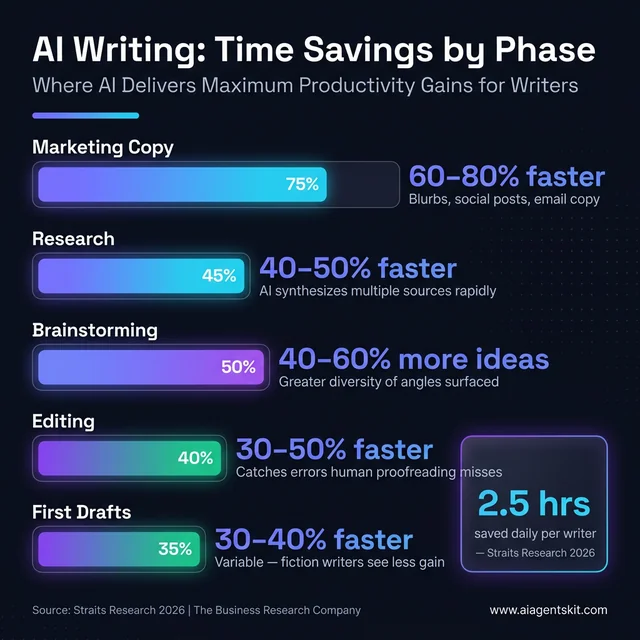 AI-driven productivity gains in 2026: Marketing copy and research see the most dramatic time savings (up to 80%), while first drafting and creative fiction remain more human-dependent, typically yielding 30-40% faster outputs when used as a collaborative starting point.
Which AI Writing Tools Actually Deliver Results?
Not all AI writing tools are built equal, and the right choice depends heavily on what type of writing you do. Here’s a clear-eyed breakdown organized by use case.
General-Purpose AI Models for Writers
The major AI models have become sophisticated enough that most writers should understand their distinct strengths before choosing a primary tool. For a detailed head-to-head breakdown, see comparing today’s leading AI models.
ChatGPT (GPT-5) remains the most versatile option:
- Strong at brainstorming, outline development, and transitional writing
- Voice mode lets writers talk through ideas — many find this more natural than typing
- Excellent for business and marketing copy where speed matters over stylistic precision
- GPT-5’s context window handles documents up to 128K tokens
Claude 4 (Sonnet and Opus) is arguably the strongest choice for serious long-form writers:
- 200K context window (expandable to 1M) — can hold an entire manuscript in mind simultaneously
- Significantly better at preserving stylistic nuance than generalist models
- Writers upload three to five samples of their own work, ask Claude to continue “in this voice” — results are noticeably more style-accurate than other models
- Particularly strong for literary, essay, and journalistic writing
Gemini 3 (Google’s current model family) offers:
- Deepest research integration — searches the web natively while writing
- Native integration with Google Docs for writers already in that ecosystem
- Strong multimodal capabilities: generate images alongside text from the same prompt
- Best choice for research-heavy non-fiction projects
Llama 4 (Meta, open source) deserves mention for writers with privacy concerns:
- Runs locally on your machine — nothing leaves your device
- Highly customizable for writers wanting fine-tuned, specialized models
- Requires more technical setup than hosted services
Fiction Writing AI Tools
General-purpose models handle many tasks, but fiction writers often find specialized tools deliver meaningfully different results.
Sudowrite remains the standout for literary fiction:
- Custom model trained specifically on prose fiction — outputs that sound like fiction, not marketing copy
- “Story Engine” guides the entire drafting process from premise to chapter completion
- “Describe” feature generates multi-sensory scene descriptions from minimal input
- Pricing: $19–$89/month depending on word limit
NovelCrafter is the best choice for series writers managing complex story worlds:
- “Codex” feature tracks characters, locations, lore, and timelines — catches consistency errors automatically
- Highly flexible prompting for writers who want precise control
- Pairs well with Inkshift for developmental manuscript critique
- Pricing: ~$19/month
NovelAI performs particularly well for fantasy and speculative fiction:
- Trained on genre-specific fiction — understands genre conventions deeply
- Maintains consistent world-building voices across long projects
- Pricing: $10–$25/month
AI Writing Tools Comparison
| Tool | Best For | Key Strength | Price Range |
|---|---|---|---|
| ChatGPT (GPT-5) | General writing, marketing copy | Versatility, voice mode | Free–$20/mo |
| Claude 4 | Long-form, style matching | Context window, voice accuracy | Free–$20/mo |
| Gemini 3 | Research-heavy writing | Real-time research, Google Docs | Free–$20/mo |
| Sudowrite | Literary fiction | Prose quality, scene understanding | $19–$89/mo |
| NovelCrafter | Complex series fiction | Story bible, consistency tracking | $19/mo |
| NovelAI | Fantasy/speculative fiction | Genre-specific model | $10–$25/mo |
| Grammarly | Grammar and style | Universal integration, real-time | Free–$30/mo |
| ProWritingAid | Manuscript-level editing | Pacing, dialogue, deep analysis | $10–$30/mo |
| Hemingway Editor | Readability | Simplicity, clarity scoring | One-time $20 |
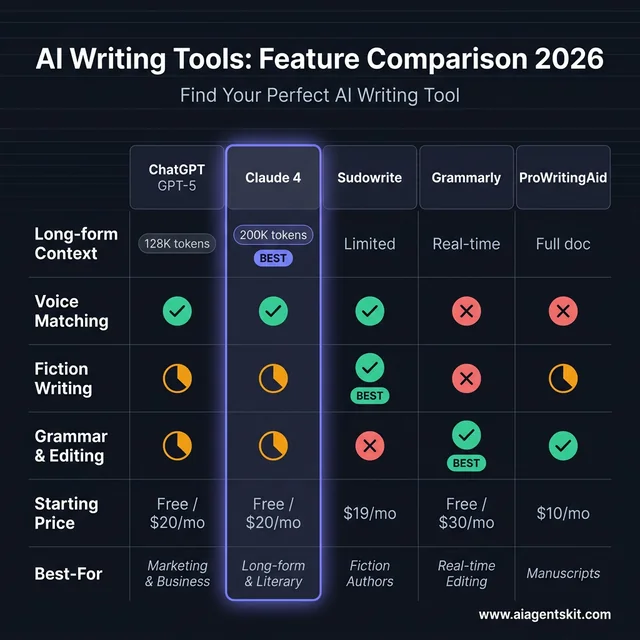 2026 AI writing tool showdown: Claude 4 leads in long-form context and voice accuracy, making it the premier choice for novelists, while Sudowrite remains the gold standard for genre-specific fiction prose. General tools like ChatGPT offer the best versatility for broad marketing tasks.
5 AI Writing Workflows by Writing Type
The biggest gap in most AI writing guides is treating “writing” as a monolithic activity. It isn’t. A novelist’s workflow is fundamentally different from a content marketer’s or an academic researcher’s. Here are optimized workflows for five main writing types.
Content Writing and Blogging Workflow
Content writers face a volume challenge — producing consistent, high-quality articles at scale. AI handles the parts that don’t require specific subject-matter expertise. For tool recommendations tailored to content work, see AI writing tools compared.
Research phase (40% faster):
- Use AI to summarize competitor articles and identify what’s missing from existing coverage
- Generate lists of questions real readers ask — cross-reference with Google’s PAA boxes
- Ask AI to identify what angle no existing article takes on the topic
Outline phase (50% faster):
- Describe topic, audience, and desired angle to the AI
- Request three structural variations — choose the strongest elements from each
- Lock in headings before drafting (changing structure mid-draft is expensive)
Drafting phase:
- Write the introduction yourself — this sets the voice for everything that follows
- Use AI to expand bullet points into paragraphs
- Generate examples or analogies for technical concepts
- Key caution: AI-expanded content requires heavy editing for SEO specificity — generic expansions often lose the precise keyword intent that drives search traffic
Editing phase:
- Grammar and clarity pass with Grammarly or Hemingway
- Ask AI: “What arguments in this piece are weakest, and what would strengthen them?”
- Generate multiple headline variations, then apply editorial judgment to select
Fiction and Creative Writing Workflow
Fiction writers have the most complex relationship with AI because voice and originality matter more than speed. This workflow protects voice while using AI for the zones where it genuinely helps.
Brainstorming (freely usable):
- Generate “what if” scenarios for plot development without premature commitment
- Explore character backstory variations — find the one that feels authentic
- Test structural experiments: what happens if this chapter moves earlier?
Story bible creation (useful):
- Build consistency documents — Codex entries in NovelCrafter, or structured notes in Claude
- Generate names, locations, and world-building details that match the world’s internal logic
- Create timeline documents to prevent continuity errors across long projects
Scene drafting (use carefully):
- Write a rough scene sketch — even 100 words of your own work
- Ask AI to expand with sensory detail or provide an alternative version
- Rewrite the output completely in your voice — treat AI output as notes, not draft
- Any passage that isn’t fully rewritten will stand out to skilled readers
Dialogue (minimal AI use recommended):
- Character voice is the hardest thing for AI to get right — it averages all speaking patterns
- AI dialogue tends toward theatrical predictability
- Use only for placeholder dialogue you intend to fully rewrite in revision
Editing:
- ProWritingAid for pacing analysis across chapters
- Ask Claude to identify inconsistencies in character behavior or timeline logic
- Never let AI “correct” deliberate stylistic choices — disable generic grammar rules for fiction
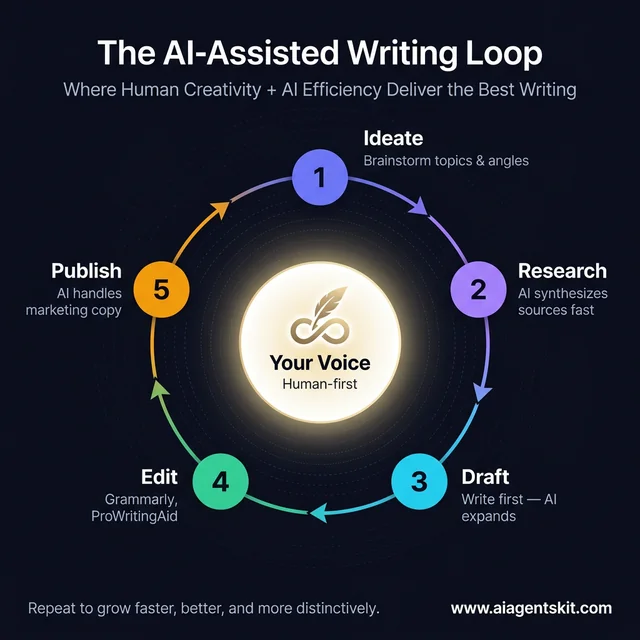 The human-centric AI writing loop: By keeping “Your Voice” at the center, writers can leverage AI for research and initial drafting without losing their unique perspective. This circular flow ensures that human judgment controls the ideation and final publishing phases for maximum impact.
Academic and Research Writing Workflow
Academic writers face unique challenges: citation requirements, precision standards, and institutional policies on AI use. For literature search and citation tasks, AI research tools have become genuinely essential.
Literature review (high AI value):
- Elicit finds relevant papers and extracts key findings — dramatically faster than manual database searching
- Use AI summaries to triage papers before reading in full
- Ask Claude to identify citation networks and summarize the state of debate on your research question
Argument testing:
- Present your thesis to an AI and ask it to steelman the strongest counterarguments
- Identify logical gaps before a committee or peer reviewer does
- Test whether your evidence actually supports your conclusion or only partially supports it
Drafting (limited — institutional policies vary):
- Most institutions now require disclosure of AI assistance; check your specific policy
- Write core arguments yourself — original analysis is where academic value lies
- AI is safest for connecting paragraphs, transitions, and boilerplate methodology text
- Critical warning: AI has a documented tendency to hallucinate specific citations — never use AI-generated references without independent verification
Citation formatting:
- AI handles citation formatting consistently and quickly
- Cross-reference every cited paper — bibliographic details must be verified from the original source
Business and Professional Writing Workflow
Business writing prioritizes speed and clarity over artistic distinction. AI delivers its clearest ROI here — the AI productivity tools that save hours are genuine transformations for professional communicators.
Email and communications (70-80% faster):
- Draft routine emails from three to five bullet points
- Adjust tone for different audiences: executive summary, technical detail, client-facing explanation
- Generate multiple versions for A/B testing high-stakes communications
Reports and documentation (60% faster):
- Use AI to structure complex information into readable, scannable sections
- Generate executive summaries from longer documents or meeting transcripts
- Maintain consistent formatting throughout multi-section documents
Proposals and pitches:
- Expand outline bullets into persuasive paragraphs with logical progression
- Ask AI to anticipate and preemptively address objections a skeptical reader would raise
- Customize templates for client-specific concerns and industry language
The practical rule: Create a “voice guide” prompt describing your organization’s communication style. Prepend it to every content generation request to avoid AI defaulting to its generic professional register.
Screenwriting and Script Workflow
Screenwriting presents distinct challenges: formatting conventions, dialogue naturalism, and balancing character voice with structural momentum.
Story structure (AI strength):
- Test beat sheet variations against three-act or Save the Cat structures
- Identify pacing issues in treatment documents before drafting full scenes
- Generate logline variations from premise descriptions to test which framing resonates
Scene descriptions (useful, requires rewrite):
- AI generates functional scene description quickly
- Must rewrite for cinematic specificity — AI tends toward generic visual language
- More reliable for exterior scenes; less reliable for nuanced interior visual storytelling
Dialogue (scratch material only):
- Generate rough dialogue as placeholder — treat as scratch, never as draft
- Final dialogue must always be human-written; AI averages speaking patterns across all influences
- Character-specific voice requires human writing that knows this character specifically
AI for Journalists and Newsroom Writers
Journalism has some of the most demanding accuracy requirements of any writing profession, which means AI use must be more deliberate — and more restricted — than in other fields.
Where AI genuinely helps newsrooms:
- Document analysis: Claude 4’s 200K context window reads entire court documents, regulatory filings, and leaked records faster than any human. Reporters feed in a 400-page document and ask Claude to surface the most significant passages relevant to a specific story angle
- Transcription: Otter.ai and Fireflies convert interviews to text in minutes, leaving more time for analysis than transcription
- Research synthesis: Perplexity for fast fact-checking during breaking news — it cites sources alongside answers, making verification faster
- Headline and intro variations: AI generates 10 angle variations from a set of facts; reporters choose the strongest or use them as creative springboards
The non-negotiable red lines:
- Never use AI to generate quotes attributed to real people — fabricated quotes are a fundamental journalistic breach
- Never summarize eyewitness or source accounts through AI without direct human verification
- Always verify every AI-generated fact independently — AI confidently presents falsehoods at the same pace it presents truths
Major news organizations including the Associated Press, Reuters, and BBC have explicit AI use policies. Check organizational policy before deploying AI in any reporting workflow.
AI for UX Writers and Technical Writers
UX writers and technical writers face different challenges: precision, consistency across large documentation sets, and adherence to style guides that can run hundreds of pages.
High-value AI applications:
- UI microcopy generation: Given a feature description and brand voice guide, AI generates button labels, error messages, onboarding copy, and tooltip text with high consistency — then A/B variation sets for testing
- API documentation: AI drafts technical documentation from code comments and function signatures. Engineers describe what a function does; AI produces the reference documentation structure. Requires thorough technical review before publishing
- Style guide enforcement: Feed the complete style guide into Claude’s context alongside new copy and ask: “Identify every place this copy violates the style guide, with specific rule citations.” Catches violations faster than manual review
- Localization preparation: AI flags idioms, cultural references, and constructs that translate poorly before the localization process begins
Tools: Claude 4 for long document consistency, Notion AI for documentation environments, Grammarly Business for enterprise-wide tone enforcement
AI for Social Media Writers
Social media writing is high-volume, platform-specific, and turnover-intensive — exactly where AI delivers strong ROI. The challenge is preventing AI’s homogenizing tendency from making brand social accounts sound identical to every other brand.
Platform-specific content strategy: LinkedIn rewards substantive professional insights; Instagram rewards visual storytelling with emotional hooks; X/Twitter rewards compression and provocation; TikTok captions require trend awareness that AI rarely has. A single social media AI prompt must specify platform, because the same information needs completely different treatment on each.
Content repurposing pipeline:
- Publish one long-form piece (blog post, newsletter, podcast episode)
- Feed it to AI with platform-specific briefs: “From this article, write a LinkedIn post highlighting the counterintuitive finding, 150 words. Then write a Twitter thread of 7 tweets covering the main argument. Then write 3 Instagram caption options with hooks in the first line.”
- Human review for engagement hooks, brand-specific personality, and cultural relevance
- Add the observation, topical tie-in, or personality element only the brand can add
Specialized tools: Lately.ai (purpose-built for repurposing long-form to social), Buffer AI (scheduling + copy generation), Metricool (content planning with AI suggestions)
The standard that distinguishes performing AI social content from generic AI social content: every post needs one element AI couldn’t have generated — a current cultural reference, a brand-specific in-joke, a specific observation from real experience.
How to Use AI Without Losing Your Writing Voice
The single biggest risk with AI-assisted writing is homogenization — prose that’s technically competent, clear, and in no way distinctive. Recognizing this risk early is half the solution.
The homogenization pattern to recognize: AI trained on enormous text volumes regresses toward the statistical center of all writing — competent, pleasant, forgettable. It uses slightly elevated vocabulary without specificity. It hedges when a sharp opinion would serve better. It explains when a precise observation would resonate more.
The test for any AI output: “Could any other writer covering this topic have produced this sentence?” If yes — rewrite it until the answer is no.
Practical techniques for voice preservation:
1. Write first, expand with AI The most reliable method: produce rough drafts first, then use AI to expand specific passages needing development. The reverse — generating with AI, then editing — produces AI-voiced content that’s expensive to fully reclaim.
2. Voice training via sample upload Claude 4 and GPT-5 accept sample uploads. Provide three to five excerpts of your strongest writing and ask the model to “continue in this exact voice, including these specific tendencies.” Results are measurably better than using AI cold.
3. Maintain section-by-section control Never hand an entire document to AI. Working section by section keeps writers’ perspective on whether the total piece is voice-consistent. AI working on an isolated section loses the thread of what preceded it.
4. Regular AI-free writing sessions Writing entirely without AI at least weekly serves two purposes: it maintains the compositional skill itself, and it generates raw writing material — not influenced by any AI output — useful for replenishing voice training samples.
5. Identify and protect your “human tells” Name three stylistic characteristics of your writing that AI consistently gets wrong. These might be specific vocabulary choices, unusual sentence rhythm, or a characteristic type of analogy. Actively preserve these in every AI-assisted piece.
AI Editing Tools That Catch What You Miss
If there’s one category where AI delivers unambiguous value for writers of every type, it’s editing. AI-powered editing tools catch errors human proofreading misses, identify patterns invisible to writers in their own work, and provide feedback at a speed that previously required professional editor rates.
For a practical introduction, ChatGPT for writing covers editing workflows in detail alongside drafting techniques.
The Layered Editing Approach
Layer 1: Grammarly (real-time, fast) Run first for grammar, spelling, and clarity. Grammarly’s real-time suggestions catch mechanical errors as you write. GrammarlyGO adds generative capabilities — useful for rephrasing awkward sentences in context without leaving the document.
Layer 2: Hemingway Editor (readability) Second pass for complexity and clarity. Hemingway scores reading difficulty, flags overly complex sentences, and identifies passive voice overuse. A score of Grade 7-9 performs well for most web content; literary fiction can legitimately run higher.
Layer 3: ProWritingAid (manuscripts and long-form) For manuscripts and long-form content, ProWritingAid’s report system catches:
- Overused words and phrases across the entire document (not just locally)
- Pacing variation across chapters — shows where narrative slows structurally
- Dialogue tag analysis and variety assessment
- Clichés, sticky sentences, and repeated paragraph openers
Layer 4: AI assistant targeted editing prompts After mechanical editing, use Claude or GPT-5 for structural review:
- “Identify the three weakest arguments in this piece and explain the specific weakness in each”
- “Where does this section lose momentum, and what would restore it?”
- “Read this as a skeptical editor — what questions did I leave unanswered?”
The core insight: AI assistants work better as editors than as generators for most writers. Useful generation requires overcoming barriers of voice and specificity; useful critique only requires reading finished text.
AI for Freelance Writers: Income, Rates, and Opportunities
The freelance writing market is experiencing a genuine structural shift. AI hasn’t eliminated freelance writing — it has bifurcated the market. Writers who’ve integrated AI tools are out-earning and out-producing those who haven’t, while the bottom tier of commodity writing work is contracting.
The income picture in 2026: ZipRecruiter reports that AI writers in the United States earn an average of $87,111 per year as of early 2026. On Upwork, freelancers performing AI-related writing tasks earn 40% more on average than peers doing equivalent writing work without AI. AI Prompt Consulting — building and refining prompt libraries for businesses — has emerged as a standalone service category, with rates typically running $80–$175 per hour.
The market disruption that’s real: Research from Washington University documents a 21% decline in job postings for automation-prone writing work since 2023 — specifically templated copy, low-complexity product descriptions, and formulaic content. Writers whose work sits in those categories face genuine revenue pressure.
The market that’s growing: Specialized content requiring subject-matter expertise, original research, specific audience knowledge, and human creative judgment is growing, not shrinking. The premium for writing that AI cannot replicate — first-person reported journalism, memoir, deeply technical domain expertise, narrative non-fiction — has increased relative to commodity content.
Three income models for AI-assisted freelancers:
- Volume model: Use AI to write faster, take on more clients at existing rates. A writer who produces 2 articles at $500 each per day produces 4–6 with AI assistance. Same quality floor, same rates, double or triple revenue
- Upgrade model: Use AI efficiency to spend more human time on the highest-value elements per piece — deeper research, more original angles, stronger voice. Charge premium rates for demonstrably superior output
- Service expansion model: Offer services AI makes newly possible: AI content audits (reviewing clients’ AI output for quality and voice), prompt library development, AI-assisted content strategy
The critical mistake to avoid: Reducing rates because AI speeds delivery. Clients don’t pay for hours — they pay for results. Speed is the freelancer’s gain, not the client’s discount. Raise rates or maintain them; never lower them because AI made work faster.
Ghostwriting with AI: AI is well-suited to ghostwriting — capturing a client’s voice from samples and maintaining it across long projects. The ethical standard: never disclose client content to AI platforms without understanding the platform’s data handling. Use privacy-focused options (Claude’s privacy mode, local Llama 4 deployments) for sensitive client material. For a complete breakdown of tools that maximize the AI freelancer productivity stack, see the dedicated guide.
AI for Self-Publishing Authors: Complete Book Writing Workflow
Self-publishing has undergone a structural transformation. AI has made the entire path from manuscript to published book dramatically faster — and flooded the market with the results. The authors succeeding in 2026 are those who use AI to work faster without losing the human depth that distinguishes books worth reading.
The Human Sandwich method: The workflow pattern that consistently produces the strongest self-published work uses AI in the middle, not at the edges:
- Human ideation: Concept, characters, emotional arc, thematic core — all human. This is the irreplaceable foundation
- AI drafting and expansion: AI fleshes out scenes from human-written outlines, generates descriptive passages from sparse notes, expands dialogue into complete exchanges, and maintains worldbuilding consistency
- Human polish: The author rewrites AI output with their voice, emotional intelligence, and lived experience — transforming AI scaffolding into the real book
The purpose-built self-publishing toolkit:
- AuthorFlows: Story analysis, outline generation, character/location/timeline systems built specifically for book-length projects. More structured than general AI for authors who need project management alongside writing
- Squibler: Transforms story ideas into full manuscripts with AI assistance and built-in project management. Strong for novelists and screenwriters who need integrated organization
- AutoCrit: Compares manuscripts against bestsellers in the specific genre, identifying where a manuscript’s pacing, dialogue density, and showing vs. telling ratios diverge from market standards. Uniquely useful for writers trying to understand genre expectations objectively
- Atticus: Combines drafting features with professional book formatting for Amazon KDP, IngramSpark, Kobo, and other platforms. Replaces both your writing environment and your layout software
The full self-publishing AI workflow:
- Concept + high-level outline (human only — AI cannot generate the original premise that makes a book worth reading)
- Research (Elicit for non-fiction source gathering; Perplexity for fast fact-checking; Claude with web search for background synthesis)
- Chapter-level outline (human writes; AI suggests what’s missing, flags structural problems, tests logical flow)
- First draft (AI expands chapter outlines into prose; human reviews and flags passages that don’t work before moving forward)
- Deep revision (ProWritingAid for pacing and style analysis; AutoCrit for genre comparison; Grammarly for mechanical)
- Formatting (Atticus produces professional print-ready and ebook files simultaneously)
- Cover design (Midjourney for concept exploration; human designer for finished cover — fully AI covers still signal indie quality problems to experienced readers)
- Marketing (AI for blurbs, back-cover copy, social media launch content, Amazon description A/B variants; Gamma converts chapters into lead magnets and reader workbooks)
The market saturation reality: AI has compressed the time from idea to published book from years to months. The market has responded — quality signals matter more than ever. Reviews, author platform, series consistency, and production quality are the differentiation factors. More books in the market means readers have higher selectivity, not lower.
Prompt Engineering for Writers: Getting 3× Better AI Output
Prompt engineering has shifted from a technical curiosity to a core professional skill for writers who use AI regularly. The output quality difference between a well-constructed prompt and a vague one is often larger than the difference between AI tools. Better prompting is free; it just requires understanding what AI models respond to.
Why prompting matters more than most writers realize: AI models don’t have preferences or judgment about what a writer needs — they pattern-match from the input provided. A vague prompt produces statistically average output because average is all the model can infer from limited information. A specific, constrained, context-rich prompt narrows the output space to exactly what the writer needs.
The 5 prompt structures every writer should master:
1. The Role + Context prompt Structure: “Act as [specific persona]. The audience is [specific description]. The goal is [specific outcome]. The tone should be [descriptor].” Effect: Shapes voice, expertise level, assumed reader sophistication, and framing simultaneously. Dramatically outperforms open-ended “write about X” prompts.
2. The Constraint prompt Structure: “Write [X]. DO NOT use [specific words]. DO NOT exceed [specific length]. Avoid [specific pattern]. Never [specific behavior].” Effect: Prevents the generic defaults AI falls back to — elevated vocabulary without specificity, passive constructions, hedge phrases, overuse of transitional clichés. Constraints force specificity.
3. The Voice Sample prompt Structure: “Match this writing sample exactly — rhythm, diction, sentence length patterns, tone, and the specific tendencies shown: [paste 150–250 words of your own strongest writing]. Now write [new content] in this voice.” Effect: The single most powerful voice preservation technique available. Claude 4 and GPT-5 both respond exceptionally well to sample-based voice training. Results are measurably more style-accurate than any other technique.
4. The Iterative Refinement prompt Structure: “This draft is 70% there. [Specific praise — what to keep]. Now: make it [more X / less Y]. Remove [specific element]. Don’t change [protected element]. The goal is [outcome].” Effect: Layered refinement produces output that would be unrecognizable from the first draft. Each round narrows the output toward the writer’s actual vision. Most writers stop too early — three refinement rounds typically produce dramatically better results than one.
5. The Critique-First prompt Structure: “You are a harsh, experienced editor reading this with fresh eyes. Identify the 3 specific weaknesses in this paragraph. DO NOT rewrite anything yet — only diagnose the problems and explain exactly why each is weak.” Effect: Separates diagnosis from prescription, which prevents AI from making changes before the writer understands the problem. Forces the model to adopt an analytical stance rather than a generative one — and the diagnoses are often sharper than the rewrites.
Building a personal prompt library: Save every prompt that produces consistently strong output. Organize by task type: brainstorming prompts, voice-matching prompts, editing prompts, outline prompts, marketing copy prompts. A library of 20–30 battle-tested prompts removes the friction of rebuilding effective prompts from scratch. Share prompt libraries across writing teams — they compound in value with each improvement.
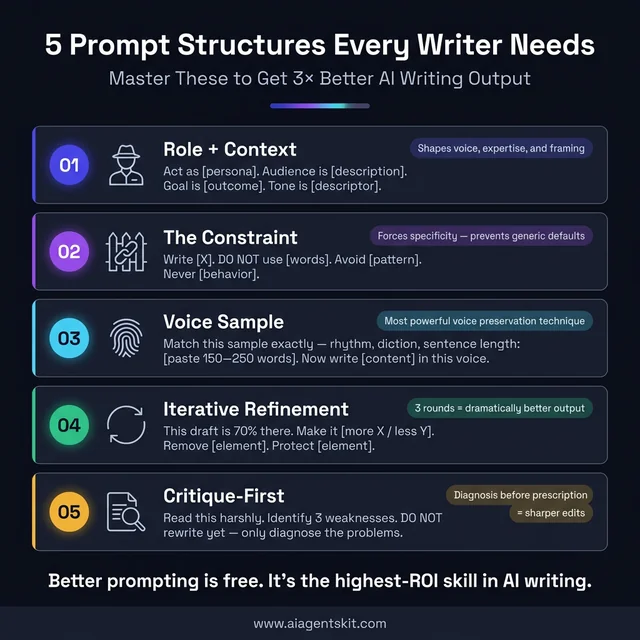 Mastering the architectural layer of AI writing: Using specific prompt structures like “Voice Sample” and “Constraint” allows writers to bypass generic AI defaults. These techniques transform a generic chatbot into a precise thinking partner that respects your specific dictation and rhythmic style.
The skill ceiling: Unlike most software, there’s no ceiling on prompt improvement. Writers who invest in prompting skill continuously get better results from the same tools — making it one of the highest-ROI skills to develop in 2026.
AI for Writers: Publishing and Marketing Phase
Writing the manuscript is half the work. Publishing, marketing, and distribution have historically required skills most writers don’t have — design, marketing, audio production. AI has substantially lowered those barriers.
Book formatting: Tools like Atticus produce professional print and ebook layouts without design software knowledge. What once required formatting specialists now takes hours. Export to Amazon KDP, IngramSpark, Kobo, and other major platforms is built-in.
Marketing asset generation: The most underutilized AI application for writers is marketing copy. Back cover descriptions, Amazon blurbs, series taglines, and social media content for book launches are tasks AI handles very well. Feed the AI a manuscript summary, target reader description, and comparable titles — it generates multiple marketing copy variants in seconds, ready for human selection and refinement.
AI audiobook narration: AI voice synthesis crossed a meaningful quality threshold in 2026:
- Multiple voice options with distinct character registers
- Emotional range sufficient for most fiction genres
- Cost: roughly $50–$200 per finished audiobook hour (human narrators: $400–$500/hour)
- Turnaround: days instead of weeks
AI narration isn’t preferred for premium titles where narrator performance is part of the value. But for midlist and backlist titles, or authors publishing directly, the ROI is increasingly clear.
SEO for writer websites: Writers with content marketing needs — bloggers, non-fiction authors building platform, journalists — benefit from AI for:
- Metadata optimization (title tags, meta descriptions)
- Content gap analysis against competitors
- Social distribution post variation and scheduling
AI Writing Tools for Students
Students represent one of the largest and most conflicted audiences for AI writing tools. The fundamental tension: AI can help students learn and produce better work, or it can replace the learning process entirely — and the line between those outcomes is often invisible until grades or knowledge gaps surface later.
Uses that genuinely help without undermining development:
- Grammar and clarity editing: Grammarly’s free tier catches mechanical errors and suggests clearer phrasing. This is equivalent to asking a teacher to review a draft — the student still writes the content
- Research synthesis: Google’s NotebookLM converts uploaded papers and readings into interactive study guides, summaries, and question-answer pairs. Dramatically more efficient for literature review than re-reading everything from scratch
- Outline development: Give AI a topic and thesis, ask it to generate 5 different structural approaches. The student chooses, combines, and builds — AI provides scaffolding options, not the finished architecture
- Counterargument testing: “What are the strongest arguments against this thesis?” — one of the most valuable academic writing exercises. AI generates counterarguments consistently and quickly; the student addresses them in the essay
- Citation formatting: Tedious and error-prone when done manually. AI handles APA, MLA, Chicago, and other formats accurately, though every citation must be verified against the original source
Uses that typically violate academic integrity:
- Generating essay text, conclusions, or interpretive analysis presented as the student’s own work
- Producing answers to graded assignment questions
- Creating research summaries presented as having read the original sources
The institutional policy landscape: Most universities and many secondary schools now have explicit AI policies. Policies vary significantly — some prohibit all AI use, others require disclosure, others permit AI for specific tasks. Check the specific institutional policy before assuming any AI use is permitted. When in doubt, disclose.
The skill development concern worth naming: Writing is thinking made visible. Students who use AI to avoid the struggle of drafting may produce better-looking essays while developing weaker thinking and communication skills. Regular AI-free writing practice maintains the underlying capability that AI tools are meant to augment, not replace.
AI Writing Detection, Copyright, and Ethical Considerations
As AI-generated and AI-assisted content becomes mainstream, writers face new questions about detection, ownership, and professional ethics. These questions are genuinely unsettled — the legal and institutional frameworks are still developing — but writers need to understand the current state.
How AI Content Detection Works (and Why It Often Fails)
AI detection tools analyze two primary statistical signals: perplexity (how predictable each word choice is given the preceding context — AI tends toward lower perplexity, meaning more statistically predictable word sequences) and burstiness (variation in sentence length and structure — human writing tends toward higher burstiness, with natural variation between short and long sentences; AI tends toward more uniform patterns).
The major detection tools — GPTZero, Turnitin AI Detection, Copyleaks, Originality.ai — all use variations of these signals, sometimes augmented with neural classifiers trained on known AI and human text.
The reliability problem: Multiple peer-reviewed studies have documented false positive rates of 10–15% or higher for AI detection tools. Non-native English speakers are particularly likely to be falsely flagged — their more regular sentence structures and careful word choices more closely resemble AI’s statistical patterns. Technical and academic writers face similar issues. The practical implication: detector results can suggest possible AI involvement, but they cannot prove it. Detection results are not reliable enough to serve as evidence of misconduct.
What detection tools cannot catch: AI output that has been substantially rewritten by a human often passes detection entirely. Heavily edited AI content and heavily constrained AI content (via specific prompting) produce more varied text that resembles human writing statistically. This is the correct approach anyway — AI output should be substantially edited regardless of detection concerns.
Copyright: Who Owns AI-Generated Writing?
The US Copyright Office has issued multiple rulings between 2023 and 2026 establishing a consistent position: AI-generated content without meaningful human authorship is not protected by copyright. The critical variable is the degree of human creative contribution.
Strong copyright position: A writer who drafts a rough outline, writes opening and closing sections, provides detailed content direction, and extensively rewrites AI-generated middle sections has made substantial creative contributions. That work is copyrightable — the human creative choices determine the protected expression.
Weak or no copyright position: A writer who inputs a single prompt and publishes the AI output without significant editing has not made the kind of human creative choices that copyright law requires to protect expression. That work likely has limited or no copyright protection.
Practical guidance: Write first and expand with AI second. The human creative decisions — what to say, how to structure it, which voice to use — made in the human-written drafts constitute the authorship that copyright protects. The more meaningful the human creative contribution, the stronger the copyright claim.
The training data controversy: Multiple high-profile lawsuits brought by authors and publishers against AI companies for training on copyrighted works without permission remain unresolved as of 2026. The fair use arguments made by AI companies and the copyright infringement arguments made by authors’ guilds are pending in courts. The outcomes will materially affect the legal landscape — monitor developments if this affects your publishing decisions.
The UK and EU position: Both differ from US law in specific ways. EU copyright law extends broader protection to human-AI collaborative works under some conditions. UK law is evolving. Writers publishing internationally should understand that jurisdiction matters.
Professional Disclosure Standards
Disclosure standards vary significantly by context and are still developing industry-wide:
- Academic writing: Disclosure required by most institutions; check policy and default to disclosure when uncertain
- Journalism: Major publications require disclosure of AI assistance in reporting; AI editing of prose is treated differently from AI generation of reported content
- Literary fiction: No industry standard, but literary agents increasingly request disclosure; some publishers have explicit policies
- Commercial and marketing copy: No standard requirement; AI assistance is standard practice at most agencies
- Legal writing: Many bar associations have issued guidance; check jurisdiction-specific rules
The AI Hallucination Risk for Writers
AI models generate false information with the same confident tone used for accurate information. For writers specifically, the documented hallucination patterns to watch:
- Fabricated citations: AI invents plausible-sounding academic papers with real-seeming authors, journals, and publication years that do not exist. Every citation from any AI source must be independently verified in the original database
- Invented statistics: AI generates statistics that fit the narrative being constructed, fabricating sources. Verify every number
- False quotes: AI attributes statements to real people that those people never said. Never publish AI-generated quotes about real individuals without verification
- Outdated information presented as current: AI training cutoffs mean recent developments may be unknown to the model. Verify time-sensitive claims independently
The safest approach: treat all factual claims in AI output as hypotheses to verify, not facts to publish.
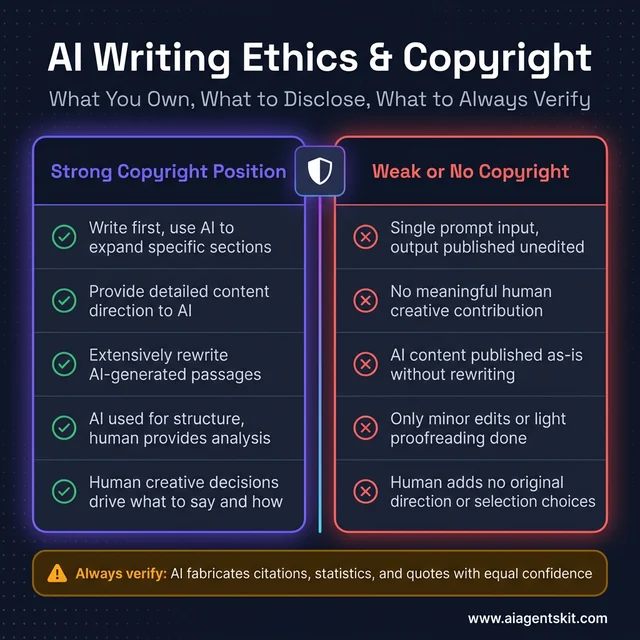 Navigating AI copyright in 2026: Maintaining a “strong copyright position” requires using AI for expansion rather than total generation. Extensive human rewriting and creative direction are the key legal differentiators that protect your intellectual property in an increasingly automated landscape.
AI for Writers: Frequently Asked Questions
Will AI replace human writers?
The evidence suggests no for most professional writing — but the economics are clearly shifting. AI decreases the cost of producing competent, functional text, which simultaneously commoditizes generic writing and increases the premium on writing that is distinctive, specific, and genuinely human. Platforms like Upwork report that freelancers performing AI-related writing tasks earn 40% more on average than peers not using AI. ZipRecruiter’s 2026 data puts the average annual salary for AI writers in the US at $87,111 — suggesting the skills to direct, edit, and improve AI output are well-compensated.
What’s being disrupted: low-complexity templated writing, formulaic product descriptions, basic SEO filler content. Research documents a 21% decline in freelance job postings for these categories.
What’s growing: specialized writing requiring domain expertise, original research, first-person reporting, narrative non-fiction, and high-stakes business communication. New roles are emerging — AI Prompt Consultant ($80–$175/hr), AI Content Strategist — that didn’t exist three years ago. Writers who combine deep subject matter expertise with AI collaboration skills are positioned well. Writers who treat writing as pure execution — words on a page with no particular expertise behind them — face genuine disruption.
Which AI writing tool is best for novelists and fiction authors?
For literary fiction where prose quality matters most, Sudowrite remains the standout — its custom model understands narrative structure and produces prose that sounds like fiction rather than marketing text. For series writers managing complex story worlds with many characters and continuity requirements, NovelCrafter offers the strongest organizational features through its Codex system. Writers who want maximum flexibility often pair a general model (Claude 4 for voice-matching, ChatGPT for brainstorming) with a specialized fiction tool for actual drafting.
How can writers use AI without losing their unique voice?
The most reliable approach: write first, expand with AI second. This means producing rough outlines, rough paragraphs, or rough scene sketches before engaging AI — then using it to expand specific sections, not generate from nothing. Additionally, upload writing samples to AI models (Claude 4 accepts this well) and explicitly ask the model to match your stylistic patterns. Treat every AI output as raw material requiring full rewrite, not as a draft requiring light editing. Writers who do heavy rewriting of AI output preserve voice; writers who do only light editing consistently lose it.
Can AI help with academic writing without violating academic integrity?
Yes, within limits that vary by institution. AI is generally accepted for: finding relevant literature (Elicit is particularly useful here), organizing research notes, testing arguments against counterarguments, formatting citations, and editing for clarity. AI is often restricted for: generating original analysis, writing conclusions or interpretive sections, and producing text presented as the student’s own work. Check institutional policies before using AI for graded work. And regardless of policy, never use AI-generated citations without independent verification — AI reliably hallucinates specific publication details.
What is the best free AI writing tool for writers?
Claude 4 Sonnet’s free tier and ChatGPT GPT-5 Mini are both genuinely useful for most writing tasks at no cost. For grammar and clarity editing, Grammarly’s free tier catches most mechanical errors. Hemingway Editor is a one-time $20 purchase. For academic research assistance, Elicit’s free tier handles basic literature search. The practical recommendation: start with Claude’s free tier for long-form work, ChatGPT’s free tier for brainstorming and marketing copy, and add paid tools selectively once you’ve identified where actual workflow bottlenecks exist.
How do I disclose AI usage in my writing?
Disclosure standards are evolving and context-dependent. Academic writing: most institutions require explicit disclosure — check policies and default to disclosure when uncertain. Journalism: major publications require disclosure; AI assistance in reporting is treated differently than AI editing of prose. Commercial and marketing copy: no standard requirement; AI assistance is increasingly standard practice. Creative writing: no industry-wide requirement, but disclosure is considered honest when AI contributed substantially to generated text. The emerging norm: disclose AI use in process or methodology notes rather than in finished text — similar to acknowledging research assistants without naming them in every sentence.
Is AI-generated content bad for SEO?
Google evaluates content quality, not production method. AI-generated content that is helpful, original, and well-structured is not penalized; AI-generated content that is low-quality, thin, or mass-produced is penalized through the same helpful content standards applied to all content. In practice: AI-assisted content that goes through substantive human editing, genuinely addresses search intent, and provides information with unique depth performs comparably to human-written content at equivalent quality levels. The risk is mass-producing low-effort AI content — Google’s helpful content systems have become increasingly effective at identifying this pattern.
How does AI help writers overcome writer’s block?
Writer’s block usually involves one of three problems: not knowing what comes next (structural uncertainty), difficulty starting a specific passage (blank-page paralysis), or motivation loss on a long project. AI addresses each differently. For structural uncertainty: describe the current situation and ask AI to generate five different directions the story or argument could take. For blank-page paralysis: ask AI to write a rough, imperfect version of the stuck passage — even a mediocre AI version provides something to react against, breaking the paralysis. For motivation: use AI as a project “accountability partner” that summarizes where you left off and identifies the next specific writing task.
How do AI content detection tools work, and are they reliable?
AI detectors analyze two primary statistical signals: perplexity (how predictable each word choice is — AI output tends toward more predictable sequences) and burstiness (variation in sentence length — human writing varies more naturally). Major tools including GPTZero, Turnitin, Copyleaks, and Originality.ai use these signals, sometimes combined with neural classifiers. The reliability problem: multiple studies document false positive rates of 10–15% or higher, meaning human-written text gets regularly flagged as AI-generated — especially from non-native English speakers and technical writers whose prose is naturally more regular. Detection results can suggest AI involvement but cannot prove it. Substantially edited AI output often passes detection entirely because the editing process restores the statistical variation that characterizes human writing.
Who owns the copyright on AI-generated writing?
Under current US Copyright Office rulings (2023–2026), AI-generated content without meaningful human authorship is not copyright-protected. The critical variable is the degree of human creative contribution. A writer who provides detailed direction, writes significant portions, and extensively rewrites AI output has made the creative choices that copyright protects. A writer who inputs a single prompt and publishes the output unedited likely has weak or no copyright protection. The safest approach: write first, use AI to expand — the human decisions about what to say, how to structure it, and which voice to use constitute the creative authorship the law recognizes. UK and EU copyright positions differ in specifics; consult jurisdiction-appropriate legal counsel for publishing outside the US.
How do freelance writers use AI to earn more without underselling their work?
The critical mistake is reducing rates because AI speeds delivery. Clients pay for results, not hours — faster delivery is the freelancer’s efficiency gain, not the client’s discount. The correct approaches: maintain rates and take on more clients simultaneously; use time saved by AI to invest more deeply in research and quality per piece, justifying higher rates; or expand into new services AI makes possible (AI content audits, prompt library development, AI-assisted content strategy). Upwork data confirms that AI-skilled freelancers earn 40% more than non-AI peers. Specialization amplifies this further — writers who combine deep niche expertise with AI capability command the highest rates. Ghostwriters handling sensitive client material should use privacy-focused AI options: Claude’s privacy mode or locally-run Llama 4 deployments where nothing leaves the device.
Can AI write social media content that actually performs well?
Yes — with important caveats about what AI does versus what humans must add. AI excels at volume (generating 20 post variations from a single brief in minutes) and format adaptation (rewriting a blog section as a LinkedIn post, then a tweet thread, then an Instagram caption). What AI cannot add: knowledge of current cultural moments and trending conversations, brand-specific personality and community in-jokes, or observations grounded in real experience. The effective formula: AI handles structure and format; humans add the specific hook, cultural reference, or personal observation that makes the post feel alive rather than generated. Tools purpose-built for social — Lately.ai (specializes in repurposing long-form to social), Buffer AI, Metricool — produce more usable social first drafts than general-purpose AI because they’re trained on engagement patterns across platforms.
Conclusion
AI has moved from experimental to essential in professional writing — not because it replaces the craft, but because it eliminates friction in the parts of writing that were never actually about craft. Research assembly, structural scaffolding, grammar checking, marketing copy generation — these were always the least creative aspects of a writer’s work. AI now handles them faster and often more thoroughly than manual effort.
What remains irreplaceable: the perspective that comes from a specific life, the instinct that tells a writer when a sentence isn’t right yet, the willingness to cut 500 words that aren’t working even though writing them took three hours. AI has no stakes in the quality of the finished work. Writers do.
Start with one tool that addresses your specific bottleneck. If research is slow, try Elicit or Claude. If editing is time-consuming, try Grammarly plus a ProWritingAid trial. If marketing copy takes too long, test ChatGPT for blurb generation. Measure actual time savings over two real weeks. For writers who want to go deeper into the technical layer, the Claude API tutorial shows how to build custom writing assistance workflows beyond what off-the-shelf tools provide.
The blank page isn’t going away. But the tools for filling it — thoughtfully, distinctively, in your own voice — are better than they’ve ever been.
Related: ChatGPT for writing | AI writing tools compared | Prompt engineering guide