AI for Law Firm Management: Complete Guide (2026)
How top law firms use AI for legal research, billing, case management, and client intake in 2026. Practical tools, workflows, vendor checklist, and implementation steps.
At a law firm partnership strategy session, a senior partner once slid a billing report across the table and pointed to a single line item. “Six hours,” he said. “Six hours to draft a motion for summary judgment — on the exact same issue we’ve handled twice this year already.” No one in the room responded, because everyone already knew: with AI drafting support, that same motion now takes closer to 45 minutes to reach a polished first draft.
That moment captures where law firms stand in 2026. The economics of legal practice are shifting faster than most partnership committees want to acknowledge, and law firm AI tools are at the center of it.
Here is the number that should end the “wait and see” debate at any firm leadership meeting: according to Clio’s 2025 Legal Trends Report, firms with wide AI adoption are nearly three times more likely to report revenue growth compared to firms without it. Among legal professionals who have widely adopted AI, 69% report a positive financial impact — compared to just 36% overall.
That is not a marginal edge. That is a structural competitive gap forming in real time.
This guide breaks down which AI workflows are delivering ROI for law firms, which tools match which practice sizes, how to evaluate and select AI vendors, how to measure success with real KPIs, and the hard conversations firm leadership needs to have — including what AI does to the billable hour model. Firms looking at AI tools for individual attorneys first will find this guide covers the next layer: how to build AI into the operating model of the practice itself.
The State of AI in Law Firms: Where the Industry Actually Stands
The headline statistic most legal professionals have heard: 79% of legal professionals use AI tools. The more revealing data lives underneath that number.
According to Thomson Reuters’ 2025 Future of Professionals Report, each lawyer expects to save an average of 190 work-hours per year by using AI — representing an estimated $20 billion in time savings across the US legal market. A separate 2025 Federal Bar Association survey found that among legal professionals already using AI, 65% saved between one and five hours per week, and 12% saved six to ten hours weekly.
By December 2025, 55% of lawyers were using AI daily or hourly — up from a negligible percentage in mid-2024. Mid-sized law firms lead adoption, with 93% reporting AI usage and 51% calling it a standard part of their operations. The ABA’s 2024 Legal Technology Survey Report (released March 2025) found that 30% of attorneys now use AI in their practice — nearly triple the 11% reported in 2023 — with large firms (100+ attorneys) leading at 46% adoption.
Yet the governance gap remains stark. Only about 21% of firms have implemented firm-wide generative AI strategies. The majority of that 79% individual usage is happening outside any formal governance or acceptable-use framework — associates using tools on personal subscriptions, sometimes with client-adjacent data, without IT awareness. The ABA survey found that 75% of legal professionals cite AI hallucination and inaccuracy as their primary barrier to adoption — underscoring why governance infrastructure matters as much as the tools themselves.
That gap between individual adoption and firm-level strategy is where the real risk — and the real competitive opportunity — currently lives.
Gartner projects LLMs will boost legal department productivity by 10–20% within the next two to five years — a greater impact than any previous legal technology cycle — and forecasts the legal tech market will expand to $50 billion by 2027, nearly doubling from $23 billion in 2022. Separately, Gartner predicts that by 2026, 70% of corporate legal teams will be leveraging AI and contract lifecycle management platforms as standard operational infrastructure. And the efficiency advantage compounds: Clio’s report found that growing law firms doubled their revenue over four years with only a 50% increase in clients and matters — they became dramatically more efficient per matter.
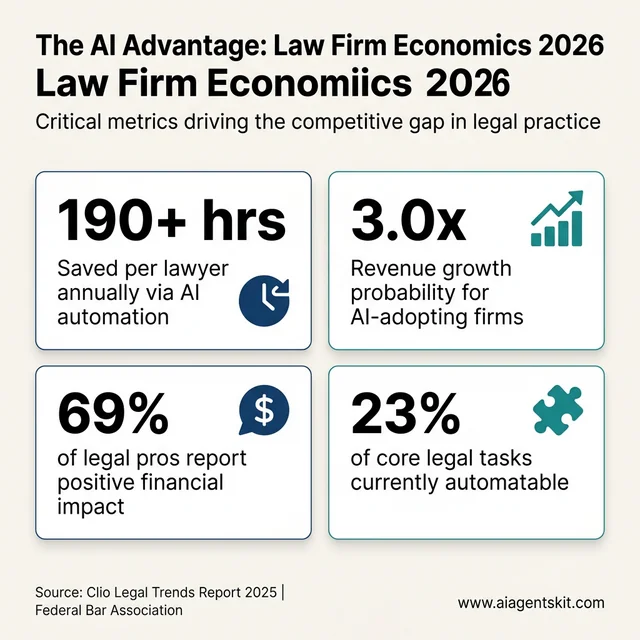 The AI economic divide: Adopting firms are seeing 3x revenue growth probability and saving nearly 200 hours per lawyer annually.
What Law Firm AI Actually Does (And What It Doesn’t)
Significant vendor hype surrounds legal AI right now. A clear-eyed look at where AI actually earns its keep serves firm leadership better than marketing language.
Where AI genuinely delivers:
- Synthesizing and summarizing large volumes of case law, statutes, and regulatory materials
- Reviewing and flagging contract clauses against standard or custom templates
- Generating first-draft motions, agreements, and correspondence from structured intake data
- Transcribing and summarizing depositions, client calls, and hearings
- Analyzing e-discovery documents at scale
- Identifying missed billable time through passive work activity analysis
- Automating client intake qualification and CRM follow-up sequences
Where AI reliably falls short:
- Legal arguments requiring genuine novel strategic thinking
- Empathetic client communication during emotionally difficult matters
- Courtroom advocacy and judge-specific litigation strategy
- Reading between the lines of what a client’s real underlying problem is
- Ethical judgment calls under genuine professional uncertainty
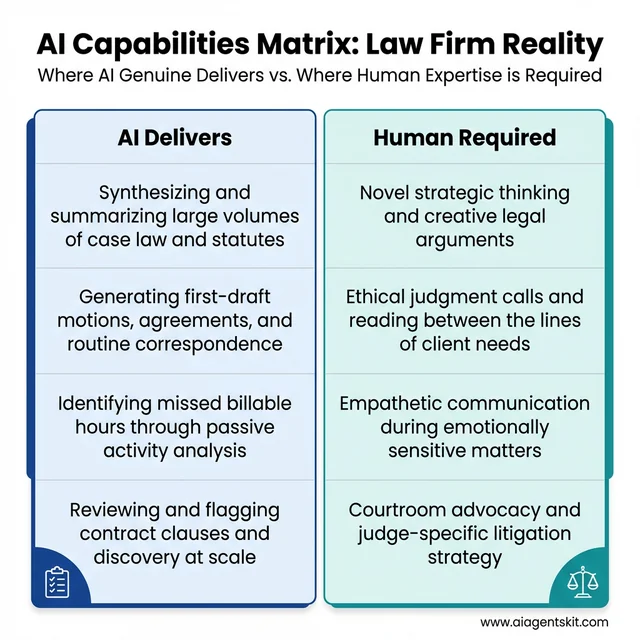 The Law Firm AI Matrix: High-volume processing and drafting are best handled by AI, while strategic judgment and advocacy remain uniquely human.
The AI Hallucination Problem in Legal Practice
The hallucination problem deserves more serious attention than it currently receives across the profession.
AI language models confabulate. They generate confident, detailed, plausible-sounding information that is simply not accurate. Well-documented cases — several receiving national press attention — involved attorneys filing briefs citing cases that AI fabricated wholesale. Real-sounding case names, real jurisdictions, real dates. Completely invented. The attorneys whose names appeared on those filings faced significant professional and financial consequences. Bloomberg Law’s analysis found that as of 2025, AI hallucination-related errors have appeared in filings across at least a dozen federal jurisdictions, with sanctions ranging from reprimands to five-figure monetary penalties.
The mitigation is non-negotiable: every legal authority cited in any AI-generated work product must be verified against primary sources before it moves beyond internal drafts. Westlaw, LexisNexis, Bloomberg Law — every time, without exception. Implementing strong AI security and accuracy verification protocols across legal teams is part of responsible deployment at any firm.
AI research output functions like a highly confident first-year associate’s memo: impressive synthesis, occasionally fabricated citation. The partner verifies before signing off. That principle does not change because the associate is an algorithm.
The 5 High-Impact AI Workflows for Law Firms
These five workflows are delivering the strongest, most measurable return on investment for firms currently using AI tools. McKinsey’s Global Institute estimates that 23% of a lawyer’s core tasks can be automated with current AI technology — and that figure rises notably when document-intensive workflows like contract review and discovery are included. For law firms, that 23% represents an enormous pool of recoverable time.
1. Legal Research and Case Analysis
Casetext CoCounsel (Thomson Reuters, used by over 10,000 law firms) and Lexis+ AI enable natural language research queries. Instead of building Boolean search strings and reviewing dozens of partially relevant results, attorneys ask: “What is the current Eighth Circuit standard on adverse possession claims involving landlocked parcels since 2020?” and receive a structured synthesis with citations to verify.
Research that historically required 6–8 hours for a complex question now reaches a credible working foundation in 30–45 minutes. Harvey AI sits at the top of the enterprise market — purpose-built for legal work, trained on substantial legal corpora, and integrating with existing document management systems.
The critical discipline regardless of tool: AI narrows the territory faster. The judgment about which cases are controlling, how they apply to specific facts, and what arguments they support belongs entirely to the attorney.
2. Client Intake and Lead Management
Lawmatics has built the most capable intake-specific platform in this space — AI-powered intake forms, automated lead qualification, follow-up sequences, and a CRM built specifically for law firm dynamics. When a prospective client submits a contact form at 11 PM, the platform qualifies the inquiry, collects structured data, and schedules a consultation before any staff member touches it.
For contingency and volume-based practices, speed to first meaningful contact is a primary driver of client conversion. The firm that responds within minutes consistently wins against the firm responding the following morning.
3. Contract Review and Due Diligence
Luminance, Litera Kira, and eBrevia can ingest hundreds of contract pages and flag clause variations, unusual provisions, and risk areas in the time a paralegal team would read the first 50 pages.
For M&A deal teams running buy-side diligence across 400 vendor contracts, the efficiency math is difficult to overstate. Senior associate and partner time concentrates on highest-risk anomalies. The human review layer cannot be eliminated, but as an acceleration and triage tool, this technology has reached genuine practical utility.
4. Document Drafting and Automation
Spellbook and LawGeex convert structured intake data and prior pleadings into intelligent first drafts. Clio’s document automation generates templated documents — retainer agreements, discovery requests, standard form motions — triggered by matter type using client data already in the system.
The appropriate framing: AI handles the architectural draft. The attorney provides the professional work — reviewing, applying legal judgment, catching what AI missed, and putting their professional reputation on the final product.
5. Time Tracking, Billing, and Practice Management
Revenue leakage from unbilled time is one of the most consistently underestimated problems in law. Clio’s 2025 data shows lawyers currently collect 93% of billed time — meaning 7% of what gets billed is written off or waived, before counting hours never entered at all.
A rapidly expanding category of AI legal billing software addresses this gap:
- Clio Manage AI — Analyzes activity patterns across email, documents, and calls to suggest time entries for unlogged work. Passive capture rather than active tracking.
- SmartTime by BigHand — Creates AI-generated timesheets from background activity monitoring. Attorneys review and finalize rather than build from scratch.
- Billables AI — Automatically tracks billable hours across Microsoft 365, Teams, Adobe, Chrome, and Zoom. Aims to reduce billing administration to under one hour per month.
- Laurel — AI-powered timekeeping using Smart Work Coding™ that captures and organizes billable activities with minimal review burden.
- MagicTime by Lawgro — Captures billable minutes in the background and builds draft timesheets for review, with direct Clio integration.
- Smokeball — Auto-time capture tied directly to documents, with matter-centric billing and profitability reporting.
Gartner projects that over half of legal billing work will be automated within the near-term planning horizon — making automated time tracking one of the highest-ROI investments available at any practice size.
The same AI-driven operational transformation visible in accounting firms adopting AI is accelerating in law — efficiency gains at the workflow level compound when they reach billing models built around time.
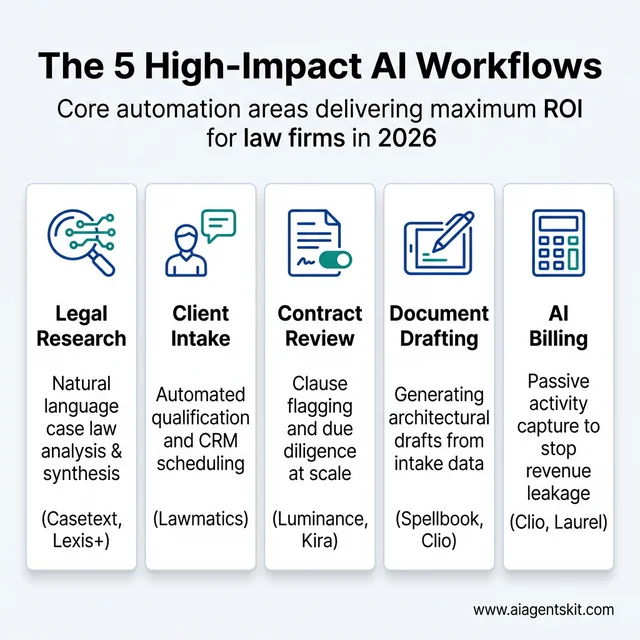 The 5 core AI workflows for modern law firms: Research, Intake, Contract Review, Document Drafting, and Passive Billing.
AI Tools by Legal Practice Area
Generic AI adoption advice only goes so far. The tools and workflows that deliver the highest ROI differ significantly by practice area. Here is a breakdown of what is working by specialization.
Personal Injury and Plaintiff Practices
Personal injury firms deal with high case volumes, extensive medical records, and complex lien structures — exactly the kind of document-intensive, pattern-driven work where AI performs strongest.
Medical records and chronologies are the primary win. Tools like ProPlaintiff.ai and CasePeer can summarize hundreds of pages of medical records, extract key injury data, and generate structured medical chronologies in minutes rather than the hours a paralegal would require. For a firm handling 300+ active files simultaneously, this recovery of paralegal capacity is material.
Demand letter automation is the second high-impact use case. AI platforms can draft demand letters from structured intake and medical data, incorporating jurisdiction-specific arguments and case-type language. Attorneys review and customize rather than write from blank pages.
Automated lien resolution support — another PI-specific capability — helps track provider liens and monitor negotiation stages automatically, preventing the revenue leakage that comes from missed or mis-tracked lien settlements.
24/7 AI intake and lead qualification matters especially in PI, where signed retention agreements often go to whoever calls back first. Automated intake that responds substantively within minutes of inquiry submission provides a measurable conversion advantage.
Immigration Law
Immigration practice involves complex, frequently changing regulations, extensive government forms, and clients who often face language barriers — making AI assistance particularly valuable.
Automated USCIS form population is the clearest time-saver. Platforms like Docketwise and Imagility use OCR to extract data from passports, birth certificates, and prior filings, then automatically populate government forms — reducing manual data entry and entry errors simultaneously.
Multilingual AI intake addresses a perennial challenge. Intelligent intake systems can conduct initial client questionnaires in the client’s native language, translate responses, and summarize key eligibility information for attorney review — dramatically reducing the time attorneys spend on initial consultation preparation.
Country conditions research for asylum cases benefits significantly from AI’s ability to synthesize large volumes of State Department reports, news sources, and case law quickly. Research that previously required hours to compile can be structured in minutes, with attorneys focusing on analysis rather than compilation.
Corporate, M&A, and Transactional Law
M&A practice is arguably the area where AI delivers the most dramatic single-use-case ROI — because the work is inherently data-intensive, time-pressured, and pattern-driven.
Data room AI from platforms like Imprima AI and Luminance can automatically organize, categorize, and analyze thousands of documents uploaded to a deal data room, generating issue lists and flagging anomalies. Due diligence that required weeks of associate hours can be prioritized and structured in days.
Customizable review playbooks allow firms to build repeatable, firm-specific review rules for M&A diligence — change-of-control provisions, assignment restrictions, IP ownership clauses — that AI then applies consistently across every contract in the data room without fatigue or variation.
Multi-document comparison — tracking how contract terms evolve through a deal negotiation across dozens of redline versions — is a use case where AI eliminates a genuinely tedious and error-prone manual process.
Litigation
Litigation benefits from AI across the full matter lifecycle, from case assessment through discovery and trial preparation.
E-discovery is the highest-impact area by dollar value. Platforms like Everlaw and Logikcull apply AI to batch document review — topic detection, coding suggestions, privilege flagging, and near-duplicate identification — compressing what previously required weeks of contract attorney review into days.
Judicial analytics from Lex Machina and Trellis provide historical analysis of judge decision patterns, motion outcomes, and settlement ranges for specific courts and case types. Litigators can assess the realistic probability of a motion being granted before filing it — genuine strategic intelligence that did not exist in this form before AI.
Deposition and transcript analysis tools can summarize lengthy deposition transcripts, flag testimony inconsistencies, and identify follow-up areas — compressing trial preparation that previously required days into hours.
AI-assisted TrialPrep platforms now offer case law suggestions, argument strength assessment, and opposing-argument simulation — tools that allow litigators to stress-test their theories before presenting them to a judge. Regulated industries beyond law are navigating comparable transformation; the patterns playing out in AI adoption in healthcare — privileged data governance, professional liability, and agentic workflow design — translate directly to legal practice.
The Rise of Agentic AI in Legal Practice
The most significant development in legal AI for 2026 is not incremental improvement in existing tools. It is the emergence of agentic AI — systems capable of autonomously planning, executing, and reasoning through multi-step legal workflows without constant human direction at each step.
Where traditional legal AI tools answer a question or draft a document when prompted, agentic systems take initiative. They monitor matter deadlines and trigger proactive actions, follow up on outstanding client document requests, generate billing narratives continuously, initiate intake sequences when a prospective client inquiry arrives, and flag potential conflicts before humans in the loop would notice them.
Thomson Reuters’ 2026 legal technology research identifies agentic AI as the critical threshold — the point where AI shifts from a tool attorneys use to a participant in legal workflows that attorneys supervise.
This distinction matters practically. Current AI tools require a lawyer to initiate every task. Agentic systems initiate tasks based on matter state, calendar triggers, and document status. An agentic system integrated with a matter management platform can, for example, automatically generate a pre-hearing checklist, draft a routine motion, request missing client documents, and update billing narratives — all triggered by a calendar entry showing a hearing 14 days out.
For law firms evaluating technology investment priorities in 2026, agentic AI capabilities are increasingly the differentiating factor between practice management platforms. The governance requirements are also more demanding — firms deploying agentic systems need clear rules about which workflows agents are authorized to execute autonomously, which require attorney confirmation, and how audit trails are maintained for bar compliance purposes. Understanding how multi-agent systems coordinate tasks is increasingly relevant context for any firm evaluating agentic legal platforms.
The Best AI Tools for Law Firms in 2026 (Compared)
Not every firm needs the same tools. Here is a practical breakdown by practice size:
For Large Firms and BigLaw
Harvey AI — Purpose-built for legal work with capabilities spanning research, drafting, due diligence, and internal knowledge management. Requires IT coordination and significant budget; most capable broadly available legal AI platform for high-volume sophisticated work.
Litera Kira — Dominates enterprise contract analysis. For firms doing significant M&A or private equity work, the document review acceleration justifies the price point.
Lex Machina — Serves litigation-heavy practices with historical analysis of judge decision patterns, opposing counsel tendencies, and outcome probabilities across thousands of cases.
For Mid-Sized Firms
Casetext CoCounsel (Thomson Reuters) — Most broadly adopted legal research AI for mid-market firms. AI-synthesized access to Westlaw’s comprehensive database.
Clio Manage with AI — Practice management and AI capability in a unified system. The integrated workflow reduces friction that kills most tech adoption initiatives.
Lawmatics — Clear leader for intake-heavy practices in personal injury, immigration, family law, and estate planning.
For Solo and Small Firms
Spellbook — Word add-in for contract and document drafting inside existing workflow. Accessible price point, minimal learning curve.
MyCase — Practice management with integrated AI features suited to smaller practices wanting a unified system.
For non-client-specific tasks — internal research, drafting firm policies, thinking through arguments — understanding how to select the right AI model from major providers helps choose the right general-purpose tool.
How to Evaluate and Select Legal AI Vendors
Vendor selection is where many firm AI initiatives go wrong. The right questions to ask before signing any legal AI contract. According to a Deloitte 2025 legal technology survey, firms that conduct formal vendor due diligence — including security audits and reference checks — are 2.3x more likely to report successful AI implementation than those selecting tools based primarily on demos or peer recommendations.
Data Security and Isolation
Is client data used to train future models? This is the most important question. Any acceptable enterprise legal AI vendor must explicitly confirm that client data is never used for general model training. Insist on contractual language to this effect, not just a verbal assurance.
Is client data isolated between firms? Confirm that one firm’s documents cannot influence outputs for another firm using the same platform. Request documentation of the data isolation architecture.
What certifications does the vendor hold? SOC 2 Type II certification is the baseline standard for legal tech. ISO 27001 is a stronger signal. Vendors without these certifications represent meaningful security risk for client data.
Where is data hosted geographically? For firms with international clients, data residency matters both for compliance and client expectations. Confirm which geographic regions store data and whether users can restrict hosting locations.
What is the incident response plan? Ask for documentation of the vendor’s breach notification process and timeline. A credible vendor has a written, tested incident response plan.
Transparency and Accuracy
Which underlying AI model powers the tool? Understand whether the vendor is using a foundation model (GPT-class, Claude, Gemini) with legal fine-tuning, or a proprietary model trained on legal-specific data. Each has different accuracy and hallucination profiles.
Can the AI provide citations and reasoning for its outputs? Any legal AI tool used for research or drafting must link outputs to verifiable primary sources. Tools that generate text without source attribution create verification burdens that negate efficiency gains.
What bias mitigation testing has been done? AI models trained on historical legal data can reflect historical biases in legal outcomes. Ask vendors what testing they have done to identify and mitigate bias, particularly for tools used in intake qualification or case assessment.
Integration and Commercials
How does the tool integrate with existing practice management software? The best AI tool is the one attorneys will actually use. If it requires switching between three systems, adoption will fail. Prioritize tools with API integrations to Clio, MyCase, or whatever practice management system the firm already uses.
What is the total cost of ownership? Beyond licensing fees, account for implementation, training, and any per-document or per-query usage charges. Some AI tools are priced on subscription; others on volume. Model the full annual cost before comparing sticker prices.
What are the data portability and exit terms? Firms change vendors. Contractual terms should guarantee that all firm data can be exported in standard formats, that no vendor lock-in applies to data ownership, and that deletion of data can be confirmed after contract termination.
Are there references from comparable firms? Ask for three references from firms of similar size and practice area. A vendor confident in their product will provide them. One that hedges is a signal.
The Billable Hour Problem — AI’s Inconvenient Financial Reality
If AI reduces the time required to draft a complex brief from twelve hours to two hours, what does the firm charge the client? This question sits at the center of legal practice economics in 2026, and most partnership conversations about AI do not make it past the technology discussion to address it directly.
Under the traditional model: two hours billed. The client benefits from efficiency. The firm accepts lower billings on that matter in exchange for capacity. The problem is that law firm financial models — partner compensation structures, billing targets, associate performance metrics — were built around hourly realization. When AI compresses hours required for standard work, the traditional model directly disadvantages the attorneys and firms that adopt AI most aggressively. A Thomson Reuters survey of 1,200+ legal professionals found that 62% believe AI will fundamentally alter the billable hour model within five years — while only 18% of managing partners report having a formal plan to address that shift.
ROI Break-Even Analysis
The financial picture is genuinely complex. Wells Fargo’s Legal Specialty Group reported that in the first half of 2025, generative AI adoption pushed law firm overhead costs up by 8.6% — excluding employment costs. AI currently adds costs before it offsets them. Firms should plan for a capital investment period of 6–12 months before measurable financial return.
Over time, the direction reverses. Here is a simple break-even framework:
| Firm Size | Monthly Tool Cost | Hours Saved/Attorney/Month | Billing Rate | Monthly Net Gain |
|---|---|---|---|---|
| Solo | $150 | 8 hrs | $250/hr | $1,850 |
| Small (5 att.) | $500 | 8 hrs each | $300/hr | $11,500 |
| Mid (20 att.) | $2,000 | 10 hrs each | $350/hr | $68,000 |
| Large (50 att.) | $8,000 | 10 hrs each | $400/hr | $192,000 |
Based on 2025 average billing rate of $349/hr (Clio data) and Federal Bar Association survey finding of 1–10 hrs saved weekly per adopter.
The break-even on most mid-market legal AI tools occurs within 4–8 weeks of effective adoption. The compounding benefit comes when saved time is redirected to billable work rather than simply reducing hours worked.
Clio’s CEO Jack Newton has publicly described AI as potentially “the death knell for the billable hour” as efficiencies enable a structural shift toward fixed-fee models. In the UK, 54% of law firms anticipate a significant move toward fixed-fee billing driven by client demand. Firms that work out this pricing model shift earliest will have a structural advantage that is difficult for slower competitors to close.
The accounting profession navigated the exact same disruption when productivity software arrived, with forward-thinking firms pivoting to value-based and fixed-fee pricing models — charging for outcomes and expertise rather than hours spent on standard-form tasks. That same transition is underway in law.
Confidentiality, Ethics, and the AI Acceptable Use Policy
Attorney-client privilege is foundational to the legal system, and it can be inadvertently compromised through careless AI use. When attorneys upload client documents to public consumer AI models, they may be agreeing to terms permitting that data to be used for training future models — a privilege problem and potential professional responsibility violation. The ABA’s 2023 Formal Opinion 512 on generative AI explicitly clarified that attorneys must take “reasonable measures” to prevent unauthorized disclosure of client information when using AI tools — a standard that rules out uploading client documents to unapproved consumer platforms.
The Three ABA Model Rules That Apply
Rule 1.1 — Competence: Lawyers must understand the benefits and risks of relevant technology. In 2026, this increasingly means attorneys must understand AI tools well enough to critically evaluate their output — not just know that a tool exists, but know its failure modes.
Rule 1.6 — Confidentiality: Client data must remain protected when using AI platforms. Uploading confidential documents to unapproved consumer AI models almost certainly violates this rule in most jurisdictions.
Rules 5.1 & 5.3 — Supervision: Partners and supervising attorneys are responsible for establishing AI use policies and overseeing AI-assisted work product. “The AI generated it” does not relieve the supervising attorney of professional responsibility for what a filing or document says.
AI Acceptable Use Policy Framework
Every firm using AI needs a written AI Acceptable Use Policy. Here is a section-by-section framework:
Section 1 — Scope and Purpose Define which attorneys and staff the policy covers, which AI tools are included, and what the policy is designed to protect (client confidentiality, professional responsibility compliance, data security).
Section 2 — Approved Tools Register Maintain an active list of AI tools approved for use with client data. Any tool not on this list may only be used for internal, non-client-specific tasks. The register should be reviewed quarterly as new tools emerge.
Section 3 — Client Data Classification Define three tiers of data handling:
- Tier 1 (Approved Enterprise Tools Only): Any document, communication, or information specific to an identified client matter
- Tier 2 (Case-Type General, No Client Identifiers): Research on legal issues without client-specific facts — can use enterprise tools; use of consumer tools requires confirmation no PII is included
- Tier 3 (Public/Internal Only): Firm policy documents, templates, marketing content, legal education — general AI tools acceptable
Section 4 — Mandatory Review Requirements AI-generated work product must receive human attorney review before it is filed, sent to a client, or shared with opposing counsel. Every citation in AI-generated research must be verified against the primary source before inclusion in any filing or correspondence.
Section 5 — Prohibited Uses Explicitly prohibit: uploading client documents to unapproved tools; submitting AI-generated work without human review; relying on AI-generated citations without primary source verification; and sharing AI outputs externally without attorney sign-off.
Section 6 — Incident Reporting Establish a clear escalation path when AI output appears incorrect, when a potential confidentiality breach occurs, or when an attorney is uncertain whether a specific use complies with the policy. A designated AI Policy Officer — typically a senior attorney or COO — should be the reporting point.
Section 7 — Training Requirements All attorneys and staff with AI tool access complete an annual AI literacy training covering tool capabilities, limitations, confidentiality requirements, and the firm’s policy. Progressive firms are now allocating billable credit hours for this training, signaling its importance alongside traditional professional development.
Most state bars have issued guidance on professional responsibility implications of AI use. The ABA’s formal ethics opinions on AI have clarified that ABA Model Rule 1.1 (competence) now requires sufficient understanding of AI tools to use them responsibly.
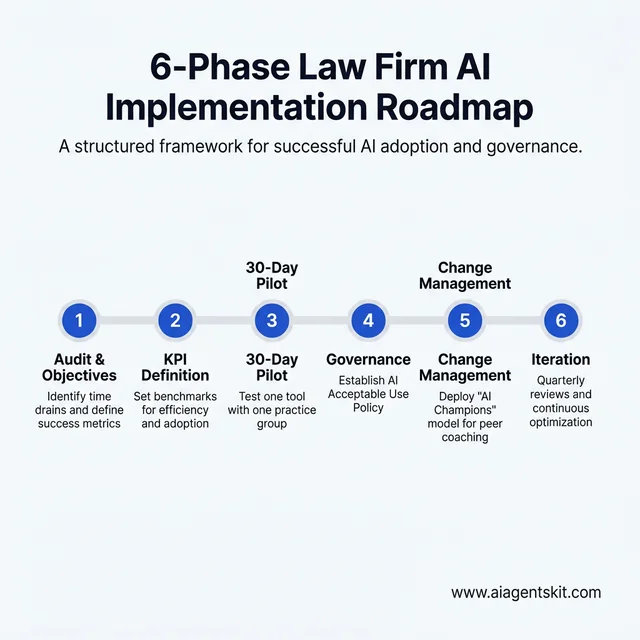 A structured approach to law firm AI implementation: From initial audit to ongoing refinement.
How to Implement AI in Your Law Firm: A 6-Phase Roadmap
Most legal tech initiatives fail not because the tools underperform, but because the rollout approach is wrong.
Phase 1: Audit Time Drains and Define Objectives
Before evaluating any vendor, pull matter data and billing records for the previous six months. Where are attorney hours going that AI could reasonably absorb? For litigation practices: research and routine motion drafting. For transactional practices: document review and templated agreements. For plaintiff firms: intake and client communication follow-up.
Define measurable objectives before selecting tools. Revenue growth and efficiency improvement are outcomes; the measurable indicators are the inputs that drive them. Knowing your target metrics before implementation makes success visible and builds internal support.
Phase 2: Prioritize with KPIs
Successful AI implementation tracks specific metrics from day one. The KPIs most relevant to law firm AI adoption:
Research efficiency: Average hours per research task before and after AI adoption. Federal Bar Association data shows a target benchmark of 30–60% reduction in research-heavy tasks.
Draft-to-review ratio: How many AI-generated drafts require substantial revision versus minor editing? This measures output quality and calibrates how much time drafting actually saves.
Intake conversion rate: Percentage of prospective client inquiries that become signed retainers, and time from inquiry to first contact. Target: under 5 minutes for initial automated response.
Attorney AI adoption rate: Percentage of attorneys using AI tools at least weekly after 90 days. This is the leading indicator of whether the implementation is actually working. A rate below 60% at 90 days signals a training or workflow friction problem.
Realization rate improvement: The percentage of billed time that is actually collected. AI billing tools that recover unbilled time should show measurable realization rate improvement within the first billing cycle after deployment.
Time recovered per attorney per month: Baseline this before deployment; track monthly after. The Federal Bar Association finding — 65% of users save 1–5 hours weekly — provides a widely-accepted benchmark.
Phase 3: Select Tools and Run a 30-Day Pilot
Pick one workflow, one tool, one practice group. Measure time saved. Assess output quality. Collect honest attorney feedback before any firm-wide expansion.
Attempting to overhaul research, drafting, intake, and billing simultaneously creates chaos, burns out IT teams, and gives skeptical senior partners grounds to write off “the AI initiative” as a failed experiment.
Phase 4: Build Governance Before Scaling
When the pilot succeeds, construct the AI Acceptable Use Policy (see framework above) before expanding. Firm-wide AI deployment without a written policy is the fastest path to a professional responsibility problem.
Phase 5: Change Management and Attorney Buy-In
The most consistent single failure point in legal AI adoption is senior attorney resistance. Understanding why makes it possible to address:
The “AI Champions” model works. Designate one tech-forward attorney per practice group as an internal AI champion — not IT staff, but a practicing attorney who has demonstrated the tools’ value on real work. Peer-to-peer coaching from someone who understands the actual workflows overcomes resistance that top-down mandates cannot.
Reframe the conversation. The billable-hour incentive structure inadvertently disincentivizes AI adoption — if AI compresses hours and the firm bills only for time, the attorney who adopts AI most aggressively sees their billable hours decline under the traditional model. This requires an explicit firm-level conversation about how AI adoption will be recognized and rewarded during the transition period away from pure hourly billing.
Allocate training time. Progressive firms in 2025 are beginning to allocate billable credit hours for associates to complete AI fluency training, signaling that developing AI competency is valued alongside traditional legal skill-building. This change in how training time is treated removes a practical adoption barrier.
Show results on real work. The most effective internal marketing for AI tools is a before-and-after demonstration using an actual matter type the resistant attorney handles regularly. Abstract productivity claims do not overcome skepticism; documented time savings on a familiar work product usually do.
Phase 6: Continuous Monitoring and Iteration
Treat AI adoption as an ongoing program rather than a deployment event. Review AI processes quarterly: which tools are actually being used, which promised efficiency gains are materializing, what new tools have emerged that should be evaluated. The legal AI tool landscape is evolving faster than any previous technology cycle — capabilities available in Q4 2026 will be materially different from those available in Q1.
Future Outlook: Legal AI in 2027 and Beyond
Law firm AI capabilities in 2027 will be meaningfully different from what exists today. Understanding the trajectory helps firms make technology investments that remain durable rather than becoming obsolete. Gartner’s 2025 legal technology forecast projects the legal tech market will reach $50 billion by 2027, with agentic AI transitioning from experimental to operational status at leading firms within 18–24 months. By 2028, Gartner warns, AI regulatory violations could trigger a 30% increase in legal disputes for technology companies — making law firms that build deep AI compliance competency uniquely positioned to serve that demand.
Multi-agent legal systems. Multiple AI agents working in coordination on a single matter — one agent handling research, another monitoring deadlines, another drafting correspondence — with a supervising “orchestrator” agent routing tasks and managing conflicts. This is already emerging in experimental form; practical deployment at law firms will follow in 12–24 months.
Predictive matter management. AI systems that forecast likely case duration, settlement ranges, and resource requirements at intake — based on case type, jurisdiction, opposing counsel, and judge assignment — enabling more accurate staffing and pricing from day one of engagement.
Automated regulatory monitoring. AI that continuously monitors regulatory changes in the firm’s core practice areas and automatically flags when new rules affect existing client matters or standard document templates. For practices in heavily regulated industries — healthcare, financial services, environmental — this capability removes a significant ongoing compliance burden.
Real-time courtroom assistance. AI systems providing live transcript analysis during proceedings, flagging inconsistencies in opposing testimony, surfacing relevant case law when a new argument is raised, and providing deposition summary references instantly. Currently experimental; court-specific rules about AI use in proceedings will determine adoption pace.
Client-facing AI interfaces. Matter status portals where clients interact with an AI layer that can answer status questions, provide document access, and escalate to attorneys for matters requiring professional judgment. Reduces the “where does my case stand?” call volume that consumes significant non-billable attorney time.
AI-generated predictive pricing. Value-based and fixed-fee pricing requires accurate cost prediction — historically difficult because legal matters involve uncertain variables. AI systems trained on historical matter data will increasingly enable firms to price fixed-fee engagements confidently, accelerating the transition away from hourly billing.
Firms that build genuine AI competency now — governance frameworks, piloted workflows, attorney-level proficiency, and early agentic AI experimentation — will have a structural advantage heading into this next wave that will be difficult for later adopters to close quickly.
Frequently Asked Questions
Will AI replace lawyers?
No — but the nuance matters. AI will increasingly absorb specific tasks: basic research, first-draft document creation, standard contract review, routine correspondence. Attorneys who rely primarily on those tasks for their professional value proposition face economic pressure. Attorneys providing strategic judgment, client relationships, nuanced advocacy, and creative problem-solving will not be replaced — they will be augmented, performing more high-value work as AI handles the scaffolding. AI will not replace lawyers, but AI-proficient lawyers will increasingly outcompete those who decline to adapt.
What is the best AI tool for legal research?
For large and mid-sized firms, Casetext CoCounsel (Thomson Reuters) is the most widely adopted option. Lexis+ AI is a strong alternative for firms already in the LexisNexis ecosystem. For BigLaw, Harvey AI offers enterprise-grade capabilities across research and other workflows. For solo practitioners, careful use of accessible language model tools combined with verification through primary legal databases delivers meaningful acceleration — with human verification as an absolute throughout.
Is it ethical for lawyers to use AI?
Yes, with proper safeguards. The ABA and most state bars have confirmed AI use is compatible with professional responsibility requirements — provided attorneys exercise appropriate supervision of AI output, maintain client confidentiality, and do not blindly rely on AI-generated work without human review. Using AI without sufficient understanding of its capabilities and limitations to critically review its output is the ethical risk, not using AI itself.
How much does legal AI software cost?
Pricing varies significantly by tier. At the enterprise end, Harvey AI and similar BigLaw-targeted platforms can run six figures annually. Mid-market tools like Casetext CoCounsel are available at per-seat subscription rates accessible to mid-sized practices. Spellbook starts at a few hundred dollars per month per user. Clio Manage including AI features runs under $100/month per user depending on tier. The ROI calculation matters more than the sticker price — at the 2025 average billing rate of $349/hour, recovering two billable hours per week pays back most mid-market tool costs within weeks.
What is agentic AI and how does it apply to law firms?
Agentic AI refers to systems that autonomously plan and execute multi-step workflows without requiring human direction at each step. In legal context, this means AI that monitors matter deadlines, generates billing entries continuously, initiates intake sequences, and flags conflicts — rather than waiting to be prompted. Law firms evaluating practice management platforms in 2026 should specifically assess agentic AI capabilities as a differentiating factor.
What should a law firm’s AI Acceptable Use Policy include?
At minimum: an approved tools register, data classification tiers specifying what can be used with approved versus unapproved tools, mandatory human review requirements for AI-generated work product before any external distribution, citation verification requirements, a prohibited uses list, an incident reporting pathway, and annual training requirements. A written policy in place before firm-wide AI deployment is the most effective way to prevent professional responsibility exposure.
What is Harvey AI and is it worth it for law firms?
Harvey AI is a purpose-built legal AI platform used by some of the world’s largest law firms for research, drafting, due diligence, and internal knowledge management. For large firms doing high-volume sophisticated work, the ROI case is credible. For solo practitioners or small firms, the pricing and implementation complexity do not fit — more accessible tools like Spellbook, MyCase, or lower-tier Casetext access deliver meaningful value at smaller scale.
Can small law firms afford AI tools?
Yes. Spellbook, MyCase, and Lawmatics are specifically designed and priced for smaller practices. Free-tier access to consumer AI models is genuinely useful for internal tasks that do not involve confidential client data — drafting firm policies, preparing client education materials, brainstorming arguments. The recommended approach: start with one tool, prove the ROI in the actual practice context, then expand.
Closing Thoughts
Law has always moved deliberately, and that instinct exists for sound reasons — the consequences of incorrect legal work are real and often irreversible. But the current AI technology wave is moving faster and is more structurally disruptive than any previous technology cycle in legal history.
According to Thomson Reuters’ 2025 research, 80% of law firm respondents anticipate AI will fundamentally change how they operate. The firms building genuine AI competency now — governance frameworks, piloted workflows, attorney-level proficiency, and early experimentation with agentic systems — will have a structural efficiency advantage in 24 months that will be genuinely difficult for later adopters to close.
The lawyers who define the profession over the next decade are not the skeptics who waited until AI became unavoidable. They are the ones building competency — tools, workflows, governance, and pricing model thinking — while others are still deciding whether to form a committee to study the question.
For firms ready to build a structured approach to this transition, an AI implementation roadmap provides a practical starting point for mapping specific practice area priorities and governance requirements.
The same adoption pattern — early resistance, then rapid uptake once ROI becomes visible — is documented across every professional services sector. Real estate agencies are moving through this cycle now; the complete AI stack guide for real estate agencies shows exactly which tools are driving results and how firms structure the implementation to stick.