AI for Freelancers: The Ultimate Productivity Stack (2026)
Discover the top freelancer AI tools and solopreneur automation workflows for 2026. Scale your solo business to agency-level output with agentic AI stacks.
Something fundamental shifted in how independent professionals operate at the start of 2026. The most successful solo operators no longer view themselves as manual laborers; they’ve become architects of integrated agentic systems.
The primary challenge isn’t a lack of available technology, but the overwhelming complexity of the “tool fatigue” trap. Most freelancers still spend 40% of their week on administrative busywork like lead sorting, invoicing, and proposal drafting according to recent industry benchmarks.
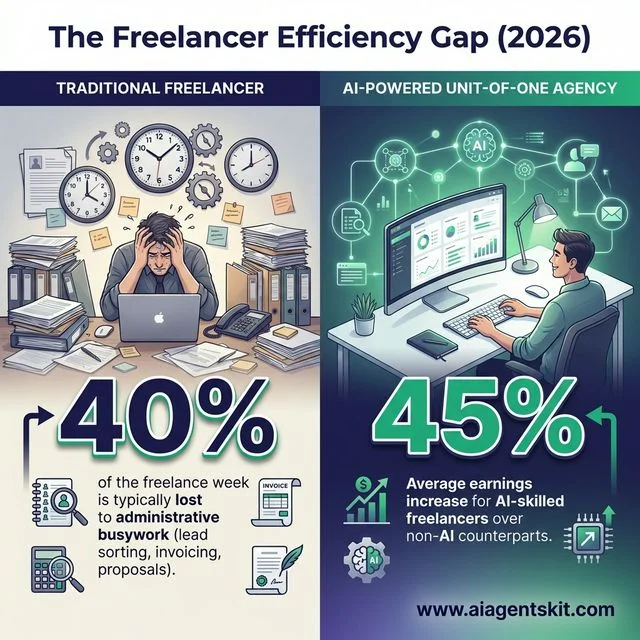 The Freelancer Efficiency Gap (2026): A statistical visualization of the hidden operational costs currently burdening the independent economy. Recent industry data indicates that the average freelancer still loses approximately 40% of their billable week to administrative busywork—repetitive tasks such as manual lead qualification, invoice chasing, and project proposal drafting that do not directly contribute to revenue. However, the emergence of agentic AI stacks has created a definitive earnings divide: AI-skilled freelancers who automate these operational bottlenecks are now commanding 45% higher average wages than their manual counterparts. This gap reflects not just a difference in speed, but a fundamental shift in business model from a manual solo operator to a scalable ‘Unit-of-One’ agency. By recovering nearly two days per week, automated solopreneurs can pivot from executing tasks to orchestrating systems, effectively decoupling their income from their limited personal hours.
This guide explores the most effective freelancer ai tools for 2026 and provides a blueprint for building high-performance automation stacks. According to Upwork’s 2025 Skill Demand Report, freelancers working with AI-integrated workflows are already earning 40% more per hour than those on traditional projects. By understanding what AI agents are, solopreneurs can finally decouple their income from their limited personal hours through strategic System Architecture.
As McKinsey’s 2025 Global AI Survey notes, 88% of organizations have now integrated AI into at least one business function. This widespread adoption means freelancers are no longer just competing with each other, but with automated internal systems at the enterprise level.
What Are Freelancer AI Tools and Why Use Them?
The definition of a productivity tool underwent a radical transformation as the industry moved from isolated software to interconnected ecosystems. In 2026, the most effective AI productivity tools are no longer just “calculators for text” but autonomous assistants capable of multi-step reasoning. Traditional software required constant human input, whereas modern freelancer ai tools function as “background processes” that handle data transformation and decision-making while the professional focuses on high-level strategy.
Many teams find that the distinction between a freelancer and a traditional agency is blurring because of this technological leverage. A single individual using a well-orchestrated stack can now manage the output volume that previously required a staff of ten. The primary motivation for adoption has shifted from simple “time saving” to “business scaling” without the overhead of hiring employees. Research shows that professionals who master these agentic workflows are able to handle 3.5 times more projects simultaneously than their manual counterparts.
The modern freelancer uses these tools to establish a “Second Brain” and an “Autonomous Workforce” simultaneously. This isn’t about replacing human creativity; it’s about providing that creativity with the infrastructure it needs to thrive at scale. Practitioners often discover that once the administrative friction is removed, the quality of their creative work improves because they are no longer mentally exhausted by logistical tasks. The reality is that in 2026, AI literacy is the single greatest competitive advantage for anyone working in the independent economy.
Building this literacy involves more than just knowing “prompts.” It requires a deep understanding of data flows—knowing how an output from a research agent becomes the structured input for a secondary writing agent. This “chaining” of capabilities is what defines the professional user in 2026. Experts suggest that the current market rewards those who can orchestrate these complex systems more than those who simply possess a single specialized skill like design or coding. The tools have become the leverage, while the freelancer has become the lever.
Why Solopreneur Automation Is Essential in 2026?
The economic landscape for independent workers has reached a tipping point where manual execution is no longer financially viable. As AI compresses the time required for standard deliverables, the market price for “labor” is dropping, while the premium for “strategic oversight” is rising. Solopreneur automation is the only way to remain competitive in a landscape where clients expect agency-quality results with the speed of an automated system. According to Upwork’s Freelance Forward Report (2025), AI-skilled freelancers are already earning 45% higher wages than their non-AI counterparts.
The most common stumbling block for solo operators is the “ceiling of hours,” where income is capped by the number of hours in a day. Automation breaks this ceiling by allowing business processes to run 24/7 without human intervention. Managing a lead pipeline, following up on invoices, and generating initial project drafts can all happen while the freelancer is literally asleep. This shift from “active work” to “supervised automation” is the hallmark of the 2026 professional class.
Industry analysts increasingly point to the “Unit of One” agency model as the dominant structure for the future. In this model, the freelancer acts as the CEO, while a suite of AI agents handles the roles of project manager, researcher, and content producer. Gartner’s 2026 Strategic Trends identifies the “Freelance Agentic” as a top-five shift, where solo pros use specialized agents to match the capabilities of mid-sized firms. The evidence suggests that those who fail to automate will be forced to compete on price alone, a race to the bottom that is difficult to win. Conversely, those who implement deep AI automation workflows can command higher rates by delivering superior consistency and speed.
Furthermore, the introduction of self-correcting agents has reduced the “oversight tax” that previously plagued early automation attempts. In 2026, systems are capable of identifying their own errors in logic or data entry and flagging them for the freelancer’s review. Deloitte’s 2026 State of AI Report shows that 74% of companies plan to deploy such agentic systems within 24 months. This high-fidelity automation allows a solopreneur to maintain a client list that would have required a dedicated customer success team just two years ago. The goal isn’t to work harder; it’s to build systems that work harder than any human possibly could.
The “Human-Plus” Skills Framework: What AI Can’t Replace
The most common anxiety for freelancers in 2026 is the fear of being made obsolete. However, a closer look at the market reveals that while “manual output” is being commoditized, “Strategic Insight” is seeing a price premium. To thrive, solopreneurs must move from being “Doers” to “Directors.”
The Strategy Gap
AI models are excellent at following instructions but lack the ability to understand a client’s unspoken business objectives. Your value as a freelancer in 2026 lies in your ability to act as a Strategic Consultant. This involves:
- Nuance Detection: Identifying cultural or emotional subtleties in a project that a LLM might miss.
- Conflict Resolution: Navigating the complex interpersonal dynamics of high-stakes client negotiations.
- The “AI Specialist” Pivot: Transforming your existing services into an “AI Implementation” offer, where you don’t just provide the deliverable, but the system that produces it.
By mastering the “Human-Plus” skills—creativity, empathy, and macro-strategy—you ensure that your role remains indispensable even as models become more capable. The AI handles the “what” and the “how,” while you define the “why.” According to McKinsey Global Institute research, job postings specifically requiring “AI fluency” have grown sevenfold over the last 24 months. This indicates that the market isn’t just looking for AI users, but for professionals who can strategically direct these systems.
7 Essential Categories of AI for Freelancy Pros
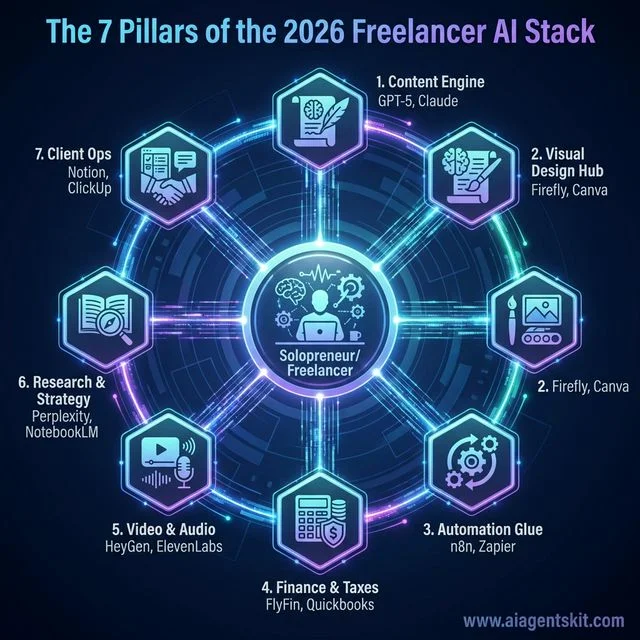 The 7 Pillars of the 2026 Freelancer AI Stack: A comprehensive architectural framework for building a high-performance solopreneur ecosystem. The modern independent professional no longer relies on a single tool, but orchestrates an interconnected web of seven critical functional layers. These pillars include the Content Engine for high-fidelty narrative strategy, the Visual Design Hub for rapid brand prototyping, and the Automation Glue that serves as the connective tissue for data flows. Supporting these are the Finance and Taxes layer for automated compliance, the Video and Audio multiplier for personalized client engagement at scale, and the Research Intelligence layer for data-backed strategy. Finally, the Client Ops layer acts as the central ‘Project Operating System,’ housing the business’s collective memory. Mastering these categories allows a solo operator to maintain the output volume previously reserved for full-service agencies while keeping overhead remarkably low and focus remarkably high.
To build a high-performance stack, one must categorize tools by their functional role in the business ecosystem. It’s not about having the “most” tools, but having the right tool for each critical workflow pillar. The 2026 stack is characterized by modularity, where each component can speak to the others through API triggers or agentic reasoning.
Content Engine: Advanced Language Models
The heart of every modern freelancer’s output is an AI writing assistant like GPT-5, Claude 4, or Jasper. These models have evolved past simple text generation to become sophisticated research and brainstorming partners. GPT-5 excels at complex logical reasoning and data synthesis, while Claude 4 is often preferred by creative professionals for its more “human” and nuanced prose. Jasper and Writesonic remain the gold standard for marketing-specific content because they can be trained on specific client brand voices to ensure consistency across multiple accounts.
Many writers now use “agentic drafting” where one model creates the outline based on client notes, and a second, more creative model, flesh out the prose. This separation of “structure” and “style” allows for much higher quality control. Upwork data shows that demand for AI-integrated video and writing skills grew by over 100% in 2025 alone. Human-First Branding is the critical counter-balance to this generation, ensuring the output feels authentic and passes all quality checks.
Visual Design Hub: Generative Media
Design has been democratized through platforms like Canva Magic Studio and Adobe Firefly, which allow non-designers to produce professional-grade assets in seconds. Freelancers use these tools for everything from social media graphics to complex client presentations. Midjourney also remains a powerhouse for high-concept artistic visuals that can differentiate a brand’s aesthetic. The value-add for the freelancer is no longer the ability to “use Photoshop,” but the creative direction required to prompt these systems for specific, high-impact results.
Creative professionals often find that using AI for “rapid prototyping” allows them to present ten different design directions to a client in the time it used to take to create one. This high-velocity feedback loop leads to faster approvals and higher client satisfaction. In 2026, design automation is less about the tool and more about the “aesthetic library” a freelancer maintains to guide the AI’s output toward a specific brand standard.
Automation Glue: The Orchestration Layer
The most critical component of the 2026 stack isn’t a creative tool, but the orchestration layer that connects them. Zapier Central and n8n act as the “connective tissue” that allows a lead coming in via a website form to trigger a research agent, draft a proposal, and set up a project folder automatically. Developing AI automation workflows is now considered a core competency for any service-based freelancer. Without this layer, the professional is still manually copying and pasting data between apps, which is a significant drain on high-value hours.
[!TIP] Orchestration ROI: Focus your first automation on the “Administrative Gap”—the 15 minutes between finishing a task and sending an update. Automating this single bridge can recover up to 5 billable hours per week for high-volume freelancers.
The shift toward “Event-Driven Automation” is particularly important. This means tools aren’t just sitting idle; they are listening for specific client behaviors. If a client opens a proposal three times but hasn’t signed, a background agent can automatically draft a friendly follow-up email that addresses the likely concerns based on the project scope. This type of proactive, automated account management is what separates the six-figure solopreneur from the rest of the market.
Finance & Taxes: Automated Compliance
Managing the books is often the most hated part of the solo business, but AI has turned it into a background task. Tools like FlyFin and QuickBooks with AI integration automatically categorize expenses, identify tax deductions, and even predict quarterly tax liabilities with high accuracy. Invoicer.ai and similar tools handle the “chase,” automatically following up with clients on overdue payments using professional, AI-tuned reminders. This ensures that the freelancer’s cash flow remains healthy without requiring hours of manual bookkeeping.
Research indicates that the average freelancer misses out on over $5,000 in annual tax deductions simply because of poor record-keeping. AI finance tools eliminate this “leakage” by scanning historical data for forgotten subscriptions or business-related meals. By the end of 2026, automated compliance is expected to be so efficient that human accountants will pivot almost exclusively toward high-level wealth strategy rather than data entry.
Video & Audio: The Content Multiplier
For freelancers in the marketing or education space, video and audio production can be a massive bottleneck. AI tools such as HeyGen and Synthesia allow for the creation of professional spokesperson videos from a simple text script, removing the need for expensive equipment or on-camera presence. ElevenLabs has set the standard for high-fidelity AI voices, making it possible to produce podcasts or voiceovers with studio quality in minutes. Descript further simplifies the process by allowing creators to edit audio and video files as easily as a text document, removing “um” and “ah” sounds automatically.
The ability to “clone” one’s voice or appearance for standardized client updates is a massive time-saver. Consider a freelancer who manages twenty accounts; instead of recording twenty custom Loom videos, they can input twenty short scripts into a video agent that generates personalized updates for each client using the freelancer’s digital twin. This maintains the “human touch” while requiring only five percent of the actual human effort.
Research & Strategy: Intelligence Agents
Deep market research that used to take days now takes minutes thanks to AI research tools like Perplexity, Notebook LM, and Perplexity Comet. These systems can scan the live web, synthesize complex reports, and provide cited sources for every claim, ensuring that the freelancer’s strategy is always data-backed. The most significant upgrade for high-volume research workflows is Perplexity Computer — the Max plan’s 19-model orchestration layer that can run entire competitive intelligence projects autonomously overnight. Notebook LM, in particular, acts as a personal research assistant, allowing users to upload documents and transcripts to generate searchable knowledge. Many practitioners use these agents to perform competitive analysis for clients, providing a level of depth that was previously only available to enterprise-level consulting firms.
Furthermore, agents can be programmed to “monitor” specific competitors or industry trends in real-time. If a client’s main competitor launches a new product, the freelancer’s research agent can immediately produce a one-page reaction strategy. This proactive intelligence turns the freelancer from a “vendor” into a “strategic partner,” a position that commands much higher retention rates and premium pricing.
Project & Client Ops: The Operating System
Finally, the entire business needs a home, which is where Notion AI and ClickUp Brain come in. These tools serve as the “operating system” for the business, housing everything from project timelines to client wikis. Upwork’s Uma (Mindful AI) is also gaining traction for platform-specific task management and proposal drafting. Notion AI’s ability to summarize long meeting notes and extract action items has become a standard requirement for maintaining client alignment.
The integration of “Customer Context” is the biggest trend for 2026. This allows the AI project manager to “read” every previous email and project file a client has shared, ensuring that every new task is aligned with the client’s long-term history. No more “Wait, what did we discuss last month?”—the AI provides a full contextual briefing for the freelancer before every call, ensuring they appear fully prepared and professional at all times.
Industry-Specific AI Blueprints (Cheat-Sheets)
A generic AI stack is often less effective than one tailored to a specific niche. To maximize your competitive edge, consider these three professional blueprints for 2026:
1. The Creative Director Blueprint
Focus: Maximum visual and narrative impact with minimal manual effort.
- Core Tools: Midjourney (Concepts) + Adobe Firefly (Production) + Suno AI (Audio/Music).
- The Workflow: Use Midjourney to generate mood boards, Firefly’s generative fill to create pixel-perfect assets, and Suno to add custom branded audio—all orchestrated through a central Notion workspace.
2. The Technical Solopreneur Blueprint
Focus: Extreme efficiency in coding, DevOps, and technical documentation.
- Core Tools: GitHub Copilot Pro + Cursor (IDE) + Perplexity Comet (Live Research).
- The Workflow: Use Perplexity to source the latest API documentation, Cursor to generate the boilerplate logic, and Copilot to audit the code for security vulnerabilities.
3. The Marketing Agency-of-One Blueprint
Focus: High-volume content production and autonomous lead management.
- Core Tools: Jasper 2.0 (Brand Voice) + AdCreative.ai (Performance Graphics) + HubSpot AI (Sales).
- The Workflow: Jasper drafts the multi-channel campaign based on a single brand brief, AdCreative generates the 100+ ad variations, and HubSpot manages the autonomous follow-ups for incoming leads.
How to Build a Fully Automated Freelance Workflow
Establishing a truly automated workflow requires moving away from the “one-tool-at-a-time” mentality. The goal is to build a “pipeline” where data flows seamlessly from one stage of the client lifecycle to the next. McKinsey’s 2025 analysis of automated marketplaces found that AI-powered client-professional matching has improved project compatibility scores by 37%. This allows freelancers to spend less time in the “wrong” meetings and more time on high-margin projects.
Lead-to-Cash: A Step-by-Step Automation Guide
The transition from a manual freelancer to an automated “Unit of One” agency involves a phased implementation of several critical stages. Here is the step-by-step logic for a high-performance 2026 pipeline:
- Inquiry Received: Your lead capture system (website form, LinkedIn automation, or email trigger) acts as the entry point. A webhook immediately captures the prospect’s data and routes it into your central orchestration layer (Zapier or n8n).
- The AI Lead Auditor: Instead of manually vetting the inquiry, your AI research agent scans the prospect’s website and LinkedIn profile. It compares their budget and needs against your “Ideal Client Profile” (ICP) and assigns a qualification score.
- Autonomous Proposal Generation: For qualified leads, a research agent synthesizes previous project data and current client needs to draft a custom project proposal. This is created as a “Live Draft” in Google Docs or Notion, ready for your final 5-minute strategic review.
- Automated Onboarding: Once the proposal is signed and the deposit is paid via Stripe, the system triggers a chain reaction: it creates a shared Slack channel, populates a Notion client wiki, and sends an automated “Welcome Questionnaire” to gather technical requirements.
- AI-Assisted Production: This is where you apply your human leverage. You use specialized agents (Notebook LM for research, Claude 4 for drafting) to execute the high-value deliverables at 10x speed, maintaining a “Human-in-the-Loop” protocol for quality control.
- The Referral & Retention Loop: Upon project delivery, the system monitors client satisfaction. If a milestone is marked complete, it automatically requests a video testimonial and triggers a follow-up marketing sequence to offer a recurring retainer service.
This structured approach ensures that you are never starting from zero, allowing your business to remain responsive 24/7 without requiring your constant presence.
The first step in building this stack is identifying the TRIGGER events in the business—such as a new email inquiry, a signed contract, or a completed project milestone. Once these triggers are identified, a freelancer can use n8n or Zapier to build a sequence of events. For example, a “New Inquiry” trigger should automatically:
- ACTION: Scan the prospect’s website for key business data.
- ACTION: Cross-reference their needs with the freelancer’s current portfolio items.
- ACTION: Draft a customized proposal in a Google Doc.
- ACTION: Send a Slack notification to the freelancer for final review.
[!CAUTION] The Hallucination Trap: Never automate your “Final Deliverable” send-off. Maintain a Human-in-the-Loop (HITL) protocol to verify that the agentic output hasn’t “hallucinated” project dates or legal clauses.
This level of automation ensures that the prospect receives a response within minutes, not days, which significantly increases conversion rates. From there, the workflow should transition into the “Production” phase, where AI agents help generate initial outlines, research briefs, and drafts based on the client’s specific requirements. The final “Delivery” phase can then be automated with tools that handle file sharing, feedback collection, and the automated generation of an final invoice upon approval.
The Shift to Value-Based Pricing and Outcome Literacy
The ultimate goal of solopreneur automation is the “Million-Dollar Stack”—a configuration that allows an individual to generate agency-level revenue with near-zero employee overhead. This model relies on high-margin specialized services supported by heavy AI orchestration. Instead of hiring a junior account manager, the freelancer builds an account management agent; instead of hiring a researcher, they deploy a real-time web-scraping pipeline. The result is a business that scales horizontally without the traditional “human-resource drag” that limits most solo operations.
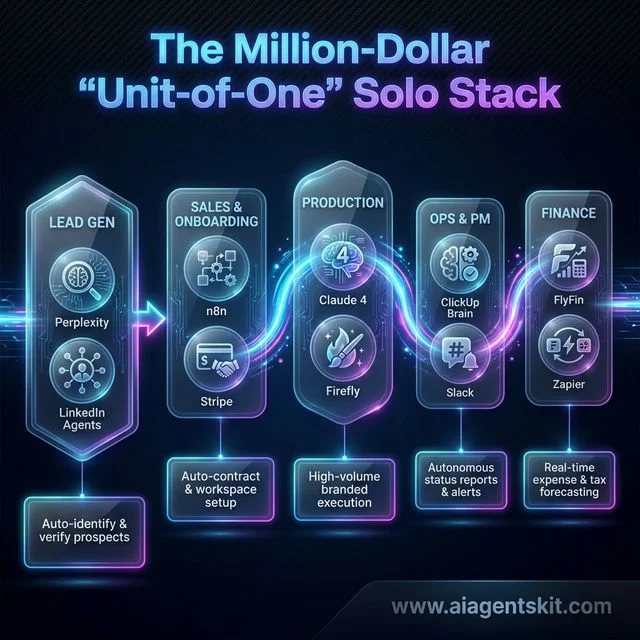 The Million-Dollar ‘Unit-of-One’ Solo Stack: A linear workflow architecture illustrating the autonomous pipeline required to generate agency-level revenue with zero employee overhead. This high-efficiency flow begins with AI-driven Lead Generation, where intelligence agents identify and qualify prospects 24/7. The Sales and Onboarding stage automates contract generation and workspace setup instantly upon payment, removing the typical friction of manual client entry. In the Production phase, specialized language and design agents execute high-volume branded deliverables under human strategic direction. The Operations layer manages autonomous status reports and deadline alerts via integrated Slack and ClickUp brains, while the Finance pillar provides real-time expense tracking and tax forecasting. This orchestrated system allows the freelancer to operate as a Strategic Director, focusing exclusively on the 10% of work that requires human nuance while the ‘Autonomous Workforce’ handles the repetitive 90%.
Organizations that have successfully made this transition often focus on a “Productized Service” model. In this setup, the freelancer sells a specific, repeatable outcome rather than their time. Because AI handles 80% of the execution, the profit margin on each project increases exponentially as the freelancer gets faster at oversight. The most efficient AI agents in 2026 are those that can take a high-level goal and break it down into dozens of sub-tasks across different platforms without human intervention.
The table below outlines the core components of a “Million-Dollar” solo stack for 2026:
| Business Pillar | AI Implementation | Automation Logic |
|---|---|---|
| Lead Generation | Perplexity + LinkedIn Agents | Auto-identify prospects, verify email, and draft personalized bridge copy. |
| Sales & Onboarding | GPT-5 + n8n + Stripe | Auto-generate contract, send invoice, and set up project workspace on payment. |
| Content Execution | Claude 4 + Adobe Firefly | Draft multi-channel content using specific client brand voice and custom visuals. |
| Project Management | ClickUp Brain + Slack | Group chat summarization, automated deadline alerts, and client status reports. |
| Finance & Ops | FlyFin + Zapier Central | Real-time expense tracking, automated tax withholding, and quarterly reporting. |
Transitioning to this model requires a mindset shift from “doing the work” to “designing the system.” Many freelancers find that the most profitable move they can make is spending a week building an automation rather than taking on one more manual client project. This investment pays off as “infinite leverage”—the ability to scale output without increasing input. The most successful solo agencies of the next decade will be those that view their stack as their most valuable employee. The evidence suggests that as long-tail keywords and niche markets become more accessible, the “specialized solo agency” will become the most resilient business model in the AI era.
Experts emphasize that the Human-in-the-Loop (HITL) factor is the final piece of the puzzle. While the AI agents do the heavy lifting, the human freelancer acts as the “Strategic Director.” They review the final deliverables, manage the nuanced client relationships, and make the high-level pivots that data alone cannot predict. This synergy—AI for scale and human for strategy—is the foundation of the modern million-dollar solopreneur. Organizations that reach this level often find their enterprise value is much higher than traditional agencies because their overhead is remarkably low and their systems are fully documented in code.
Ethical Governance: Managing Data Privacy and Client Trust
As AI becomes a standard part of the freelance workflow, Client Trust has become the new currency. High-ticket B2B clients are increasingly worried about how their proprietary data is being handled by third-party AI models.
3-Point Data Privacy Protocol
To protect your business and reputation in 2026, implement these protocols:
- The Sandbox Rule: Never upload raw client documents to public, free models. Always use enterprise tiers with “Zero Data Training” guarantees.
- Local Model Redaction: Use tools like Ollama or LM Studio to process sensitive sensitive PII (Personally Identifiable Information) on your local machine before sending redacted data to the cloud for creative expansion.
- The Transparency Disclosure: Turning your AI usage into a feature. Provide clients with a “Trust Document” that outlines which tools you use, how you verify output, and why this results in a superior product for them.
By prioritizing ethical governance, you position yourself as a “Safe” partner for enterprise clients, allowing you to win contracts that riskier, “black-box” freelancers cannot touch.
Frequently Asked Questions About Freelancer AI Tools
What are the best AI tools for freelancers in 2026?
The best tools for 2026 are those that offer “agentic” capabilities, meaning they can perform multi-step tasks independently. For writing and strategy, GPT-5 and Claude 4 are the industry leaders. For automation, n8n and Zapier Central provide the necessary connectivity to link different apps. For design, Canva Magic Studio and Adobe Firefly offer the most streamlined generative workflows. The key is choosing tools that provide API access, allowing the freelancer to integrate them into a larger, self-running business engine rather than using them as isolated islands. Furthermore, tools that offer local hosting or enhanced data privacy are gaining traction among professionals handling sensitive client data.
Can AI replace a personal assistant for solopreneurs?
Yes, modern AI orchestration platforms can handle approximately 80-90% of the tasks typically assigned to a human personal assistant. This includes complex scheduling across multiple time zones, email triaging, travel booking, and even basic research. While a human is still recommended for high-stakes interpersonal negotiations or physical tasks, the vast majority of administrative friction can now be managed by background AI processes. This allows the solopreneur to save thousands of dollars in monthly salary costs while maintaining 24/7 availability for their business operations. Many professionals find that an AI assistant is actually more reliable for data-heavy tasks like expense tracking or calendar management.
How much do AI tools for freelancers cost per month?
A professional-grade AI stack typically costs between $150 and $400 per month, depending on the volume of usage and the specific tools required. This usually includes subscriptions to a flagship LLM (like ChatGPT Plus or Claude Pro), an automation platform (n8n or Zapier), a design suite (Canva or Adobe), and specialized industry tools (like FlyFin for taxes). While this may seem higher than traditional software costs, it replaces the need for human employees or expensive outsourced agencies, representing a massive net saving for a growing freelance business. For most, the return on investment is realized within the first week of implementation through reclaimed billable hours.
Is it ethical for freelancers to use AI for client work?
Using AI is ethical as long as the freelancer maintains transparency with the client and ensures they are providing a verified, high-quality final product. Most clients in 2026 expect their service providers to use AI to improve speed and consistency, much like they expected them to use computers in the 1990s. The ethical line is crossed when a freelancer presents raw, unverified AI output as their own original work. The professional’s role is to act as the “Editor-in-Chief,” providing the human nuance, fact-checking, and strategic direction that AI cannot yet replicate. Additionally, protecting client data privacy by using secure AI environments is a critical ethical obligation.
How do I automate my freelance client onboarding with AI?
Automating onboarding starts with a webhook trigger from your payment or contract platform (like Stripe or HelloSign). Once a client pays or signs, n8n or Zapier can trigger a series of actions: creating a shared Notion folder, sending a welcome questionnaire, and setting up a Slack channel with pre-loaded onboarding documents. You can also use GPT-5 to analyze the questionnaire results and automatically generate a project roadmap before you even hop on the first kick-off call. This level of professionalism builds immediate trust and ensures the project starts with maximum momentum. Many freelancers also automate the “handover” process when a project ends to ensure a smooth transition and future referral opportunities.
How do I choose between Zapier and n8n for solo business?
Zapier is best for freelancers who want a “no-code” experience and need quick integrations with thousands of apps via a simple interface. It is highly reliable but can become expensive as your automation volume increases. n8n is the preferred choice for those who want more complex, logic-driven workflows and the ability to self-hosted to save on costs. While n8n has a steeper learning curve, it offers significantly more power for “agentic” workflows where an AI needs to make multiple decisions in a row based on conditional data. The decision often comes down to the freelancer’s comfort level with technical logic and their long-term automation volume.
What is the best AI for freelance tax management?
FlyFin is currently the top-rated AI tool for freelance tax management because it is specifically built for the self-employed. It scans your bank statements and uses machine learning to identify every possible tax deduction, often finding thousands of dollars in savings that humans might miss. It also handles quarterly tax estimates and provides access to human CPAs for final verification. For those already using QuickBooks, the platform’s “Self-Employed” AI features provide strong competition, particularly for tracking mileage and simple expense categorization throughout the year. The primary goal of these tools is to eliminate the end-of-year tax season anxiety.
Will AI make freelance writing obsolete in 2026?
Freelance writing is not becoming obsolete, but it is undergoing a massive transformation toward “AI-Assisted Strategy.” Clients are no longer paying for “words on a page,” but for the research, voice, and perspective that a human writer brings to a project. The writers who will thrive in 2026 are those who can use AI to research and draft at 10x speed, while focusing their own efforts on high-level narrative structure and original reporting. The demand for “generic SEO content” has vanished, but the demand for authoritative, expert-led thought leadership has never been higher. Professionals who specialize in high-stakes industries like law, medicine, or finance are particularly insulated from AI-only competition.
How can a freelancer build their own custom AI agent?
Building a custom agent used to require coding, but in 2026, it can be done through “Agent Builders” or custom GPTs. You can upload your specific business documents, past project examples, and brand voice guidelines to a system like Claude Projects or OpenAI’s GPT Builder. This “fine-tuned” assistant then understands your specific business context and can draft documents or respond to queries in your exact style. More advanced users can build multi-agent teams in frameworks like CrewAI or LangGraph by defining specific roles and goals for different AI “workers” in their business. This allows a freelancer to build an entire “internal team” of AI bots that know exactly how their business operates.
What AI skills are most in-demand for freelancers in 2026?
The most in-demand skill is “Agentic Orchestration”—the ability to design systems where multiple AI models work together to achieve a goal. Clients are also looking for freelancers with deep Prompt Engineering capability, as the quality of AI output is directly tied to the quality of the input instructions. Additionally, data privacy and AI ethics are becoming critical as companies seek to protect their proprietary information while using cloud-based AI. Any freelancer who can prove they know how to securely integrate AI into a business workflow will be at the top of the talent list. Finally, the ability to train AI on specific brand voices is a highly valuable niche for creative freelancers.
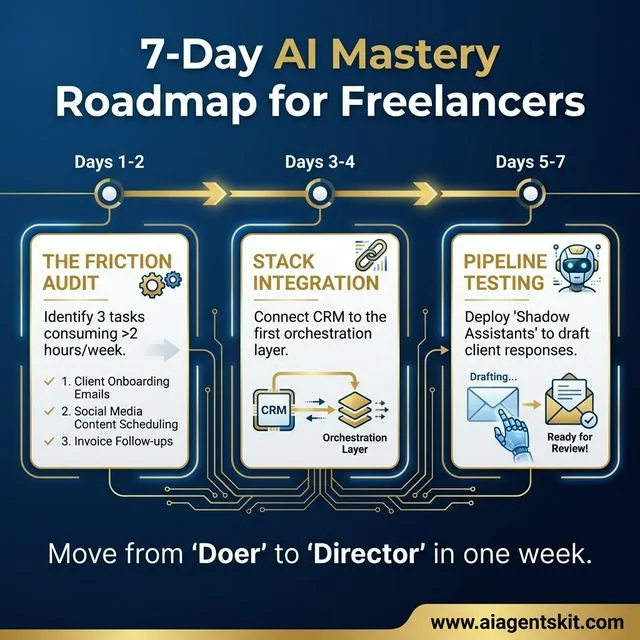 7-Day AI Mastery Roadmap for Freelancers: A phased implementation guide for transitioning from a manual ‘Doer’ to a strategic ‘Director’ in one week. The roadmap begins in Days 1-2 with a deep Friction Audit, where professionals identify and document the three specific tasks currently consuming more than two hours of their billable week. Days 3-4 focus on Stack Integration, establishing the first orchestration layer to connect the practice’s CRM with automated logic triggers. Finally, Days 5-7 involve Pipeline Testing, where ‘Shadow Assistants’ are deployed to draft client communications and initial project briefs for human review. This structured approach prevents ‘tool fatigue’ by focusing on solving immediate operational bottlenecks rather than chasing feature trends. By following this roadmap, solopreneurs can establish a sustainable foundation for scaling their output without an equivalent increase in their personal workload.
Conclusion
The transition to an AI-powered freelance model is no longer a choice between “early adoption” and “waiting”; it’s a choice between scaling and stagnation. The most resilient solo professionals in 2026 are those who have mastered the art of agentic orchestration, turning a collection of tools into a self-running business engine. By implementing a high-performance stack today, you can eliminate administrative busywork and refocus your energy on the high-value work that only a human can perform.
Mastery Roadmap: Your First 7 Days
| Day | Focus | Outcome |
|---|---|---|
| 1-2 | Friction Audit | Identify 3 tasks that consume >2 hours/week. |
| 3-4 | Stack Integration | Connect your CRM to your first agentic orchestration layer. |
| 5-7 | Pipeline Testing | Deploy one “Shadow Assistant” to draft client responses. |
The key insight for independent workers is that AI does not replace the freelancer; it replaces the mundane labor that used to hold them back. As the “Unit of One” agency becomes the standard for high-performance service providers, the ability to build and manage these systems will be the primary factor in financial success. Start by automating your most time-consuming task today and slowly build toward your own “Million-Dollar Stack.”
If you’re ready to begin your journey into professional AI management, consider studying the current AI career path to understand the high-level skills that market leaders are looking for. You may also want to explore AI research tools to further refine your competitive edge. The future of work is solo, automated, and infinitely scalable.