AI for Dental Practices: Patient Management (2026)
Discover how AI adoption is transforming dental practices in 2026, from automated patient scheduling and CRM to clinical diagnostics and ROI.
For decades, the chaotic scene of ringing phones and frustrated front-desk staff was accepted as the unavoidable cost of running a clinic. But in 2026, the rapid adoption of AI for dental practices is fundamentally dismantling this bottleneck through intelligent automation.
While clinical tools like AI-powered dental X-ray analysis remain vital, practice owners have recognized a more pragmatic truth. Knowing a patient needs a restorative procedure is irrelevant if the clinic cannot efficiently coordinate the appointment and verify insurance benefits rapidly.
This guide examines the trajectory of AI adoption in modern dental practices. It explores how intelligent administrative systems optimize daily schedules and manage patient flow, allowing human professionals to return their focus to providing exceptional patient care.
The State of AI Adoption in Dental Practices
The adoption curve for dental AI has shifted dramatically from early experimentation by tech-savvy pioneers to mainstream necessity. As of early 2026, research indicates that up to 70% of competitive dental clinics have integrated some form of artificial intelligence into their daily operations.
This is no longer fringe technology reserved for elite, multi-location Dental Service Organizations (DSOs). AI in dentistry in 2026 is the new baseline for independent practices striving to maintain healthy profit margins amidst rising overhead costs.
Why has adoption accelerated so aggressively in recent years? The answer lies in the specific operational diseases that plague healthcare administration.
Staff turnover in front-office roles is historically high, driven by the intense stress of managing calendars, resolving billing disputes, and fielding constant patient inquiries. Simultaneously, patient expectations have evolved.
A patient accustomed to instantly booking a restaurant, ordering groceries, or managing a bank account via a smartphone expects the exact same frictionless digital experience when scheduling a dental cleaning. When clinics force patients to play phone tag between 9 AM and 5 PM, they actively lose business to more modernized competitors.
Dental professionals are turning to automation not to replace their teams, but to radically augment them. By handing over the repetitive, high-volume tasks to autonomous AI agents, practices create an environment where human staff can engage in high-value, high-empathy interactions.
Moving Beyond Clinical Diagnostics
To fully grasp the scope of AI implementation in this sector, one must understand the clear distinction between clinical and administrative AI. Both are crucial to the modern practice, but they serve entirely different functions within the ecosystem.
Clinical AI acts as an over-the-shoulder expert for the dentist. Tools powered by highly trained machine learning algorithms analyze radiographs in seconds, bringing AI-powered dental X-ray analysis for early cavity detection directly to the operatory monitor.
This ensures diagnostic consistency across different providers within the same practice. This technology enhances clinical precision and builds patient trust through objective, visual evidence of necessary treatments.
Conversely, administrative AI functions as an untiring, highly efficient extension of the front desk team. Utilizing underlying large language models like GPT-5 or Claude 4, these systems comprehend natural human language, allowing them to interact with patients seamlessly.
If a patient sends a text message at midnight stating, “My jaw is throbbing on the left side, do you have any time tomorrow?”, a dental CRM AI processes the intent behind the message. It identifies it as a true dental emergency, cross-references the scheduling software for blocked triage time, and books an appropriate slot.
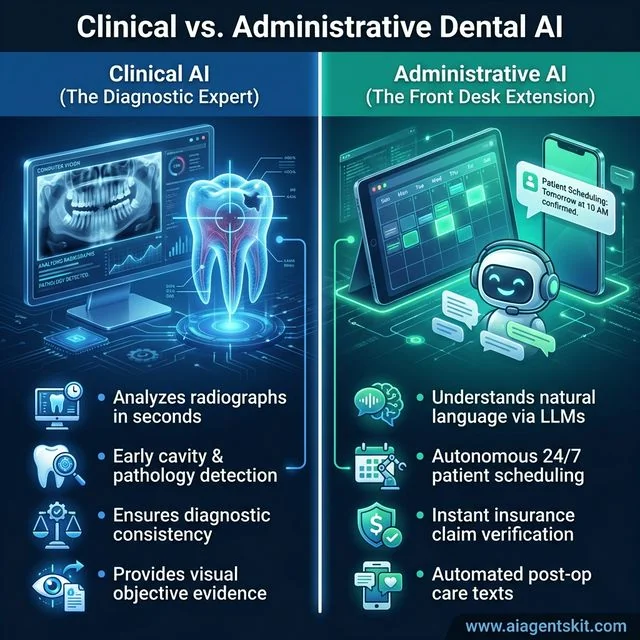 Clinical vs. Administrative Dental AI: A side-by-side comparison illustrating the two distinct operational pillars of modern dental technology. On the left, Clinical AI functions as an over-the-shoulder diagnostic expert, using trained machine learning models to analyze radiographs in seconds, detect early-stage caries and pathology with precision, ensure consistency across multiple providers, and generate objective visual evidence to communicate treatment necessity directly to patients. On the right, Administrative AI acts as a tireless front-desk extension, leveraging large language models like GPT-5 to communicate naturally with patients at any hour. It autonomously manages scheduling, verifies insurance coverage instantly, and triggers personalized post-op care sequences. Understanding this critical distinction prevents practices from deploying clinical tools to solve operational problems—and vice versa.
Top AI Use Cases in Dental Practices
Moving away from broad theoretical concepts, it is vital to examine exactly how to use AI in a dental practice today. Industry analysts frequently observe practices achieving massive return on investment by deploying artificial intelligence in three specific, highly practical workflows.
1. Automated Insurance Claim Verification
Insurance verification is universally recognized as the single most frustrating bottleneck in a modern clinic. Dental professionals routinely spend hours trapped on hold with providers like Delta Dental or MetLife attempting to pull standard benefit breakdowns.
Today, AI-driven practice management software utilizes direct APIs and advanced data scraping to automatically pull full breakdown of benefits precisely 48 hours before an appointment. The AI reads the complex pre-authorizations, instantly calculates the estimated patient portion based on the clinic’s fee schedule, and drops the final figure directly into the patient’s ledger.
2. Post-Op Care Automation
Another critical operational hurdle involves postoperative care. Following complex extractions or implant placements, clinical standards dictate a follow-up call the next morning.
However, busy mornings frequently derail these intentions. A modern dental CRM AI solves this by triggering an automated, personalized SMS sequence specifically tailored to the procedure.
At 9:00 AM the following day, the AI texts the patient asking them to rate their pain from 1 to 10. If the patient replies with a “3,” the AI sends a comforting message reinforcing the post-op instructions.
If the patient replies with an “8,” the AI instantly alerts the doctor via a secure internal dashboard to intervene personally.
3. Re-activation of Dormant Patients
Reactivating “lost” patients is vastly more profitable than acquiring new ones. Predictive analytics tools seamlessly scan a practice database to identify individuals who accepted a treatment plan six months ago but failed to book the restorative appointment.
Rather than generating a sterile, easily ignored email, the AI crafts a highly specific SMS: “Hi Sarah, Dr. Smith noted that we didn’t finish the crown prep on your lower molar. We actually had a cancellation open up tomorrow at 2 PM. Want to grab it?”
This specific, targeted outreach routinely recaptures thousands of dollars in dormant revenue weekly.
Transforming Patient Management and Scheduling
The calendar is the heartbeat of any dental practice. An empty chair is pure, unrecoverable lost revenue.
Therefore, the most aggressive and immediate tech adoption in dentistry centers around protecting and optimizing the daily schedule. Practice owners continually search for the best AI software for dental scheduling because it directly impacts bottom-line revenue.
Intelligent Autonomous Scheduling
Traditional online scheduling frequently forces patients into clunky, rigid grid systems that fail to account for the nuance of clinical procedures. A generic web form cannot effectively distinguish between a basic new patient exam, an extensive scaling and root planing, or a complex restorative procedure.
AI patient scheduling operates as an intelligent digital concierge. These systems ask contextual, conversational questions to determine the precise nature of the visit, calculating the specific amount of chair time required and identifying the exact provider needed.
More importantly, it optimizes the calendar to prevent jagged, inefficient schedules. Rather than allowing a patient to book a 30-minute consultation directly in the middle of a two-hour block, the AI intelligently guides the patient toward slots that maximize provider production.
Eradicating the No-Show Epidemic
Late cancellations and no-shows completely derail dental economics. The historical solution involved front-desk staff spending hours leaving voicemails to confirm appointments two days prior.
This is a strategy yielding rapidly diminishing returns as consumers consistently ignore unknown phone numbers. The modern automated approach targets this issue with relentless efficiency.
Upon receiving a cancellation text from a patient, the AI system immediately initiates an automated waitlist protocol. By rapidly analyzing the patient database, the AI instantly identifies individuals holding future appointments who are overdue for similar treatments, or those who previously requested earlier times.
It dispatches targeted texts to a segmented list; the very first patient to reply claims the slot, and the core Practice Management System is updated instantly.
Predictive CRM: Retaining the Dental Patient
Customer Relationship Management in dentistry has evolved far beyond sending generic birthday postcards. Artificial intelligence now commands a central role in patient retention strategies.
AI CRMs continuously analyze patient attendance patterns, treatment acceptance histories, and demographic data. These systems accurately predict which patients are at high risk of leaving the practice for a competitor.
For example, if an AI notices a specific patient frequently reschedules Friday afternoon appointments, it learns to organically stop offering them those specific slots. This significantly reduces friction and frustration for both the patient and the clinic.
Furthermore, these tools act as an omnichannel virtual assistant. Modern patients communicate across a massive digital landscape: SMS, web chat, emails, and social media.
When a prospective patient sends a Facebook message asking, “Do you take Medicaid?” the AI accesses a secure, practice-specific knowledge base to formulate an instant, accurate reply. It filters out routine noise so human staff can focus on serious inquiries.
AI in Dental Marketing and SEO
Attracting new patients in a hyper-competitive local market is notoriously expensive. AI marketing tools explicitly designed for dentistry are now bridging this gap.
Rather than paying a marketing agency thousands of dollars a month to manage basic social media, practices use generative AI to automatically craft SEO-optimized local blog posts. It can also write high-converting Google ad copy and automatically solicit five-star reviews from patients who just completed successful cosmetic procedures.
This turns the CRM from a passive patient database into an active, automated lead generation engine.
The True Impact on Dental Jobs
When executing a technological upgrade, clinic owners inevitably face the massive internal anxiety surrounding job displacement. The persistent, overarching industry question is: will AI replace dental receptionists?
The definitive answer is no. However, AI completely transforms what their job looks like.
Incorporating advanced technology into a local healthcare setting does not fire human staff; it fundamentally evolves their daily responsibilities.
The Evolution to “Patient Concierges”
For decades, front-desk administrators were chained to keyboards, acting primarily as data-entry clerks and phone operators. By deploying automated systems to handle the tedious, highly repetitive tasks—insurance breakdowns, appointment confirmations, and generic FAQs—practices liberate their staff.
A receptionist transforms into a true “patient concierge.” Freed from the ringing phones, they can step out from behind the desk, engage warmly with anxious patients in the waiting area, and confidently navigate complex treatment plan financing.
They can focus purely on establishing the vital emotional connection that drives patient loyalty.
The Birth of the Practice Technology Coordinator
The introduction of advanced automation is actually creating completely new career paths within larger practices and DSOs. The role of the “Practice Technology Coordinator” is rapidly emerging across the landscape.
This individual is explicitly tasked with managing the software suite, auditing the AI’s performance, and updating the knowledge base when clinical policies change. They also read robust analytics dashboards to identify scheduling trends.
Rather than destroying jobs, dental AI adoption elevates administrative team members into highly skilled technology managers.
Ready-to-Use AI Prompts for Dental Teams
For practices not yet ready to overhaul their entire core software infrastructure with expensive integrations, utilizing standalone tools like ChatGPT remains an incredibly powerful method for dipping a toe into operational efficiency. Knowing exactly how to command the technology is critical.
Here are highly actionable, ready-to-use prompts for clinical teams actively using ChatGPT for dental patient emails, reputation management, and marketing:
Prompt 1: Calming the Anxious Patient
Use Case: Sending a preoperative email to a patient terrified of an upcoming procedure. The Prompt: “Act as an empathetic dental office manager. Write a warm, highly reassuring email to a patient named [Patient Name] who is feeling extreme anxiety about an upcoming [Procedure, e.g., root canal]. Acknowledge their fear is completely normal. Briefly explain the commitment to pain-free dentistry, highlight that sedation options are available if needed, and emphasize that the doctor is incredibly gentle. Keep the tone professional but exceedingly kind and welcoming.”
Prompt 2: Reputation Management Responses
Use Case: Navigating a negative public review without violating HIPAA regulations. The Prompt: “Act as a professional public relations specialist for a dental clinic. Craft a calm, de-escalating response to a 1-star Google review where the patient complained aggressively about a 45-minute wait time in the lobby. Apologize for the frustration without admitting explicit medical fault or confirming any private health information. Cordially invite them to call the office manager directly at [Phone Number] to resolve the situation.”
Prompt 3: Social Media Content Generation
Use Case: Keeping the practice’s social media presence active without spending hours copywriting. The Prompt: “Act as a social media manager for a modern pediatric dental practice. Generate 5 engaging, upbeat Instagram caption ideas promoting ‘National Children’s Dental Health Month.’ Focus on tips for getting toddlers to brush their teeth. Ensure the language is fun, distinctly friendly to parents, use 1-2 relevant emojis per post, and include local hashtags for [City/Neighborhood].”
Why Dental Practices Must Adopt AI Today
The transition toward intelligent automation is no longer a luxury reserved for the top 1% of the industry; it is a fundamental competitive requirement. Clinics delaying adoption find themselves increasingly squeezed by rising operational salaries, supply costs, and an inability to meet modern consumer expectations.
The role of a dental front-desk coordinator is an exercise in extreme, high-stakes multitasking. Empowering staff with AI structurally alleviates this massive pressure valve, actively preventing burnout.
Just as seen in broader automated customer service sectors, when the mundane tasks drop away, morale predictably skyrockets.
Financially, the justification is brutally clear. The cost of an empty restorative column easily dwarfs the monthly subscription fee of a premium scheduling platform.
Data compiled by observers at Group Dentistry Now emphatically highlights that comprehensive AI agent implementation drives significant new patient bookings perfectly. It achieves this simply by capturing after-hours web traffic.
Top AI Tools for Dental Practices in 2026
The software marketplace is notoriously crowded, requiring practice owners to aggressively cut through marketing noise. Based on massive adoption patterns and verified clinical performance metrics, several key platforms dominate the patient management sector.
Adit
Adit frequently emerges as the undisputed system of choice for practices seeking a deeply unified platform. Adit’s AI Call Intelligence transcribes and analyzes incoming phone calls, identifying exactly why certain prospective patients decline to book an appointment.
Combined with robust automated scheduling that syncs deeply into the core Practice Management System, Adit operates as a complete central nervous system for front desk management.
CareStack
For clinics prepared to completely overhaul their outdated server architectures, CareStack offers a full cloud-based practice management system with AI deeply embedded in its foundation. It automates complex revenue cycle management and streamlines clinical coding to ensure exceptionally clean claims submissions, significantly improving overall cash flow.
Patientdesk.ai
Focusing intensely on the immediate triage and booking lifecycle, Patientdesk.ai operates as an autonomous digital receptionist. A prospective patient can call the office, articulate their need for a hygiene appointment, and verify their dental insurance eligibility in real-time within the PMS.
The patient can even finalize the appointment entirely without a single second of human intervention.
A Step-by-Step Implementation Roadmap
Software sitting unused is a severe financial liability. Rushing implementation guarantees failure.
Successful integration demands a careful, strategic AI implementation roadmap.
First, practice leadership must rigorously identify the exact friction points. Does the clinic suffer from a crippling 15% no-show rate? Do calls go straight to voicemail at lunchtime?
Clearly quantifying the precise disease allows the practice to prescribe the correct automated cure.
Second, clinics must select the appropriate tech stack, ensuring guaranteed, bi-directional synchronization with their existing Practice Management System. The AI must be able to reliably read data and instantly write it back into the clinical calendar without generating synchronization errors.
Finally, managing the human element is paramount. A massive barrier to deployment is the psychological fear of job displacement.
Leadership must forcefully reframe the narrative, introducing the technology as a “virtual co-worker” explicitly hired to execute frustrating tasks. Furthermore, comprehensive training in protected, non-clinical hours is vital.
How Much Does Dental AI Software Cost?
A major driving factor for search traffic regarding AI adoption is understanding the true financial commitment. “How much does dental AI software cost?” is a highly searched query for a reason.
Pricing structures vary wildly depending on the vendor, the size of the clinic, and whether the tool is clinical or administrative.
Here is a general breakdown of expectations in 2026:
- Administrative AI (Scheduling & CRM): Most platforms utilize a Software-as-a-Service (SaaS) monthly subscription model.
- Small Clinics (1-2 doctors): Expect to pay between $200 to $500 per month.
- Mid-to-Large Clinics: Subscriptions generally scale to $500 to $900+ per month.
- Clinical Diagnostic AI (e.g., Pearl, Overjet): These often carry higher integration costs. Subscriptions can range from $1,000 to $2,500+ per month, occasionally paired with per-scan pricing models ($10–$15 per analyzed 3D scan).
- Hidden Implementation Costs: Practice owners must account for the initial setup. Integrating deeply into an old legacy server can carry implementation and hardware upgrade fees ranging anywhere from $10,000 to $30,000 upfront.
When evaluating vendors, practices must demand transparent, flat-rate pricing rather than predatory models that charge per text message sent to a patient.
The Tangible ROI of Dental AI
Dentistry is an evidence-based profession, and owners rightly require clear financial justification before investing capital. Unlike abstract marketing ventures, the return on investment for administrative automation is aggressively measurable.
If an automated scheduling protocol successfully fills just two broken appointments per week that would have otherwise sat completely empty, the recovered revenue routinely exceeds thousands of dollars monthly. A massive report from Towards Healthcare projects the global dental AI market to rigorously exceed $3.2 billion by the year 2034.
This is massive sustained growth driven by undeniable operational ROI. For a comprehensive breakdown, analysts frequently utilize specific frameworks when calculating the ROI of AI across local healthcare clinics.
Common Pitfalls in AI Adoption
While the organizational benefits are transformative, implementing artificial intelligence in healthcare carries distinct risks.
The catastrophic error a practice can make is attempting to automate a fundamentally broken process. Layering an intelligent, fast-acting chatbot over a completely disorganized patient intake protocol simply accelerates chaos.
Clinics must vigorously standardize human operational workflows prior to digitizing them.
Furthermore, compliance remains paramount. A massive barrier to adoption is the fear of a data breach.
“Is ChatGPT HIPAA compliant for dentists?” The short answer is: absolutely not in its public form. Navigating Protected Health Information (PHI) requires extreme caution.
Utilizing generic, public language models to input unredacted patient data or radiographs is a severe HIPAA violation carrying massive federal penalties. Practices must partner exclusively with verified healthcare vendors who proactively sign robust Business Associate Agreements (BAAs).
Prudent development of an AI strategy must elevate patient data privacy, SOC 2 compliance, and end-to-end encryption above absolutely all other operational concerns.
Frequently Asked Questions
Will AI replace human dental receptionists at the front desk?
Absolutely not. Artificial intelligence replaces repetitive tasks, not people. AI handles high-volume work like verifying baseline insurance eligibility and answering basic FAQs, allowing human receptionists to concentrate on complex billing issues and critical patient relationship building.
How does AI adoption improve the patient scheduling process?
Intelligent systems utilize natural language processing to interact with patients anytime of day or night. They fully understand specific clinical needs based on conversational context, and match patients to optimal calendar slots in real-time, effectively eliminating manual phone tag.
Is patient data truly secure when utilizing dental AI software?
When properly implemented via specialized healthcare vendors, yes. Reputable platforms execute strict Business Associate Agreements and ensure all data processing complies entirely with HIPAA, explicitly bypassing the use of sensitive PHI to train public machine learning algorithms.
How to use AI in a dental practice for marketing?
Practices routinely use AI to generate localized social media posts and craft monthly email newsletters. They also summarize positive patient reviews into engaging website testimonials, saving hours of manual copywriting each week.
What is the primary difference between clinical AI and administrative AI?
Clinical AI strictly analyzes radiographs and clinical data to aid the dentist in diagnosis (e.g., detecting microscopic caries). Administrative AI focuses purely on operations—handling scheduling, predicting patient churn, marketing automation, and revenue cycle management.
Conclusion
The era of relying solely on intensive manual labor to operate the front desk of a modern dental practice has essentially closed. In 2026, the adoption of dental artificial intelligence represents the clear dividing line between thriving, highly profitable clinics and those suffocating under immense operational overhead.
By deploying intelligent systems to eradicate no-shows, streamline complex scheduling, and automate ongoing post-op communication, modern clinics are reclaiming their absolute most valuable asset: time. The underlying technology is definitively robust, the API integrations are secure, and the financial returns are clearly proven. The same operational transformation is accelerating across every licensed professional practice — the patterns playing out in dentistry mirror what is documented in the complete guide to AI for law firm management, where client intake automation, billing AI, and agentic workflows are reshaping how those practices operate. Real estate agencies are navigating the same transition; the complete AI stack for real estate agencies maps the equivalent journey across CRM, marketing, valuation, and operations layers.
Dental professionals systematically evaluating their operations should conduct a rigorous audit of their front-desk workflow immediately. Identifying specific bottlenecks is the vital first step toward implementing a tailored solution like Adit, CareStack, or Patientdesk.ai.
This will permanently transform the practice from a stressful administrative center into a finely tuned engine fully optimized for exceptional patient care.