AI Agents for Real Estate Lead Generation: The 2026 Guide
Master real estate lead generation in 2026 with autonomous AI agents. Learn about multi-agent systems, top tools like Ylopo and Lofty, and lead automation.
Here’s a confession: I used to think real estate was the one industry AI would never truly “solve.” I mean, how do you automate the gut feeling of a listing appointment or the delicate dance of a price negotiation? But then, last Tuesday at 3:14 AM, I watched an autonomous agent handle a complex zoning inquiry for a $1.2M property in Austin, qualify the lead’s budget, and book a tour for Thursday morning—all while I was fast asleep.
The world of real estate AI agents has moved far beyond the clunky, scripted chatbots of 2024. We’ve entered the era of Agentic PropTech, where specialized AI teams don’t just “chat” with your leads; they research properties, calculate mortgage scenarios, and maintain rapport for months without missing a beat. Understanding what AI agents are is the first step toward reclaiming your time from the “busy work” of lead scrubbing.
If you’re still manually cold-calling “just looking” leads from Zillow, you’re not just working hard; you’re working at a massive disadvantage. In 2026, the gap between the agents who use AI and those who don’t isn’t just a technical one—it’s a financial chasm.
In this guide, I’m going to break down exactly how these autonomous systems work, the top tools dominating the market right now, and how you can move from a single chatbot to a multi-agent lead generation engine that runs 24/7.
What Is a Real Estate AI Agent? (The 2026 Definition)
If you ask ten different realtors what an “AI agent” is, you’ll probably get ten different answers ranging from “a smart CRM” to “that thing that writes my property descriptions.” Let’s get precise, because the distinction matters for your bottom line.
A real estate AI agent is an autonomous software entity powered by a Large Language Model (like GPT-5 or Claude 4) that is capable of reasoning through complex tasks, using external tools, and executing goals without human oversight.
Unlike the “chatbots” of yesteryear that relied on rigid IF-THEN logic (e.g., If user says ‘price’, then show ‘price’), a modern AI agent can:
- Reason: It understands that if a lead asks about “school districts,” they are likely a family buyer and adjusts its follow-up accordingly.
- Browse: It can look at your local MLS data in real-time to answer specific questions about a property’s history.
- Act: It doesn’t just send a link; it can interface with your calendar to book an appointment or update a lead’s status in your CRM.
In short, a chatbot is a digital brochure. An AI agent is a digital employee.
The PropTech Evolution: From Basic Chatbots to Multi-Agent Systems
I remember back in 2022 when everyone was excited about “live chat” on their IDX websites. It was basically a glorified contact form that annoyed people more than it helped them. We’ve come a long way since then.
Phase 1: The Scripted Era (2018-2022)
These were the “press 1 for sales” days. They were brittle, frustrated users, and usually ended with a human agent having to apologize for the bot’s stupidity.
Phase 2: The Copilot Era (2023-2024)
This is when ChatGPT changed everything. Suddenly, we had “AI assistants” that could draft emails and summarize property notes. They were helpful, but they were still passive—they only did something when you asked them to.
Phase 3: The Multi-Agent Era (2025-2026)
This is where we are now. Instead of one “do-it-all” bot, top-performing brokerages are deploying Multi-Agent Systems (MAS). You might have one agent specialized in “Inbound Qualification,” another that handles “Nurturing and Retargeting,” and a third that acts as a “Local Area Expert” for your Sphere of Influence (SOI).
The difference between agents and chatbots is now the difference between having a filing cabinet and having a dedicated ISA (Inside Sales Agent). By specializing, these agents become incredibly efficient at their specific piece of the transaction, moving beyond simple chat to active pipeline management.
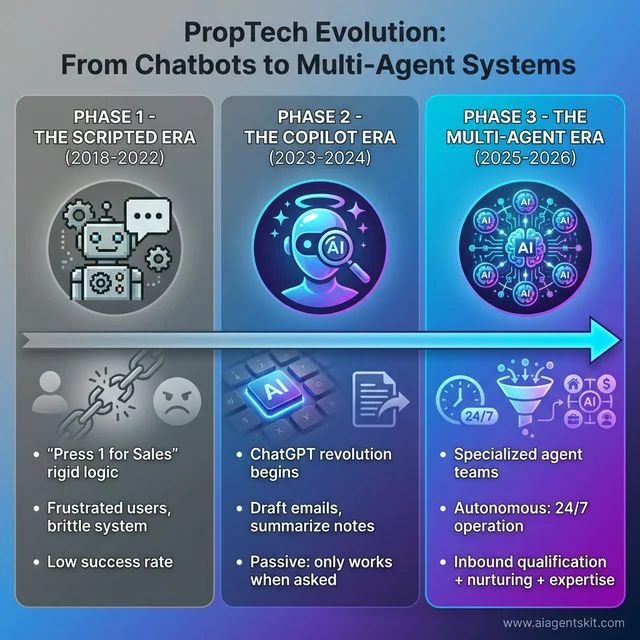 PropTech Evolution Timeline: The three-phase transformation from rigid “press 1 for sales” scripted bots (2018-2022) that frustrated users, to passive AI copilots (2023-2024) powered by ChatGPT that could draft emails, to today’s autonomous multi-agent systems (2025-2026) featuring specialized teams for inbound qualification, nurturing, and local expertise. This evolution represents the shift from basic automation to true artificial intelligence in real estate lead generation.
The 24/7 Landlord: Property Management & Rental Automation
While much of the industry focuses on sales, the rental market is where AI agents are solving the biggest “burnout” problem. If you manage a portfolio, you know the pain of 3 AM “is this available?” inquiries. In 2026, ai for property management has evolved from simple maintenance logging to a full-lifecycle rental assistant.
Automating the Rental Lead Triage
Rental inquiries are high-volume and low-margin. An AI agent can handle the entire top-of-funnel process:
- Instant Response: Every inquiry from Zillow, Apartments.com, or your site gets an immediate response.
- Tenant Screening AI: The agent doesn’t just chat; it asks pre-screening questions. “Do you have pets?” “What is your monthly income?” “Can you move in within 30 days?”
- Income Verification: Using Gemini 3 Flash, modern systems can parse uploaded pay stubs or bank statements in seconds to verify
tenant screening airequirements before a human ever sees the application.
Reducing Vacancy Rates with AI
A rental unit is a liability every day it sits empty. AI agents can reduce rental vacancy rates by analyzing local market trends and suggesting price adjustments in real-time. They can also manage the “Tenant Onboarding” workflow, sending digital leases, collecting security deposits through integrated payment gateways, and even scheduling the move-in inspection. For the modern landlord, AI isn’t just a luxury—it’s the difference between a profitable portfolio and a management nightmare.
How AI Agents for Real Estate Work: Under the Hood
You don’t need a computer science degree to run a modern real estate business, but you do need to understand the “nervous system” of these tools if you want to pick the right one.
1. The Brain: GPT-5 and Claude 4 Reasoning
Most top-tier realtor AI tools are now built on GPT-5 or Claude 4. These models have moved past simple text generation; they can now handle “long-form reasoning.” This means when a lead says, “I’m looking for something like the house on Maple St but with a bigger yard,” the agent actually understands the context of the Maple St listing and searches for similar matches based on lot size.
2. The Memory: RAG and Property Databases
This is the secret sauce. Using a technique called Retrieval-Augmented Generation (RAG), the agent connects its “brain” to your “knowledge.” It has instant access to your entire MLS data feed, local zoning laws, and even your past client interactions. When it speaks, it’s not just “hallucinating” facts; it can generate a CMA (Comparative Market Analysis) in seconds or discuss inventory levels and Days on Market (DOM) for a specific neighborhood with authority.
3. The Hands: CRM and Calendar Integration
An agent without “hands” is just a talker. In 2026, what AI agents are is defined by their ability to do. They integrate directly with tools like Follow Up Boss, LionDesk, or Lofty through robust APIs. If a lead expresses a high intent to sell, the agent doesn’t just flag it; it can trigger a direct mail campaign, prepare a Listing Agreement draft, or move the lead into a “Hot Prospect” bucket automatically.
4. Predictive Analytics: The “Motivation” Signal
Using predictive models, these agents can scan public records and social signals to identify homeowners likely to sell. They look for “Life Events”—marriage, divorce, children graduating—to prioritize who you should be talking to today, not six months from now.
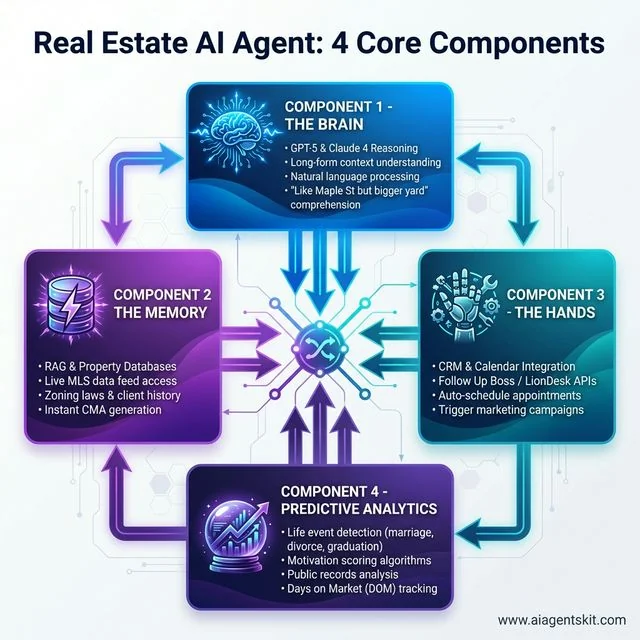 Real Estate AI Agent Architecture: The four essential components working together in a modern AI system. The Brain (GPT-5 & Claude 4) handles long-form reasoning and natural language understanding. The Memory (RAG & Property Databases) provides instant access to MLS data, zoning laws, and client history for generating CMAs. The Hands (CRM & Calendar APIs) enable direct integration with Follow Up Boss and LionDesk to auto-schedule appointments and trigger campaigns. Predictive Analytics scans public records for life events and motivation signals to identify high-intent sellers before they hit the market.
Top 5 AI Agents for Real Estate Lead Generation in 2026
The market is flooded with “AI” labels, but only a few platforms have actually made the leap from chatbots to true autonomous agents. Here are the five I’m seeing get the best results for teams right now, along with the specific pros, cons, and use cases for each.
1. Ylopo (rAIya)
If your business model depends on digital advertising (Facebook and Google), Ylopo is still the leader. Their agent, rAIya, is specifically designed to handle the “top of funnel” chaos. It doesn’t just respond to leads; it optimizes the ads themselves based on which leads are actually engaging, utilizing advanced Retargeting Pixels to maintain brand awareness throughout the buyer’s journey.
The Pros:
- Dynamic Content: rAIya can send specific property videos and listing alerts based on what the lead just looked at on your site.
- Ad Integration: It feeds data back to Meta and Google to lower your Cost Per Lead (CPL) automatically.
- Deep CRM Sync: It works seamlessly with Follow Up Boss, injecting notes that actually make sense to a human agent.
The Cons:
- Cost: This is a premium “Done For You” service. You’ll need a healthy ad spend budget to make the math work.
- Learning Curve: Because it’s so powerful, the backend can feel overwhelming for a solo agent.
Best For: Teams and brokerages spending $2,000+/mo on Facebook and Google ads who want an autonomous “Ad Manager + ISA” combo.
2. Lofty (formerly Chime)
Lofty has done a brilliant job of baking AI into every corner of their CRM. Their AI assistant handles everything from qualifying new web leads to re-engaging “zombie” leads that have been sitting in your database for two years.
The Pros:
- Omni-channel: The AI can switch between SMS, Email, and Chat without losing the thread of the conversation.
- Smart Suggestions: It gives you a “Next Best Action” for every lead, essentially actings as a coach for your human agents.
- IDX Integration: It tracks exactly which houses a lead is “favoriting” and uses that to drive the conversation.
The Cons:
- Platform Locked: To get the full power of their AI, you really need to be using the Lofty CRM and Website ecosystem.
- Slightly Robotic Tone: While better in 2026, it sometimes still falls into “salesy” patterns if you don’t customize the prompts.
Best For: Agents who want an all-in-one “Business in a Box” where the AI and CRM are perfectly synced from day one.
3. CINC (Alex)
CINC’s AI agent, Alex, is built for the long game. While other bots give up after three non-responses, Alex uses a “Polite Persistence” model that can nurture a lead for 12+ months via SMS and email.
The Pros:
- Nurture Specialist: Alex is incredibly patient. It knows how to “check in” every 30 days without being annoying.
- Lead Scoring: It uses behavior-based scoring to tell you who is a “Right Now” buyer vs. a “Next Year” researcher.
- Ease of Use: Very “set it and forget it” for the busy agent.
The Cons:
- Speed to Lead: While fast, its primary strength is the long-term follow-up rather than hyper-aggressive instant qualification.
- Customization: Fewer “knobs to turn” for agents who want to build custom complex workflows.
Best For: Agents with massive databases of old leads who need an automated way to surface “hand-raisers” without manual effort.
4. SmartZip
SmartZip takes a different approach. Instead of waiting for a lead to hit your website, they use “Smart Targeting” to tell you who is likely to sell before they call an agent. It’s the ultimate tool for Geographic Farming in the AI era, using predictive analytics to identify high-intent homeowners.
The Pros:
- Proactive Lead Gen: It identifies sellers before they ever hit Zillow, giving you a massive first-mover advantage.
- Data Rich: It pulls from hundreds of data points (credit, public records, life events) to build its “Likely to Sell” scores.
- Multichannel Marketing: It can automatically trigger direct mail, social ads, and email to those specific homeowners.
The Cons:
- Cold Outreach: These aren’t “inbound” leads; you still have to do the work of reaching out to someone who didn’t ask to be contacted yet.
- Accuracy: No predictive model is 100% correct; you will still encounter “False Positives.”
Best For: Listing agents who want to dominate a specific neighborhood (Geographic Farming) and want to spend their time only on the top 20% of homeowners.
5. NextProp.ai
For the real estate investors out there, NextProp is a game changer. It focuses on outbound automation—scraping listings, finding distressed properties, and initiating the first contact via AI-driven SMS that sounds remarkably human.
The Pros:
- Investor Focused: It understands terms like ARV (After Repair Value), MAO (Maximum Allowable Offer), and wholesaling.
- Hyper-Fast Scraping: It monitors the MLS and off-market sites for “keyword” triggers like “Handyman Special” or “Quick Sale Needed.”
- Negotiation Lite: It can actually go back and forth on a preliminary price range to see if a seller is motivated.
The Cons:
- Compliance Risk: Outbound SMS is a legal minefield. You have to be extremely careful with your opt-in strategies.
- Niche Focus: Not designed for traditional “retail” buyer/seller leads.
Best For: Wholesalers, flippers, and portfolio builders who need to scale their “deal finding” without hiring a massive team of VAs.
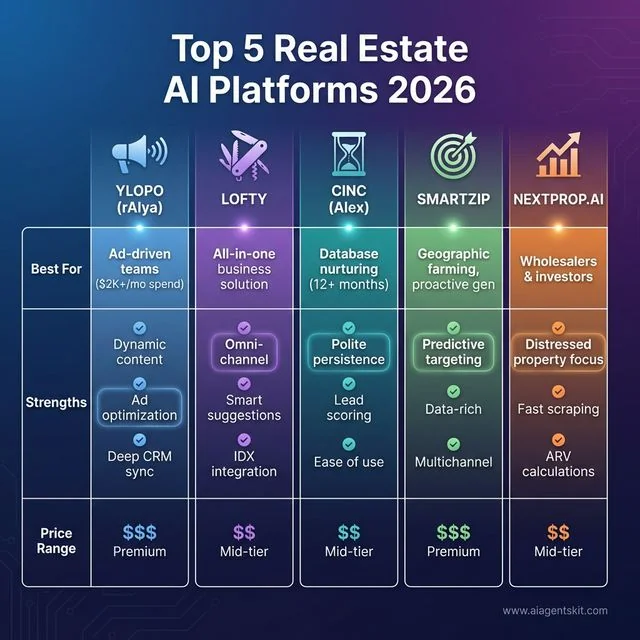 Top 5 Real Estate AI Platforms Comparison Matrix 2026: Ylopo (rAIya) excels at ad-driven teams spending $2K+/month with dynamic content and deep CRM sync ($$$ premium). Lofty provides an all-in-one business solution with omni-channel capabilities and smart suggestions ($$ mid-tier). CINC (Alex) specializes in long-term database nurturing with polite persistence for 12+ months ($$ mid-tier). SmartZip dominates geographic farming with predictive targeting and data-rich multichannel marketing ($$$ premium). NextProp.AI focuses on wholesalers and flippers with distressed property targeting and fast ARV calculations ($$ mid-tier). Choose based on your business model and budget.
The Wholesaler’s Edge: Automated Distressed Lead Triaging
While retail agents focus on rapport, real estate wholesalers live and die by volume and distressed data. In 2026, targeting ai agents for real estate wholesalers is no longer a niche—it’s the standard. Wholesalers are using agents to scan thousands of public records, tax liens, and “For Sale By Owner” (FSBO) listings simultaneously.
The power here is in the “Triage.” An AI agent can initiate contact with 500 potential sellers in a morning, identifying the 5 who are actually motivated by an immediate cash offer. By the time the wholesaler wakes up, their CRM is pre-filled with the “Maximum Allowable Offer” (MAO) calculated for each of those 5 leads, ready for a final human signature.
Beyond Residential: AI for Commercial Real Estate (CRE)
Commercial real estate is a different beast entirely. The sales cycles are longer, the stakeholders are corporate, and the data is often hidden in obscure business filings. However, ai for commercial real estate is rapidly becoming the ultimate weapon for tenant representation and investment sales.
Automate Commercial Lease Lead Generation
In CRE, your best leads are companies that are outgrowing their current space. An AI agent can be programmed to:
- Monitor Business Filings: Scan for new Series A or Series B funding rounds in your city.
- Corporate Mapping: Identify the facilities manager or CEO on LinkedIn.
- Predictive Relocation: Analyze “Lease Expiration” data from public records to
automate commercial lease lead generationby reaching out 18-24 months before a contract ends.
CRE Market Analysis Using GPT-5
While residential agents look at “Comps,” commercial agents look at “Absorption Rates” and “Capitalization Rates (Cap Rates).” A specialized AI agent can ingest a 100-page Offering Memorandum (OM) and provide a CRE market analysis using gpt-5 in seconds, highlighting potential risks in the rent roll or identifying opportunities for “Value-Add” strategies. For industrial property search or office tenant representation, this speed is a massive competitive advantage.
How to Build Your Own Real Estate AI Agent Team
Maybe you’re like me and you like to tinker. Or maybe you don’t want to be locked into a $1,500/month platform subscription. The good news is that in 2026, industry-specific AI automation has become accessible to anyone with a little bit of curiosity.
Step 1: Choose Your “Brain”
For real estate, I recommend a hybrid approach. Use Claude 4 Opus for writing property descriptions and sensitive client emails—its “human” touch is still the best. Use GPT-5-Turbo for rapid-fire lead qualification where speed is everything.
Step 2: Build Your Knowledge Base
An AI agent is only as smart as the data you give it. You need to upload your “Brand Voice” (past emails you’ve written) and your “Market Knowledge” (local school info, tax rates, zoning guides). This ensures that when the agent speaks, it sounds like you, not a generic robot from Silicon Valley.
Step 3: Set Up the “Nervous System”
You need a way for the AI to “see” new leads and “write” to your CRM. Tools like n8n or Zapier act as the connectors.
The 0-Second Response: Automating Zillow Lead Follow-Up
If you’re looking to automate zillow lead follow up with ai, this is where you build the trigger. Zillow leads are notoriously expensive and disappear if not handled instantly. By setting up a Zillow Webhook that fires into an n8n workflow, you can have an AI agent acknowledge the specific property the lead was viewing before they even close their browser tab.
Building the ‘Perfect’ n8n Real Estate Lead Generation Workflow
To truly master an n8n real estate lead generation workflow, don’t just send a generic “Hello.” Your workflow should:
- Parse the Email/Webhook: Extract the property address and lead’s name.
- Lookup Property Data: Have the agent ping an API (like Attom or Zillow) to get the “Zestimate” or square footage.
- Generate a ‘Deep’ Response: “Hi [Name], I saw you looking at 123 Maple St. Did you see that the roof was just replaced in 2025? Here is a list of 3 other homes in that school district with similar upgrades.”
- Update CRM: Automatically move the lead to “Active Engagement” in Follow Up Boss or LionDesk.
Step 4: Define the Personas
Don’t build one bot to do everything. Build a “Team”:
- The Researcher: Scans the MLS for matches.
- The Concierge: Handles the 24/7 “How many bedrooms?” questions.
- The Closer: Its only job is to get a “Yes” for a phone call or tour.
Step 5: Multi-Channel Expansion: WhatsApp & Voice AI
In many markets, email is dead. If you want to reach leads where they actually live, you need a real estate whatsapp bot. Using the WhatsApp Business API connected to an n8n agent, you can send automated property alerts that have a 98% open rate compared to 20% for email.
Voice AI for Real Estate: Vapi vs. Retell
The final frontier is the phone call. voice ai for real estate has made massive leaps in 2026. Tools like Vapi and Retell AI allow you to build an ai cold calling assistant that can actually have a back-and-forth conversation.
- Vapi: Best for speed and low latency (feels like a real person).
- Retell: Best for deep integration with your CRM logic.
A word of warning: Always ensure you are complying with tcpa for ai voice bots in 2026. This means having clear “Opt-in” procedures and disclosing that the caller is an automated assistant. When done correctly, an AI voice agent can “scrub” 1,000 cold leads in an hour, only handing the ones who want a callback to you.
Maximizing ROI: Automation vs. Human Touch
Here is a hard truth: If you try to automate everything, you will lose your business. Real estate is still a high-trust, high-emotion transaction. No one wants to buy a $800,000 home from a robot.
The goal of real estate AI agents isn’t to replace you; it’s to filter the noise so you can be 100% present for the high-value moments.
The 24/7 Advantage
The “Speed to Lead” is the biggest killer in our industry. Research published in the Harvard Business Review and confirmed by numerous industry studies shows that if you don’t respond within 5 minutes, your chances of qualifying a lead drop by over 80%. An AI agent eliminates this problem. It doesn’t sleep, it doesn’t get “lead fatigue,” and it’s just as polite at 4 AM as it is at 4 PM.
The ISA Cost Comparison
A human Inside Sales Agent (ISA) costs between $4,000 and $6,000 per month plus commissions. A sophisticated Multi-Agent AI system costs between $500 and $1,500. For a solo agent or a small team, that’s a massive amount of leverage.
Where the Human Wins
You should step in when:
- Negotiations get heated: AI lacks the “gut” to know when to push and when to fold during the critical Closing phase.
- Emotional roadblocks appear: “My husband isn’t sure about the commute” requires empathy, not a mortgage calculation.
- Complex Transaction Management: Handling the nuances of Escrow, title searches, and local building contingencies.
- Local nuances matter: AI might know the tax rate, but it doesn’t know that the coffee shop on the corner has the best muffins in the city.
Concierge AI: Handling High-Net-Worth Leads with Claude 4
For those in the luxury market, ai agents for luxury real estate require a different approach. A high-net-worth individual expects a “White Glove” experience. Using Claude 4 Opus for these leads is a strategic choice; its sophisticated tone and ability to follow complex personas allow it to act as a digital concierge. Instead of pushing for a phone call, a luxury AI agent might provide a curated “Area Lifestyle Report” or a detailed analysis of local tax advantages for seven-figure properties. The goal isn’t just lead generation—it’s brand protection.
Here’s a confession: I once tried to automate my entire weekend follow-up for a luxury listing. I set the bot to be “friendly but firm.” By Saturday afternoon, it had accidentally offended a high-net-worth buyer by being a bit too firm about their proof-of-funds. I had to spend my Sunday morning doing damage control with a very expensive bottle of wine. It was a humbling reminder that automation is a tool, not a replacement for common sense.
5 Common Mistakes When Deploying Real Estate AI Agents
In my time helping teams integrate these systems, I’ve seen the same five mistakes happen over and over. Avoiding these will save you thousands of dollars and months of frustration.
1. Treating AI Like a “Dump” for Bad Leads
Many agents think, “I’ll just throw my junk leads at the AI and see what sticks.” While AI is great at scrubbing databases, if you give it 10,000 leads that have disconnected phone numbers and fake emails, even the best GPT-5 model can’t help you. The Fix: Use a data cleaning service (like ZeroBounce) before importing your “zombie” leads into your AI-driven CRM.
2. Failing to Customize the “Human” Hand-off
The most awkward moment in any AI interaction is the transition. If your AI agent says “Okay, I’ll have Mike call you,” and then Mike calls three days later asking the same questions the AI already asked, the lead feels ignored. The Fix: Set up a notification system (Slack or Push) that sends the full transcript of the AI conversation to the human agent instantly. Mike should open the call with, “Hey, I saw you were chatting with my assistant Jordan about the Maple St property…“
3. Setting it and Forgetting it
AI agents in 2026 are smart, but they aren’t perfect. They can occasionally get caught in loops or misunderstand a specific local slang term. The Fix: Spend 15 minutes every Friday reviewing the “Failed Interactions” or “Low Confidence” logs. These are your best opportunities to tweak your system prompts and make the agent smarter for next week.
4. Over-Automating the Initial Contact
While “Speed to Lead” is vital, sending a 5-paragraph email 2 seconds after a lead hits your site is a dead giveaway that you’re using a bot. It feels aggressive and impersonal. The Fix: Build in a “Human Delay.” Have your agent wait 3-5 minutes before sending that first text. It mimics the time it would take a real human to see the notification and start typing.
5. Ignoring Your “Google AI Overviews” Presence
In 2026, many leads will find you through AI-driven search (like Perplexity or Google’s Search Generative Experience). If your website isn’t optimized for these “AI agents,” you won’t even get the lead in the first place. The Fix: Focus on SEO guidelines that prioritize structured data and clear, authoritative answers to local real estate questions.
Advanced Strategy: The “Evergreen Nurture” Loop
Most real estate lead generation is linear: Lead comes in -> You call -> They buy or they die (digitally speaking). The Multi-Agent System approach allows for a “Loop” strategy.
The Research Loop
While a lead is in your “Nurture” bucket, your Researcher Agent is constantly scanning the MLS for properties that match their initial IDX search parameters. Instead of a generic “Just Listed” email, the agent sends a personalized note identifying “Hand-raisers”—leads who have re-engaged with a specific listing: “Hey Sarah, I remembered you loved that mid-century modern vibe on Oak St. This new one on Pine just hit, and it has the exact same vaulted ceilings.”
The Market Insight Loop
Every month, your agent can send a “Property Value Report” for the lead’s current home. But instead of a static PDF, it’s an interactive chat where the lead can ask, “How would adding a pool change this valuation?” or “What is the current absorption rate in my neighborhood?” This keeps the lead engaged with your brand, even if they aren’t ready to move for another 18 months.
The Goldmine in Your CRM: AI Database Reactivation
If you have 1,000+ old leads sitting in your CRM, you are sitting on a goldmine. Using a real estate database reactivation bot is one of the fastest ways to generate “Listing Appointments” without spending a dime on new ads.
Instead of a generic “Are you still looking?” email, an AI agent can scan the market for a property similar to what the lead originally inquired about 12 months ago. It then sends a “9-Word Script” variation: “Hi [Name], I just saw a listing on [Street] that fits your old search. Are you still interested in that neighborhood?” When the lead responds, the AI handles the re-qualification and schedules the call. It’s the ultimate “Recycling” strategy for your marketing spend.
From Photo to Viral: AI-Driven Content Marketing
Lead generation isn’t just about handling inbound traffic; it’s about attracting it. In 2026, the best agents are using a “Content-to-Lead” loop that is almost entirely automated.
Real Estate AI Video Generator: Turning Photos into Tours
You no longer need a full video crew for every listing. A real estate ai video generator like HeyGen or Luma Dream Machine can take your high-quality listing photos and turn them into a 60-second cinematic tour.
- AI Voiceovers: Use ElevenLabs to clone your own voice, so the tour sounds like you are narrating it.
- Virtual Staging AI 2026: If a home is empty, use
best ai for virtual furniture stagingtools to “fill” the room with furniture that matches the lead’s specific style (Modern, Rustic, Minimalist).
Automated Real Estate Social Media & Instagram DM Lead Gen
Why wait for a lead to fill out a form on your site? Use an AI agent to automate instagram dm lead gen for realtors. When someone comments “INFO” on your listing video, an agent can:
- Direct Message: Send the property details instantly.
- Qualify: Ask if they are working with an agent.
- Capture: Ask for their phone number to send a text alert.
This “Low Friction” lead capture is the most effective way to build a pipeline in 2026. By utilizing an
ai script generator for real estate tiktok, you can maintain a daily posting schedule that would have previously required a full-time social media manager.
ROI Breakdown: Solo Agent vs. Small Team
Let’s talk numbers. Is the investment worth it?
| Metric | Manual (No AI) | Augmented (With AI Agents) |
|---|---|---|
| Response Time | 2 - 12 Hours | < 2 Minutes |
| Leads Contacted | 30% | 98% |
| Monthly Cost | $0 (Your Time) | $500 - $1,500 |
| Time Spent Scrubbing | 20 Hours/Week | 1 Hour/Week |
| Value of Time Saved | $0 | $4,000+ (Estimated) |
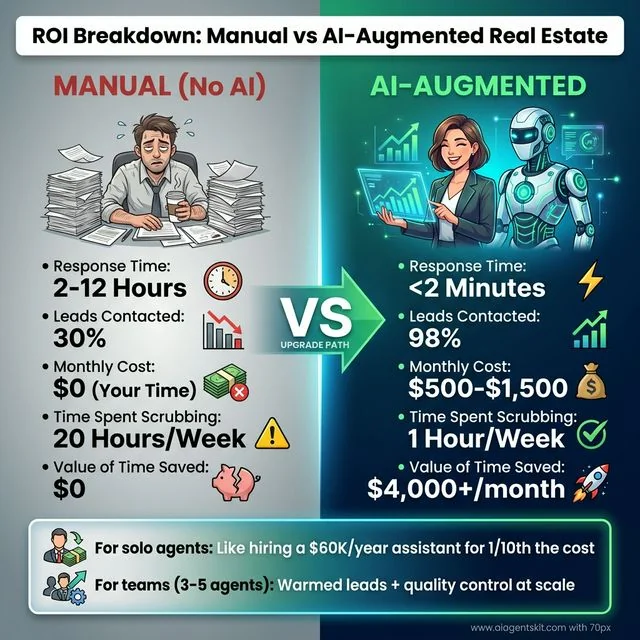 ROI Breakdown: Manual vs AI-Augmented Real Estate Operations. Manual agents face 2-12 hour response times and only contact 30% of leads while spending 20 hours per week on data scrubbing with zero cost but massive opportunity loss. AI-Augmented agents respond in under 2 minutes, contact 98% of leads, spend only 1 hour per week scrubbing, and save $4,000+ monthly in time value for a $500-$1,500 monthly investment. For solo agents, it’s like hiring a $60K/year ISA assistant for 1/10th the cost. For teams of 3-5 agents, it provides warmed leads and quality control at scale.
For the Solo Agent
For a solo agent, an AI team is like hiring a $60,000/year assistant for a fraction of the cost. It allows you to stay in the field, showing homes and closing deals, while your “digital twin” handles the grunt work of qualification.
For the Small Team (3-5 Agents)
For a team, the ROI is even higher. It levels the playing field, ensuring that every agent on the team gets “warmed up” leads. It also provides a level of quality control—you no longer have to worry about a junior agent “forgetting” to follow up with a Zillow lead on a Saturday night.
Ethical and Legal Considerations of AI Lead Gen
I can’t write a guide in 2026 without mentioning the legal landscape. According to the latest FCC Rulings on AI-Generated Voices, using AI-generated voices in robocalls is considered “artificial” and is subject to strict TCPA regulations.
Honestly, I’m still on the fence about AI voice bots. While the tech (like ElevenLabs or Vapi) sounds 99% human, there’s an uncanny valley effect that can sometimes creep people out. I’ve heard some agents say it doubled their appointments, and others say it got them banned from their local board. I’m not 100% sure where the industry will land on this, so for now, I recommend sticking to SMS and email AI for the bulk of your automation.
- Transparency: If you use an AI agent to handle phone calls, you must disclose it. Tricking people into thinking a bot is a human is a fast way to get sued.
- Data Privacy: With the rise of the “Right to be Forgotten” in many states, your AI agent needs to be able to delete a lead’s data instantly upon request.
- Algorithmic Bias: Ensure your AI isn’t accidentally violating Fair Housing laws by filtering leads based on protected characteristics.
The Future of Real Estate in an AI-First World (2027-2030)
As we look beyond 2026, the integration of AI in real estate will move from “advantageous” to “essential.” We are already seeing the early stages of Smart Contracts being executed by AI agents and Virtual Reality tours that are dynamically generated based on a lead’s preferences.
By 2030, I predict we will see the rise of the “Self-Selling Home,” where a property’s own AI agent handles the entire listing process, from scheduling inspections to vetting potential buyer agents. In this world, the human real estate agent becomes more of a “Wealth Advisor” or “Portfolio Strategist,” focusing on the macro-financial goals of their clients rather than the micro-tasks of the transaction.
If you are just starting your AI journey today, don’t be overwhelmed. The goal isn’t to build the most complex system on day one. The goal is to build a system that learns. According to the NAR 2025 Technology Survey, over 68% of Realtors have already adopted AI in some form, proving that the technology is no longer a futuristic concept but a current business necessity.
Workflow: A Day in the Life of an Augmented Agent
What does this actually look like on a Tuesday in October 2026? Here is the schedule of a high-performing agent using a hybrid real estate agent model.
| Time | AI Agent Action | Human Agent Action |
|---|---|---|
| 3:00 AM | Qualifies 4 web leads from Zillow and books 1 tour. | Sleeping. |
| 8:30 AM | Sends personalized SMS property alerts to the SOI. | Reviewing the “Hot Prospect” notifications. |
| 10:00 AM | Generates an ai script generator for real estate tiktok. | Recording the video (human face/voice). |
| 1:00 PM | Analyzes a 50-unit rent roll for a CRE prospect. | Negotiating an inspection credit on a $900k deal. |
| 4:00 PM | Sends a CMA (Comparative Market Analysis) to a seller. | Conducts the actual listing appointment. |
| 7:00 PM | Re-engages 20 “cold” leads from 2025. | Having dinner with family. |
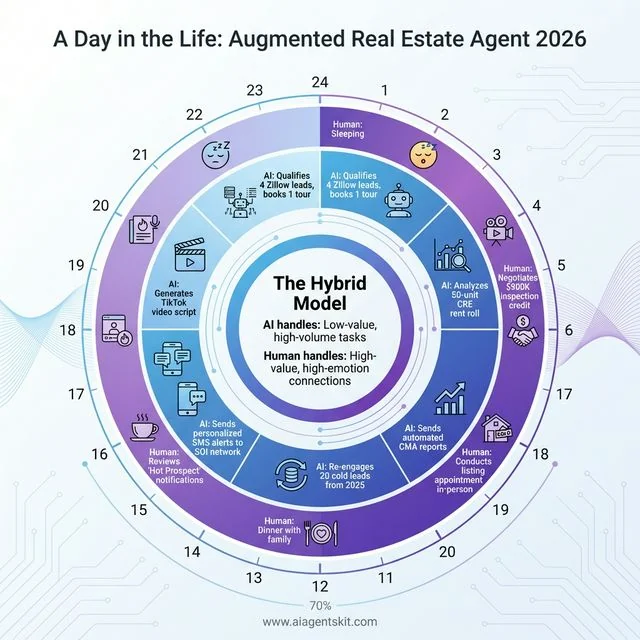 A Day in the Life: Augmented Real Estate Agent 2026. This 24-hour circular timeline shows the hybrid model in action. At 3:00 AM, AI qualifies 4 Zillow leads and books a tour while the human sleeps. By 8:30 AM, AI sends personalized SMS alerts to the SOI network while the human reviews hot prospects. At 10:00 AM, AI generates TikTok scripts while the human records with their face and voice. During the 1:00 PM slot, AI analyzes a 50-unit CRE rent roll while the human negotiates a $900K inspection credit. At 4:00 PM, AI sends automated CMA reports while the human conducts in-person listing appointments. By 7:00 PM, AI re-engages 20 cold leads from 2025 while the human enjoys family dinner. The key: AI handles low-value, high-volume tasks while humans focus on high-value, high-emotion connections.
The key takeaway? The AI handles the low-value, high-volume repetition, while the human focuses on the high-value, high-emotion connection. This is the augmented realtor workflow that will define the winners of this decade.
Every conversation your AI agent has today is data that will make it sharper, more empathetic, and more effective tomorrow. With the AI in real estate market projected to reach $404.9 billion by 2026, the industry is entering a period of rapid, tech-driven transformation.
Frequently Asked Questions
Will AI agents replace real estate agents in 2026?
No. AI agents will replace the tasks that agents hate (data entry, lead scrubbing, scheduling) but they won’t replace the relationships. The top 1% of agents are already using AI to spend MORE time with their clients, not less. AI is a tool for leverage, not a replacement for human judgment and local expertise.
How much does a real estate AI agent cost?
Platforms like Real Geeks start around $300/mo, while enterprise solutions like Ylopo or CINC can range from $1,500 to $5,000/mo depending on your ad spend. If you build your own using APIs (OpenAI/Anthropic), your costs could be as low as $50-$100 per month, though it requires more technical setup time.
What is the best AI for real estate lead qualification?
In my experience, Lofty and Ylopo have the most robust qualification engines because they are tied directly to property search behavior, not just chat scripts. However, for sheer conversational quality, building a custom agent on Claude 4 Opus often yields the highest “human-like” engagement.
Can AI agents call leads on the phone?
Yes, but with caveats. AI voice technology (like ElevenLabs or Vapi) is incredible in 2026, but you must stay compliant with local telemarketing laws. Most agents find SMS and email AI to be more effective and lower-risk, as it provides a written trail and is less intrusive for the initial contact.
How do I integrate AI with my existing CRM?
Most modern CRMs have native AI features now. If yours doesn’t, you can use Zapier or Make.com to bridge the gap between your lead source and an LLM like GPT-5. Most enterprise AI agents like rAIya (Ylopo) have direct, deep integrations with major CRMs like Follow Up Boss.
Is AI in real estate legal?
Yes, but it is subject to Fair Housing laws and the TCPA (Telephone Consumer Protection Act). You are legally responsible for the “behavior” of your AI. This means you must ensure it doesn’t engage in discriminatory practices or send unsolicited spam. Transparency is your best defense—always be clear about when a lead is interacting with an automated system.
Can AI write my property descriptions?
Absolutely. In fact, most MLS platforms now have “AI Write” buttons built-in. To get the best results, don’t just ask for a “description.” Give the AI specific details: “Write a luxury-focused description for a 4-bed home with a gourmet kitchen, emphasizing the sunset views and the proximity to the new tech corridor.”
How do I handle a lead who finds out they are talking to an AI?
Be honest. If a lead asks, “Are you a robot?”, your agent should be programmed to say something like: “I am [Agent Name]‘s digital assistant! I’m here to get you the info you need 24/7. Would you like me to have [Agent Name] jump in and give you a call directly?” Most people don’t mind the AI as long as it’s helpful and doesn’t try to lie to them.
Conclusion
The era of the “Generalist Agent” is over. We have entered the era of the “Augmented Agent.” By deploying real estate AI agents to handle the heavy lifting of lead generation and qualification, you’re not just saving time—you’re creating a better experience for your clients.
Think about it: Would you rather wait 6 hours for a human to email you back, or get an instant, accurate answer at 11 PM on a Sunday? Your clients have already made their choice. They value speed, accuracy, and convenience.
Whether you decide to go with a “done-for-you” platform like Ylopo or build your own multi-agent team using the latest LLMs, the most important step is to start. The future of AI agents is already here, and it’s booking listing appointments while you sleep.
For agencies looking to build beyond lead generation into a complete operational AI stack — CRM, valuation, marketing, transaction coordination, and predictive analytics — the full AI stack guide for real estate agencies covers every layer with tool comparisons and a phased implementation roadmap.
Start by auditing your current lead follow-up process. If a lead hits your site at midnight and doesn’t get a response until 9 AM, you have an AI-shaped hole in your business that needs to be filled. The tools are here, the data is ready, and your future clients are waiting. Don’t let your business stay stuck in the “manual” past.